

Healthcare Interoperability Solutions Market Report
First published: 21 October 2024 | Last updated: 25 May 2026 | Report Code: healthcare-interoperability-solutions
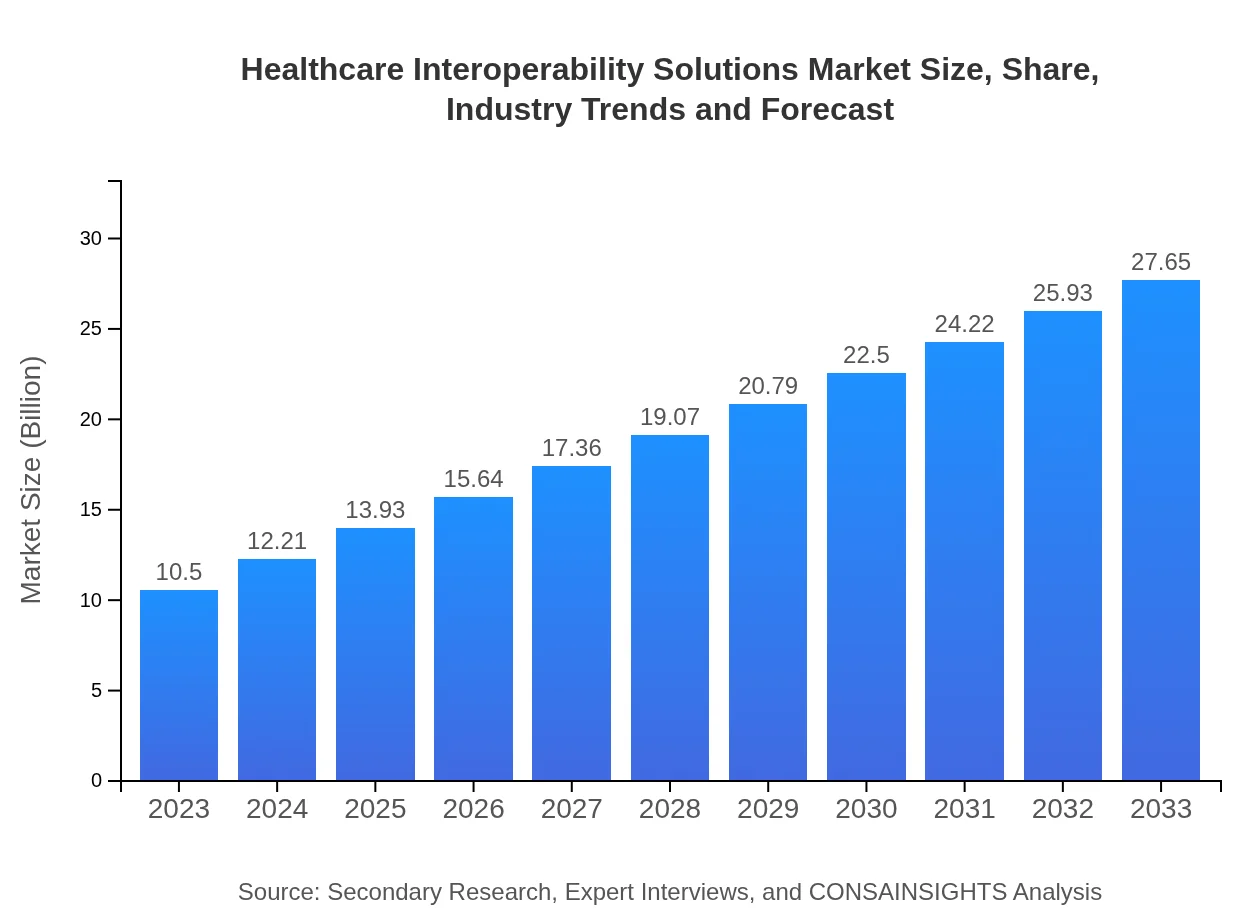
Healthcare Interoperability Solutions Market — USD 10.5 billion in 2023, Growing to USD 27.65B by 2033 at 9.8% CAGR
This report provides an in-depth analysis of the Healthcare Interoperability Solutions market, investigating current trends, growth potential, market size and CAGR from 2023 to 2033, along with a regional breakdown and insights into key segments of the industry.
Key Takeaways
- Global market expands from $10.50 Billion in 2023 to $27.65 Billion by 2033 at a 9.8% CAGR.
- North America is largest regional market, while no single fastest-growing region is stated because regional CAGR differences remain within 0.15 percentage points.
- Europe and Asia Pacific show notable growth, with Europe rising from $2.71 Billion to $7.13 Billion and Asia Pacific from $2.02 Billion to $5.31 Billion.
- Adoption drivers include clinical data sharing, population health management, telehealth integration and investments by major vendors such as Epic Systems Corporation and Cerner Corporation.
- Solution mix includes interface engines, API solutions and health information exchanges, deployed across on-premises and cloud-based platforms.
Healthcare Interoperability Solutions Market Report — Executive Summary
North America remains largest market by forecast-period value, while no single fastest-growing region is stated because top regional growth rates are separated by less than 0.15 percentage points. The Healthcare Interoperability Solutions market is forecast to grow from $10.50 Billion in 2023 to $27.65 Billion by 2033 at a 9.8% CAGR. Growth is propelled by increasing demand for secure clinical data exchange, expansion of telehealth services, and investments in integrated care technology. Key solution types include interface engines, API solutions and health information exchanges, deployed through on-premises and cloud-based modes to serve hospitals, physician practices, laboratories and pharmacies. Major vendors named in the market include Epic Systems Corporation, Cerner Corporation, Allscripts Healthcare Solutions, MEDITECH and InterSystems. Market expansion is supported by government initiatives promoting electronic records, focus on patient-centered care and rising need for interoperable frameworks to enable population health management and remote care coordination. The report presents segmentation by solution type, deployment mode, application and end-user, and offers a regional breakdown highlighting North America as the largest regional market.
Key Growth Drivers
- Growing need for clinical data sharing to improve care coordination and reduce duplicate testing.
- Expanded telehealth and remote monitoring that require interoperable platforms for real-time data exchange.
- Regulatory encouragement and digital health initiatives promoting electronic health record integration.
- Investment by major vendors in scalable interface engines, APIs and health information exchanges.
- Shift toward value-based care and population health management increasing demand for integrated data solutions.
| Metric | Value |
|---|---|
| Study Period | 2023 - 2033 |
| 2023 Market Size | $10.50 Billion |
| CAGR (2023-2033) | 9.8% |
| 2033 Market Size | $27.65 Billion |
| Top Companies | Epic Systems Corporation, Cerner Corporation, Allscripts Healthcare Solutions, MEDITECH, InterSystems |
| Published Date | 21 October 2024 |
| Last Modified Date | 25 May 2026 |
Healthcare Interoperability Solutions Market Overview
Customize Healthcare Interoperability Solutions Market Report market research report
- ✔ Get in-depth analysis of Healthcare Interoperability Solutions market size, growth, and forecasts.
- ✔ Understand Healthcare Interoperability Solutions's regional dynamics and industry-specific trends.
- ✔ Identify potential applications, end-user demand, and growth segments in Healthcare Interoperability Solutions
What is the Market Size & CAGR of Healthcare Interoperability Solutions Market Report market in 2023?
Healthcare Interoperability Solutions Industry Analysis
Healthcare Interoperability Solutions Market Segmentation and Scope
Tell us your focus area and get a customized research report.
Healthcare Interoperability Solutions Market Report Market Analysis Report by Region
Europe Healthcare Interoperability Solutions Market Report:
Europe grows from $2.71 Billion in 2023 to $7.13 Billion in 2033. Growth in the region is linked to regulatory pushes for data exchange, national digital health programs and adoption of HIEs and API-based integrations among healthcare providers.Asia Pacific Healthcare Interoperability Solutions Market Report:
Asia Pacific grows from $2.02 Billion in 2023 to $5.31 Billion in 2033. Regional drivers include rising healthcare digitization, increasing telehealth deployment and investments in interoperable solutions to support population health and cross-institution data sharing.North America Healthcare Interoperability Solutions Market Report:
North America is largest regional market, rising from $3.61 Billion in 2023 to $9.51 Billion in 2033. Regional demand is supported by extensive EHR adoption, initiatives to improve care coordination and strong vendor presence focused on scalable interoperability platforms.South America Healthcare Interoperability Solutions Market Report:
Latin America grows from $1.05 Billion in 2023 to $2.76 Billion in 2033. Market expansion is supported by growing demand for connected health solutions, investments in digital records and efforts to enable clinical data interchange across providers.Middle East & Africa Healthcare Interoperability Solutions Market Report:
Middle East and Africa grows from $1.12 Billion in 2023 to $2.94 Billion in 2033. Growth factors include expanding digital health initiatives, emphasis on modernizing healthcare IT infrastructures and adoption of interoperability frameworks to improve patient management.Tell us your focus area and get a customized research report.
Research Methodology
Healthcare Interoperability Solutions Market Analysis By Solution Type
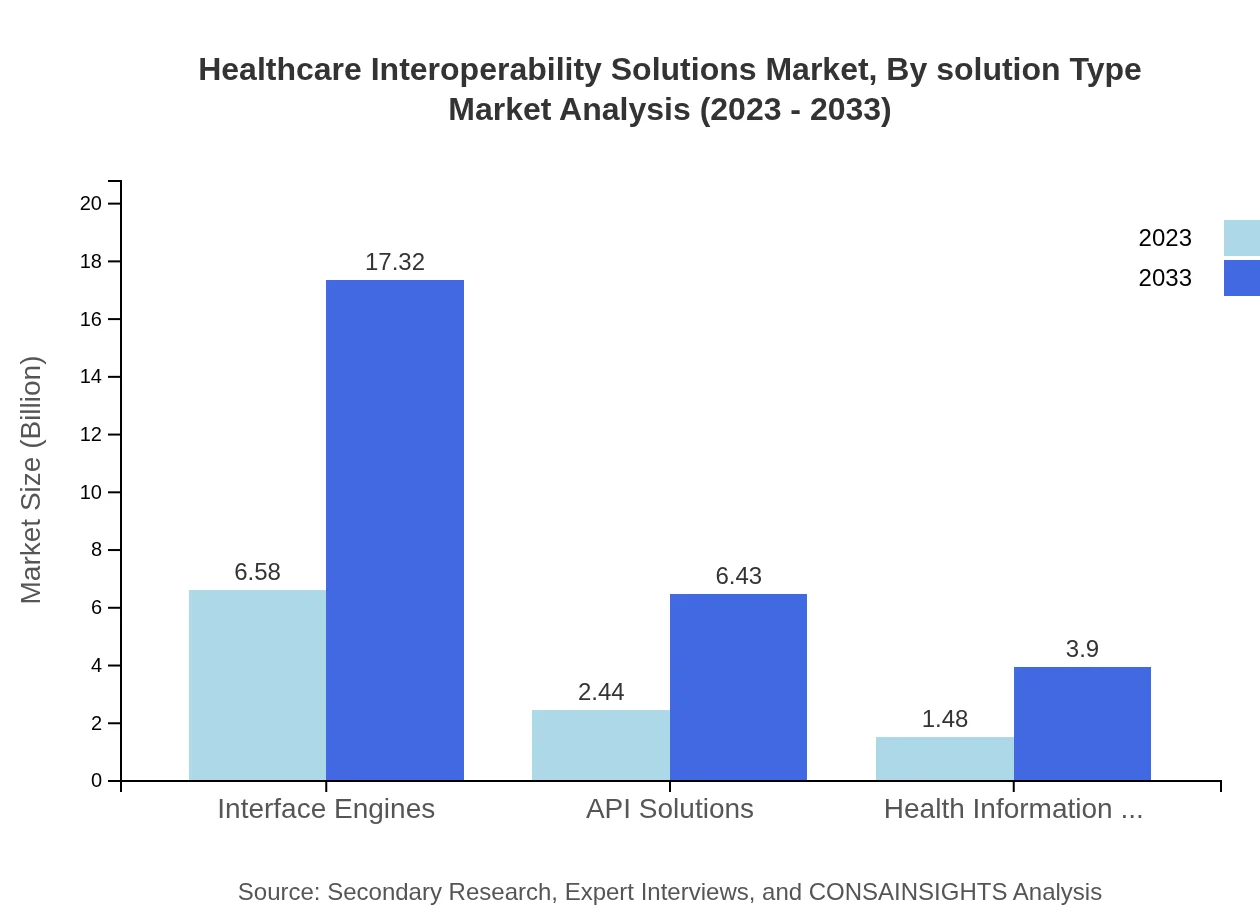
In 2023, the Interface Engines segment will dominate the Healthcare Interoperability Solutions market with a size of $6.58 billion, expected to grow to $17.32 billion in 2033, maintaining a market share of 62.63%. Health Information Exchanges (HIEs) and API Solutions also hold significant shares, indicating a robust demand for seamless data exchange capabilities across healthcare systems.
Healthcare Interoperability Solutions Market Analysis By Application
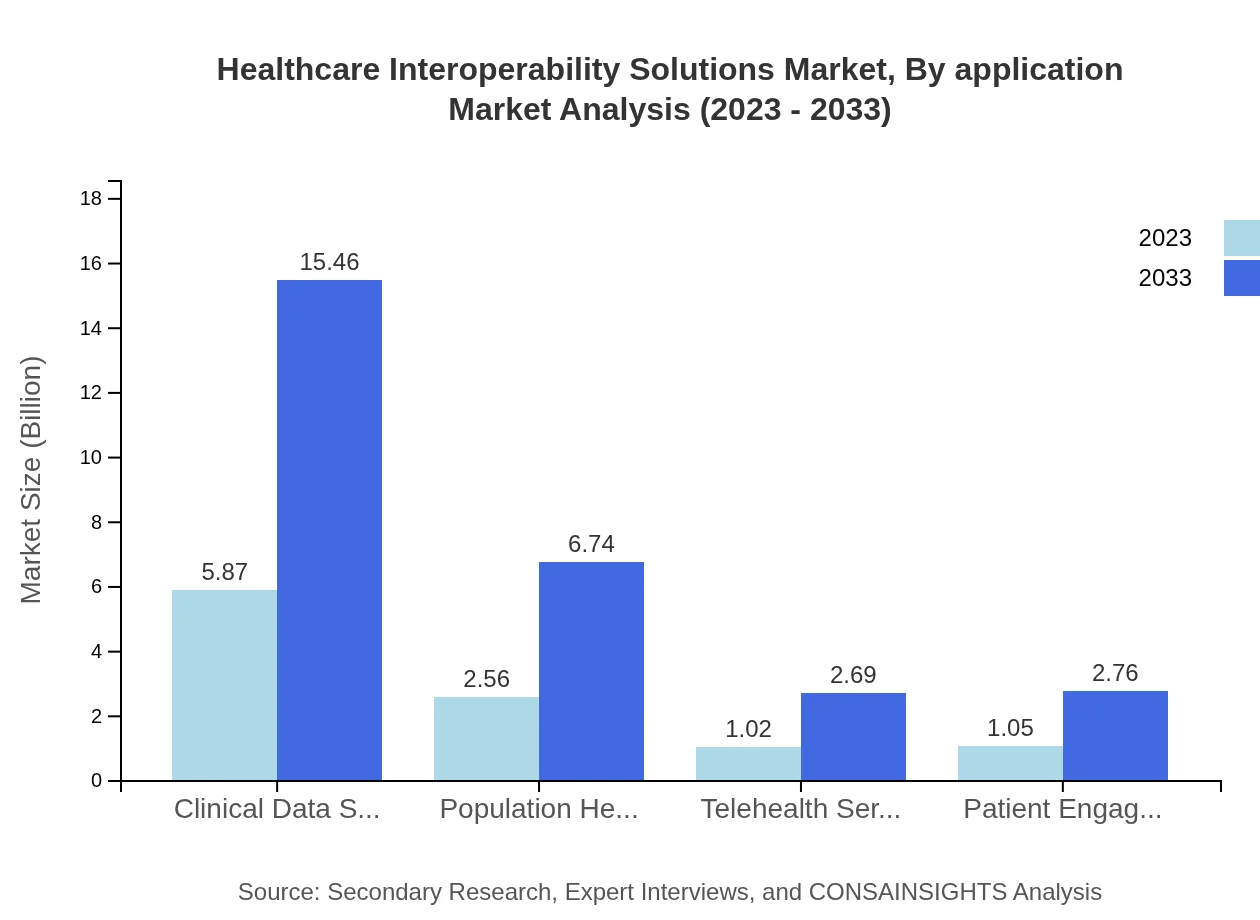
Clinical Data Sharing leads the way in application segments with a market size of $5.87 billion in 2023, anticipated to reach $15.46 billion by 2033, keeping a significant market share of 55.93%. Other applications like Population Health Management and Telehealth Services are also crucial for enhancing patient care and outcomes.
Healthcare Interoperability Solutions Market Analysis By End User
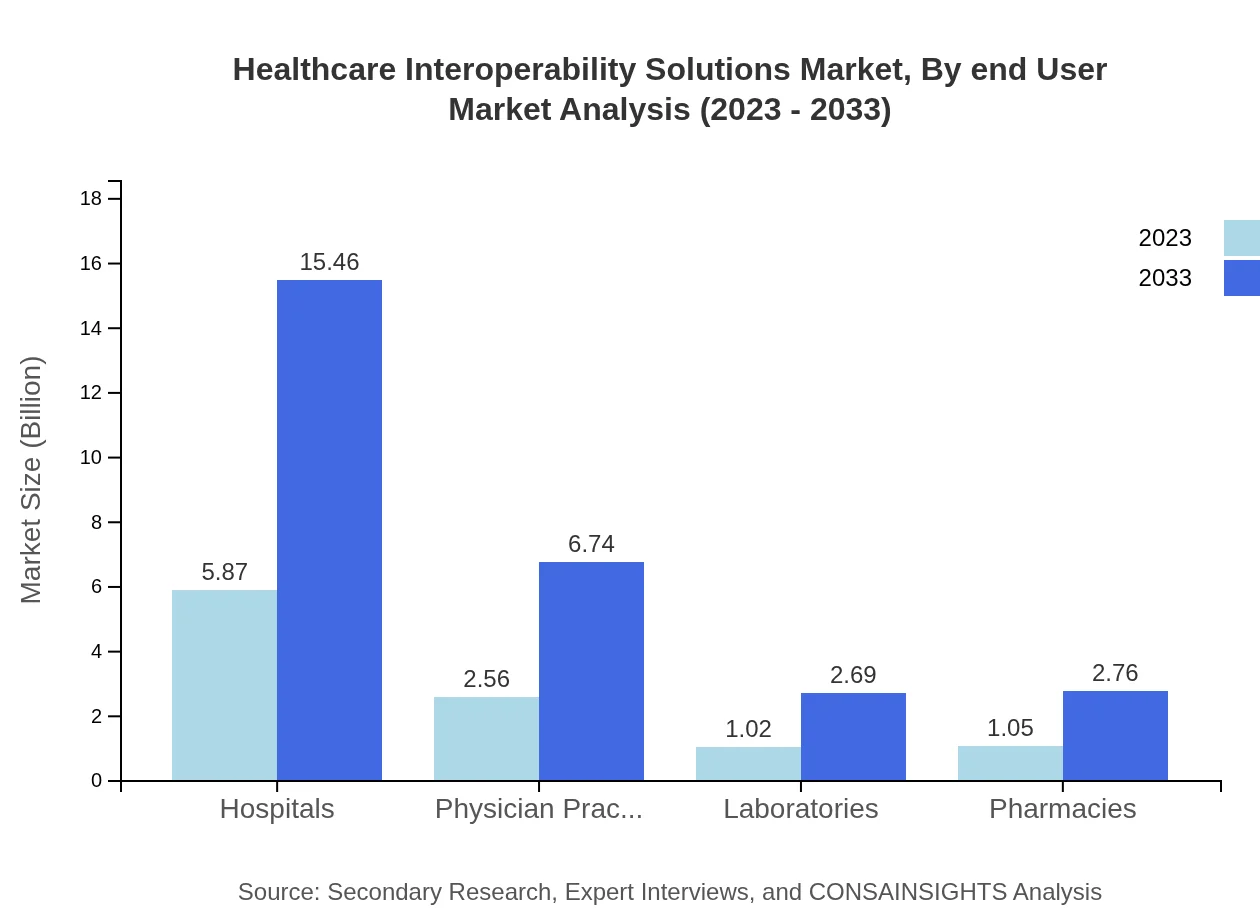
Hospitals are the primary end-users of Healthcare Interoperability Solutions, generating a market size of $5.87 billion in 2023, expected to grow to $15.46 billion by 2033, with a consistent share of 55.93%. Physician practices and laboratories also play important roles as demand for interoperability continues to enhance care delivery.
Healthcare Interoperability Solutions Market Analysis By Deployment Mode
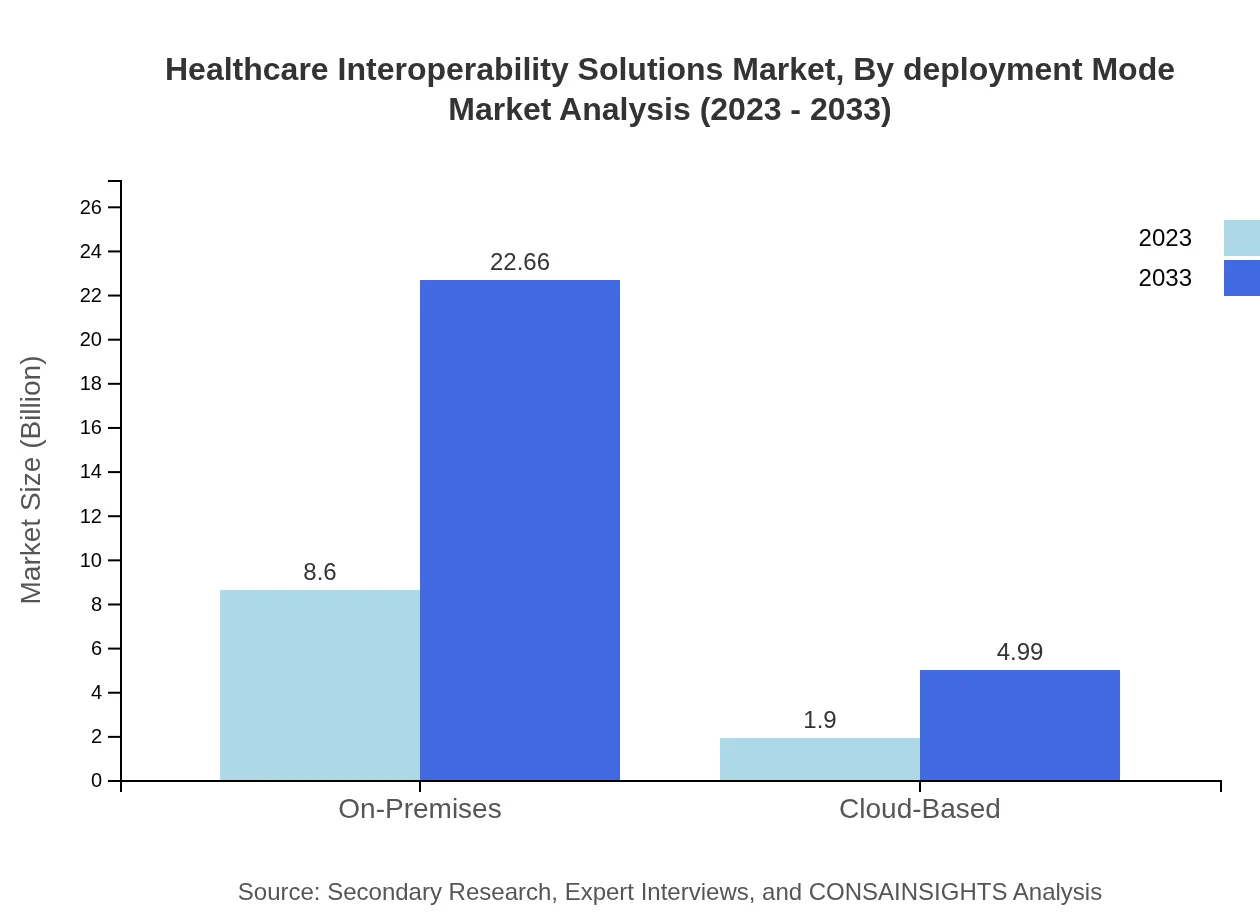
In 2023, On-Premises solutions account for a market size of $8.60 billion, poised to grow to $22.66 billion by 2033. Cloud-Based solutions, while smaller at $1.90 billion currently, are forecasted to grow significantly given the increasing preference for flexible, scalable solutions.
Healthcare Interoperability Solutions Market Analysis By Organization Size
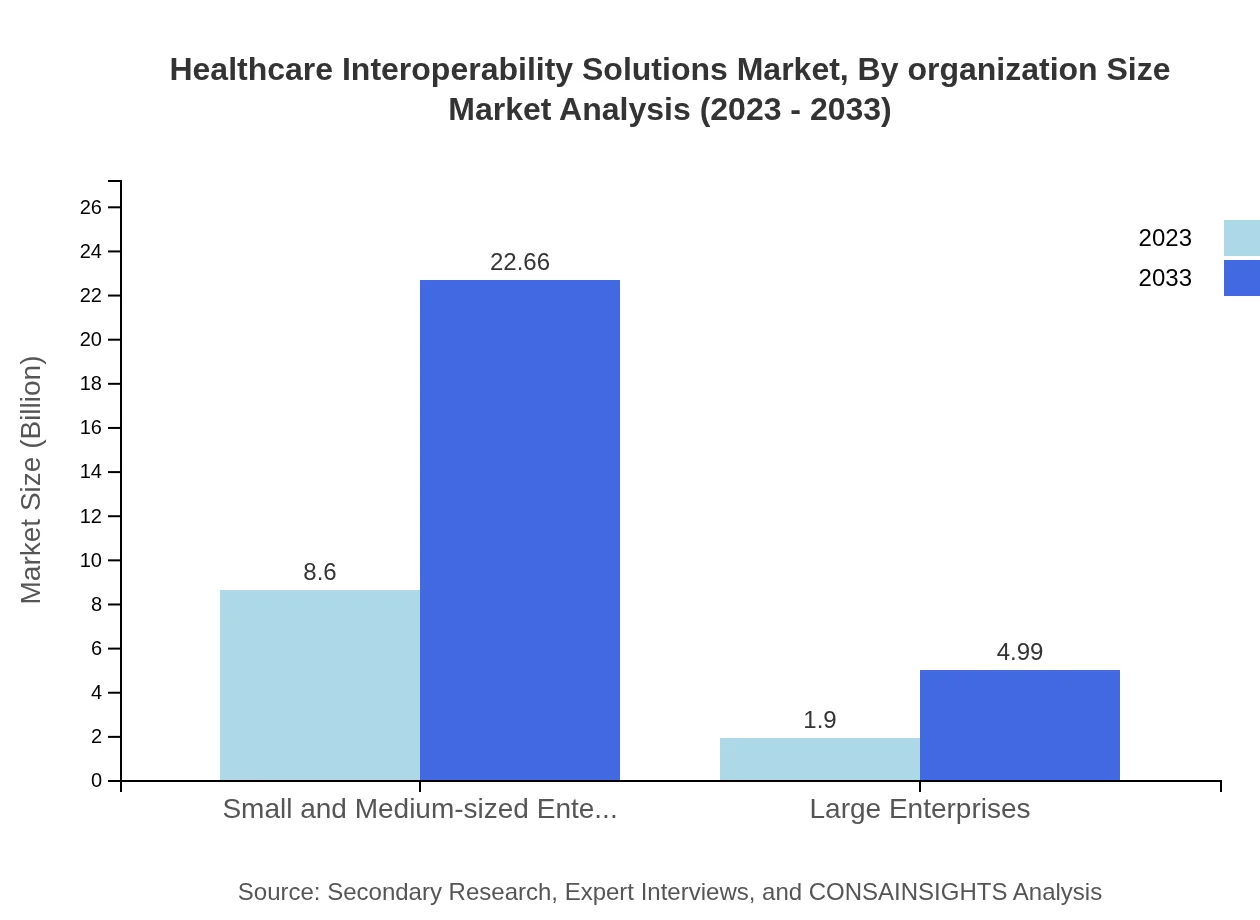
Small and Medium-sized Enterprises (SMEs) hold the majority market share due to their need for cost-effective interoperability solutions, accounting for $8.60 billion in 2023, projected to reach $22.66 billion by 2033. Large Enterprises also contribute notably, valuing $1.90 billion in 2023.
Healthcare Interoperability Solutions Market Trends and Future Forecast
Tell us your focus area and get a customized research report.
Global Market Leaders and Top Companies in Healthcare Interoperability Solutions Industry
Epic Systems Corporation:
A leader in healthcare software with a strong focus on interoperability solutions, Epic enables seamless healthcare data sharing across its EHR platform.Cerner Corporation:
Cerner is known for its robust interoperability tools, facilitating efficient data exchange and enhancing patient care through integrated health solutions.Allscripts Healthcare Solutions:
Allscripts offers comprehensive healthcare IT solutions that emphasize interoperability, particularly in EHR integration and patient engagement.MEDITECH:
A pioneer in health information technology, MEDITECH specializes in delivering interoperable solutions that optimize healthcare workflows and data accessibility.InterSystems:
InterSystems focuses on providing advanced interoperability solutions that improve data sharing across various healthcare settings, enhancing overall patient outcomes.We're grateful to work with incredible clients.








FAQs
What is the market size of the Healthcare Interoperability Solutions Market Report in 2023?
The market size in 2023 is $10.50 Billion according to the provided report data.
How big is the market expected to be in 2033?
The market is projected to reach $27.65 Billion by 2033 as specified in the input data.
What is CAGR for the forecast period?
The reported compound annual growth rate for 2023 to 2033 is 9.8%.
Is there a single fastest Growing region in the Healthcare Interoperability Solutions Market Report market?
No single fastest-growing region is stated for the Healthcare Interoperability Solutions Market Report market because the top regional implied CAGR values are within 0.15 percentage points of each other, making the ranking too close to call reliably.
Who are the top companies in this market?
Top companies listed include Epic Systems Corporation, Cerner Corporation, Allscripts Healthcare Solutions, MEDITECH and InterSystems.
What end Users are covered in the segmentation?
End-users include hospitals, physician practices, laboratories and pharmacies as specified in the segment facts.
Why is interoperability important for healthcare providers?
Interoperability enables secure exchange of patient data across systems, supporting care coordination, reducing duplication and facilitating population health initiatives.
What solution types are included in the market?
Solution types specified are interface engines, API solutions and health information exchanges (HIEs).
How are deployment modes categorized?
Deployment modes in the report are On-Premises and Cloud-Based.
Which applications are covered in the market segments?
Applications include Clinical Data Sharing, Population Health Management, Telehealth Services and Patient Engagement.