

Heart Defect Closure Devices Market Report
First published: 21 October 2024 | Last updated: 25 May 2026 | Report Code: heart-defect-closure-devices
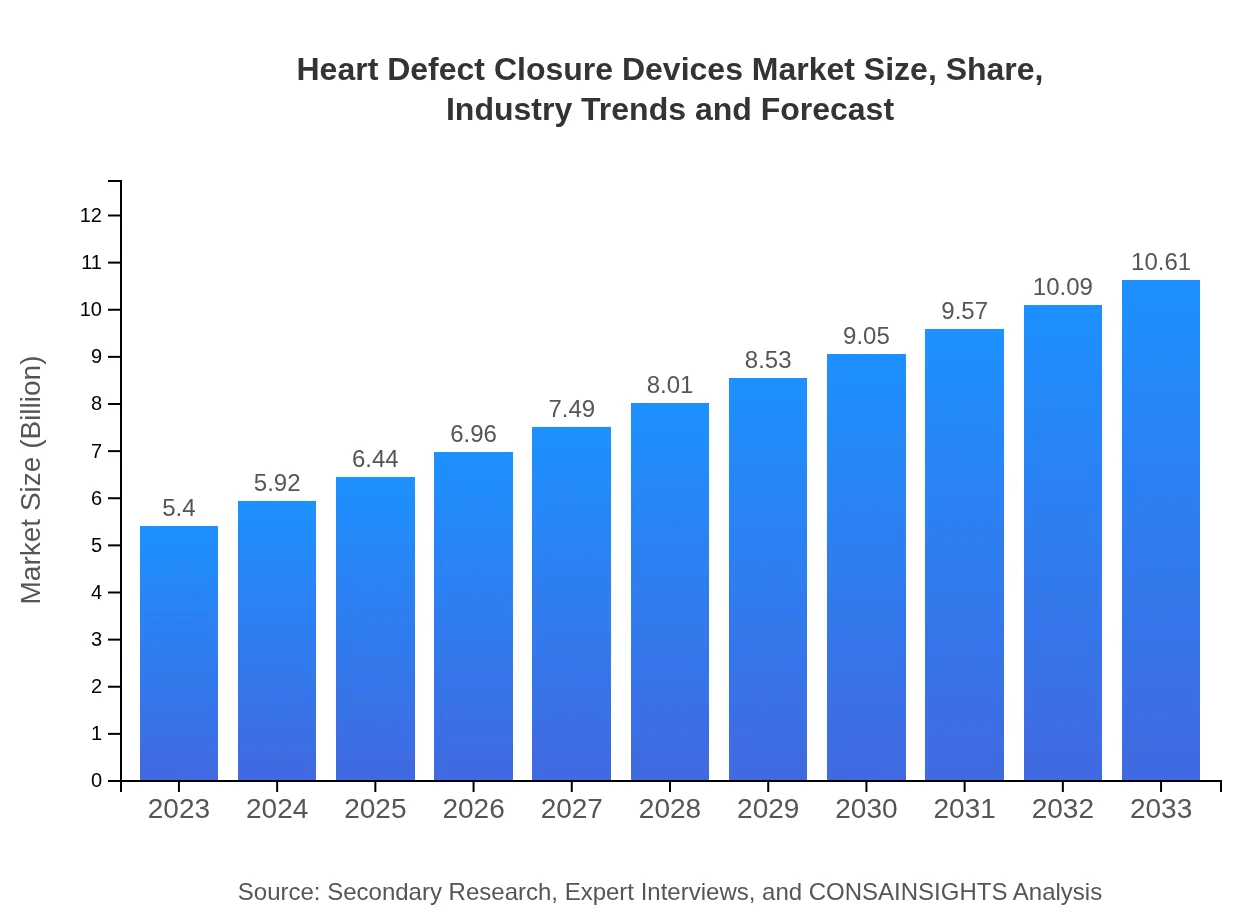
Heart Defect Closure Devices Market — USD 5.4 billion in 2023, Growing to USD 10.61B by 2033 at 6.8% CAGR
This report provides a comprehensive analysis of the Heart Defect Closure Devices market from 2023 to 2033, including insights on market size, growth trends, technological advancements, regional dynamics, and competitive landscape.
Key Takeaways
- Global market expands from $5.40 Billion in 2023 to $10.61 Billion by 2033 at a 6.8% CAGR.
- North America is largest regional market, while no single fastest-growing region is stated because regional CAGR differences remain within 0.15 percentage points.
- North America is the largest region, rising from $2 Billion in 2023 to $3.93 Billion in 2033.
- Europe grows from $1.63 Billion in 2023 to $3.2 Billion in 2033, reflecting strong regional demand.
- Device innovation and minimally invasive procedures are key trends driving adoption.
- Top companies include Abbot Laboratories, Medtronic, Boston Scientific, Edwards Lifesciences, and LivaNova.
Heart Defect Closure Devices Market Report — Executive Summary
North America remains largest market by forecast-period value, while no single fastest-growing region is stated because top regional growth rates are separated by less than 0.15 percentage points. The Heart Defect Closure Devices Market Report details market expansion driven by rising detection of congenital and acquired heart defects, improvements in minimally invasive device technologies, and growing procedural preference for percutaneous interventions. The market value increases from $5.40 Billion in 2023 to $10.61 Billion by 2033 at a 6.8% CAGR across the 2023 to 2033 forecast period. Regional dynamics vary: North America holds the largest share, while Europe and Asia Pacific demonstrate notable gains. Device-type segmentation includes occluders, stents, and clips, while applications cover pediatric, adult, and rehabilitation uses. Hospitals and cardiac centers represent primary end users with direct sales, distributors, and e-commerce as channels. Competitive activity is concentrated among established medical-device manufacturers such as Abbot Laboratories, Medtronic, Boston Scientific, Edwards Lifesciences, and LivaNova. Market expansion is influenced by technological innovation, regulatory pathways, and investment in clinical research, with ongoing opportunities in emerging markets and product development.
Key Growth Drivers
- Increased diagnosis rates of congenital and acquired heart defects expanding addressable patient populations.
- Advancements in minimally invasive device design improving procedural outcomes and recovery times.
- Rising demand for percutaneous interventions in hospitals and cardiac centers.
- Ongoing R&D and product launches by leading manufacturers supporting market uptake.
- Expanded distribution networks, including direct sales and e-commerce, enhancing device accessibility.
| Metric | Value |
|---|---|
| Study Period | 2023 - 2033 |
| 2023 Market Size | $5.40 Billion |
| CAGR (2023-2033) | 6.8% |
| 2033 Market Size | $10.61 Billion |
| Top Companies | Abbot Laboratories, Medtronic , Boston Scientific, Edwards Lifesciences, LivaNova |
| Published Date | 21 October 2024 |
| Last Modified Date | 25 May 2026 |
Heart Defect Closure Devices Market Overview
Customize Heart Defect Closure Devices Market Report market research report
- ✔ Get in-depth analysis of Heart Defect Closure Devices market size, growth, and forecasts.
- ✔ Understand Heart Defect Closure Devices's regional dynamics and industry-specific trends.
- ✔ Identify potential applications, end-user demand, and growth segments in Heart Defect Closure Devices
What is the Market Size & CAGR of Heart Defect Closure Devices Market Report market in 2023?
Heart Defect Closure Devices Industry Analysis
Heart Defect Closure Devices Market Segmentation and Scope
Tell us your focus area and get a customized research report.
Heart Defect Closure Devices Market Report Market Analysis Report by Region
Europe Heart Defect Closure Devices Market Report:
Europe grows from $1.63 Billion in 2023 to $3.2 Billion in 2033. Market expansion is supported by increased uptake of minimally invasive procedures, regulatory approvals for new devices, and investments in cardiac care facilities.Asia Pacific Heart Defect Closure Devices Market Report:
Asia Pacific grows from $0.98 Billion in 2023 to $1.93 Billion in 2033. Growth drivers include expanding healthcare infrastructure, rising awareness and diagnosis of heart defects, and greater access to interventional cardiology services.North America Heart Defect Closure Devices Market Report:
North America is largest regional market, rising from $2 Billion in 2023 to $3.93 Billion in 2033. Regional factors include established clinical infrastructure, high procedure volumes in hospitals and cardiac centers, and active participation from major device manufacturers driving product adoption.South America Heart Defect Closure Devices Market Report:
Latin America grows from $0.22 Billion in 2023 to $0.43 Billion in 2033. Regional adoption is influenced by improving healthcare delivery, growing procedural capabilities in major centers, and expanding distribution channels.Middle East & Africa Heart Defect Closure Devices Market Report:
Middle East and Africa grows from $0.57 Billion in 2023 to $1.12 Billion in 2033. Market progression stems from investments in medical infrastructure, increased access to specialized cardiac care, and gradual uptake of advanced closure devices.Tell us your focus area and get a customized research report.
Research Methodology
Heart Defect Closure Devices Market Analysis By Device Type
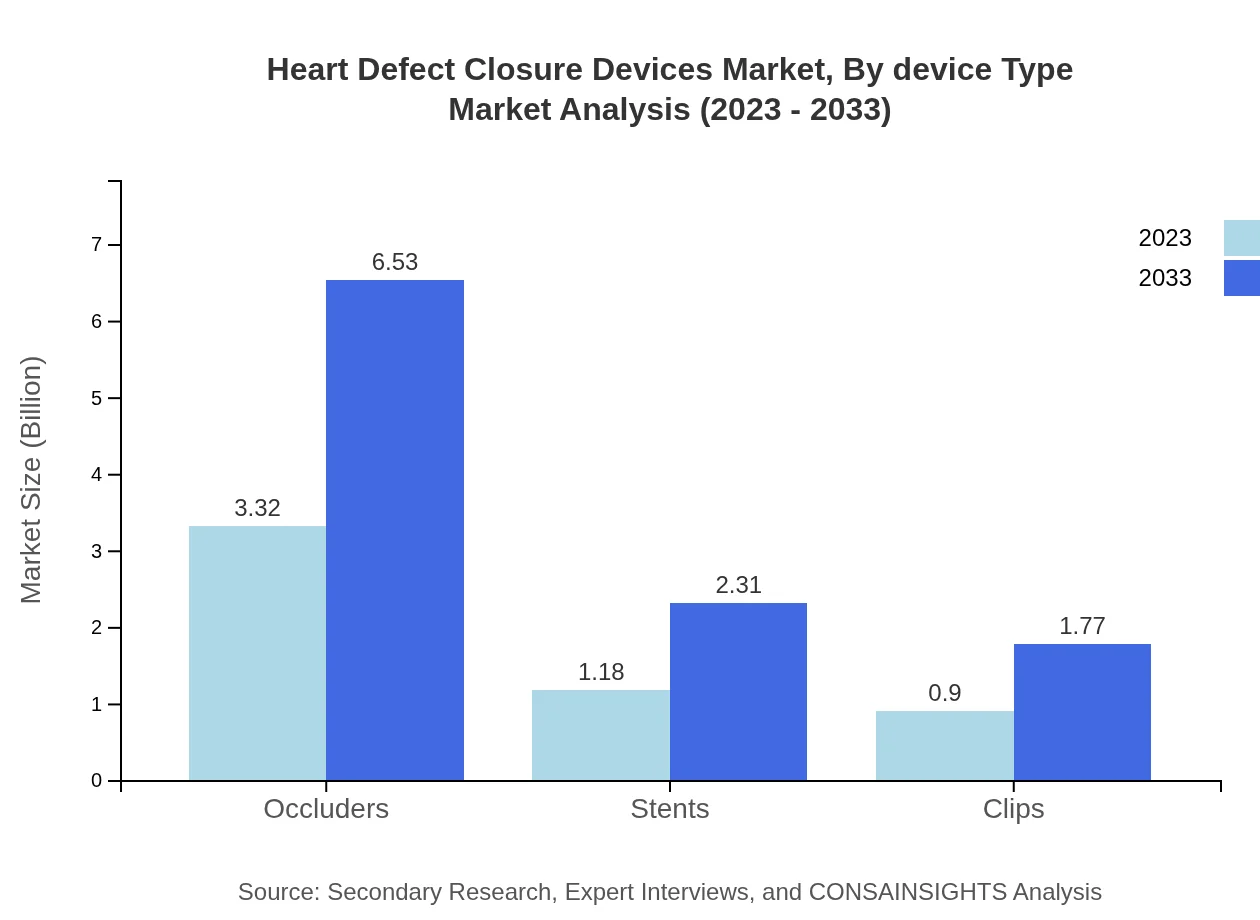
The Heart Defect Closure Devices market by device type includes Occluders, Stents, and Clips. Occluders account for the largest share with a market size of USD 3.32 billion in 2023, expanding to USD 6.53 billion by 2033. Stents and clips follow, showing market sizes of USD 1.18 billion and USD 0.90 billion in 2023, respectively.
Heart Defect Closure Devices Market Analysis By Application
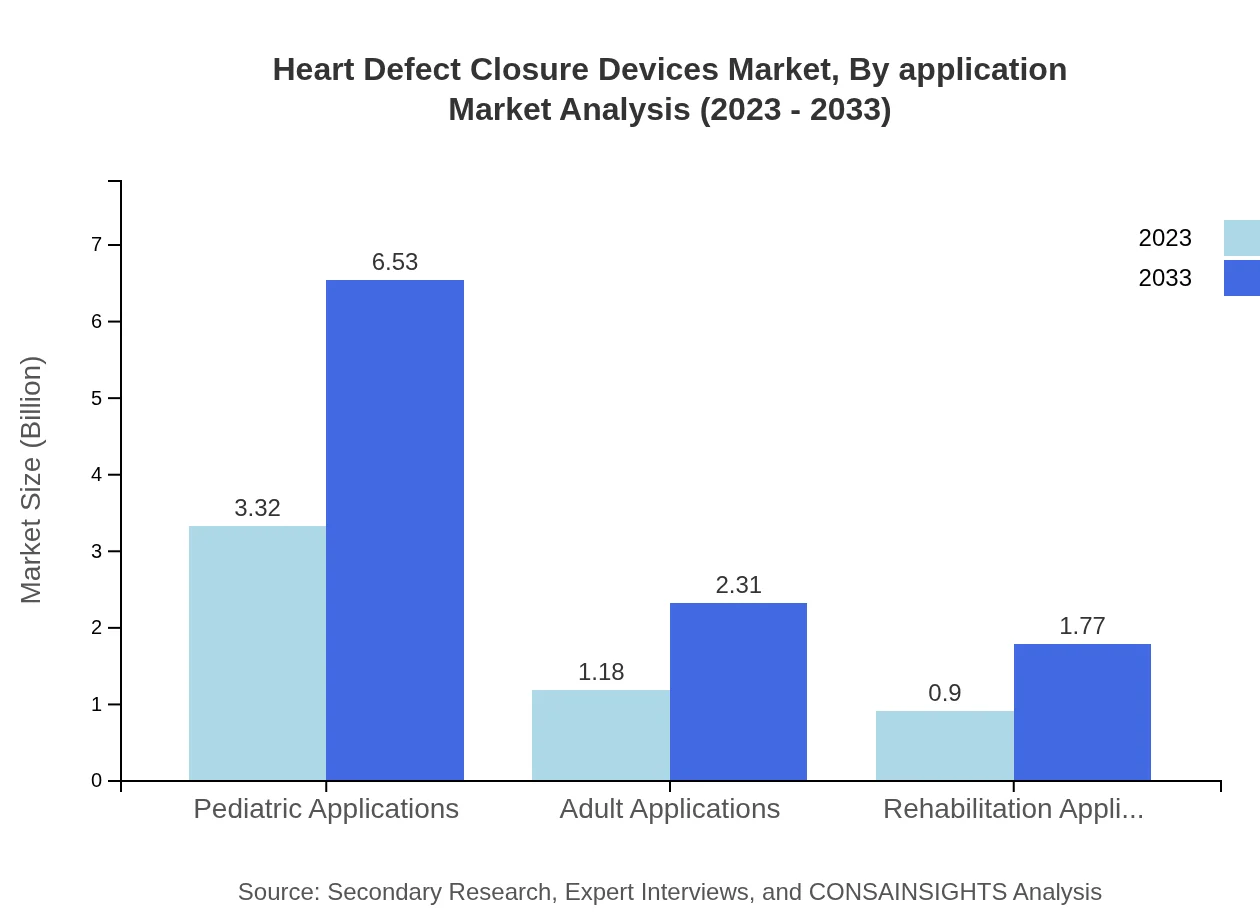
The market is segmented into Pediatric, Adult, and Rehabilitation applications. Pediatric Applications dominate with a market size of USD 3.32 billion in 2023, expected to grow to USD 6.53 billion by 2033. Adult Applications and Rehabilitation Applications hold sizes of USD 1.18 billion and USD 0.90 billion, respectively, in 2023.
Heart Defect Closure Devices Market Analysis By End User
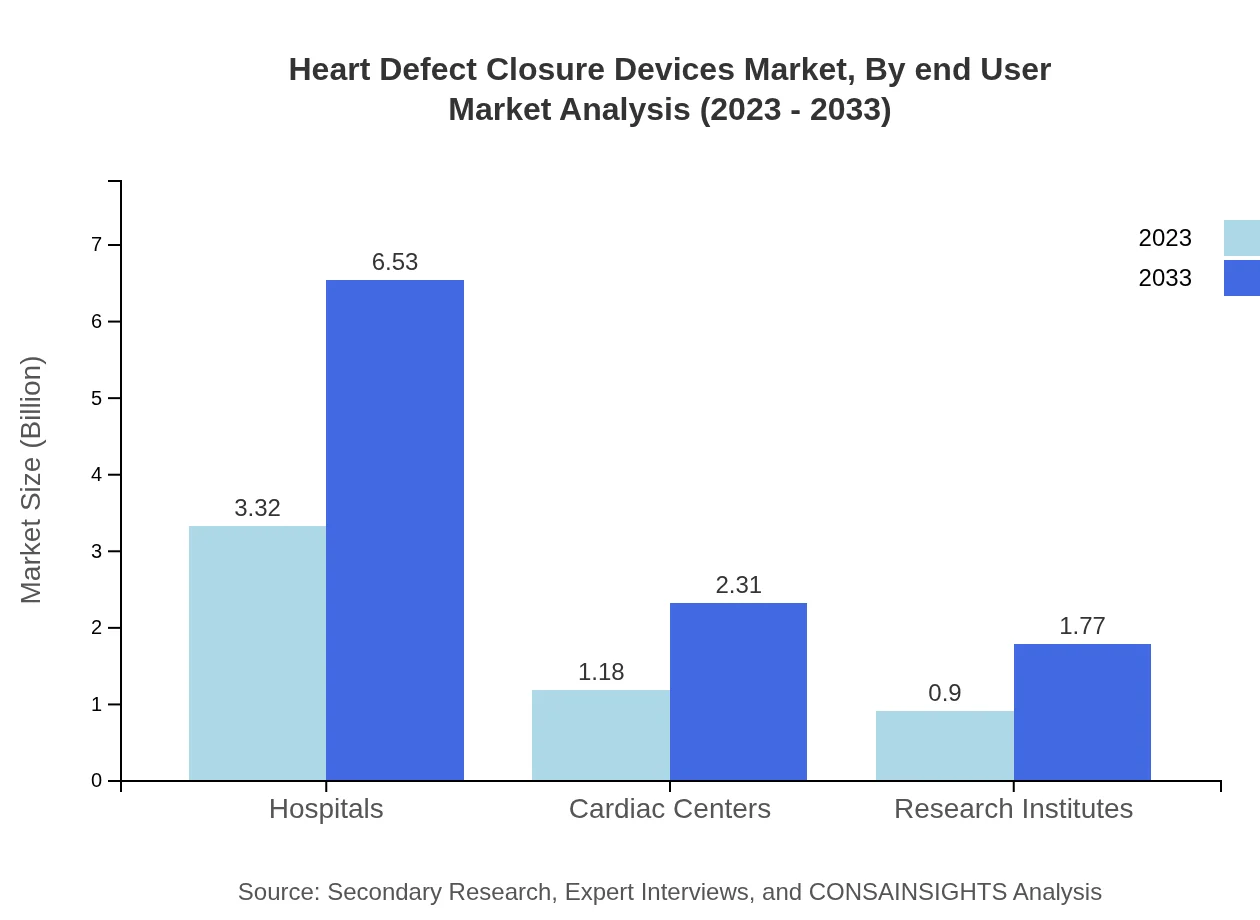
The primary end-users for Heart Defect Closure Devices include Hospitals, Cardiac Centers, and Research Institutes. Hospitals represent the largest market share with USD 3.32 billion in 2023 and a consistent share of 61.53% throughout the forecast period.
Heart Defect Closure Devices Market Analysis By Distribution Channel
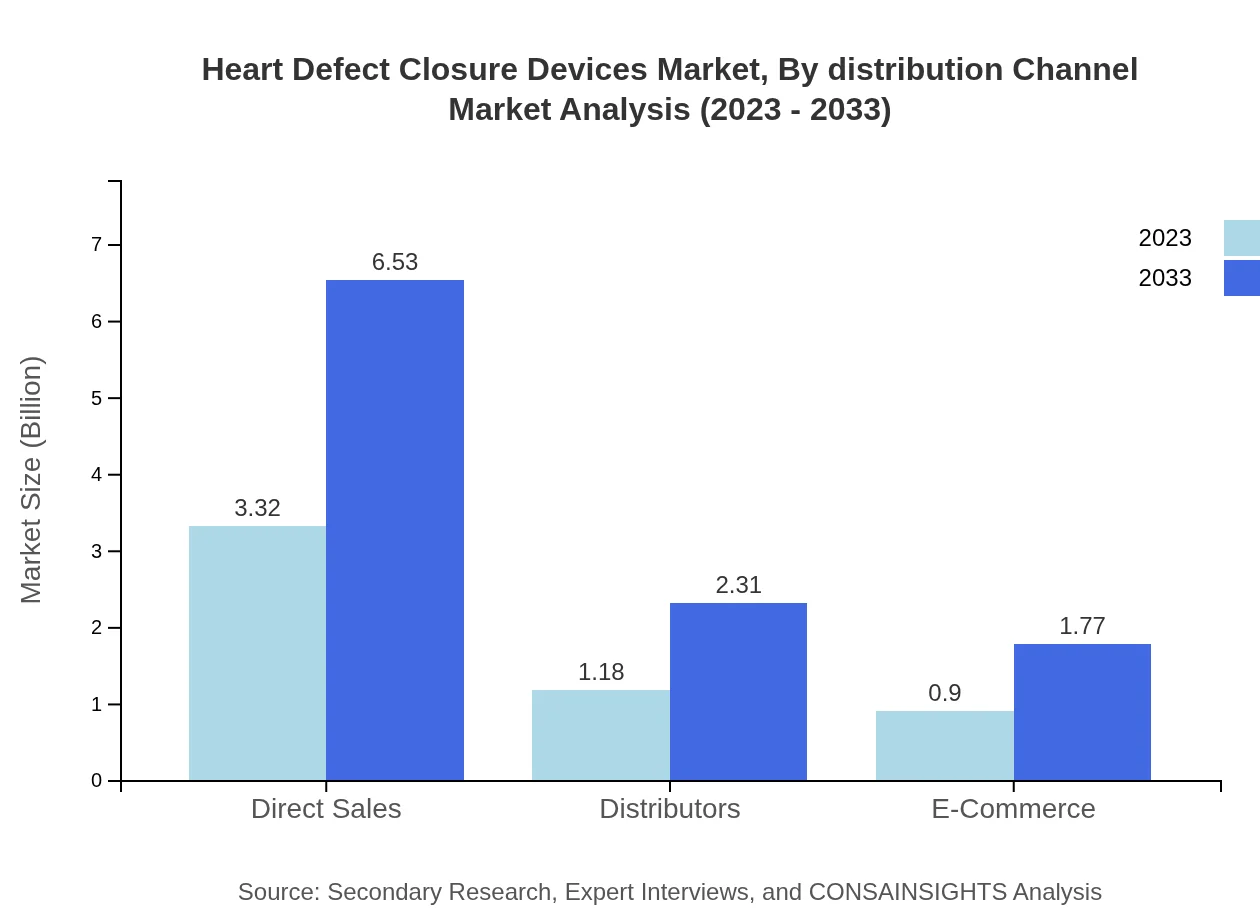
Distribution channels for Heart Defect Closure Devices consist of Direct Sales, Distributors, and E-Commerce. Direct Sales leads with a market size of USD 3.32 billion in 2023, maintaining a 61.53% share, while Distributors and E-Commerce represent 21.77% and 16.7% shares, respectively.
Heart Defect Closure Devices Market Analysis By End User Demographics
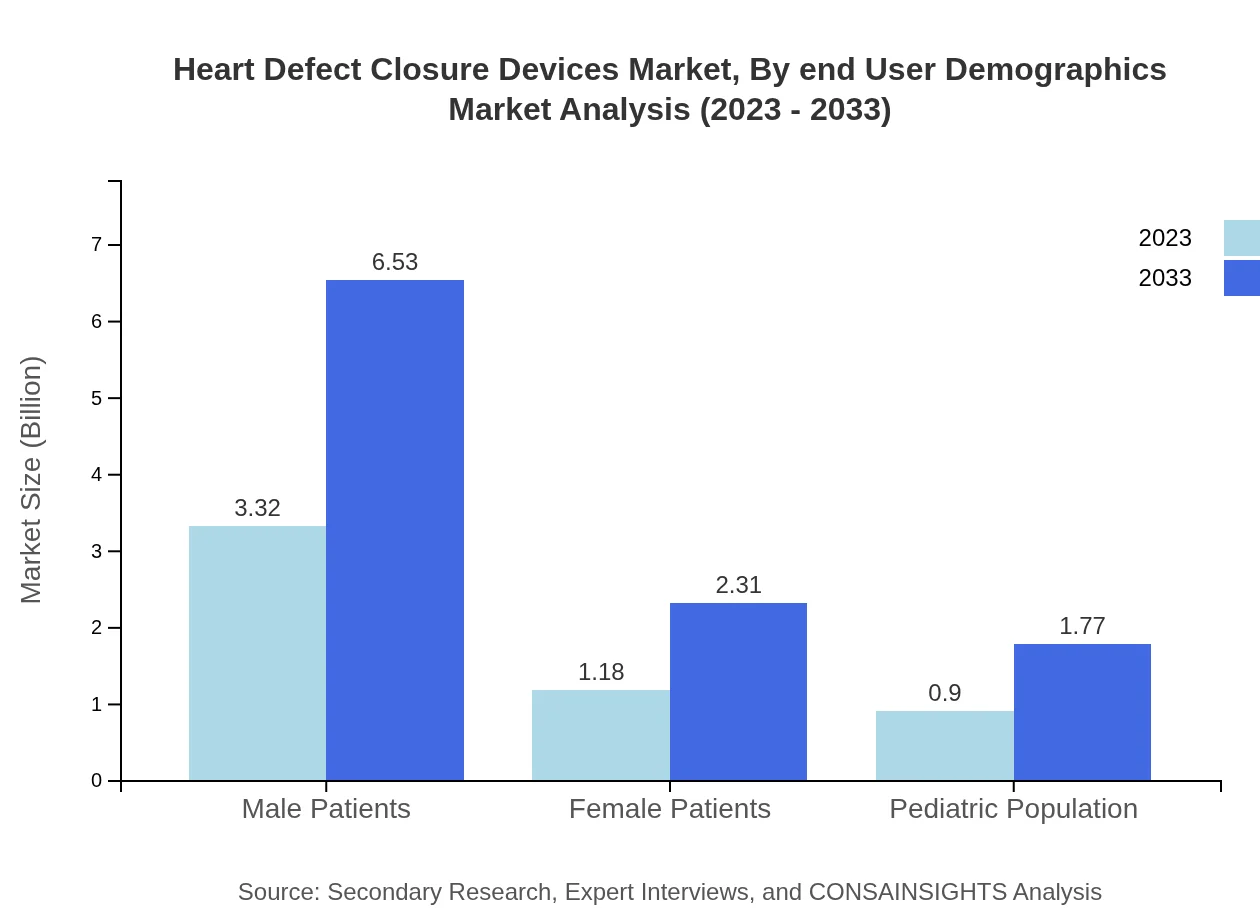
End-user demographics categorize the market into Male and Female Patients, as well as the Pediatric Population. Male Patients command the market with sizes of USD 3.32 billion in 2023, while Female Patients and Pediatric Population account for USD 1.18 billion and USD 0.90 billion, respectively.
Heart Defect Closure Devices Market Trends and Future Forecast
Tell us your focus area and get a customized research report.
Global Market Leaders and Top Companies in Heart Defect Closure Devices Industry
Abbot Laboratories:
Abbot Laboratories is a leader in medical devices, specializing in heart defect closure devices. Their innovations have significantly advanced closure technologies, improving patient outcomes.Medtronic :
Medtronic is known for its comprehensive range of heart defect closure devices and commitment to research and development, delivering cutting-edge solutions for congenital heart defects.Boston Scientific:
Boston Scientific manufactures a broad portfolio of devices, including highly effective occluders and delivery systems that enhance treatment options for patients with heart defects.Edwards Lifesciences:
Edwards Lifesciences specializes in heart valve therapy and structural heart solutions, contributing to significant advancements in heart defect closure techniques.LivaNova:
LivaNova focuses on innovative solutions in cardiac devices, playing a key role in developing next-generation heart defect closure technologies.We're grateful to work with incredible clients.








FAQs
What is the market size of the Heart Defect Closure Devices Market Report in 2023?
The market size in 2023 is $5.40 Billion, as reported for the global Heart Defect Closure Devices market.
How big will the market be in 2033?
By 2033 the market is projected to reach $10.61 Billion based on the provided forecast for the period 2023 to 2033.
What is CAGR for the forecast period?
The reported compound annual growth rate (CAGR) for the 2023 to 2033 forecast period is 6.8%.
Is there a single fastest Growing region in the Heart Defect Closure Devices Market Report market?
No single fastest-growing region is stated for the Heart Defect Closure Devices Market Report market because the top regional implied CAGR values are within 0.15 percentage points of each other, making the ranking too close to call reliably.
Which device types are included in the segmentation?
Device-type segmentation includes Occluders, Stents, and Clips as the primary categories covered in the report.
Who are the leading companies mentioned?
Top companies listed are Abbot Laboratories, Medtronic, Boston Scientific, Edwards Lifesciences, and LivaNova.
What end users are covered in the report?
Primary end-user segments include Hospitals, Cardiac Centers, and Research Institutes as specified in the segmentation.
How are distribution channels characterized?
Distribution channels identified are Direct Sales, Distributors, and E-Commerce to reflect market delivery paths.
What applications are addressed in the market?
Applications encompassed in the report include Pediatric Applications, Adult Applications, and Rehabilitation Applications.
Why does the report emphasize minimally invasive procedures?
Minimally invasive procedures are emphasized because device innovations and procedural preference are driving adoption and improved patient recovery.