

Hemodialysis Catheter
First published: 19 December 2024 | Last updated: 25 May 2026 | Report Code: hemodialysis-catheter
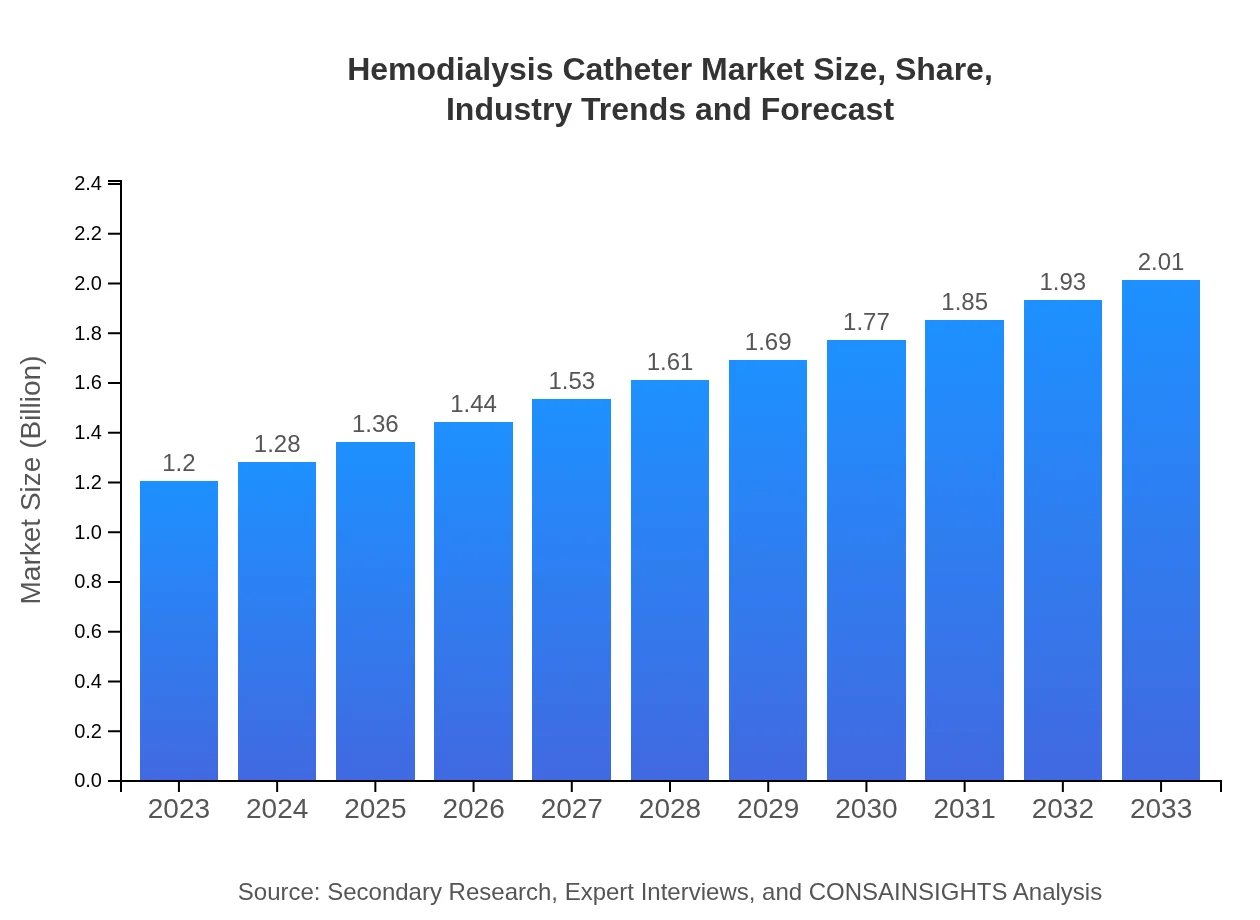
Hemodialysis Catheter Market — USD 1.2 billion in 2023, Growing to USD 2.01B by 2033 at 5.2% CAGR
This report presents a comprehensive analysis of the Hemodialysis Catheter market, including insights into market size, growth forecasts from 2023 to 2033, and a breakdown of trends, technologies, and leading players within the industry.
Key Takeaways
- Market value grows from $1.20 Billion in 2023 to $2.01 Billion in 2033 at a 5.2% CAGR over 2023 to 2033.
- North America is largest regional market, while no single fastest-growing region is stated because regional CAGR differences remain within 0.15 percentage points.
- Europe and Asia Pacific show notable expansion: Europe from $0.29 Billion to $0.49 Billion, Asia Pacific from $0.26 Billion to $0.43 Billion.
- Product and material innovation, along with rising healthcare spending and infection-control focus, are primary demand drivers.
- Key vendors listed include Fresenius Medical Care, Baxter International Inc., Medtronic, Terumo Corporation, and Cook Medical.
Hemodialysis Catheter — Executive Summary
North America remains largest market by forecast-period value, while no single fastest-growing region is stated because top regional growth rates are separated by less than 0.15 percentage points. This report presents a concise analysis of the Hemodialysis Catheter market, noting a valuation of $1.20 Billion in 2023 and a projected increase to $2.01 Billion by 2033 at a 5.2% CAGR for 2023 to 2033. Growth is supported by improved catheter designs, advanced biomaterials, and intensified measures to reduce infection risks—factors that enhance patient outcomes and spur adoption. The market structure is examined across product types (including single- and dual-lumen, tunneled and non-tunneled), materials such as silicone and polyurethane, and end users like hospitals, dialysis centers, and home care settings. Regional performance highlights North America as the largest market, with Europe, Asia Pacific, Latin America, and Middle East & Africa outlined separately. Competitive context cites leading firms such as Fresenius Medical Care, Baxter International Inc., Medtronic, Terumo Corporation, and Cook Medical. Research integrates expert interviews, company disclosures, and triangulated secondary sources to provide validated trend analysis and actionable insights for stakeholders.
Key Growth Drivers
- Advances in catheter materials and coatings that reduce infection and thrombosis risks, increasing clinical adoption.
- Product design improvements that improve patient comfort and procedural efficiency, encouraging use across care settings.
- Rising healthcare expenditures and expanded dialysis service capacity in hospitals and specialized centers.
- Growing emphasis on patient-centric care models and home-based dialysis, supporting demand for varied catheter types.
- Ongoing R&D and regulatory approvals prompting new device launches and broader market uptake.
| Metric | Value |
|---|---|
| Study Period | 2023 - 2033 |
| 2023 Market Size | $1.20 Billion |
| CAGR (2023-2033) | 5.2% |
| 2033 Market Size | $2.01 Billion |
| Top Companies | Fresenius Medical Care, Baxter International Inc., Medtronic , Terumo Corporation, Cook Medical |
| Published Date | 19 December 2024 |
| Last Modified Date | 25 May 2026 |
Hemodialysis Catheter Market Overview
Customize Hemodialysis Catheter market research report
- ✔ Get in-depth analysis of Hemodialysis Catheter market size, growth, and forecasts.
- ✔ Understand Hemodialysis Catheter's regional dynamics and industry-specific trends.
- ✔ Identify potential applications, end-user demand, and growth segments in Hemodialysis Catheter
What is the Market Size & CAGR of Hemodialysis Catheter market in 2023?
Hemodialysis Catheter Industry Analysis
Hemodialysis Catheter Market Segmentation and Scope
Tell us your focus area and get a customized research report.
Hemodialysis Catheter Market Analysis Report by Region
Europe Hemodialysis Catheter:
Europe grows from $0.29 Billion in 2023 to $0.49 Billion in 2033. This progression is influenced by technological improvements in catheter materials, enhanced clinical guidelines, and increasing healthcare expenditures supporting dialysis capacity.Asia Pacific Hemodialysis Catheter:
Asia Pacific grows from $0.26 Billion in 2023 to $0.43 Billion in 2033. Demand is shaped by expanding access to renal care, rising healthcare investment, and greater uptake of improved catheter designs and infection-prevention measures.North America Hemodialysis Catheter:
North America is largest regional market, rising from $0.41 Billion in 2023 to $0.7 Billion in 2033. Regional expansion reflects investment in dialysis services, emphasis on infection-control protocols, and adoption of advanced catheter technologies in clinical practice.South America Hemodialysis Catheter:
Latin America grows from $0.09 Billion in 2023 to $0.14 Billion in 2033. Market growth is supported by incremental improvements in dialysis services, evolving clinical practices, and gradual adoption of modern catheter materials and designs.Middle East & Africa Hemodialysis Catheter:
Middle East and Africa grows from $0.15 Billion in 2023 to $0.25 Billion in 2033. Growth drivers include expanding healthcare infrastructure, focus on infection control, and gradual implementation of improved catheter technologies.Tell us your focus area and get a customized research report.
Research Methodology
Hemodialysis Catheter Market Analysis By Product
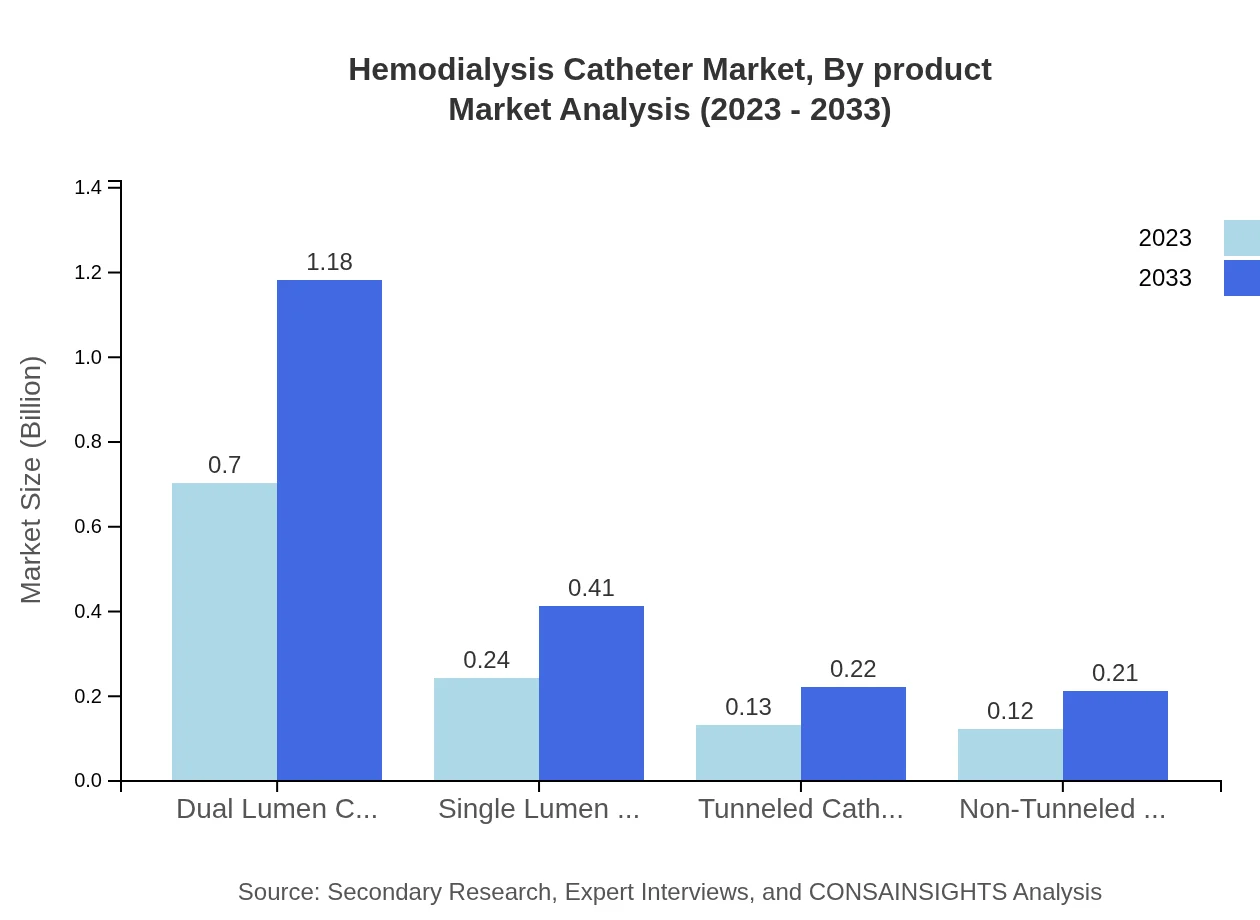
The Hemodialysis Catheter market is primarily segmented into two product categories: dual-lumen and single-lumen catheters. In 2023, dual-lumen catheters dominated with a market size of USD 0.70 billion, expected to reach USD 1.18 billion by 2033, holding 58.47% market share. Single-lumen catheters are trailing with USD 0.24 billion in 2023 and expected to grow to USD 0.41 billion by 2033, capturing 20.26% of the market. This signifies the preference for dual-lumen catheters due to their effectiveness in high-flow situations.
Hemodialysis Catheter Market Analysis By Material
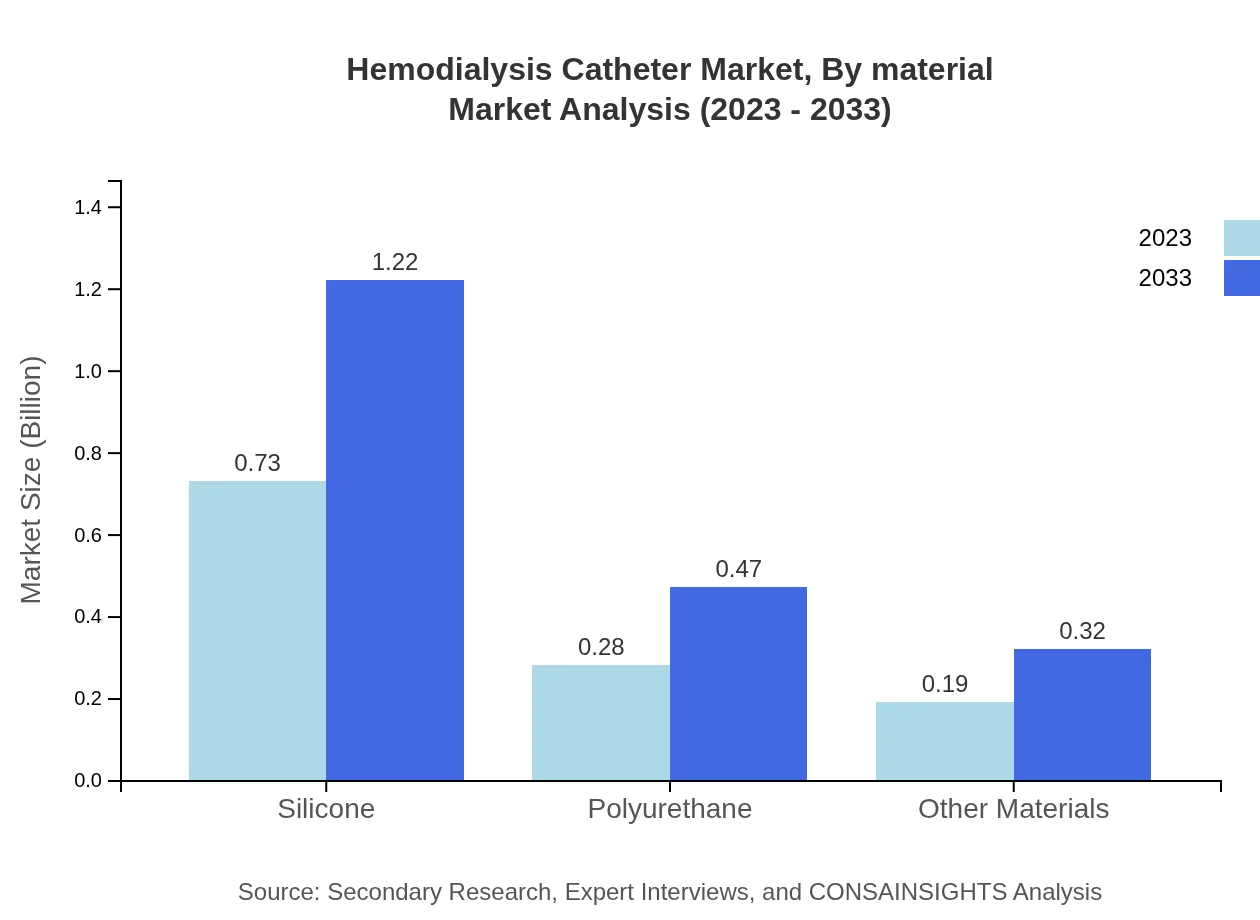
The primary materials used in Hemodialysis Catheters include silicone, polyurethane, and other materials. Silicone catheters lead the market with USD 0.73 billion in 2023, forecasted to reach USD 1.22 billion by 2033, marking a 60.72% share. Polyurethane and other materials follow, with market sizes of USD 0.28 billion and USD 0.19 billion in 2023, respectively, expected to grow significantly as innovations in material science enhance device performance.
Hemodialysis Catheter Market Analysis By End User
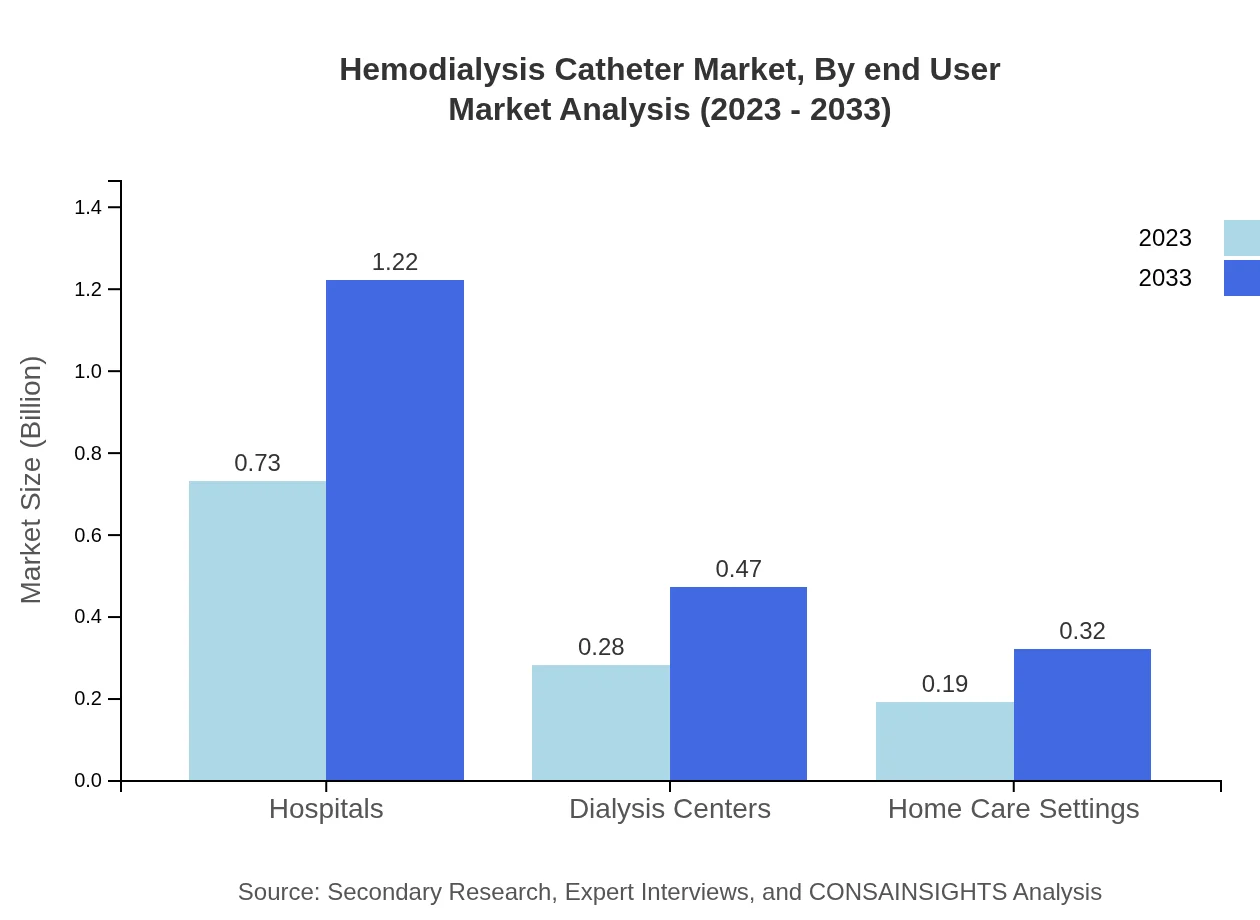
The end-user segmentation reveals hospitals as the major market player, commanding USD 0.73 billion in 2023, likely to rise to USD 1.22 billion by 2033 with a 60.72% market share. Dialysis centers see a market size of USD 0.28 billion, growing to USD 0.47 billion as demand for outpatient services increases. Home care settings are also emerging, growing from USD 0.19 billion to USD 0.32 billion, providing more options for remote patient care.
Hemodialysis Catheter Market Analysis By Region Category
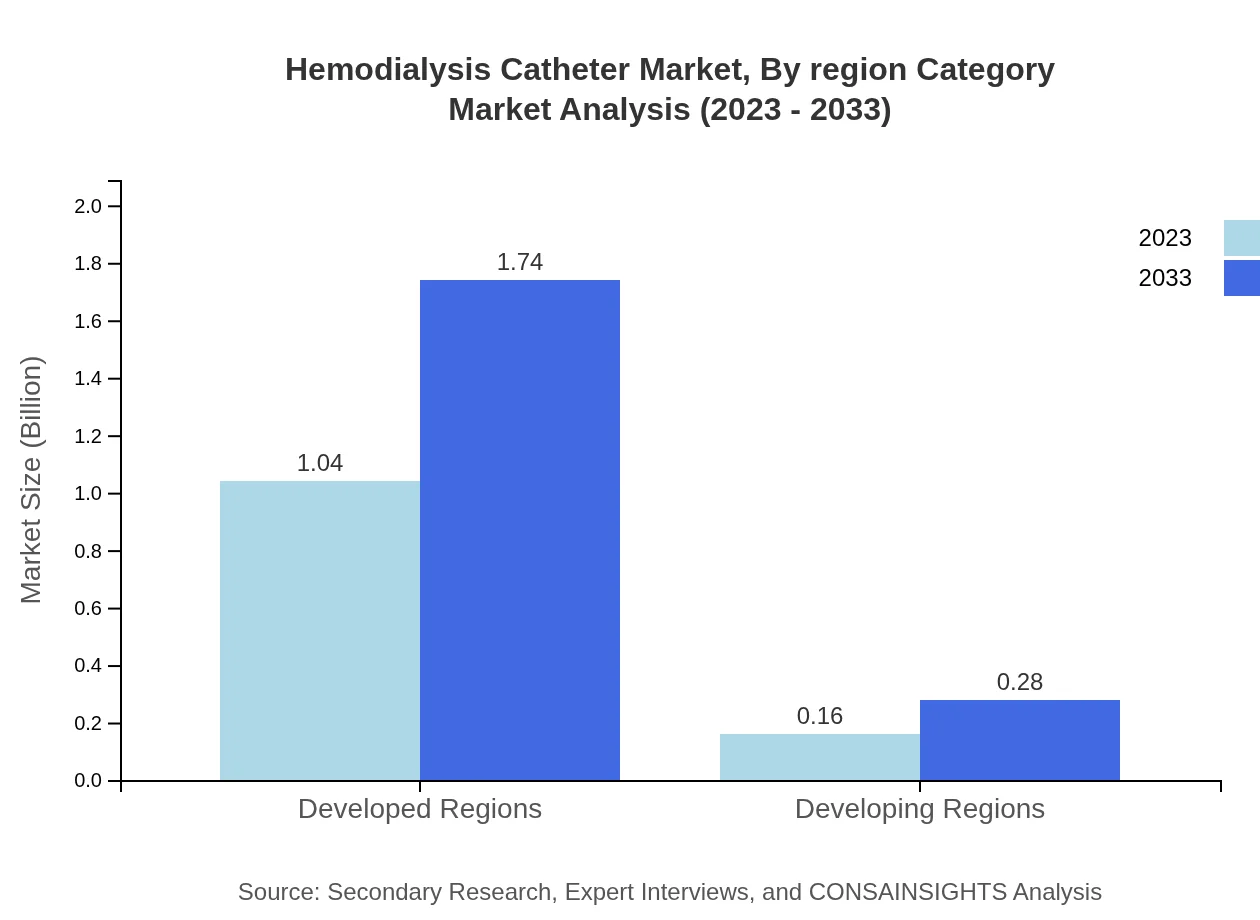
Developed regions dominate the Hemodialysis Catheter market, with a value of USD 1.04 billion in 2023 expected to grow to USD 1.74 billion by 2033 (86.34% share). In contrast, developing regions exhibit smaller market sizes but are anticipated to grow from USD 0.16 billion to USD 0.28 billion over the same timeframe (13.66% share). This trend illustrates the healthcare gap and potential growth in emerging markets.
Hemodialysis Catheter Market Analysis By Usage Type
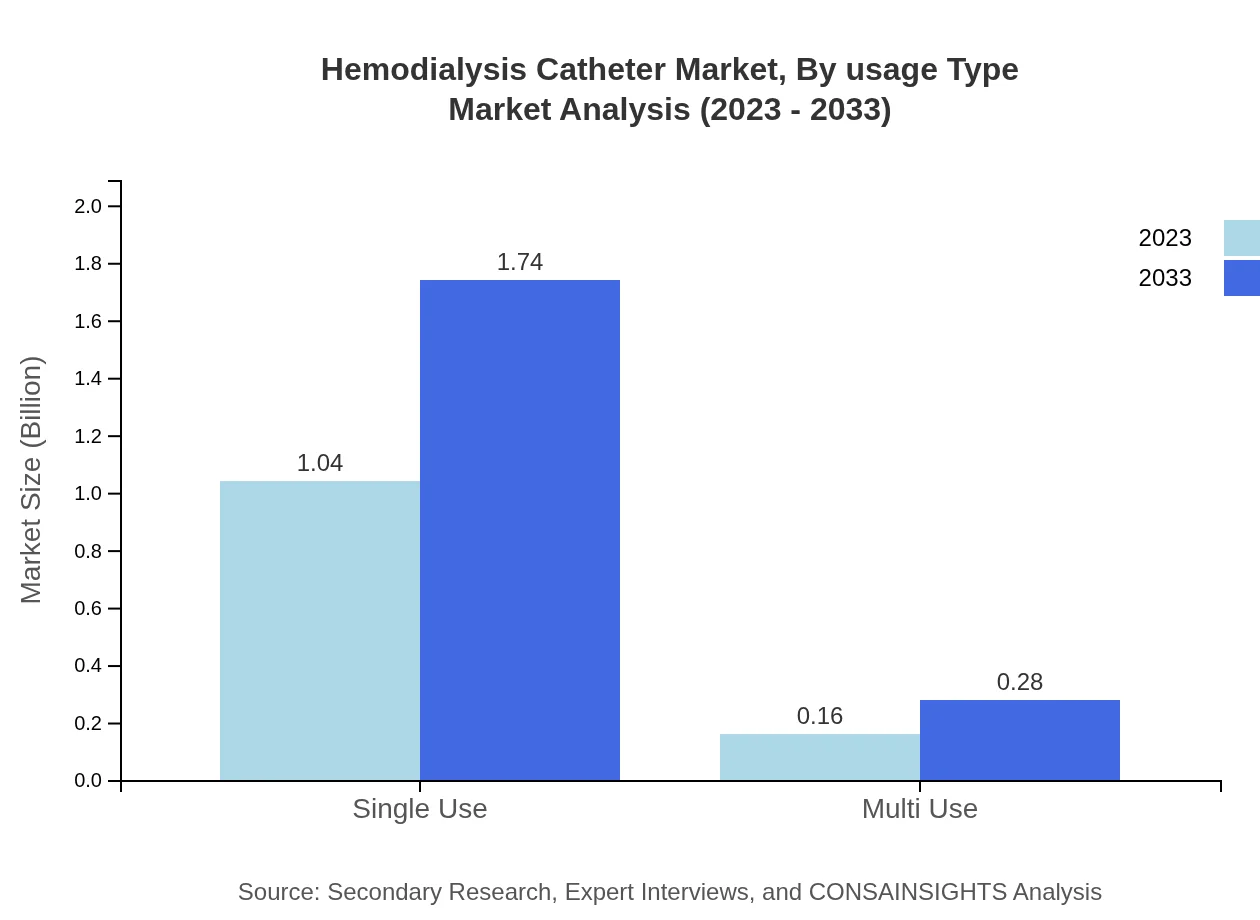
The usage type analysis categorizes catheters into single-use and multi-use. The single-use segment showcases significant market strength, with USD 1.04 billion in 2023 projected to rise to USD 1.74 billion by 2033, capturing 86.34% of the market. Multi-use options remain a small segment at USD 0.16 billion in 2023, reaching USD 0.28 billion by 2033, catering to specific clinical needs.
Hemodialysis Catheter Market Trends and Future Forecast
Tell us your focus area and get a customized research report.
Global Market Leaders and Top Companies in Hemodialysis Catheter Industry
Fresenius Medical Care:
A leading provider of products and services for individuals undergoing dialysis. Fresenius specializes in innovative hemodialysis equipment and catheters, improving patient outcomes and safety.Baxter International Inc.:
Known for its wide range of renal care products, Baxter offers various hemodialysis catheters designed for optimal performance and user safety.Medtronic :
A major player in medical device technology, Medtronic offers advanced hemodialysis solutions, including innovative catheter designs that enhance flexibility and reduce complications.Terumo Corporation:
Renowned for its medical devices, Terumo contributes significantly to the hemodialysis market with catheters that prioritize patient comfort and safety.Cook Medical:
Cook Medical is recognized for its innovative approaches to catheter technology, providing high-quality hemodialysis catheters tailored to patient and provider needs.We're grateful to work with incredible clients.







FAQs
What is the market size of Hemodialysis Catheter in 2023?
The Hemodialysis Catheter market size in 2023 is $1.20 Billion, as stated in the report's baseline valuation for the forecast analysis.
How big is the Hemodialysis Catheter market projected to be in 2033?
The market is projected to reach $2.01 Billion by 2033 based on the report's forecast figures and growth assumptions.
What is CAGR of the Hemodialysis Catheter market for 2023 to 2033?
The report specifies a compound annual growth rate (CAGR) of 5.2% for the Hemodialysis Catheter market across 2023 to 2033.
Is there a single fastest Growing region in the Hemodialysis Catheter market?
No single fastest-growing region is stated for the Hemodialysis Catheter market because the top regional implied CAGR values are within 0.15 percentage points of each other, making the ranking too close to call reliably.
Why are material innovations important in this market?
Material innovations, such as improved silicone and polyurethane formulations, help lower infection and clot risks, which supports broader clinical adoption.
Who are the top companies in the Hemodialysis Catheter market?
Top companies listed in the report include Fresenius Medical Care, Baxter International Inc., Medtronic, Terumo Corporation, and Cook Medical.
How big is the Europe market in 2023 and 2033?
Europe's market is reported at $0.29 Billion in 2023, expanding to $0.49 Billion by 2033 according to regional data.
What drives adoption in hospitals and dialysis centers?
Adoption is driven by device efficacy, infection-control priorities, procedural efficiency, and the availability of trained clinical staff in hospitals and centers.
Which end users are covered in the segmentation?
End-user segments include hospitals, dialysis centers, and home care settings, reflecting settings where hemodialysis catheters are deployed.
Why is regional analysis important for stakeholders?
Regional analysis highlights differing market sizes and growth contexts, helping stakeholders align investment, distribution, and product strategies by geography.