

Hormonal Contraceptives Market Report
First published: 21 October 2024 | Last updated: 25 May 2026 | Report Code: hormonal-contraceptives
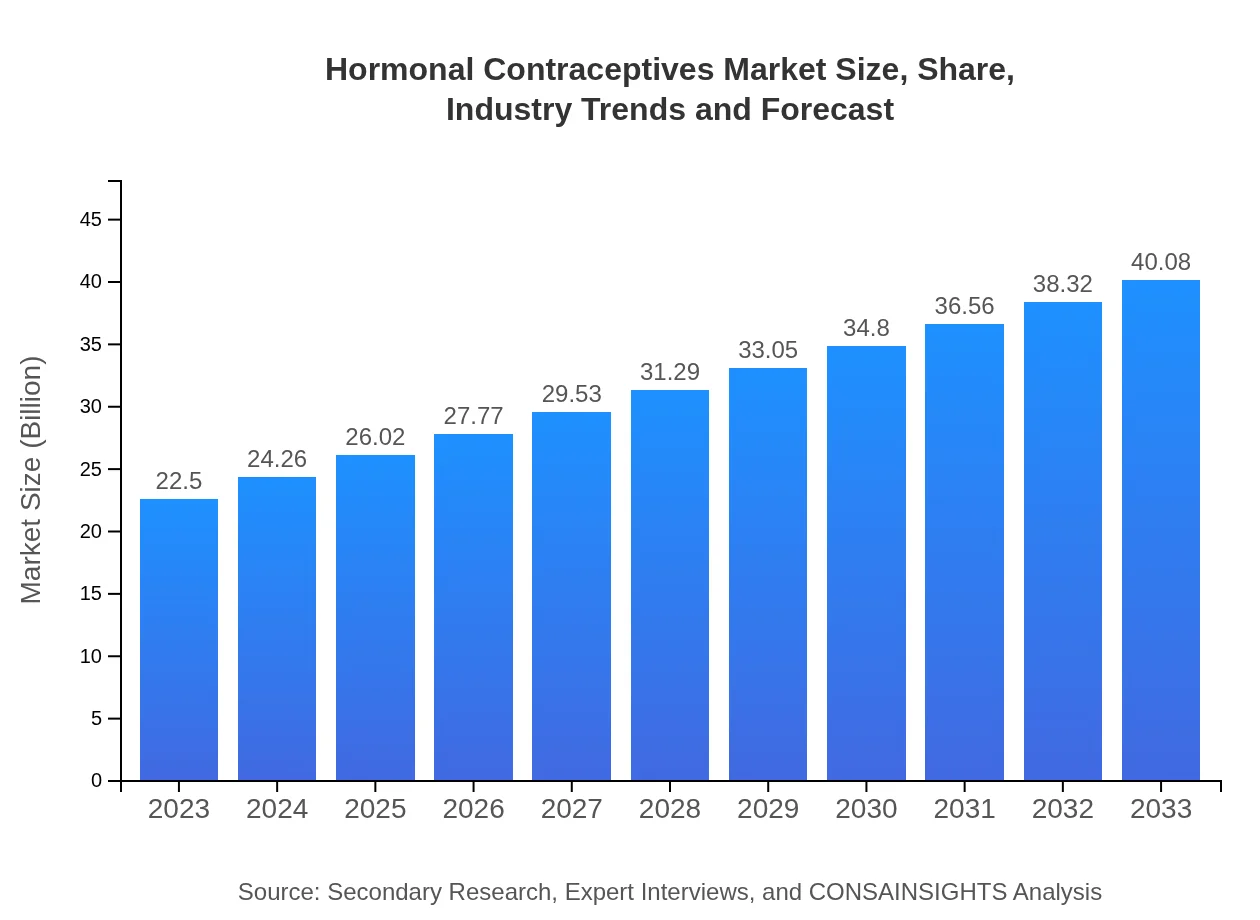
Hormonal Contraceptives Market — USD 22.5 billion in 2023, Growing to USD 40.08B by 2033 at 5.8% CAGR
This report provides a comprehensive analysis of the Hormonal Contraceptives market, highlighting key insights and data from 2023 to 2033, including market size, growth trends, segmentation, and regional dynamics.
Key Takeaways
- Global market value rises from $22.50 Billion in 2023 to $40.08 Billion in 2033, reflecting a 5.8% CAGR over the forecast period.
- North America is largest regional market, while no single fastest-growing region is stated because regional CAGR differences remain within 0.15 percentage points.
- Europe expands from $6.03 Billion in 2023 to $10.74 Billion in 2033, while Asia Pacific grows from $4.29 Billion to $7.63 Billion.
- Product mix includes oral, injectable, implantable, transdermal patches, and IUDs; key players include Bayer AG, Johnson & Johnson, Merck & Co., and Teva Pharmaceutical Industries.
- Distribution channels span online channels, pharmacies, and hospitals, supporting broader accessibility and convenience for end users.
Hormonal Contraceptives Market Report — Executive Summary
North America remains largest market by forecast-period value, while no single fastest-growing region is stated because top regional growth rates are separated by less than 0.15 percentage points. The hormonal contraceptives market is forecast to expand from $22.50 Billion in 2023 to $40.08 Billion by 2033 at a 5.8% CAGR. Growth is supported by greater healthcare spending, expanded access through online channels, and increased uptake of long-acting reversible contraceptives such as implants and IUDs. Regional demand varies: North America leads in absolute value, while Europe and Asia Pacific show notable increases. Product segmentation covers oral contraceptives, injectables, implantables, transdermal patches, and IUDs, and end users include women of reproductive age, family planning clinics, and hospitals. Competition is centered on established pharmaceutical firms including Bayer AG, Johnson & Johnson, Merck & Co., and Teva Pharmaceutical Industries. The report synthesizes primary interviews and secondary data to provide actionable insight for stakeholders assessing market opportunities and strategic positioning.
Key Growth Drivers
- Rising healthcare expenditure that increases access to contraceptive products across multiple care settings.
- Expansion of online pharmaceutical channels improving availability and patient convenience.
- Growing preference for long-acting reversible contraceptives (implants and IUDs) boosting longer-term uptake.
- Continued product innovation and clinical research led by major pharmaceutical companies to enhance safety and efficacy.
- Broader reproductive health awareness and family planning initiatives supporting sustained demand.
| Metric | Value |
|---|---|
| Study Period | 2023 - 2033 |
| 2023 Market Size | $22.50 Billion |
| CAGR (2023-2033) | 5.8% |
| 2033 Market Size | $40.08 Billion |
| Top Companies | Bayer AG, Johnson & Johnson, Merck & Co., Teva Pharmaceutical Industries |
| Published Date | 21 October 2024 |
| Last Modified Date | 25 May 2026 |
Hormonal Contraceptives Market Overview
Customize Hormonal Contraceptives Market Report market research report
- ✔ Get in-depth analysis of Hormonal Contraceptives market size, growth, and forecasts.
- ✔ Understand Hormonal Contraceptives's regional dynamics and industry-specific trends.
- ✔ Identify potential applications, end-user demand, and growth segments in Hormonal Contraceptives
What is the Market Size & CAGR of Hormonal Contraceptives Market Report market in 2023?
Hormonal Contraceptives Industry Analysis
Hormonal Contraceptives Market Segmentation and Scope
Tell us your focus area and get a customized research report.
Hormonal Contraceptives Market Report Market Analysis Report by Region
Europe Hormonal Contraceptives Market Report:
Europe grows from $6.03 Billion in 2023 to $10.74 Billion in 2033. Growth there is supported by expanded family planning services, regulatory frameworks that enable access, and adoption of a diverse product mix including oral contraceptives and IUDs.Asia Pacific Hormonal Contraceptives Market Report:
Asia Pacific grows from $4.29 Billion in 2023 to $7.63 Billion in 2033. The region’s expansion is influenced by rising healthcare investment, wider access to clinics and online channels, and growing awareness of reproductive health options.North America Hormonal Contraceptives Market Report:
North America is largest regional market, rising from $8.66 Billion in 2023 to $15.42 Billion in 2033. 66 Billion in 2023 and is expected to increase to $15.42 Billion by 2033. The region’s market scale reflects strong healthcare infrastructure, broad availability through pharmacies and hospitals, and active participation by major pharmaceutical companies.South America Hormonal Contraceptives Market Report:
Latin America grows from $1.12 Billion in 2023 to $2 Billion in 2033. Market progress is linked to strengthening distribution networks, increased clinic and pharmacy availability, and growing demand for family planning services.Middle East & Africa Hormonal Contraceptives Market Report:
Middle East and Africa grows from $2.4 Billion in 2023 to $4.28 Billion in 2033. This growth is supported by expanding healthcare access, outreach programs for reproductive health, and increased availability of contraceptive product types.Tell us your focus area and get a customized research report.
Research Methodology
Hormonal Contraceptives Market Analysis By Product Type
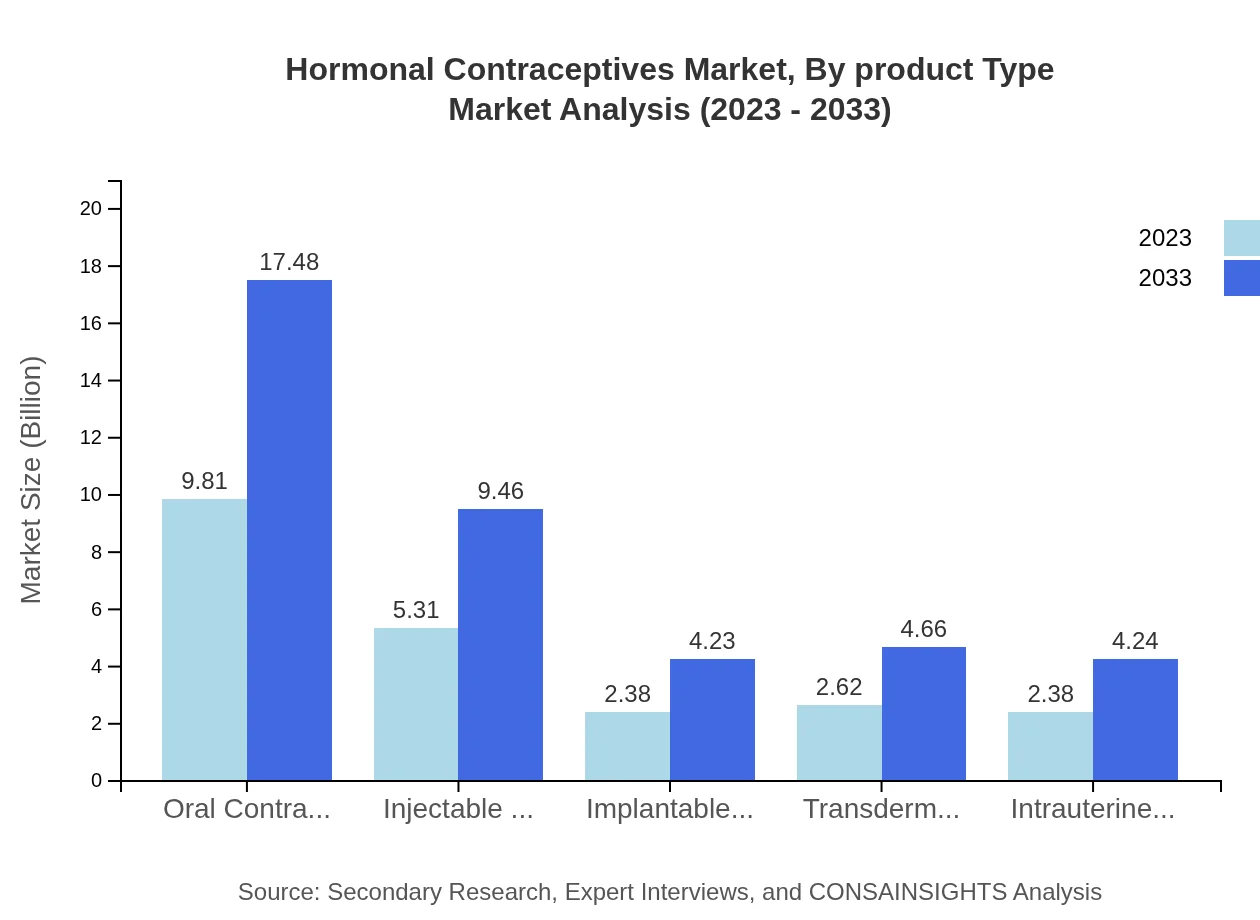
The Hormonal Contraceptives Market, segmented by product type, includes oral contraceptives, injectable contraceptives, implant-based contraceptives, transdermal patches, and intrauterine devices (IUDs). Oral contraceptives dominate the market, with a size of $9.81 billion in 2023, projected to grow to $17.48 billion by 2033. Injectable contraceptives follow closely, valued at $5.31 billion in 2023, expected to reach $9.46 billion. Implantable contraceptives show promising growth as well, anticipating a climb from $2.38 billion to $4.23 billion within the decade.
Hormonal Contraceptives Market Analysis By End User
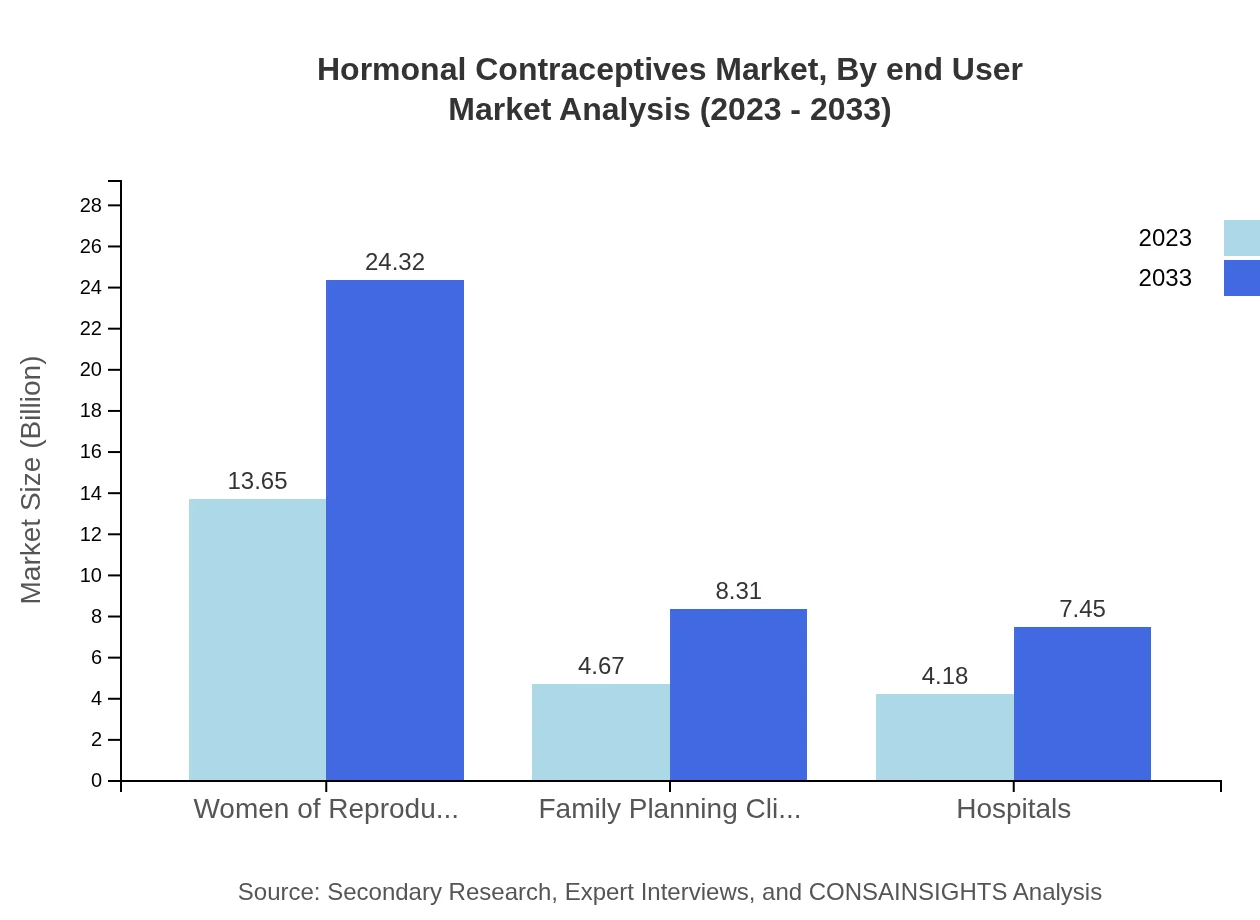
The end-user segments of the hormonal contraceptives market are primarily women of reproductive age, family planning clinics, pharmacies, and hospitals. The largest segment, women of reproductive age, is expected to hold a substantial share, driven by increased contraceptive usage. Family planning clinics and pharmacies represent significant distribution channels, with respective market sizes projected to grow from $4.67 billion in 2023 to $8.31 billion and $4.18 billion to $7.45 billion by 2033.
Hormonal Contraceptives Market Analysis By Region Type
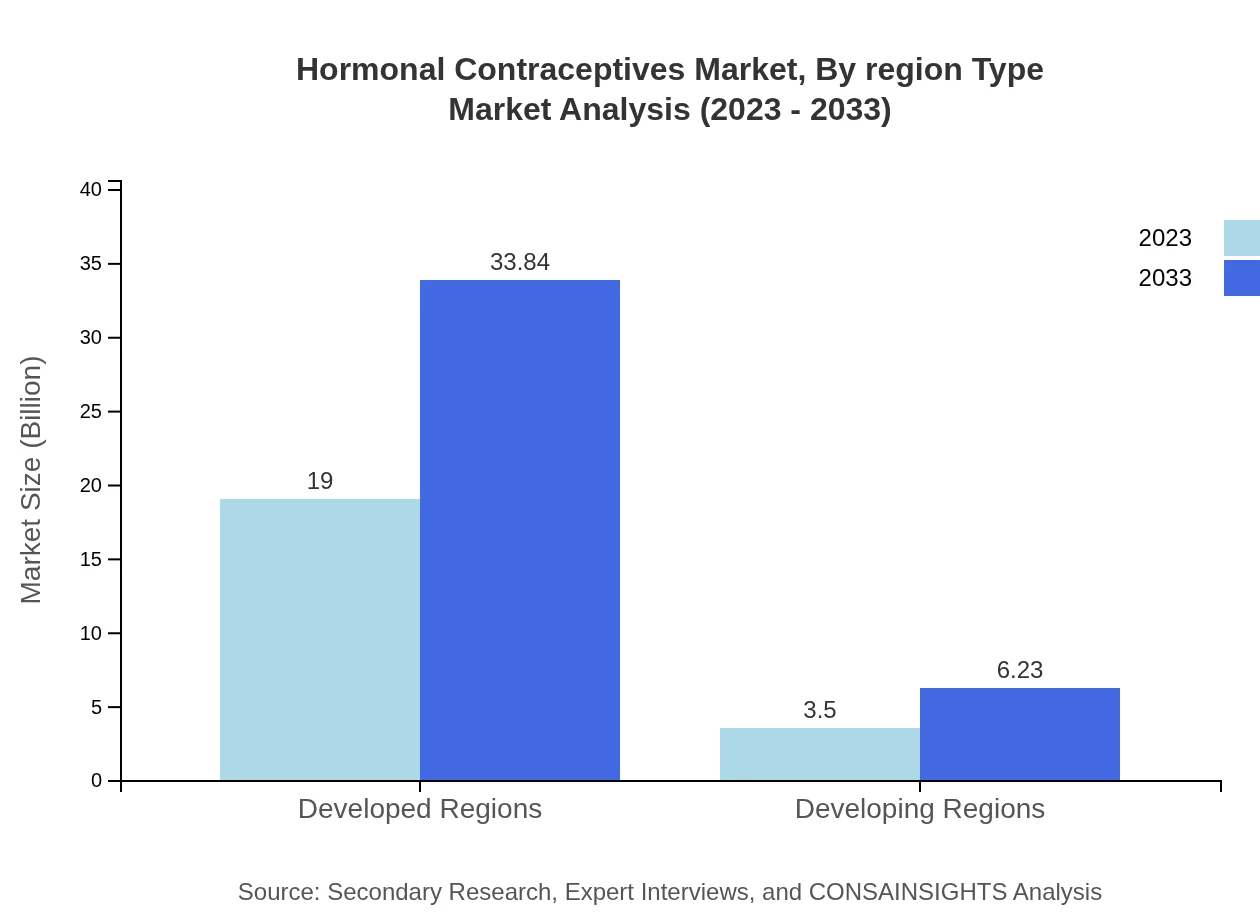
Regional analysis indicates a diverse landscape across developed and developing regions. Developed regions are expected to command a market size of $19.00 billion in 2023, increasing to $33.84 billion by 2033, while developing regions project growth from $3.50 billion to $6.23 billion, underscoring the disparities in access to hormonal contraceptives.
Hormonal Contraceptives Market Analysis By Channel
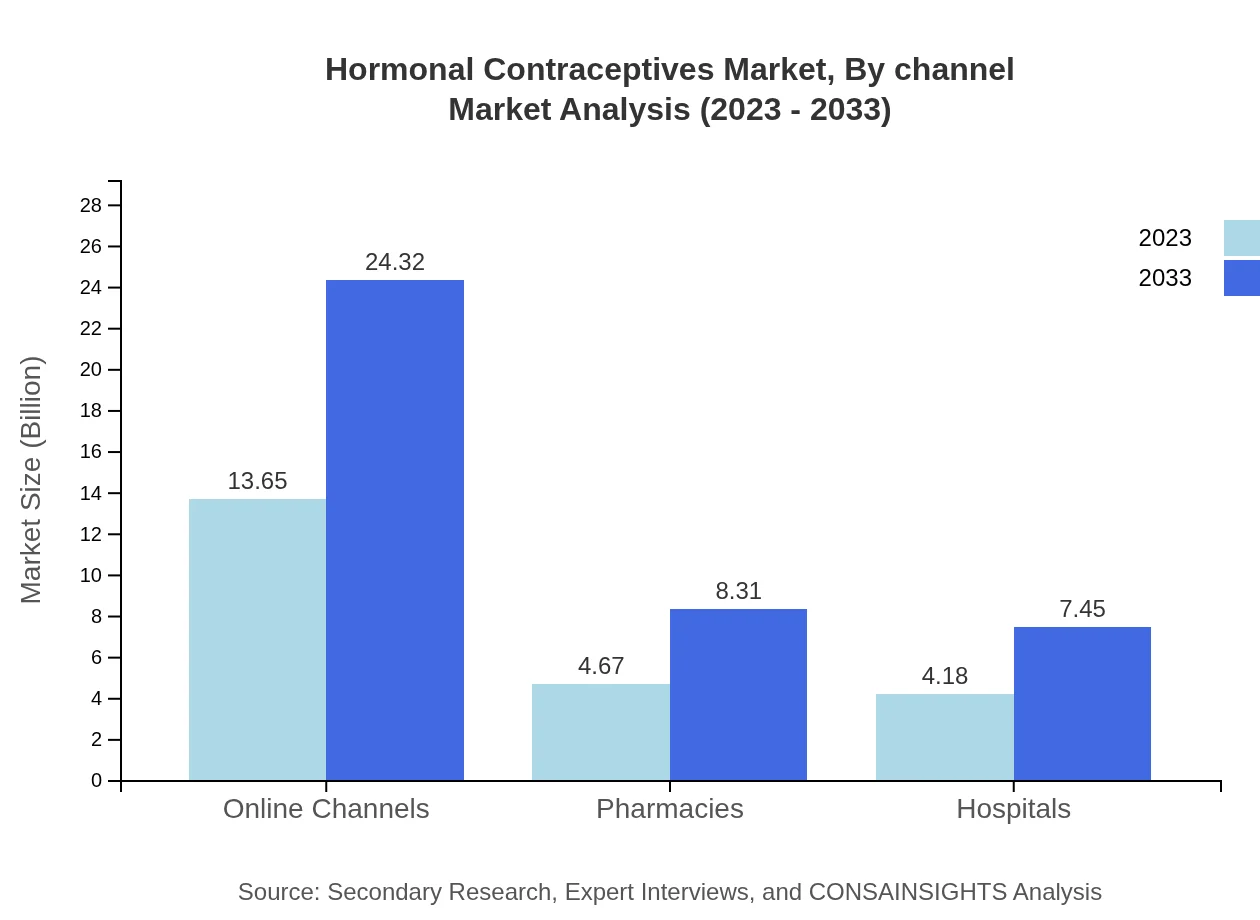
Distribution channels for hormonal contraceptives include online channels, pharmacies, hospitals, and family planning clinics. Online channels are a growing segment, with size forecasted to reach $24.32 billion by 2033, maintaining a consistent market share of approximately 60.68%. Pharmacies also showcase growth potential, projected to increase from $4.67 billion in 2023 to $8.31 billion by 2033.
Hormonal Contraceptives Market Analysis By Therapeutic Application
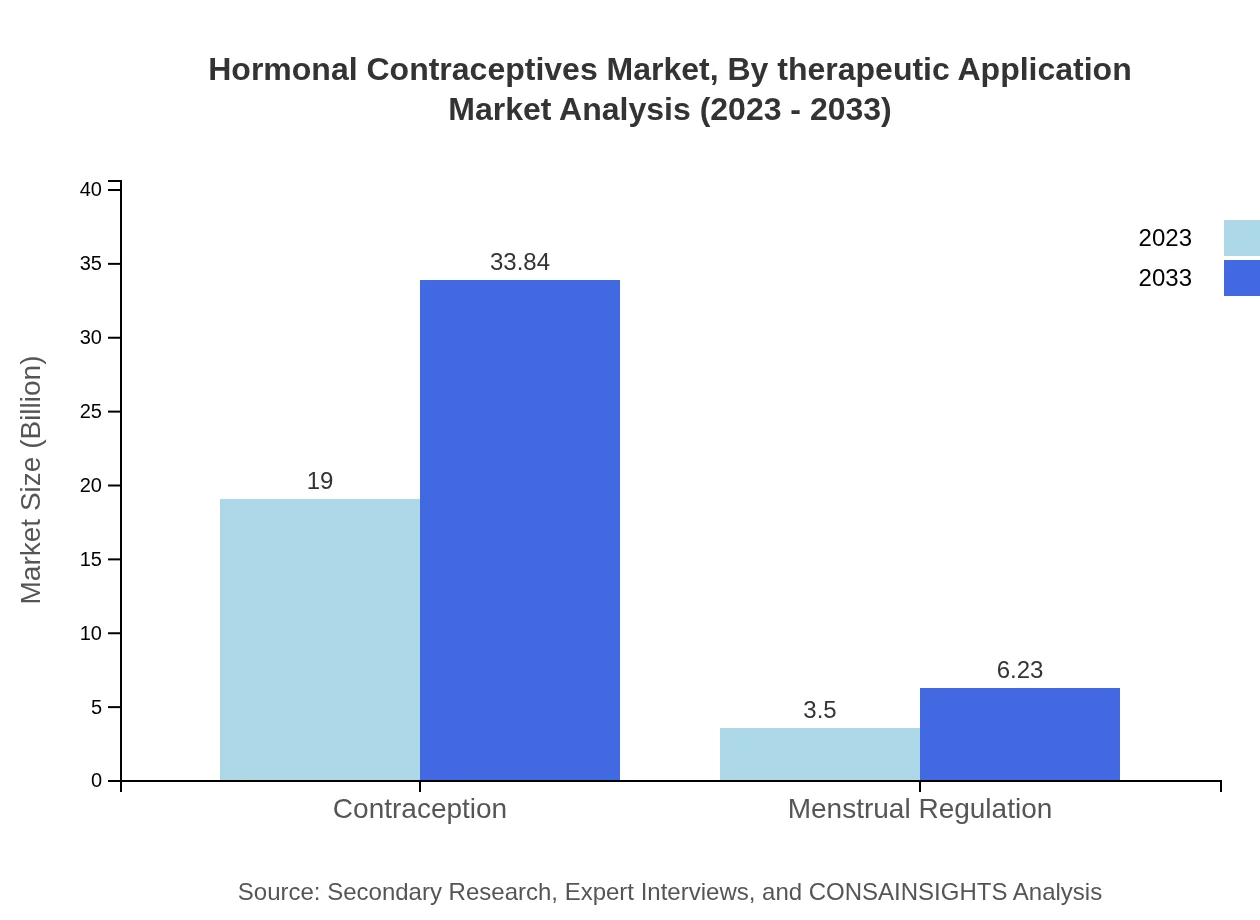
Therapeutic applications primarily encompass family planning, with a market size anticipated to rise from $19.00 billion in 2023 to $33.84 billion by 2033. Menstrual regulation, another significant segment, shows growth from $3.50 billion to $6.23 billion, reflecting increased awareness and demand for reproductive health solutions.
Hormonal Contraceptives Market Trends and Future Forecast
Tell us your focus area and get a customized research report.
Global Market Leaders and Top Companies in Hormonal Contraceptives Industry
Bayer AG:
Bayer AG is a global leader in the pharmaceutical sector, offering comprehensive contraceptive solutions including various oral and injectable hormonal contraceptives. Their commitment to innovation positions them at the forefront of the industry.Johnson & Johnson:
Johnson & Johnson excels in the healthcare sector, providing a breadth of contraceptive products, including innovative delivery systems that enhance accessibility and user convenience in hormonal contraceptive solutions.Merck & Co.:
Merck & Co. is known for producing a range of contraceptive options, with a strong emphasis on research and development. Their portfolio includes well-established products that cater to diverse consumer needs in the hormonal contraceptive space.Teva Pharmaceutical Industries:
Teva specializes in generic medications, including affordable hormonal contraceptive options, improving market access and affordability while maintaining product efficacy and safety.We're grateful to work with incredible clients.








FAQs
What is the market size of the hormonal contraceptives market in 2023?
The market size in 2023 is $22.50 Billion, as reported for the base year of the forecast period covering 2023 to 2033.
What is the expected market size in 2033?
The market is projected to reach $40.08 Billion by 2033 according to the provided forecast figures for the 2023 to 2033 period.
What is CAGR of the market during the forecast period?
The compound annual growth rate for the market over 2023 to 2033 is 5.8%, based on the stated beginning and end market values.
Is there a single fastest Growing region in the Hormonal Contraceptives Market Report market?
No single fastest-growing region is stated for the Hormonal Contraceptives Market Report market because the top regional implied CAGR values are within 0.15 percentage points of each other, making the ranking too close to call reliably.
Which companies are identified as top players in the market?
Top companies listed include Bayer AG, Johnson & Johnson, Merck & Co., and Teva Pharmaceutical Industries as primary market participants.
Why is online distribution important for the market?
Online channels expand reach and convenience, enabling wider product access and supporting consumer preferences for remote purchasing and telehealth-enabled services.
What are the main product segments covered?
Product segmentation includes oral contraceptives, injectable contraceptives, implantable contraceptives, transdermal patches, and intrauterine devices (IUDs).
Which end users are addressed in the market segmentation?
End-user categories include women of reproductive age, family planning clinics, and hospitals, reflecting clinical and community delivery settings.
How big is the Europe market in 2023 and 2033?
Europe is recorded at $6.03 Billion in 2023 and is projected to grow to $10.74 Billion by 2033, per the regional figures provided.
Why is primary research used in the report methodology?
Primary interviews with industry experts provide qualitative insight and context that support data interpretation and validation of trends observed in secondary sources.