

Injectable Drug Delivery Devices Market Report
First published: 11 October 2024 | Last updated: 25 May 2026 | Report Code: injectable-drug-delivery-devices
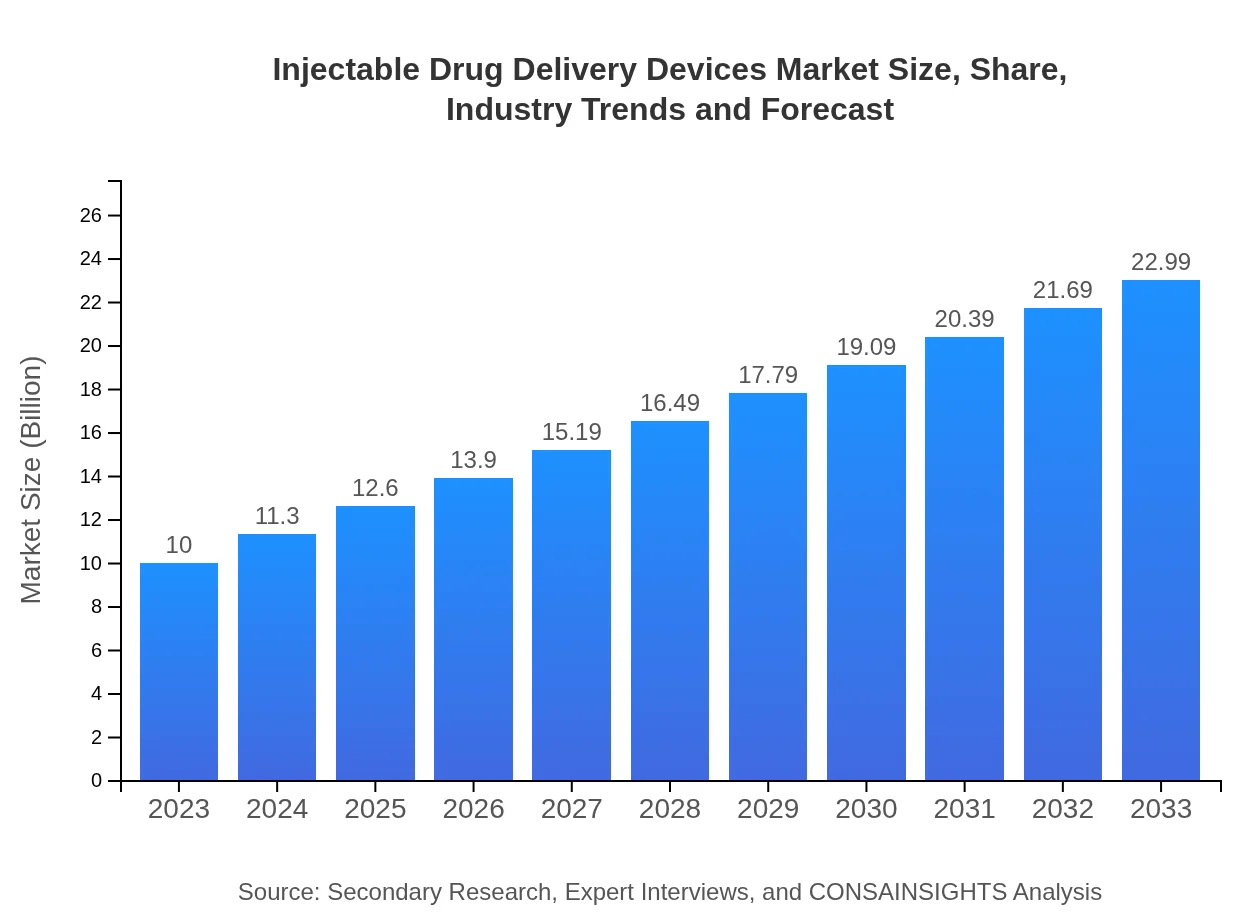
Injectable Drug Delivery Devices Market — USD $10 Billion in 2023, Growing to USD 22.99null by 2033 at 8.4% CAGR
This report provides a comprehensive analysis of the Injectable Drug Delivery Devices market, focusing on its growth from 2023 to 2033. It includes insights on market size, trends, technologies, regional performance, and key industry players.
Key Takeaways
- Global market expands from $10.00 Billion in 2023 to $22.99 Billion in 2033 at an 8.4% CAGR.
- Europe is largest regional market, while no single fastest-growing region is stated because regional CAGR differences remain within 0.15 percentage points.
- North America grows from $3.42 Billion to $7.86 Billion over the forecast, reflecting strong clinical and homecare adoption.
- Product innovation—auto-injectors and needle-free options—and the rise of self-administration drive demand.
- Leading companies include BD (Becton, Dickinson and Company), AbbVie Inc., Medtronic, Pfizer Inc., and Roche.
Injectable Drug Delivery Devices Market Report — Executive Summary
Europe remains largest market by forecast-period value, while no single fastest-growing region is stated because top regional growth rates are separated by less than 0.15 percentage points. The market for injectable drug delivery devices is projected to more than double from $10.00 Billion in 2023 to $22.99 Billion by 2033, reflecting an 8.4% CAGR across the 2023 to 2033 forecast period. Growth is supported by increasing chronic disease prevalence, a shift toward home healthcare and self-injection, and technological advances such as auto-injectors and needle-free systems. Regulatory requirements and safety standards continue to shape product development and adoption. The report examines market structure by device type, application, technology, end user and region, and profiles key participants including BD (Becton, Dickinson and Company), AbbVie Inc., Medtronic, Pfizer Inc., and Roche. Methodology combines primary expert interviews with secondary company reports, followed by data triangulation and validation to ensure robust trend interpretation and market estimates.
Key Growth Drivers
- Rising chronic disease rates prompting sustained need for repeat injectable therapies and adherence-supporting devices.
- Shift to homecare and self-administration increasing demand for user-friendly auto-injectors and needle-free systems.
- Technological advances enabling compatibility with biologics and complex formulations, broadening device applicability.
- Regulatory emphasis on safety and efficacy encouraging standardized device enhancements and clinical adoption.
- Industry consolidation and strategic partnerships expanding distribution and accelerating product availability.
| Metric | Value |
|---|---|
| Study Period | 2023 - 2033 |
| 2023 Market Size | $10.00 Billion |
| CAGR (2023-2033) | 8.4% |
| 2033 Market Size | $22.99 Billion |
| Top Companies | BD (Becton, Dickinson and Company), AbbVie Inc., Medtronic , Pfizer Inc., Roche |
| Published Date | 11 October 2024 |
| Last Modified Date | 25 May 2026 |
Injectable Drug Delivery Devices Market Overview
Customize Injectable Drug Delivery Devices Market Report market research report
- ✔ Get in-depth analysis of Injectable Drug Delivery Devices market size, growth, and forecasts.
- ✔ Understand Injectable Drug Delivery Devices's regional dynamics and industry-specific trends.
- ✔ Identify potential applications, end-user demand, and growth segments in Injectable Drug Delivery Devices
What is the Market Size & CAGR of Injectable Drug Delivery Devices Market Report market in 2023?
Injectable Drug Delivery Devices Industry Analysis
Injectable Drug Delivery Devices Market Segmentation and Scope
Tell us your focus area and get a customized research report.
Injectable Drug Delivery Devices Market Report Market Analysis Report by Region
Europe Injectable Drug Delivery Devices Market Report:
Europe is largest regional market, rising from $3.57 Billion in 2023 to $8.21 Billion in 2033. 57 Billion in 2023 to $8.21 Billion in 2033 and is the largest regional market. Market expansion is supported by regulatory standards, aging populations, and uptake of user-friendly delivery systems for chronic care.Asia Pacific Injectable Drug Delivery Devices Market Report:
Asia Pacific grows from $1.61 Billion in 2023 to $3.7 Billion in 2033. Growth is influenced by rising chronic disease incidence, expanding healthcare access, and growing interest in self-administration technologies.North America Injectable Drug Delivery Devices Market Report:
North America grows from $3.42 Billion in 2023 to $7.86 Billion in 2033. Local drivers include established clinical infrastructure, strong adoption of homecare delivery models, and demand for devices compatible with advanced biologic therapies.South America Injectable Drug Delivery Devices Market Report:
Latin America grows from $0.6 Billion in 2023 to $1.37 Billion in 2033. Regional demand is driven by increasing healthcare investment, broader availability of injectable therapies, and adoption of simplified delivery devices.Middle East & Africa Injectable Drug Delivery Devices Market Report:
Middle East and Africa grows from $0.81 Billion in 2023 to $1.85 Billion in 2033. Drivers include improving healthcare infrastructure, greater access to injectable treatments, and interest in devices that support adherence.Tell us your focus area and get a customized research report.
Research Methodology
Injectable Drug Delivery Devices Market Analysis By Device Type
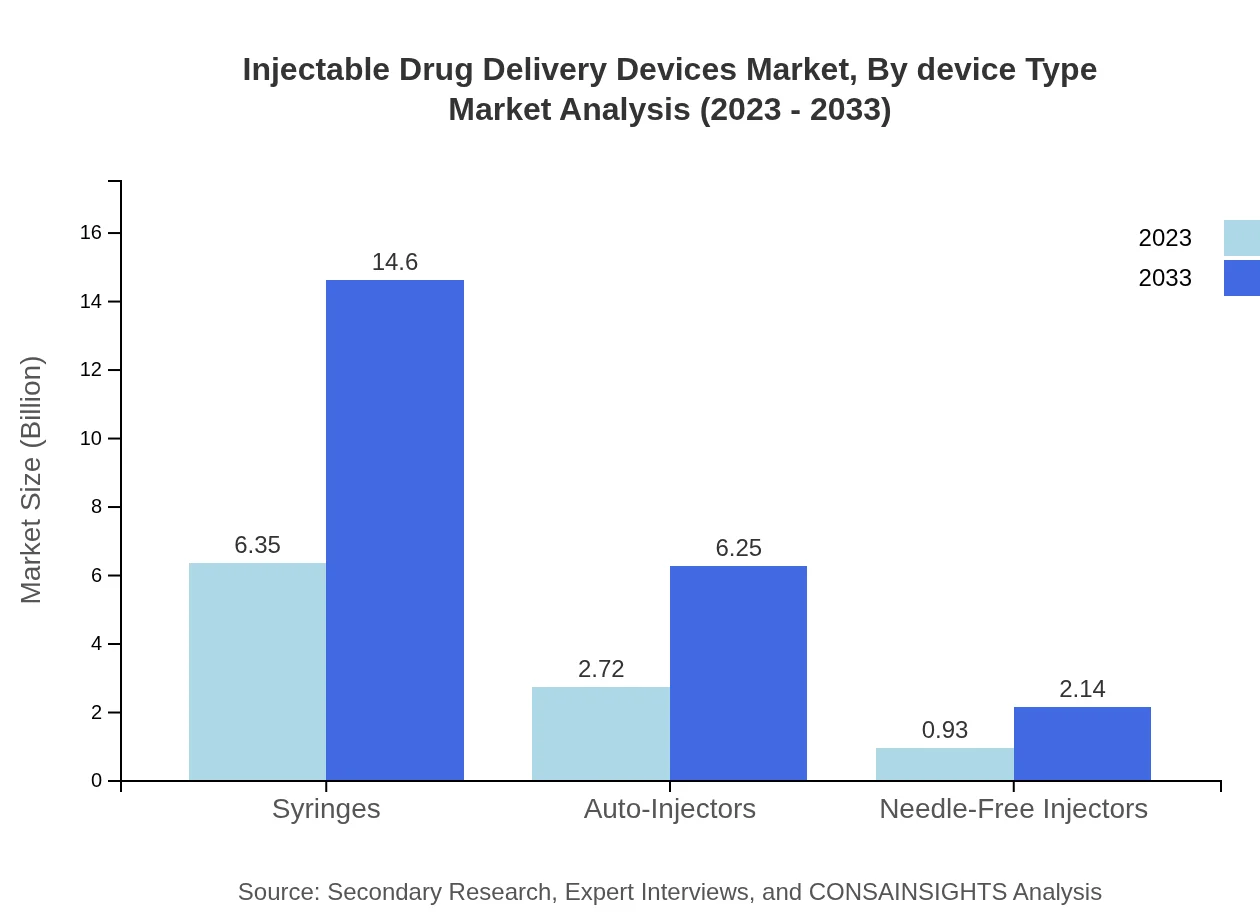
In terms of device type, syringes accounted for the majority market share at 63.5% in 2023, valued at $6.35 billion, and projected to reach $14.60 billion by 2033. Auto-injectors represent a significant portion as well, with a market size of $2.72 billion in 2023, expected to grow at the same rate, maintaining a share of 27.2%. Needle-free injectors are anticipated to increase from $0.93 billion to $2.14 billion during the forecast period.
Injectable Drug Delivery Devices Market Analysis By Application
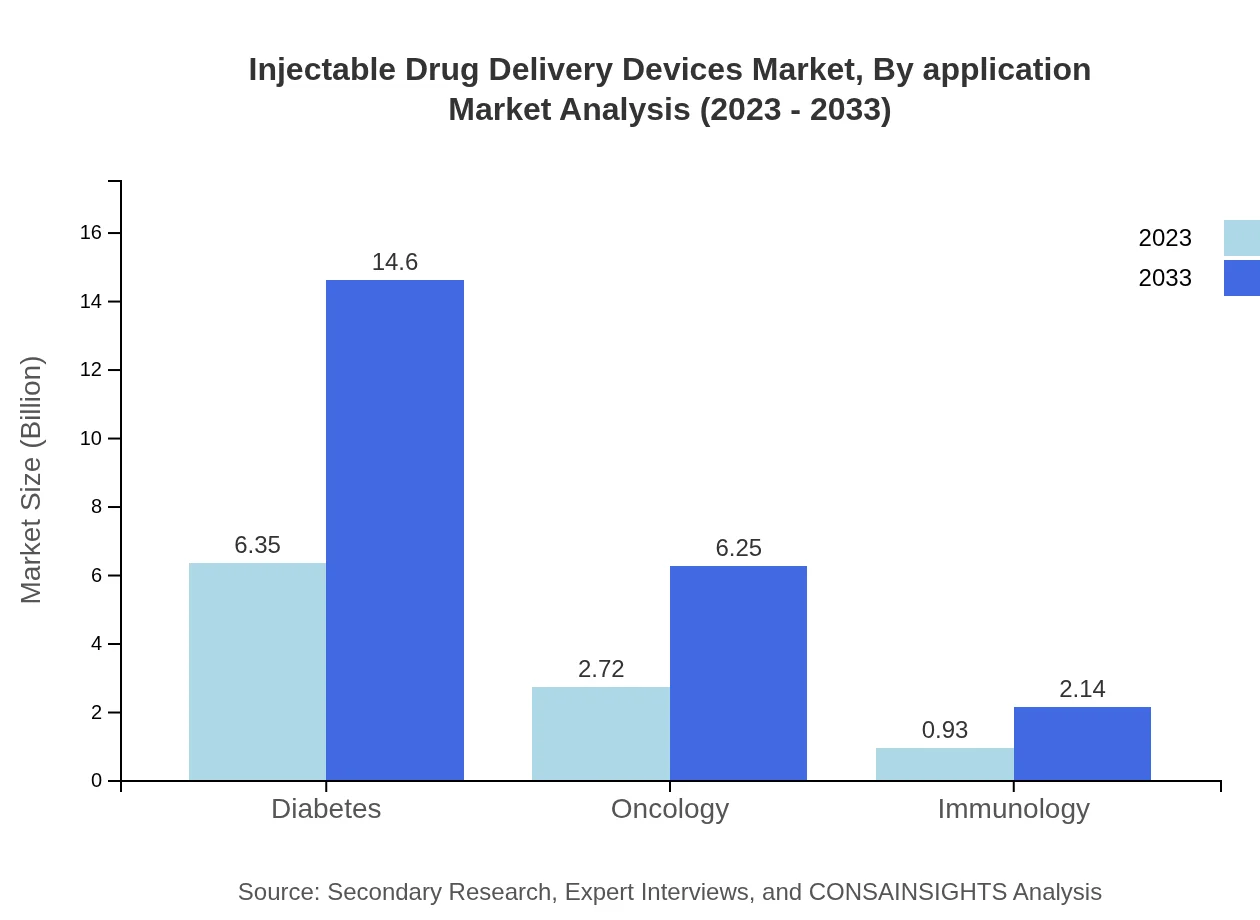
By application, the diabetes segment dominates with a market share of 63.5% and a size of $6.35 billion in 2023, growing to $14.60 billion by 2033. Oncology and immunology also present significant growth opportunities, with respective shares of 27.2% and 9.3%. Their respective markets are expected to grow from $2.72 billion to $6.25 billion for oncology, and from $0.93 billion to $2.14 billion for immunology within the forecast period.
Injectable Drug Delivery Devices Market Analysis By Technology
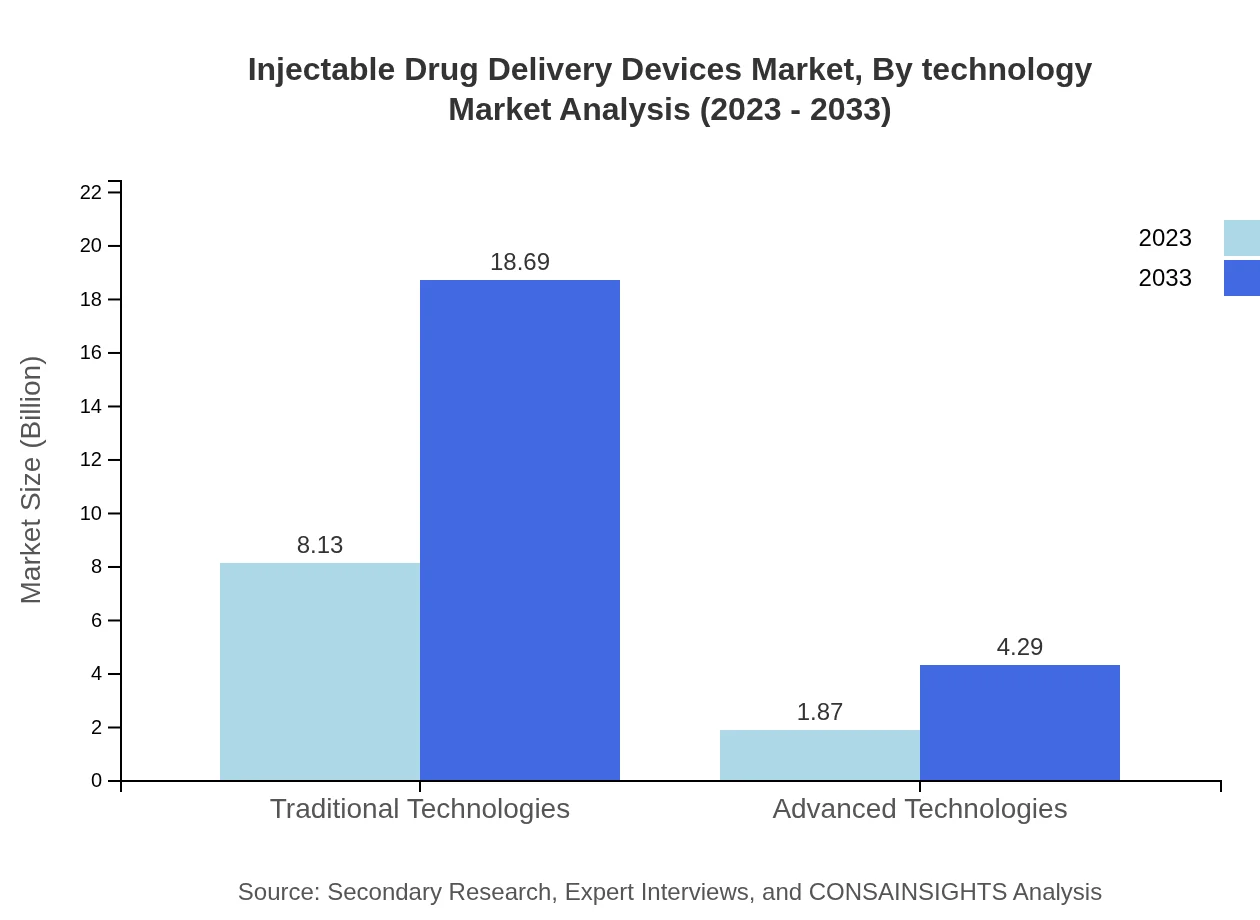
The technology segment reflects a strong preference for traditional technologies, which hold an 81.33% market share, growing from $8.13 billion to $18.69 billion by 2033. Advanced technologies, while representing a smaller share at 18.67%, show promising growth from $1.87 billion to $4.29 billion, indicating a shift towards modernity in drug delivery.
Injectable Drug Delivery Devices Market Analysis By End User
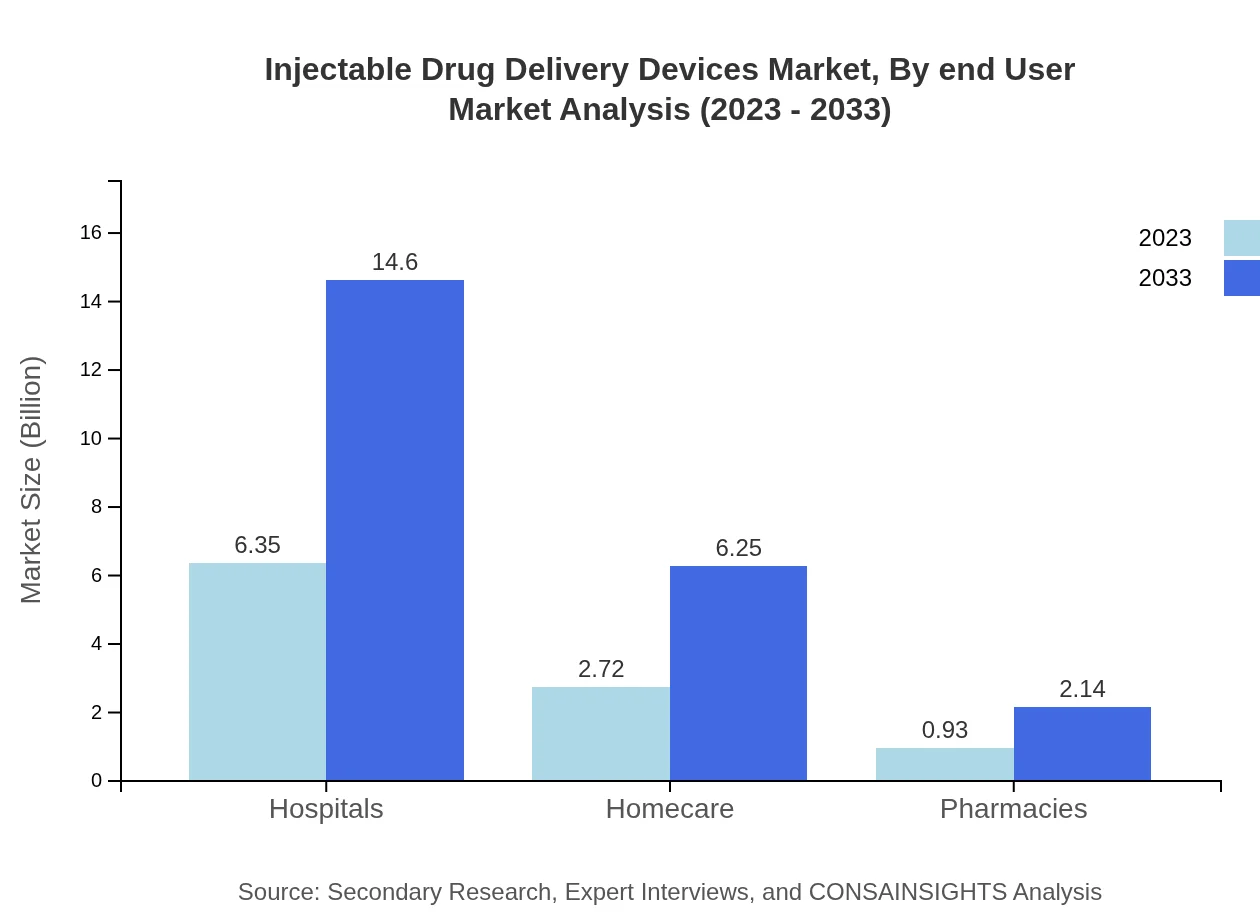
Hospitals constitute the largest end-user segment, with a market value of $6.35 billion in 2023, projected to reach $14.60 billion by 2033, reflecting a share of 63.5%. Homecare and pharmacies are also important segments, showcasing a size of $2.72 billion and $0.93 billion respectively in 2023, and anticipated to grow to $6.25 billion and $2.14 billion in 2033.
Injectable Drug Delivery Devices Market Analysis By Region
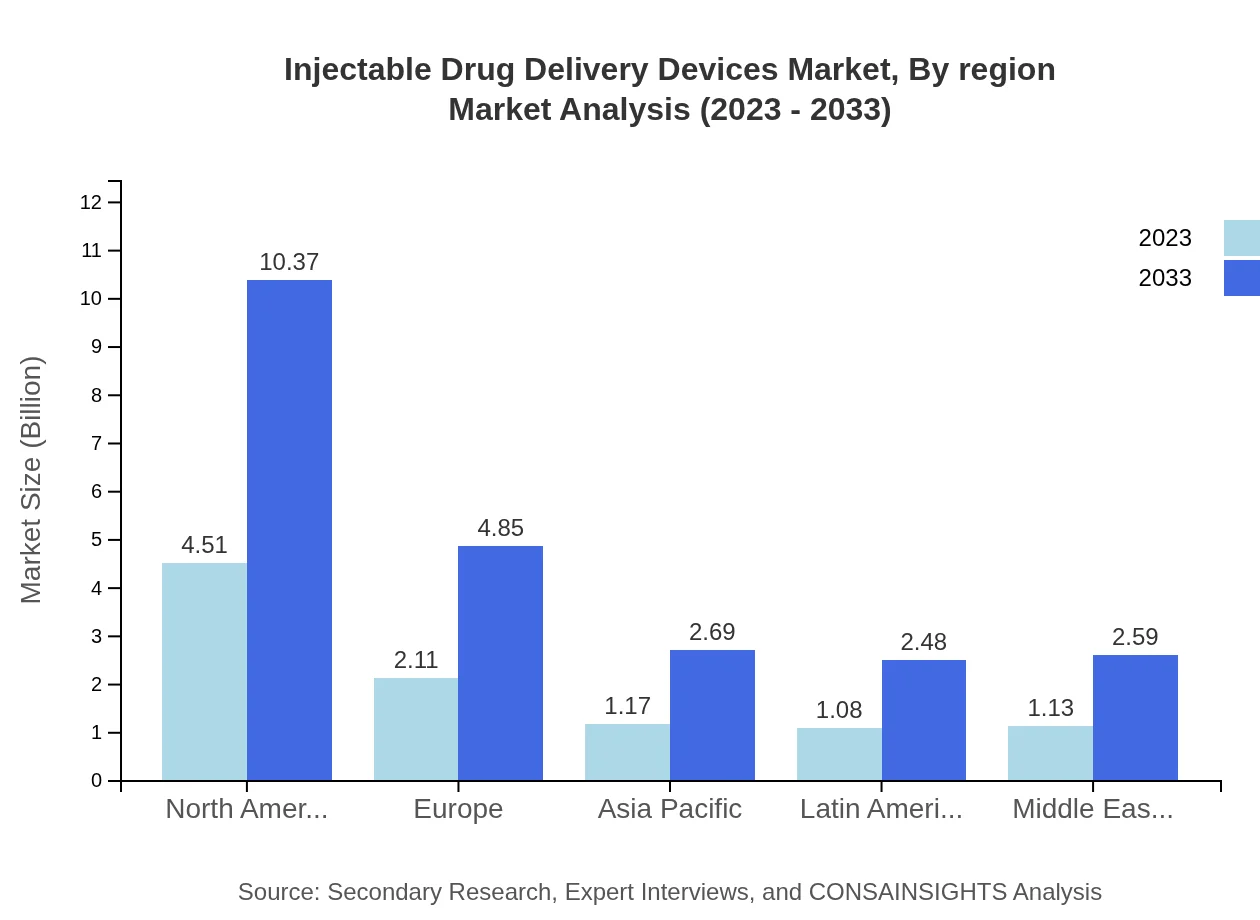
The by-region analysis emphasizes that North America, Europe, and Asia Pacific collectively represent the vast majority of the market share. North America accounts for 45.11% share in both years under review, while Europe maintains a stable share of 21.11%. Asia Pacific, expected to grow its share from 11.72% in 2023 to 11.72% in 2033, signifies emerging markets gaining traction.
Injectable Drug Delivery Devices Market Trends and Future Forecast
Tell us your focus area and get a customized research report.
Global Market Leaders and Top Companies in Injectable Drug Delivery Devices Industry
BD (Becton, Dickinson and Company):
A leading global medical technology company, BD specializes in the development and manufacturing of medical supplies, devices, laboratory equipment, and diagnostic products, including syringes and drug delivery devices.AbbVie Inc.:
AbbVie is a global biopharmaceutical company known for its innovative drugs and therapies, including advanced drug delivery systems to improve patient experiences.Medtronic :
Medtronic offers a wide range of medical technology and services, including advanced injector technologies that provide solutions for chronic diseases.Pfizer Inc.:
Pfizer is a research-based global biopharmaceutical company creating medicines and vaccines, focusing on self-injection devices for patients.Roche:
Roche develops targeted therapies tailored to patient needs, including innovative delivery systems that support better therapeutic doses.We're grateful to work with incredible clients.







FAQs
What is the market size of injectable drug delivery devices in 2023?
The market size in 2023 is $10.00 Billion according to the report.
How big will the market be in 2033?
The market is projected to reach $22.99 Billion by 2033 based on the provided forecast.
What is CAGR for the forecast period?
The reported compound annual growth rate (CAGR) for 2023 to 2033 is 8.4%.
Is there a single fastest Growing region in the Injectable Drug Delivery Devices Market Report market?
No single fastest-growing region is stated for the Injectable Drug Delivery Devices Market Report market because the top regional implied CAGR values are within 0.15 percentage points of each other, making the ranking too close to call reliably.
Which companies are named as top participants?
Top companies listed include BD (Becton, Dickinson and Company), AbbVie Inc., Medtronic, Pfizer Inc., and Roche.
What are the main device types covered?
Primary device types specified are syringes, auto-injectors, and needle-free injectors as market subsegments.
How are end users segmented in the report?
End-user segments include hospitals, homecare, and pharmacies as identified subsegments in the data.
What methodologies were used to compile the report?
The study used primary interviews, secondary company reports and publications, data triangulation, and expert-led validation.