
Reports >
Life Sciences
>
Integrated Operating Room Market Report

Integrated Operating Room Market Report
First published: 21 October 2024 | Last updated: 28 May 2026 | Report Code: integrated-operating-room
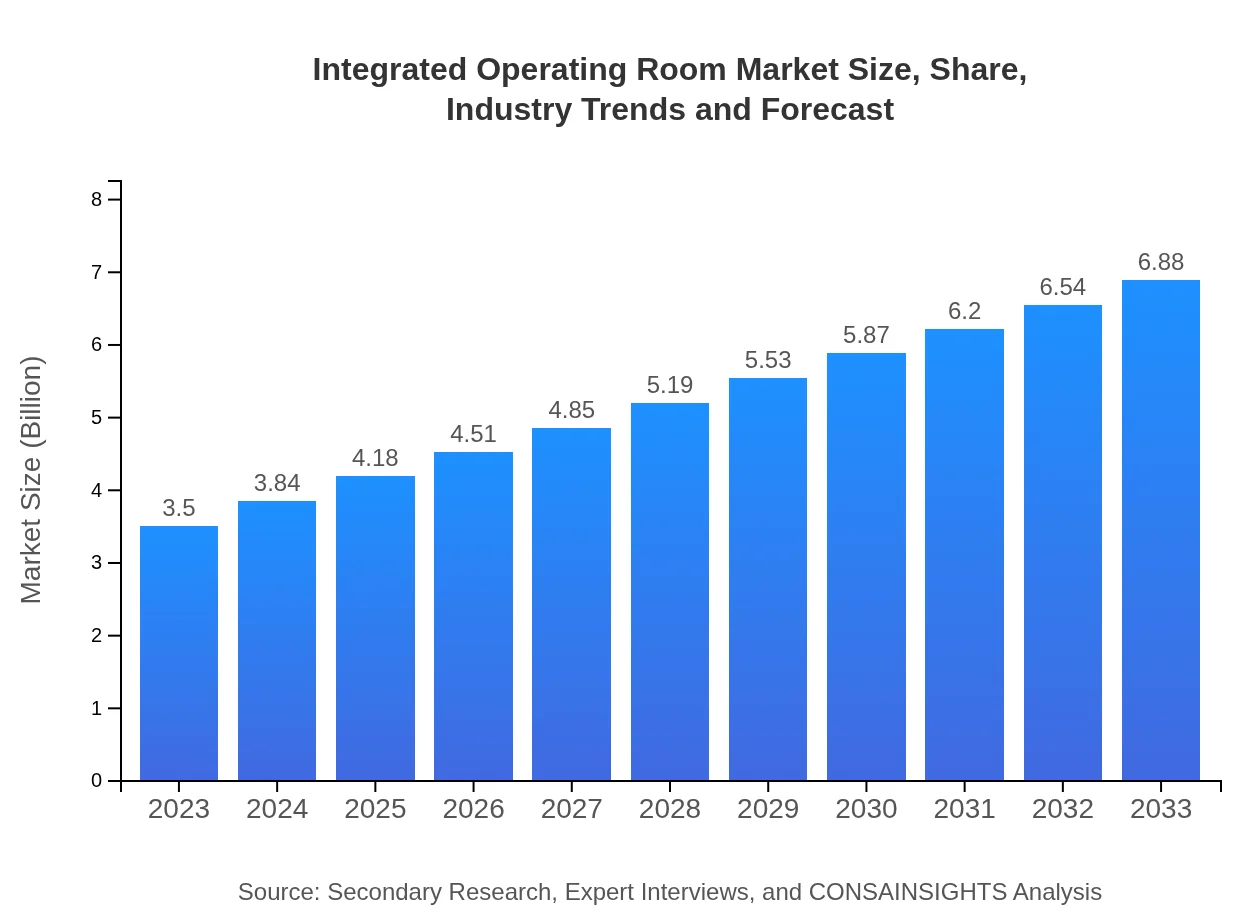
Integrated Operating Room Market — USD 3.5 billion in 2023, Growing to USD 6.88B by 2033 at 6.8% CAGR
This report provides a comprehensive analysis of the Integrated Operating Room market, detailing market size, trends, and forecasts from 2023 to 2033. It encompasses insights on regional performance, segmentation by products and technologies, and identifies prominent market players.
Key Takeaways
- Global market expands from $3.50 Billion in 2023 to $6.88 Billion in 2033 at a 6.8% CAGR.
- North America is largest regional market; Middle East and Africa is regional market region based on implied CAGR across 2023 to 2033.
- Middle East and Africa records the highest implied growth rate at 7.18%, moving from $0.19 Billion to $0.38 Billion.
- Europe and Asia Pacific show substantial gains: Europe from $1.07 Billion to $2.1 Billion; Asia Pacific from $0.61 Billion to $1.2 Billion.
- Prominent providers include Siemens Healthineers, GE Healthcare, Medtronic, Stryker Corporation, and Philips Healthcare.
Integrated Operating Room Market Report — Executive Summary
Regional analysis shows North America as largest market and Middle East and Africa as fastest-growing region by implied CAGR. Integrated operating rooms are evolving as hospitals and surgical centers prioritize interoperability, image-guided systems, and workflow efficiency. The market increased from $3.50 Billion in 2023 and is projected to reach $6.88 Billion by 2033, expanding at a 6.8% CAGR during 2023 to 2033. Growth is supported by advanced imaging, robotic-assisted procedures, and telemedicine solutions that enhance procedure safety and outcomes. Regional performance varies, with North America maintaining the largest absolute market and Middle East and Africa showing the highest implied growth rate. Product and end-user segmentation covers surgical instruments, operating tables, visualization platforms, and adoption across hospitals, ambulatory surgical centers, and research institutes. Competitive activity centers on established medical technology firms including Siemens Healthineers, GE Healthcare, Medtronic, Stryker Corporation, and Philips Healthcare. The report synthesizes primary interviews and secondary data to outline deployment patterns, technology adoption, and investment priorities through the forecast window.
Key Growth Drivers
- Wider adoption of advanced imaging and visualization systems that improve intraoperative decision-making
- Increased uptake of robotic-assisted and minimally invasive procedures driving integration of surgical platforms
- Rising healthcare expenditure and infrastructure investment in key regions supporting OR modernization
- Integration of telemedicine and data-sharing capabilities to enhance perioperative coordination and remote support
- Demand for improved surgical outcomes and efficiency motivating hospitals and ambulatory surgical centers to retrofit operating rooms
| Metric | Value |
|---|---|
| Study Period | 2023 - 2033 |
| 2023 Market Size | $3.50 Billion |
| CAGR (2023-2033) | 6.8% |
| 2033 Market Size | $6.88 Billion |
| Top Companies | Siemens Healthineers, GE Healthcare, Medtronic , Stryker Corporation, Philips Healthcare |
| Published Date | 21 October 2024 |
| Last Modified Date | 28 May 2026 |
Integrated Operating Room Market Overview
Customize Integrated Operating Room Market Report market research report
- ✔ Get in-depth analysis of Integrated Operating Room market size, growth, and forecasts.
- ✔ Understand Integrated Operating Room's regional dynamics and industry-specific trends.
- ✔ Identify potential applications, end-user demand, and growth segments in Integrated Operating Room
What is the Market Size & CAGR of Integrated Operating Room Market Report market in 2023?
Integrated Operating Room Industry Analysis
Integrated Operating Room Market Segmentation and Scope
Tell us your focus area and get a customized research report.
Integrated Operating Room Market Report Market Analysis Report by Region
Europe Integrated Operating Room Market Report:
Europe grows from $1.07 Billion in 2023 to $2.1 Billion in 2033. Expansion reflects adoption of advanced imaging, investments in minimally invasive surgery, and emphasis on interoperability and patient monitoring within surgical suites.Asia Pacific Integrated Operating Room Market Report:
Asia Pacific grows from $0.61 Billion in 2023 to $1.2 Billion in 2033. Growth is supported by rising healthcare expenditure, infrastructure upgrades, and increasing use of image-guided and robotic-assisted procedures in major markets.North America Integrated Operating Room Market Report:
North America is largest regional market, rising from $1.36 Billion in 2023 to $2.68 Billion in 2033. Regional demand is driven by high adoption of advanced surgical technologies, established hospital infrastructure, and investment in digital operating room capabilities.South America Integrated Operating Room Market Report:
Latin America grows from $0.27 Billion in 2023 to $0.52 Billion in 2033. Development is influenced by gradual infrastructure investment, expanding hospital capabilities, and growing interest in modern surgical technologies.Middle East & Africa Integrated Operating Room Market Report:
Middle East and Africa is fastest-growing region by implied CAGR, increasing from $0.19 Billion in 2023 to $0.38 Billion in 2033. 19 Billion in 2023 to $0.38 Billion in 2033 and is identified as the regional growth market at an implied 7.18% CAGR. Growth drivers include targeted healthcare investments, modernization initiatives, and adoption of telemedicine-enabled operating room solutions.Tell us your focus area and get a customized research report.
Research Methodology
Integrated Operating Room Market Analysis By Product
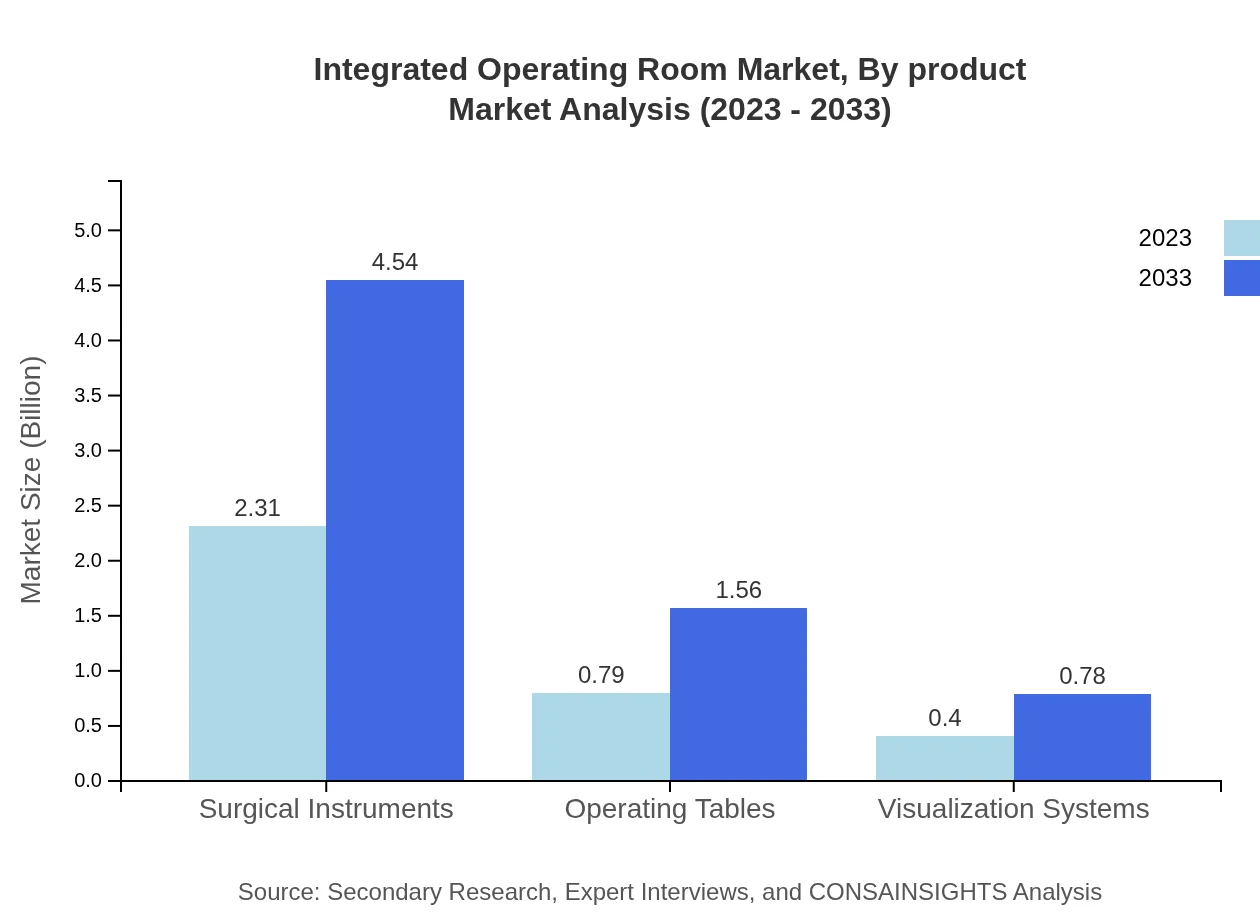
The market for surgical instruments dominates the Integrated Operating Room sector, projected to reach $4.54 billion by 2033 compared to $2.31 billion in 2023, maintaining a 65.97% market share. Operating tables and visualization systems are also crucial segments, expected to grow to $1.56 billion and $0.78 billion respectively by 2033. The growing reliance on advanced surgical tools emphasizes the need for integrated solutions in the surgical ecosystem.
Integrated Operating Room Market Analysis By Technology
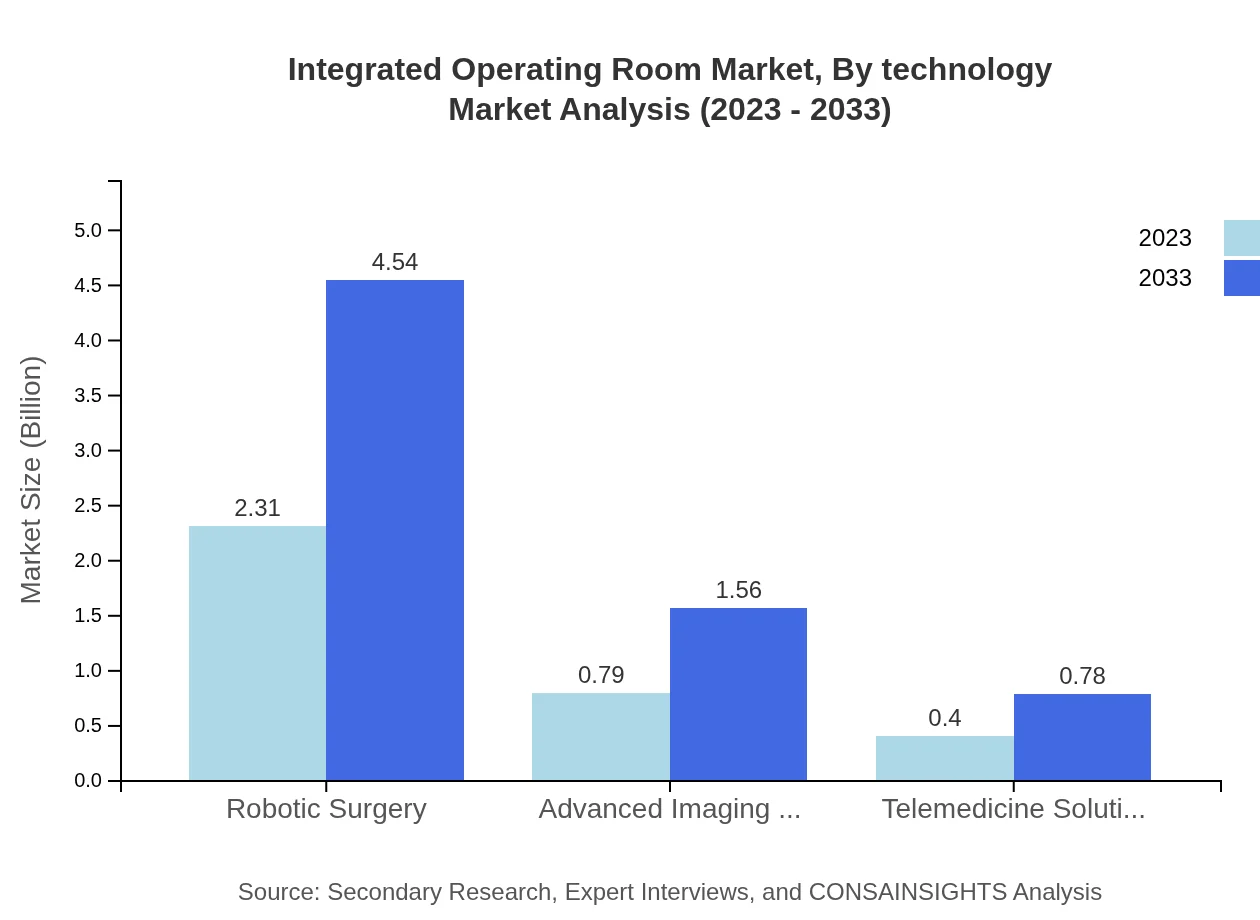
Robotic surgery is a prominent technology within the market, with a significant value of $4.54 billion anticipated by 2033, mirroring its current size of $2.31 billion. Advanced imaging technologies are projected to grow substantially, supported by increased adoption of minimally invasive surgical techniques, which require high-definition imaging for precision.
Integrated Operating Room Market Analysis By Application
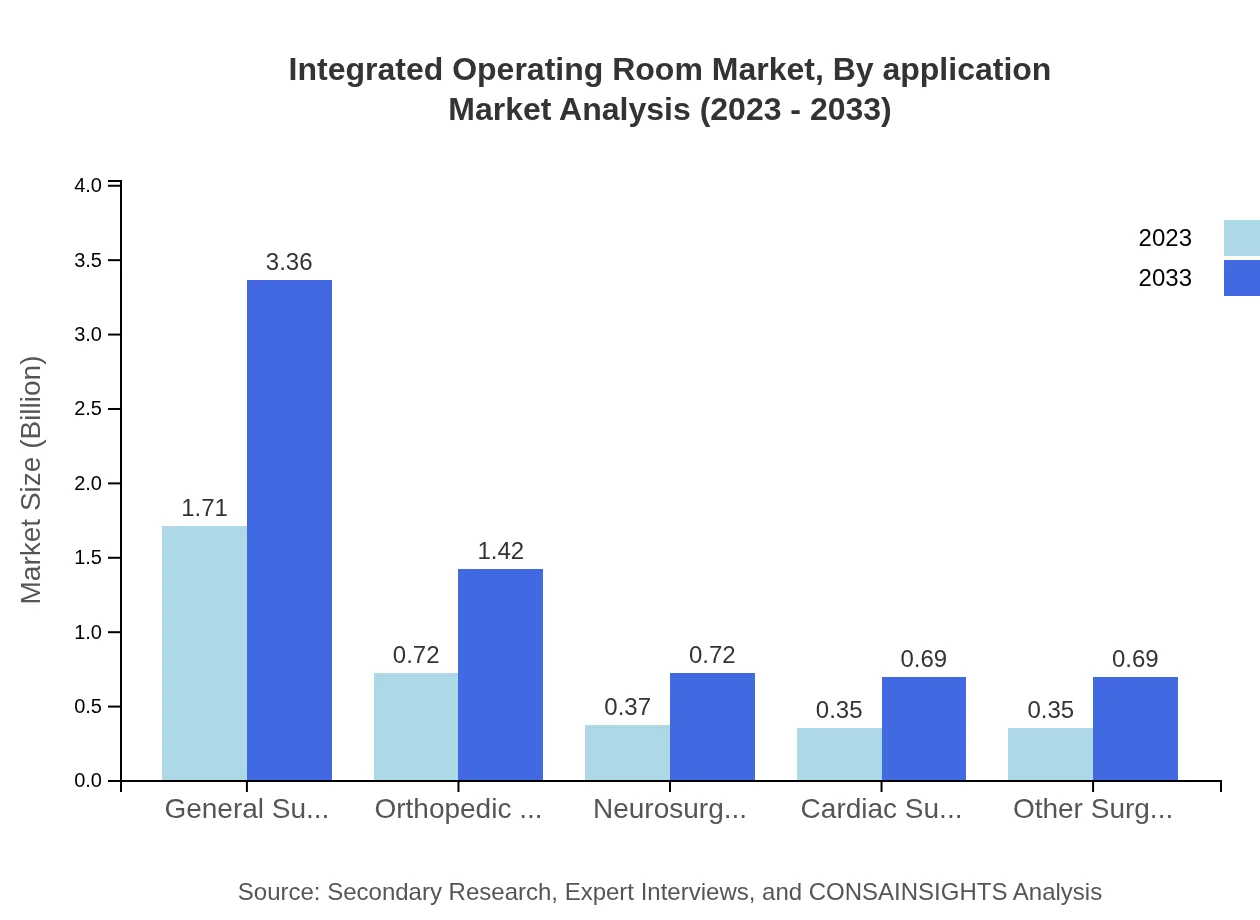
General surgery accounts for the largest application share of the Integrated Operating Room market, with a projected value of $3.36 billion by 2033. Orthopedic and neurosurgeries are also key contributors, reflecting increasing incidences of related injuries and conditions. The continuous evolution of surgical techniques enhances the value of integrated operating room environments.
Integrated Operating Room Market Analysis By End User
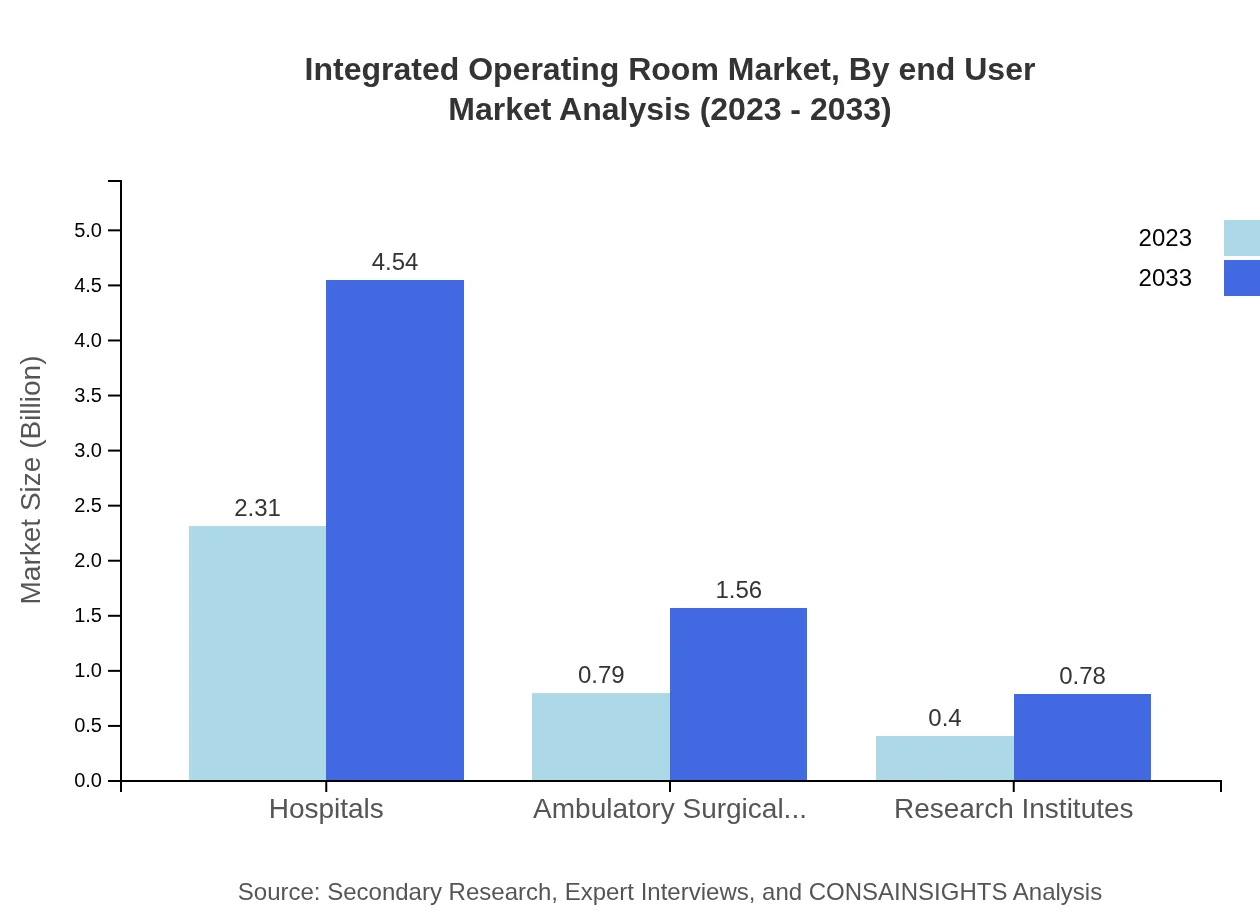
Hospitals remain the primary end-user segment, dominating the market with a share of 65.97% expected by 2033. Ambulatory surgical centers are also becoming increasingly prominent due to the shift towards outpatient surgical procedures, expected to grow to $1.56 billion by 2033.
Integrated Operating Room Market Analysis By Geography
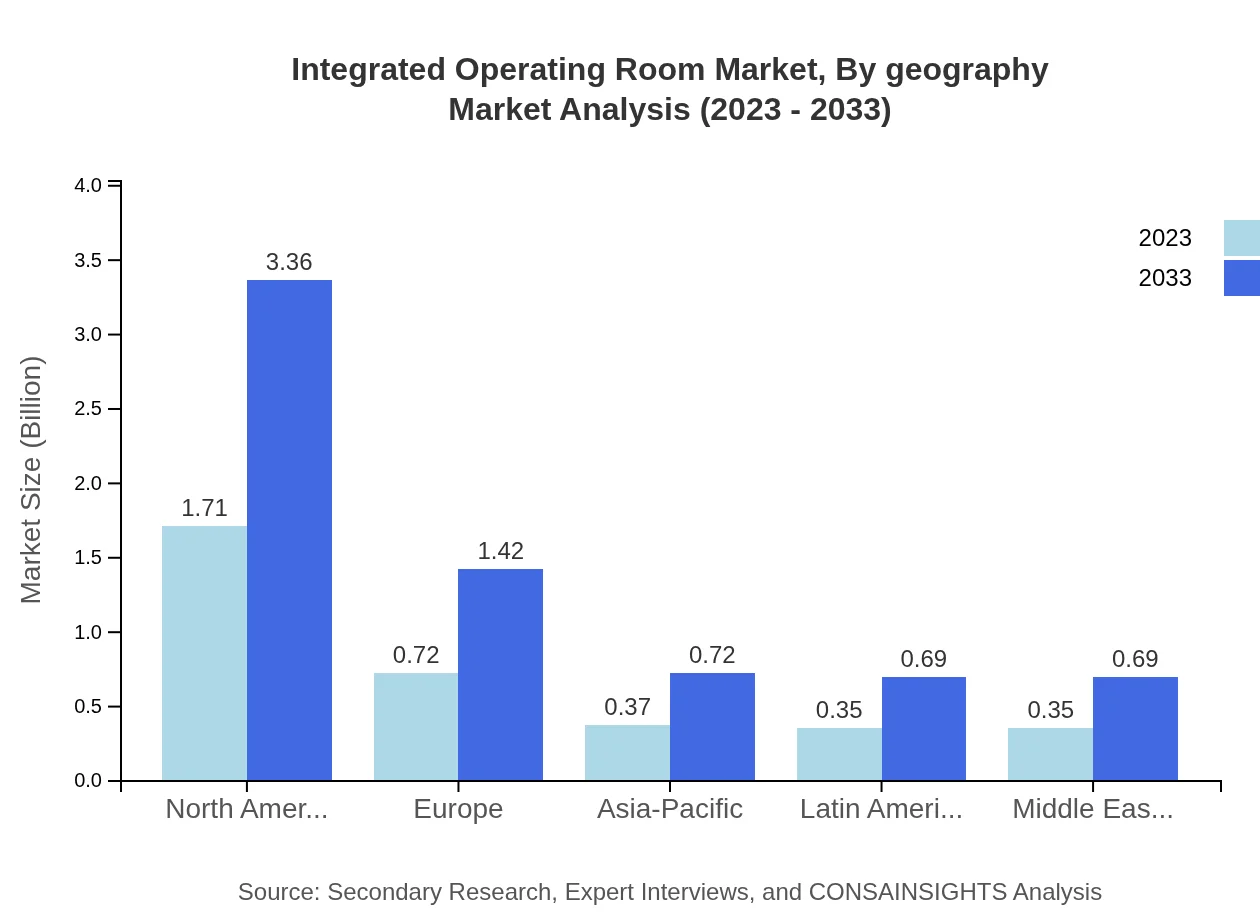
The Integrated Operating Room market shows varying trends across regions, with North America leading in market size due to established healthcare systems. In contrast, Asia-Pacific is rapidly catching up due to modernization efforts in healthcare. Europe remains stable, while Middle Eastern countries are improving their surgical readiness, fostering market growth.
Integrated Operating Room Market Trends and Future Forecast
Tell us your focus area and get a customized research report.
Global Market Leaders and Top Companies in Integrated Operating Room Industry
Siemens Healthineers:
A leader in medical technology, Siemens Healthineers provides advanced imaging systems and integrated operating solutions that enhance workflow efficiency and patient safety.GE Healthcare:
GE Healthcare is known for its innovative imaging technologies and solutions designed to improve clinical outcomes in surgical settings.Medtronic :
Medtronic specializes in medical devices linked to surgery and offers integrated solutions for improving surgical outcomes through advanced robotic technology.Stryker Corporation:
Stryker is renowned for its surgical instruments, operating tables, and advanced imaging solutions, focusing on enhancing surgical workflows.Philips Healthcare:
Philips Healthcare leverages advanced technologies in imaging and patient monitoring to enhance surgical precision and improve overall outcomes.We're grateful to work with incredible clients.








FAQs
What is the market size of the Integrated Operating Room Market Report in 2023?
The market size in 2023 is $3.50 Billion, as stated in the report. This is the baseline value used for the 2023 to 2033 forecast period.
How big is the market expected to be in 2033?
The market is expected to reach $6.88 Billion in 2033 according to the provided forecast data for 2023 to 2033.
What is CAGR for the forecast period?
The forecasted compound annual growth rate for the period 2023 to 2033 is 6.8%, based on the supplied market figures.
Which region is the fastest Growing in the Integrated Operating Room Market Report market?
Middle East and Africa is the fastest-growing region, projected to expand from $0.19 Billion in 2023 to $0.38 Billion in 2033, reflecting an implied 7.18% CAGR over the forecast period.
Which region is the fastest Growing?
The Middle East and Africa is the regional market region with an implied 7.18% CAGR, increasing from $0.19 Billion in 2023 to $0.38 Billion in 2033.
Who are the top companies in the market?
Top companies listed include Siemens Healthineers, GE Healthcare, Medtronic, Stryker Corporation, and Philips Healthcare.
What end users adopt integrated operating rooms?
Key end users specified are hospitals, ambulatory surgical centers, and research institutes, reflecting clinical and research deployment settings.
How is technology segmentation represented?
Technology subsegments include Robotic Surgery, Advanced Imaging Technologies, and Telemedicine Solutions as the primary categories.
What product categories are included in segmentation?
Product subsegments noted are Surgical Instruments, Operating Tables, and Visualization Systems among the listed categories.
Why are integrated OR solutions being adopted?
Adoption is driven by the need for improved surgical efficiency, enhanced imaging and monitoring, reduced procedural times, and better patient safety outcomes.