

Interferons Market Report
First published: 21 October 2024 | Last updated: 25 May 2026 | Report Code: interferons
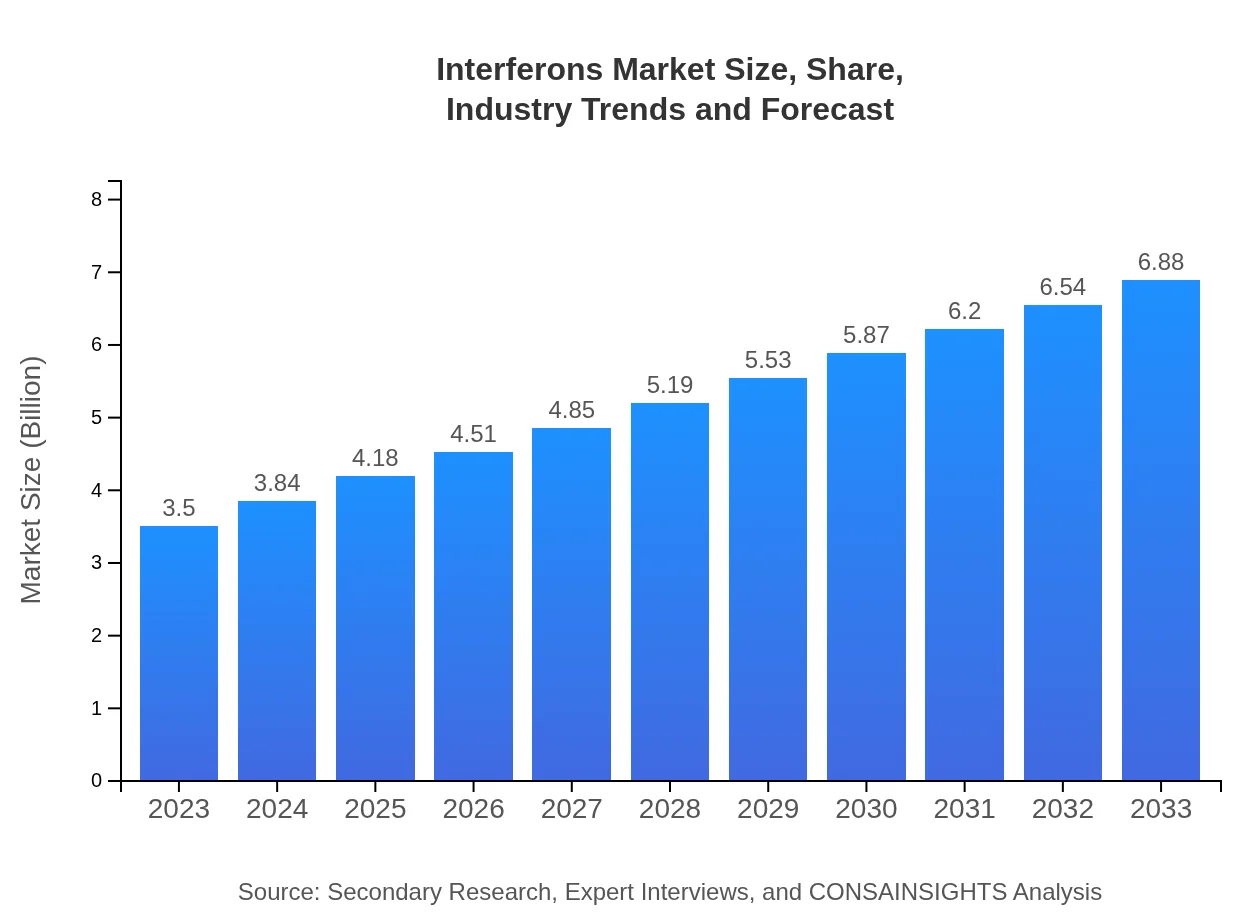
Interferons Market — USD 3.5 billion in 2023, Growing to USD 6.88B by 2033 at 6.8% CAGR
This report provides a comprehensive analysis of the Interferons market from 2023 to 2033, detailing market size forecasts, industry trends, regional insights, and company analyses, aimed at equipping stakeholders with valuable insights for strategic decision-making.
Key Takeaways
- Global market expands from $3.50 Billion in 2023 to $6.88 Billion in 2033, reflecting a 6.8% CAGR across the forecast window.
- North America is largest regional market, while no single fastest-growing region is stated because regional CAGR differences remain within 0.15 percentage points.
- Regional spreads show Europe rising from $0.97 Billion to $1.92 Billion and Asia Pacific from $0.66 Billion to $1.29 Billion by 2033.
- Clinical demand in oncology, viral infections, and multiple sclerosis underpins sustained adoption alongside formulation and biosimilar activity.
- Top companies operating include Roche, Merck KGaA, Bristol Myers Squibb, and Biogen, contributing to competitive innovation.
Interferons Market Report — Executive Summary
North America remains largest market by forecast-period value, while no single fastest-growing region is stated because top regional growth rates are separated by less than 0.15 percentage points. The Interferons Market Report details market expansion driven by therapeutic demand in oncology, viral infections, and autoimmune conditions. The global market is estimated at $3.50 Billion in 2023 and is expected to reach $6.88 Billion by 2033, representing a 6.8% CAGR over the 2023 to 2033 forecast period. Growth is supported by advances in formulation technologies, rising interest in biosimilars, and ongoing clinical research. North America represents the largest regional market with notable value growth. Market segmentation spans type (Type I, II, III), applications (cancer treatment, viral infections, multiple sclerosis, other), routes of administration, distribution channels, and end users. Competitive activity involves established biopharma players including Roche, Merck KGaA, Bristol Myers Squibb, and Biogen. Challenges include pricing and reimbursement complexity, while opportunities arise from personalized medicine approaches and broader biosimilar adoption. The report synthesizes primary expert interviews and secondary sources to present validated trends and actionable insights for stakeholders.
Key Growth Drivers
- Rising clinical demand for interferons in oncology and viral infection therapies expanding therapeutic use cases.
- Progress in drug formulation and delivery methods enhancing patient adherence and treatment applicability.
- Increased development and approval of biosimilars improving affordability and access to interferon treatments.
- Aging populations and higher chronic disease prevalence supporting long-term demand for immunomodulatory therapies.
- Sustained R&D investment and clinical trials that broaden indications and bolster pipeline activity.
| Metric | Value |
|---|---|
| Study Period | 2023 - 2033 |
| 2023 Market Size | $3.50 Billion |
| CAGR (2023-2033) | 6.8% |
| 2033 Market Size | $6.88 Billion |
| Top Companies | Roche, Merck KGaA, Bristol Myers Squibb, Biogen |
| Published Date | 21 October 2024 |
| Last Modified Date | 25 May 2026 |
Interferons Market Overview
Customize Interferons Market Report market research report
- ✔ Get in-depth analysis of Interferons market size, growth, and forecasts.
- ✔ Understand Interferons's regional dynamics and industry-specific trends.
- ✔ Identify potential applications, end-user demand, and growth segments in Interferons
What is the Market Size & CAGR of Interferons Market Report market in 2023?
Interferons Industry Analysis
Interferons Market Segmentation and Scope
Tell us your focus area and get a customized research report.
Interferons Market Report Market Analysis Report by Region
Europe Interferons Market Report:
Europe grows from $0.97 Billion in 2023 to $1.92 Billion in 2033. Expansion reflects demand in cancer and viral infection treatments, regulatory activity around biosimilars, and ongoing R&D within European pharmaceutical hubs.Asia Pacific Interferons Market Report:
Asia Pacific grows from $0.66 Billion in 2023 to $1.29 Billion in 2033. Growth drivers include rising healthcare access, expanding clinical adoption of immunotherapies, and greater availability of biologics and biosimilars across markets.North America Interferons Market Report:
North America is largest regional market, rising from $1.35 Billion in 2023 to $2.66 Billion in 2033. Regional growth is supported by strong clinical adoption in oncology and viral therapies, established biopharma investment, and robust healthcare infrastructure driving demand.South America Interferons Market Report:
Latin America grows from $0.19 Billion in 2023 to $0.38 Billion in 2033. Market momentum is driven by improved healthcare delivery, increased focus on chronic disease management, and gradual uptake of advanced biologic therapies.Middle East & Africa Interferons Market Report:
Middle East and Africa grows from $0.32 Billion in 2023 to $0.64 Billion in 2033. Growth is supported by expanding healthcare infrastructure, rising demand for specialty therapies, and increased investment in medical services.Tell us your focus area and get a customized research report.
Research Methodology
Interferons Market Analysis By Type
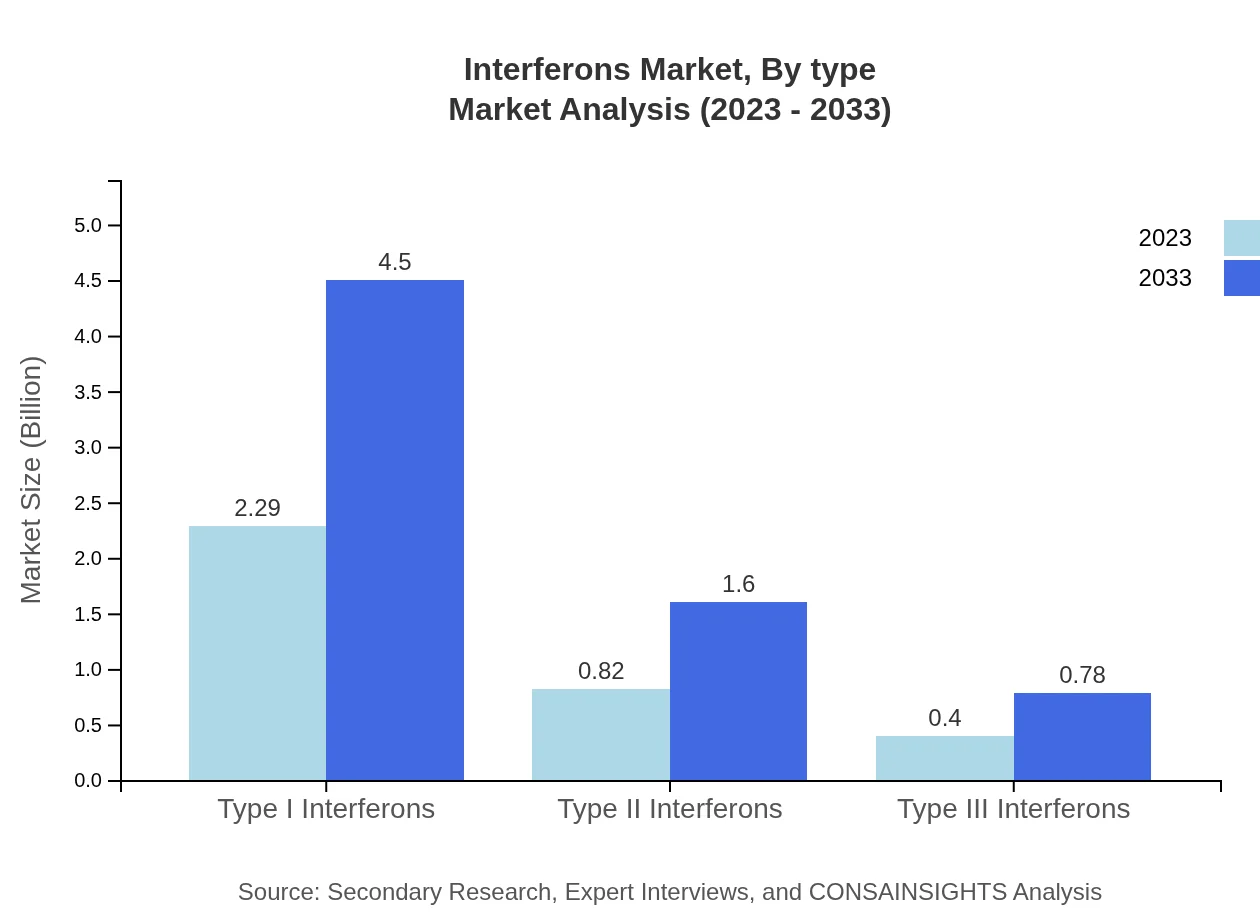
The market segmented by type reveals that Type I Interferons dominate with a size of $2.29 billion in 2023 and expected to grow to $4.50 billion by 2033, maintaining a market share of 65.39%. Type II Interferons follow at $0.82 billion, with projections to reach $1.60 billion. Type III Interferons account for a smaller share of the market, with a 2023 size of $0.40 billion expected to rise to $0.78 billion.
Interferons Market Analysis By Application
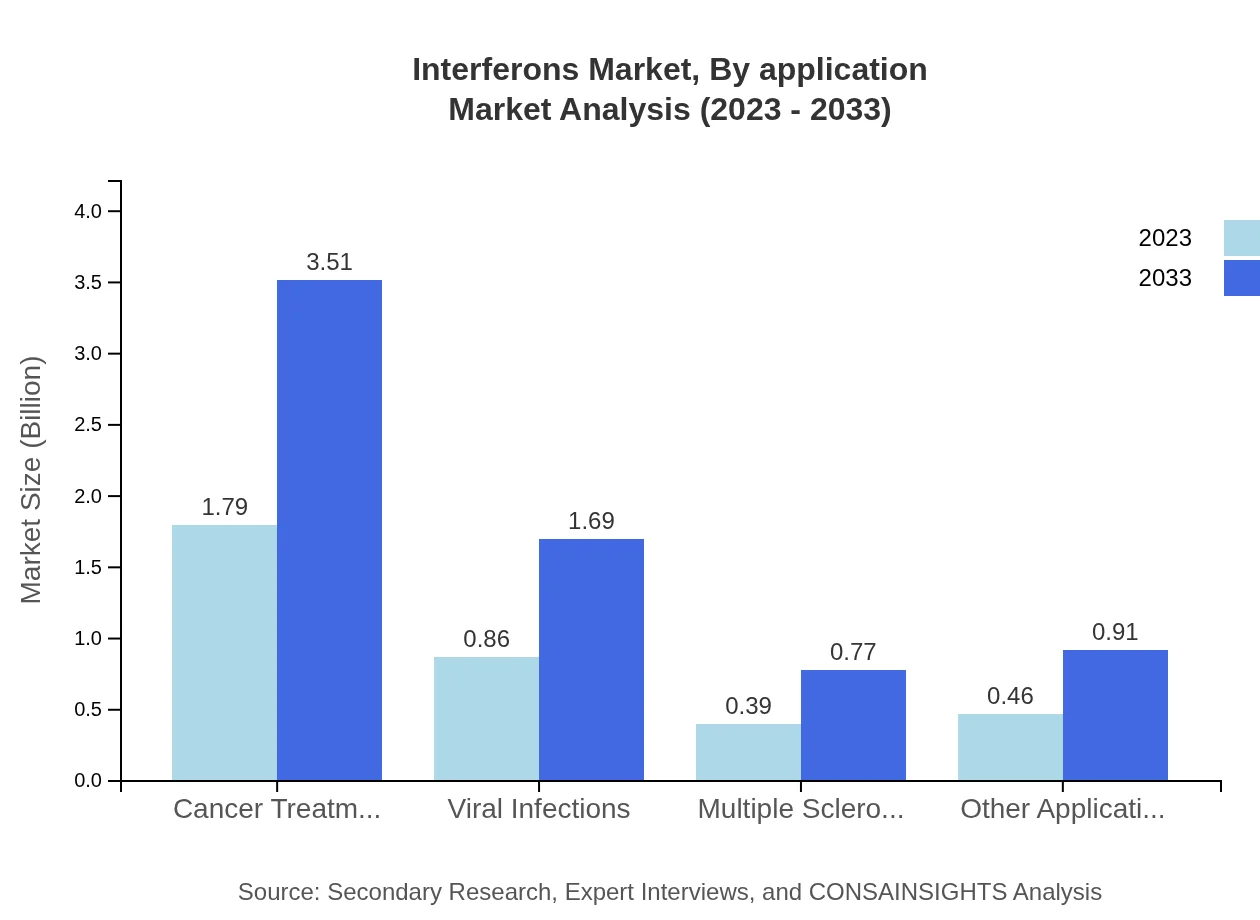
In terms of application, cancer treatment is the leading segment, with revenue of $1.79 billion in 2023 and growth to $3.51 billion by 2033, holding a share of 51.07%. Viral infections represent $0.86 billion and are expected to grow to $1.69 billion. Other applications, including multiple sclerosis and others, show projections of $0.39 billion and $0.46 billion respectively.
Interferons Market Analysis By Route Of Administration
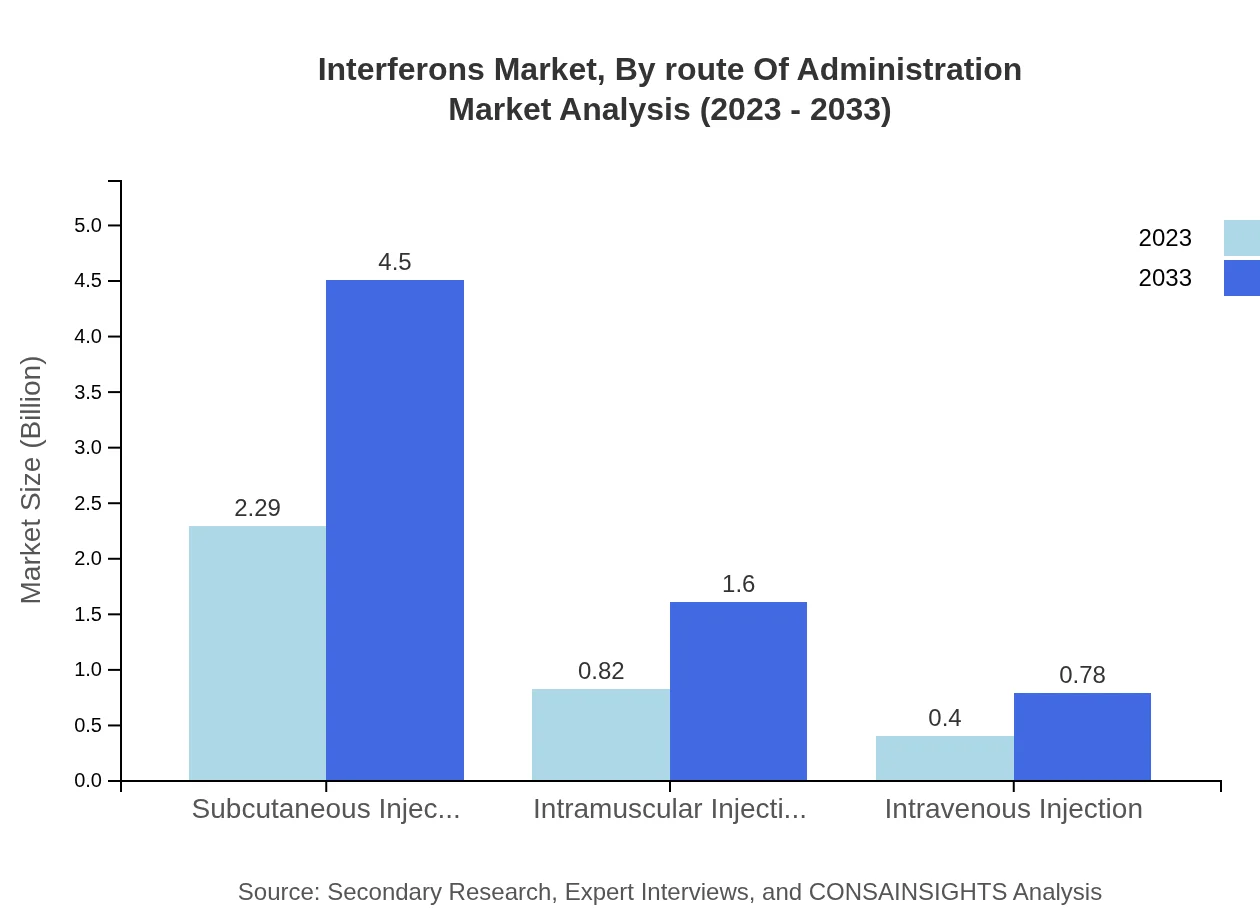
The route of administration analysis shows that subcutaneous injection is the dominant method, valued at $2.29 billion in 2023 and expected to reach $4.50 billion by 2033. Intramuscular and intravenous routes are much smaller, standing at $0.82 billion and $0.40 billion respectively in 2023, with moderate growth projected.
Interferons Market Analysis By Distribution Channel
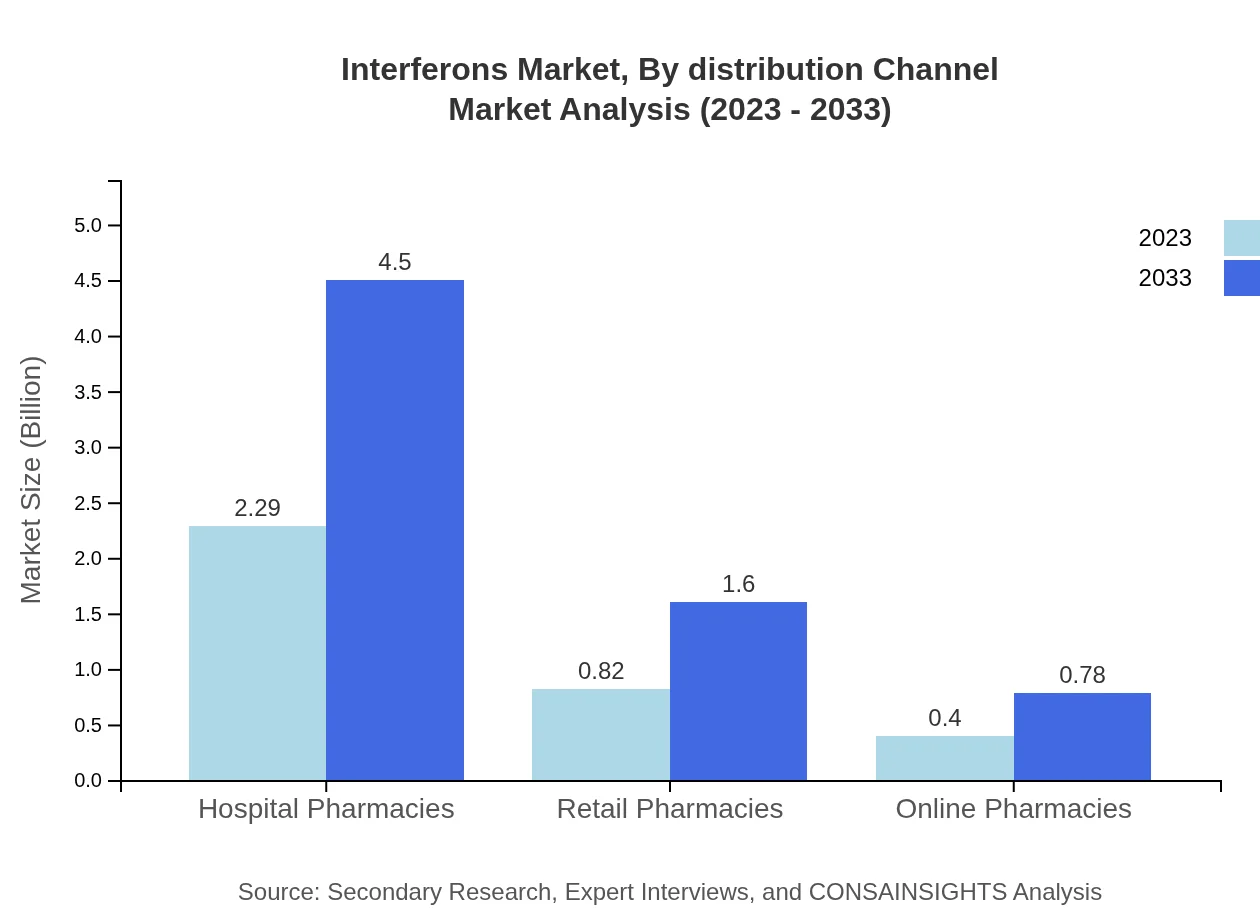
Distribution channels are segmented into hospital pharmacies, retail pharmacies, and online pharmacies. Hospital pharmacies lead the market with a size of $2.29 billion in 2023 and estimated growth to $4.50 billion. Retail pharmacies also hold a significant share at $0.82 billion, projecting to double by 2033.
Interferons Market Analysis By End User
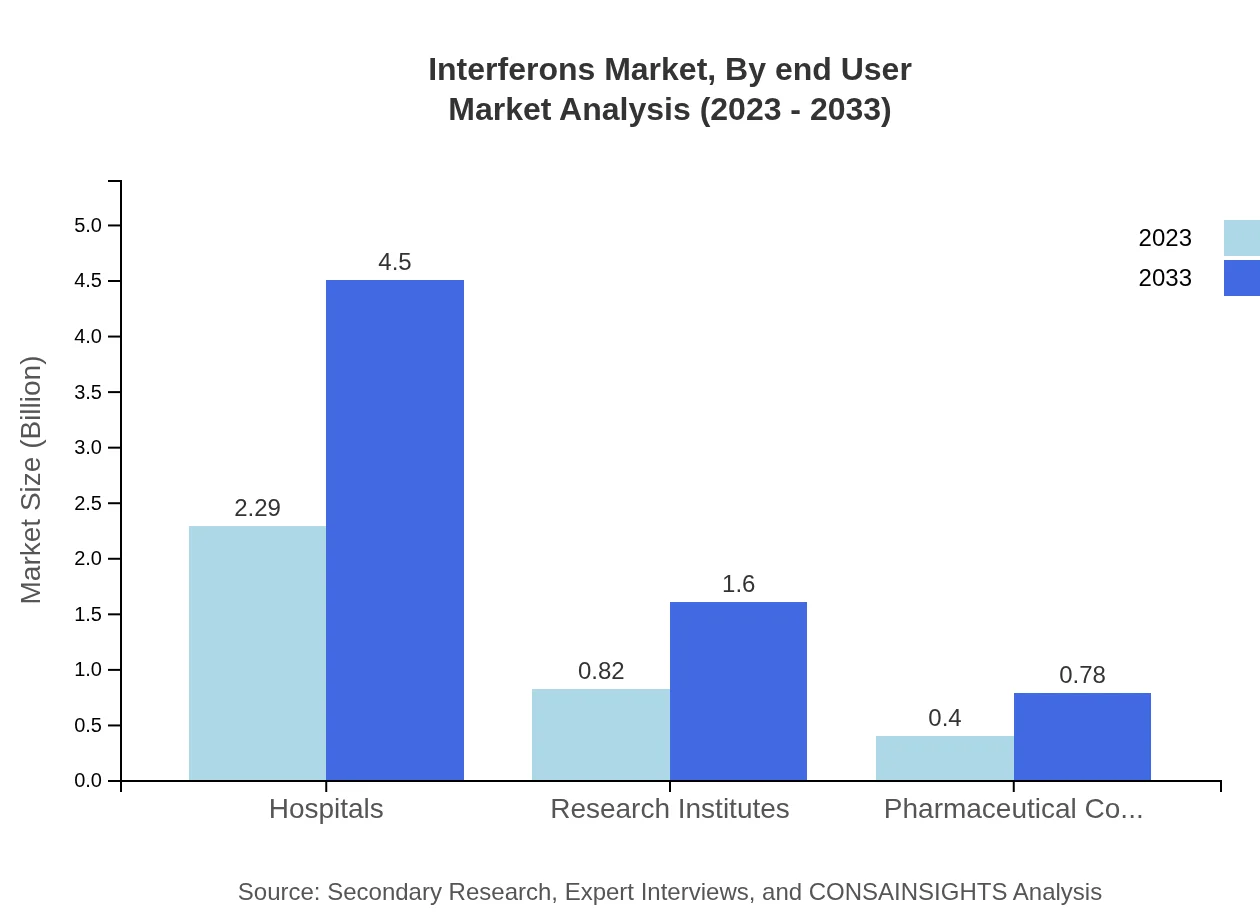
The major end-users include hospitals, research institutes, and pharmaceutical companies. Hospitals dominate the market with a share of 65.39% in both 2023 and projected 2033. Research institutes follow closely behind, indicating strong demand for ongoing research into Interferons.
Interferons Market Trends and Future Forecast
Tell us your focus area and get a customized research report.
Global Market Leaders and Top Companies in Interferons Industry
Roche:
Roche is a leading player in the Interferons market, known for its innovative therapies targeting multiple sclerosis and hepatitis. The company’s extensive R&D investments have positioned it at the forefront of biopharmaceutical development.Merck KGaA:
Merck KGaA offers a robust portfolio of Interferon products, especially focusing on oncology. Their commitment to research supports the development of enhanced therapies that improve patient outcomes.Bristol Myers Squibb:
Bristol Myers Squibb is recognized for integrating cutting-edge scientific research into the Interferons market, contributing significantly towards treatments for various oncological conditions.Biogen:
Biogen specializes in therapies for neurological diseases, including interferon treatments for multiple sclerosis, showcasing their strength in improving patient quality of life through innovative solutions.We're grateful to work with incredible clients.








FAQs
What is the market size of the Interferons market in 2023?
The market size for Interferons in 2023 is $3.50 Billion, as stated in the report data for the base year.
How big is the market expected to be in 2033?
The market is expected to reach $6.88 Billion in 2033 according to the provided forecast figures.
What is CAGR of the Interferons market for 2023 to 2033?
The compound annual growth rate (CAGR) for the forecast period 2023 to 2033 is 6.8%, as specified in the input.
Is there a single fastest Growing region in the Interferons Market Report market?
No single fastest-growing region is stated for the Interferons Market Report market because the top regional implied CAGR values are within 0.15 percentage points of each other, making the ranking too close to call reliably.
Which companies are listed as key players?
The top companies referenced in the report are Roche, Merck KGaA, Bristol Myers Squibb, and Biogen.
What are the primary applications driving demand?
Primary applications include cancer treatment, viral infections, and multiple sclerosis, which are cited as major therapeutic drivers.
How are distribution channels categorized?
Distribution channels are listed as hospital pharmacies, retail pharmacies, and online pharmacies in the segmentation details.
What is the forecast period covered by the report?
The report covers the forecast period from 2023 to 2033, matching the provided market timeline.
Who contributed to the research methodology?
Research included primary interviews with industry experts and secondary analysis of company reports and publications, with data triangulation and validation.
What end User segments are included?
End-user segmentation includes hospitals, research institutes, and pharmaceutical companies as listed in the input.