
Reports >
Life Sciences
>
Internal Tissue Sealants Market Report

Internal Tissue Sealants Market Report
First published: 11 October 2024 | Last updated: 25 May 2026 | Report Code: internal-tissue-sealants
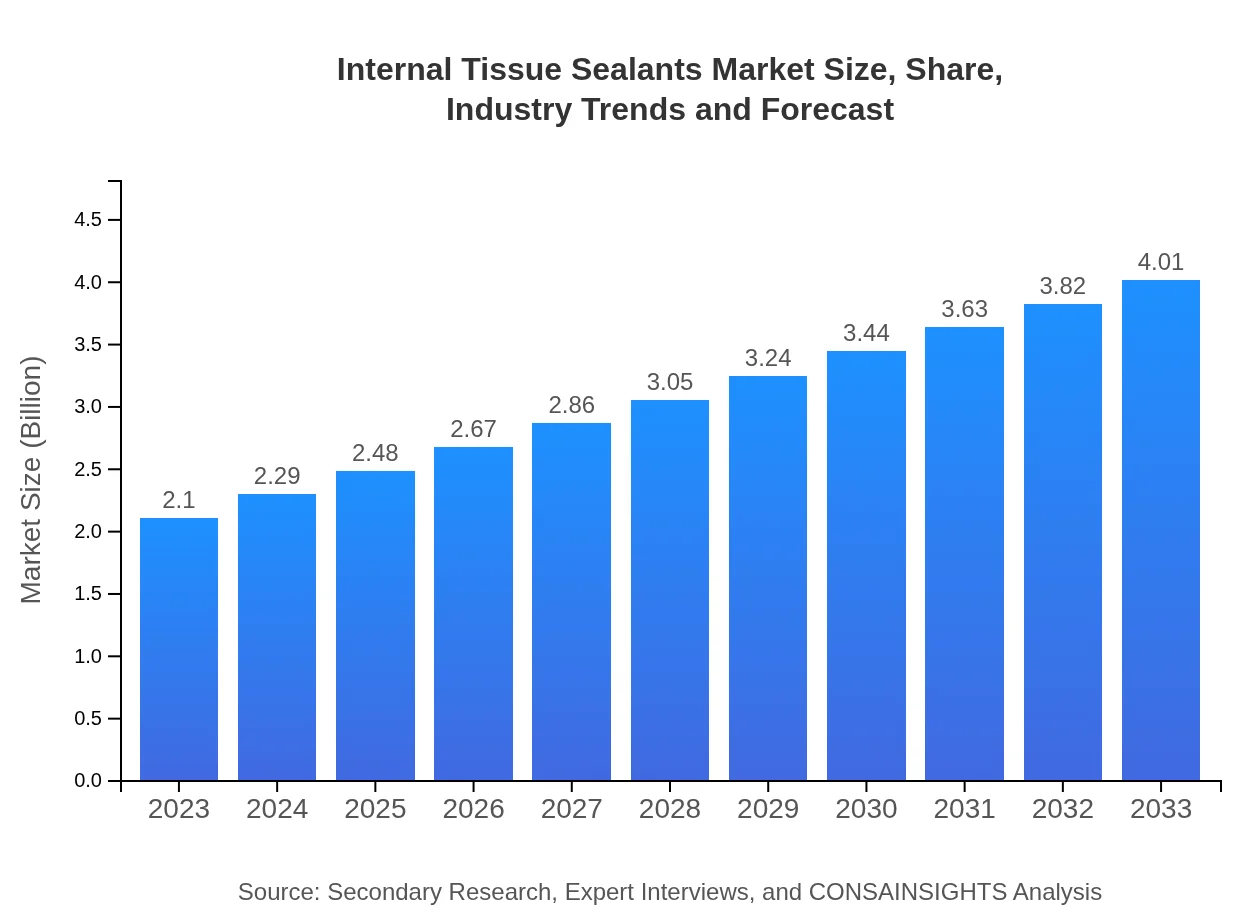
Internal Tissue Sealants Market — USD 2.1 billion in 2023, Growing to USD 4.01B by 2033 at 6.5% CAGR
This report provides an in-depth analysis of the Internal Tissue Sealants market from 2023 to 2033, focusing on market dynamics, segmentation, regional insights, and future forecasts to provide valuable insights for stakeholders.
Key Takeaways
- Global market value rises from $2.10 Billion in 2023 to $4.01 Billion by 2033 at a 6.5% CAGR.
- Europe is largest regional market, while no single fastest-growing region is stated because regional CAGR differences remain within 0.15 percentage points.
- North America grows from $0.7 Billion to $1.33 Billion between 2023 and 2033, reflecting strong clinical uptake.
- Biological and synthetic sealants coexist as primary product types, with hospitals and ambulatory surgical centers as key end users.
- Top manufacturers include Baxter International Inc., Ethicon Inc. (Johnson & Johnson), Medtronic plc., and Smith & Nephew plc.
Internal Tissue Sealants Market Report — Executive Summary
Europe remains largest market by forecast-period value, while no single fastest-growing region is stated because top regional growth rates are separated by less than 0.15 percentage points. The Internal Tissue Sealants market is projected to expand from $2.10 Billion in 2023 to $4.01 Billion in 2033, supported by a 6.5% CAGR. Growth is fueled by increasing surgical volumes, demand for minimally invasive procedures, and investments in advanced sealing technologies. Product innovation favors synthetic and biological formulations designed to improve healing and minimize complications. Distribution pathways span direct sales, retail, and e-commerce, while primary end users include hospitals, clinics, and ambulatory surgical centers. Regulatory scrutiny and cost pressures remain notable challenges, prompting manufacturers such as Baxter International Inc., Ethicon Inc. (Johnson & Johnson), Medtronic plc., and Smith & Nephew plc. to intensify R&D and strategic collaborations to broaden product portfolios and market reach.
Key Growth Drivers
- Rising number of surgical procedures increases demand for effective internal tissue sealing solutions.
- Shift toward minimally invasive surgery supports adoption of advanced sealants that speed recovery and reduce complications.
- Ongoing product innovation and R&D by leading firms enhance sealant performance and clinical acceptance.
- Expansion of healthcare infrastructure in several regions improves access to advanced surgical consumables.
- Wider adoption of e-commerce and diversified distribution channels increases product availability to end users.
| Metric | Value |
|---|---|
| Study Period | 2023 - 2033 |
| 2023 Market Size | $2.10 Billion |
| CAGR (2023-2033) | 6.5% |
| 2033 Market Size | $4.01 Billion |
| Top Companies | Baxter International Inc., Ethicon Inc. (Johnson & Johnson), Medtronic plc., Smith & Nephew plc. |
| Published Date | 11 October 2024 |
| Last Modified Date | 25 May 2026 |
Internal Tissue Sealants Market Overview
Customize Internal Tissue Sealants Market Report market research report
- ✔ Get in-depth analysis of Internal Tissue Sealants market size, growth, and forecasts.
- ✔ Understand Internal Tissue Sealants's regional dynamics and industry-specific trends.
- ✔ Identify potential applications, end-user demand, and growth segments in Internal Tissue Sealants
What is the Market Size & CAGR of Internal Tissue Sealants Market Report market in 2023?
Internal Tissue Sealants Industry Analysis
Internal Tissue Sealants Market Segmentation and Scope
Tell us your focus area and get a customized research report.
Internal Tissue Sealants Market Report Market Analysis Report by Region
Europe Internal Tissue Sealants Market Report:
Europe is largest regional market, rising from $0.7 Billion in 2023 to $1.34 Billion in 2033. 7 Billion in 2023 to $1.34 Billion in 2033 and is identified as the largest regional market. Growth reflects mature clinical infrastructure, steady demand for improved surgical outcomes, and investment in advanced medical consumables.Asia Pacific Internal Tissue Sealants Market Report:
Asia Pacific grows from $0.39 Billion in 2023 to $0.75 Billion in 2033. 39 Billion in 2023 to $0.75 Billion in 2033, with rising healthcare capacity and expanding access to modern surgical technologies contributing to greater uptake of internal tissue sealants.North America Internal Tissue Sealants Market Report:
North America grows from $0.7 Billion in 2023 to $1.33 Billion in 2033. Local expansion is supported by advanced healthcare systems, high procedural volumes, and ongoing adoption of innovative sealant products by hospitals and surgical centers.South America Internal Tissue Sealants Market Report:
Latin America grows from $0.05 Billion in 2023 to $0.09 Billion in 2033. 05 Billion in 2023 to $0.09 Billion in 2033, where improving healthcare infrastructure and growing procedural volumes are gradually increasing demand for surgical sealants and related products.Middle East & Africa Internal Tissue Sealants Market Report:
Middle East and Africa grows from $0.26 Billion in 2023 to $0.5 Billion in 2033. 26 Billion in 2023 to $0.5 Billion in 2033, driven by investments in healthcare facilities and a rising focus on adopting technologies that support better surgical outcomes and recovery.Tell us your focus area and get a customized research report.
Research Methodology
Internal Tissue Sealants Market Analysis By Product Type
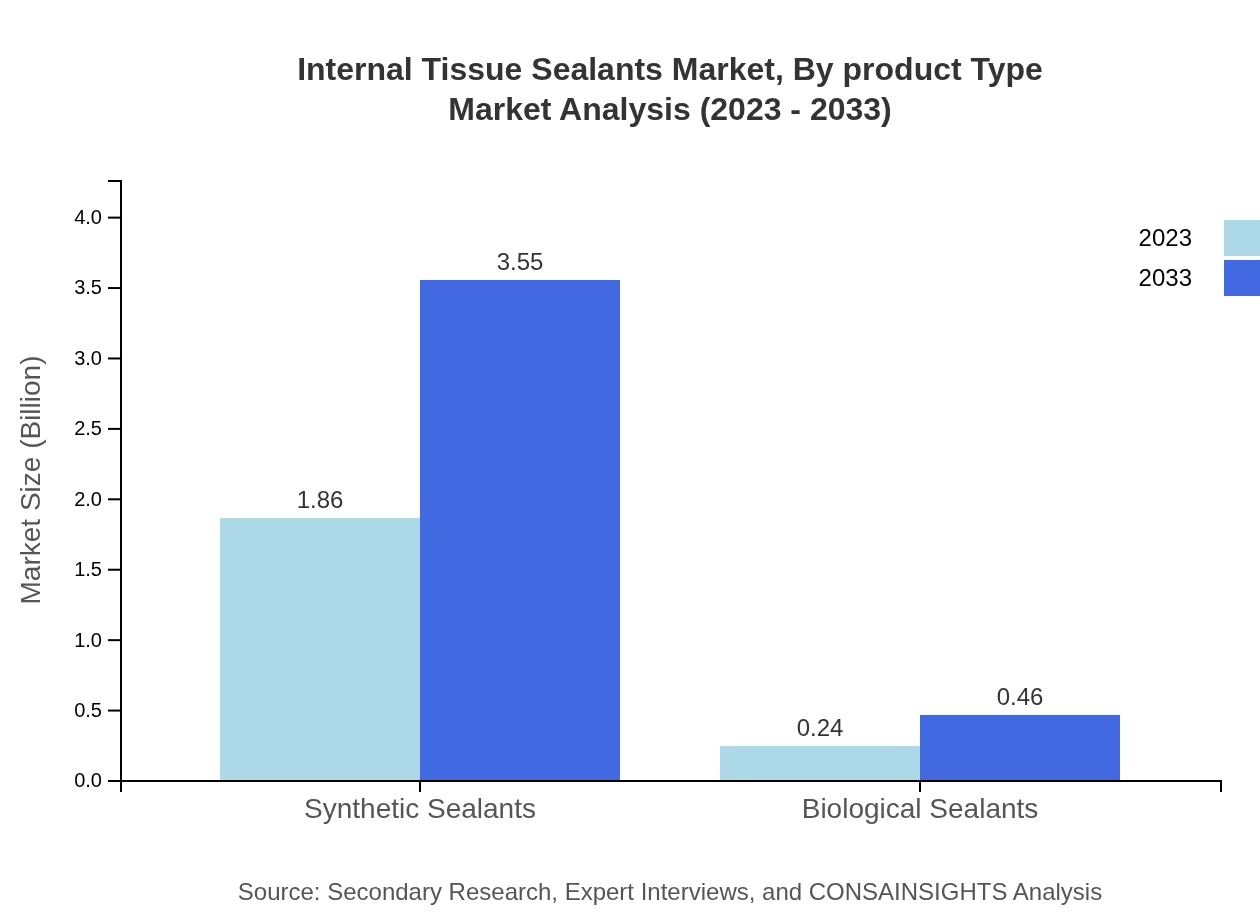
The Internal Tissue Sealants Market is segmented into biological and synthetic sealants. In 2023, biological sealants dominate the market with a size of $1.86 billion, projected to grow to $3.55 billion by 2033. Synthetic sealants account for a smaller market share of $0.24 billion in 2023, expected to grow to $0.46 billion. The preference for biological sealants arises from their enhanced compatibility with human tissues and reduced risk of complications.
Internal Tissue Sealants Market Analysis By Application
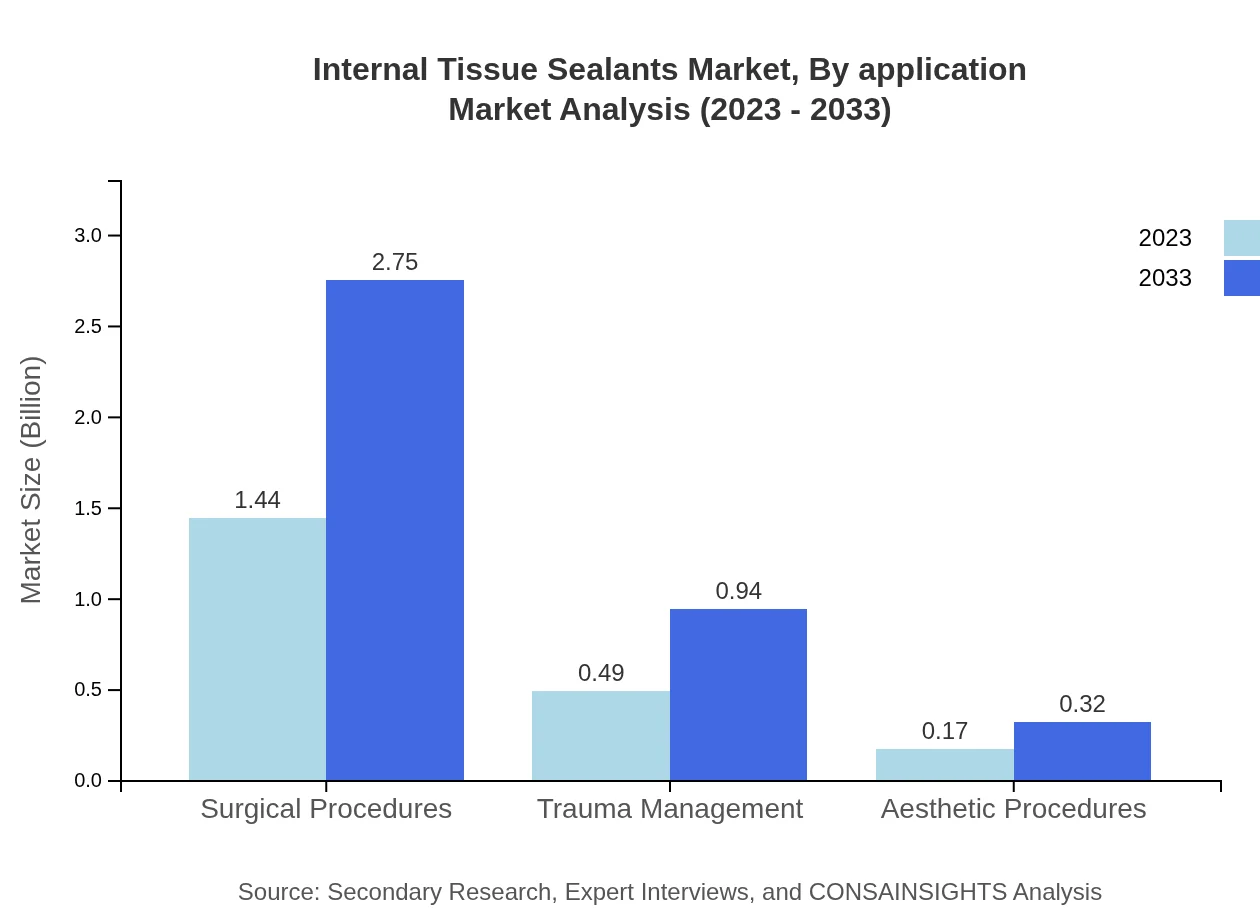
The applications of tissue sealants encompass surgical procedures, trauma management, and aesthetic procedures. Surgical procedures account for $1.44 billion in 2023, expected to grow to $2.75 billion by 2033. Trauma management holds a market valve of $0.49 billion in 2023 with expectations of reaching $0.94 billion by 2033. Aesthetic procedures, while smaller, are also growing with a forecast from $0.17 billion to $0.32 billion.
Internal Tissue Sealants Market Analysis By End User
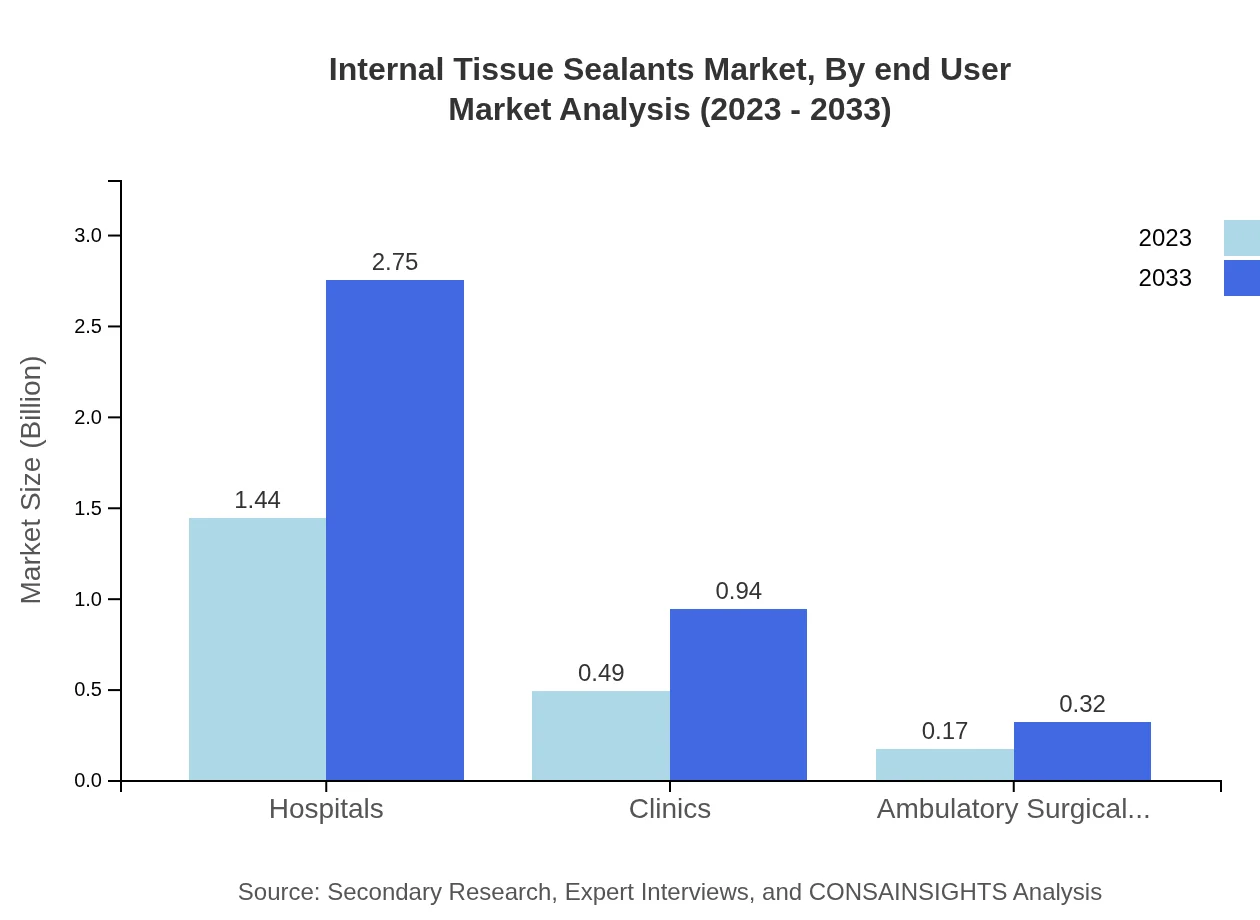
In 2023, hospitals account for the largest market share, valued at $1.44 billion, projected to grow to $2.75 billion by 2033. Clinics and ambulatory surgical centers follow, with sizes of $0.49 billion and $0.17 billion in 2023, respectively. The continued rise in surgical procedures in hospitals boosts the demand for tissue sealants.
Internal Tissue Sealants Market Analysis By Distribution Channel
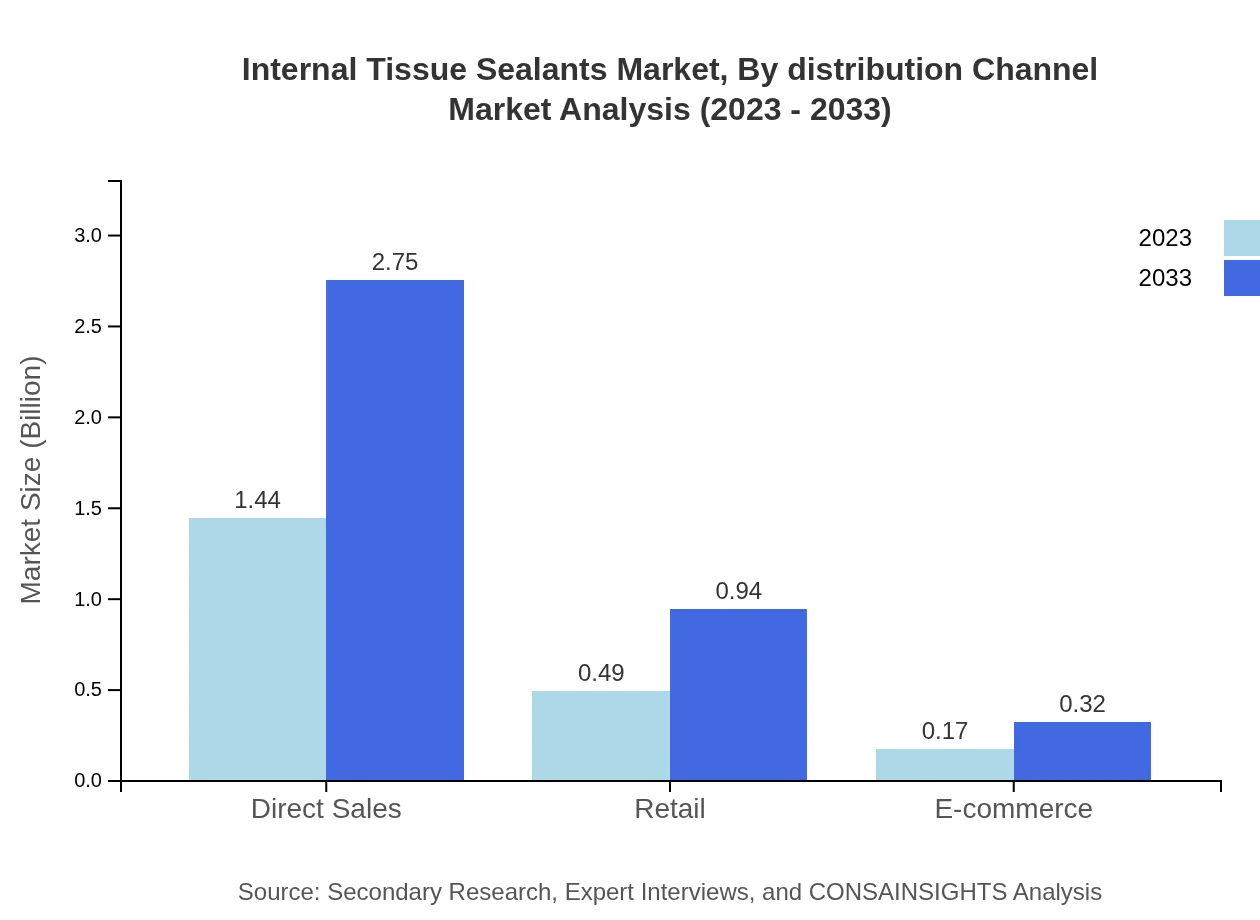
The distribution channels for Internal Tissue Sealants include direct sales, retail, and e-commerce. Direct sales are predominant, holding a share of $1.44 billion in 2023, with an expected growth to $2.75 billion by 2033. Retail and e-commerce channels are smaller segments but are demonstrating significant growth, particularly with increasing online healthcare sales.
Internal Tissue Sealants Market Analysis By Material
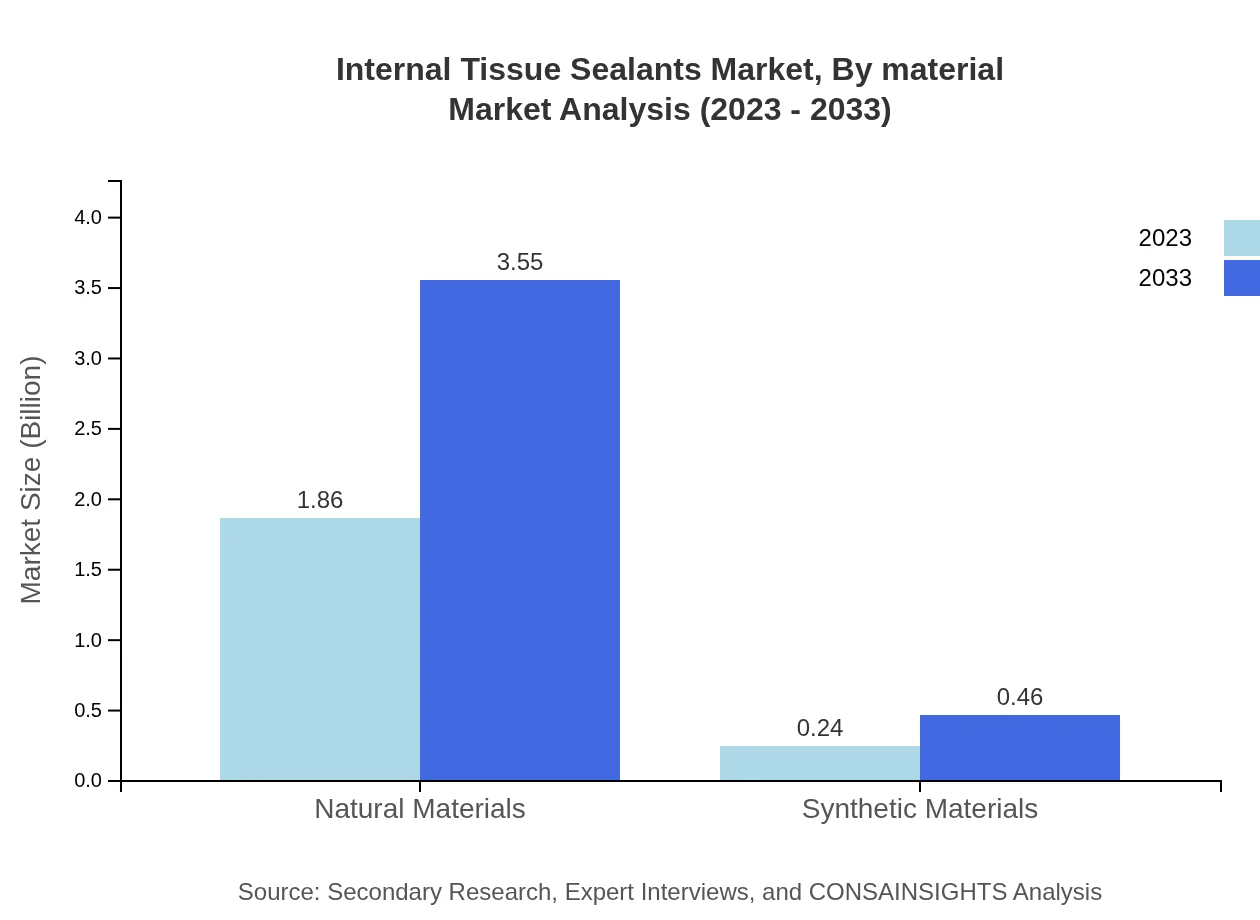
The Internal Tissue Sealants market is further divided by material into natural and synthetic materials. Natural materials occupy the majority share at $1.86 billion in 2023, with an expected rise to $3.55 billion by 2033. Synthetic materials, while smaller at $0.24 billion in 2023, are projected to grow to $0.46 billion as manufacturers develop new synthetic options with enhanced features.
Internal Tissue Sealants Market Trends and Future Forecast
Tell us your focus area and get a customized research report.
Global Market Leaders and Top Companies in Internal Tissue Sealants Industry
Baxter International Inc.:
Baxter is a leading global medical products company known for its innovative surgical sealants that improve surgical outcomes and have a significant presence in the Internal Tissue Sealants market.Ethicon Inc. (Johnson & Johnson):
Ethicon, a part of Johnson & Johnson, is renowned for its range of surgical products and advancements in tissue adhesives that promote healing and tissue regeneration.Medtronic plc.:
Medtronic is a major player in the medical technology space, offering various sealant products designed for different surgical applications, thus enhancing procedural efficiency.Smith & Nephew plc.:
Smith & Nephew provides a wide range of advanced wound management and surgical products, including innovative tissue sealants that cater to surgical needs across regions.We're grateful to work with incredible clients.








FAQs
What is the market size of the Internal Tissue Sealants market in 2023?
The market size for 2023 is $2.10 Billion, based on reported figures for the current assessment year and used as the baseline for the 2023 to 2033 forecast period.
How big will the market be in 2033?
The market is projected to reach $4.01 Billion in 2033, reflecting reported growth across regions and product segments during the 2023 to 2033 period.
What is CAGR for the forecast period?
The compound annual growth rate for the forecast period 2023 to 2033 is 6.5%, as stated for the overall market expansion between the two reference years.
Is there a single fastest Growing region in the Internal Tissue Sealants Market Report market?
No single fastest-growing region is stated for the Internal Tissue Sealants Market Report market because the top regional implied CAGR values are within 0.15 percentage points of each other, making the ranking too close to call reliably.
Which companies are leading the Internal Tissue Sealants market?
Leading companies identified include Baxter International Inc., Ethicon Inc. (Johnson & Johnson), Medtronic plc., and Smith & Nephew plc., all active in product development and market distribution.
What end users purchase internal tissue sealants?
Primary end users include hospitals, clinics, and ambulatory surgical centers, all listed as subsegments for by-end-user in the market segmentation.
How are sealants distributed to buyers?
Distribution channels cited include direct sales, retail, and e-commerce, reflecting multiple routes to market for manufacturers and suppliers.
What materials are used in internal tissue sealants?
Materials include natural materials and synthetic materials, both identified as subsegments under the by-material classification for products in this market.