

Biocompatibility Testing Services Market Report
First published: 11 October 2024 | Last updated: 25 May 2026 | Report Code: biocompatibility-testing-services
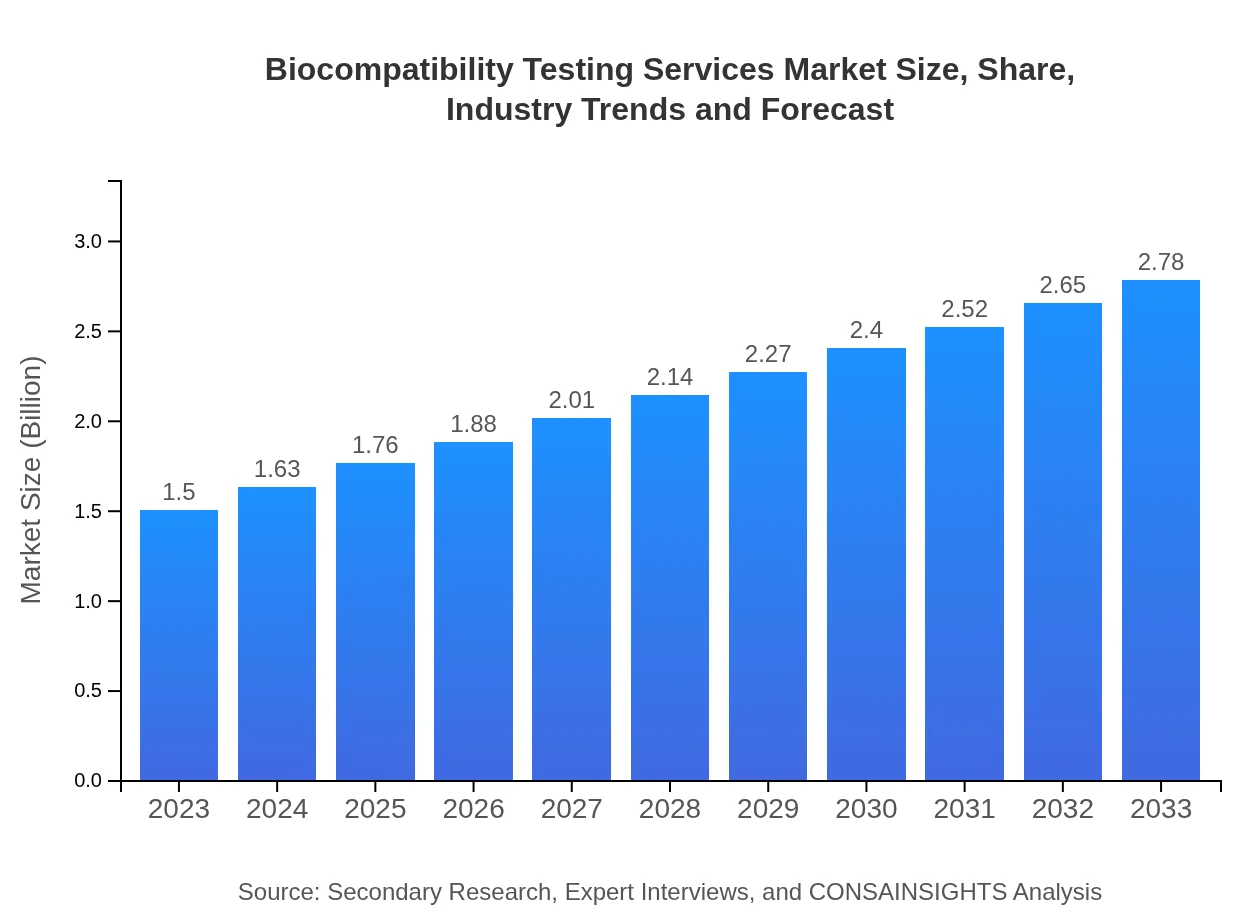
Biocompatibility Testing Services Market — USD $1.5 Billion in 2023, Growing to USD 2.78null by 2033 at 6.2% CAGR
This report provides an in-depth analysis of the Biocompatibility Testing Services market, covering market size, growth forecasts, regional insights, segmentation analysis, and trends from 2023 to 2033.
Key Takeaways
- Global market expands from $1.50 Billion in 2023 to $2.78 Billion in 2033 at a 6.2% CAGR.
- North America is largest regional market, while no single fastest-growing region is stated because regional CAGR differences remain within 0.15 percentage points.
- Service demand driven by regulatory compliance, increased medical device and pharmaceutical testing needs, and technological improvements.
- Top global providers include Eurofins Scientific, Charles River Laboratories, NAMSA, and TÜV Rheinland.
- Segment coverage spans end-users, industries, service types, and test methodologies, highlighting CROs and manufacturers.
Biocompatibility Testing Services Market Report — Executive Summary
North America remains largest market by forecast-period value, while no single fastest-growing region is stated because top regional growth rates are separated by less than 0.15 percentage points. This report analyzes the Biocompatibility Testing Services market, which grows from $1.50 Billion in 2023 to $2.78 Billion in 2033 at a 6.2% CAGR. Drivers include stricter regulatory requirements for medical devices and pharmaceuticals, rising R&D expenditure, and technological advancements in testing methods. The analysis covers service-type trends such as cytotoxicity, sensitization, and irritation testing, and test methodologies including in vitro, in vivo, and computational approaches. Regional breakdowns quantify market values across North America, Europe, Asia Pacific, Latin America, and Middle East and Africa, with North America identified as the largest region. The competitive landscape profiles leading providers: Eurofins Scientific, Charles River Laboratories, NAMSA, and TÜV Rheinland. Methodology relies on expert interviews, company reports, secondary sources, and internal validation to ensure robust findings and actionable insights for stakeholders.
Key Growth Drivers
- Rising regulatory stringency for medical devices and pharmaceuticals increasing testing requirements.
- Higher R&D spending in life-sciences fuels demand for third-party testing services.
- Advances in testing technology improve accuracy and expand available methodologies.
- Growth of contract research organizations and outsourcing by manufacturers increases service uptake.
- Greater emphasis on patient safety and compliance drives routine and premarket testing volumes.
| Metric | Value |
|---|---|
| Study Period | 2023 - 2033 |
| 2023 Market Size | $1.50 Billion |
| CAGR (2023-2033) | 6.2% |
| 2033 Market Size | $2.78 Billion |
| Top Companies | Eurofins Scientific, Charles River Laboratories, NAMSA, TÜV Rheinland |
| Published Date | 11 October 2024 |
| Last Modified Date | 25 May 2026 |
Biocompatibility Testing Services Market Overview
Customize Biocompatibility Testing Services Market Report market research report
- ✔ Get in-depth analysis of Biocompatibility Testing Services market size, growth, and forecasts.
- ✔ Understand Biocompatibility Testing Services's regional dynamics and industry-specific trends.
- ✔ Identify potential applications, end-user demand, and growth segments in Biocompatibility Testing Services
What is the Market Size & CAGR of Biocompatibility Testing Services Market Report market in 2023?
Biocompatibility Testing Services Industry Analysis
Biocompatibility Testing Services Market Segmentation and Scope
Tell us your focus area and get a customized research report.
Biocompatibility Testing Services Market Report Market Analysis Report by Region
Europe Biocompatibility Testing Services Market Report:
Europe grows from $0.46 Billion in 2023 to $0.86 Billion in 2033. Regional expansion reflects regulatory enforcement, pharmaceutical and device development, and service provider presence supporting compliance testing.Asia Pacific Biocompatibility Testing Services Market Report:
Asia Pacific grows from $0.28 Billion in 2023 to $0.51 Billion in 2033. Growth is linked to expanding manufacturing bases, rising clinical and product development activity, and greater regulatory alignment that encourages testing services.North America Biocompatibility Testing Services Market Report:
North America is largest regional market, rising from $0.54 Billion in 2023 to $1 Billion in 2033. Local demand is driven by concentrated medical device and pharmaceutical R&D activity, stringent regulatory frameworks, and established testing infrastructure.South America Biocompatibility Testing Services Market Report:
Latin America grows from $0.13 Billion in 2023 to $0.24 Billion in 2033. Market movement is influenced by growing local healthcare product development, increasing regulatory attention, and outsourcing of testing to specialist providers.Middle East & Africa Biocompatibility Testing Services Market Report:
Middle East and Africa grows from $0.09 Billion in 2023 to $0.16 Billion in 2033. Regional drivers include nascent medical product development, strengthening regulatory requirements, and demand for validated biocompatibility assessments.Tell us your focus area and get a customized research report.
Research Methodology
Biocompatibility Testing Services Market Analysis By Service Type
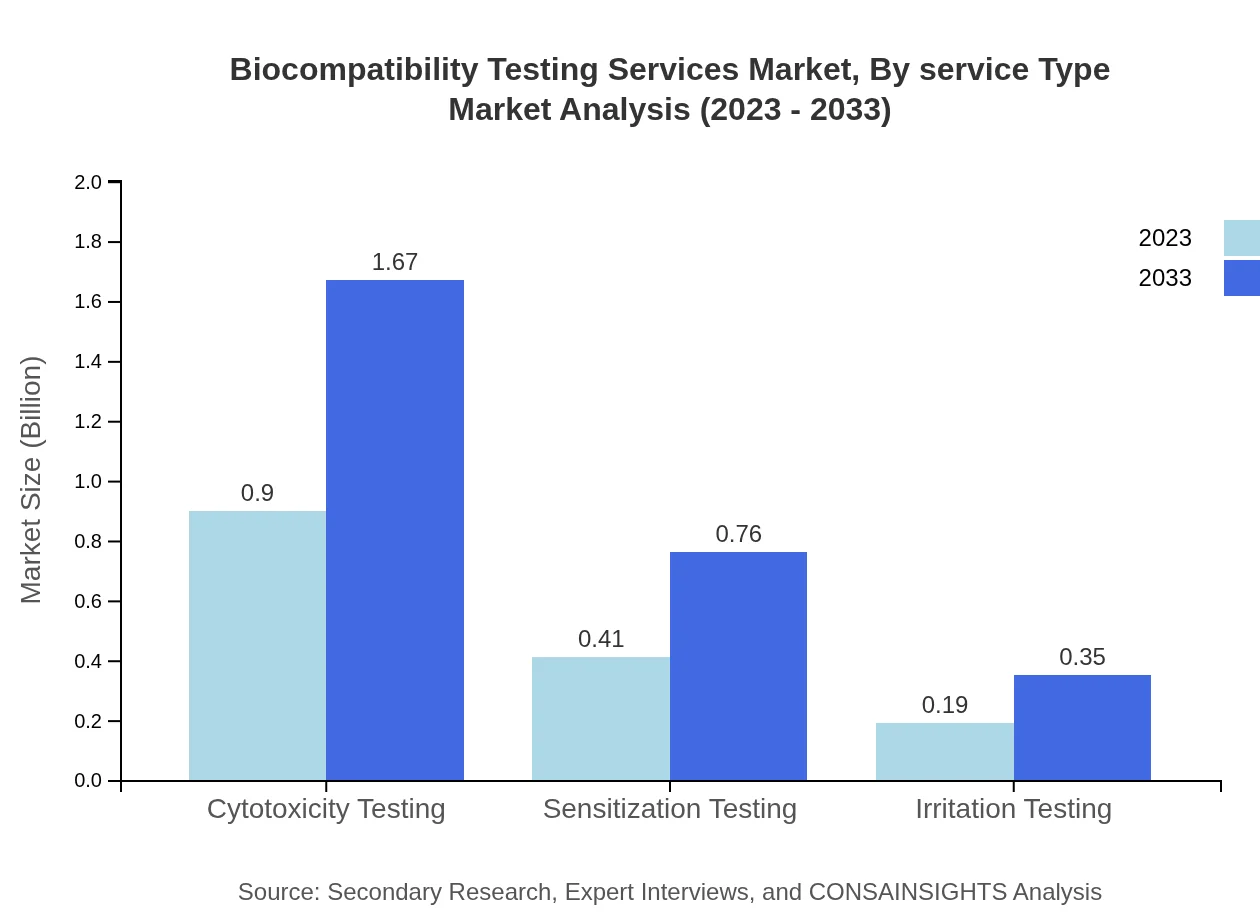
The Biocompatibility Testing Services Market, segmented by service type, highlights that manufacturers hold the largest market share, expected to grow from $0.90 billion in 2023 to $1.67 billion by 2033, capturing 60.2% of the market. CROs follow behind, with an increasing market size from $0.41 billion to $0.76 billion, thereby maintaining 27.35% market share. Regulatory bodies account for $0.19 billion, growing to $0.35 billion, capturing 12.45%. This segmentation showcases the reliance on established manufacturers and CROs for accurate testing services.
Biocompatibility Testing Services Market Analysis By Industry
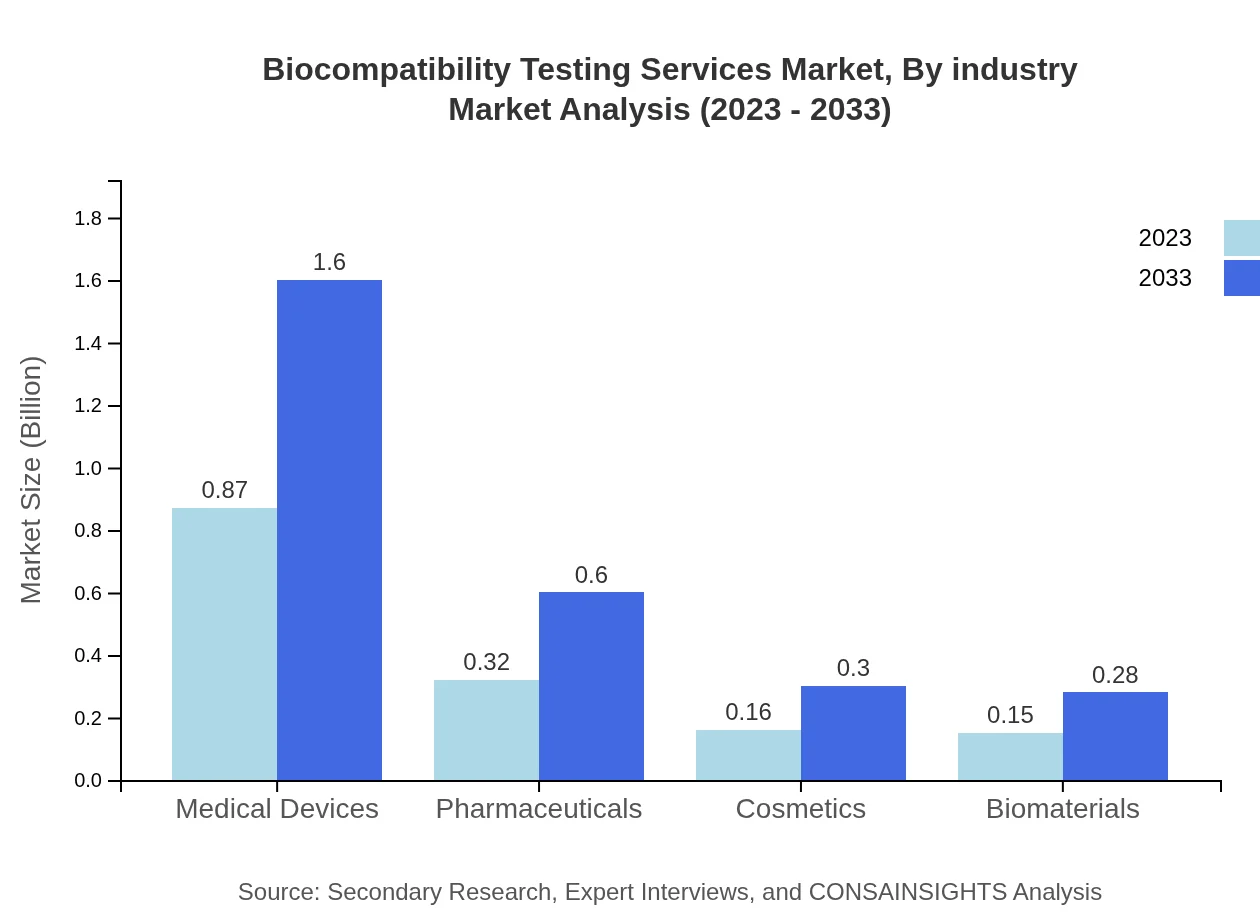
In the Biocompatibility Testing Services Market, industry segmentation indicates that medical devices dominate with a market size rising from $0.87 billion in 2023 to $1.60 billion by 2033, accounting for a 57.69% share. Pharmaceuticals will see growth from $0.32 billion to $0.60 billion for a 21.43% share, while cosmetics contribute $0.16 billion to $0.30 billion and biomaterials progress from $0.15 billion to $0.28 billion, each capturing around 10% shares.
Biocompatibility Testing Services Market Analysis By Test Methodology
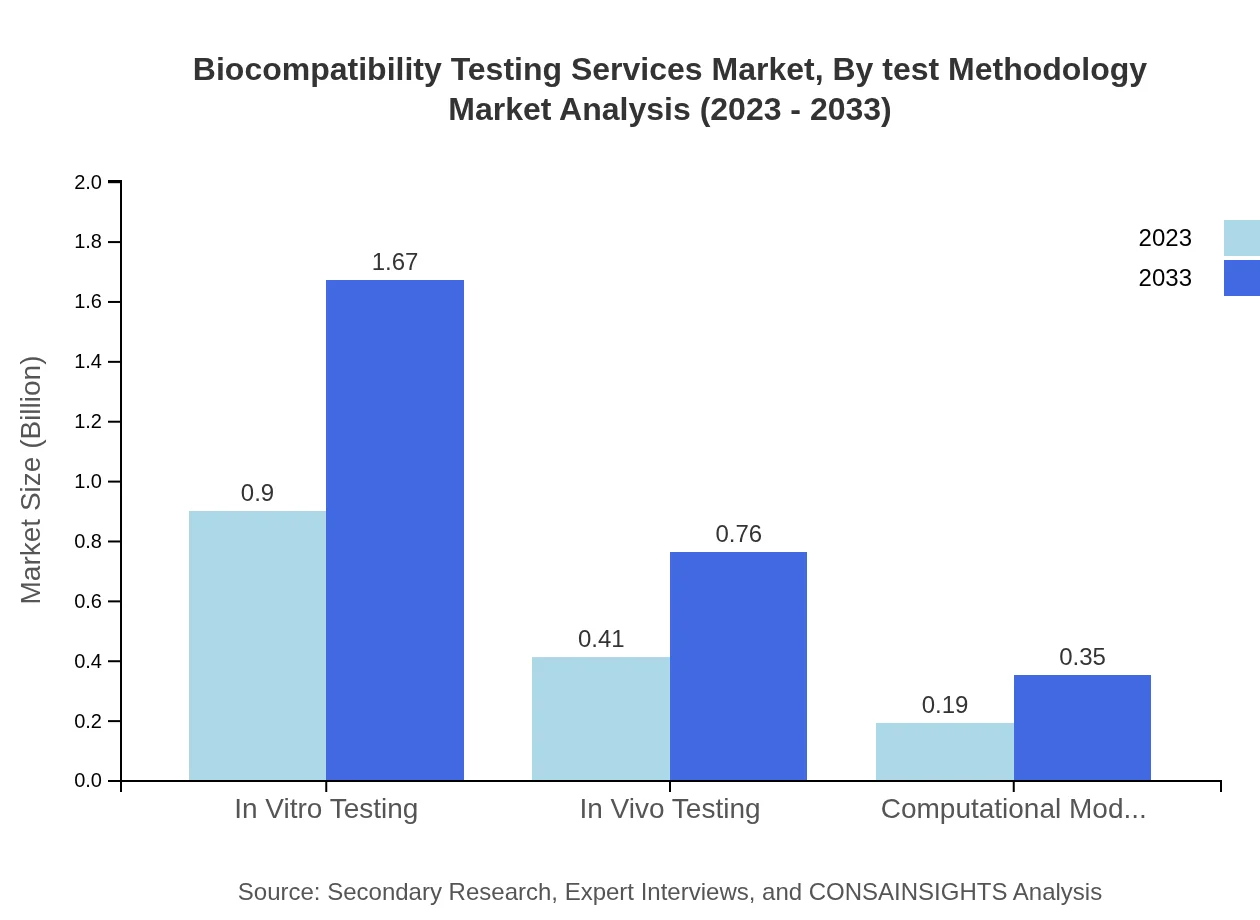
The testing methodology segment reveals that In Vitro Testing leads with a sizable market share, estimated at $0.90 billion growing to $1.67 billion, and accounting for 60.2%. In Vivo Testing grows from $0.41 billion to $0.76 billion, representing 27.35%. Computational Modeling also maintains a steady growth from $0.19 billion to $0.35 billion, capturing 12.45% market share, indicating a trend towards more technologically advanced testing methodologies.
Biocompatibility Testing Services Market Analysis By End User
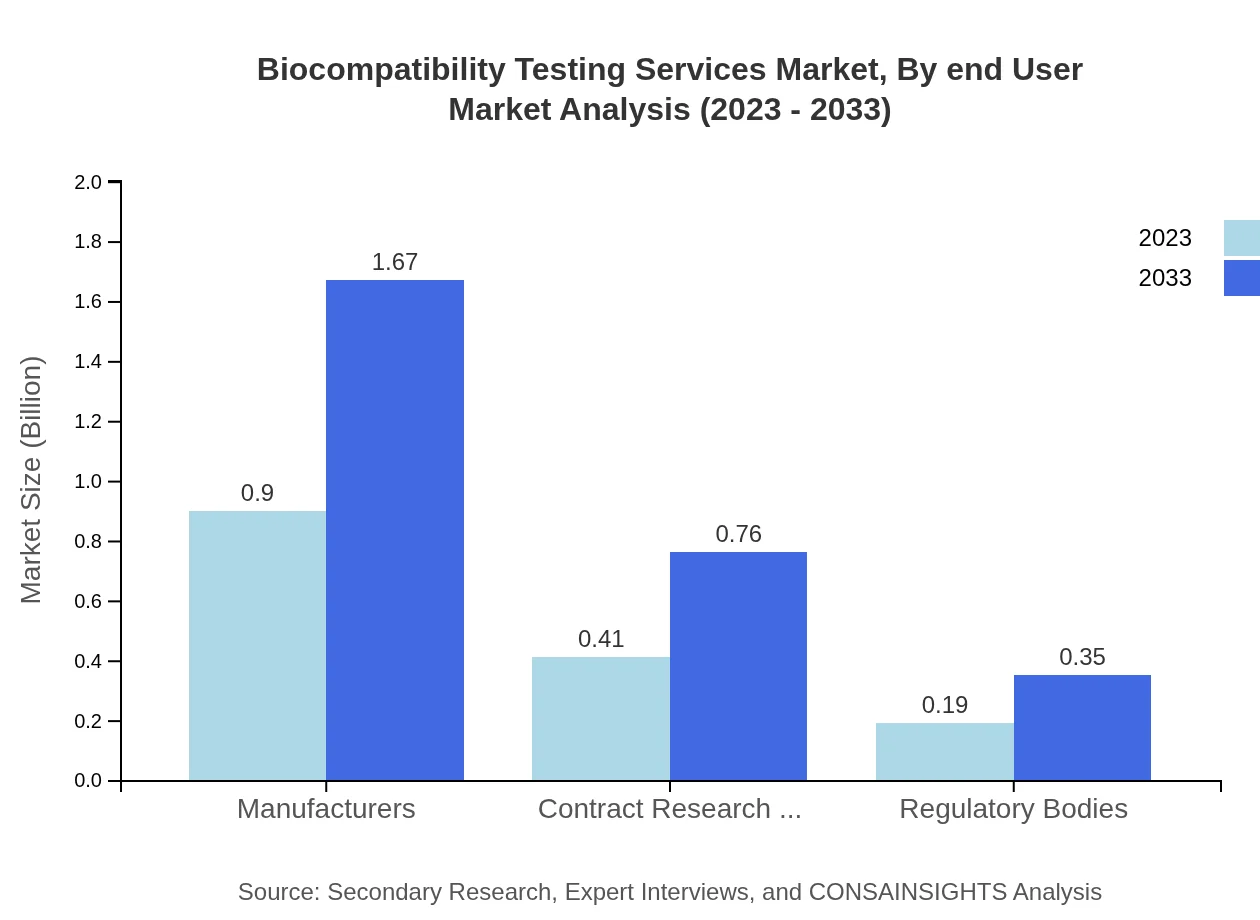
The end-user analysis shows that major players in the medical device sector leverage biocompatibility testing extensively, with a market size of $2.00 billion in 2023 projected to reach $3.50 billion in 2033. Pharmaceuticals will extensively utilize these services, with the market expanding from $0.40 billion to $0.80 billion. The cosmetics sector is expected to see utilization increasing from $0.20 billion to $0.30 billion, showcasing the diverse applications of biocompatibility testing across sectors.
Biocompatibility Testing Services Market Trends and Future Forecast
Tell us your focus area and get a customized research report.
Global Market Leaders and Top Companies in Biocompatibility Testing Services Industry
Eurofins Scientific:
Eurofins Scientific is a global group of laboratories known for its commitment to quality and expertise in biocompatibility testing and analytical services, catering to the pharmaceutical and medical device sectors.Charles River Laboratories:
Charles River is a prominent provider of early-stage contract research services, offering comprehensive biocompatibility testing to support their clients in accelerating the development and approval of new pharmaceutical and biotechnology products.NAMSA:
Named as a leader in biocompatibility testing, NAMSA specializes in preclinical and clinical research services, helping manufacturers bring safe and effective medical devices to market.TÜV Rheinland:
TÜV Rheinland is a major player in the field, providing testing and certification to ensure products meet global standards for quality and safety, including those in biocompatibility.We're grateful to work with incredible clients.








FAQs
What is the market size of the Biocompatibility Testing Services Market Report in 2023?
The market size for 2023 is $1.50 Billion, as stated in the report. This figure represents the global value of biocompatibility testing services for that year.
How big will the market be in 2033?
The market is projected to reach $2.78 Billion by 2033 according to the provided data, reflecting growth over the 2023 to 2033 forecast period.
What is CAGR for the forecast period?
The compound annual growth rate for the 2023 to 2033 forecast period is 6.2%, based on the input figures and market projection details.
Is there a single fastest Growing region in the Biocompatibility Testing Services Market Report market?
No single fastest-growing region is stated for the Biocompatibility Testing Services Market Report market because the top regional implied CAGR values are within 0.15 percentage points of each other, making the ranking too close to call reliably.
Which companies are listed as top providers?
Top companies identified in the report include Eurofins Scientific, Charles River Laboratories, NAMSA, and TÜV Rheinland as key market participants.
What are the primary service types covered?
Primary service types include cytotoxicity testing, sensitization testing, and irritation testing, reflecting core assessments required for biocompatibility evaluations.
Who are the main end Users mentioned?
End-users specified include Manufacturers, Contract Research Organizations (CROs), and Regulatory Bodies, each playing roles in testing and compliance.
How is the market segmented by test methodology?
Test methodologies listed comprise In Vitro Testing, In Vivo Testing, and Computational Modeling, covering laboratory, animal-based, and simulation approaches.