
Reports >
Life Sciences
>
Hypogonadism Treatment Market Report

Hypogonadism Treatment Market Report
First published: 11 October 2024 | Last updated: 25 May 2026 | Report Code: hypogonadism-treatment
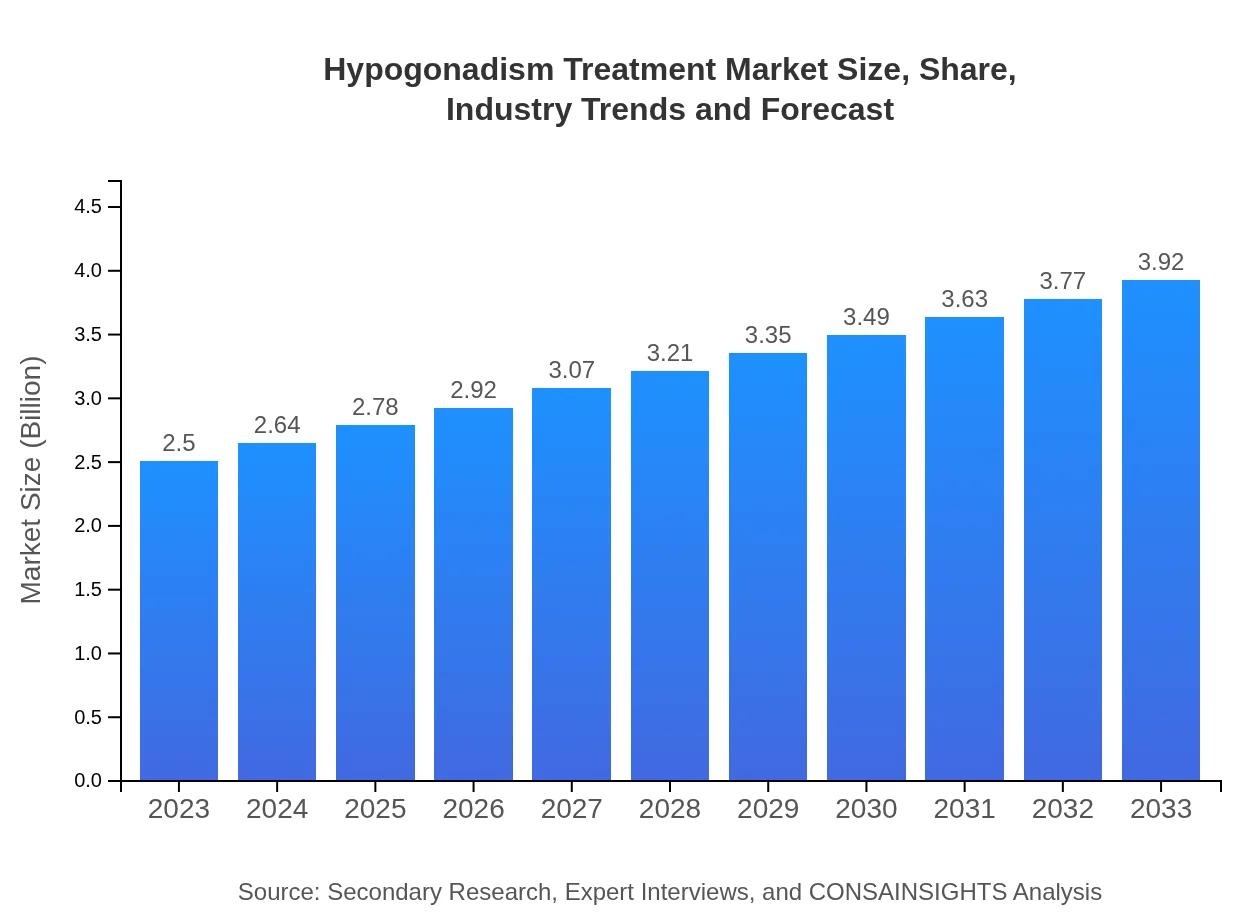
Hypogonadism Treatment Market — USD 2.5 billion in 2023, Growing to USD 3.92B by 2033 at 4.5% CAGR
This report provides an in-depth analysis of the Hypogonadism Treatment market from 2023 to 2033, highlighting key insights, market trends, regional analysis, and forecasts.
Key Takeaways
- Global market value was $2.50 Billion in 2023 and is projected to reach $3.92 Billion by 2033 at a 4.5% CAGR.
- North America is largest regional market, while no single fastest-growing region is stated because regional CAGR differences remain within 0.15 percentage points.
- Europe, Asia Pacific, Latin America, and Middle East & Africa also show steady increases based on region-specific growth drivers.
- Treatment segmentation includes testosterone replacement therapy, non-hormonal therapies, and complementary therapies across multiple administration routes.
- Leading companies in the landscape include AbbVie Inc., Eli Lilly and Company, Endo International plc, Bayer AG, and Impotence and Hormone Replacement Therapy Clinics.
Hypogonadism Treatment Market Report — Executive Summary
North America remains largest market by forecast-period value, while no single fastest-growing region is stated because top regional growth rates are separated by less than 0.15 percentage points. This report outlines the Hypogonadism Treatment market from 2023 to 2033, projecting growth from $2.50 Billion to $3.92 Billion at a 4.5% CAGR. Key drivers include rising awareness of hypogonadism symptoms, improvements in testosterone replacement therapies, and demographic shifts toward older populations. The market structure covers treatment types—testosterone replacement, non-hormonal options, and complementary therapies—along with routes of administration and distribution channels. Regional breakdown highlights North America as the largest market, with Europe and Asia Pacific recording notable expansions. Competitive dynamics feature established pharma names such as AbbVie Inc., Eli Lilly and Company, Endo International plc, and Bayer AG, alongside specialized clinics. Methodology combines primary expert interviews and secondary sources with data triangulation to support trend interpretation and strategic insights for stakeholders.
Key Growth Drivers
- Growing public and clinical awareness of hypogonadism symptoms which increases diagnosis and treatment uptake.
- Advances in testosterone replacement formulations and delivery technologies improving patient adherence and outcomes.
- An aging population that expands the pool of patients eligible for hypogonadism therapies.
- Diverse treatment options including non-hormonal and complementary therapies broadening clinical choices and patient preferences.
- Wider distribution through hospital, retail, and online pharmacies enhancing access to treatments.
| Metric | Value |
|---|---|
| Study Period | 2023 - 2033 |
| 2023 Market Size | $2.50 Billion |
| CAGR (2023-2033) | 4.5% |
| 2033 Market Size | $3.92 Billion |
| Top Companies | AbbVie Inc., Eli Lilly and Company, Endo International plc, Bayer AG, Impotence and Hormone Replacement Therapy Clinics |
| Published Date | 11 October 2024 |
| Last Modified Date | 25 May 2026 |
Hypogonadism Treatment Market Overview
Customize Hypogonadism Treatment Market Report market research report
- ✔ Get in-depth analysis of Hypogonadism Treatment market size, growth, and forecasts.
- ✔ Understand Hypogonadism Treatment's regional dynamics and industry-specific trends.
- ✔ Identify potential applications, end-user demand, and growth segments in Hypogonadism Treatment
What is the Market Size & CAGR of Hypogonadism Treatment Market Report market in 2023?
Hypogonadism Treatment Industry Analysis
Hypogonadism Treatment Market Segmentation and Scope
Tell us your focus area and get a customized research report.
Hypogonadism Treatment Market Report Market Analysis Report by Region
Europe Hypogonadism Treatment Market Report:
Europe grows from $0.73 Billion in 2023 to $1.14 Billion in 2033. This progression is driven by increasing clinical awareness, evolving treatment protocols, and improved availability of hormone replacement and adjunct therapies across healthcare settings.Asia Pacific Hypogonadism Treatment Market Report:
Asia Pacific grows from $0.49 Billion in 2023 to $0.76 Billion in 2033. Growth is supported by rising awareness, expanding healthcare access, and adoption of newer formulations and distribution channels including online pharmacies.North America Hypogonadism Treatment Market Report:
North America is largest regional market, rising from $0.82 Billion in 2023 to $1.29 Billion in 2033. Regional expansion reflects higher diagnosis rates, established clinical pathways, and broad access through hospital and retail pharmacies coupled with active participation from major pharmaceutical companies.South America Hypogonadism Treatment Market Report:
Latin America grows from $0.15 Billion in 2023 to $0.23 Billion in 2033. Market momentum is influenced by growing recognition of hypogonadism, expanding treatment availability, and gradual improvements in healthcare infrastructure and patient access.Middle East & Africa Hypogonadism Treatment Market Report:
Middle East and Africa grows from $0.32 Billion in 2023 to $0.49 Billion in 2033. Drivers include increased diagnosis, broader treatment options entering regional markets, and improving delivery networks through hospitals and pharmacies.Tell us your focus area and get a customized research report.
Research Methodology
Hypogonadism Treatment Market Analysis By Treatment Type
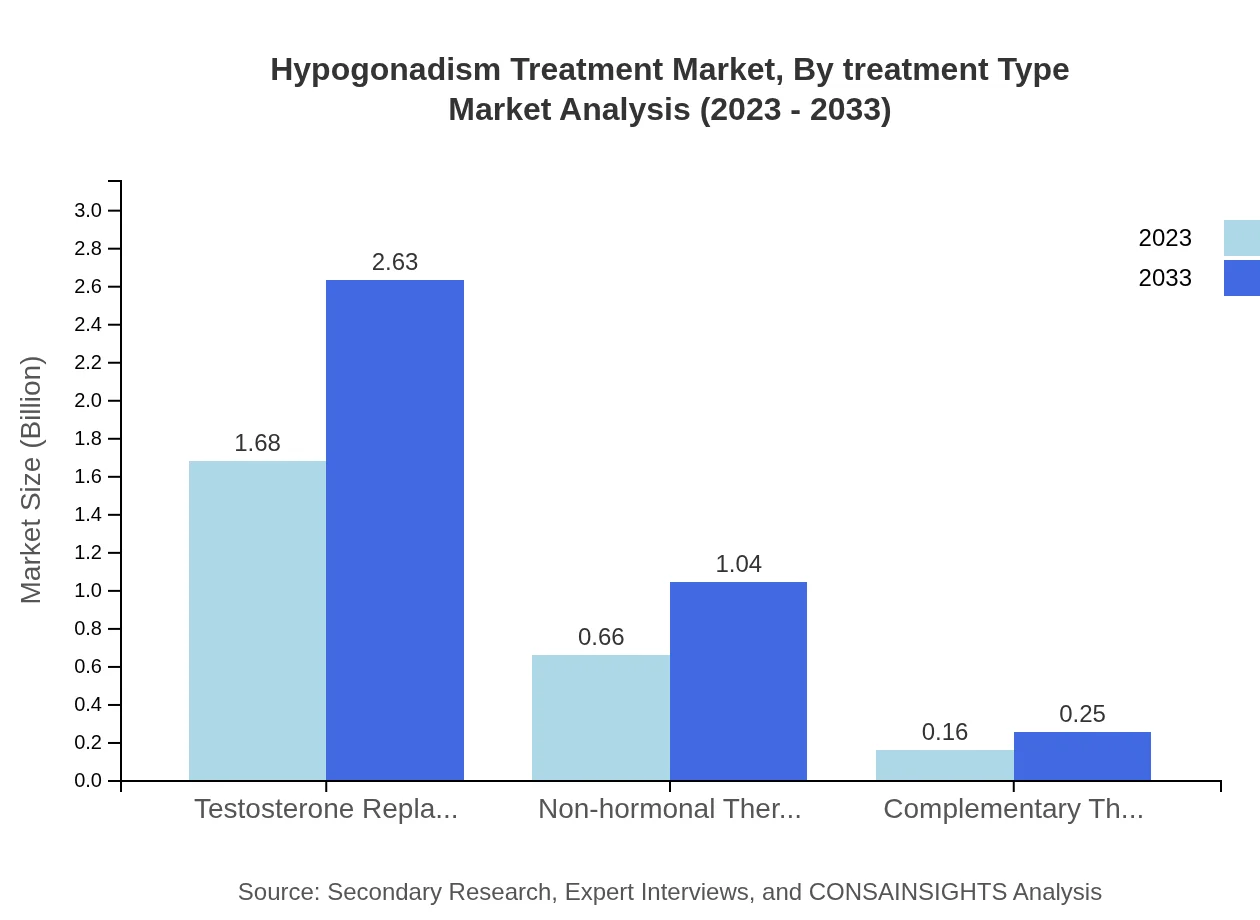
In 2023, the Testosterone Replacement Therapy segment leads the market, with a size of $1.68 billion, accounting for 67.07% of the overall market. It's expected to grow to $2.63 billion by 2033. Non-hormonal therapies follow with a size of $0.66 billion (26.54% market share) in 2023, expected to rise to $1.04 billion by 2033. Complementary therapies, though smaller, also show growth from $0.16 billion (6.39%) to $0.25 billion.
Hypogonadism Treatment Market Analysis By Route Of Administration
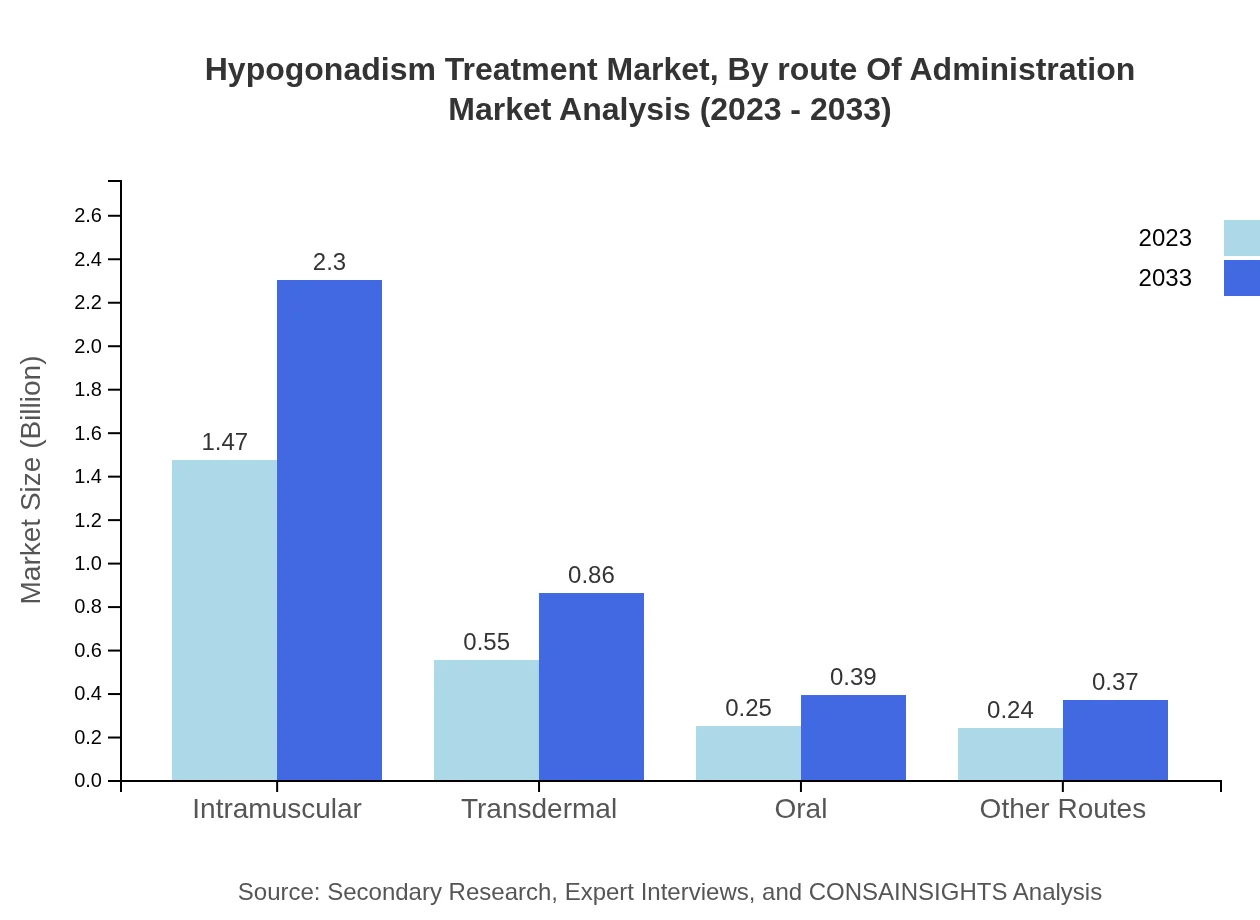
Intramuscular injections dominate the market with a 58.64% share, valued at $1.47 billion in 2023 and projected to reach $2.30 billion by 2033. Transdermal patches and gels account for 22.05% ($0.55 billion), and oral formulations capture 9.86% ($0.25 billion). Other routes also constitute 9.45%, indicating emerging preferences among patients.
Hypogonadism Treatment Market Analysis By Patient Type
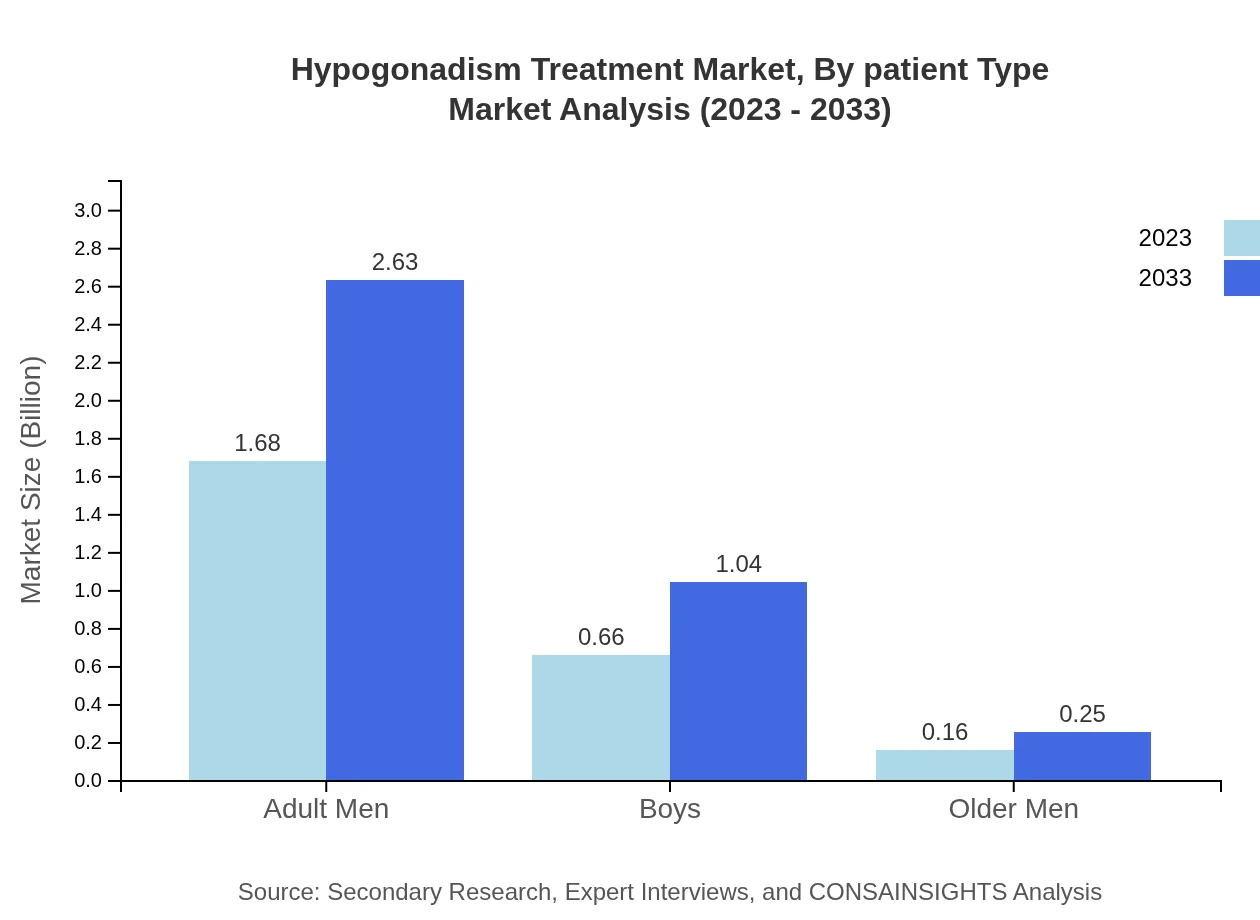
The market for Adult Men is substantial, currently at $1.68 billion (67.07% share) in 2023, expected to grow to $2.63 billion by 2033. The segment focusing on Boys accounts for $0.66 billion (26.54%) and is anticipated to reach $1.04 billion. Older Men represent a smaller segment with $0.16 billion (6.39%), growing to $0.25 billion.
Hypogonadism Treatment Market Analysis By Distribution Channel
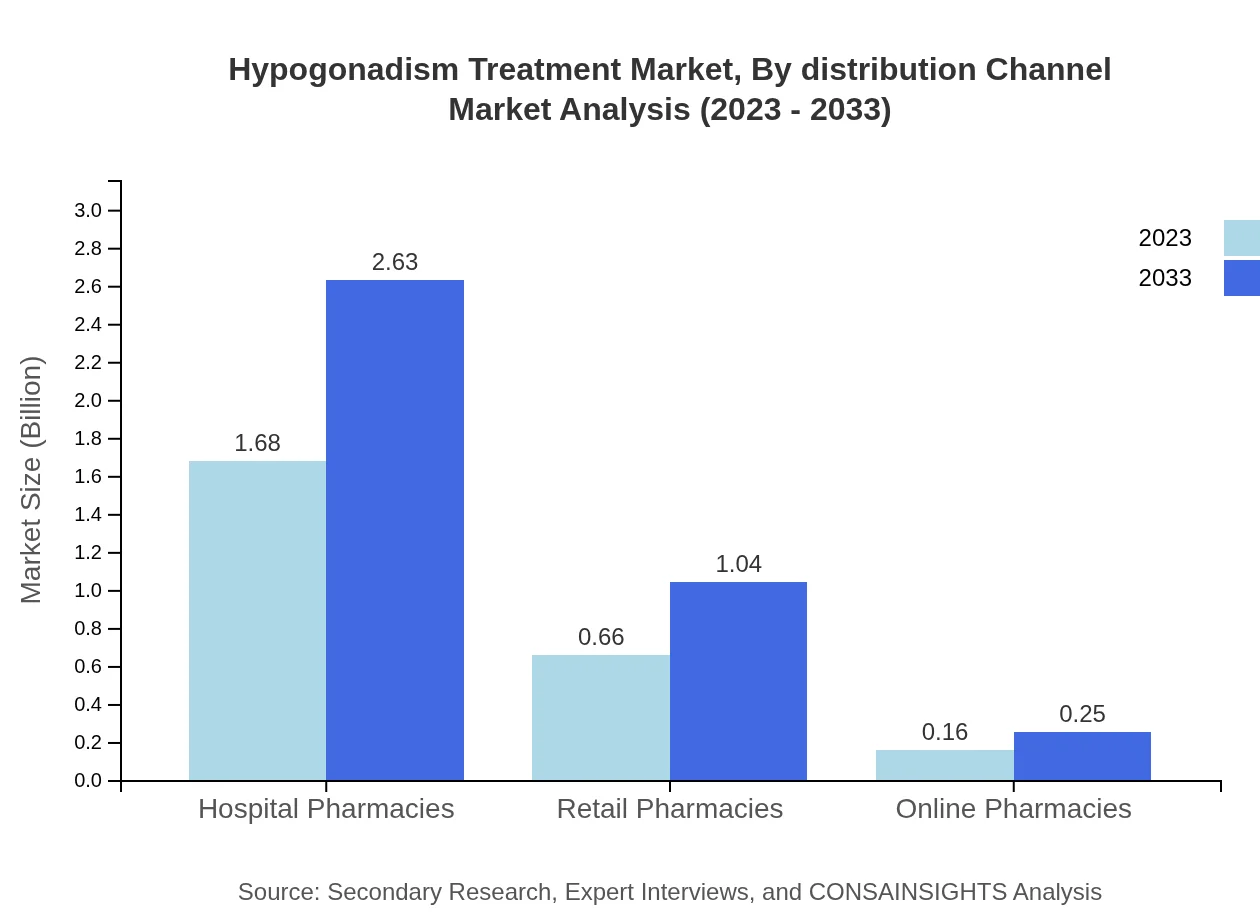
Sales through Hospital Pharmacies represent the largest distribution channel, accounting for 67.07% market share in 2023 ($1.68 billion), projected to grow to $2.63 billion by 2033. Retail Pharmacies and Online Pharmacies are expected to grow as well, with current sizes at $0.66 billion (26.54%) and $0.16 billion (6.39%) respectively.
Hypogonadism Treatment Market Trends and Future Forecast
Tell us your focus area and get a customized research report.
Global Market Leaders and Top Companies in Hypogonadism Treatment Industry
AbbVie Inc.:
A leading global biopharmaceutical company that develops and markets advanced therapeutic solutions, including Androgel for testosterone replacement.Eli Lilly and Company:
A pharmaceutical titan focused on discovering and developing innovative treatments, including its well-known testosterone therapy products.Endo International plc:
A global specialty pharmaceutical company with a robust portfolio of hormone replacement therapies, including testosterone solutions.Bayer AG:
A multinational company that develops and markets medications for various medical fields, including treatments for male hypogonadism.Impotence and Hormone Replacement Therapy Clinics:
Clinics specializing in comprehensive assessment and treatments for men experiencing hormonal deficiencies.We're grateful to work with incredible clients.









FAQs
What is the market size of the Hypogonadism Treatment market in 2023?
The reported market size for 2023 is $2.50 Billion, reflecting the base-year valuation used for the 2023 to 2033 forecast period.
How big is the Hypogonadism Treatment market expected to be in 2033?
By 2033 the market is projected to reach $3.92 Billion according to the provided forecast for the 2023 to 2033 period.
What is CAGR for the forecast period?
The compound annual growth rate for the 2023 to 2033 forecast period is stated as 4.5%.
Which region is the largest in this market?
North America is identified as the largest regional market, increasing from $0.82 Billion in 2023 to $1.29 Billion in 2033.
Is there a single fastest Growing region in the Hypogonadism Treatment Market Report market?
No single fastest-growing region is stated for the Hypogonadism Treatment Market Report market because the top regional implied CAGR values are within 0.15 percentage points of each other, making the ranking too close to call reliably.
Who are the top companies operating in this market?
Top companies listed include AbbVie Inc., Eli Lilly and Company, Endo International plc, Bayer AG, and Impotence and Hormone Replacement Therapy Clinics.
What treatment types are included in the segmentation?
Segmentation covers testosterone replacement therapy, non-hormonal therapies, and complementary therapies across multiple administration routes.
How are distribution channels characterized?
Distribution channels include hospital pharmacies, retail pharmacies, and online pharmacies, reflecting varied points of patient access.
What patient types are segmented in the report?
Patient-type segmentation lists groups such as adult men, boys, and older men to reflect clinical and demographic distinctions.
What routes of administration are analyzed?
Routes of administration analyzed include intramuscular, transdermal, oral, and other routes to capture delivery method variations.