
Reports >
Life Sciences
>
Intraoperative Imaging Market Report

Intraoperative Imaging Market Report
First published: 20 October 2024 | Last updated: 28 May 2026 | Report Code: intraoperative-imaging
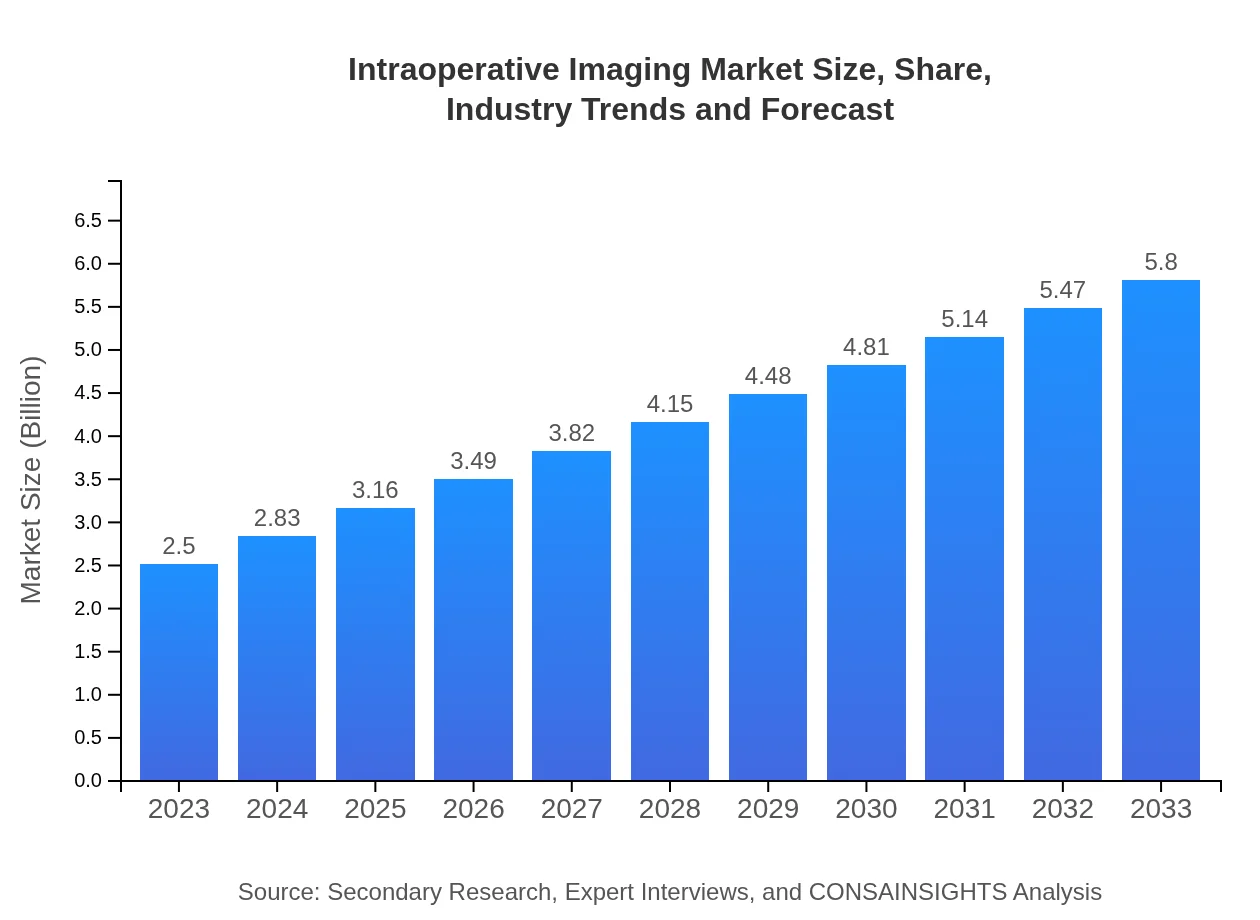
Intraoperative Imaging Market — USD 2.5 billion in 2023, Growing to USD 5.80B by 2033 at 8.5% CAGR
This report provides an in-depth analysis of the Intraoperative Imaging market from 2023 to 2033. It covers market trends, growth forecasts, and segmentation, along with insights on the competitive landscape and regional developments.
Key Takeaways
- Global market expands from $2.50 Billion in 2023 to $5.80 Billion in 2033 at an 8.5% CAGR.
- North America is largest regional market; Latin America is regional market region based on implied CAGR across 2023 to 2033.
- Latin America is identified as the regional market region, rising from $0.04 Billion to $0.1 Billion with an implied 9.60% CAGR.
- Europe, Asia Pacific, and Middle East & Africa all show multi-fold increases reflecting broader adoption across care settings.
- Key vendors include GE Healthcare, Philips Healthcare, Siemens Healthineers, and Canon Medical Systems.
Intraoperative Imaging Market Report — Executive Summary
Regional analysis shows North America as largest market and Latin America as fastest-growing region by implied CAGR. The Intraoperative Imaging Market Report outlines a market trajectory from $2.50 Billion in 2023 to $5.80 Billion in 2033, at an 8.5% CAGR. Growth is supported by enhancements in imaging systems, wider uptake of minimally invasive procedures, and demand for improved surgical precision. Product categories span imaging hardware, software, and services, while end users include hospitals, surgical centers, and academic institutions. Regional dynamics vary: North America is the largest market, and Latin America records the highest implied CAGR. Major suppliers such as GE Healthcare, Philips Healthcare, Siemens Healthineers, and Canon Medical Systems remain central to technology diffusion. Ongoing trends include expansion of 2D and 3D modalities and integration of advanced imaging capabilities to assist intraoperative decision-making. The report synthesizes primary interviews, company disclosures, and validated data to support actionable insights for stakeholders across the life-sciences sector.
Key Growth Drivers
- Rising adoption of minimally invasive surgeries increases demand for intraoperative visualization tools.
- Continuous improvements in imaging hardware and advanced imaging modalities enhance intraoperative accuracy.
- Broader deployment of imaging software and services supports workflow efficiency in surgical environments.
- Expansion of surgical procedures and growing healthcare investments in key regions bolster market uptake.
- Hospitals and academic centers investing in intraoperative systems to improve patient outcomes and procedural success.
| Metric | Value |
|---|---|
| Study Period | 2023 - 2033 |
| 2023 Market Size | $2.50 Billion |
| CAGR (2023-2033) | 8.5% |
| 2033 Market Size | $5.80 Billion |
| Top Companies | GE Healthcare, Philips Healthcare, Siemens Healthineers, Canon Medical Systems |
| Published Date | 20 October 2024 |
| Last Modified Date | 28 May 2026 |
Intraoperative Imaging Market Overview
Customize Intraoperative Imaging Market Report market research report
- ✔ Get in-depth analysis of Intraoperative Imaging market size, growth, and forecasts.
- ✔ Understand Intraoperative Imaging's regional dynamics and industry-specific trends.
- ✔ Identify potential applications, end-user demand, and growth segments in Intraoperative Imaging
What is the Market Size & CAGR of Intraoperative Imaging Market Report market in 2023?
Intraoperative Imaging Industry Analysis
Intraoperative Imaging Market Segmentation and Scope
Tell us your focus area and get a customized research report.
Intraoperative Imaging Market Report Market Analysis Report by Region
Europe Intraoperative Imaging Market Report:
Europe grows from $0.84 Billion in 2023 to $1.94 Billion in 2033. Expansion reflects increasing use of intraoperative modalities across surgical specialties and investments by healthcare providers in imaging equipment and services.Asia Pacific Intraoperative Imaging Market Report:
Asia Pacific grows from $0.43 Billion in 2023 to $1.01 Billion in 2033. Growth drivers include rising surgical volumes, expanding healthcare infrastructure, and wider access to imaging technologies in hospitals and specialty centers.North America Intraoperative Imaging Market Report:
North America is largest regional market, rising from $0.91 Billion in 2023 to $2.12 Billion in 2033. Regional growth is supported by strong hospital adoption, investments in advanced imaging platforms, and established vendor presence.South America Intraoperative Imaging Market Report:
Latin America is fastest-growing region by implied CAGR, increasing from $0.04 Billion in 2023 to $0.1 Billion in 2033. 04 Billion in 2023 to $0.1 Billion in 2033 and is identified as the regional growth market with an implied 9.60% CAGR, driven by growing healthcare investments and gradual adoption of intraoperative imaging solutions.Middle East & Africa Intraoperative Imaging Market Report:
Middle East and Africa grows from $0.27 Billion in 2023 to $0.63 Billion in 2033. 27 Billion in 2023 to $0.63 Billion in 2033, supported by increasing procurement of imaging systems, development of surgical capabilities, and greater emphasis on improving procedural outcomes.Tell us your focus area and get a customized research report.
Research Methodology
Intraoperative Imaging Market Analysis By Product
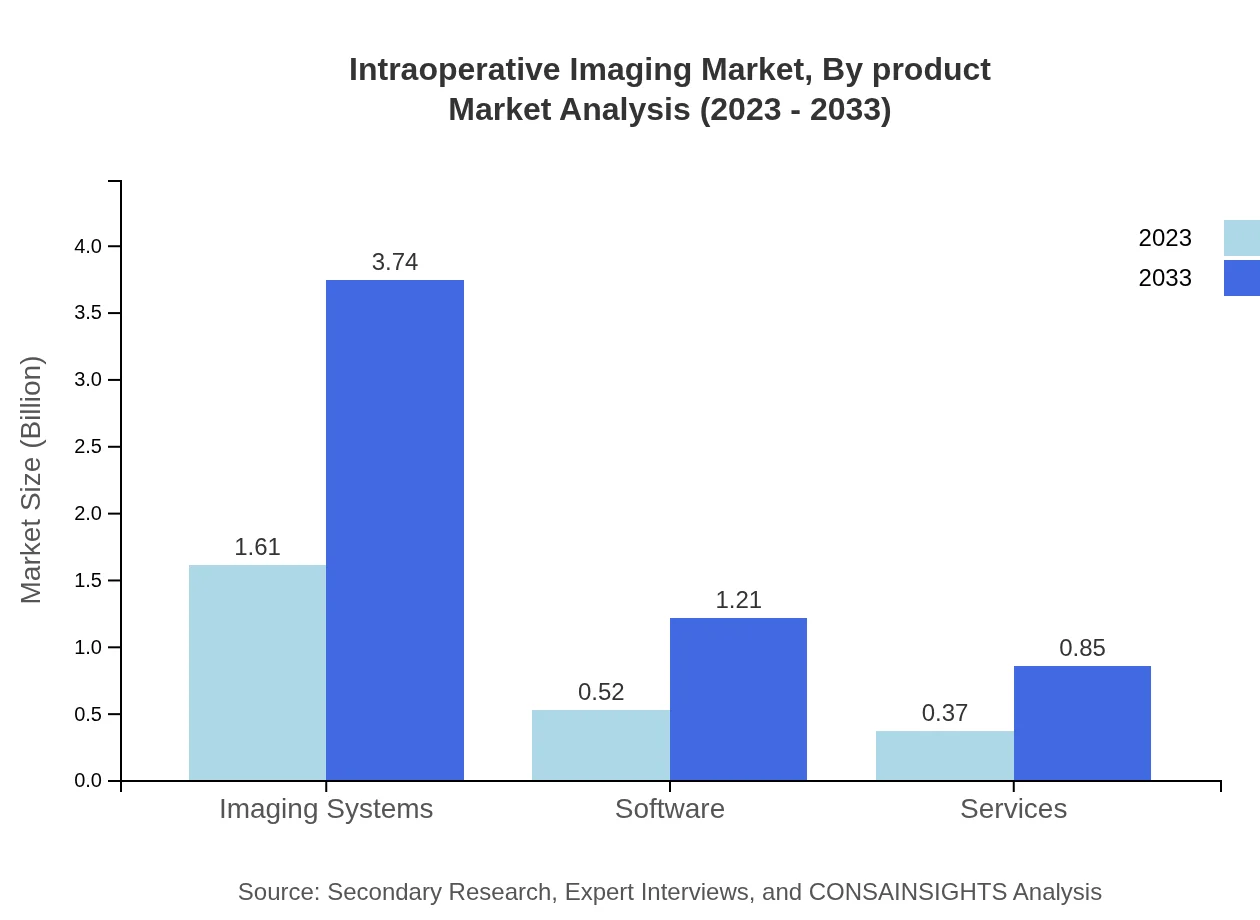
The Intraoperative Imaging market, segmented by product, includes imaging systems, software, and services. Imaging systems encompass technologies like CT, MRI, and fluoroscopy, contributing significantly to market growth, with a market size of USD 1.61 billion in 2023 expected to reach USD 3.74 billion by 2033. Software tools for intraoperative imaging play a critical role in enhancing imaging accuracy and workflow efficiency, set to grow from USD 0.52 billion in 2023 to USD 1.21 billion by 2033.
Intraoperative Imaging Market Analysis By Application
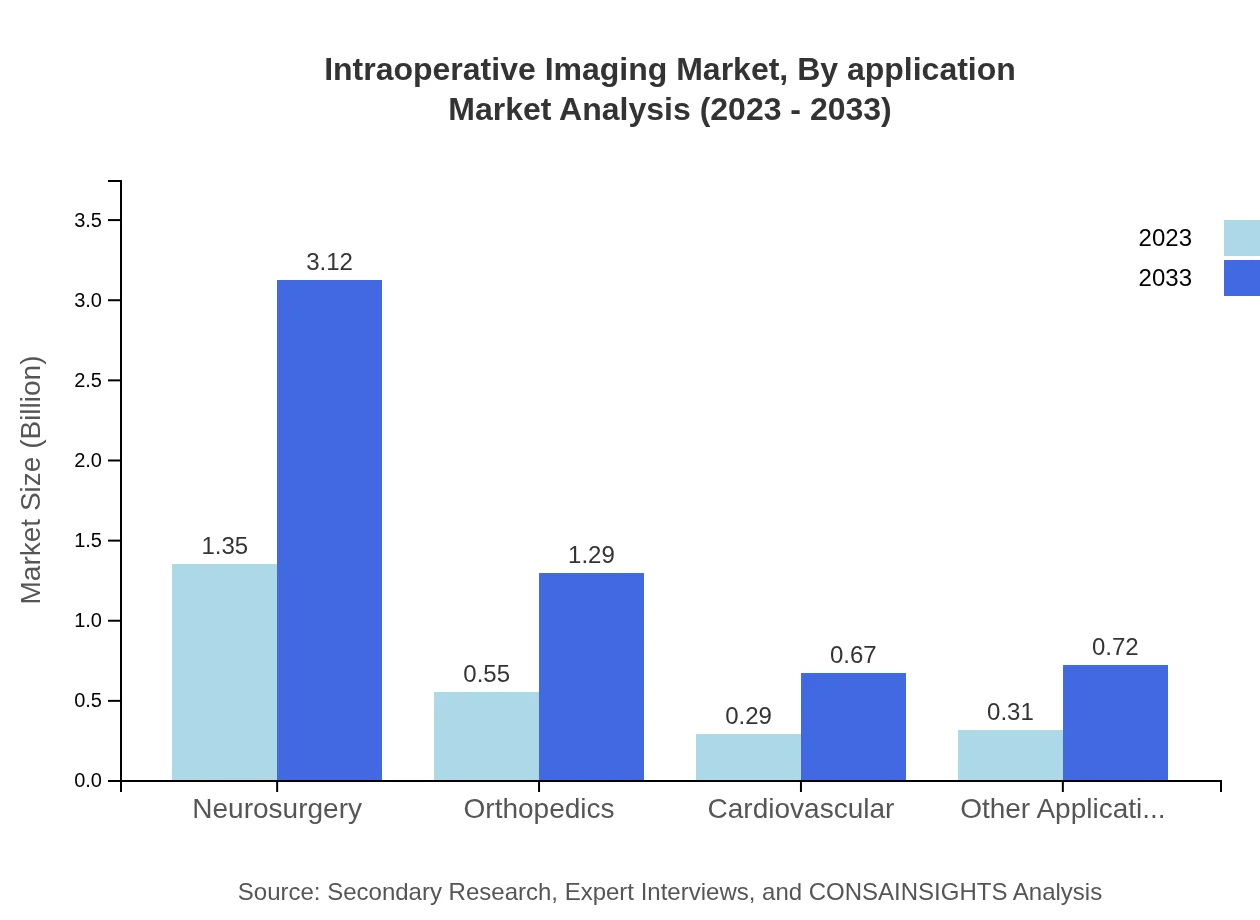
The applications of intraoperative imaging are primarily divided into diagnostic and therapeutic uses. The diagnostic applications account for a dominant market share of 81.19%, with a notable growth from USD 2.03 billion in 2023 to USD 4.71 billion by 2033, showcasing the critical role these technologies play in improving surgical outcomes.
Intraoperative Imaging Market Analysis By End User
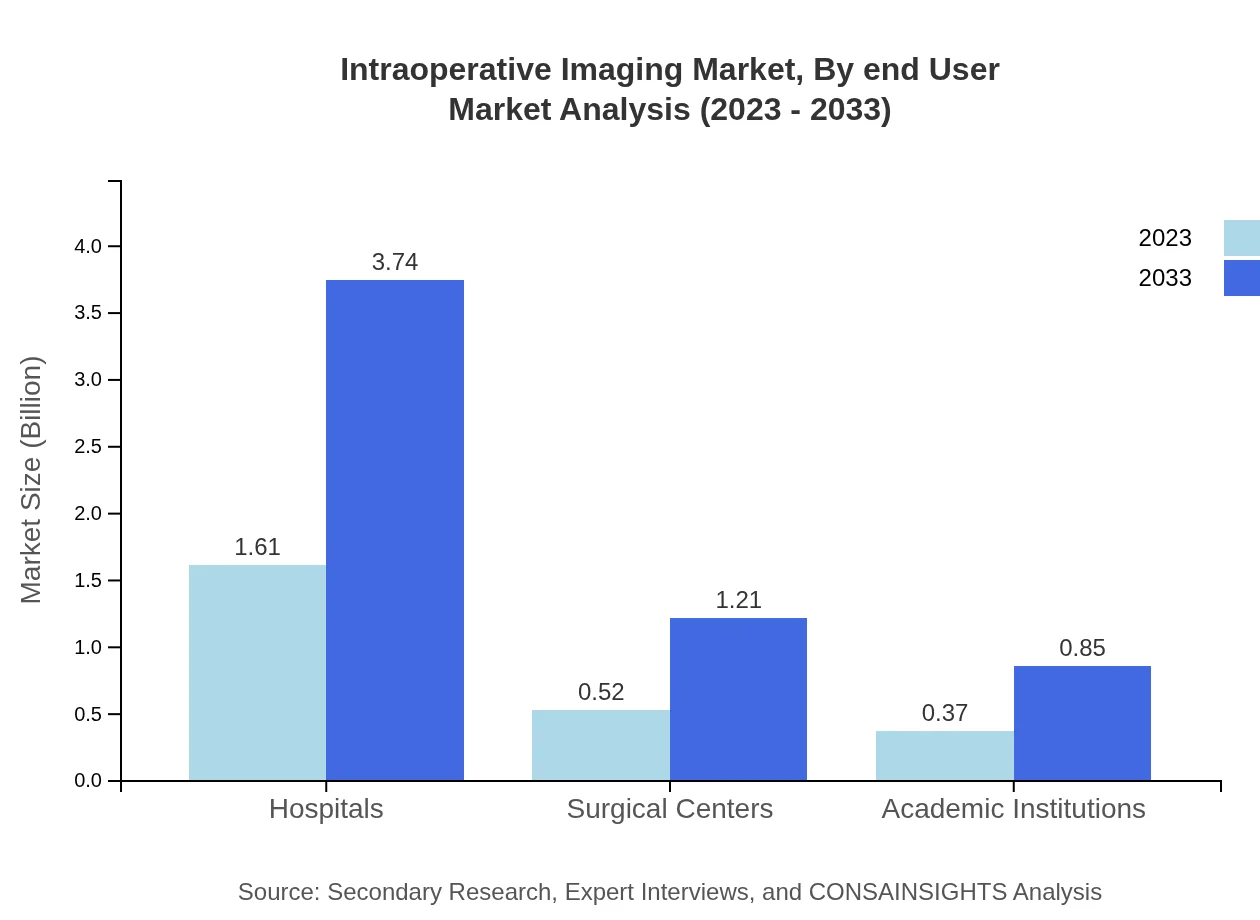
By end-user, hospitals account for a significant share of the Intraoperative Imaging market, expected to grow from USD 1.61 billion in 2023 to USD 3.74 billion by 2033. Surgical centers and academic institutions also present growth opportunities, with respective market sizes of USD 0.52 billion and USD 0.37 billion in 2023.
Intraoperative Imaging Market Analysis By Technology
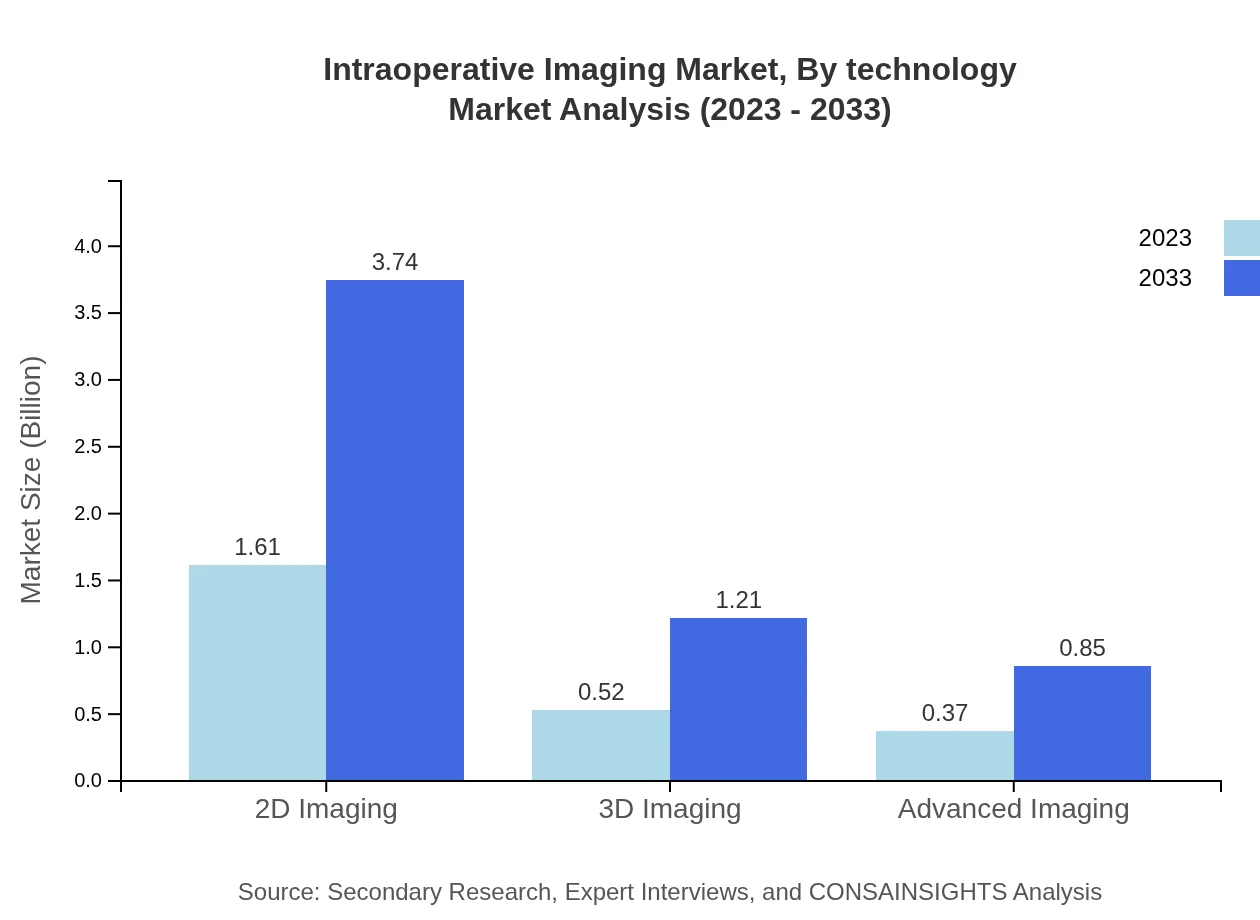
The technology segment includes 2D imaging, 3D imaging, and advanced imaging solutions. 2D imaging dominates the market with a share of 64.48%, projected to expand from USD 1.61 billion in 2023 to USD 3.74 billion by 2033. 3D imaging and advanced technologies are also seeing increased interest, with growing applications in complex surgical cases.
Intraoperative Imaging Market Analysis By End Use
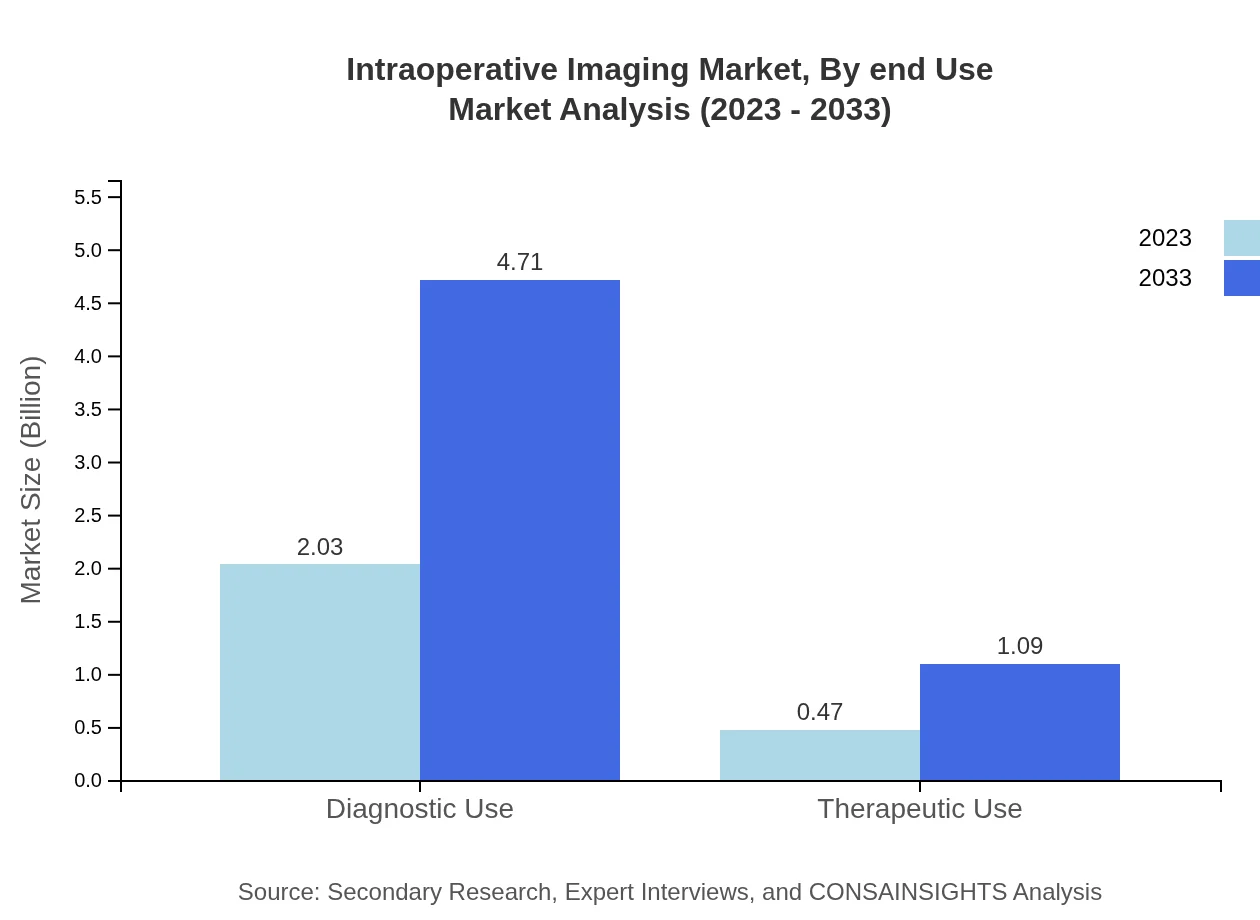
In the end-use category, neurosurgery accounts for the largest share at 53.84%, with a market size growing from USD 1.35 billion in 2023 to USD 3.12 billion by 2033. Other applications in orthopedics and cardiovascular surgery, with respective shares of 22.16% and 11.51%, highlight the diverse applications of intraoperative imaging technologies across various surgical specialties.
Intraoperative Imaging Market Trends and Future Forecast
Tell us your focus area and get a customized research report.
Global Market Leaders and Top Companies in Intraoperative Imaging Industry
GE Healthcare:
A leading global provider of medical imaging equipment and technologies, GE Healthcare focuses on innovative solutions that enhance the quality of imaging and patient care.Philips Healthcare:
Recognized for its advanced imaging systems, Philips Healthcare emphasizes integration and innovation, delivering comprehensive solutions for intraoperative imaging.Siemens Healthineers:
Siemens Healthineers offers a robust portfolio of imaging systems and services designed for various surgical procedures, with an increasing focus on AI-driven diagnostics.Canon Medical Systems:
Canon Medical is committed to providing imaging solutions that enhance patient safety and care, supporting healthcare professionals with advanced imaging technologies.We're grateful to work with incredible clients.









FAQs
What is the market size of the intraoperative imaging market in 2023?
The market size for 2023 is $2.50 Billion, as reported in the input data, representing the baseline for the 2023 to 2033 forecast period.
How big will the market be in 2033?
By 2033 the market is projected to reach $5.80 Billion according to the provided forecast figures for the 2023 to 2033 period.
What is CAGR of the market for 2023 to 2033?
The reported compound annual growth rate for the forecast period 2023 to 2033 is 8.5%, based on the supplied market projections.
Which region is the fastest Growing in the Intraoperative Imaging Market Report market?
Latin America is the fastest-growing region, projected to expand from $0.04 Billion in 2023 to $0.1 Billion in 2033, reflecting an implied 9.60% CAGR over the forecast period.
Which region is the fastest Growing?
Latin America is specified as the regional market region with an implied 9.60% CAGR, increasing from $0.04 Billion in 2023 to $0.1 Billion in 2033.
Who are the top companies in the market?
Top companies listed include GE Healthcare, Philips Healthcare, Siemens Healthineers, and Canon Medical Systems as key market participants.
What end users adopt intraoperative imaging systems?
End users identified include hospitals, surgical centers, and academic institutions, reflecting primary adoption settings for intraoperative solutions.
How are products segmented in this market?
Product segmentation covers imaging systems, software, and services, with technology categories including 2D imaging, 3D imaging, and advanced imaging modalities.
What applications drive demand for intraoperative imaging?
Applications listed include neurosurgery, orthopedics, cardiovascular procedures, and other surgical uses that require real-time visualization.
What research methods were used to prepare the report?
The methodology relies on primary interviews with industry experts, secondary research from company reports and publications, data triangulation, and internal validation.