

Intravascular Temperature Management Market Report
First published: 20 October 2024 | Last updated: 25 May 2026 | Report Code: intravascular-temperature-management
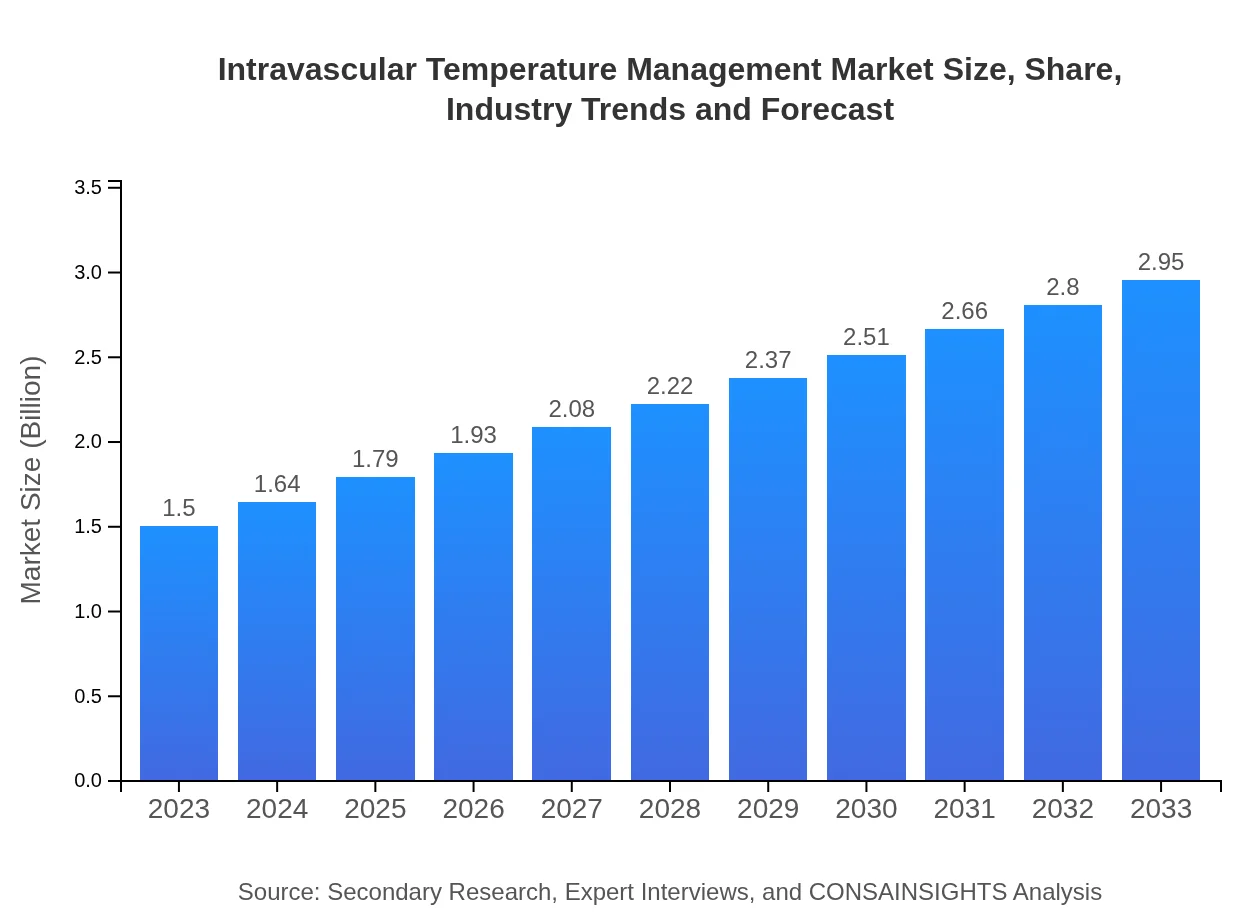
Intravascular Temperature Management Market — USD 1.5 billion in 2023, Growing to USD 2.95B by 2033 at 6.8% CAGR
This market report analyzes the Intravascular Temperature Management sector, providing insights into market trends, sizes, growth forecasts, and competitive dynamics from 2023 to 2033.
Key Takeaways
- Global market grows from $1.50 Billion in 2023 to $2.95 Billion in 2033, reflecting a 6.8% CAGR.
- Europe is largest regional market, while no single fastest-growing region is stated because regional CAGR differences remain within 0.15 percentage points.
- Europe is the largest region, expanding from $0.52 Billion in 2023 to $1.02 Billion in 2033.
- North America rises from $0.51 Billion to $1.01 Billion between 2023 and 2033, indicating strong regional momentum.
- Device categories include temperature management catheters, temperature control units, and other devices.
- Top players in the landscape include Medtronic, Gordon Medical Associates, Stryker Corporation, and ZOLL Medical Corporation.
Intravascular Temperature Management Market Report — Executive Summary
Europe remains largest market by forecast-period value, while no single fastest-growing region is stated because top regional growth rates are separated by less than 0.15 percentage points. This report examines the intravascular temperature management sector, documenting market size, expansion drivers, and competitive dynamics. The market value increases from $1.50 Billion in 2023 to $2.95 Billion in 2033 at a 6.8% CAGR through 2023 to 2033. Growth is supported by heightened emphasis on patient safety during surgeries and in critical care, technological enhancements such as integrated sensors and connected devices, and a rising volume of procedures requiring precise thermal control. The analysis covers device segments—temperature management catheters, temperature control units, and other devices—alongside end users like hospitals and ambulatory surgical centers, and applications spanning surgery, critical care, neurology, and pediatrics. Regional performance is detailed with Europe identified as the largest regional market. The competitive landscape profiles leading companies including Medtronic, Gordon Medical Associates, Stryker Corporation, and ZOLL Medical Corporation. Findings are intended to help stakeholders evaluate investment priorities, product development, and partnership opportunities within this evolving medical device market.
Key Growth Drivers
- Increased focus on maintaining patient temperature during surgical and critical care procedures drives demand for intravascular solutions.
- Advances in device technology, including enhanced sensing and connected functionality, improve monitoring accuracy and clinical adoption.
- Rising numbers of surgeries and intensive care treatments that require precise thermal management support market expansion.
- Regulatory attention on patient safety encourages vendor investment in research and development to meet compliance and performance needs.
| Metric | Value |
|---|---|
| Study Period | 2023 - 2033 |
| 2023 Market Size | $1.50 Billion |
| CAGR (2023-2033) | 6.8% |
| 2033 Market Size | $2.95 Billion |
| Top Companies | Medtronic , Gordon Medical Associates, Stryker Corporation, ZOLL Medical Corporation |
| Published Date | 20 October 2024 |
| Last Modified Date | 25 May 2026 |
Intravascular Temperature Management Market Overview
Customize Intravascular Temperature Management Market Report market research report
- ✔ Get in-depth analysis of Intravascular Temperature Management market size, growth, and forecasts.
- ✔ Understand Intravascular Temperature Management's regional dynamics and industry-specific trends.
- ✔ Identify potential applications, end-user demand, and growth segments in Intravascular Temperature Management
What is the Market Size & CAGR of Intravascular Temperature Management Market Report market in 2023?
Intravascular Temperature Management Industry Analysis
Intravascular Temperature Management Market Segmentation and Scope
Tell us your focus area and get a customized research report.
Intravascular Temperature Management Market Report Market Analysis Report by Region
Europe Intravascular Temperature Management Market Report:
Europe is largest regional market, rising from $0.52 Billion in 2023 to $1.02 Billion in 2033. Growth is supported by established healthcare systems, focus on patient safety during surgical and critical care procedures, and adoption of advanced monitoring and temperature control technologies.Asia Pacific Intravascular Temperature Management Market Report:
Asia Pacific grows from $0.25 Billion in 2023 to $0.49 Billion in 2033. Expansion is linked to increasing procedural volumes, rising awareness of thermal management in clinical care, and gradual adoption of improved device technologies across care settings.North America Intravascular Temperature Management Market Report:
North America grows from $0.51 Billion in 2023 to $1.01 Billion in 2033. Regional demand reflects strong clinical adoption in hospitals and intensive care settings, technology uptake, and healthcare spending that supports deployment of intravascular temperature control devices.South America Intravascular Temperature Management Market Report:
Latin America grows from $0.05 Billion in 2023 to $0.1 Billion in 2033. Market progress is driven by growing recognition of temperature management benefits during surgeries and critical care, along with incremental adoption of device solutions in regional healthcare facilities.Middle East & Africa Intravascular Temperature Management Market Report:
Middle East and Africa grows from $0.16 Billion in 2023 to $0.32 Billion in 2033. Growth reflects expanding healthcare services, heightened awareness of perioperative temperature control, and gradual incorporation of temperature management devices into clinical practice.Tell us your focus area and get a customized research report.
Research Methodology
Intravascular Temperature Management Market Analysis By Device
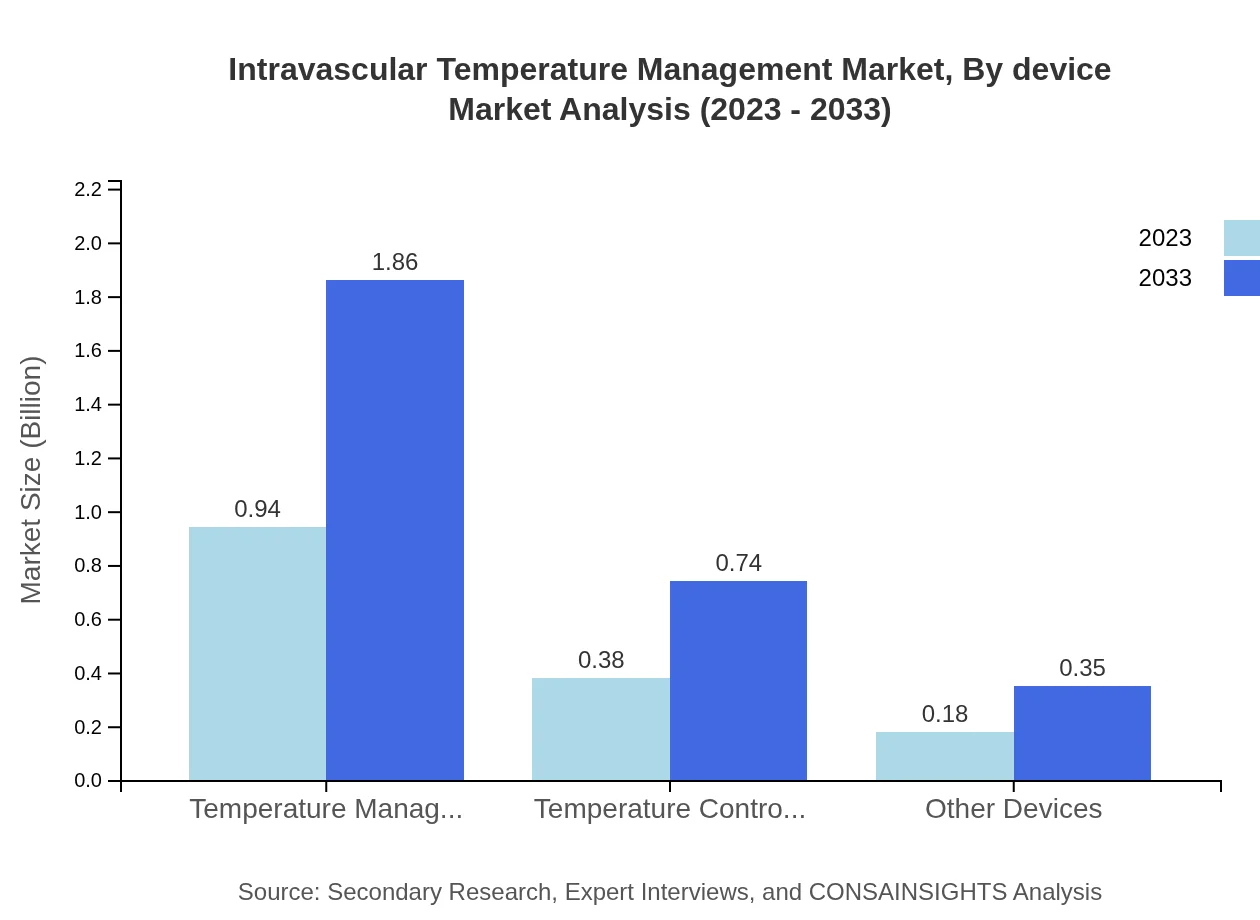
In 2023, temperature management catheters dominate the market with a size of $0.94 billion, projected to reach $1.86 billion by 2033. They hold a 62.95% market share. Temperature control units follow, with a market size of $0.38 billion in 2023, doubling to $0.74 billion by 2033, commanding a 25.19% share. Other devices account for $0.18 billion, with expectations to experience growth to $0.35 billion, making up 11.86% of the market.
Intravascular Temperature Management Market Analysis By Application
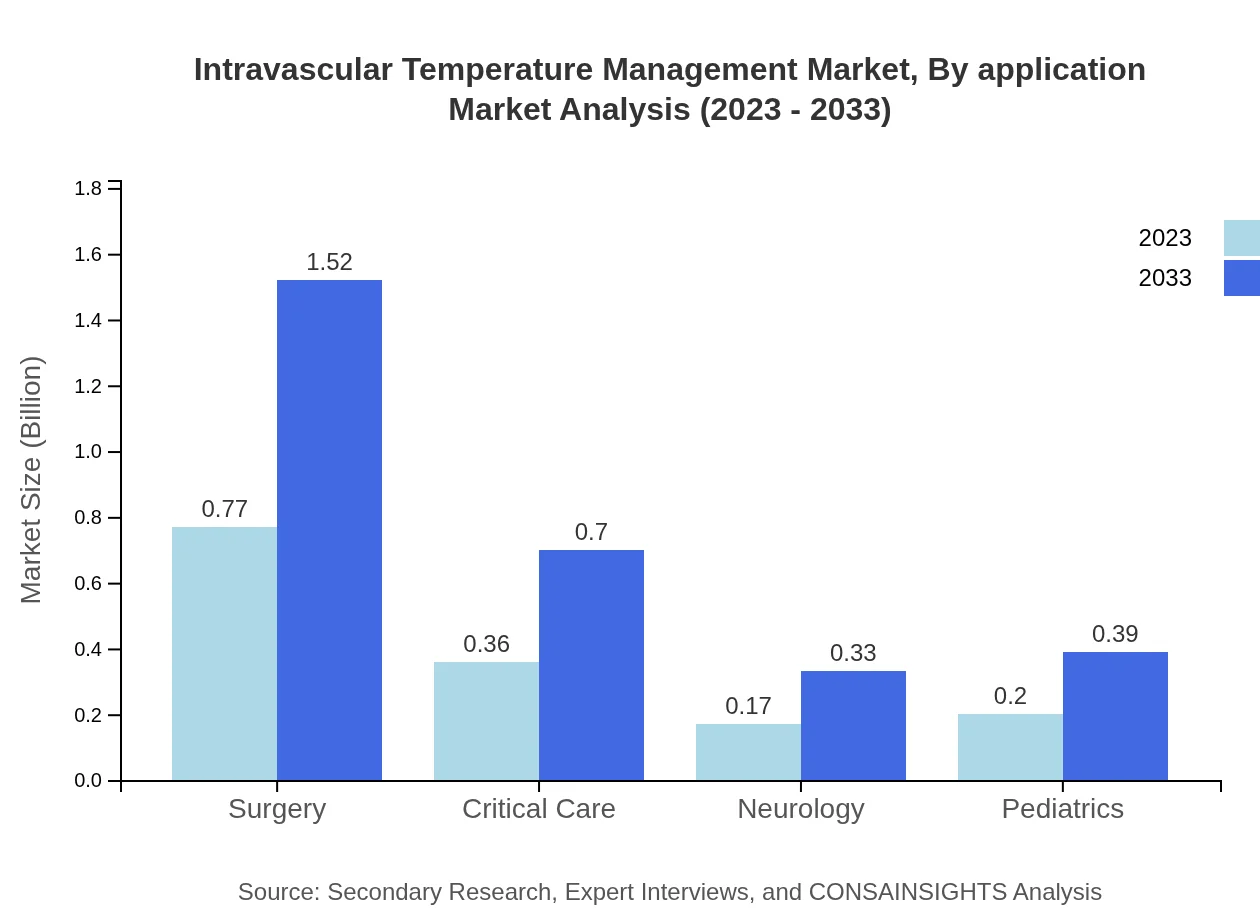
Surgery remains the largest application area for the intravascular temperature management market, standing at $0.77 billion in 2023 and projected to reach $1.52 billion by 2033, a 51.62% market share. Critical care applications account for $0.36 billion and are expected to grow to $0.70 billion, representing 23.9%. Neurology and pediatrics applications contribute $0.17 billion and $0.20 billion respectively, with similar growth expected up to $0.33 billion and $0.39 billion by 2033.
Intravascular Temperature Management Market Analysis By End User
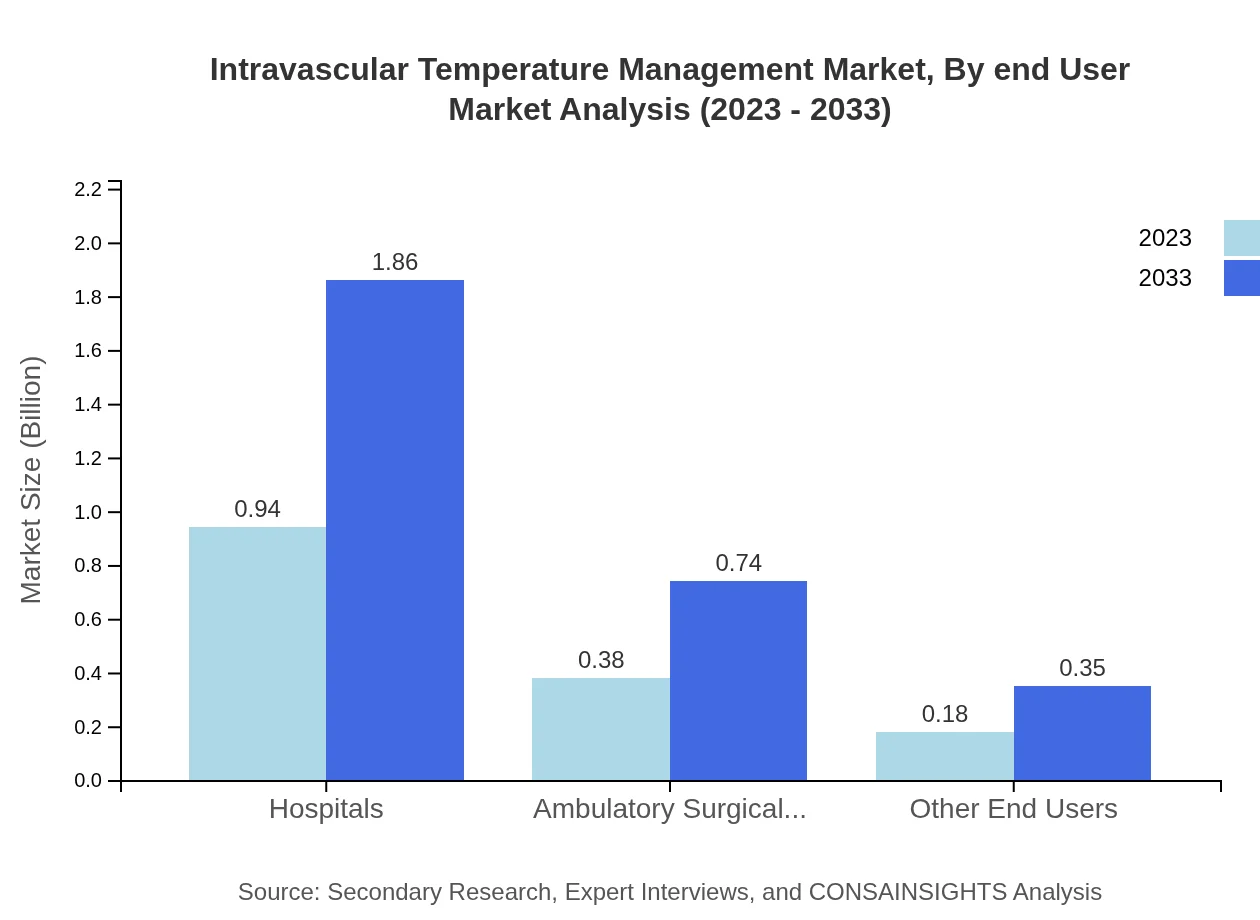
Hospitals are the primary end-users of intravascular temperature management systems, with a market size of $0.94 billion in 2023, expected to reach $1.86 billion by 2033 (62.95% market share). Ambulatory surgical centers follow with a market size of $0.38 billion, projected to grow to $0.74 billion, holding a 25.19% share in the market. Other end-users represent $0.18 billion with an increase anticipated up to $0.35 billion (11.86%).
Intravascular Temperature Management Market Analysis By Region
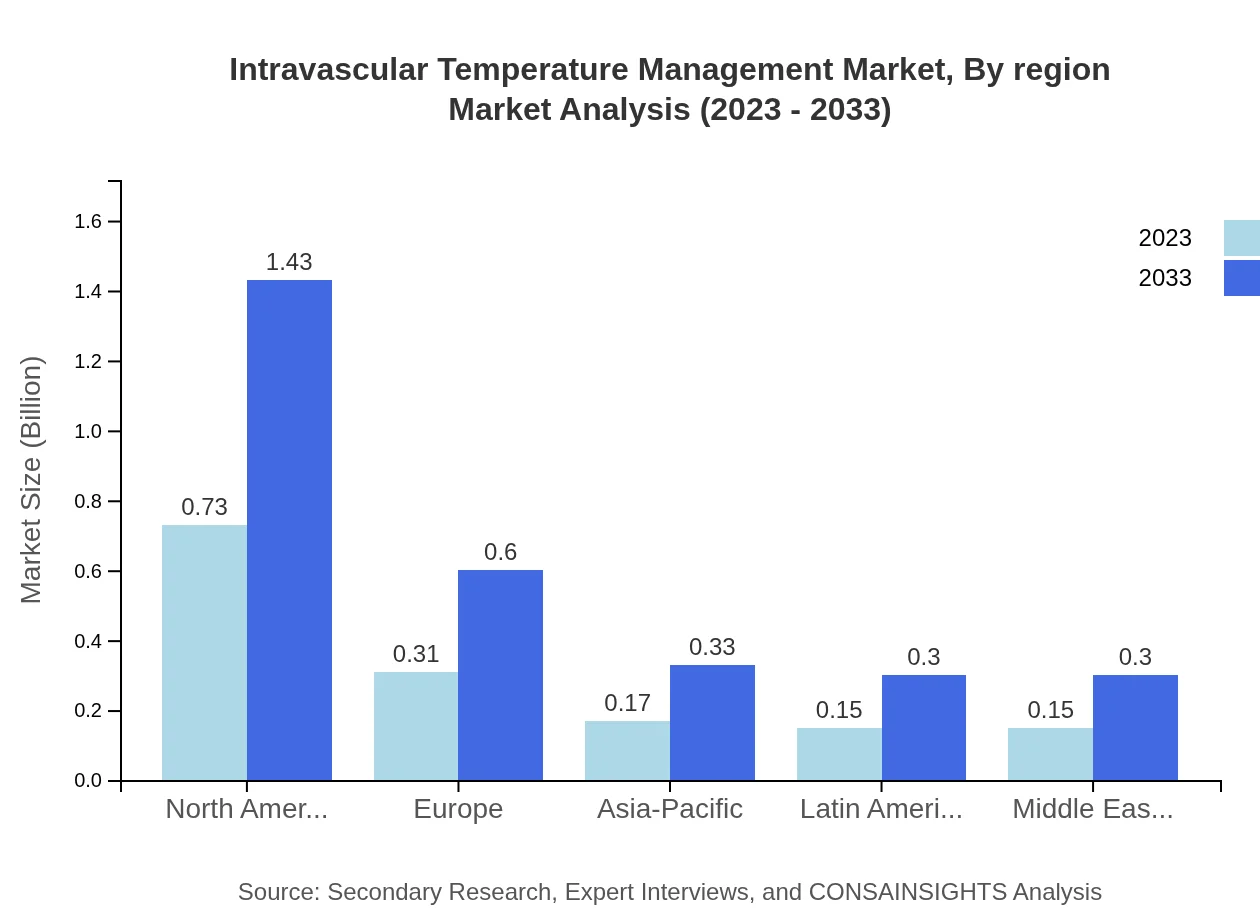
Regional market segmentation reveals North America as the leader, with a market size of $0.73 billion in 2023 projected to grow to $1.43 billion by 2033 (48.47% share). Europe stands next with an increase from $0.31 billion to $0.60 billion (20.4% share). Asia-Pacific markets report sizes of $0.17 billion, expected to reach $0.33 billion (11.1% share). Latin America and the Middle East & Africa markets hold smaller shares, growing toward $0.30 billion each, constituting 10.02% and 10.01% share respectively.
Intravascular Temperature Management Market Trends and Future Forecast
Tell us your focus area and get a customized research report.
Global Market Leaders and Top Companies in Intravascular Temperature Management Industry
Medtronic :
Medtronic is a leading healthcare technology company that specializes in developing innovative medical devices, including intravascular temperature management systems to enhance patient care in critical environments.Gordon Medical Associates:
Gordon Medical Associates focuses on temperature management solutions that integrate advanced technologies, providing healthcare professionals with reliable tools to manage patient body temperature effectively.Stryker Corporation:
Stryker is known for its extensive portfolio in surgical and medical devices, particularly its cutting-edge temperature management products that ensure optimal patient outcomes during surgical procedures.ZOLL Medical Corporation:
ZOLL is dedicated to advancing critical care through innovative technologies, offering solutions in intravascular temperature management that improve recovery rates and patient safety.We're grateful to work with incredible clients.








FAQs
What is the market size of the intravascular temperature management market in 2023?
The market size in 2023 is $1.50 Billion, reflecting baseline demand across devices, applications, and regions as captured in the report.
How big will the market be in 2033?
By 2033 the market is projected to reach $2.95 Billion, based on the report’s forecast covering trends and regional growth through 2023 to 2033.
What is CAGR of the market for the forecast period?
The compound annual growth rate (CAGR) for the forecast period 2023 to 2033 is 6.8%, reflecting steady expansion across device and regional segments.
Is there a single fastest Growing region in the Intravascular Temperature Management Market Report market?
No single fastest-growing region is stated for the Intravascular Temperature Management Market Report market because the top regional implied CAGR values are within 0.15 percentage points of each other, making the ranking too close to call reliably.
Which companies are highlighted in the competitive landscape?
Reported leading companies include Medtronic, Gordon Medical Associates, Stryker Corporation, and ZOLL Medical Corporation as notable participants in the market.
What are the main device categories covered in the report?
Devices detailed include temperature management catheters, temperature control units, and other devices used for intravascular thermal regulation.
How does clinical need influence market growth?
Clinical emphasis on preventing hypothermia and hyperthermia during surgery and critical care elevates demand for precise intravascular temperature control solutions.
What end users are assessed in the study?
The report examines hospitals, ambulatory surgical centers, and other end users to capture deployment and procurement patterns across care settings.