
Reports >
Life Sciences
>
Lab Automation Market Report

Lab Automation Market Report
First published: 08 October 2024 | Last updated: 25 May 2026 | Report Code: lab-automation
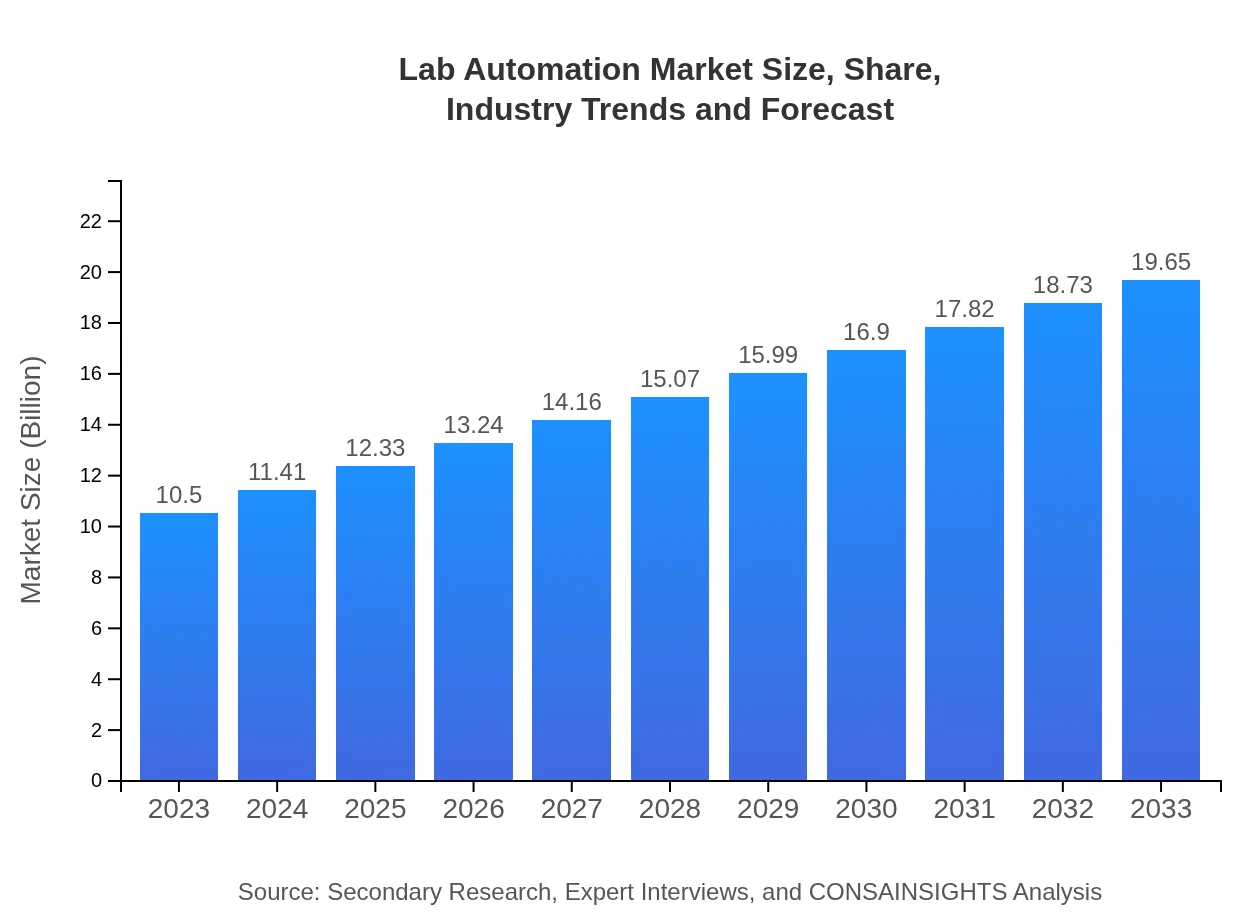
Lab Automation Market — USD 10.5 billion in 2023, Growing to USD 19.65B by 2033 at 6.3% CAGR
This report provides a comprehensive analysis of the Lab Automation market from 2023 to 2033, detailing market trends, size, segmentation, regional insights, and key players, along with future forecasts and technological advancements that are shaping this industry.
Key Takeaways
- Global market expands from $10.50 Billion in 2023 to $19.65 Billion in 2033 at a 6.3% CAGR.
- North America is largest regional market, while no single fastest-growing region is stated because regional CAGR differences remain within 0.15 percentage points.
- North America leads regional market value, increasing from $3.94 Billion in 2023 to $7.38 Billion in 2033.
- Europe and Asia Pacific show substantial absolute growth with Europe rising from $2.89 Billion to $5.42 Billion, and Asia Pacific from $2.01 Billion to $3.75 Billion.
- Market composition includes instruments, software and consumables alongside robotics, AI and IoT-enabled solutions.
- Major vendors cited include Thermo Fisher Scientific, Agilent Technologies, Beckman Coulter, Roche and Siemens Healthineers.
Lab Automation Market Report — Executive Summary
North America remains largest market by forecast-period value, while no single fastest-growing region is stated because top regional growth rates are separated by less than 0.15 percentage points. This report examines the lab automation sector across products, technologies, end users and regions, highlighting drivers such as the need for higher throughput, process standardization and cost reduction. Adoption is propelled by instrument innovations, integration of software and consumables, and increased deployment of robotics, AI and IoT for workflow optimization. The study profiles market sizing from $10.50 Billion in 2023 to $19.65 Billion in 2033 at a 6.3% CAGR and analyzes the roles of pharmaceutical, clinical and academic laboratories in demand formation. Regional breakdowns quantify shifts in North America, Europe, Asia Pacific, Latin America and Middle East & Africa, while competitive coverage includes Thermo Fisher Scientific, Agilent Technologies, Beckman Coulter, Roche and Siemens Healthineers. Methodology blends primary expert interviews with secondary sources, triangulation and internal validation to produce trend-driven insights and actionable implications for stakeholders.
Key Growth Drivers
- Rising demand for higher laboratory throughput and reduced manual error is driving investment in automated instruments and workflows.
- Integration of software, AI and IoT capabilities enables real-time monitoring and predictive maintenance, improving lab efficiency.
- Cost pressures and the need for standardized processes in pharmaceutical and clinical testing push adoption of end-to-end automation platforms.
- Development of specialized consumables and interoperable instruments expands applicability across drug discovery, diagnostics and environmental testing.
| Metric | Value |
|---|---|
| Study Period | 2023 - 2033 |
| 2023 Market Size | $10.50 Billion |
| CAGR (2023-2033) | 6.3% |
| 2033 Market Size | $19.65 Billion |
| Top Companies | Thermo Fisher Scientific, Agilent Technologies, Beckman Coulter, Roche, Siemens Healthineers |
| Published Date | 08 October 2024 |
| Last Modified Date | 25 May 2026 |
Lab Automation Market Overview
Customize Lab Automation Market Report market research report
- ✔ Get in-depth analysis of Lab Automation market size, growth, and forecasts.
- ✔ Understand Lab Automation's regional dynamics and industry-specific trends.
- ✔ Identify potential applications, end-user demand, and growth segments in Lab Automation
What is the Market Size & CAGR of Lab Automation Market Report market in 2023?
Lab Automation Industry Analysis
Lab Automation Market Segmentation and Scope
Tell us your focus area and get a customized research report.
Lab Automation Market Report Market Analysis Report by Region
Europe Lab Automation Market Report:
Europe grows from $2.89 Billion in 2023 to $5.42 Billion in 2033. 89 Billion in 2023 to $5.42 Billion in 2033, with demand driven by clinical diagnostics modernization, research funding and adoption of software-driven laboratory workflows in biotech and academic settings.Asia Pacific Lab Automation Market Report:
Asia Pacific grows from $2.01 Billion in 2023 to $3.75 Billion in 2033. Expansion is linked to rising research activity, growing pharmaceutical manufacturing and wider uptake of robotics and IoT-enabled lab solutions.North America Lab Automation Market Report:
North America is largest regional market, rising from $3.94 Billion in 2023 to $7.38 Billion in 2033. Growth is supported by high adoption in pharmaceutical and clinical laboratories, investment in advanced instruments and widespread integration of automation technologies.South America Lab Automation Market Report:
Latin America grows from $0.38 Billion in 2023 to $0.72 Billion in 2033. Growth factors include increased testing capacity, investments in diagnostics and gradual deployment of automated instruments and consumables.Middle East & Africa Lab Automation Market Report:
Middle East and Africa grows from $1.27 Billion in 2023 to $2.39 Billion in 2033. 27 Billion in 2023 to $2.39 Billion in 2033, supported by expanding clinical laboratory infrastructure, public health testing initiatives and gradual incorporation of automation technologies.Tell us your focus area and get a customized research report.
Research Methodology
Lab Automation Market Analysis By Product
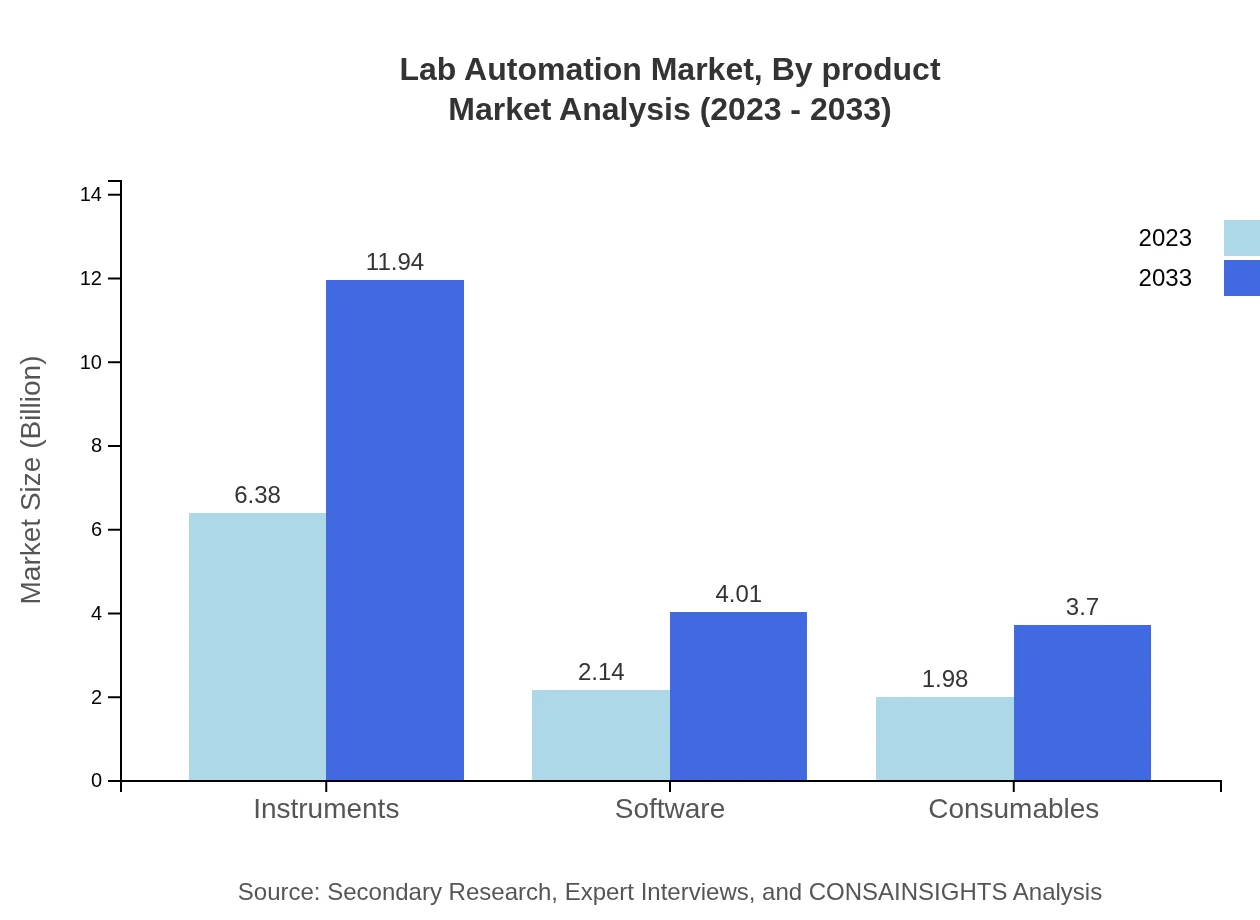
The product segment consists of Instruments, Software, and Consumables. Instruments dominate the market with a size of $6.38 billion in 2023, forecasted to reach $11.94 billion by 2033, holding a share of 60.79%. The software segment, with a market size of $2.14 billion in 2023, is expected to grow to $4.01 billion, contributing 20.4% to the market. Consumables account for $1.98 billion in 2023, projected to grow to $3.70 billion with an 18.81% market share.
Lab Automation Market Analysis By Application
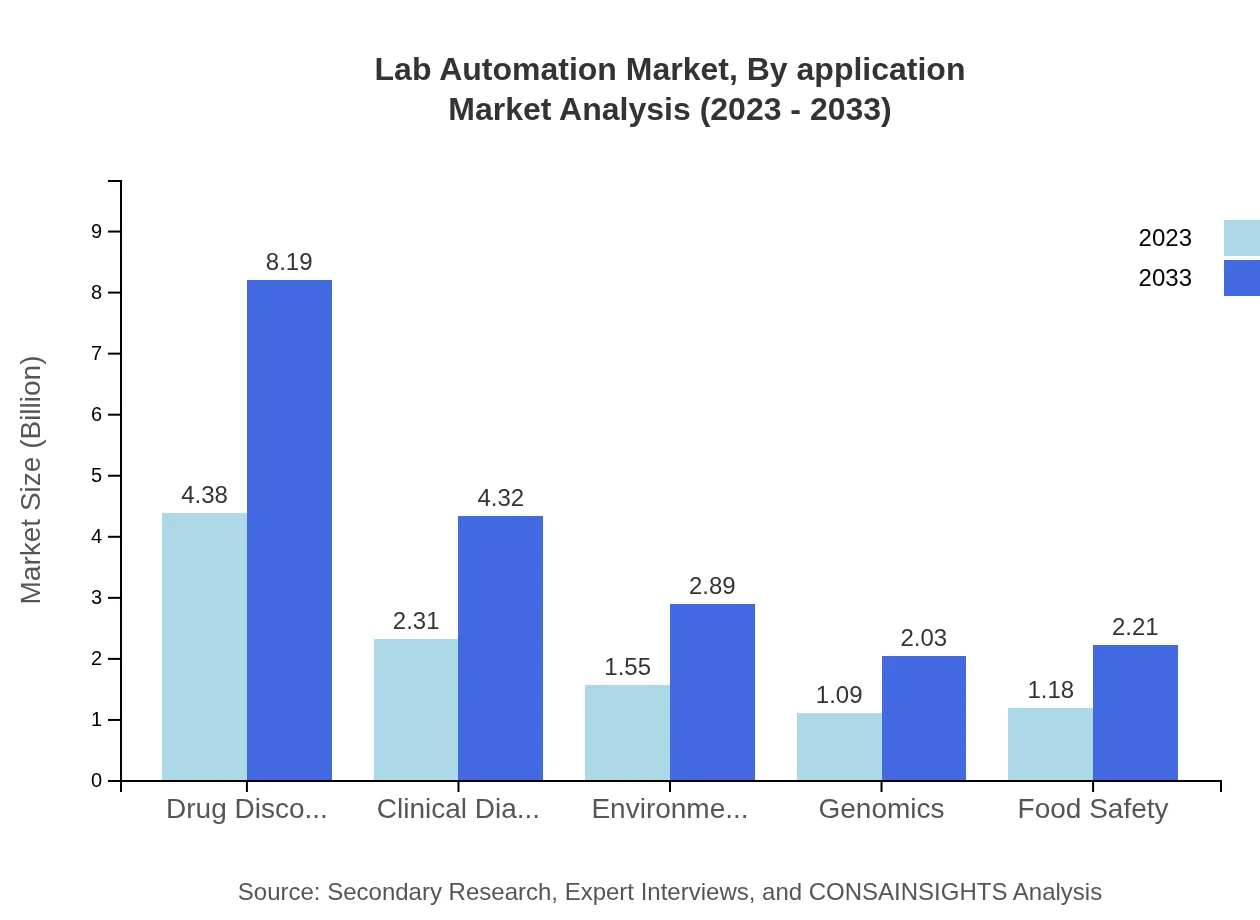
Applications in the Lab Automation market include Drug Discovery, Clinical Diagnostics, Environmental Testing, and Academic Research. Drug Discovery, being a significant segment, occupies 41.68% of the market with a size of $4.38 billion in 2023, rising to $8.19 billion by 2033. Clinical Diagnostics follows with a market share of 22%, growing from $2.31 billion to $4.32 billion. Other applications are also seeing growth due to increased laboratory automation needs.
Lab Automation Market Analysis By End User
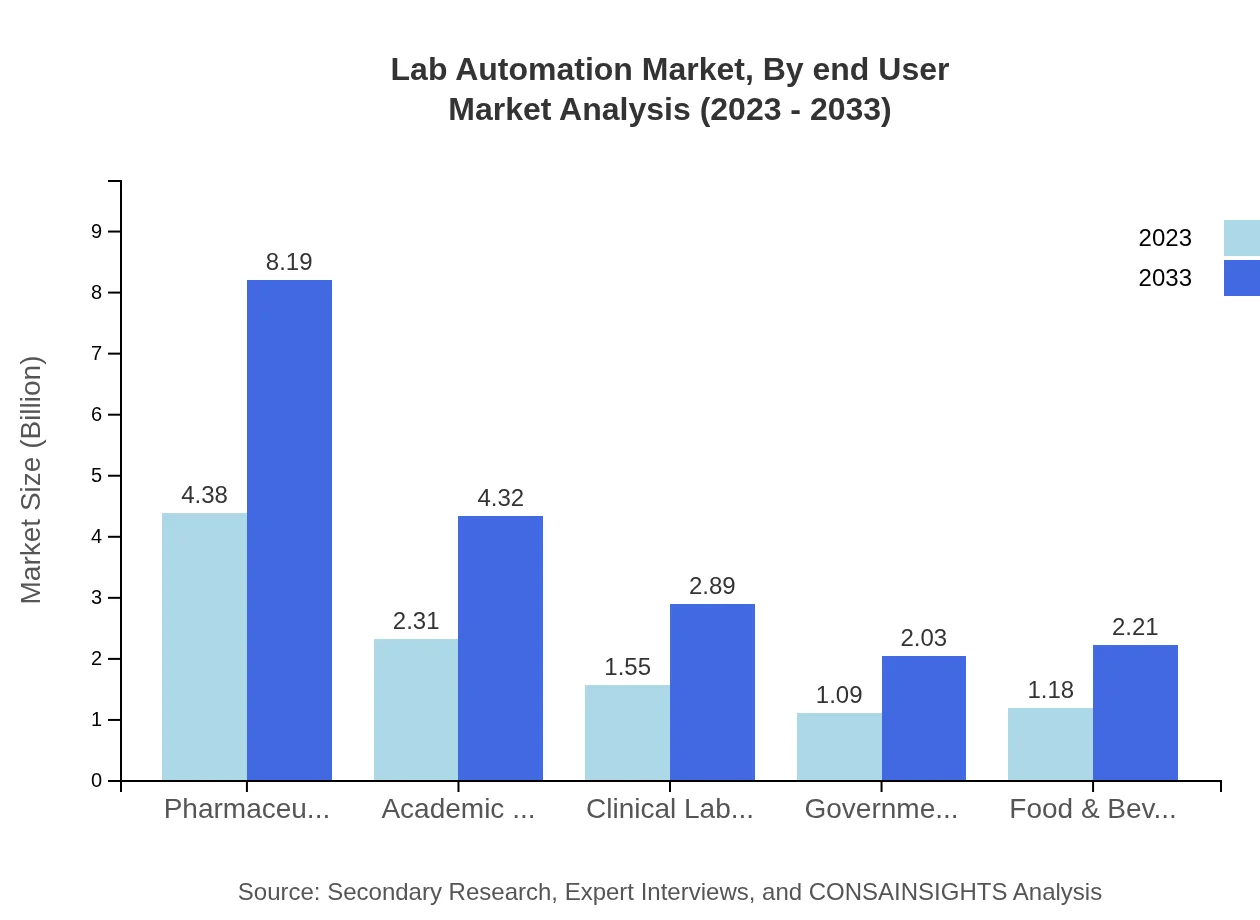
The end-user segment encompasses Pharmaceuticals, Clinical Laboratories, Government Laboratories, and Food & Beverage. The Pharmaceuticals sector, which is a dominant player in the market, holds a 41.68% share with sales anticipated to rise from $4.38 billion in 2023 to $8.19 billion by 2033. Clinical Laboratories and Government Laboratories are also notable segments with shares of 14.73% and 10.35%, respectively.
Lab Automation Market Analysis By Technology
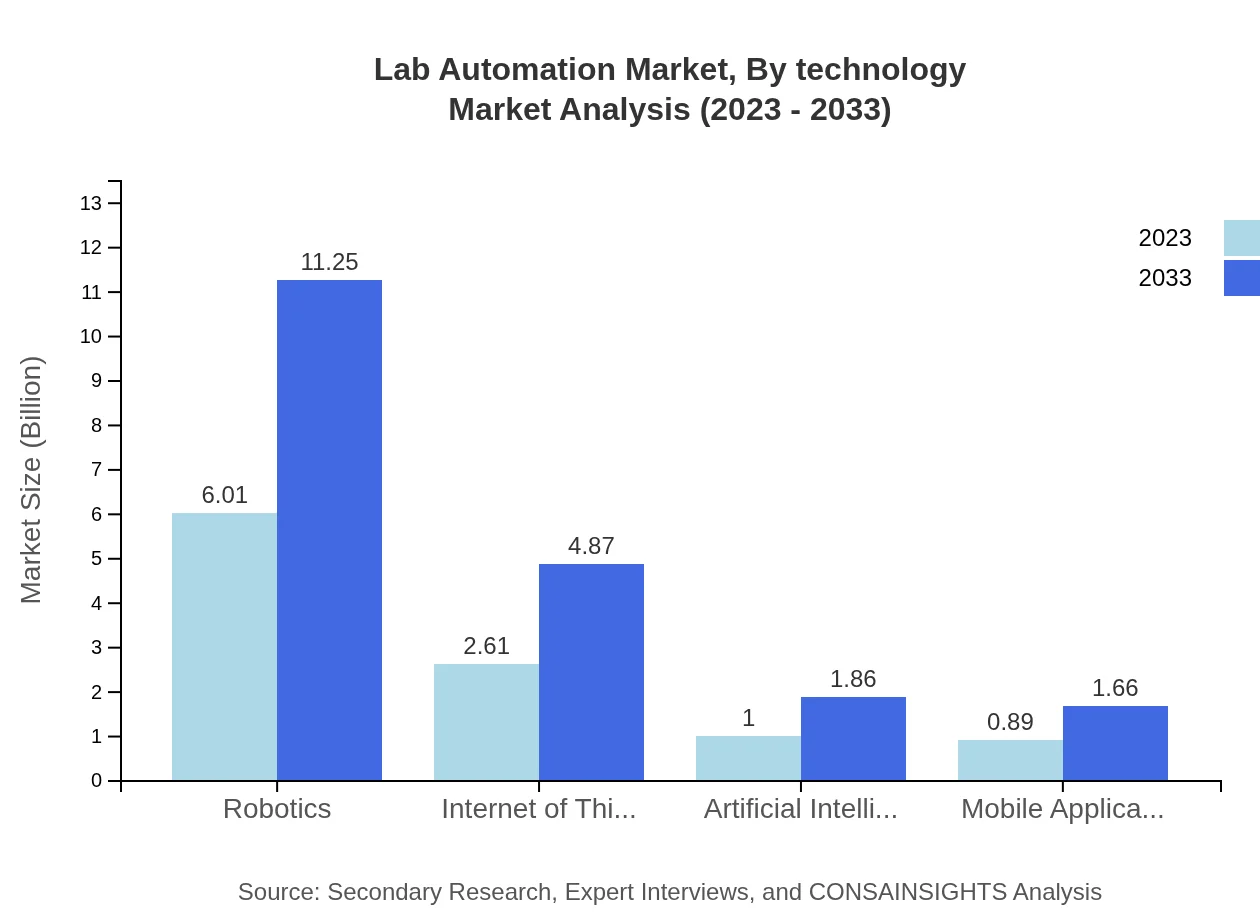
Key technologies impacting the Lab Automation market include Robotics, Internet of Things (IoT), Artificial Intelligence, and Mobile Applications. Robotics stands out with a market size of $6.01 billion in 2023, increasing to $11.25 billion by 2033, contributing 57.24% market share. IoT technology is also expanding its footprint, growing from $2.61 billion in 2023 to $4.87 billion. The integration of AI is becoming critical in enhancing automation processes, with a projected market size from $1.00 billion to $1.86 billion in the same period.
Lab Automation Market Trends and Future Forecast
Tell us your focus area and get a customized research report.
Global Market Leaders and Top Companies in Lab Automation Industry
Thermo Fisher Scientific:
Thermo Fisher Scientific is a leader in laboratory equipment and automation solutions, providing a wide range of products to enhance laboratory efficiency and productivity.Agilent Technologies:
Agilent Technologies specializes in analytical instrumentation and laboratory automation tools, contributing significantly to innovations in lab processes and workflows.Beckman Coulter:
Beckman Coulter focuses on laboratory instruments and automation solutions that improve laboratory workflow and reduce analysis times for clinical diagnostics.Roche:
Roche is known for its advanced offerings in lab automation, particularly in the fields of diagnostics and personalized healthcare driven by data insights.Siemens Healthineers:
Siemens Healthineers provides comprehensive laboratory automation solutions focused on delivering high-quality diagnostics and workflow efficiency.We're grateful to work with incredible clients.









FAQs
What is the market size of the lab automation market in 2023?
The market size in 2023 is $10.50 Billion, as reported in the provided dataset for the 2023 baseline year.
How big will the lab automation market be in 2033?
The projected market size for 2033 is $19.65 Billion according to the input figures provided for the forecast end year.
What is CAGR for the forecast period?
The compound annual growth rate for the 2023 to 2033 forecast period is 6.3% as stated in the input data.
Is there a single fastest Growing region in the Lab Automation Market Report market?
No single fastest-growing region is stated for the Lab Automation Market Report market because the top regional implied CAGR values are within 0.15 percentage points of each other, making the ranking too close to call reliably.
Which vendors are listed as top companies?
Top companies named in the input include Thermo Fisher Scientific, Agilent Technologies, Beckman Coulter, Roche and Siemens Healthineers.
What product categories are included in the segmentation?
Product segmentation includes instruments, software and consumables as specified among the provided sub-segment facts.
Who are the primary end users of lab automation solutions?
End users identified include pharmaceutical firms, academic research institutions, clinical laboratories, government laboratories and food & beverage testing facilities.
How was the research conducted?
Research combined primary interviews with industry experts, secondary review of company reports and publications, followed by data triangulation and internal validation.
What technologies drive lab automation adoption?
Technologies cited in the input include robotics, Internet of Things (IoT), artificial intelligence and mobile applications supporting automation deployments.
Why is the fastest Growing region not named?
A regional growth market is not specified because the top regional implied growth rates are within 0.15 percentage points, so no single region is designated as fastest-growing.