

Metaverse
First published: 26 February 2026 | Last updated: 26 February 2026 | Report Code: metaverse
Metaverse Market — USD $1.54 Trillion in 2024, Growing to USD 50.76 by 2033 at 43.3% CAGR
This comprehensive report provides an in‐depth analysis of the Metaverse market from 2024 to 2033, offering key insights into market size, growth drivers, regional performance, technology innovations, and product segmentation. The report covers detailed industry analysis, segmentation scope, leading players and future forecasts to guide stakeholders in strategic decision making.
| Metric | Value |
|---|---|
| Study Period | 2024 - 2033 |
| 2024 Market Size | $1.54 Trillion |
| CAGR (2024-2033) | 43.3% |
| 2033 Market Size | $50.76 Trillion |
| Top Companies | Meta Platforms Inc., Microsoft Corporation, NVIDIA Corporation |
| Published Date | 26 February 2026 |
| Last Modified Date | 26 February 2026 |
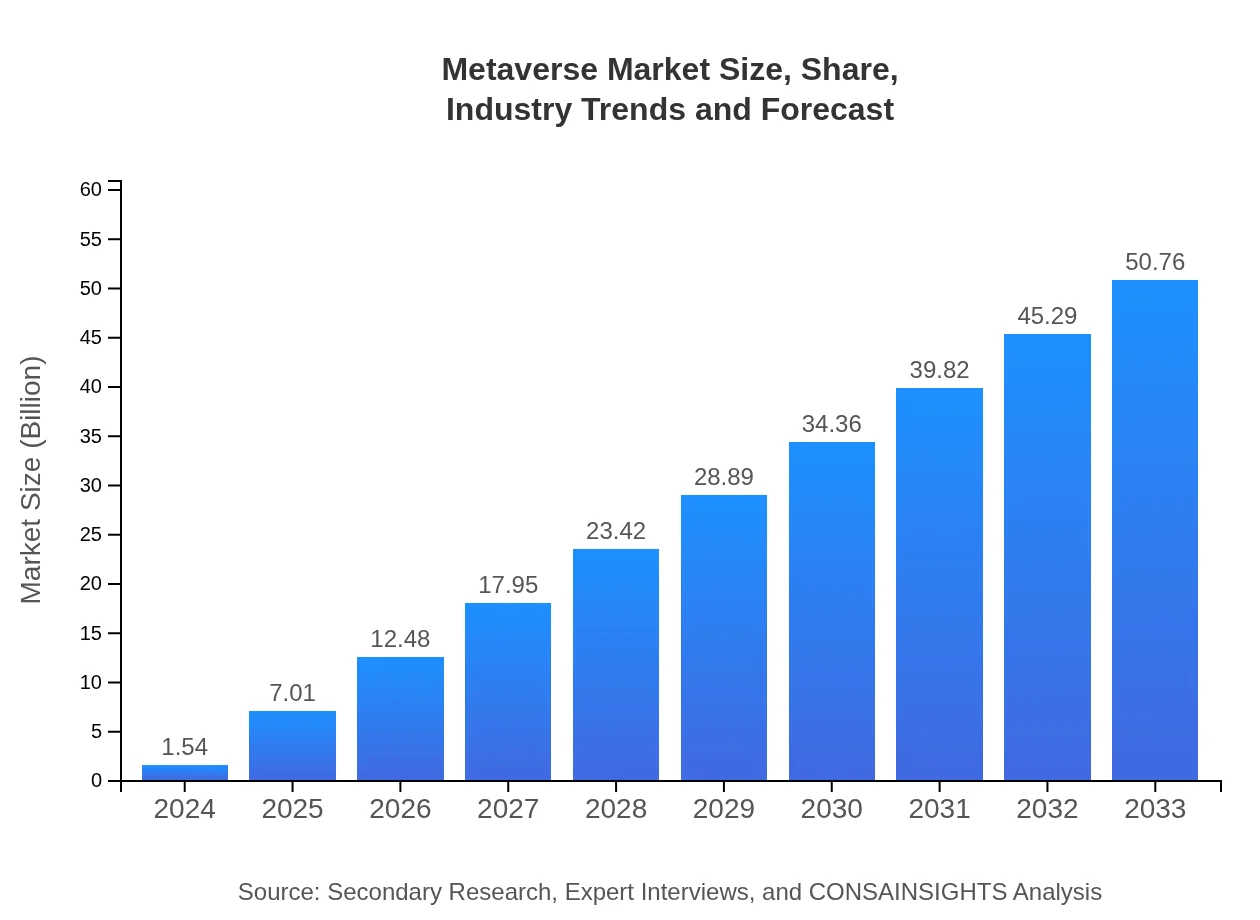
Metaverse Market Overview
Customize Metaverse market research report
- ✔ Get in-depth analysis of Metaverse market size, growth, and forecasts.
- ✔ Understand Metaverse's regional dynamics and industry-specific trends.
- ✔ Identify potential applications, end-user demand, and growth segments in Metaverse
What is the Market Size & CAGR of Metaverse market in 2024?
Metaverse Industry Analysis
Metaverse Market Segmentation and Scope
Tell us your focus area and get a customized research report.
Metaverse Market Analysis Report by Region
Europe Metaverse:
Europe exhibits robust growth trends, with market estimates increasing from $0.57 trillion in 2024 to an impressive $18.63 trillion by 2033. Strategic investments in technology and a strong digital policy framework have helped create a fertile environment for the evolution of immersive experiences.Asia Pacific Metaverse:
The Asia Pacific region is emerging as a key growth driver, with estimates rising from $0.27 trillion in 2024 to approximately $9.03 trillion by 2033. Strong government support for digital innovation, a burgeoning tech-savvy population, and significant investments in infrastructure are contributing to this upward trajectory. The region is witnessing accelerated adoption of immersive technologies across diverse industries.North America Metaverse:
North America remains a mature market with a well-established technological infrastructure, expanding from $0.50 trillion in 2024 to an expected $16.51 trillion in 2033. Innovation hubs and leading tech companies are continuously driving consumer demand and platform enhancements.South America Metaverse:
South America, described by its dynamic start-up culture and improving broadband connectivity, is gradually realizing the potential of the Metaverse. Although starting from a smaller base of $0.05 trillion in 2024, the region is projected to reach $1.80 trillion by 2033 as digital penetration deepens and investor interest grows.Middle East & Africa Metaverse:
The Middle East and Africa region is catching up rapidly, with initial market values of $0.15 trillion in 2024 and projected expansion to $4.80 trillion in 2033. Government initiatives, increasing mobile connectivity, and rising interest in digital transformation are key factors fueling this growth.Tell us your focus area and get a customized research report.
Metaverse Market Analysis By Technology
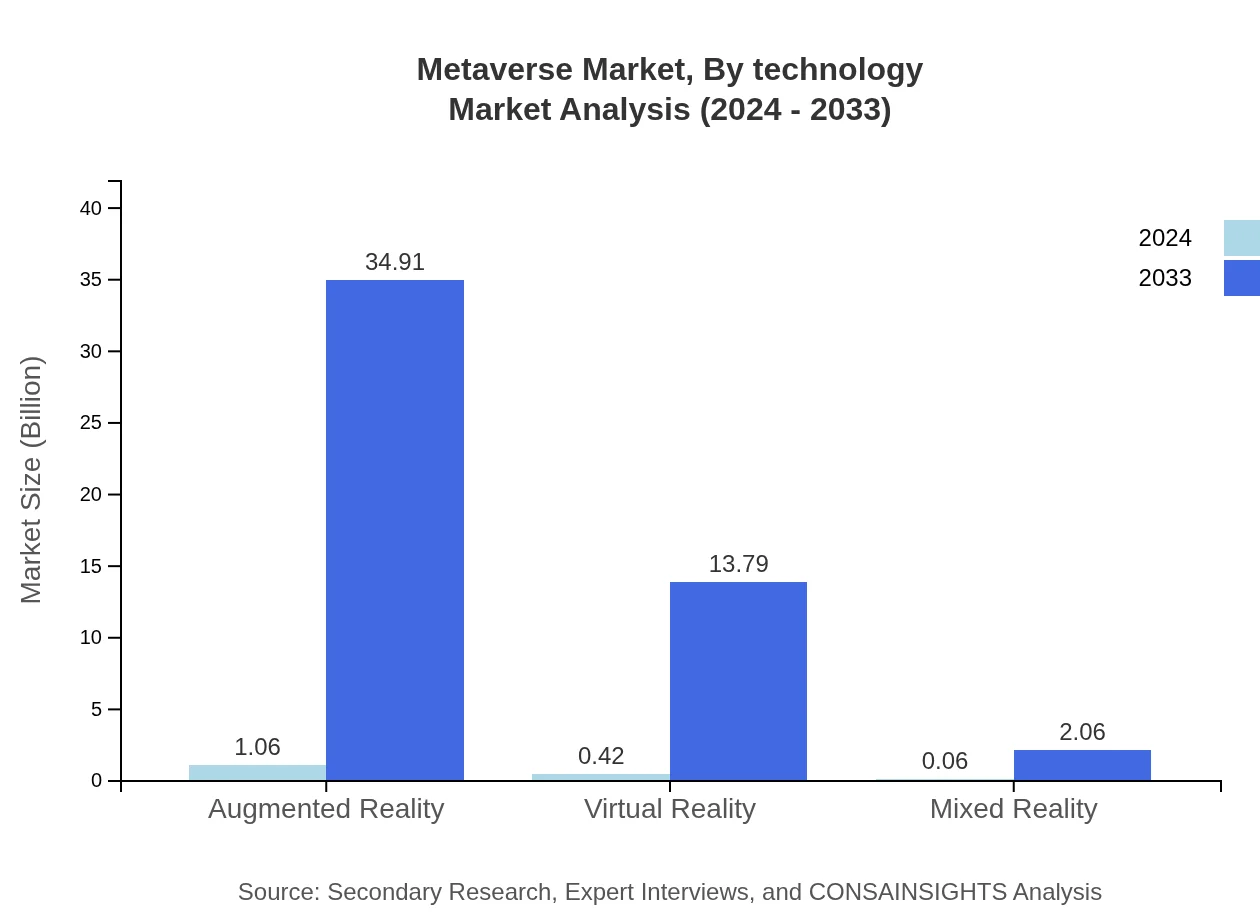
In the technology segment, augmented reality, virtual reality, and mixed reality are crucial drivers behind the evolution of the Metaverse. Augmented reality leads with market sizes projected to jump from $1.06 trillion in 2024 to $34.91 trillion in 2033, while virtual reality is expected to scale from $0.42 trillion to $13.79 trillion over the same period. Mixed reality, although smaller in size, is projected to grow steadily. These advancements are largely fueled by improvements in hardware performance, enhanced software capabilities, and increasing consumer demand for immersive experiences.
Metaverse Market Analysis By Application
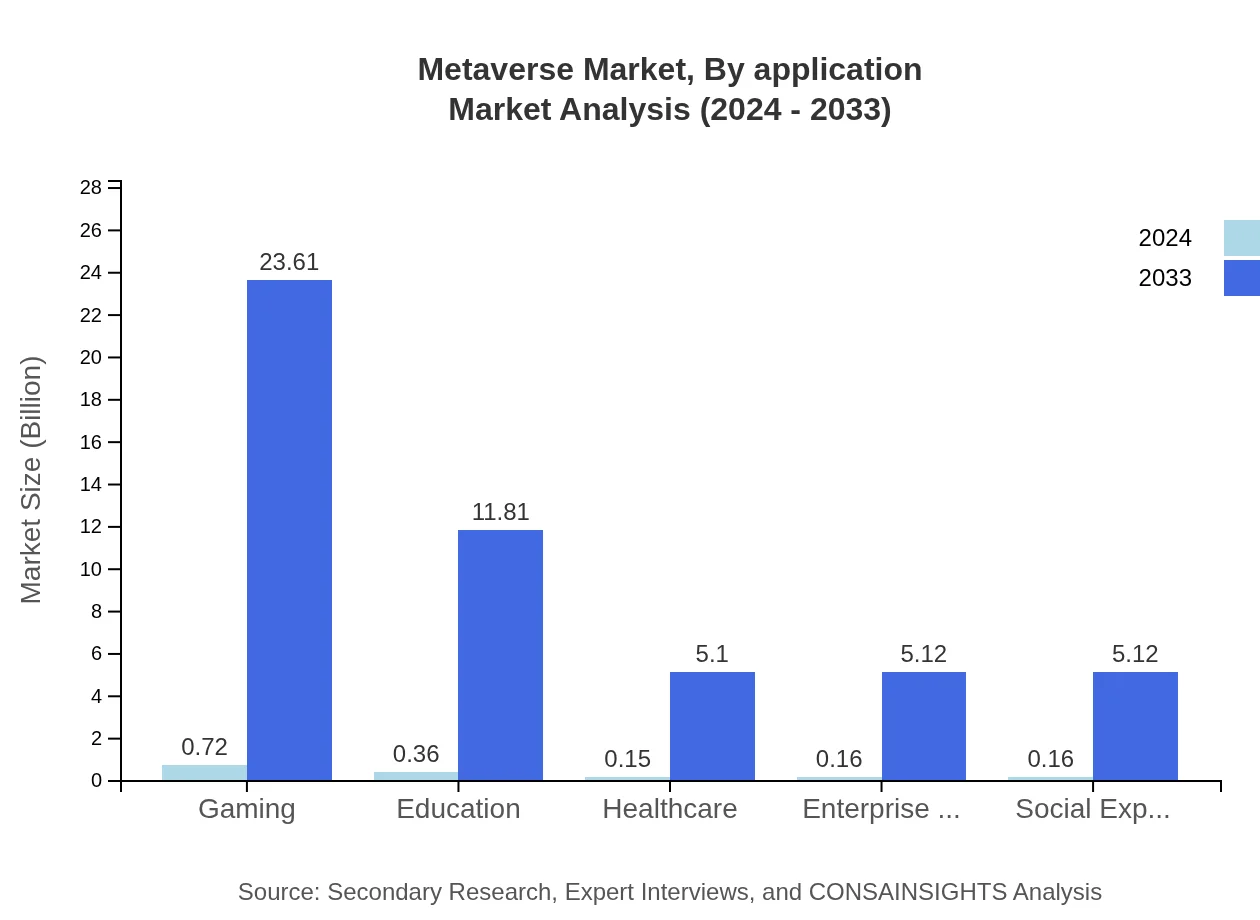
Application segments within the Metaverse include gaming, education, healthcare, and more. The gaming segment notably reflects significant engagement, with market sizes expected to grow substantially, reinforcing its share at 46.51% from 2024 to 2033. Additionally, sectors such as education and healthcare are expanding their footprints by integrating immersive learning and telehealth solutions. This diversity ensures that the Metaverse continues to break traditional boundaries, fostering cross-industry collaboration and innovative content delivery.
Metaverse Market Analysis By Device
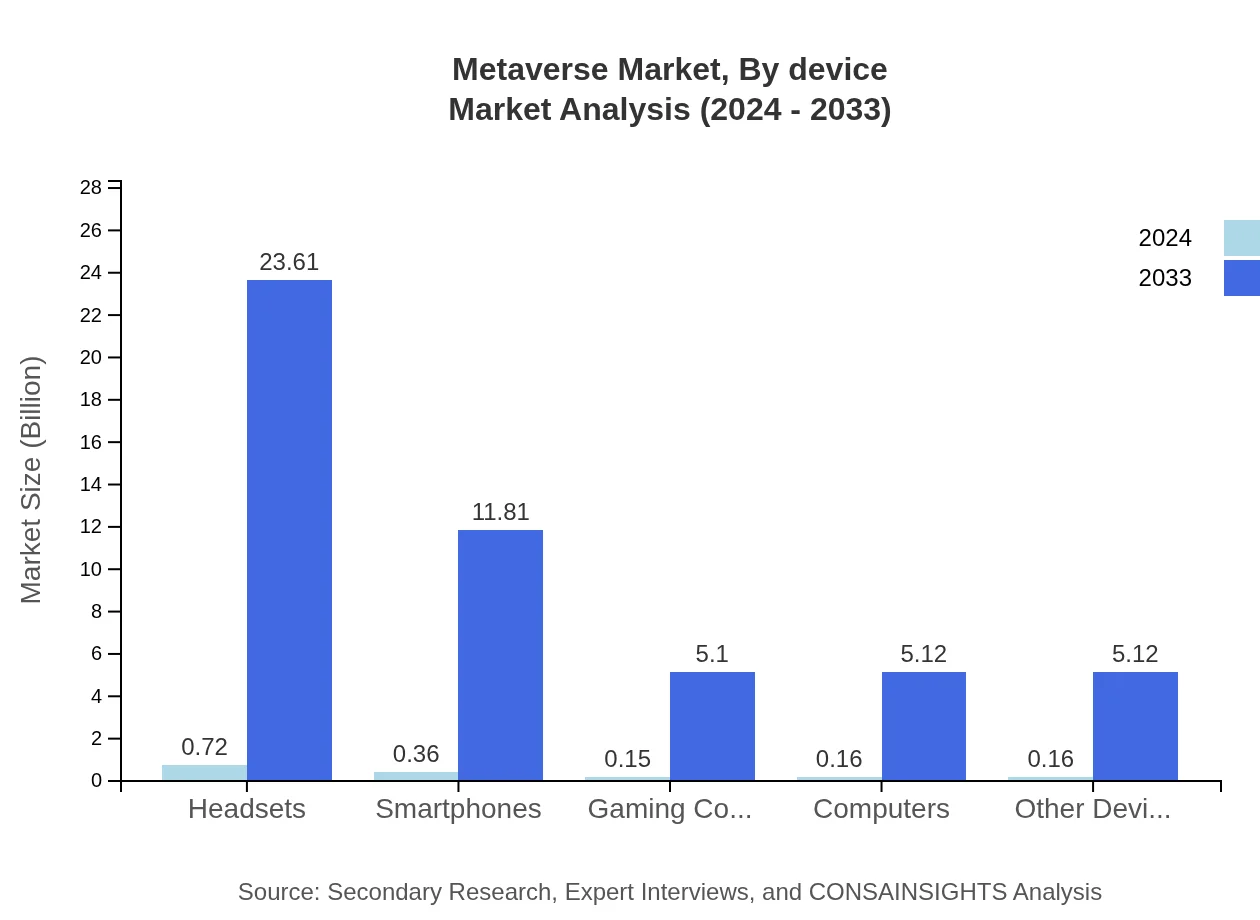
Device segmentation is driven by various platforms that deliver immersive content. Headsets, a critical device category, are projected to witness a dramatic increase from a market size of $0.72 trillion in 2024 to $23.61 trillion by 2033 while maintaining a constant share of 46.51%. Smartphones, gaming consoles, computers, and other devices contribute uniquely to the overall market penetration. The growing integration of these devices into daily activities not only enhances user engagement but also broadens accessibility to Metaverse environments.
Metaverse Market Analysis By Industry
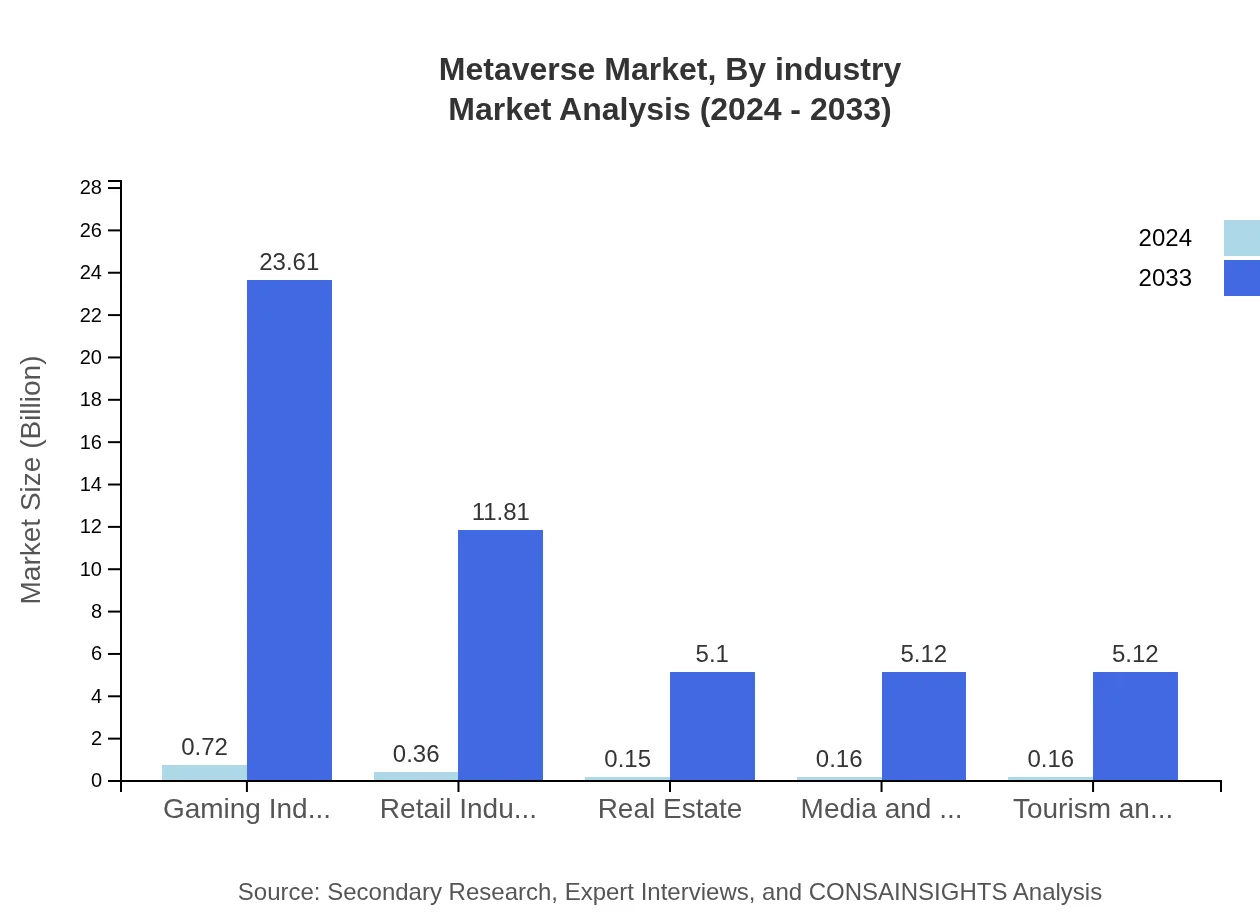
Industry segmentation underlines the transformative potential of the Metaverse across traditional sectors such as retail, media, real estate, tourism, and enterprise solutions. The retail and media industries are experiencing substantial digital disruption, with vibrant consumer interactions lending momentum to market growth. Real estate and tourism sectors are leveraging virtual reality for immersive conversions and property showcases. This cross-industry integration highlights the adaptability of Metaverse technologies in meeting evolving consumer and business needs.
Metaverse Market Analysis By Business Model
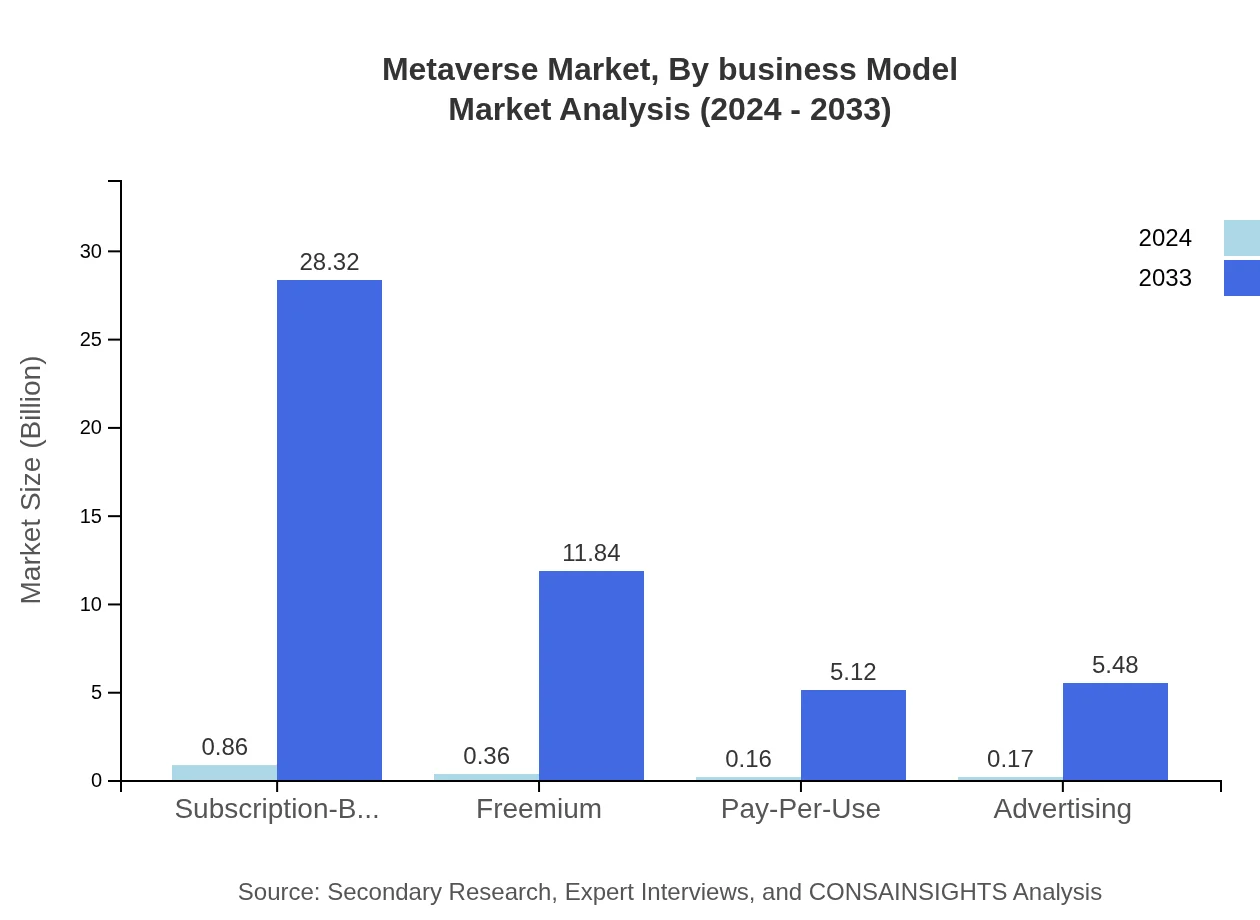
Business models in the Metaverse industry are rapidly evolving to encompass various revenue generation strategies such as subscription-based services, freemium models, pay-per-use frameworks, and advertising-driven formats. The subscription-based model is particularly dominant, with market estimates rising from $0.86 trillion in 2024 to $28.32 trillion in 2033, supporting a 55.79% share. These dynamic models are designed to accommodate diverse consumer preferences and ensure sustainable growth through continuous platform innovation and value-added services.
Metaverse Market Trends and Future Forecast
Tell us your focus area and get a customized research report.
Global Market Leaders and Top Companies in Metaverse Industry
Meta Platforms Inc.:
Meta Platforms is at the forefront of the Metaverse revolution, investing heavily in virtual and augmented reality technologies. Its expansive reach in social media and digital communications positions it as a leader in shaping immersive digital experiences.Microsoft Corporation:
Microsoft leverages its profound expertise in enterprise solutions and cloud computing to develop innovative Metaverse applications. The company is pivotal in integrating virtual collaboration tools into mainstream business operations.NVIDIA Corporation:
NVIDIA drives the technological advancements essential for high-performance graphics and computing. Its products support the computational needs of immersive environments, making it a central player in the Metaverse ecosystem.We're grateful to work with incredible clients.








FAQs
How can the report on the metaverse help align our marketing strategy with customer adoption trends?
The metaverse market is projected to reach $1.54 trillion by 2033, with a CAGR of 43.3%. Understanding these trends enables marketers to tailor strategies that resonate with shifting consumer preferences in immersive experiences, thus boosting customer engagement and adoption.
What product features are in highest demand according to the metaverse trends?
According to the metaverse trends, features aligning with immersive experiences, virtual reality (27.17% share), and augmented reality (68.77% share) are highly demanded, driving product development to cater to these technologies over the next decade.
Which regions offer the best market entry and expansion opportunities in the metaverse industry?
The metaverse presents significant opportunities in Europe ($18.63 billion by 2033) and North America ($16.51 billion by 2033), indicating strong potential for market entry and expansion strategies targeting these regions post-2024.
What emerging technologies and innovations are shaping the metaverse market?
Emerging technologies such as augmented reality (34.91 billion by 2033) and advanced gaming solutions are pivotal in shaping the metaverse. Innovations in VR capacity (up to 13.79) also represent critical advancements that will impact consumer interaction moving forward.
Does the metaverse report include competitive landscape and market share analysis?
Yes, the metaverse report encompasses a thorough competitive landscape and market share analysis, providing insights into major segments such as headsets, gaming, and retail, enabling businesses to strategize their competitive positioning effectively.
How can executives use the metaverse report to evaluate investment risks and ROI?
Executives can utilize the metaverse report to identify high-growth segments with projected market sizes providing insights into potential investment risks and ROI. This data-driven approach ensures strategic allocation of resources in promising areas.
What is the market size of the metaverse?
The metaverse market is estimated at $1.54 trillion by 2033, with a robust CAGR of 43.3%. This highlights the significant business potential and rapid growth in immersive digital environments for various industries.
What segment data can we expect from the metaverse report?
Segment data in the metaverse report reveals key markets: headsets (23.61 billion by 2033), smartphones (11.81 billion by 2033), and gaming (23.61 billion by 2033), allowing for targeted strategies across diverse consumer electronics and application areas.