
Reports >
Life Sciences
>
Molecular Biosensors Market Report

Molecular Biosensors Market Report
First published: 20 October 2024 | Last updated: 25 May 2026 | Report Code: molecular-biosensors
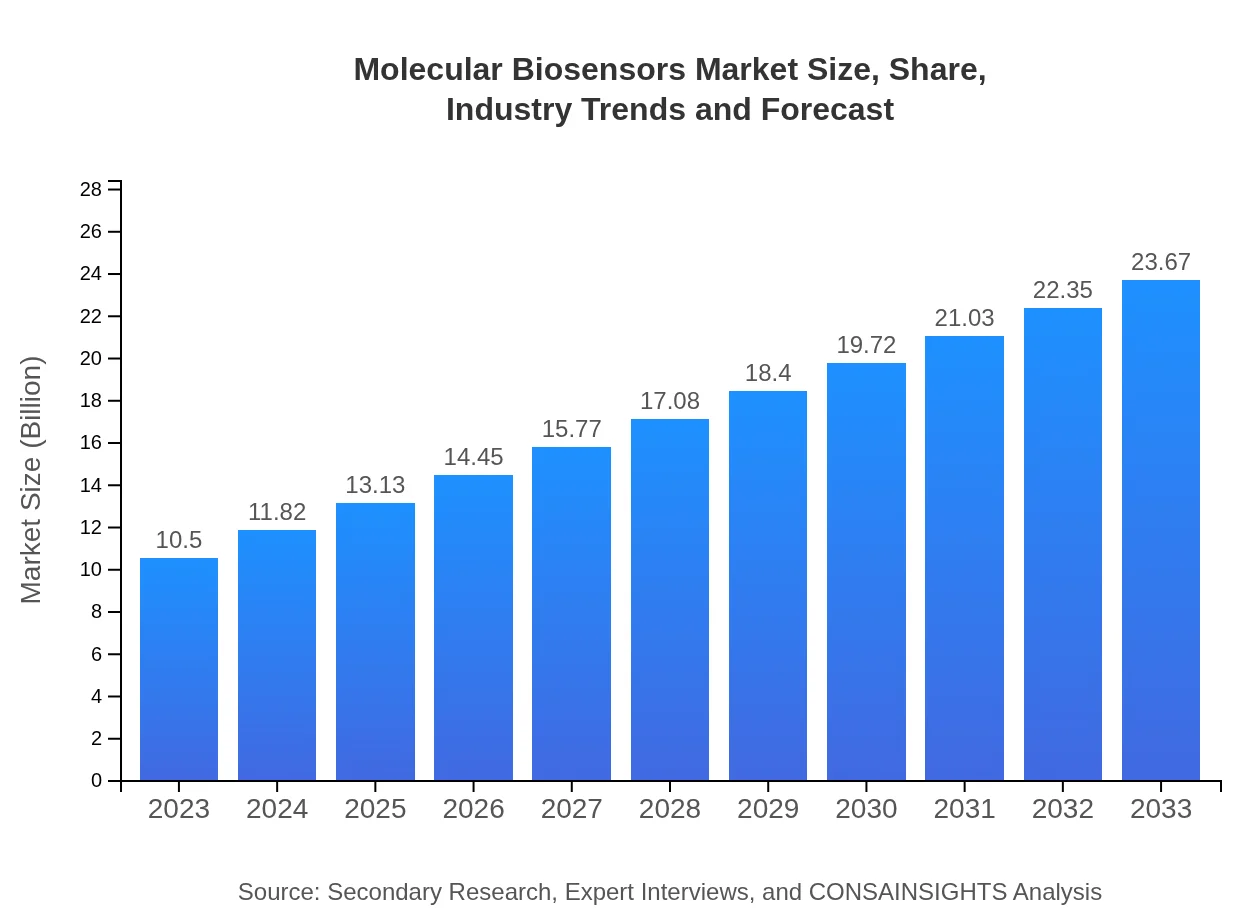
Molecular Biosensors Market — USD $10.5 Billion in 2023, Growing to USD 23.67null by 2033 at 8.2% CAGR
This report provides a comprehensive analysis of the Molecular Biosensors market, covering key insights, trends, and forecasts from 2023 to 2033, including market size, growth prospects, and regional performances.
Key Takeaways
- Global market value rises from $10.50 Billion in 2023 to $23.67 Billion by 2033 at an 8.2% CAGR.
- Europe is largest regional market, while no single fastest-growing region is stated because regional CAGR differences remain within 0.15 percentage points.
- North America moves from $3.49 Billion in 2023 to $7.87 Billion in 2033, reflecting strong commercial and clinical uptake.
- Asia Pacific expands from $1.96 Billion in 2023 to $4.41 Billion in 2033, driven by adoption in clinical and environmental sectors.
- Leading companies include Siemens Healthineers, Abbott Laboratories, Roche Diagnostics, Thermo Fisher Scientific, and Medtronic.
Molecular Biosensors Market Report — Executive Summary
Europe remains largest market by forecast-period value, while no single fastest-growing region is stated because top regional growth rates are separated by less than 0.15 percentage points. The molecular biosensors market is on a sustained growth path, rising from $10.50 Billion in 2023 to $23.67 Billion by 2033 at an 8.2% CAGR. Growth is supported by technological advances in detection platforms, rising need for point-of-care diagnostics, and expanding applications across healthcare, food safety and environmental monitoring. The landscape features diversified product types and technologies—electrochemical, optical, mass-sensitive, label-free and label-based approaches—serving clinical diagnostics, environmental surveillance and food testing. Regionally, Europe is the largest market, with significant increases projected to 2033. Major industry participants such as Siemens Healthineers, Abbott Laboratories, Roche Diagnostics, Thermo Fisher Scientific and Medtronic are active through product innovation and commercialization. The report uses primary expert interviews and secondary sources to map segmentation, deployment modes, end-use categories, and competitive activity, providing stakeholders with actionable insights for strategic planning and investments.
Key Growth Drivers
- Advances in sensor technologies and miniaturization improving sensitivity and portability.
- Rising demand for rapid point-of-care testing across clinical and decentralized settings.
- Increased investment in R&D and commercialization from established medical device and diagnostics firms.
- Broader adoption in food safety and environmental monitoring expanding nonclinical applications.
- Regulatory focus and funding for diagnostic innovation supporting market expansion.
| Metric | Value |
|---|---|
| Study Period | 2023 - 2033 |
| 2023 Market Size | $10.50 Billion |
| CAGR (2023-2033) | 8.2% |
| 2033 Market Size | $23.67 Billion |
| Top Companies | Siemens Healthineers, Abbott Laboratories, Roche Diagnostics, Thermo Fisher Scientific, Medtronic |
| Published Date | 20 October 2024 |
| Last Modified Date | 25 May 2026 |
Molecular Biosensors Market Overview
Customize Molecular Biosensors Market Report market research report
- ✔ Get in-depth analysis of Molecular Biosensors market size, growth, and forecasts.
- ✔ Understand Molecular Biosensors's regional dynamics and industry-specific trends.
- ✔ Identify potential applications, end-user demand, and growth segments in Molecular Biosensors
What is the Market Size & CAGR of Molecular Biosensors Market Report market in 2023?
Molecular Biosensors Industry Analysis
Molecular Biosensors Market Segmentation and Scope
Tell us your focus area and get a customized research report.
Molecular Biosensors Market Report Market Analysis Report by Region
Europe Molecular Biosensors Market Report:
Europe is largest regional market, rising from $3.5 Billion in 2023 to $7.9 Billion in 2033. Growth reflects strong clinical adoption, research investment, and industry activity in diagnostic innovations across the region.Asia Pacific Molecular Biosensors Market Report:
Asia Pacific grows from $1.96 Billion in 2023 to $4.41 Billion in 2033. 96 Billion in 2023 and growing to $4.41 Billion in 2033. Expansion is driven by increased diagnostic adoption, investments in healthcare infrastructure, and growing applications in environmental and food safety testing.North America Molecular Biosensors Market Report:
North America grows from $3.49 Billion in 2023 to $7.87 Billion in 2033. 49 Billion in 2023 and is projected to reach $7.87 Billion in 2033. Regional momentum is supported by commercial deployment in clinical diagnostics, well-established healthcare infrastructure, and active participation from major device manufacturers.South America Molecular Biosensors Market Report:
Latin America grows from $0.91 Billion in 2023 to $2.05 Billion in 2033. 91 Billion in 2023 and is expected to advance to $2.05 Billion by 2033. Regional demand is linked to expanding public health initiatives, rising awareness of diagnostics, and broader use in agriculture and food safety monitoring.Middle East & Africa Molecular Biosensors Market Report:
Middle East and Africa grows from $0.64 Billion in 2023 to $1.44 Billion in 2033. 64 Billion in 2023 and is projected to reach $1.44 Billion in 2033. Growth drivers include improving diagnostic capabilities, investments in healthcare systems, and expanding environmental monitoring applications.Tell us your focus area and get a customized research report.
Research Methodology
Molecular Biosensors Market Analysis By Type
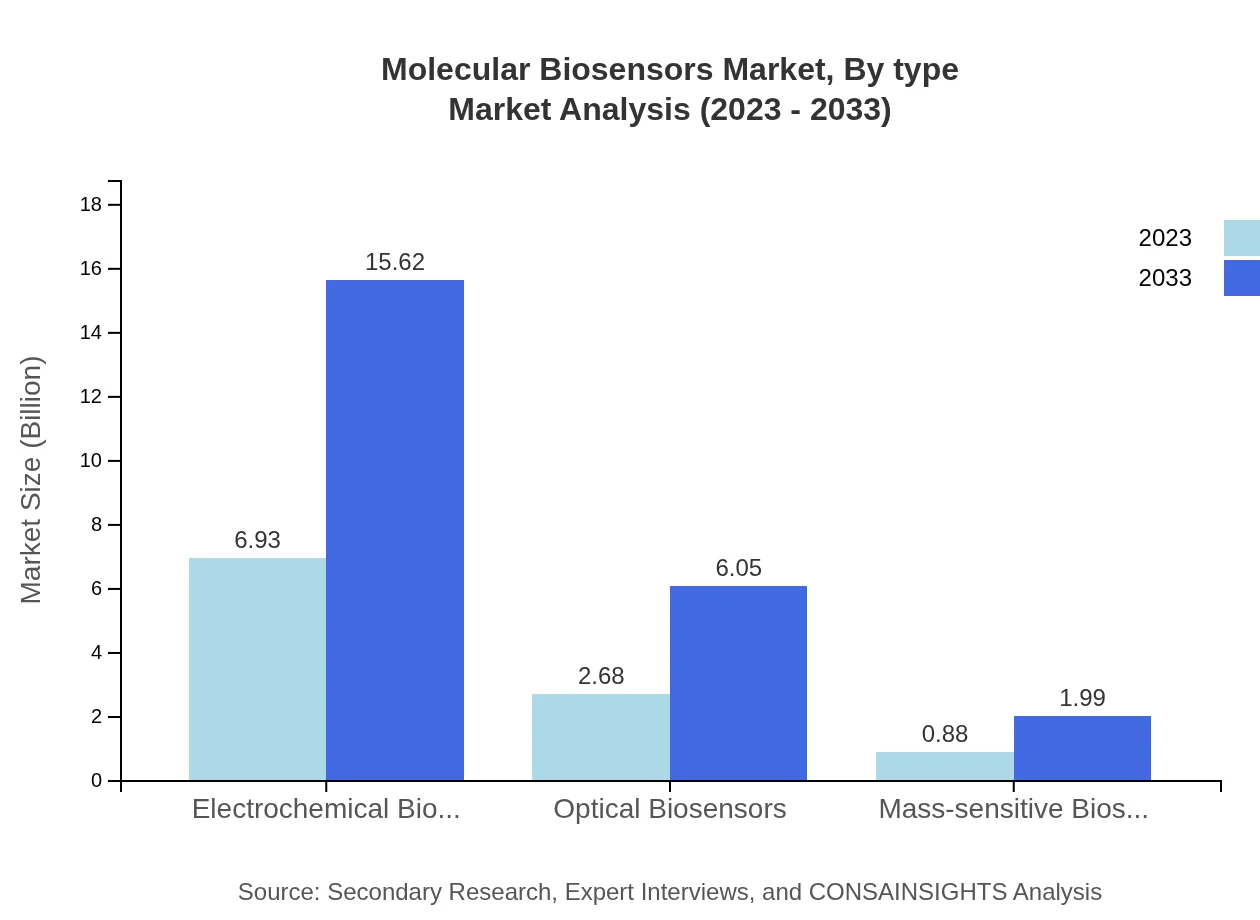
The major segments by type include Electrochemical Biosensors, which dominate due to their enhanced sensitivity and low cost, with a market size of USD 6.93 billion in 2023 expected to reach USD 15.62 billion by 2033. Optical Biosensors follow closely, with a market size of USD 2.68 billion projected to grow to USD 6.05 billion, while Mass-sensitive Biosensors represent a smaller segment, growing from USD 0.88 billion to USD 1.99 billion during the same period.
Molecular Biosensors Market Analysis By Technology
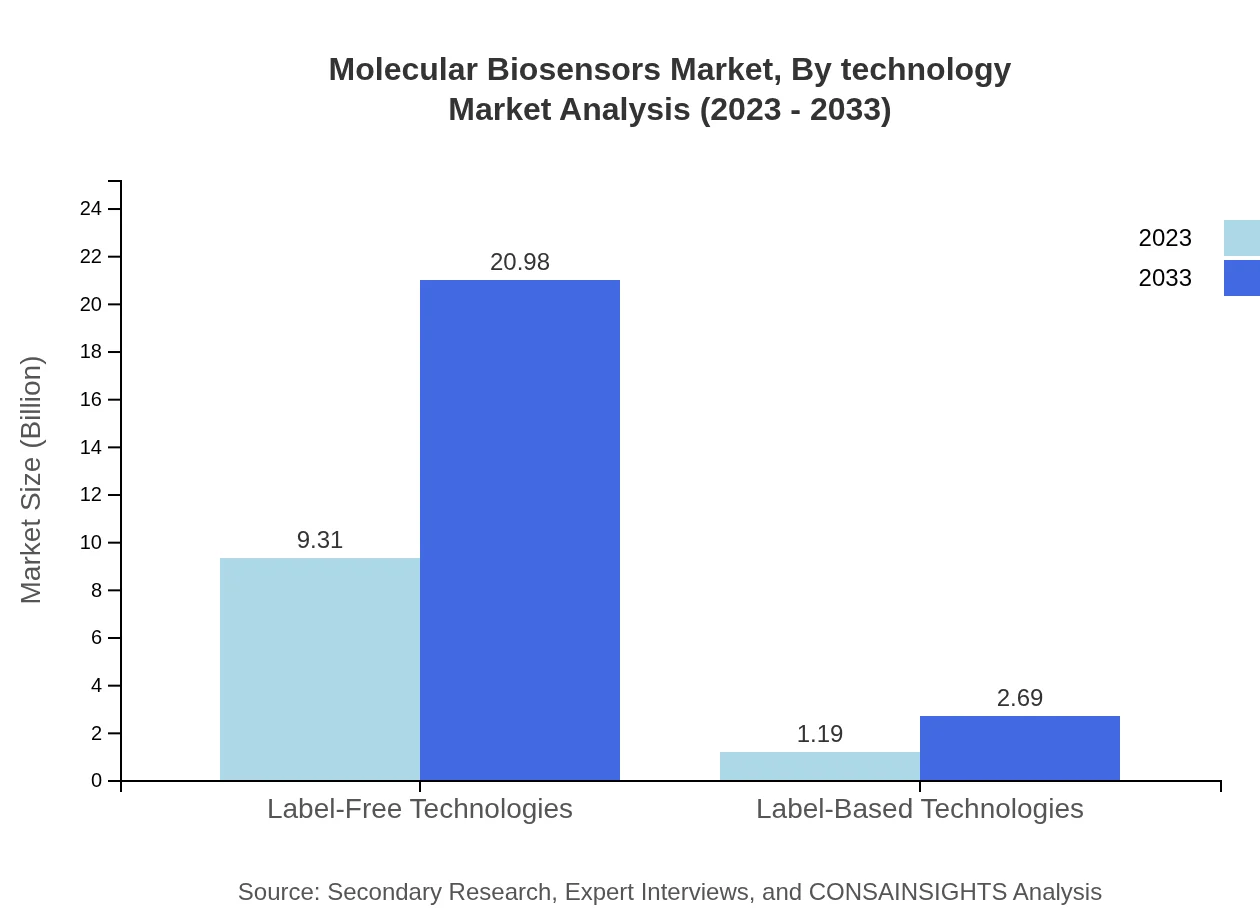
In the technology segment, Label-Free Technologies lead the market with a size of USD 9.31 billion in 2023, expected to reach USD 20.98 billion by 2033, representing 88.62% market share. Label-Based Technologies, while smaller, are also important, expanding from USD 1.19 billion to USD 2.69 billion, securing an 11.38% share.
Molecular Biosensors Market Analysis By Application
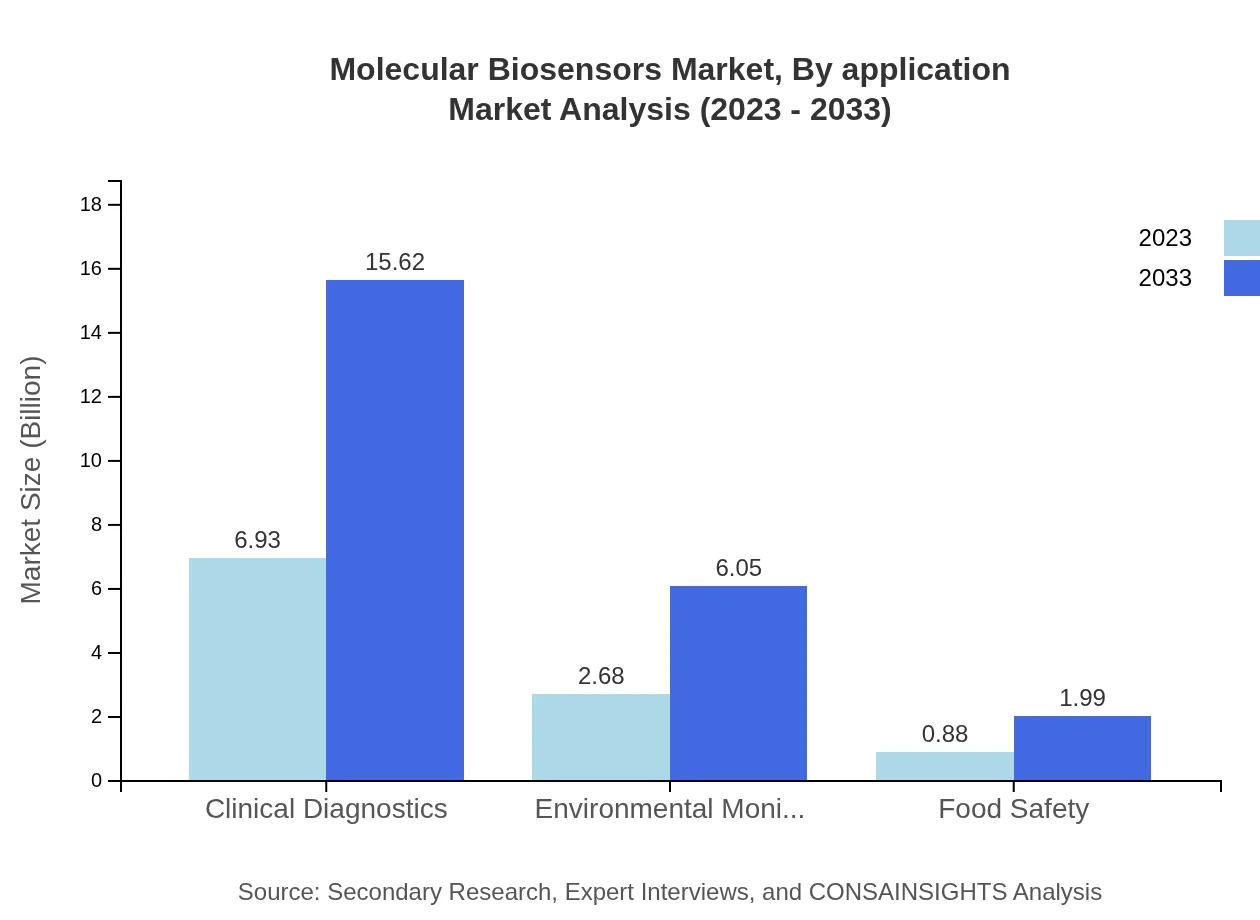
By application, the healthcare segment stands out with a market size of USD 6.93 billion in 2023, projected to reach USD 15.62 billion by 2033, accounting for a 66.01% market share. Other applications include environmental monitoring, growing from USD 2.68 billion to USD 6.05 billion, and food safety, from USD 0.88 billion to USD 1.99 billion.
Molecular Biosensors Market Analysis By End Use
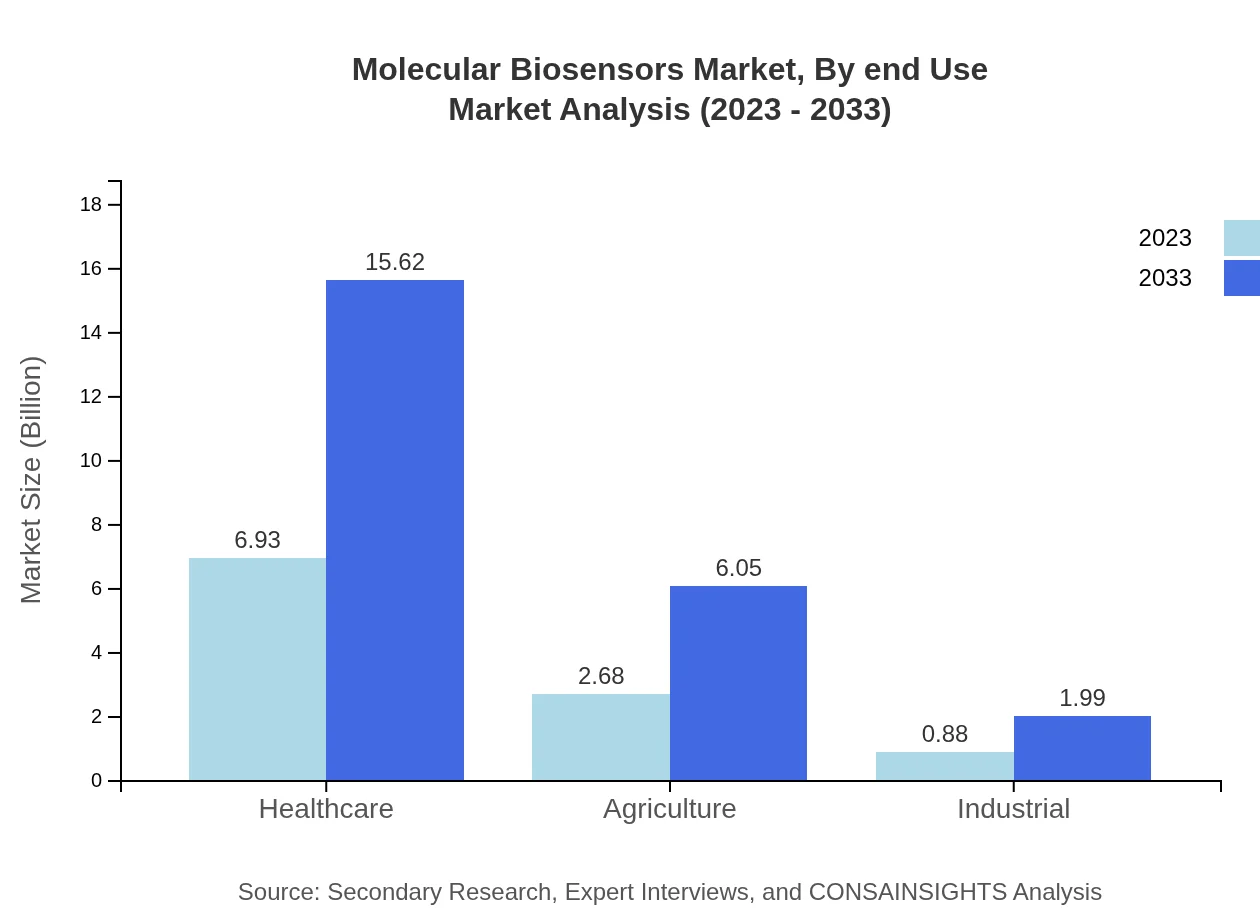
The market is primarily driven by the healthcare sector, followed by agricultural and industrial applications. The industrial end-use segment is garnered a size of USD 0.88 billion in 2023, growing to USD 1.99 billion, accounting for an 8.42% market share.
Molecular Biosensors Market Trends and Future Forecast
Tell us your focus area and get a customized research report.
Global Market Leaders and Top Companies in Molecular Biosensors Industry
Siemens Healthineers:
A leader in medical technology and diagnostics, Siemens Healthineers is renowned for developing cutting-edge solutions in biosensing and laboratory diagnostics.Abbott Laboratories:
Abbott is a global healthcare company that excels in biosensor technology, particularly in glucose monitoring systems and rapid diagnostic tests.Roche Diagnostics:
Known for its innovative diagnostic solutions, Roche focuses on molecular diagnostics and biosensors, enabling early disease detection and personalized health solutions.Thermo Fisher Scientific:
Thermo Fisher provides measurement and analytic solutions through biosensors, aimed at biotechnology and pharmaceutical sectors to enhance research and production quality.Medtronic :
Medtronic is a key player in the biosensor market, known for its continuous glucose monitoring products and innovations in wearable diagnostic devices.We're grateful to work with incredible clients.









FAQs
What is the market size of molecular biosensors in 2023?
The market size for molecular biosensors in 2023 is $10.50 Billion, based on the provided market data for the base year.
How big is the molecular biosensors market expected to be in 2033?
By 2033 the market is projected to reach $23.67 Billion, reflecting growth over the 2023 baseline provided in the report data.
What is CAGR for the forecast period?
The compound annual growth rate (CAGR) for the forecast period 2023 to 2033 is 8.2%, as stated in the supplied market figures.
Is there a single fastest Growing region in the Molecular Biosensors Market Report market?
No single fastest-growing region is stated for the Molecular Biosensors Market Report market because the top regional implied CAGR values are within 0.15 percentage points of each other, making the ranking too close to call reliably.
Which companies are leading the molecular biosensors sector?
Top companies listed include Siemens Healthineers, Abbott Laboratories, Roche Diagnostics, Thermo Fisher Scientific, and Medtronic as key market participants.
What are common application areas for molecular biosensors?
Applications include clinical diagnostics, environmental monitoring, and food safety, reflecting the primary end-use areas noted in the segmentation facts.
How big is the North American market in 2023 and 2033?
North America is reported at $3.49 Billion in 2023 and is projected to grow to $7.87 Billion by 2033 according to the region-specific data.
What is the market size for Asia Pacific in 2023 and 2033?
Asia Pacific is recorded at $1.96 Billion in 2023 and is expected to reach $4.41 Billion by 2033 as per the regional facts provided.
Why are point Of Care tests driving demand?
Point-of-care testing increases demand by enabling rapid, decentralized diagnostics, which supports broader adoption across clinical settings and urgent testing needs.
Who contributed to the report research?
Research involved primary interviews with industry experts and secondary review of company reports and publications, coupled with data triangulation and internal validation.