

Motion Sickness Treatment Market Report
First published: 20 October 2024 | Last updated: 25 May 2026 | Report Code: motion-sickness-treatment
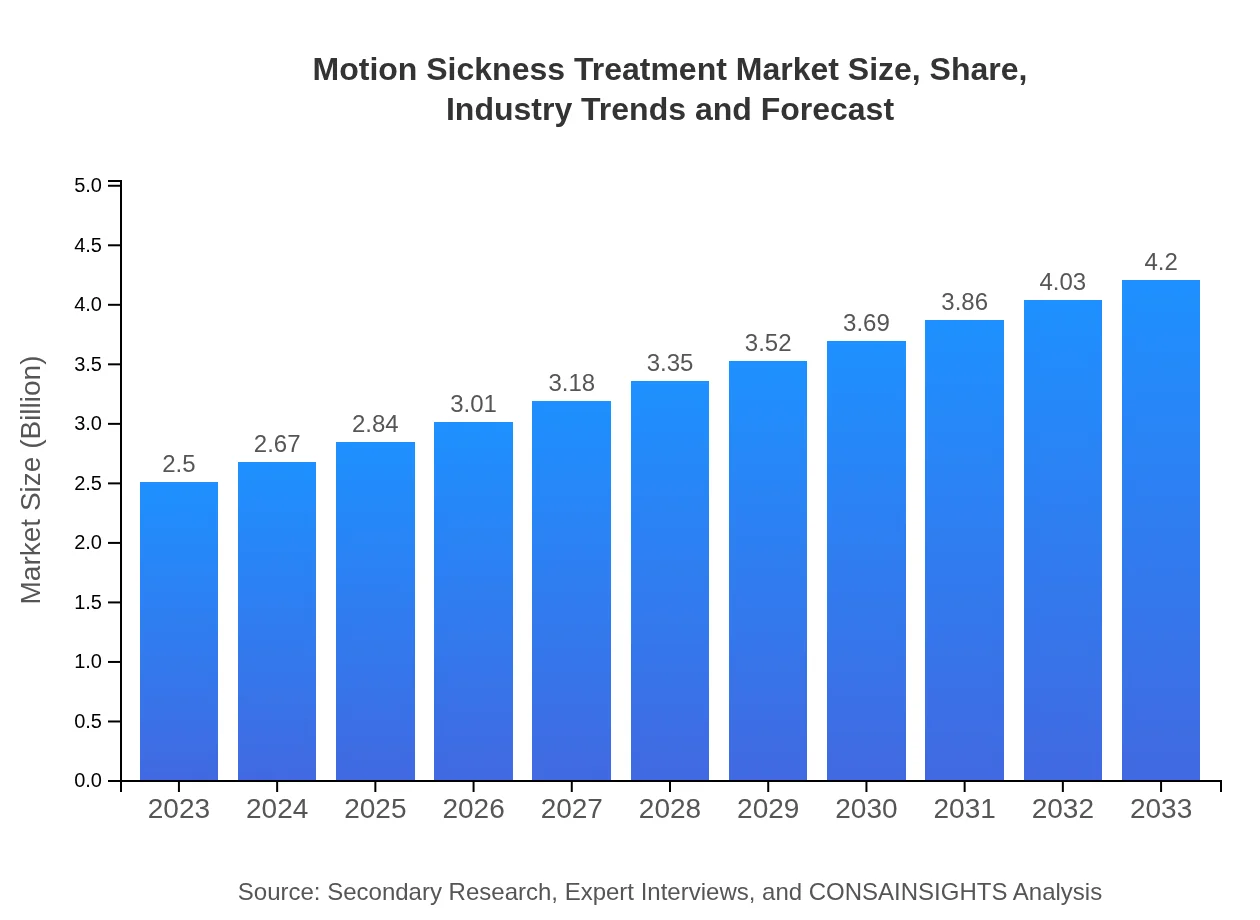
Motion Sickness Treatment Market — USD 2.5 billion in 2023, Growing to USD 4.20B by 2033 at 5.2% CAGR
This report provides a comprehensive analysis of the Motion Sickness Treatment market, including insights on market size, trends, technologies, and forecasts from 2023 to 2033, aimed at understanding current conditions and future growth opportunities.
Key Takeaways
- Market expands from $2.50 Billion in 2023 to $4.20 Billion in 2033, reflecting a 5.2% CAGR over 2023 to 2033.
- North America is largest regional market, while no single fastest-growing region is stated because regional CAGR differences remain within 0.15 percentage points.
- North America is the largest region, increasing from $0.89 Billion in 2023 to $1.5 Billion in 2033.
- Europe rises from $0.83 Billion to $1.4 Billion between 2023 and 2033, underscoring steady regional adoption.
- Treatment mix includes medications, natural remedies, and devices, with distribution across pharmacies, online retail, and hospitals.
- Top companies featured: GlaxoSmithKline, Pfizer Inc., Bayer AG, and Medtronic, focusing on product innovation and broader reach.
Motion Sickness Treatment Market Report — Executive Summary
North America remains largest market by forecast-period value, while no single fastest-growing region is stated because top regional growth rates are separated by less than 0.15 percentage points. The Motion Sickness Treatment market is forecast to move from $2.50 Billion in 2023 to $4.20 Billion in 2033, driven by a 5.2% CAGR during 2023 to 2033. Rising travel activity and greater public awareness are principal demand catalysts, while pharmaceutical advances and new delivery formats broaden treatment options. The market structure covers treatment types — medications, natural remedies, and devices — and serves distinct age cohorts including children, adults, and the elderly. Distribution channels span pharmacies, online retail, and hospitals. Regional evolution shows North America as the largest market, with Europe and Asia Pacific also recording notable increases. Competitive activity centers on research, formulation improvements, and expanded access. Regulatory frameworks and consumer safety remain important considerations for manufacturers and care providers as the sector grows.
Key Growth Drivers
- Increasing travel frequency, across leisure and business, expands need for effective motion sickness interventions.
- Improved public awareness about motion-related conditions encourages earlier treatment-seeking and wider adoption of solutions.
- Advances in pharmaceutical formulations and novel delivery methods diversify available treatment options.
- Expanded retail access, including online channels, enhances availability and convenience for consumers seeking therapies.
- Product development by key players supports market expansion through targeted therapies and improved safety profiles.
| Metric | Value |
|---|---|
| Study Period | 2023 - 2033 |
| 2023 Market Size | $2.50 Billion |
| CAGR (2023-2033) | 5.2% |
| 2033 Market Size | $4.20 Billion |
| Top Companies | GlaxoSmithKline, Pfizer Inc., Bayer AG, Medtronic |
| Published Date | 20 October 2024 |
| Last Modified Date | 25 May 2026 |
Motion Sickness Treatment Market Overview
Customize Motion Sickness Treatment Market Report market research report
- ✔ Get in-depth analysis of Motion Sickness Treatment market size, growth, and forecasts.
- ✔ Understand Motion Sickness Treatment's regional dynamics and industry-specific trends.
- ✔ Identify potential applications, end-user demand, and growth segments in Motion Sickness Treatment
What is the Market Size & CAGR of Motion Sickness Treatment Market Report market in 2023?
Motion Sickness Treatment Industry Analysis
Motion Sickness Treatment Market Segmentation and Scope
Tell us your focus area and get a customized research report.
Motion Sickness Treatment Market Report Market Analysis Report by Region
Europe Motion Sickness Treatment Market Report:
Europe grows from $0.83 Billion in 2023 to $1.4 Billion in 2033. This expansion reflects heightened consumer awareness, regulatory support for safe therapeutic options, and uptake of improved formulations and delivery methods across multiple channels.Asia Pacific Motion Sickness Treatment Market Report:
Asia Pacific grows from $0.46 Billion in 2023 to $0.77 Billion in 2033. Growth drivers include increasing travel volume, greater healthcare access, and expanding availability of both pharmaceutical and nonpharmaceutical treatment options.North America Motion Sickness Treatment Market Report:
North America is largest regional market, rising from $0.89 Billion in 2023 to $1.5 Billion in 2033. Regional expansion is supported by established healthcare infrastructure, broad access to treatments, and active involvement by major firms in product development and distribution.South America Motion Sickness Treatment Market Report:
Latin America grows from $0.15 Billion in 2023 to $0.24 Billion in 2033. Market momentum is linked to growing awareness of motion sickness, improving distribution networks, and wider retail access including pharmacies and online channels.Middle East & Africa Motion Sickness Treatment Market Report:
Middle East and Africa grows from $0.17 Billion in 2023 to $0.28 Billion in 2033. Regional growth is influenced by rising travel-related demand, evolving healthcare services, and improved access to treatments through multiple distribution routes.Tell us your focus area and get a customized research report.
Research Methodology
Motion Sickness Treatment Market Analysis By Age Group
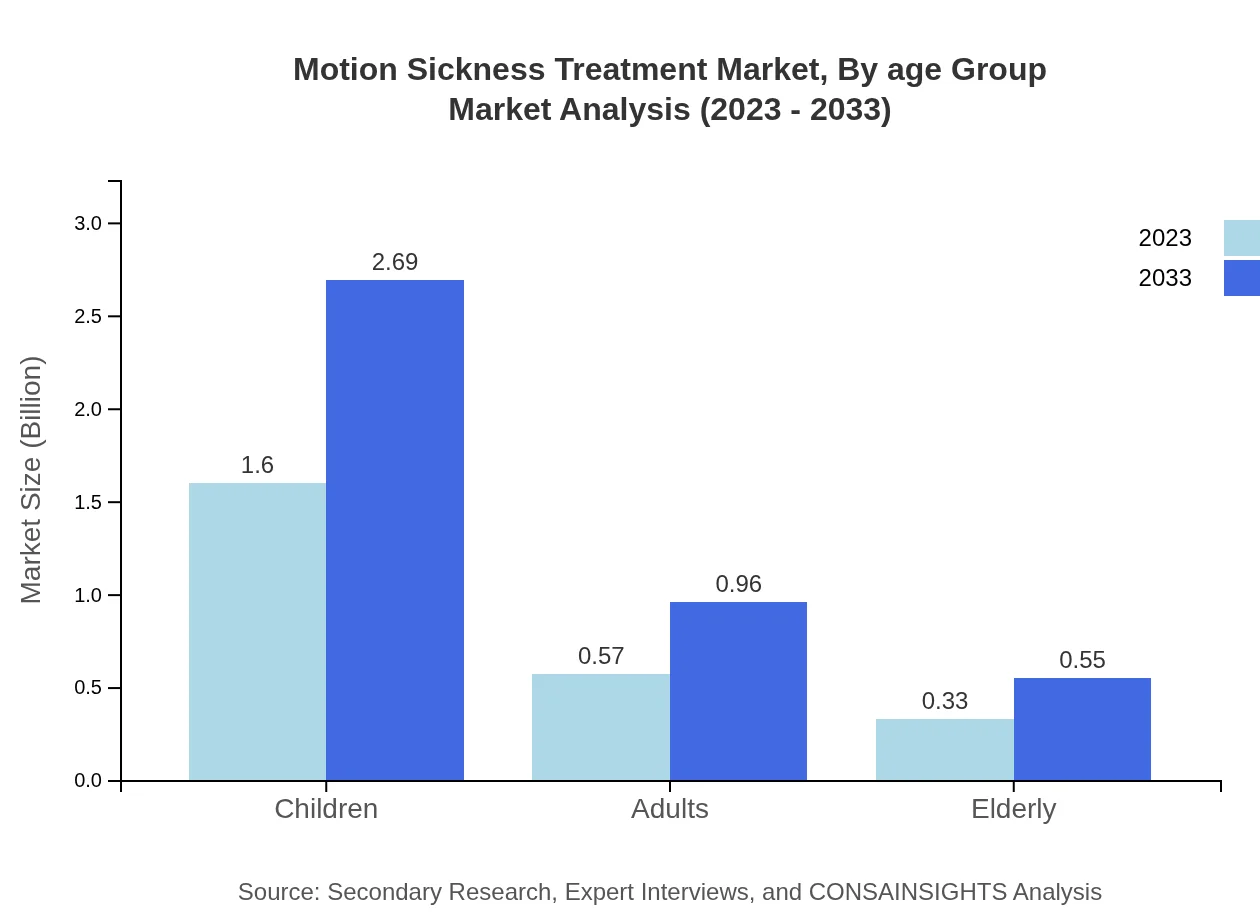
The Children segment dominates the Motion Sickness Treatment market with a size of $1.60 billion in 2023, projected to grow to $2.69 billion by 2033, capturing a market share of 64.03% throughout the period. Adults follow with a market size of $0.57 billion (22.89% share), expected to rise to $0.96 billion by 2033. The Elderly segment accounts for $0.33 billion (13.08%) in 2023, growing to $0.55 billion by 2033.
Motion Sickness Treatment Market Analysis By Treatment Type
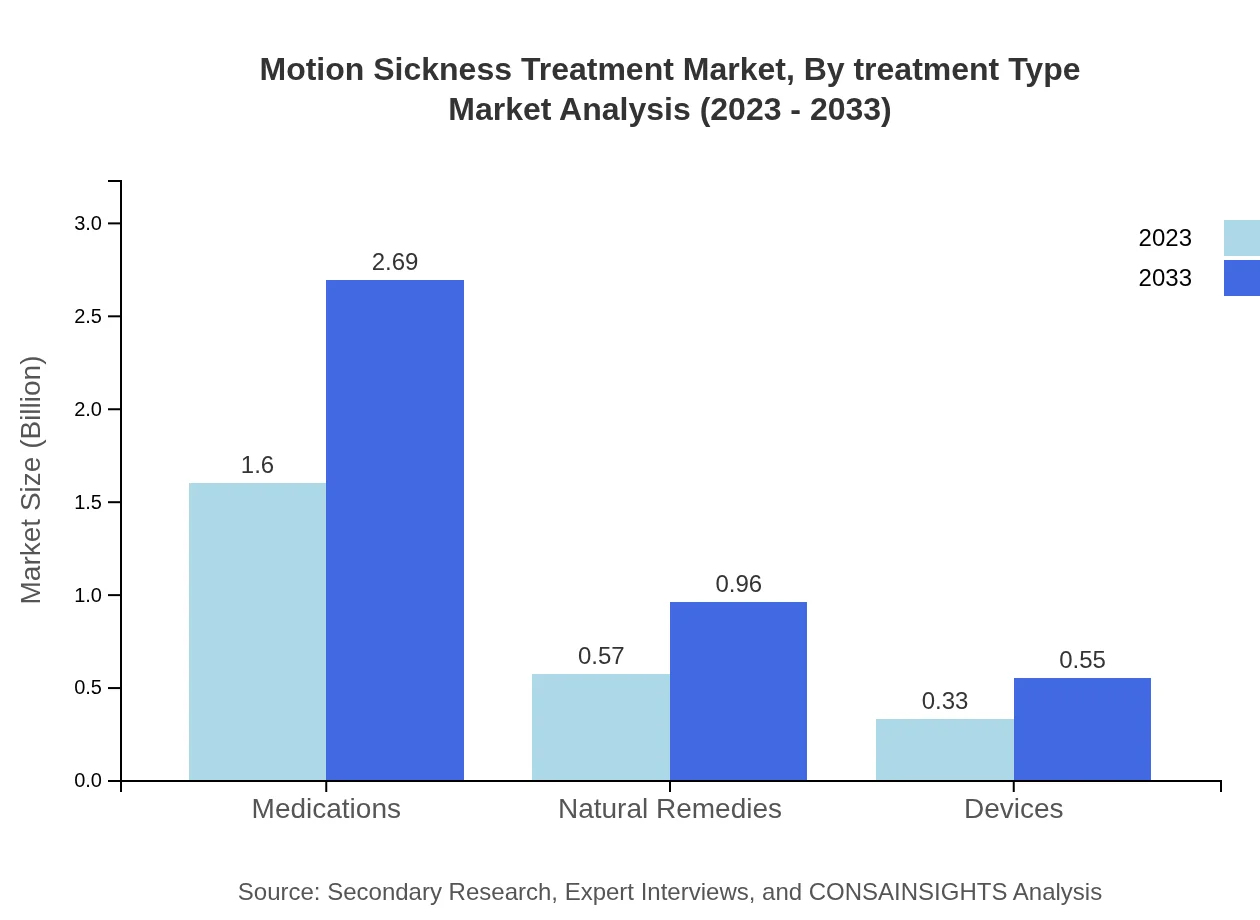
The Medications category stands as the most significant segment, holding a size of $1.60 billion in 2023, with a projected increase to $2.69 billion by 2033 (64.03% market share). Natural Remedies and Devices represent other important segments, starting at $0.57 billion (22.89%) and $0.33 billion (13.08%) respectively, signaling consumer interest in holistic options.
Motion Sickness Treatment Market Analysis By Indication
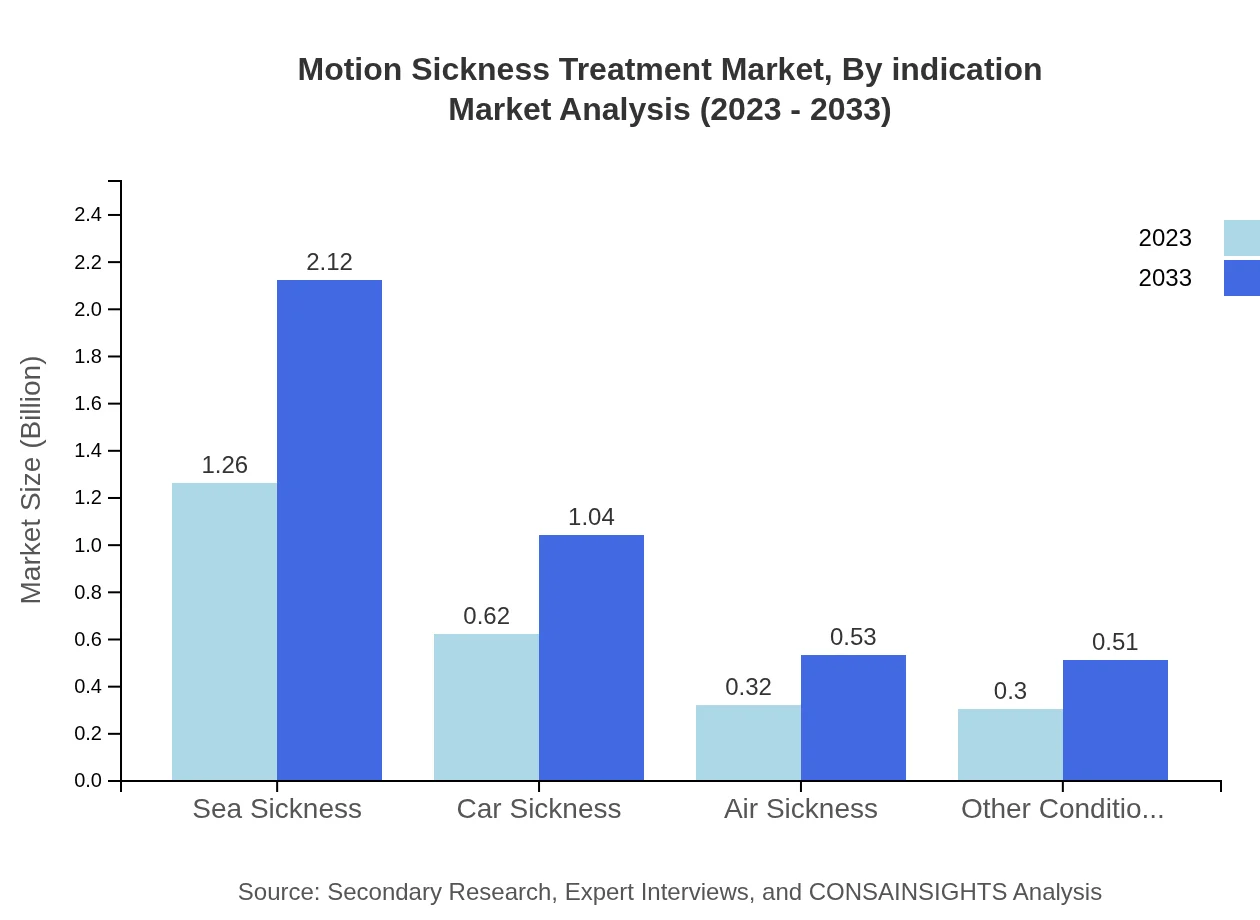
Sea Sickness is a noteworthy indication within the market, with a size of $1.26 billion in 2023, projected to reach $2.12 billion by 2033 (50.43% market share). Car Sickness and Air Sickness indicate substantial demand as well, with $0.62 billion (24.84%) and $0.32 billion (12.61%) respectively in 2023, emphasizing the need for extensive and effective treatment solutions.
Motion Sickness Treatment Market Analysis By Distribution Channel
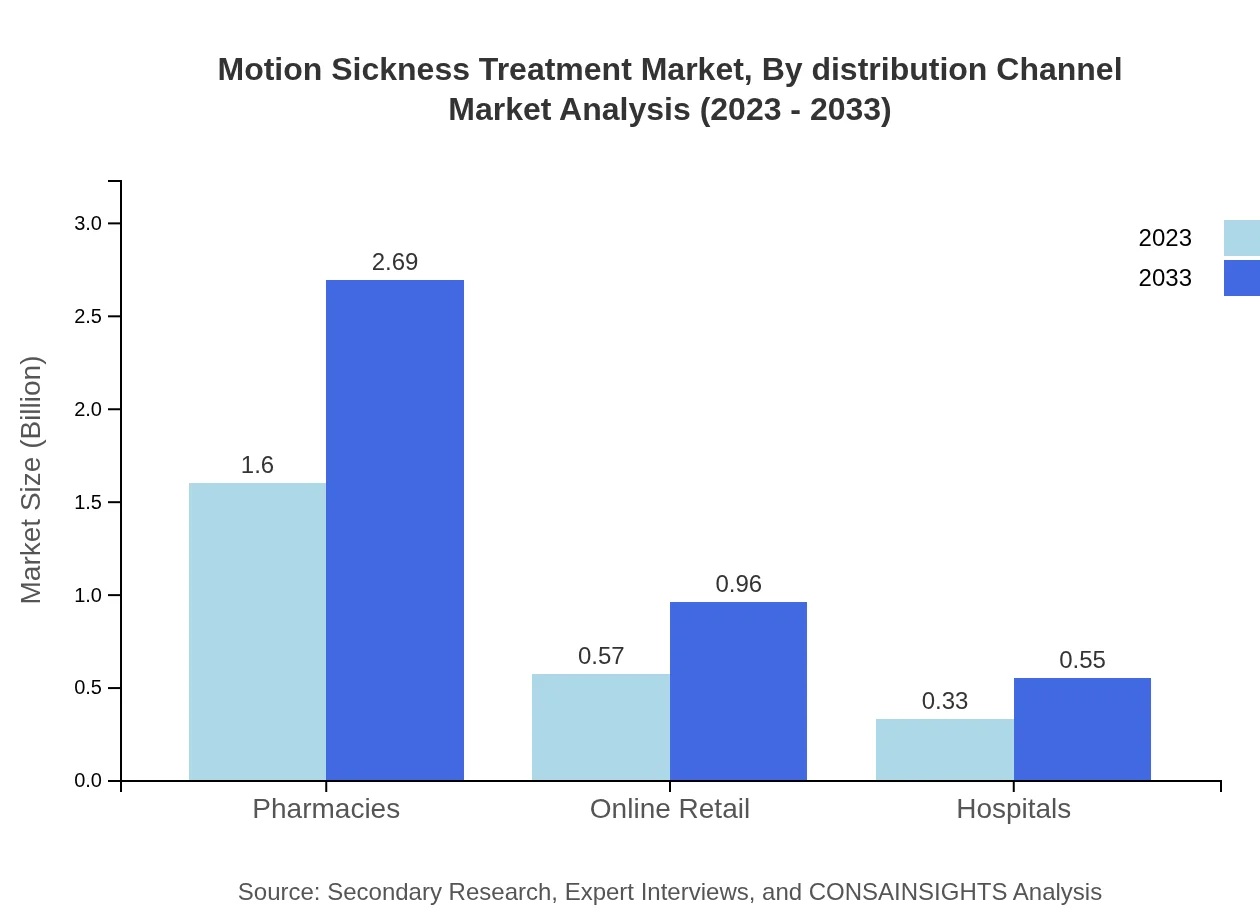
Pharmacies continue to dominate distribution channels with a market size of $1.60 billion in 2023, sharing 64.03% of the market. Online Retail is gaining traction, starting at $0.57 billion (22.89%), while Hospitals comprise $0.33 billion (13.08%), highlighting the shift towards convenient purchasing methods as consumer preferences evolve.
Motion Sickness Treatment Market Trends and Future Forecast
Tell us your focus area and get a customized research report.
Global Market Leaders and Top Companies in Motion Sickness Treatment Industry
GlaxoSmithKline:
A leading global healthcare company known for its innovative therapies and consumer healthcare products, including over-the-counter motion sickness treatments.Pfizer Inc.:
A major pharmaceutical corporation offering a range of medications for motion sickness, along with research-led innovations in the treatment area.Bayer AG:
Renowned for its healthcare products, Bayer's portfolio includes effective solutions for managing symptoms related to motion sickness, with a focus on consumer health.Medtronic :
A major player in the medical technology space, Medtronic develops devices that aid in treating motion sickness, emphasizing a high standard of safety and efficacy.We're grateful to work with incredible clients.








FAQs
What is the market size of the Motion Sickness Treatment Market Report in 2023?
The market size for 2023 is $2.50 Billion, as reported. This figure represents the baseline used for forecasting through the 2023 to 2033 period and market analysis.
How big will the Motion Sickness Treatment market be in 2033?
By 2033 the market is projected to reach $4.20 Billion according to the provided forecast, reflecting expected demand growth and continued product development across segments.
What is CAGR of the Motion Sickness Treatment Market Report?
The reported compound annual growth rate (CAGR) for the forecast period 2023 to 2033 is 5.2%, which underpins the expansion from $2.50 Billion to $4.20 Billion.
Is there a single fastest Growing region in the Motion Sickness Treatment Market Report market?
No single fastest-growing region is stated for the Motion Sickness Treatment Market Report market because the top regional implied CAGR values are within 0.15 percentage points of each other, making the ranking too close to call reliably.
Which companies are leading market activity?
Top companies listed include GlaxoSmithKline, Pfizer Inc., Bayer AG, and Medtronic, which are active in product innovation, distribution expansion, and clinical development.
What treatment types are included in the market?
Treatment types noted are medications, natural remedies, and devices. These categories cover pharmaceutical and nonpharmaceutical approaches available through multiple distribution channels.
How are distribution channels structured in this market?
Distribution channels include pharmacies, online retail, and hospitals, enabling both over-the-counter and institutional access to motion sickness treatments across demographics.
What age groups are covered in segmentation?
Age-group segmentation includes children, adults, and the elderly, reflecting tailored treatment needs and differing prevalence patterns across life stages.