
Reports >
Life Sciences
>
Nanoemulsion Market Report

Nanoemulsion Market Report
First published: 11 October 2024 | Last updated: 25 May 2026 | Report Code: nanoemulsion
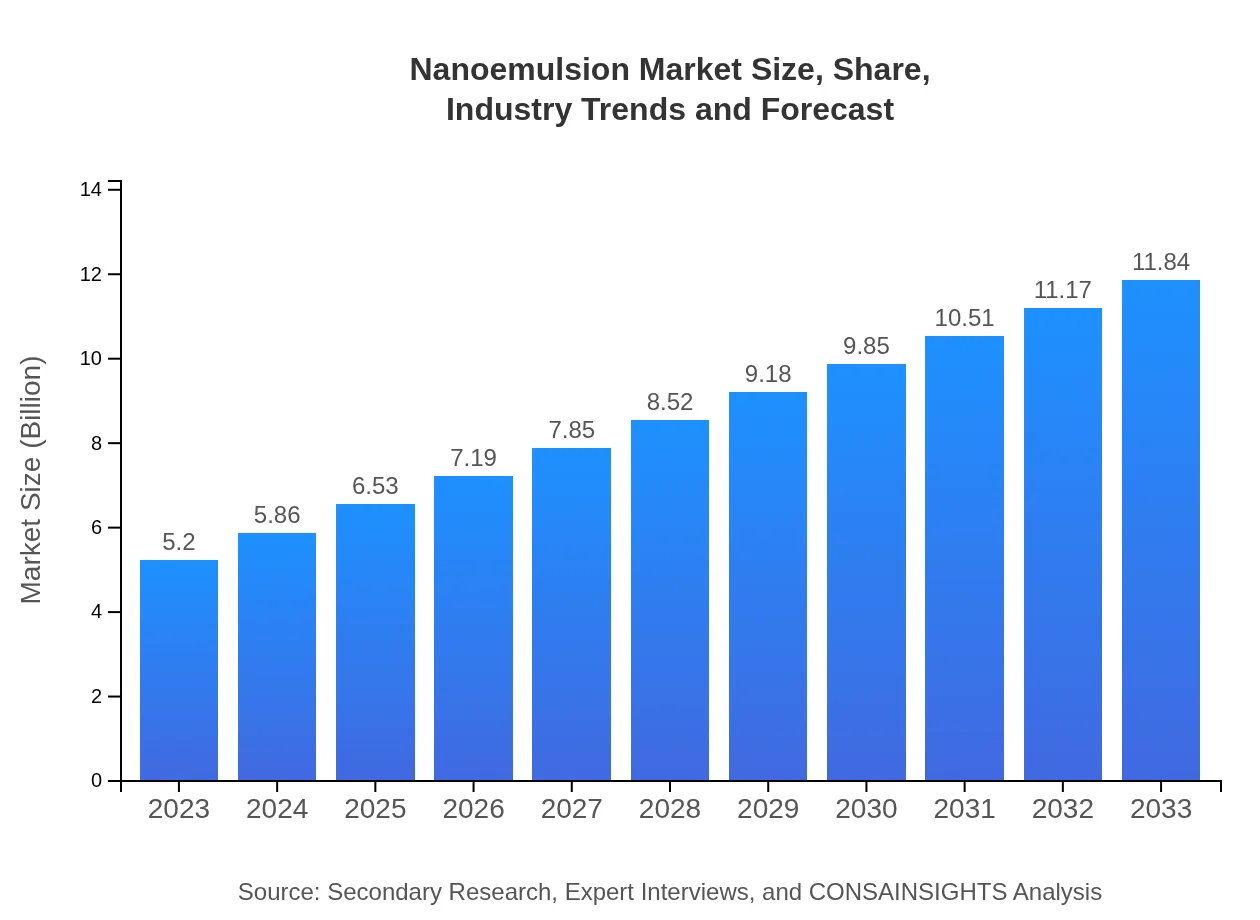
Nanoemulsion Market — USD 5.2 billion in 2023, Growing to USD 11.84B by 2033 at 8.3% CAGR
This report covers the Nanoemulsion market from 2023 to 2033, providing key insights including market size, CAGR, industry analysis, segmentation, regional dynamics, technology trends, product performance, market leaders, and future forecasts.
Key Takeaways
- Global market is expected to expand from $5.20 Billion in 2023 to $11.84 Billion by 2033, with an 8.3% CAGR over 2023 to 2033.
- North America is largest regional market, while no single fastest-growing region is stated because regional CAGR differences remain within 0.15 percentage points.
- North America is the largest region, growing from $2.02 Billion in 2023 to $4.6 Billion in 2033.
- Europe increases from $1.39 Billion in 2023 to $3.17 Billion in 2033, supported by formulations and R&D.
- Primary industry players include BASF SE, DuPont de Nemours, Inc., Gattefossé S.A., and Evonik Industries AG.
Nanoemulsion Market Report — Executive Summary
North America remains largest market by forecast-period value, while no single fastest-growing region is stated because top regional growth rates are separated by less than 0.15 percentage points. The nanoemulsion sector is propelled by demand across pharmaceuticals, cosmetics, and food and beverage applications that benefit from improved solubility and targeted delivery. Market expansion is driven by advanced formulation techniques and increasing adoption of high-energy and low-energy production methods. Regional investment and regulatory focus influence commercialization timelines, while sustainability and personalized medicine trends shape product development. The competitive landscape includes established chemical and life-science firms such as BASF SE, DuPont de Nemours, Inc., Gattefossé S.A., and Evonik Industries AG. Forecasted growth to $11.84 Billion by 2033 at an 8.3% CAGR reflects ongoing innovation, growing end-user uptake, and enhanced performance characteristics of nanoemulsion-based systems.
Key Growth Drivers
- Rising pharmaceutical and cosmetic adoption due to improved bioavailability and delivery performance.
- Advances in formulation technologies, including high-energy and low-energy approaches, enabling scalable production.
- Increasing demand for targeted and stabilized active ingredient delivery in food, nutrition, and personal care.
- Higher R&D investment and partnerships among chemical and life-sciences companies to accelerate product innovation.
| Metric | Value |
|---|---|
| Study Period | 2023 - 2033 |
| 2023 Market Size | $5.20 Billion |
| CAGR (2023-2033) | 8.3% |
| 2033 Market Size | $11.84 Billion |
| Top Companies | BASF SE, DuPont de Nemours, Inc., Gattefossé S.A., Evonik Industries AG |
| Published Date | 11 October 2024 |
| Last Modified Date | 25 May 2026 |
Nanoemulsion Market Overview
Customize Nanoemulsion Market Report market research report
- ✔ Get in-depth analysis of Nanoemulsion market size, growth, and forecasts.
- ✔ Understand Nanoemulsion's regional dynamics and industry-specific trends.
- ✔ Identify potential applications, end-user demand, and growth segments in Nanoemulsion
What is the Market Size & CAGR of Nanoemulsion Market Report market in 2023?
Nanoemulsion Industry Analysis
Nanoemulsion Market Segmentation and Scope
Tell us your focus area and get a customized research report.
Nanoemulsion Market Report Market Analysis Report by Region
Europe Nanoemulsion Market Report:
Europe grows from $1.39 Billion in 2023 to $3.17 Billion in 2033. 39 Billion in 2023 to $3.17 Billion in 2033, underpinned by active formulation research, regulatory frameworks, and investment in sustainable and advanced delivery systems.Asia Pacific Nanoemulsion Market Report:
Asia Pacific grows from $0.99 Billion in 2023 to $2.26 Billion in 2033. 99 Billion in 2023 to $2.26 Billion in 2033, driven by rising consumer demand, expanding pharmaceutical manufacturing, and increasing adoption in cosmetics and nutrition applications.North America Nanoemulsion Market Report:
North America is largest regional market, rising from $2.02 Billion in 2023 to $4.6 Billion in 2033. This growth is supported by strong R&D activity, commercialization capacity, and demand across pharmaceutical and personal care sectors.South America Nanoemulsion Market Report:
Latin America grows from $0.17 Billion in 2023 to $0.39 Billion in 2033. 17 Billion in 2023 to $0.39 Billion in 2033, with regional development supported by targeted applications in food, personal care, and local formulation initiatives.Middle East & Africa Nanoemulsion Market Report:
Middle East and Africa grows from $0.62 Billion in 2023 to $1.41 Billion in 2033. 62 Billion in 2023 to $1.41 Billion in 2033, influenced by growing interest in advanced formulations, emerging market investment, and expanding use in cosmetics and pharmaceutical products.Tell us your focus area and get a customized research report.
Research Methodology
Nanoemulsion Market Analysis By Methods
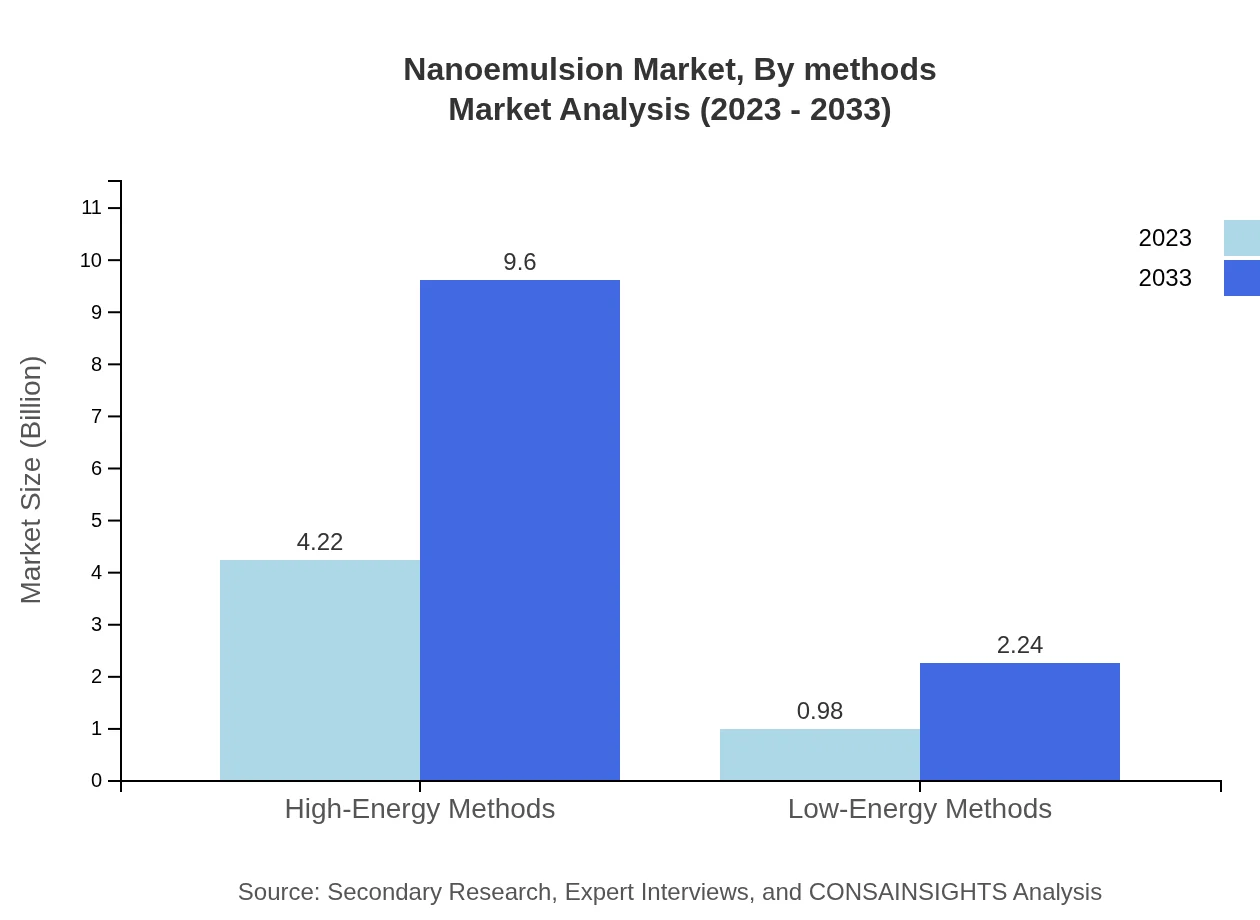
The Nanoemulsion market is significantly influenced by production methods, mainly categorized into high-energy methods and low-energy methods. High-energy methods dominate with a market share of 81.08%, showcasing a size increase from $4.22 billion in 2023 to $9.60 billion by 2033. Low-energy methods, while growing, represent a smaller share but are critical for specific applications, increasing from $0.98 billion to $2.24 billion in the same period.
Nanoemulsion Market Analysis By Application
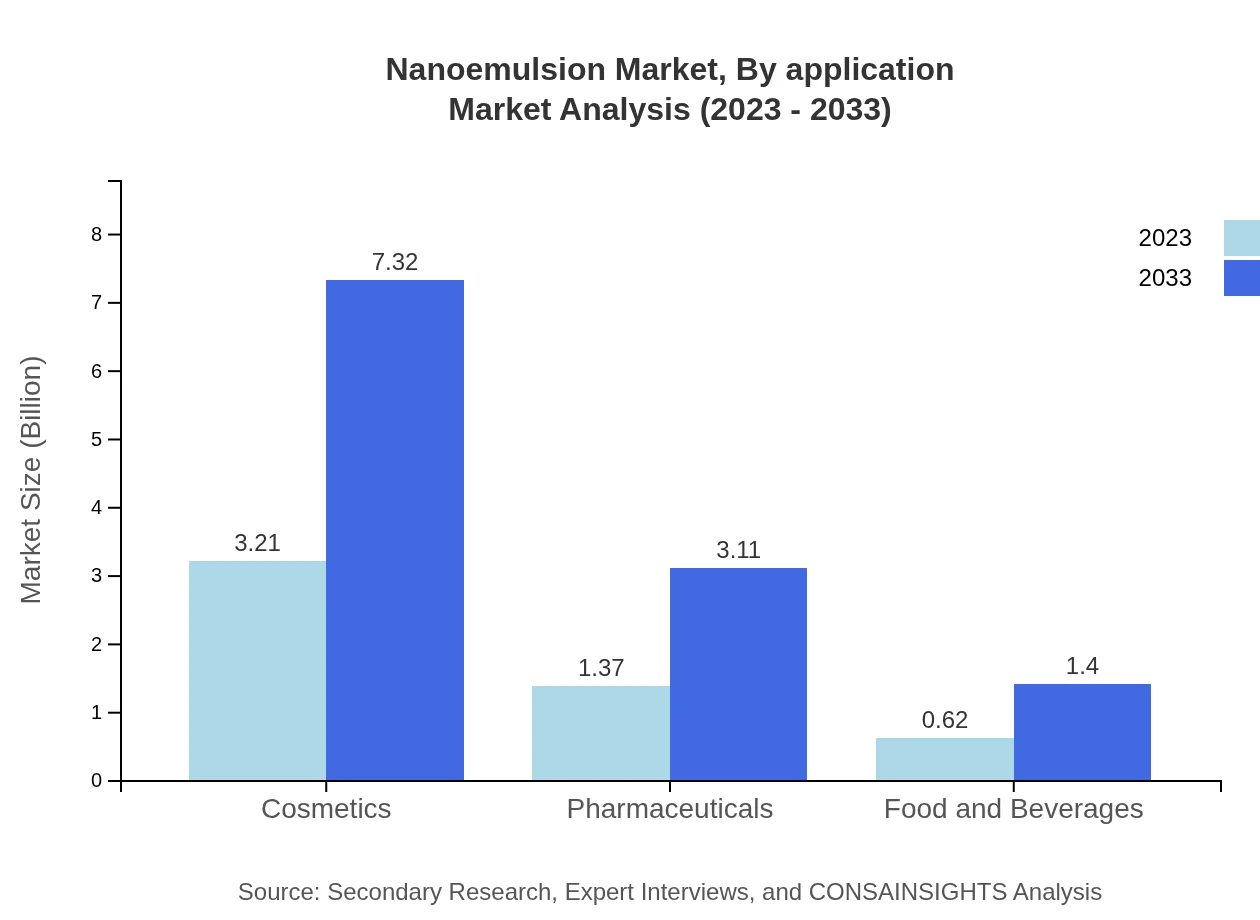
The applications of Nanoemulsions span pharmaceuticals, cosmetics, nutrition, and food & beverages. Pharmaceuticals hold a leading share at 61.82%, growing from $3.21 billion in 2023 to $7.32 billion by 2033. Cosmetics, holding 26.31% share, are expected to grow from $1.37 billion to $3.11 billion. The nutrition and food & beverages sectors also show significant growth potential, driven by increased health awareness and demand for functional foods.
Nanoemulsion Market Analysis By Materials
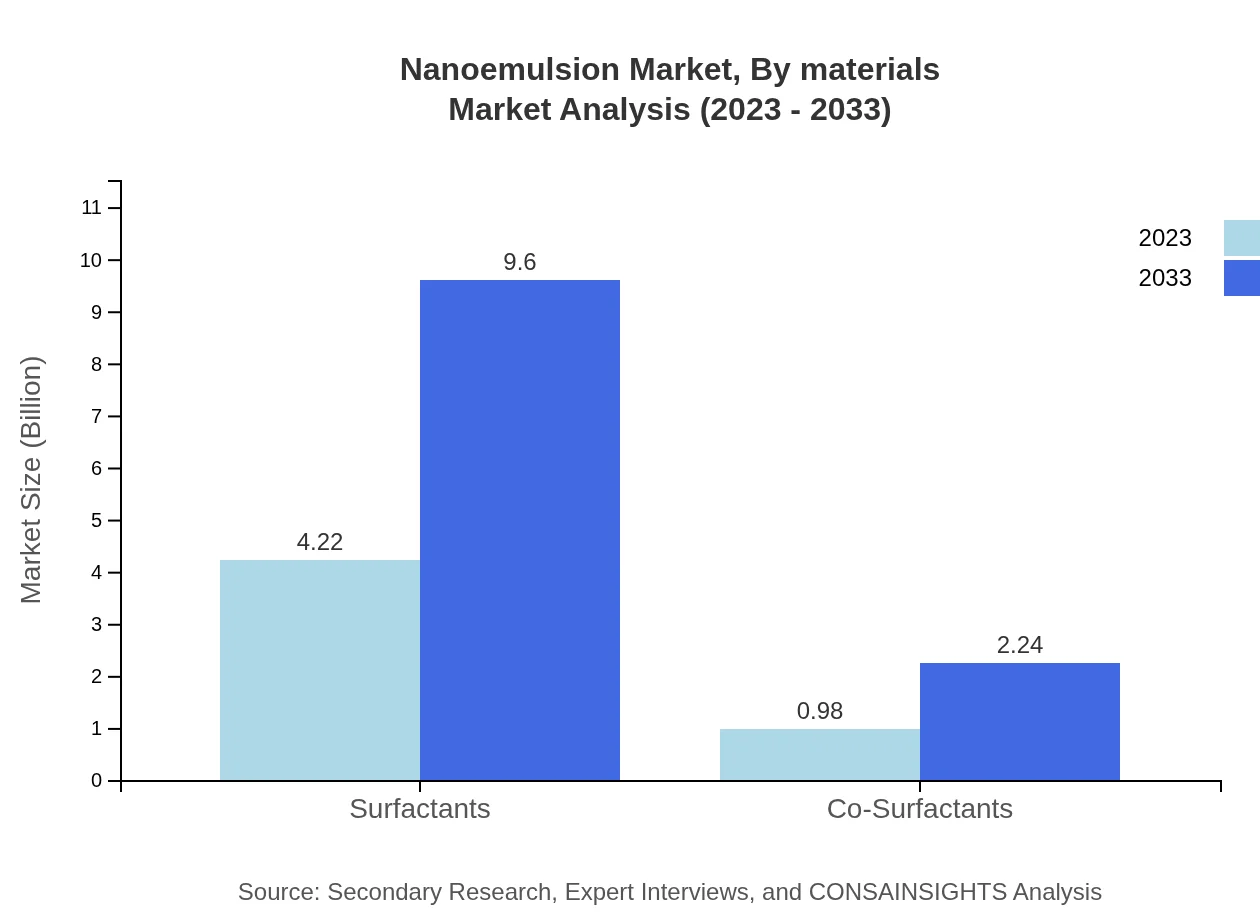
In terms of materials, surfactants dominate the market at 81.08%, increasing from $4.22 billion in 2023 to $9.60 billion in 2033. Co-surfactants, while comprising a smaller market segment at 18.92%, are essential for formulating specific types of Nanoemulsions, witnessing growth from $0.98 billion to $2.24 billion.
Nanoemulsion Market Analysis By End User
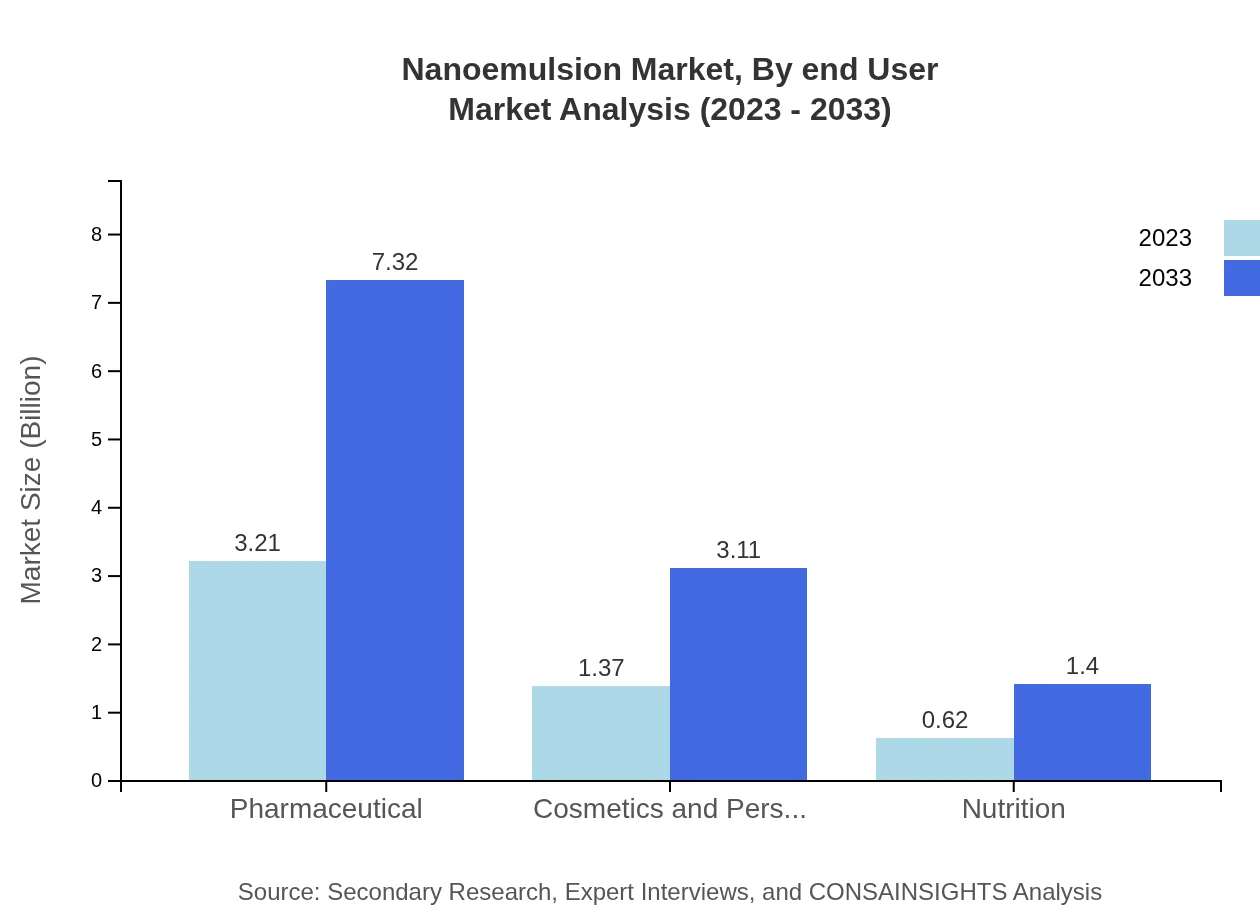
Key end-user industries for Nanoemulsions include pharmaceuticals, cosmetics, nutrition, and food & beverages, with pharmaceuticals leading the market. The trend toward personalization in medicine and consumer products further drives the demand for specialized Nanoemulsion formulations across these sectors.
Nanoemulsion Market Analysis By Formulation
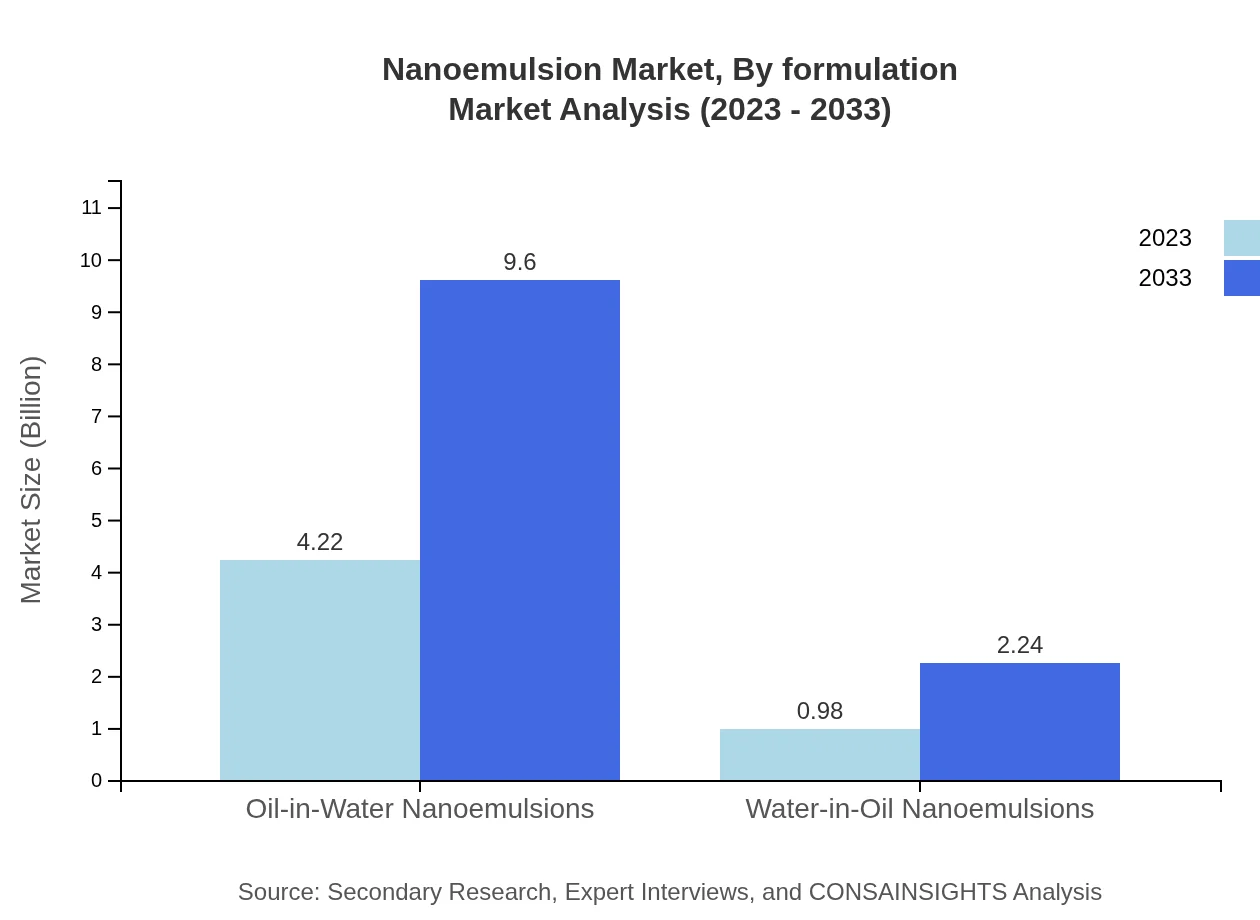
The formulations are primarily categorized into oil-in-water and water-in-oil Nanoemulsions. Oil-in-water Nanoemulsions hold a significant market share (81.08%), with a substantial growth trajectory, from $4.22 billion in 2023 to $9.60 billion by 2033. Water-in-oil formulations are essential for niche pharmaceutical applications, expected to grow steadily as their advantages are more widely recognized.
Nanoemulsion Market Trends and Future Forecast
Tell us your focus area and get a customized research report.
Global Market Leaders and Top Companies in Nanoemulsion Industry
BASF SE:
BASF SE is a global leader in the creation of innovative chemical solutions, including Nanoemulsions, with a strong focus on sustainability and research development.DuPont de Nemours, Inc.:
DuPont is at the forefront of Nanoemulsion technology, offering advanced materials for various applications, particularly in the pharmaceutical and food sectors.Gattefossé S.A.:
A key player in the cosmetic sector, Gattefossé specializes in the development of Nanoemulsions to improve the properties of cosmetic formulations.Evonik Industries AG:
Evonik focuses on high-performance Nanoemulsion systems, particularly in the fields of pharmaceuticals and personal care products.We're grateful to work with incredible clients.









FAQs
What is the current market size of the nanoemulsion market?
The market size was $5.20 Billion in 2023, as reported for the nanoemulsion industry. This figure serves as the base year measure for the 2023 to 2033 forecast period.
How big will the nanoemulsion market be in 2033?
The projected market value for 2033 is $11.84 Billion, reflecting growth across pharmaceuticals, cosmetics, and food and beverage applications over the 2023 to 2033 forecast period.
What is CAGR for the nanoemulsion market?
The compound annual growth rate specified for the 2023 to 2033 forecast period is 8.3%, based on the increase from the 2023 market size to the 2033 projection.
Is there a single fastest Growing region in the Nanoemulsion Market Report market?
No single fastest-growing region is stated for the Nanoemulsion Market Report market because the top regional implied CAGR values are within 0.15 percentage points of each other, making the ranking too close to call reliably.
Which companies are listed as leading players?
Top companies named include BASF SE, DuPont de Nemours, Inc., Gattefossé S.A., and Evonik Industries AG, representing major chemical and life-science contributors to the sector.
What factors drive adoption in cosmetics and personal care?
Adoption in cosmetics and personal care is supported by enhanced delivery of active ingredients, formulation stability, and customer demand for improved sensory and functional product attributes.
How big is the Europe regional market in 2023 and 2033?
Europe’s market value is listed as $1.39 Billion in 2023 and is projected to grow to $3.17 Billion by 2033, reflecting regional formulation development and regulatory activity.
Why are formulation methods significant for the market?
Formulation methods, including high-energy and low-energy techniques, affect production efficiency, product performance, and scalability, influencing manufacturer choices and cost structures.
What is the role of nanoemulsions in pharmaceuticals?
In pharmaceuticals, nanoemulsions improve solubility and bioavailability of active compounds, supporting targeted delivery and enabling novel formulation strategies for challenging molecules.
Who benefits most from nanoemulsion innovations?
Manufacturers across pharmaceuticals, cosmetics, and food and beverages benefit from formulation advances that enhance ingredient performance, enable new product features, and support market differentiation.