
Reports >
Life Sciences
>
Next Generation Implants Market Report

Next Generation Implants Market Report
First published: 08 October 2024 | Last updated: 25 May 2026 | Report Code: next-generation-implants
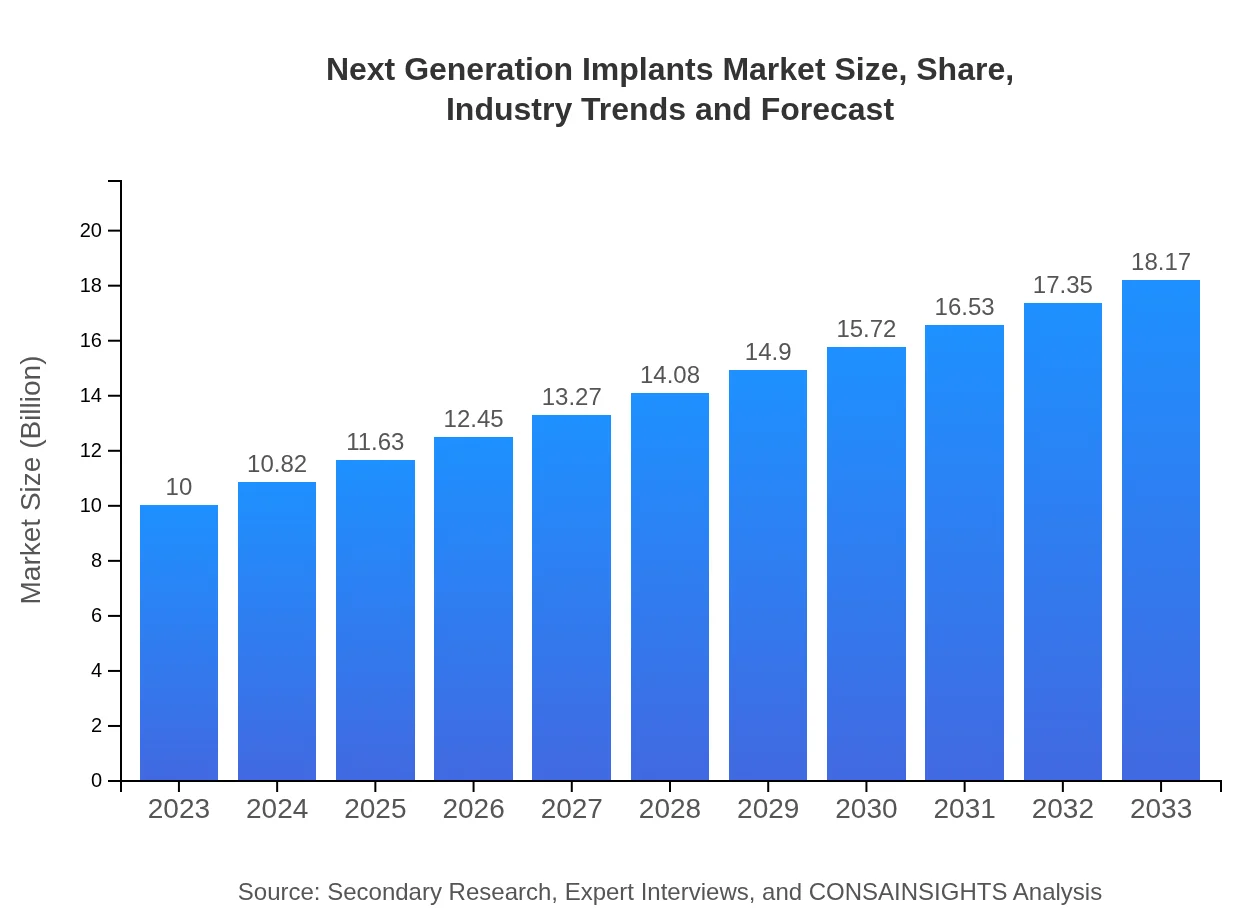
Next Generation Implants Market — USD 10 billion in 2023, Growing to USD 18.17B by 2033 at 6% CAGR
This report provides a comprehensive analysis of the Next Generation Implants market, exploring market dynamics, size, segmentation, regional insights, and future trends over the forecast period from 2023 to 2033.
Key Takeaways
- Global market expands from $10.00 Billion in 2023 to $18.17 Billion in 2033 at a 6% CAGR.
- North America is largest regional market, while no single fastest-growing region is stated because regional CAGR differences remain within 0.15 percentage points.
- North America leads regionally, rising from $3.81 Billion in 2023 to $6.92 Billion in 2033.
- Europe grows from $2.68 Billion in 2023 to $4.87 Billion in 2033, reflecting sustained demand.
- Advances in 3D printing, bioengineering and smart materials drive product innovation and customization.
- Top companies include Zimmer Biomet, Stryker Corporation, Johnson & Johnson, Medtronic, and Dentsply Sirona.
Next Generation Implants Market Report — Executive Summary
North America remains largest market by forecast-period value, while no single fastest-growing region is stated because top regional growth rates are separated by less than 0.15 percentage points. This report examines the Next Generation Implants market, driven by improved materials, advanced manufacturing methods and demand for personalized implant solutions. Market size increases from $10.00 Billion in 2023 to $18.17 Billion by 2033 at a 6% CAGR for 2023 to 2033. Key growth factors include adoption of 3D printing technology, progress in biocompatible and smart materials, and rising procedural volumes in orthopedic and dental care. The analysis covers segmentation by material, technology, application and implant type, and provides regional breakdowns that show North America as the largest market. The competitive landscape profiles leading suppliers, including Zimmer Biomet, Stryker Corporation, Johnson & Johnson, Medtronic and Dentsply Sirona. Regulatory considerations and cost pressures are discussed alongside opportunities for R&D and strategic partnerships.
Key Growth Drivers
- Wider use of additive manufacturing enables customized implants and shorter production cycles.
- Improvements in biocompatible ceramics, metals and polymers increase implant durability and acceptance.
- Rising volumes of orthopedic and dental procedures boost demand for advanced implant solutions.
- Investment in smart materials and bioengineering expands functional capabilities of devices.
- Collaborations between medical device firms and research institutions accelerate product development.
| Metric | Value |
|---|---|
| Study Period | 2023 - 2033 |
| 2023 Market Size | $10.00 Billion |
| CAGR (2023-2033) | 6% |
| 2033 Market Size | $18.17 Billion |
| Top Companies | Zimmer Biomet, Stryker Corporation, Johnson & Johnson, Medtronic , Dentsply Sirona |
| Published Date | 08 October 2024 |
| Last Modified Date | 25 May 2026 |
Next Generation Implants Market Overview
Customize Next Generation Implants Market Report market research report
- ✔ Get in-depth analysis of Next Generation Implants market size, growth, and forecasts.
- ✔ Understand Next Generation Implants's regional dynamics and industry-specific trends.
- ✔ Identify potential applications, end-user demand, and growth segments in Next Generation Implants
What is the Market Size & CAGR of Next Generation Implants Market Report market in 2023?
Next Generation Implants Industry Analysis
Next Generation Implants Market Segmentation and Scope
Tell us your focus area and get a customized research report.
Next Generation Implants Market Report Market Analysis Report by Region
Europe Next Generation Implants Market Report:
Europe grows from $2.68 Billion in 2023 to $4.87 Billion in 2033. Regional uptake is driven by investments in research, adoption of advanced materials and manufacturing methods, and steady demand across orthopedic and dental applications.Asia Pacific Next Generation Implants Market Report:
Asia Pacific grows from $1.97 Billion in 2023 to $3.58 Billion in 2033. Growth factors include expanding procedural volumes, increasing healthcare access, and adoption of 3D printing and bioengineering technologies in product development.North America Next Generation Implants Market Report:
North America is largest regional market, rising from $3.81 Billion in 2023 to $6.92 Billion in 2033. The region’s scale reflects established healthcare infrastructure, high adoption of new implant technologies and significant clinical procedure volumes, positioning it as the largest regional market.South America Next Generation Implants Market Report:
Latin America grows from $0.77 Billion in 2023 to $1.39 Billion in 2033. Market expansion is linked to growing demand for implantable solutions and gradual adoption of newer manufacturing techniques and materials.Middle East & Africa Next Generation Implants Market Report:
Middle East and Africa grows from $0.77 Billion in 2023 to $1.4 Billion in 2033. Regional development is supported by improving healthcare infrastructure, targeted investments and growing interest in advanced implant options.Tell us your focus area and get a customized research report.
Research Methodology
Next Generation Implants Market Analysis By Material
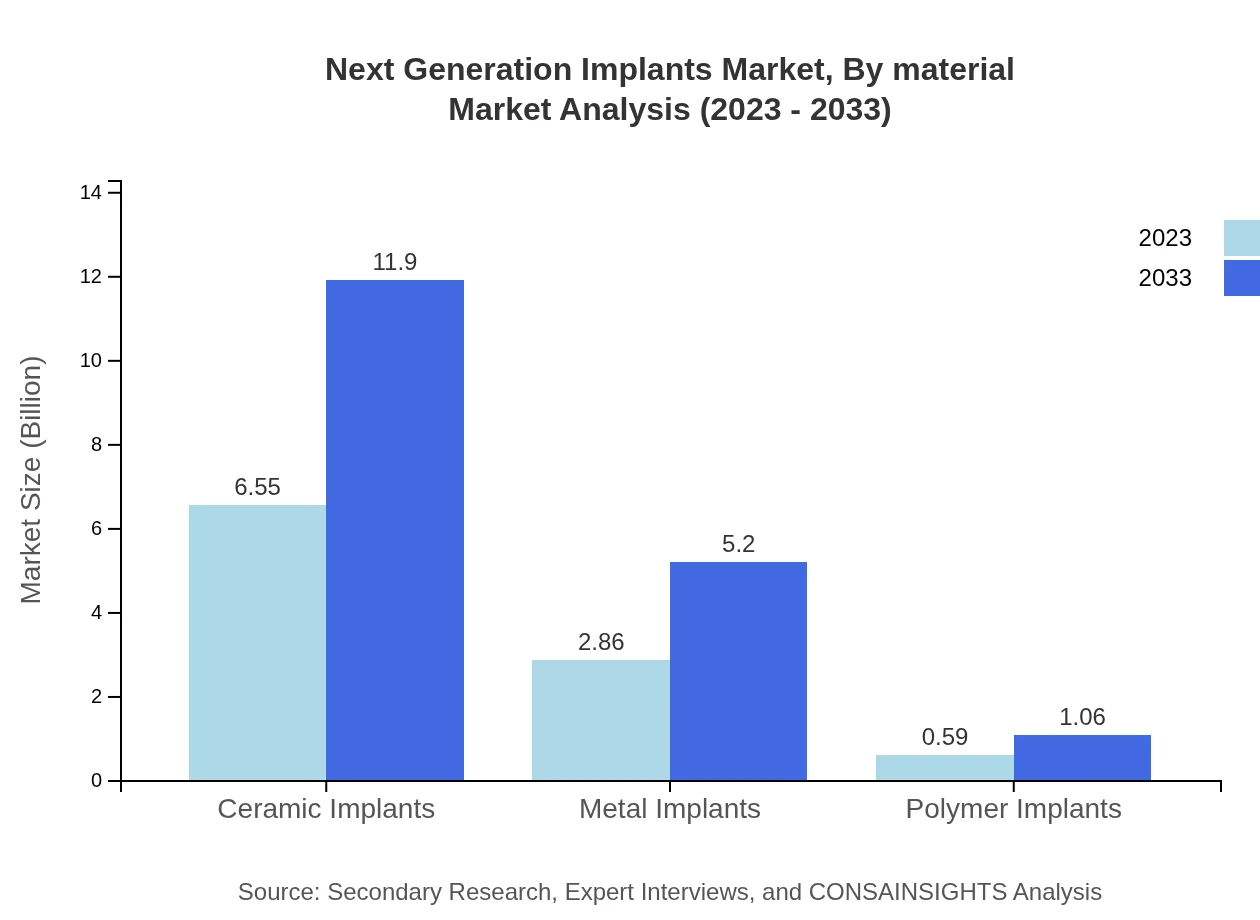
The material segment is dominated by Ceramic Implants, which represent the largest share with a market size of $6.55 billion in 2023, projected to grow to $11.90 billion by 2033. Metal Implants, crucial for their strength and versatility, are forecasted to grow from $2.86 billion to $5.20 billion, while Polymer Implants remain essential but smaller in size at $0.59 billion growing to $1.06 billion.
Next Generation Implants Market Analysis By Implant Type
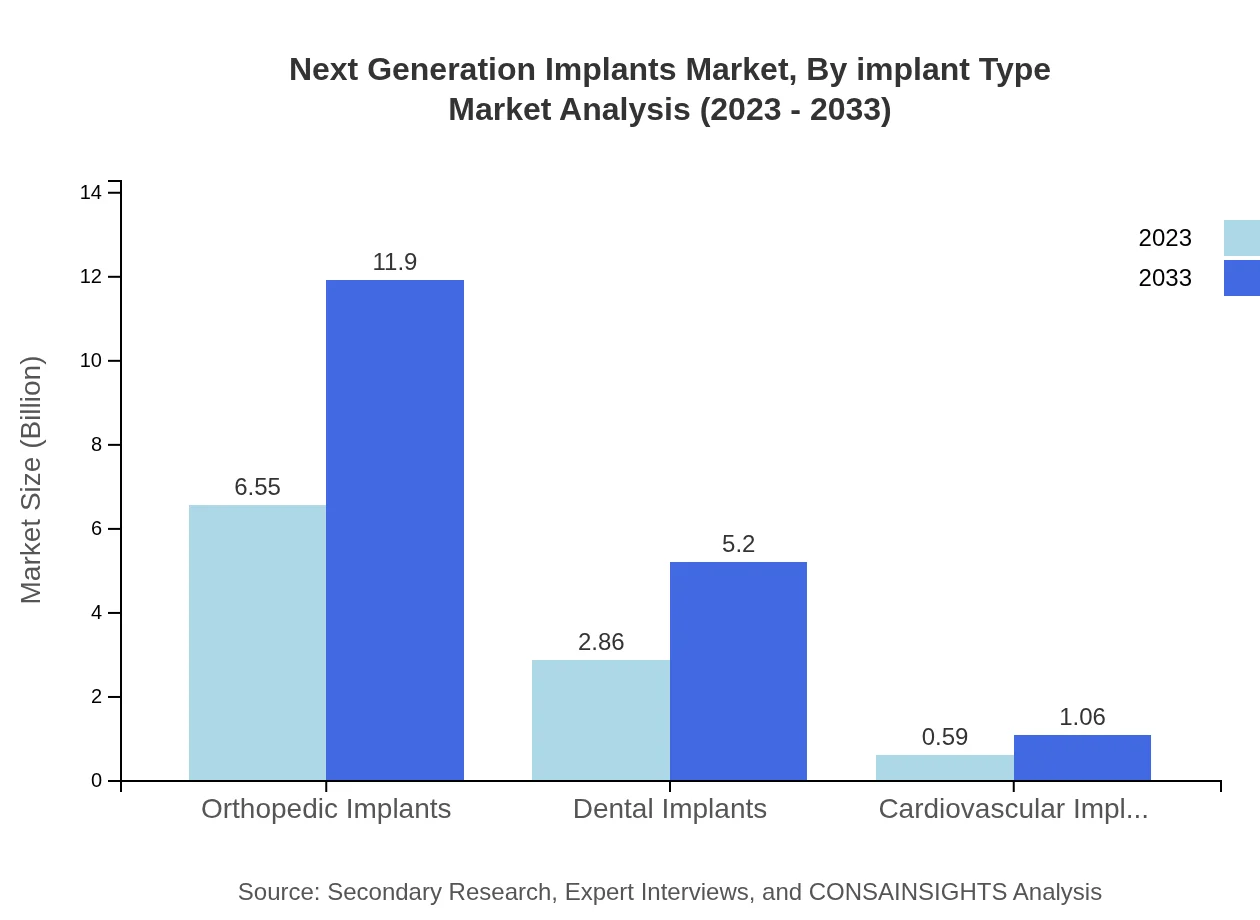
Orthopedic Implants dominate the segment with a substantial market share and will reach $6.55 billion by 2033 from $11.90 billion in 2023. Dental Implants will also see notable growth from $2.86 billion to $5.20 billion, driven by the rising need for dental solutions. Cardiovascular Implants, although smaller, will experience growth reaching $0.59 billion by 2033.
Next Generation Implants Market Analysis By Technology
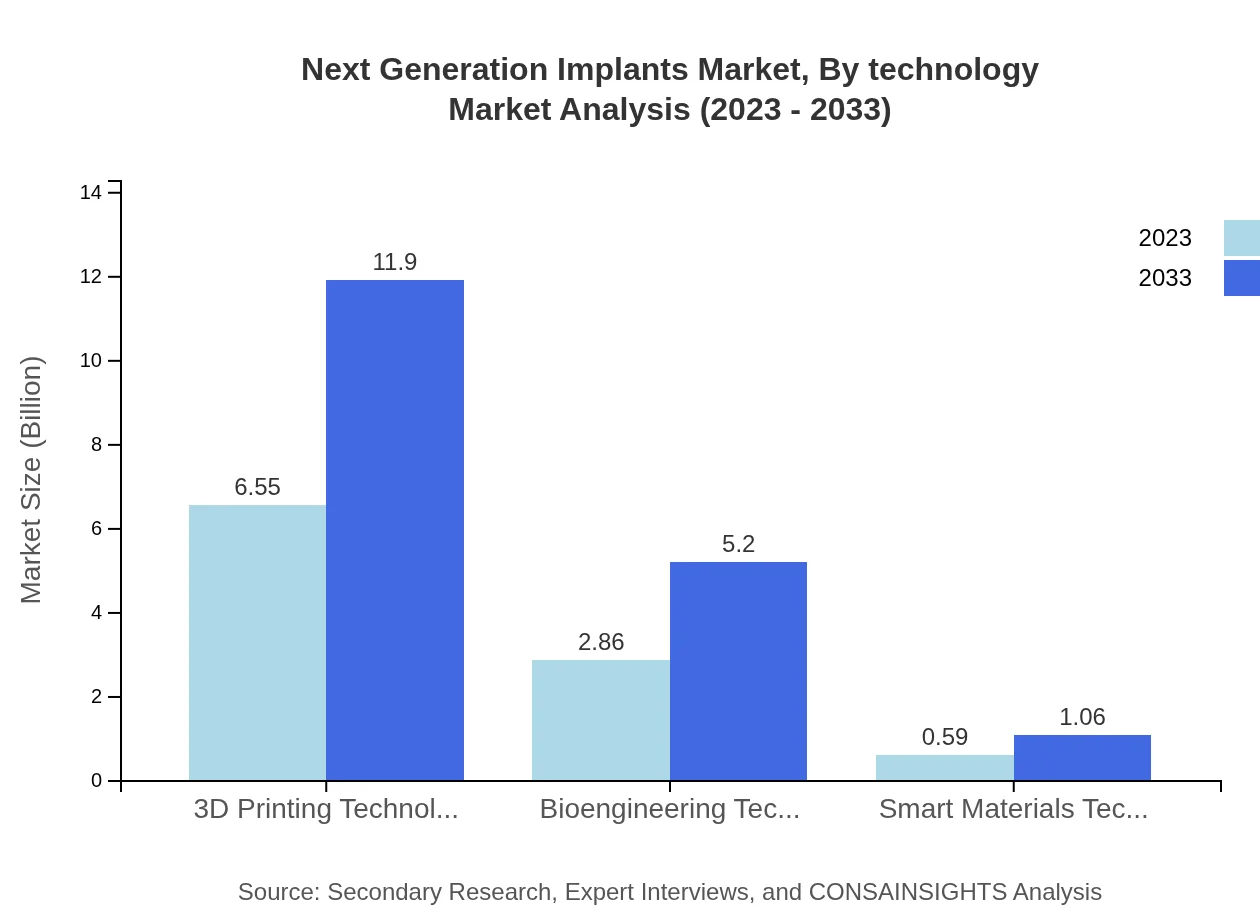
The technological landscape is evolving with 3D Printing Technology holding a significant market share, growing to $11.90 billion by 2033 from $6.55 billion in 2023. Bioengineering Technology also plays a pivotal role, anticipated to expand from $2.86 billion to $5.20 billion due to innovative modeling and materials science applications. Smart Materials Technology is expected to grow similarly from $0.59 billion to $1.06 billion.
Next Generation Implants Market Analysis By Application
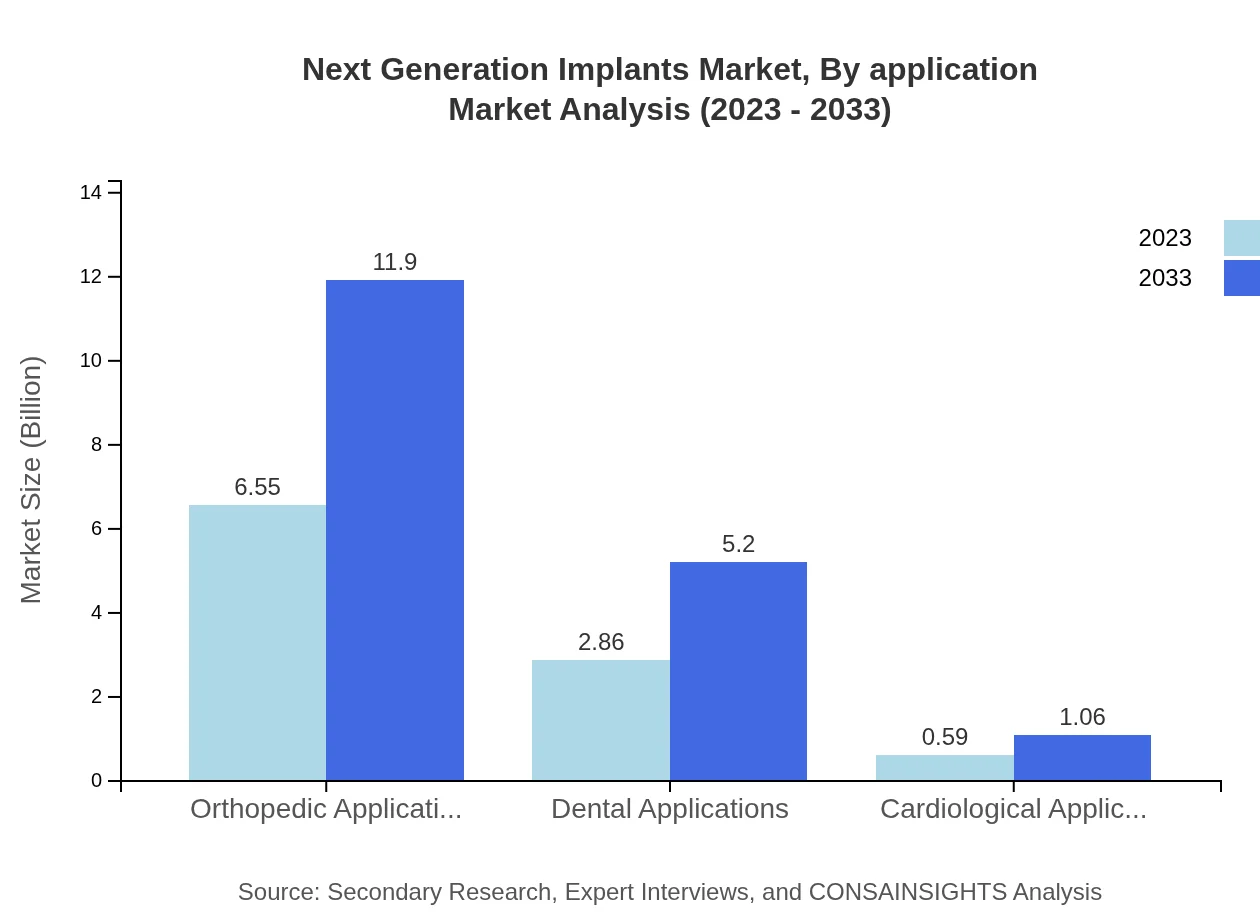
Orthopedic Applications will lead this segment, with a size reaching $11.90 billion by 2033. Dental applications are expected to grow to $5.20 billion, while Cardiological Applications will reach $1.06 billion. This diversification illustrates the increasing reliance on specialized surgical solutions across medical disciplines.
Next Generation Implants Market Trends and Future Forecast
Tell us your focus area and get a customized research report.
Global Market Leaders and Top Companies in Next Generation Implants Industry
Zimmer Biomet:
A global leader in musculoskeletal healthcare, Zimmer Biomet is known for its innovative solutions in orthopedic implants, focusing on transforming patient care through advanced technologies.Stryker Corporation:
Stryker specializes in innovative medical technologies, including minimally invasive surgical implants and advanced robotics, setting industry standards in implant design and manufacturing.Johnson & Johnson:
Through its operating companies, Johnson & Johnson develops a wide range of medical devices, including cutting-edge implants for orthopedic and surgical applications, catering to various patient needs.Medtronic :
Medtronic leads in medical technology innovation, providing advanced implantable devices focused on therapeutic outcomes in cardiology and pain management.Dentsply Sirona:
Dentsply Sirona is a leader in dental products, specializing in implant technology and solutions that enhance oral health and patient experiences.We're grateful to work with incredible clients.








FAQs
What is the market size of the Next Generation Implants Market Report in 2023?
The market size in 2023 is $10.00 Billion, as stated in the report data provided for the 2023 baseline period.
How big will the market be in 2033?
By 2033, the market is reported to reach $18.17 Billion based on the forecast figures included in the source data.
What is CAGR for the forecast period?
The specified compound annual growth rate for 2023 to 2033 is 6%, according to the input figures for the forecast period.
Is there a single fastest Growing region in the Next Generation Implants Market Report market?
No single fastest-growing region is stated for the Next Generation Implants Market Report market because the top regional implied CAGR values are within 0.15 percentage points of each other, making the ranking too close to call reliably.
Which companies are listed as top players?
Top companies named in the report include Zimmer Biomet, Stryker Corporation, Johnson & Johnson, Medtronic and Dentsply Sirona.
What are the main technology trends noted?
Key technology trends include the growing application of 3D printing, bioengineering methods and smart materials, which support personalized and higher-performing implants.
How big is the European market in the forecast?
Europe is reported to grow from $2.68 Billion in 2023 to $4.87 Billion in 2033, per the regional figures supplied in the dataset.
What drives demand in Asia Pacific?
Demand in Asia Pacific is tied to procedure volume growth and innovation uptake; the region is shown increasing from $1.97 Billion in 2023 to $3.58 Billion in 2033.
Which segmentations are covered in the report?
The report includes segmentation by material, technology, application and implant type, with listed subsegments for each category as provided in the source data.
How is regulatory pressure affecting the market?
Regulatory complexity and associated manufacturing costs are noted as constraints, influencing company strategies around compliance and product development.