

Optical Coherence Tomography Market Report
First published: 11 October 2024 | Last updated: 25 May 2026 | Report Code: optical-coherence-tomography
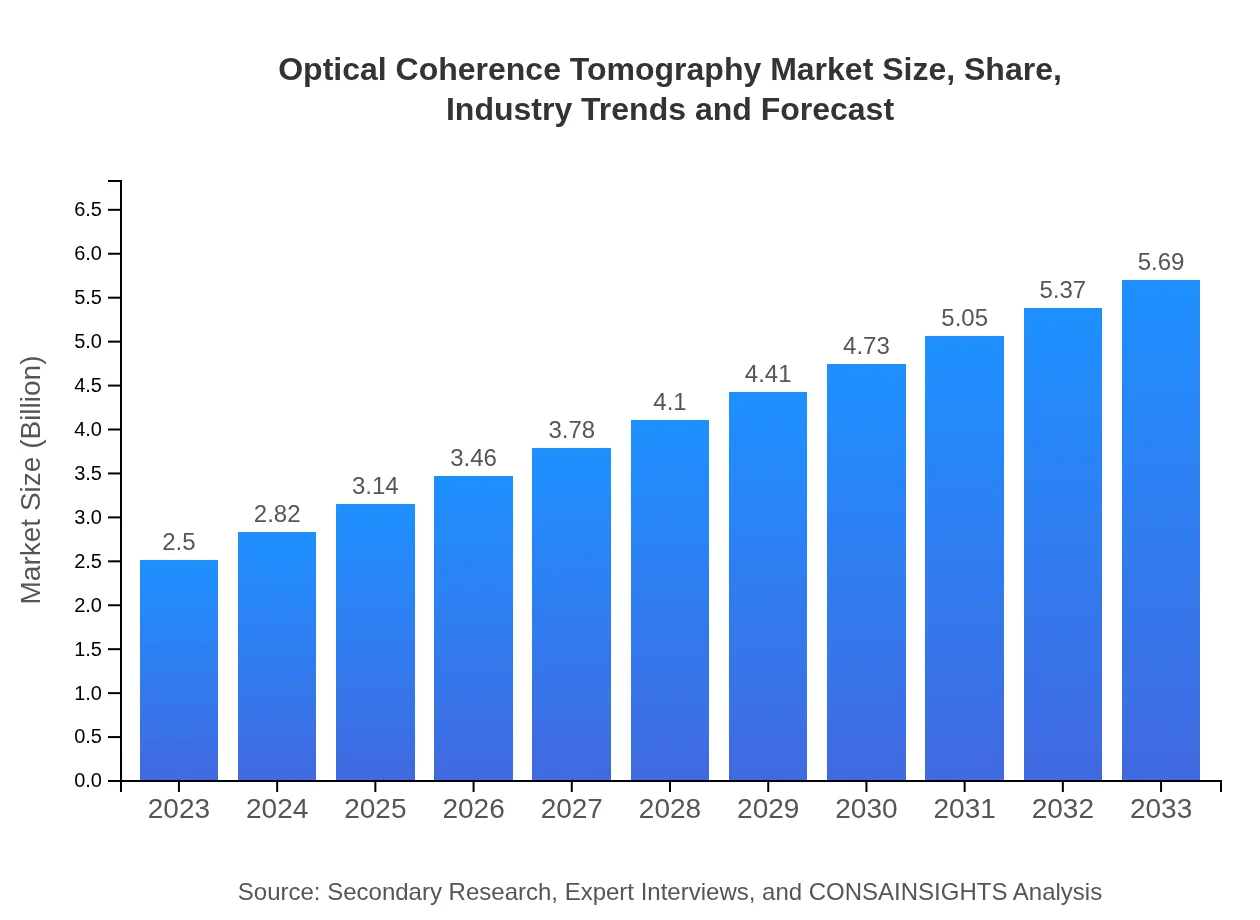
Optical Coherence Tomography Market — USD 2.5 billion in 2023, Growing to USD 5.69B by 2033 at 8.3% CAGR
This report provides an in-depth analysis of the Optical Coherence Tomography (OCT) market, covering market size, segmentation, and trends from 2023 to 2033. Insights into regional dynamics and key market players are also discussed, offering a comprehensive view of the factors shaping the future of OCT technology.
Key Takeaways
- Global market expands from $2.50 Billion (2023) to $5.69 Billion (2033) at an 8.3% CAGR.
- North America is largest regional market, while no single fastest-growing region is stated because regional CAGR differences remain within 0.15 percentage points.
- Europe and Asia Pacific show notable absolute growth: Europe rises from $0.67 Billion to $1.52 Billion; Asia Pacific from $0.54 Billion to $1.23 Billion.
- Top vendors include Carl Zeiss AG, Optovue, Inc., Nidek Co., Ltd., Topcon Corporation and Heidelberg Engineering.
- Market momentum driven by imaging improvements, expanding diagnostic use cases, and integration with complementary technologies.
Optical Coherence Tomography Market Report — Executive Summary
North America remains largest market by forecast-period value, while no single fastest-growing region is stated because top regional growth rates are separated by less than 0.15 percentage points. This report outlines the Optical Coherence Tomography market trajectory, quantifying growth from $2.50 Billion in 2023 to $5.69 Billion by 2033 at an 8.3% CAGR for 2023 to 2033. Demand is supported by enhanced imaging resolution, broader clinical adoption across ophthalmology and other specialties, and increased healthcare capacity. Product innovation spans OCT systems, imaging software and accessories, while deployment settings include hospitals, ambulatory surgical centers, specialty clinics and research institutes. Regional patterns show North America as the largest market, and Europe, Asia Pacific, Latin America and Middle East and Africa each contributing to overall expansion. Competitive activity centers on established manufacturers such as Carl Zeiss AG and Heidelberg Engineering, with partnerships and technology upgrades shaping offerings. Regulatory pathways, cost considerations and the shift toward user-friendly and portable devices will influence market paths through the forecast period.
Key Growth Drivers
- Advances in imaging technology improving resolution and acquisition speed, enabling broader clinical applications.
- Rising use in ophthalmology and expansion into cardiology, dermatology and general surgery increasing device demand.
- Upgrades in healthcare infrastructure and growing diagnostic capacity support higher adoption in hospitals and clinics.
- Integration with complementary diagnostic tools and software enhances clinical workflow and device utility.
- Product diversification across systems, software and accessories expands purchasing options for end users.
| Metric | Value |
|---|---|
| Study Period | 2023 - 2033 |
| 2023 Market Size | $2.50 Billion |
| CAGR (2023-2033) | 8.3% |
| 2033 Market Size | $5.69 Billion |
| Top Companies | Carl Zeiss AG, Optovue, Inc., Nidek Co., Ltd., Topcon Corporation, Heidelberg Engineering |
| Published Date | 11 October 2024 |
| Last Modified Date | 25 May 2026 |
Optical Coherence Tomography Market Overview
Customize Optical Coherence Tomography Market Report market research report
- ✔ Get in-depth analysis of Optical Coherence Tomography market size, growth, and forecasts.
- ✔ Understand Optical Coherence Tomography's regional dynamics and industry-specific trends.
- ✔ Identify potential applications, end-user demand, and growth segments in Optical Coherence Tomography
What is the Market Size & CAGR of Optical Coherence Tomography Market Report market in 2023?
Optical Coherence Tomography Industry Analysis
Optical Coherence Tomography Market Segmentation and Scope
Tell us your focus area and get a customized research report.
Optical Coherence Tomography Market Report Market Analysis Report by Region
Europe Optical Coherence Tomography Market Report:
Europe grows from $0.67 Billion in 2023 to $1.52 Billion in 2033. Expansion reflects increased use in ophthalmology, upgrades to diagnostic infrastructure and adoption of advanced OCT systems and software within clinical networks.Asia Pacific Optical Coherence Tomography Market Report:
Asia Pacific grows from $0.54 Billion in 2023 to $1.23 Billion in 2033. Regional drivers include expanding healthcare access, rising demand for diagnostic imaging and growing investments in outpatient and specialty care facilities.North America Optical Coherence Tomography Market Report:
North America is largest regional market, rising from $0.8 Billion in 2023 to $1.83 Billion in 2033. As the largest regional market, growth is supported by clinical uptake, investments in imaging technologies, and established vendor presence driving procurement across hospitals and specialty centers.South America Optical Coherence Tomography Market Report:
Latin America grows from $0.23 Billion in 2023 to $0.52 Billion in 2033. Market progress is tied to gradual healthcare capacity improvements, adoption of imaging technologies and growing awareness of non-invasive diagnostic options.Middle East & Africa Optical Coherence Tomography Market Report:
Middle East and Africa grows from $0.26 Billion in 2023 to $0.58 Billion in 2033. Growth is influenced by healthcare infrastructure development, selective technology adoption and expanding clinical services in key markets.Tell us your focus area and get a customized research report.
Research Methodology
Optical Coherence Tomography Market Analysis By Product Type
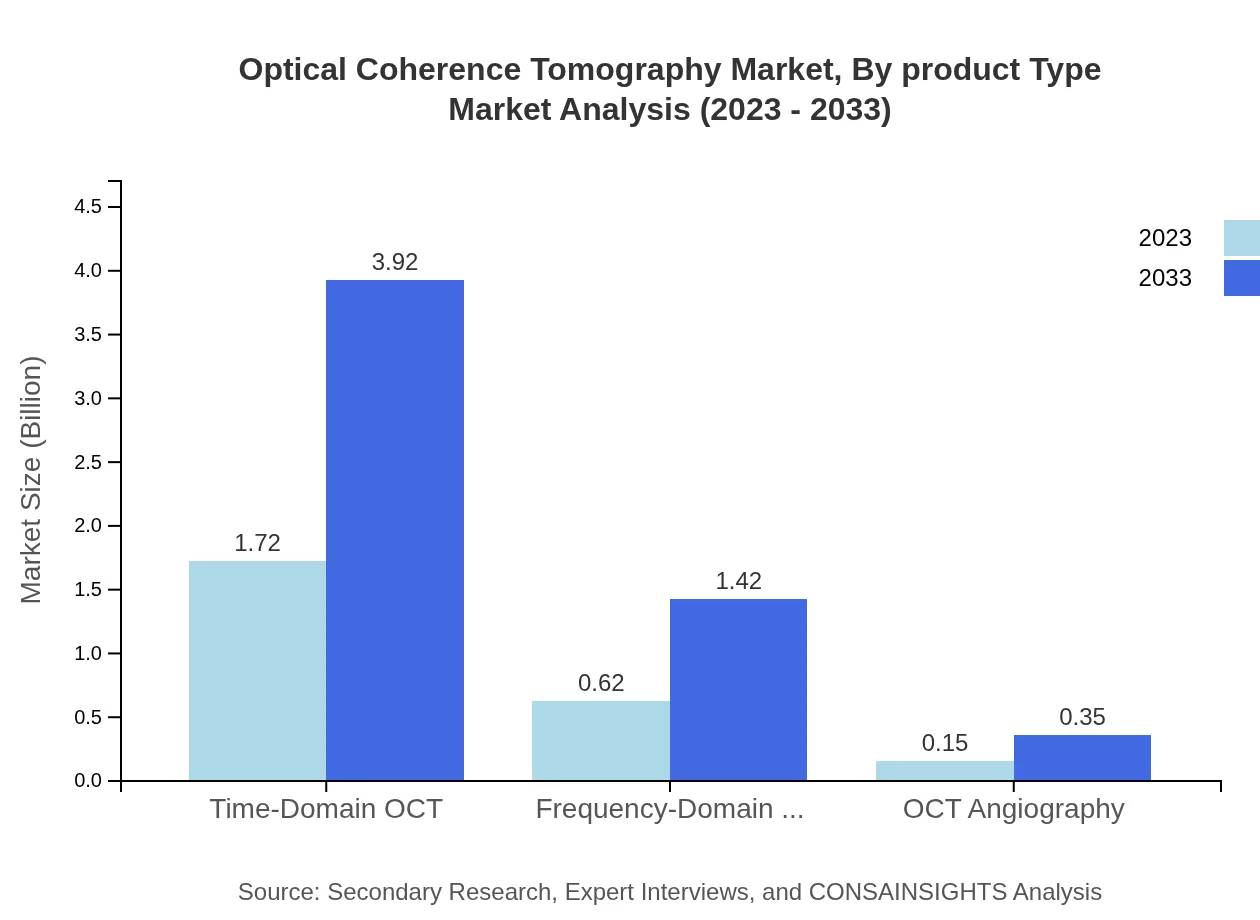
The Optical Coherence Tomography market is notably dominated by OCT systems, which accounted for approximately $1.72 billion in 2023, expected to grow to $3.92 billion by 2033. Other notable segments include OCT Imaging Software and Accessories, with their respective market sizes of $0.62 billion and $0.15 billion in 2023, growing to $1.42 billion and $0.35 billion by 2033.
Optical Coherence Tomography Market Analysis By Application
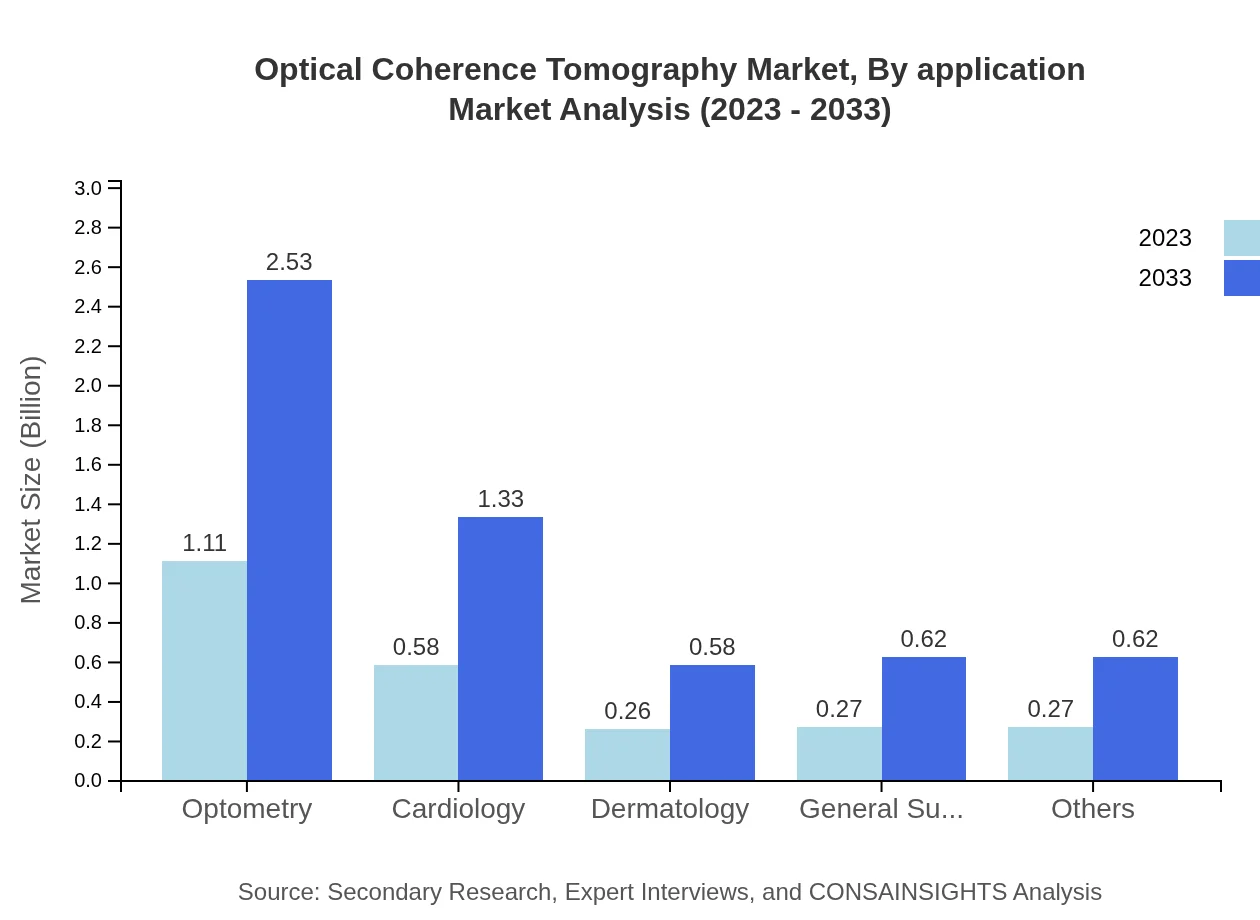
In terms of application, ophthalmology remains the largest segment, followed by cardiology and dermatology. The market values for ophthalmology will increase from $2.25 billion in 2023 to an estimated $5.12 billion by 2033, while cardiology will see a rise from $0.58 billion to $1.33 billion in the same period.
Optical Coherence Tomography Market Analysis By End User
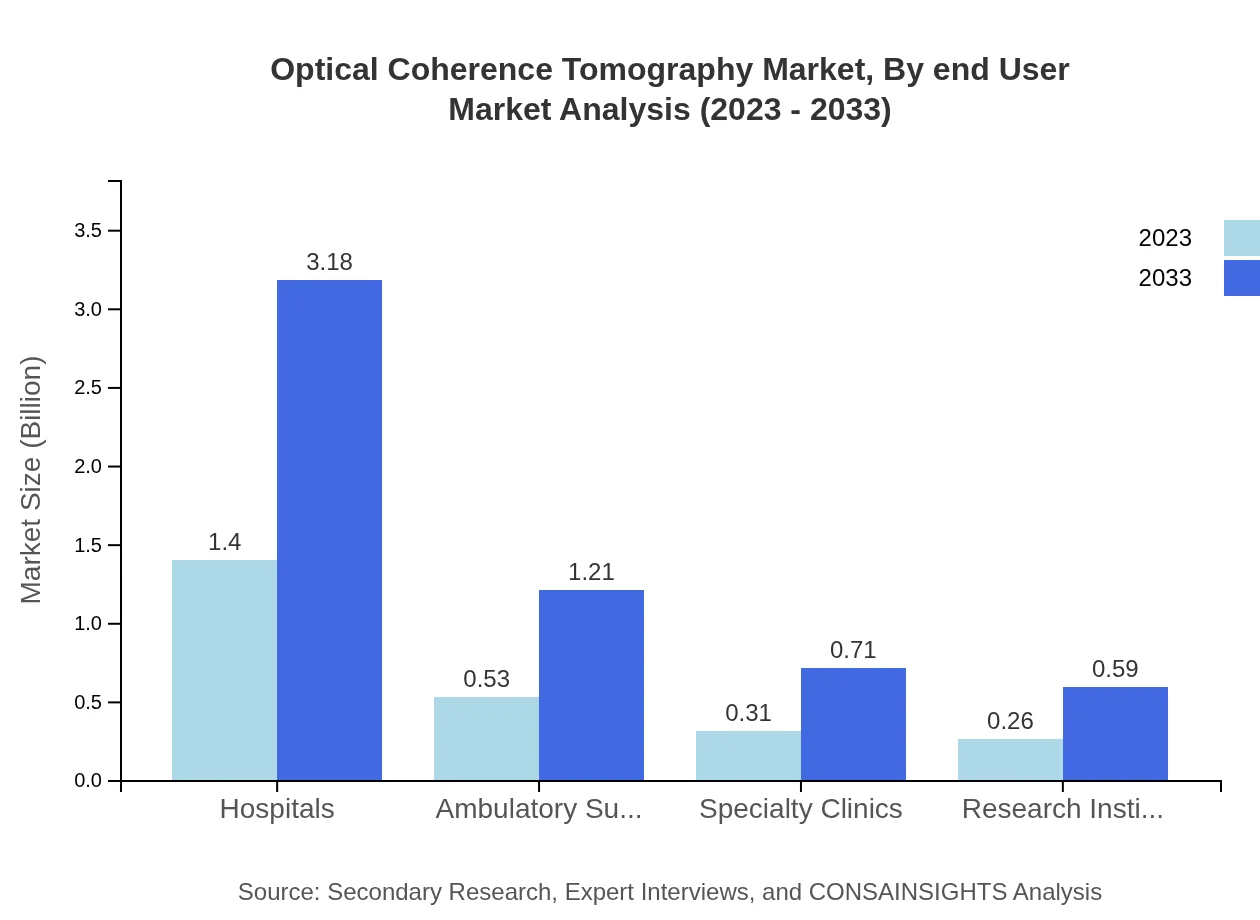
Hospitals are the leading end-user segment, expected to grow from $1.40 billion in 2023 to $3.18 billion by 2033. Ambulatory Surgical Centers follow closely, with an expected growth from $0.53 billion to $1.21 billion, reflecting the increasing use of OCT in outpatient settings.
Optical Coherence Tomography Market Analysis By Technology
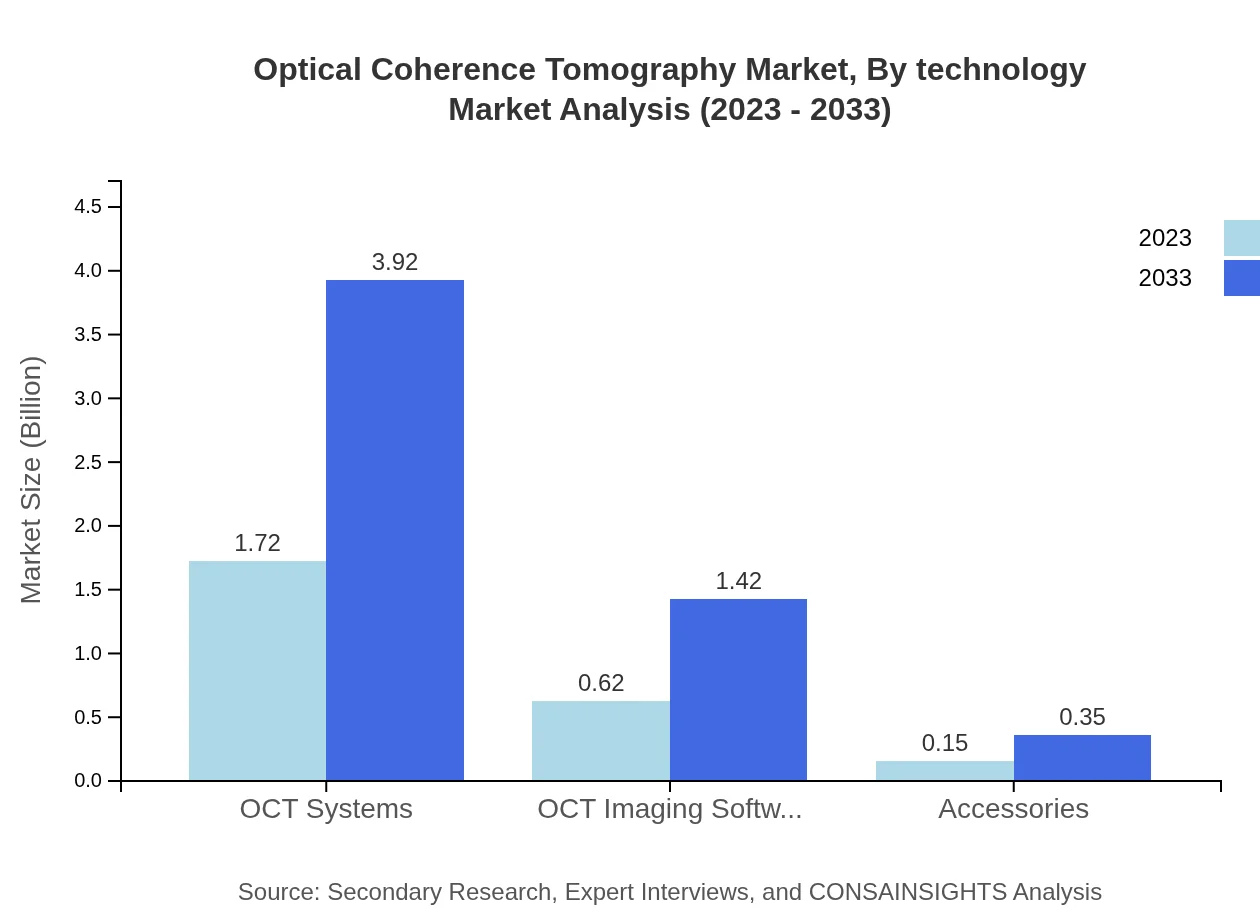
Technology-wise, Time-Domain OCT leads with a market size of $1.72 billion in 2023, projected to reach $3.92 billion by 2033. Frequency-Domain OCT and OCT Angiography also show substantial growth, reflecting diversification in imaging capabilities and technology integration into various medical applications.
Optical Coherence Tomography Market Analysis By Region Based Market
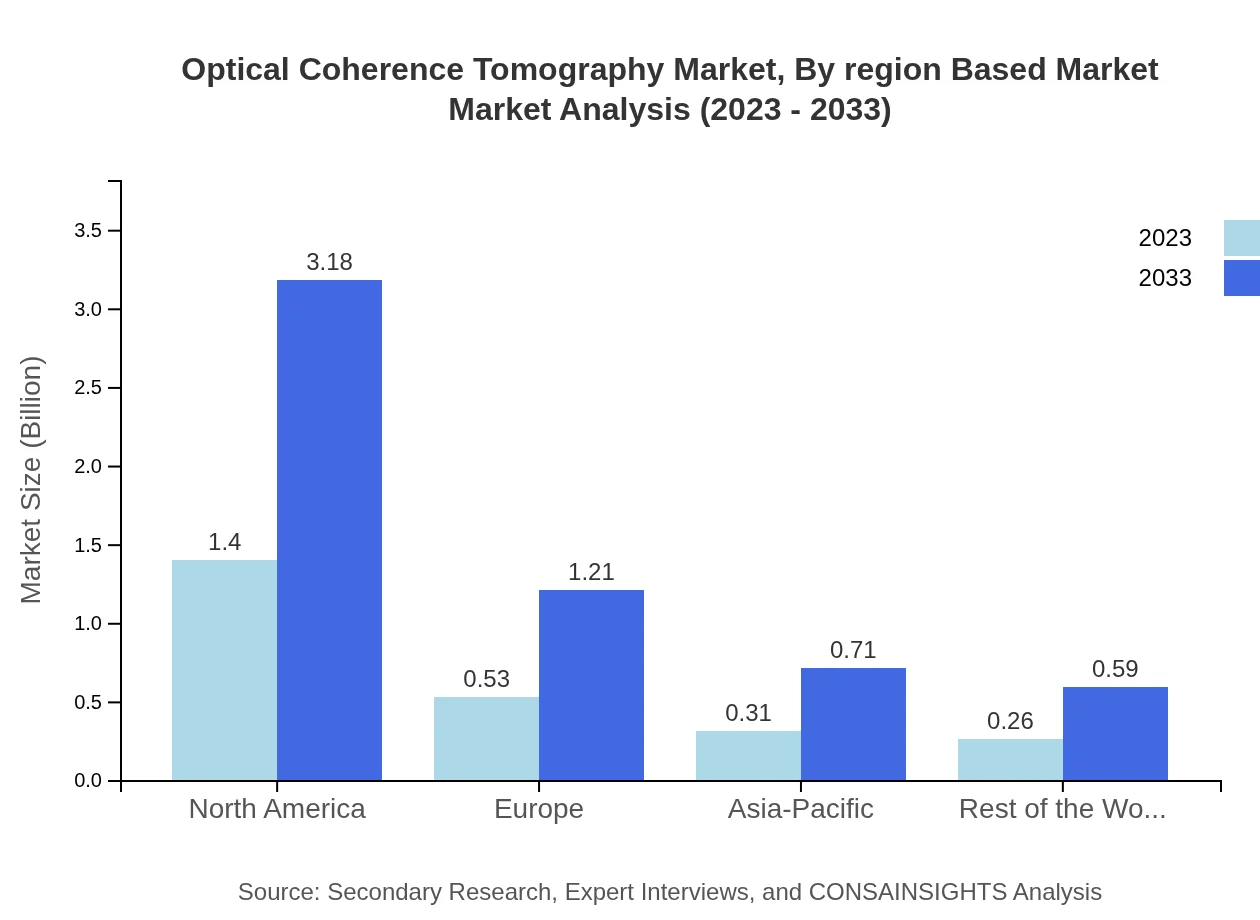
The market analysis reflects robust growth across regions, with North America, Europe, and Asia Pacific accounting for the largest shares. North America currently leads in market size and revenue generation, followed closely by Europe, with Asia Pacific showing significant potential growth driven by increasing healthcare investments.
Optical Coherence Tomography Market Trends and Future Forecast
Tell us your focus area and get a customized research report.
Global Market Leaders and Top Companies in Optical Coherence Tomography Industry
Carl Zeiss AG:
A key player in manufacturing precision optical and optoelectronic devices, renowned for its high-end OCT systems targeting ophthalmology.Optovue, Inc.:
Specializes in innovative OCT products, particularly in the field of eye care, offering advanced imaging solutions for better diagnostics.Nidek Co., Ltd.:
Contributes significantly to the OCT market with products that are integrated into comprehensive diagnostic imaging tools for eyecare professionals.Topcon Corporation:
Offers a range of advanced OCT solutions tailored for optometry and ophthalmology, focusing on user-friendly designs and precision imaging.Heidelberg Engineering:
Recognized for its innovations in high-end OCT systems, providing extensive options for retinal imaging, focusing on research and clinical applications.We're grateful to work with incredible clients.








FAQs
What is the market size of the Optical Coherence Tomography market in 2023?
The Optical Coherence Tomography market size in 2023 is $2.50 Billion, as reported for the base year of the forecast period.
How big will the market be in 2033?
By 2033 the market is projected to reach $5.69 Billion, reflecting growth across clinical applications and product categories through the forecast period.
What is CAGR of the market for 2023 to 2033?
The reported compound annual growth rate for the forecast period 2023 to 2033 is 8.3%.
Is there a single fastest Growing region in the Optical Coherence Tomography Market Report market?
No single fastest-growing region is stated for the Optical Coherence Tomography Market Report market because the top regional implied CAGR values are within 0.15 percentage points of each other, making the ranking too close to call reliably.
Which companies are noted as leading vendors?
Top companies named include Carl Zeiss AG, Optovue, Inc., Nidek Co., Ltd., Topcon Corporation and Heidelberg Engineering.
What end users are included in market segmentation?
Reported end-user segments comprise hospitals, ambulatory surgical centers, specialty clinics and research institutes as primary deployment settings.
How is the market segmented by technology?
Technology segmentation lists OCT systems, OCT imaging software and accessories as the main categories considered in the report.
What factors are driving adoption of OCT devices?
Key adoption drivers include improved imaging capabilities, broader clinical applications, expanding healthcare infrastructure and integration with diagnostic workflows.