

Photobiostimulation Market Report
First published: 15 October 2024 | Last updated: 25 May 2026 | Report Code: photobiostimulation
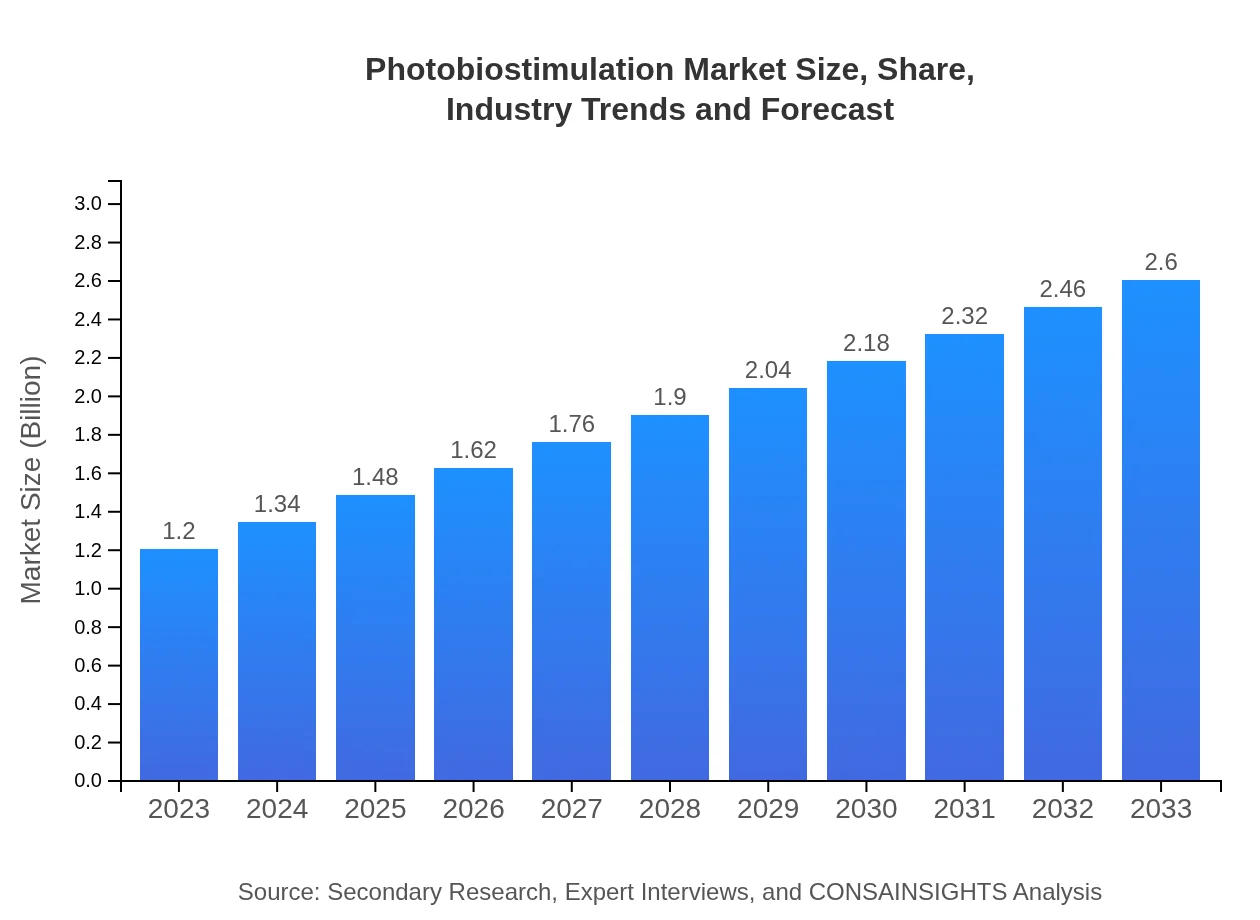
Photobiostimulation Market — USD 1.2 billion in 2023, Growing to USD 2.60B by 2033 at 7.8% CAGR
This report provides a comprehensive analysis of the Photobiostimulation market from 2023 to 2033, including insights on market size, trends, segmentation, and regional performance. It helps stakeholders understand growth opportunities and challenges in this evolving industry.
Key Takeaways
- $1.20 Billion market size in 2023 expanding to $2.60 Billion by 2033 at a 7.8% CAGR.
- North America is largest regional market, while no single fastest-growing region is stated because regional CAGR differences remain within 0.15 percentage points.
- Europe and Asia Pacific show notable expansion: Europe from $0.3 Billion to $0.65 Billion; Asia Pacific from $0.26 Billion to $0.56 Billion.
- Product mix includes LED Devices, Lasers, and Accessories; end users span Clinics, Hospitals, and Home Use.
- Key players identified: Philips Healthcare, Cynosure, Inc., Lumenis, Biolight Technologies.
Photobiostimulation Market Report — Executive Summary
North America remains largest market by forecast-period value, while no single fastest-growing region is stated because top regional growth rates are separated by less than 0.15 percentage points. The report assesses the Photobiostimulation market across products, technologies, applications, end users, and regions. Market value increases from $1.20 Billion in 2023 to $2.60 Billion in 2033 at a 7.8% CAGR for the 2023 to 2033 forecast period. Adoption is propelled by broader clinical and cosmetic acceptance of light-based therapies and the emergence of at-home devices. Product segmentation covers LED Devices, Lasers, and Accessories, while technology segmentation highlights Low-Level Laser Therapy (LLLT) and Light Emitting Diode (LED) Therapy. Regional breakdowns present North America as the largest market, with Europe, Asia Pacific, Latin America, and Middle East and Africa showing progressive growth. The competitive landscape lists Philips Healthcare, Cynosure, Inc., Lumenis, and Biolight Technologies among the leading participants. The study synthesizes primary interviews, company reports, and expert trend analysis to map opportunities and challenges such as regulatory requirements and the need for clinical validation. Findings provide actionable insight for stakeholders evaluating investment, product development, or market entry strategies.
Key Growth Drivers
- Rising clinical and consumer awareness of non-invasive light therapies increasing demand across medical and cosmetic applications.
- Technological improvements in LEDs and lasers enhancing device efficiency and enabling broader at-home use.
- Product diversification — availability of LED Devices, Lasers, and Accessories — expanding addressable end-user segments.
- Growing application areas including medical, cosmetic, and agricultural uses supporting wider market adoption.
- Ongoing research and development and industry partnerships advancing device performance and therapeutic validation.
| Metric | Value |
|---|---|
| Study Period | 2023 - 2033 |
| 2023 Market Size | $1.20 Billion |
| CAGR (2023-2033) | 7.8% |
| 2033 Market Size | $2.60 Billion |
| Top Companies | Philips Healthcare, Cynosure, Inc., Lumenis, Biolight Technologies |
| Published Date | 15 October 2024 |
| Last Modified Date | 25 May 2026 |
Photobiostimulation Market Overview
Customize Photobiostimulation Market Report market research report
- ✔ Get in-depth analysis of Photobiostimulation market size, growth, and forecasts.
- ✔ Understand Photobiostimulation's regional dynamics and industry-specific trends.
- ✔ Identify potential applications, end-user demand, and growth segments in Photobiostimulation
What is the Market Size & CAGR of Photobiostimulation Market Report market in 2023?
Photobiostimulation Industry Analysis
Photobiostimulation Market Segmentation and Scope
Tell us your focus area and get a customized research report.
Photobiostimulation Market Report Market Analysis Report by Region
Europe Photobiostimulation Market Report:
Europe grows from $0.3 Billion in 2023 to $0.65 Billion in 2033. Growth is driven by clinical applications, aesthetic and dermatological use cases, and increasing regulatory clarity that supports deployment of LED and laser devices.Asia Pacific Photobiostimulation Market Report:
Asia Pacific grows from $0.26 Billion in 2023 to $0.56 Billion in 2033. Momentum is attributable to rising healthcare infrastructure investments, expanding cosmetic treatment demand, and broader availability of consumer-oriented photobiostimulation devices.North America Photobiostimulation Market Report:
North America is largest regional market, rising from $0.45 Billion in 2023 to $0.98 Billion in 2033. Regional growth is supported by established clinical adoption, strong investment in device innovation, and growing consumer acceptance of non-invasive therapies.South America Photobiostimulation Market Report:
Latin America grows from $0.1 Billion in 2023 to $0.22 Billion in 2033. Adoption is influenced by growing awareness of therapeutic and cosmetic uses, increasing access to device suppliers, and gradual expansion of clinical services.Middle East & Africa Photobiostimulation Market Report:
Middle East and Africa grows from $0.09 Billion in 2023 to $0.19 Billion in 2033. Regional uptake is supported by niche clinical applications, rising demand for non-invasive therapies, and incremental availability of LEDs and lasers.Tell us your focus area and get a customized research report.
Research Methodology
Photobiostimulation Market Analysis By Product
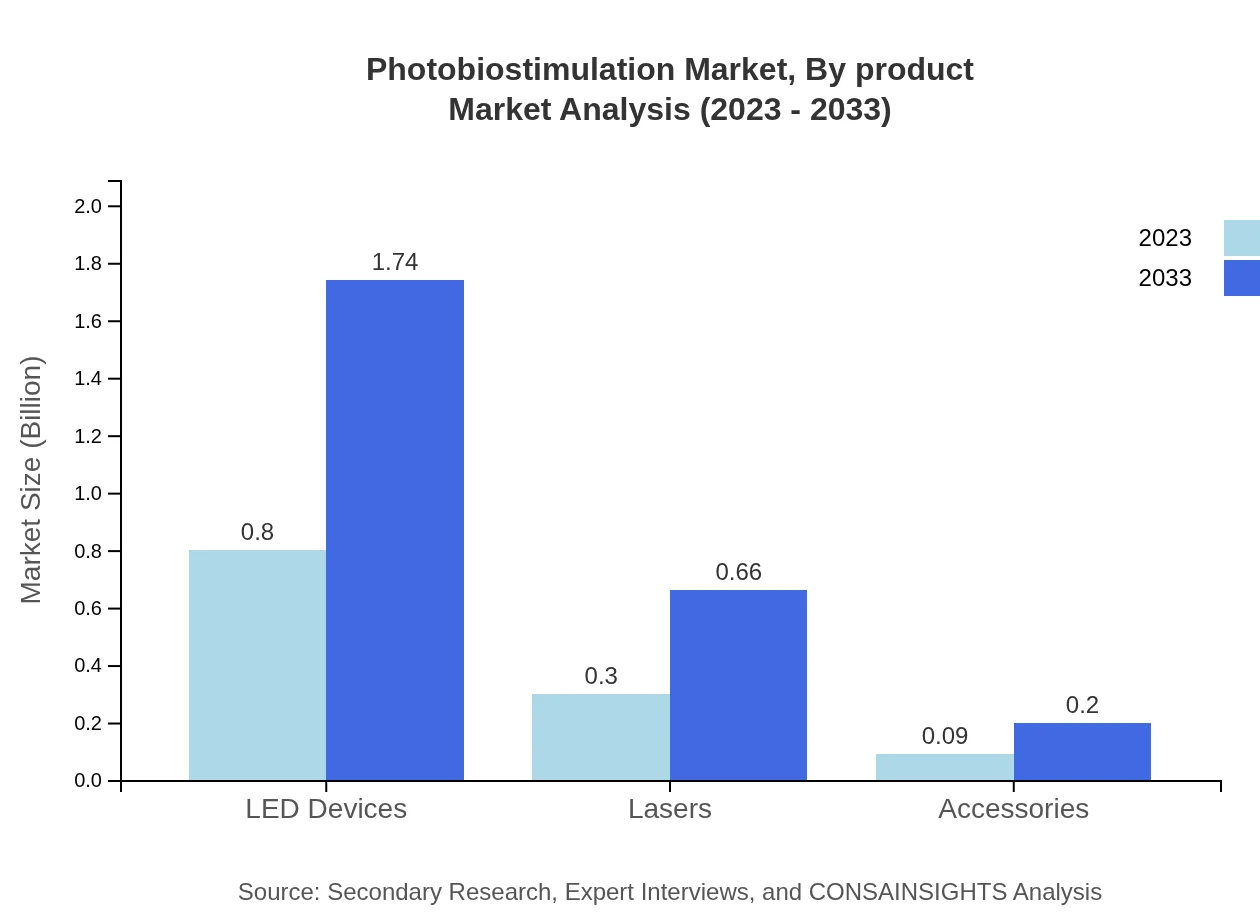
The product segmentation shows that LED devices dominate the market with a size of $0.80 billion in 2023, projected to grow to $1.74 billion by 2033, maintaining a share of 67.01%. Lasers are expected to follow, with a market size of $0.30 billion in 2023, reaching $0.66 billion by 2033, retaining a 25.37% market share. Accessories comprise the smallest segment but show potential growth, with expectations of increasing from $0.09 billion to $0.20 billion.
Photobiostimulation Market Analysis By Application
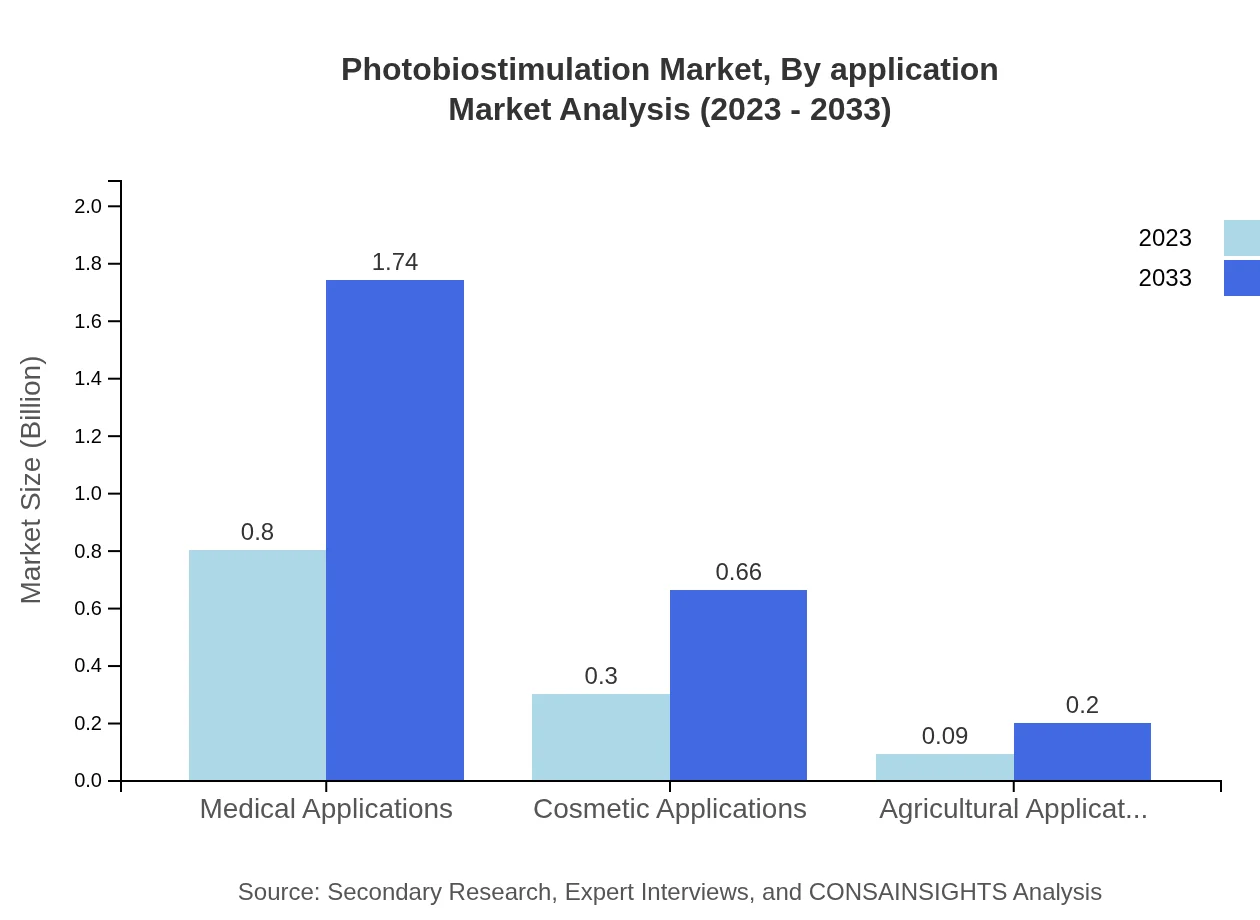
Medical applications lead with a projected growth from $0.80 billion in 2023 to $1.74 billion by 2033, maintaining a 67.01% market share. Cosmetic and agricultural applications are also significant, expected to grow from $0.30 billion to $0.66 billion and $0.09 billion to $0.20 billion, respectively, showcasing the versatility of photobiostimulation technologies across sectors.
Photobiostimulation Market Analysis By End User
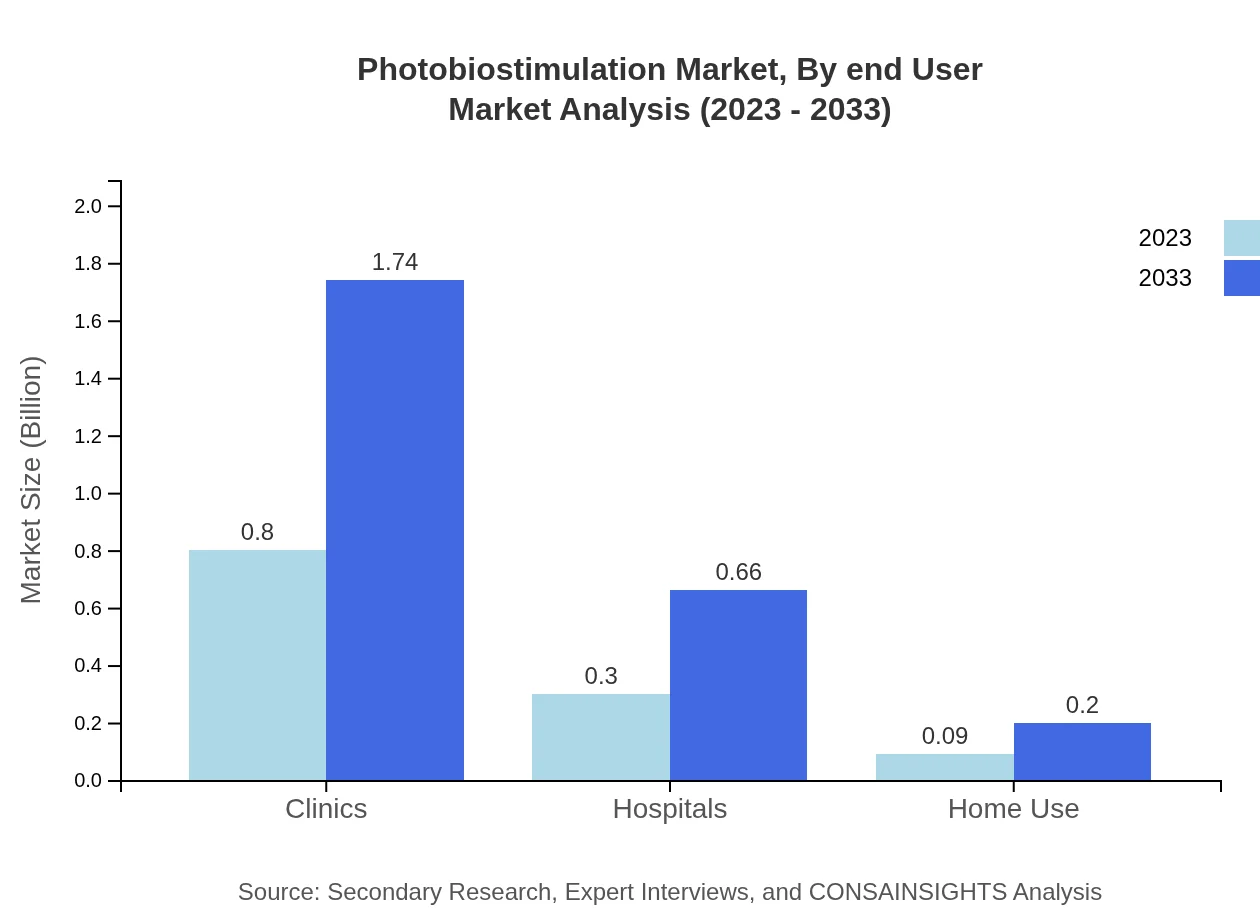
Hospitals and clinics account for a significant portion of the end-user market, with sizes of $0.30 billion and $0.80 billion respectively in 2023, expected to grow substantially to $0.66 billion and $1.74 billion by 2033. Home use applications are smaller but growing, indicating a shift towards personal care and at-home treatments.
Photobiostimulation Market Analysis By Technology
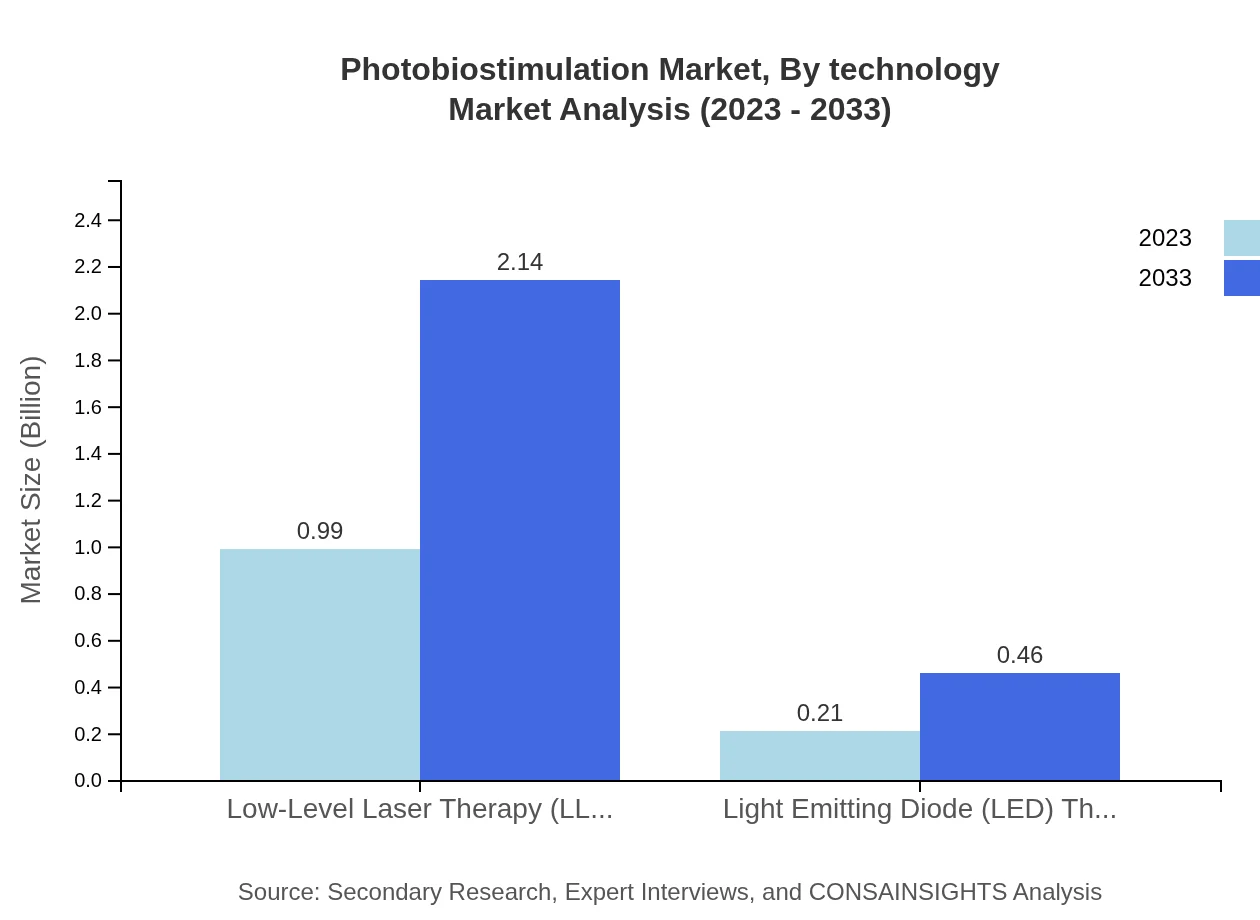
Technological advancements in LED and laser therapies are transforming the Photobiostimulation landscape. The emergence of low-level laser therapy (LLLT) is expected to see significant growth, from $0.99 billion in 2023 to $2.14 billion by 2033, with a prominent market share of 82.25%.
Photobiostimulation Market Analysis By Region
Global Photobiostimulation Market, By Region Market Analysis (2023 - 2033)
Regional analyses reveal varied growth patterns, with North America leading in size and innovation, followed closely by Europe and Asia Pacific, where increasing healthcare spending and technological adoption influence market dynamics. Emerging markets in South America and the Middle East also represent significant potential growth areas.
Photobiostimulation Market Trends and Future Forecast
Tell us your focus area and get a customized research report.
Global Market Leaders and Top Companies in Photobiostimulation Industry
Philips Healthcare:
A global leader in healthcare technology, Philips has made significant contributions to the photobiostimulation market through the development of innovative light therapy solutions for various medical applications.Cynosure, Inc.:
Specializing in laser and light-based aesthetic technology, Cynosure has been at the forefront of advancing photobiostimulation for cosmetic applications, enhancing skin health and beauty treatments.Lumenis:
Lumenis is a pioneer in laser and light technologies, well-known for its versatile photobiostimulation devices and solutions that cater to both medical and cosmetic markets.Biolight Technologies:
Focusing on LED-based solutions, Biolight Technologies has developed various products targeted at wellness and therapeutic light applications across different sectors.We're grateful to work with incredible clients.









FAQs
What is the current market size of the Photobiostimulation market?
The market size for 2023 is $1.20 Billion as reported, based on the provided market data for the 2023 baseline year.
How big will the Photobiostimulation market be in 2033?
The projected market value for 2033 is $2.60 Billion according to the supplied forecast figures for the period 2023 to 2033.
What is CAGR for the Photobiostimulation market during the forecast?
The compound annual growth rate for the forecast period 2023 to 2033 is 7.8% as specified in the input data.
Is there a single fastest Growing region in the Photobiostimulation Market Report market?
No single fastest-growing region is stated for the Photobiostimulation Market Report market because the top regional implied CAGR values are within 0.15 percentage points of each other, making the ranking too close to call reliably.
Why is product diversification important in this market?
Product diversification into LED Devices, Lasers, and Accessories broadens application scope and supports adoption across clinics, hospitals, and home use segments.
Who are the top companies in the Photobiostimulation market?
Top companies listed in the dataset include Philips Healthcare, Cynosure, Inc., Lumenis, and Biolight Technologies.
What drives regional demand for Photobiostimulation solutions?
Regional demand is driven by clinical acceptance, consumer interest in non-invasive therapies, and availability of devices suited for medical, cosmetic, and agricultural uses.
How is the market research data compiled?
Research relies on primary interviews with industry experts, secondary company reports and publications, data triangulation, internal validation, and expert-led trend analysis.