

Pneumococcal Vaccines Market Report
First published: 21 October 2024 | Last updated: 25 May 2026 | Report Code: pneumococcal-vaccines
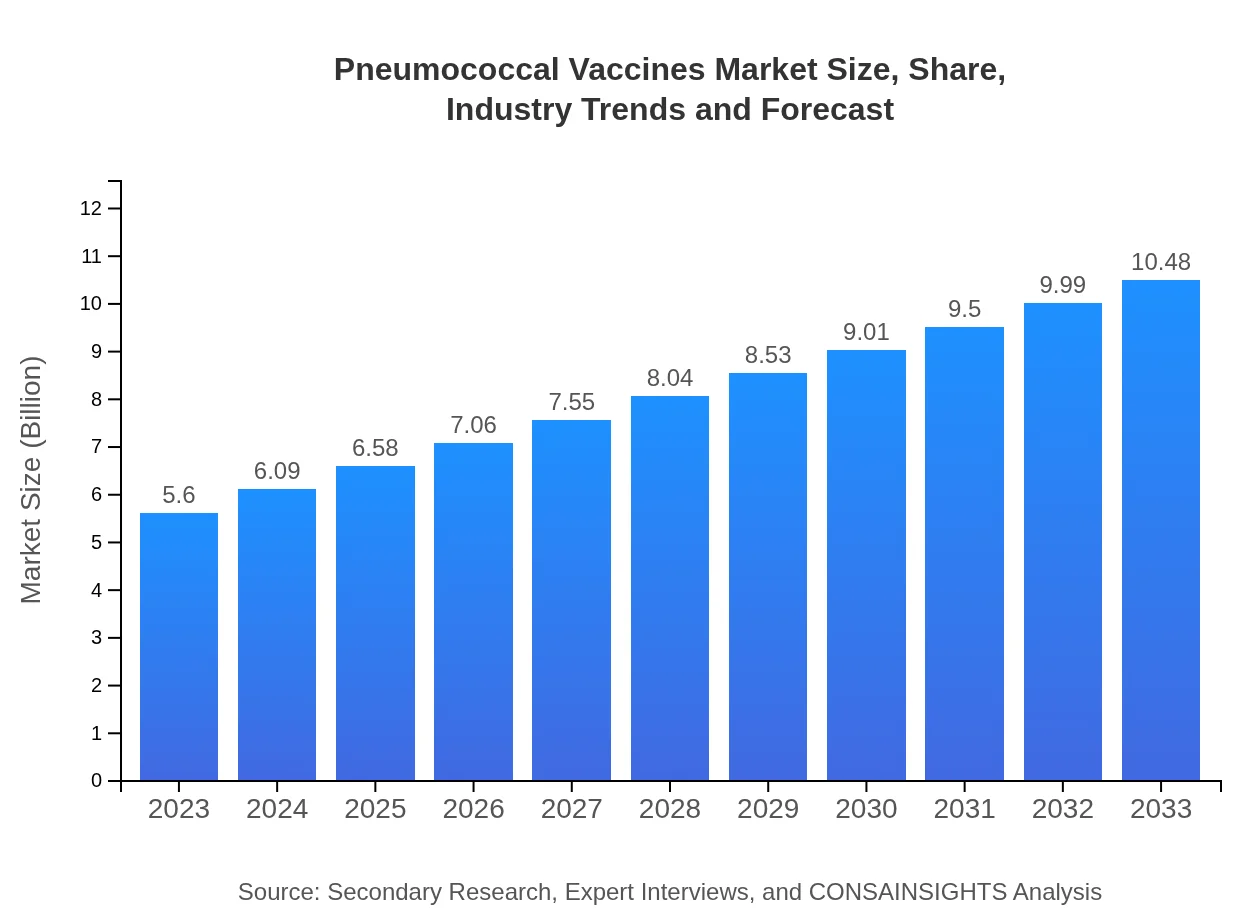
Pneumococcal Vaccines Market — USD 5.6 billion in 2023, Growing to USD 10.48B by 2033 at 6.3% CAGR
This report provides a comprehensive analysis of the Pneumococcal Vaccines market from 2023 to 2033, including market size, growth trends, regional insights, technological advancements, and competitive landscape. Insights into market segmentation, leading companies, and future forecasts are included to guide stakeholders.
Key Takeaways
- Global market grows from $5.60 Billion in 2023 to $10.48 Billion by 2033 at a 6.3% CAGR.
- North America is largest regional market, while no single fastest-growing region is stated because regional CAGR differences remain within 0.15 percentage points.
- Product mix centers on Pneumococcal Conjugate Vaccines (PCV) and Pneumococcal Polysaccharide Vaccines (PPV).
- Major firms active in the market include Pfizer Inc., Merck & Co., Inc., Sanofi Pasteur, and GlaxoSmithKline (GSK).
- Distribution channels span hospitals, pharmacies, clinics, and public health programs supporting wider vaccine access.
Pneumococcal Vaccines Market Report — Executive Summary
North America remains largest market by forecast-period value, while no single fastest-growing region is stated because top regional growth rates are separated by less than 0.15 percentage points. This report examines the pneumococcal vaccine landscape from 2023 to 2033, where the market increases from $5.60 Billion to $10.48 Billion at a 6.3% CAGR. Growth is supported by rising awareness of pneumococcal disease, preventive immunization initiatives, and investments in vaccine R&D. The market structure is organized by product type, age group, application, and distribution channel, highlighting PCV and PPV vaccines and age-based focus on children under five, adults over five, and high-risk groups. Regional performance varies, with North America identified as the largest market. Key competitors include Pfizer Inc., Merck & Co., Inc., Sanofi Pasteur, and GlaxoSmithKline (GSK). The analysis addresses regulatory influences, public health programs, and distribution mechanisms shaping uptake and access across regions.
Key Growth Drivers
- Increased public health emphasis on preventive vaccination and immunization campaigns.
- Rising awareness of pneumococcal disease risk among children, elderly, and high-risk populations.
- Continued investment in vaccine research and product development to improve efficacy and coverage.
- Expanded distribution through hospitals, pharmacies, clinics, and government-run public health programs.
- Supportive reimbursement and regulatory policies encouraging wider vaccine adoption.
| Metric | Value |
|---|---|
| Study Period | 2023 - 2033 |
| 2023 Market Size | $5.60 Billion |
| CAGR (2023-2033) | 6.3% |
| 2033 Market Size | $10.48 Billion |
| Top Companies | Pfizer Inc., Merck & Co., Inc., Sanofi Pasteur, GlaxoSmithKline (GSK) |
| Published Date | 21 October 2024 |
| Last Modified Date | 25 May 2026 |
Pneumococcal Vaccines Market Overview
Customize Pneumococcal Vaccines Market Report market research report
- ✔ Get in-depth analysis of Pneumococcal Vaccines market size, growth, and forecasts.
- ✔ Understand Pneumococcal Vaccines's regional dynamics and industry-specific trends.
- ✔ Identify potential applications, end-user demand, and growth segments in Pneumococcal Vaccines
What is the Market Size & CAGR of Pneumococcal Vaccines Market Report market in 2023?
Pneumococcal Vaccines Industry Analysis
Pneumococcal Vaccines Market Segmentation and Scope
Tell us your focus area and get a customized research report.
Pneumococcal Vaccines Market Report Market Analysis Report by Region
Europe Pneumococcal Vaccines Market Report:
Europe grows from $1.78 Billion in 2023 to $3.33 Billion in 2033. Growth is supported by coordinated vaccination policies, public awareness campaigns, and investments in vaccine access, with established healthcare systems facilitating distribution through hospitals and public health programs.Asia Pacific Pneumococcal Vaccines Market Report:
Asia Pacific grows from $1.05 Billion in 2023 to $1.97 Billion in 2033. Expansion is driven by heightened immunization efforts, wider public health outreach, and increasing focus on pediatric and high-risk population coverage supported by clinics and community programs.North America Pneumococcal Vaccines Market Report:
North America is largest regional market, rising from $2.12 Billion in 2023 to $3.97 Billion in 2033. Regional drivers include established immunization programs, strong public health infrastructure, and active participation by major vaccine manufacturers such as Pfizer Inc. and Merck & Co., Inc., supporting uptake and distribution.South America Pneumococcal Vaccines Market Report:
Latin America grows from $0.28 Billion in 2023 to $0.52 Billion in 2033. Regional uptake is shaped by government vaccination initiatives, NGO-supported programs, and expanded access through clinics and public health distribution networks targeting vulnerable populations.Middle East & Africa Pneumococcal Vaccines Market Report:
Middle East and Africa grows from $0.37 Billion in 2023 to $0.69 Billion in 2033. Progress is influenced by donor-supported immunization campaigns, growing awareness, and efforts to expand vaccine delivery via hospitals, clinics, and public health programs.Tell us your focus area and get a customized research report.
Research Methodology
Pneumococcal Vaccines Market Analysis By Product
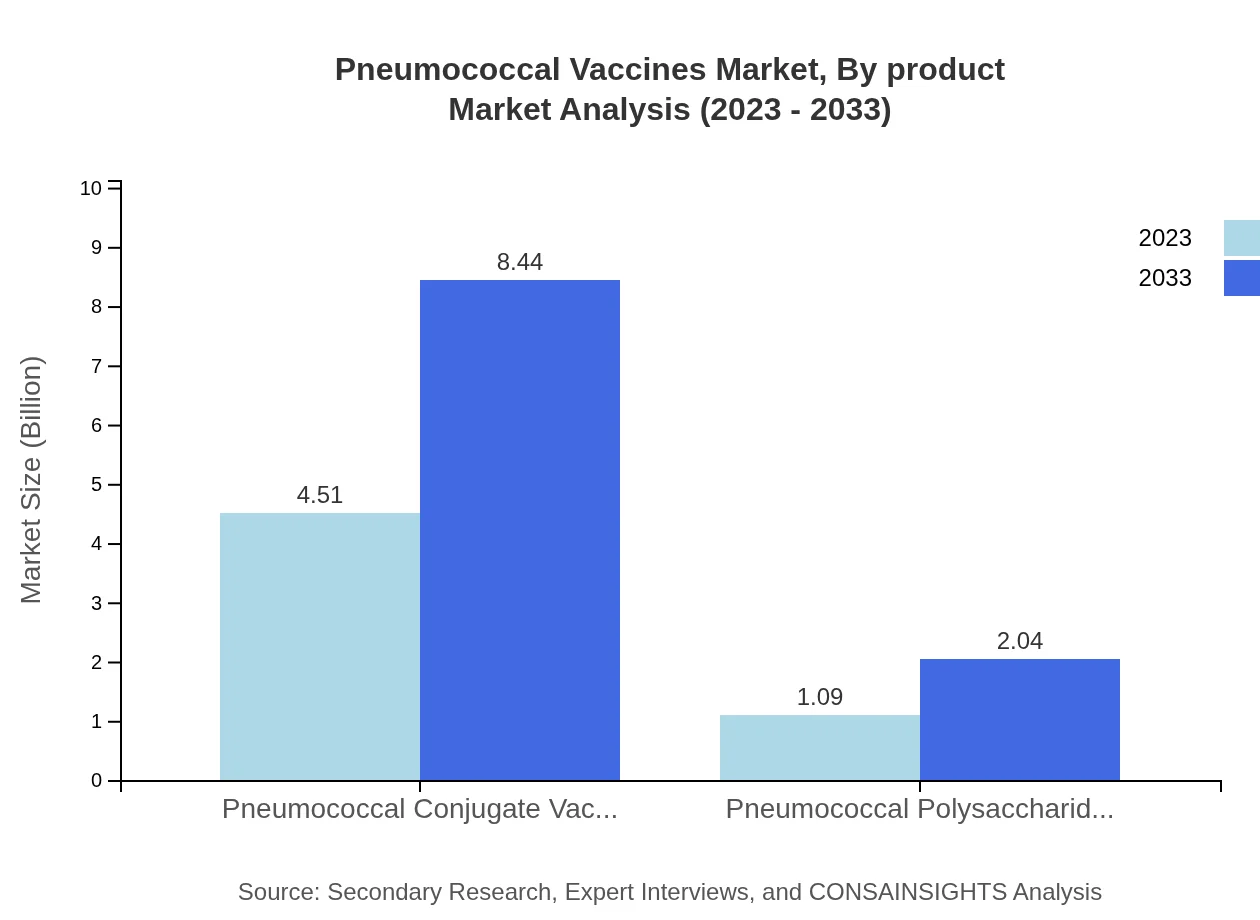
The Pneumococcal Vaccines Market, segmented by product, showcases significant growth in Pneumococcal Conjugate Vaccines (PCV) which account for a market size of $4.51 billion in 2023 and is forecasted to reach $8.44 billion by 2033, representing an 80.51% market share. Pneumococcal Polysaccharide Vaccines (PPV) are also notable, sized at $1.09 billion in 2023, expected to grow to $2.04 billion with a 19.49% market share.
Pneumococcal Vaccines Market Analysis By Age Group
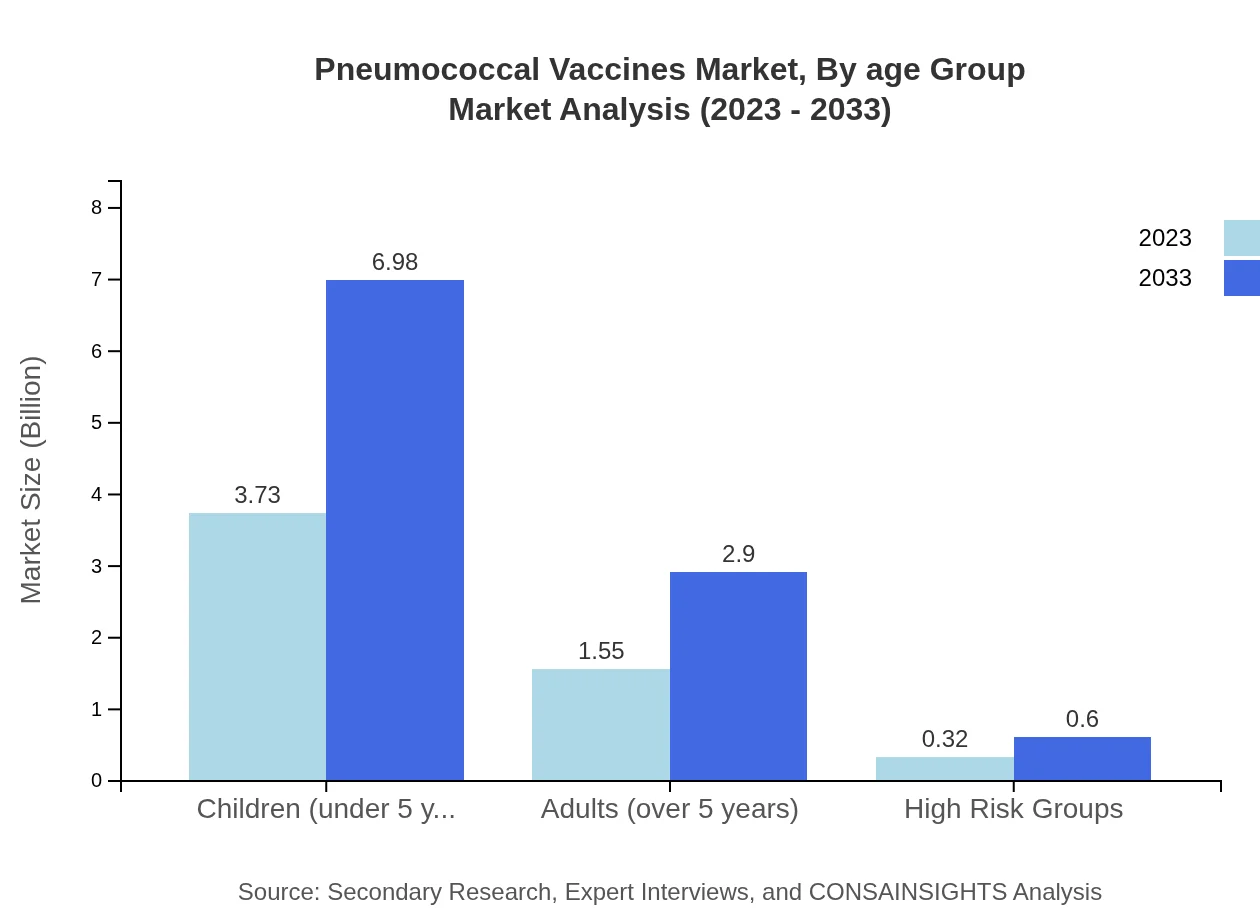
Segmenting by age group, the market for children under 5 years stands at $3.73 billion in 2023 with anticipated growth to $6.98 billion by 2033, maintaining a substantial share of around 66.63%. For adults over 5 years, the market is currently $1.55 billion and projected to rise to $2.90 billion, representing a 27.65% share, while high-risk groups encompass a smaller segment with a current size of $0.32 billion, expected to grow to $0.60 billion.
Pneumococcal Vaccines Market Analysis By Application
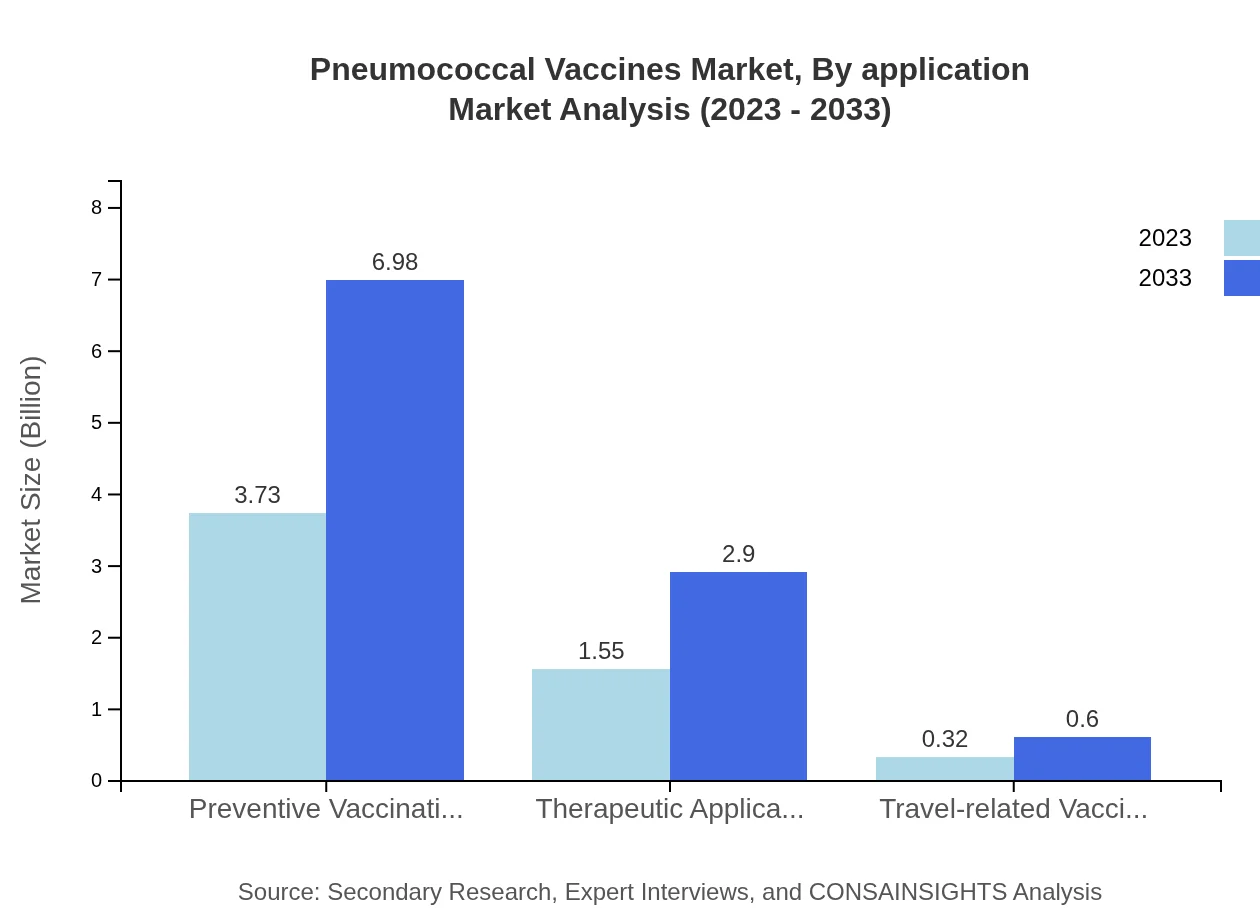
The application segment of preventive vaccinations accounts for a substantial market size of $3.73 billion in 2023, growing to $6.98 billion by 2033, constituting about 66.63% share. Therapeutic applications currently represent $1.55 billion, growing to $2.90 billion with a 27.65% share. Travel-related vaccination is comparatively smaller at $0.32 billion, expanding to $0.60 billion.
Pneumococcal Vaccines Market Analysis By Distribution Channel
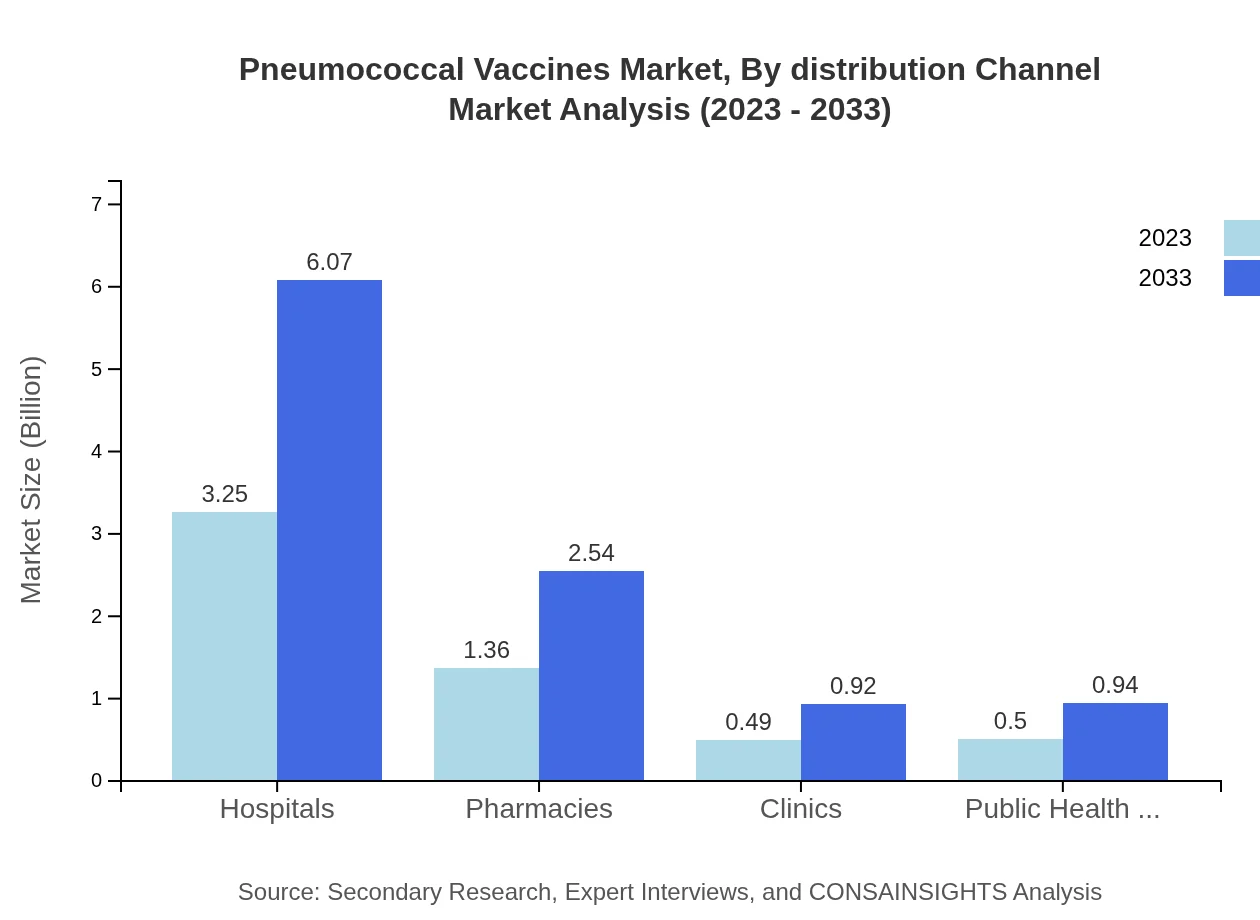
Examining distribution channels, hospitals dominate the segment with a market size of $3.25 billion in 2023, anticipated to rise to $6.07 billion by 2033, holding a share of 57.97%. Pharmacies account for $1.36 billion, growing to $2.54 billion with 24.23%, while clinics represent a smaller $0.49 billion, projected to reach $0.92 billion in the coming years. Public health programs also play a crucial role with a market size of $0.50 billion expected to increase to $0.94 billion.
Pneumococcal Vaccines Market Trends and Future Forecast
Tell us your focus area and get a customized research report.
Global Market Leaders and Top Companies in Pneumococcal Vaccines Industry
Pfizer Inc.:
A leading pharmaceutical company with a strong presence in the immunization sector, known for its pneumococcal conjugate vaccine Prevnar 13.Merck & Co., Inc.:
A global healthcare company recognized for its contributions to vaccine development, particularly the Pneumococcal polysaccharide vaccine Pneumovax 23.Sanofi Pasteur:
The vaccines division of Sanofi, contributing innovative pneumococcal vaccines and actively involved in global vaccination initiatives.GlaxoSmithKline (GSK):
A research-based company known for its vaccines, GSK is pivotal in providing pneumococcal vaccines and expanding immunization reach.We're grateful to work with incredible clients.








FAQs
What is the market size of the Pneumococcal Vaccines market in 2023?
The market size in 2023 is $5.60 Billion as specified in the report data for the forecast analysis covering 2023 to 2033.
How big is the Pneumococcal Vaccines market expected to be in 2033?
The market is projected to reach $10.48 Billion by 2033 according to the provided forecast figures for the 2023 to 2033 period.
What is CAGR of the Pneumococcal Vaccines market during the forecast period?
The specified compound annual growth rate for the market over 2023 to 2033 is 6.3% as provided in the input dataset.
Is there a single fastest Growing region in the Pneumococcal Vaccines Market Report market?
No single fastest-growing region is stated for the Pneumococcal Vaccines Market Report market because the top regional implied CAGR values are within 0.15 percentage points of each other, making the ranking too close to call reliably.
Which product types are highlighted in the segmentation?
The segmentation lists Pneumococcal Conjugate Vaccines (PCV) and Pneumococcal Polysaccharide Vaccines (PPV) as primary product subsegments.
Who are the top companies operating in this market?
Top companies named in the report data include Pfizer Inc., Merck & Co., Inc., Sanofi Pasteur, and GlaxoSmithKline (GSK).
What are the main distribution channels for pneumococcal vaccines?
Distribution channels specified include hospitals, pharmacies, clinics, and public health programs facilitating vaccine delivery and outreach.
How big is the market in Europe according to the report?
Europe’s market is reported to grow from $1.78 Billion in 2023 to $3.33 Billion in 2033 based on the provided regional figures.
What drives adoption among age groups?
Adoption is driven by targeted programs for children under five, adults over five, and high-risk groups, with policy emphasis on preventive vaccination and risk-based prioritization.
Which regions are covered in the analysis?
The regional breakdown includes North America, Europe, Asia Pacific, Latin America, and Middle East and Africa as specified in the input.