

Pulmonary Respiratory Drug Delivery Market Report
First published: 21 October 2024 | Last updated: 28 May 2026 | Report Code: pulmonary-respiratory-drug-delivery
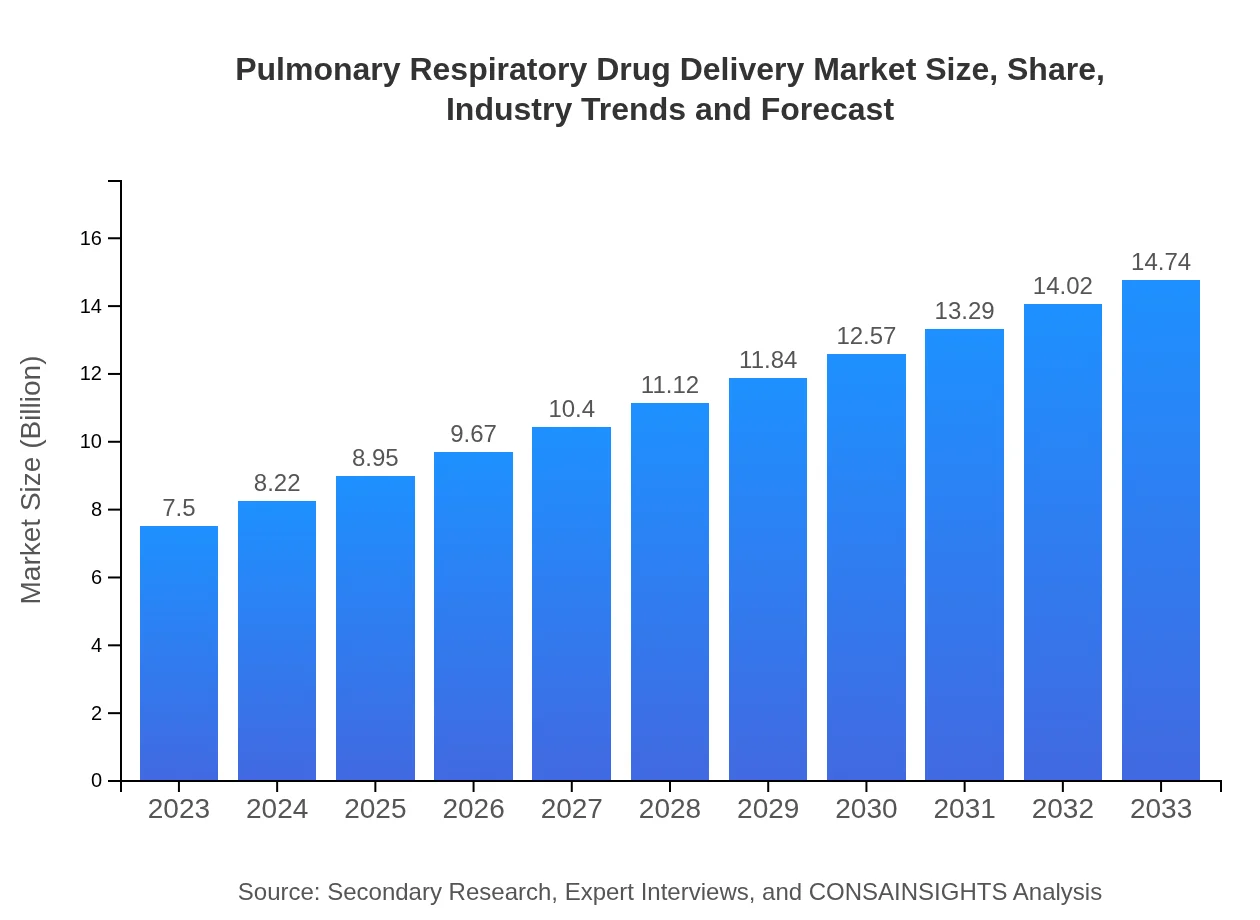
Pulmonary Respiratory Drug Delivery Market — USD 7.5 billion in 2023, Growing to USD 14.74B by 2033 at 6.8% CAGR
This report provides an in-depth analysis of the Pulmonary Respiratory Drug Delivery market, including insights into market dynamics, growth trends, and forecasts from 2023 to 2033. It presents valuable data for stakeholders to understand current conditions and future opportunities.
Key Takeaways
- Global market expected to grow from $7.50 Billion (2023) to $14.74 Billion (2033) at a 6.8% CAGR.
- North America is the largest region, expanding from $2.75 Billion in 2023 to $5.41 Billion in 2033.
- North America is largest regional market; Latin America is regional market region based on implied CAGR across 2023 to 2033.
- Europe and Asia Pacific show substantial gains: Europe from $2.31 Billion to $4.54 Billion; Asia Pacific from $1.42 Billion to $2.79 Billion.
- Key manufacturers include GlaxoSmithKline, AstraZeneca, Boehringer Ingelheim, and Novartis, focused on device and formulation advances.
Pulmonary Respiratory Drug Delivery Market Report — Executive Summary
Regional analysis shows North America as largest market and Latin America as fastest-growing region by implied CAGR. The Pulmonary Respiratory Drug Delivery market is set for sustained expansion between 2023 and 2033, with total value increasing from $7.50 Billion to $14.74 Billion at a 6.8% CAGR. Growth is supported by rising incidences of asthma and COPD, demographic shifts, and innovation in inhalation devices and drug formulations. Technological advancements, including connectivity and improved dose delivery, are prompting manufacturers and healthcare providers to adopt newer solutions. Regional dynamics vary: North America remains the largest market while Latin America is identified as the regional market region. Established pharmaceutical and device companies such as GlaxoSmithKline, AstraZeneca, Boehringer Ingelheim, and Novartis are prominent participants, investing in R&D and strategic collaborations. Market segmentation encompasses product types, end users, applications, device formats, and administration routes, reflecting diverse clinical needs and care settings. Regulatory developments and increased awareness of respiratory health are additional factors shaping market trajectories over the forecast period.
Key Growth Drivers
- Increasing prevalence of respiratory disorders driving demand for inhalation therapies and related delivery devices.
- Advances in device technology and formulation methods improving dosing accuracy and patient adherence.
- Rising healthcare access and aging populations expanding patient pools for chronic respiratory care.
- Strategic investments and partnerships by major industry players to accelerate product development and market reach.
- Heightened focus on respiratory health following global health events, boosting R&D and commercialization activity.
| Metric | Value |
|---|---|
| Study Period | 2023 - 2033 |
| 2023 Market Size | $7.50 Billion |
| CAGR (2023-2033) | 6.8% |
| 2033 Market Size | $14.74 Billion |
| Top Companies | GlaxoSmithKline, AstraZeneca, Boehringer Ingelheim, Novartis |
| Published Date | 21 October 2024 |
| Last Modified Date | 28 May 2026 |
Pulmonary Respiratory Drug Delivery Market Overview
Customize Pulmonary Respiratory Drug Delivery Market Report market research report
- ✔ Get in-depth analysis of Pulmonary Respiratory Drug Delivery market size, growth, and forecasts.
- ✔ Understand Pulmonary Respiratory Drug Delivery's regional dynamics and industry-specific trends.
- ✔ Identify potential applications, end-user demand, and growth segments in Pulmonary Respiratory Drug Delivery
What is the Market Size & CAGR of Pulmonary Respiratory Drug Delivery Market Report market in 2023?
Pulmonary Respiratory Drug Delivery Industry Analysis
Pulmonary Respiratory Drug Delivery Market Segmentation and Scope
Tell us your focus area and get a customized research report.
Pulmonary Respiratory Drug Delivery Market Report Market Analysis Report by Region
Europe Pulmonary Respiratory Drug Delivery Market Report:
Europe grows from $2.31 Billion in 2023 to $4.54 Billion in 2033. Growth in this region is driven by strong clinical adoption, regulatory support for advanced inhalation therapies, and ongoing investments in respiratory care technologies.Asia Pacific Pulmonary Respiratory Drug Delivery Market Report:
Asia Pacific grows from $1.42 Billion in 2023 to $2.79 Billion in 2033. Regional drivers include growing healthcare access, rising respiratory disease burden, and increasing penetration of modern drug delivery devices.North America Pulmonary Respiratory Drug Delivery Market Report:
North America is largest regional market, rising from $2.75 Billion in 2023 to $5.41 Billion in 2033. This region's scale reflects established healthcare systems, rapid uptake of advanced delivery devices, and active participation by major manufacturers.South America Pulmonary Respiratory Drug Delivery Market Report:
Latin America is fastest-growing region by implied CAGR, increasing from $0.13 Billion in 2023 to $0.26 Billion in 2033. 13 Billion in 2023 to $0.26 Billion in 2033 and is identified as the regional growth market at an implied 7.18% CAGR. Expansion stems from improving healthcare infrastructure and rising awareness of respiratory conditions.Middle East & Africa Pulmonary Respiratory Drug Delivery Market Report:
Middle East and Africa grows from $0.89 Billion in 2023 to $1.74 Billion in 2033. Market progression is supported by expanding healthcare services, greater availability of medical technologies, and attention to chronic respiratory disease management.Tell us your focus area and get a customized research report.
Research Methodology
Pulmonary Respiratory Drug Delivery Market Analysis By Product
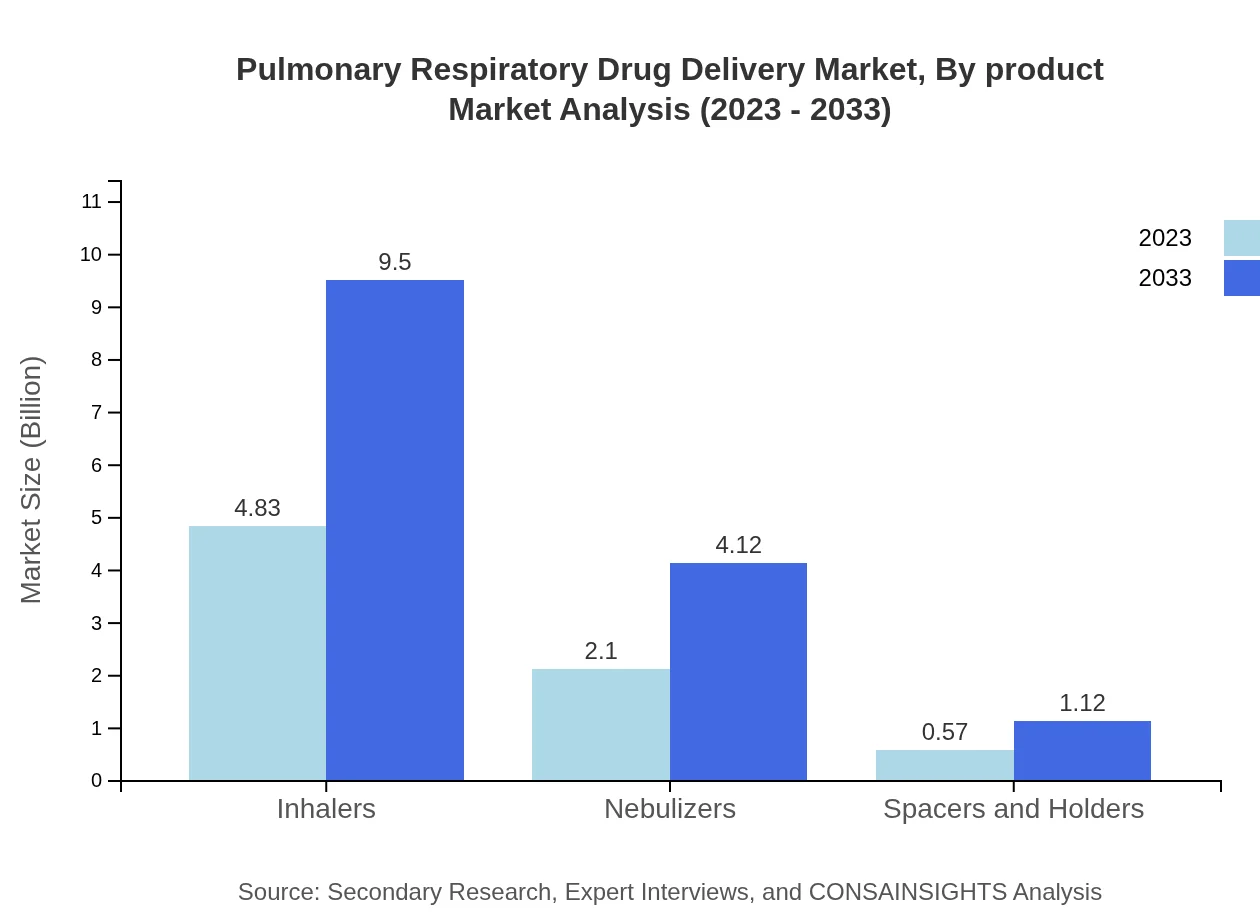
Inhalers are the leading segment, expected to grow from $4.83 billion in 2023 to $9.50 billion by 2033, holding 64.46% market share. Nebulizers follow with a market size of $2.10 billion in 2023, reaching $4.12 billion by 2033, accounting for 27.94% of the market. Spacers and holders contribute to a smaller segment, expanding from $0.57 billion to $1.12 billion, with a 7.6% share.
Pulmonary Respiratory Drug Delivery Market Analysis By Application
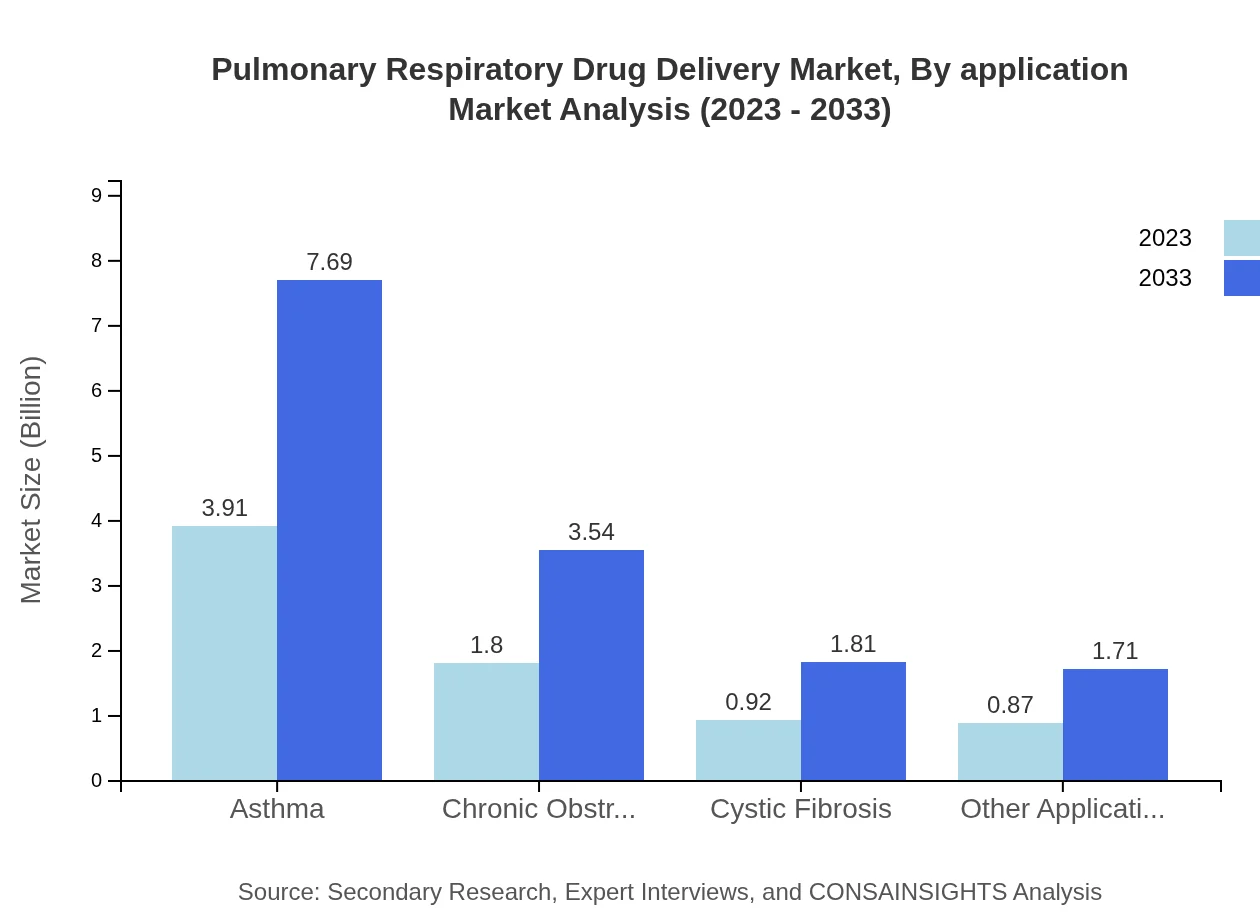
Asthma treatment dominates the application segment, with a market size of $3.91 billion in 2023 and expected to double to $7.69 billion by 2033. COPD accounts for $1.80 billion, potentially growing to $3.54 billion, while cystic fibrosis has a smaller share, moving from $0.92 billion to $1.81 billion. Other application segments comprise $0.87 billion rising to $1.71 billion.
Pulmonary Respiratory Drug Delivery Market Analysis By End User
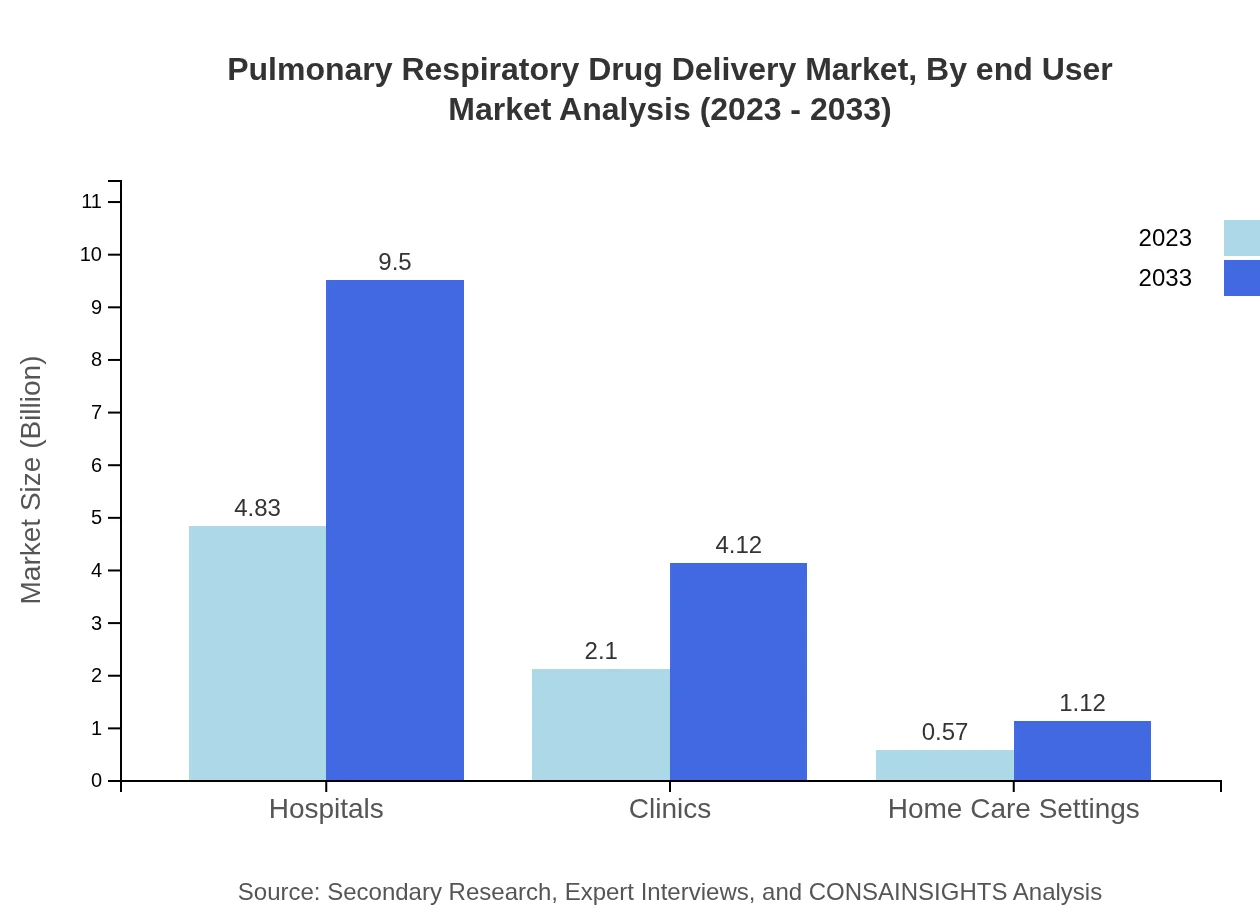
Hospitals remain the predominant end-user segment, valued at $4.83 billion in 2023 and growing to $9.50 billion by 2033, with a consistent share of 64.46%. Clinics are expected to grow from $2.10 billion to $4.12 billion, representing 27.94% of the market. Home care settings, although smaller, are projected to rise from $0.57 billion to $1.12 billion, securing a 7.6% share.
Pulmonary Respiratory Drug Delivery Market Analysis By Route Of Administration
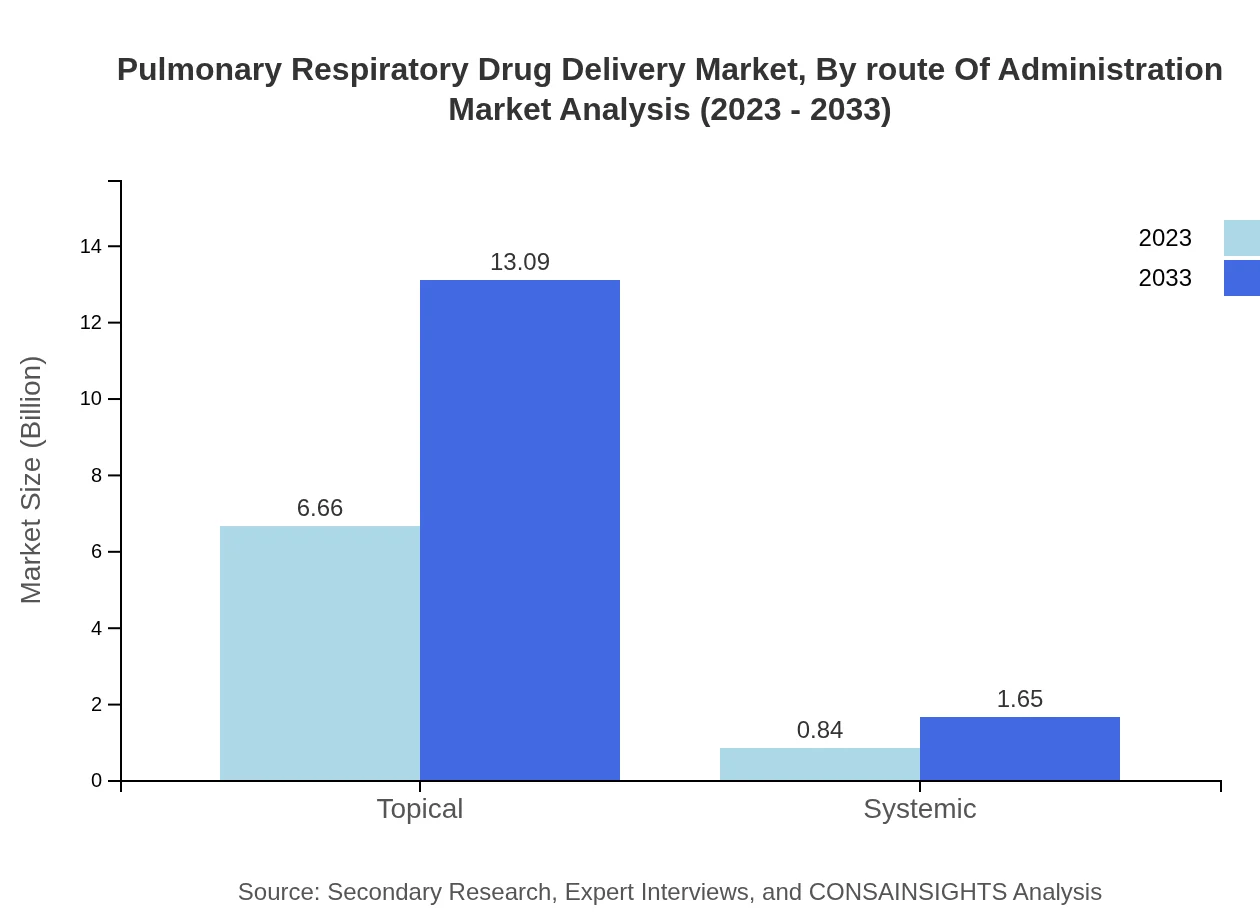
The market is characterized by a substantial emphasis on portable devices, which currently hold an 88.79% share, growing from $6.66 billion in 2023 to $13.09 billion by 2033. Stationary devices, while trailing behind, are expected to grow from $0.84 billion to $1.65 billion, maintaining an 11.21% share.
Pulmonary Respiratory Drug Delivery Market Analysis By Device Type
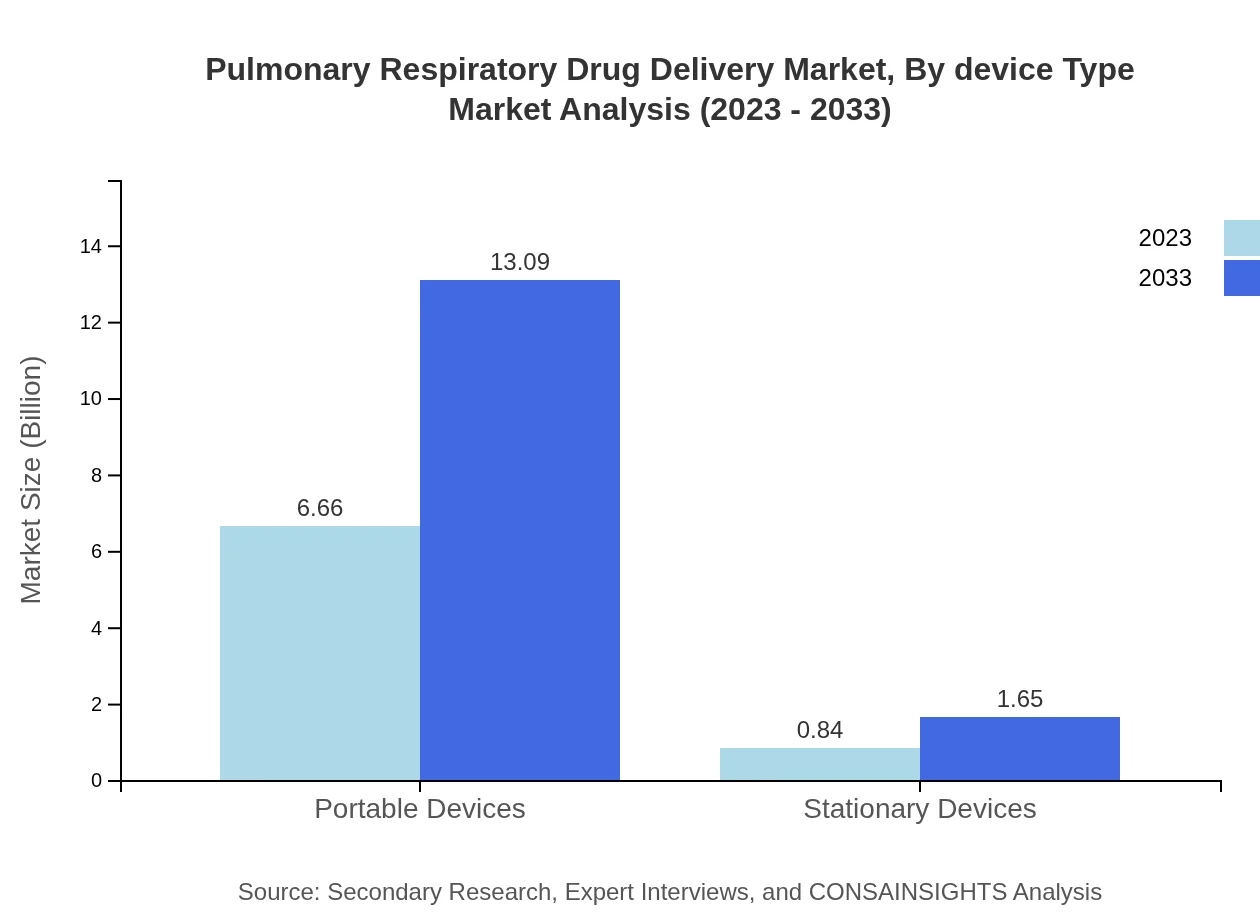
The device segment includes topical delivery systems, which dominate with an 88.79% share, expanding from $6.66 billion to $13.09 billion by 2033, while systemic devices account for 11.21%, showing growth from $0.84 billion to $1.65 billion.
Pulmonary Respiratory Drug Delivery Market Trends and Future Forecast
Tell us your focus area and get a customized research report.
Global Market Leaders and Top Companies in Pulmonary Respiratory Drug Delivery Industry
GlaxoSmithKline:
A leading global healthcare company, GlaxoSmithKline specializes in pharmaceuticals that include respiratory therapies, leveraging advanced formulations in the drug delivery space.AstraZeneca:
Known for its significant contributions to the respiratory drug market, AstraZeneca focuses on innovative inhalation therapies, boosting global health through advanced medication solutions.Boehringer Ingelheim:
Boehringer Ingelheim offers a portfolio of products designed for respiratory diseases and engages in research to enhance inhalation technologies.Novartis:
Novartis focuses on strategic R&D to develop novel inhalation therapies, making significant contributions to the Pulmonary Respiratory Drug Delivery market.We're grateful to work with incredible clients.









FAQs
What is the market size of the Pulmonary Respiratory Drug Delivery market in 2023?
The market size in 2023 is $7.50 Billion, according to the report's baseline figure for the global Pulmonary Respiratory Drug Delivery sector.
How big will the market be in 2033?
By 2033 the market is forecast to reach $14.74 Billion, reflecting projected demand growth across devices, formulations, and regional markets through 2033.
What is CAGR for the forecast period?
The compound annual growth rate for the 2023 to 2033 forecast period is 6.8%, representing the expected average annual expansion rate over that decade.
Which region is the fastest Growing in the Pulmonary Respiratory Drug Delivery Market Report market?
Latin America is the fastest-growing region, projected to expand from $0.13 Billion in 2023 to $0.26 Billion in 2033, reflecting an implied 7.18% CAGR over the forecast period.
Which region is growing fastest?
Latin America is identified as the regional market region, rising from $0.13 Billion in 2023 to $0.26 Billion in 2033 at an implied 7.18% CAGR.
Who are the top companies in this market?
Key companies named in the report include GlaxoSmithKline, AstraZeneca, Boehringer Ingelheim, and Novartis, each active in device and drug development.
What are primary applications covered?
Primary applications include asthma, COPD, cystic fibrosis, and other respiratory indications addressed via inhalers, nebulizers, and related devices.
How are devices segmented in the report?
Device segmentation covers portable and stationary devices, alongside inhalers, nebulizers, spacers, and holders to reflect clinical and home-based use cases.
What end User settings are analyzed?
End-user segments in the study include hospitals, clinics, and home care settings, tracking demand across institutional and domestic care environments.
What research methods supported the report?
The report relies on primary interviews with industry experts, secondary company reports and publications, data triangulation, internal validation, and expert trend analysis.