

Remote Workplace Services
First published: 12 March 2026 | Last updated: 14 March 2026 | Report Code: remote-workplace-services
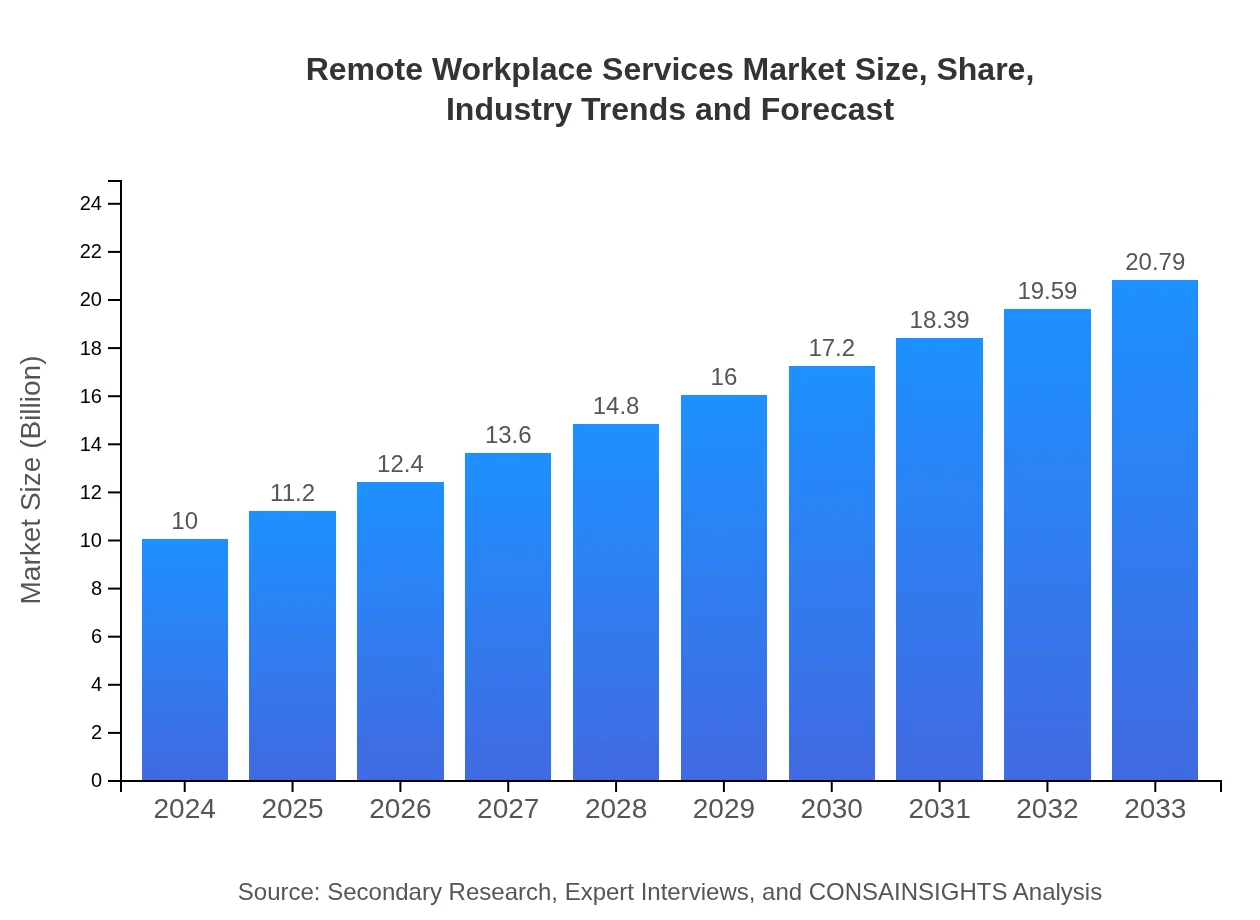
Remote Workplace Services Market — USD $10 Billion in 2024, Growing to USD 20.79 by 2033 at 8.2% CAGR
This detailed report on Remote Workplace Services provides an in‐depth analysis of market dynamics, technological innovation, and competitive trends. Spanning the forecast period from 2024 to 2033, the report offers valuable insights into market size, growth drivers, segmentation, and regional performance. It is designed to guide stakeholders in understanding the evolving landscape of remote work solutions and associated services.
| Metric | Value |
|---|---|
| Study Period | 2024 - 2033 |
| 2024 Market Size | $10.00 Billion |
| CAGR (2024-2033) | 8.2% |
| 2033 Market Size | $20.79 Billion |
| Top Companies | RemoteConnect Inc., VirtualWorks Solutions |
| Published Date | 12 March 2026 |
| Last Modified Date | 14 March 2026 |
Remote Workplace Services Market Overview
Customize Remote Workplace Services market research report
- ✔ Get in-depth analysis of Remote Workplace Services market size, growth, and forecasts.
- ✔ Understand Remote Workplace Services's regional dynamics and industry-specific trends.
- ✔ Identify potential applications, end-user demand, and growth segments in Remote Workplace Services
What is the Market Size & CAGR of Remote Workplace Services market in 2024?
Remote Workplace Services Industry Analysis
Remote Workplace Services Market Segmentation and Scope
Tell us your focus area and get a customized research report.
Remote Workplace Services Market Analysis Report by Region
Europe Remote Workplace Services:
Europe demonstrates a balanced growth profile in the Remote Workplace Services market, with market size estimates rising from 2.65 units in 2024 to around 5.52 units by 2033. The region benefits from rigorous data protection laws, a robust technological ecosystem, and a strong emphasis on work-life integration. These factors, combined with governmental incentives for digital innovations, make Europe a fertile ground for market development.Asia Pacific Remote Workplace Services:
In the Asia Pacific region, the market for Remote Workplace Services is witnessing rapid growth, driven by aggressive digital transformation initiatives and rising investments in IT infrastructure. With the market size expanding from approximately 2.05 units in 2024 to an estimated 4.26 units by 2033, businesses in this region are increasingly adopting remote work solutions to stay competitive. Factors such as a young, tech-savvy workforce, supportive government policies, and a surge in SME participation contribute significantly to market expansion.North America Remote Workplace Services:
North America remains a leading market for Remote Workplace Services, backed by advanced digital infrastructure, a high concentration of technology enterprises, and early adoption of innovative work models. The market is anticipated to grow significantly from 3.78 units in 2024 to approximately 7.86 units by 2033. Investment in new technology and a mature regulatory framework further support growth, making North America a critical market for innovation and expansion.South America Remote Workplace Services:
South America exhibits a burgeoning interest in remote workplace solutions, albeit on a smaller scale compared to other regions. The market is projected to grow from around 0.28 units in 2024 to roughly 0.58 units by 2033. Although the region faces challenges due to economic fluctuations and infrastructural constraints, gradual improvement in digital connectivity and increasing adoption of remote working practices are driving growth.Middle East & Africa Remote Workplace Services:
The Middle East and Africa region, while still developing, is expected to show promising growth in Remote Workplace Services. With market estimates moving from 1.24 units in 2024 to approximately 2.58 units by 2033, the region is gradually embracing digital transformation. Improvements in telecommunications infrastructure, coupled with rising demand for flexible working arrangements among businesses, are key drivers of market expansion in this region.Tell us your focus area and get a customized research report.
Remote Workplace Services Market Analysis By Service Type
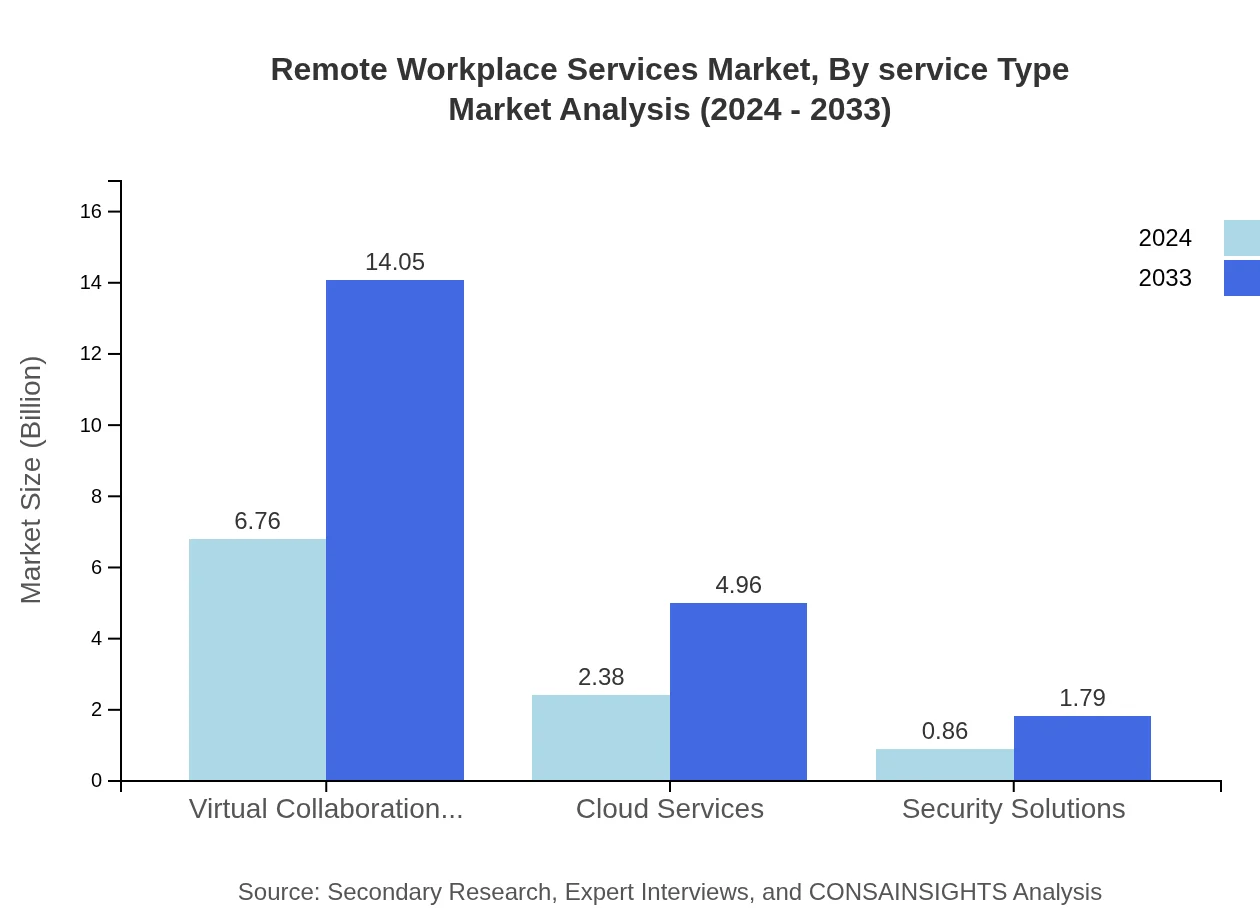
This segment examines the performance of various service types driving the remote workplace services market. Virtual Collaboration Tools lead the segment with a remarkable market size increase from 6.76 units in 2024 to 14.05 units by 2033, maintaining a dominant share of 67.57% throughout the period. Complementing these are Cloud Services, which are forecasted to grow from 2.38 units to 4.96 units, supported by a stable market share of 23.84%. Security Solutions, despite a smaller scale, play a crucial role with expected growth from 0.86 units to 1.79 units while retaining an 8.59% share. This analysis highlights the strategic importance of these service types in addressing the evolving needs of remote work environments and emphasizes the role of continuous technological investment and innovation.
Remote Workplace Services Market Analysis By Industry
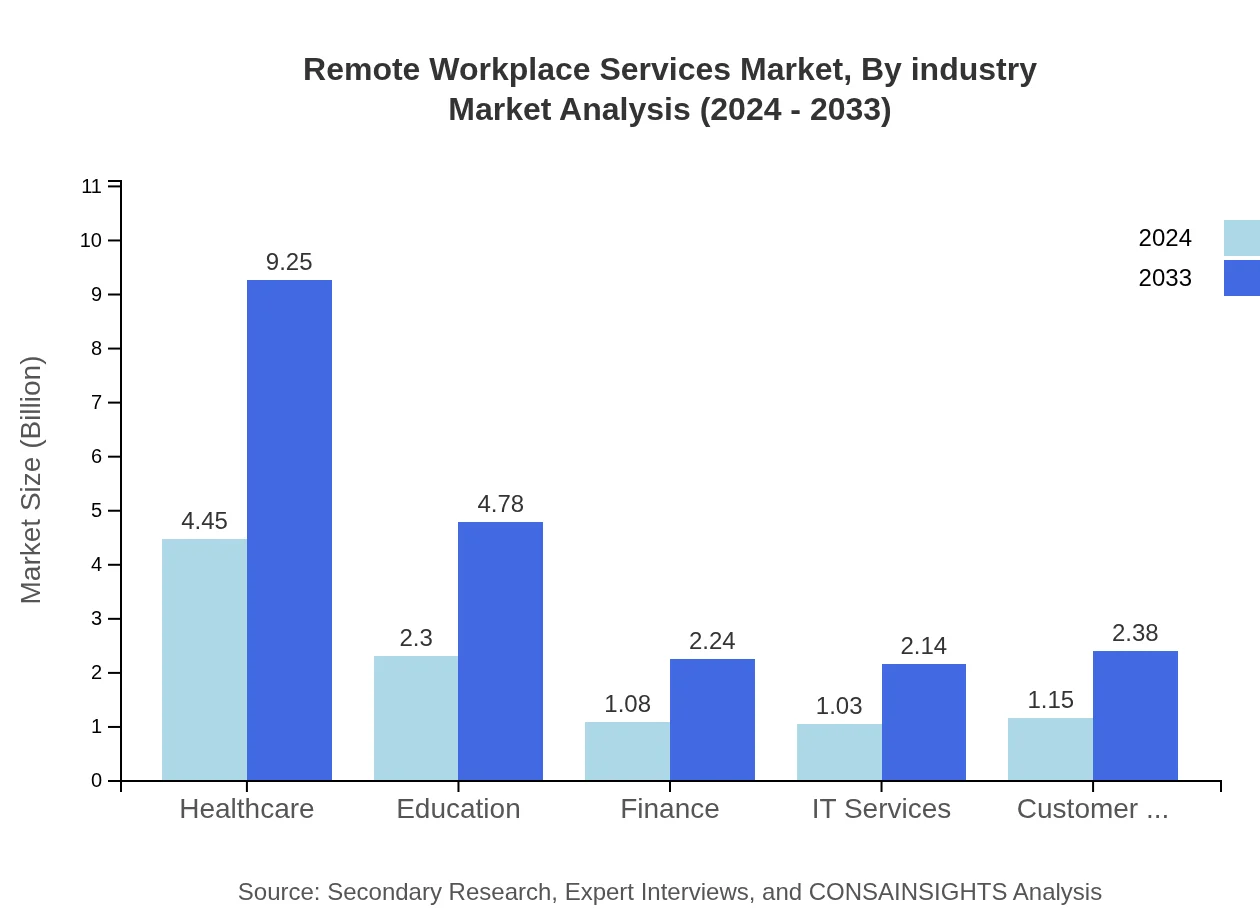
The industry segmentation analysis covers key verticals such as Healthcare, Education, Finance, IT Services, and Customer Service. The Healthcare segment, with a market size increasing from 4.45 units to 9.25 units, remains a major adopter due to the criticality of secure and reliable remote solutions. Education follows with growth from 2.30 units to 4.78 units, underscoring the rising demand for digital learning platforms. Finance, IT Services, and Customer Service, though smaller in scale relative to Healthcare, maintain steady market shares of 10.79%, 10.27%, and 11.45% respectively. These sectors are continuously enhancing their digital infrastructures to support remote operations, thereby establishing a foundation for sustained growth and innovation.
Remote Workplace Services Market Analysis By Delivery Model
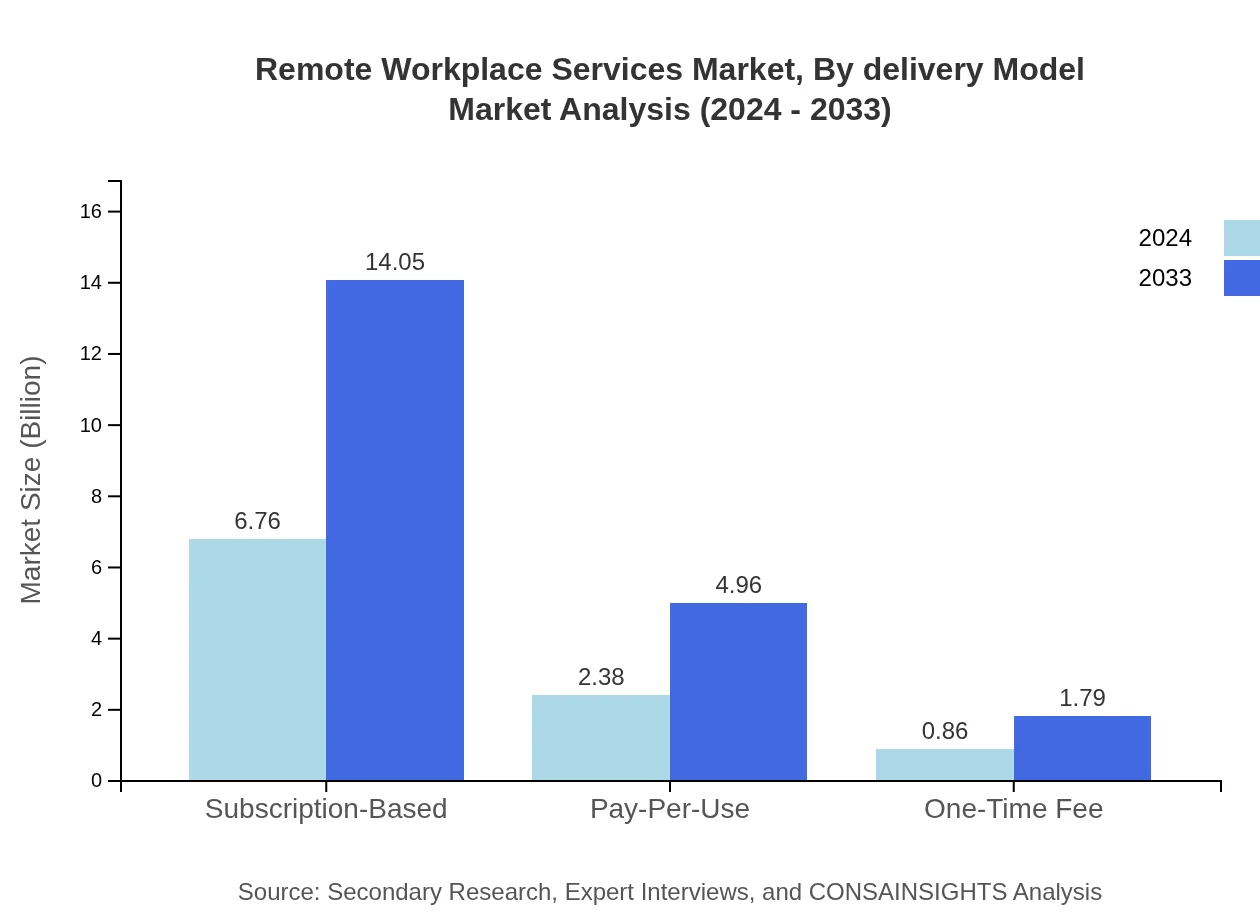
This segment focuses on the delivery models used for Remote Workplace Services, including Subscription-Based, Pay-Per-Use, and One-Time Fee models. The Subscription-Based model is prominent, showing a market size increase from 6.76 units in 2024 to 14.05 units by 2033, with its share remaining at 67.57%. The Pay-Per-Use model, which caters to organizations preferring flexible cost structures, is expected to grow from 2.38 units to 4.96 units and maintain a 23.84% share. Similarly, the One-Time Fee model, though representing a smaller segment with growth from 0.86 units to 1.79 units and a stable share of 8.59%, remains important for clients preferring straightforward payment structures. The analysis emphasizes that tailored delivery models allow service providers to cater to diverse client needs and budgetary constraints.
Remote Workplace Services Market Analysis By User Type
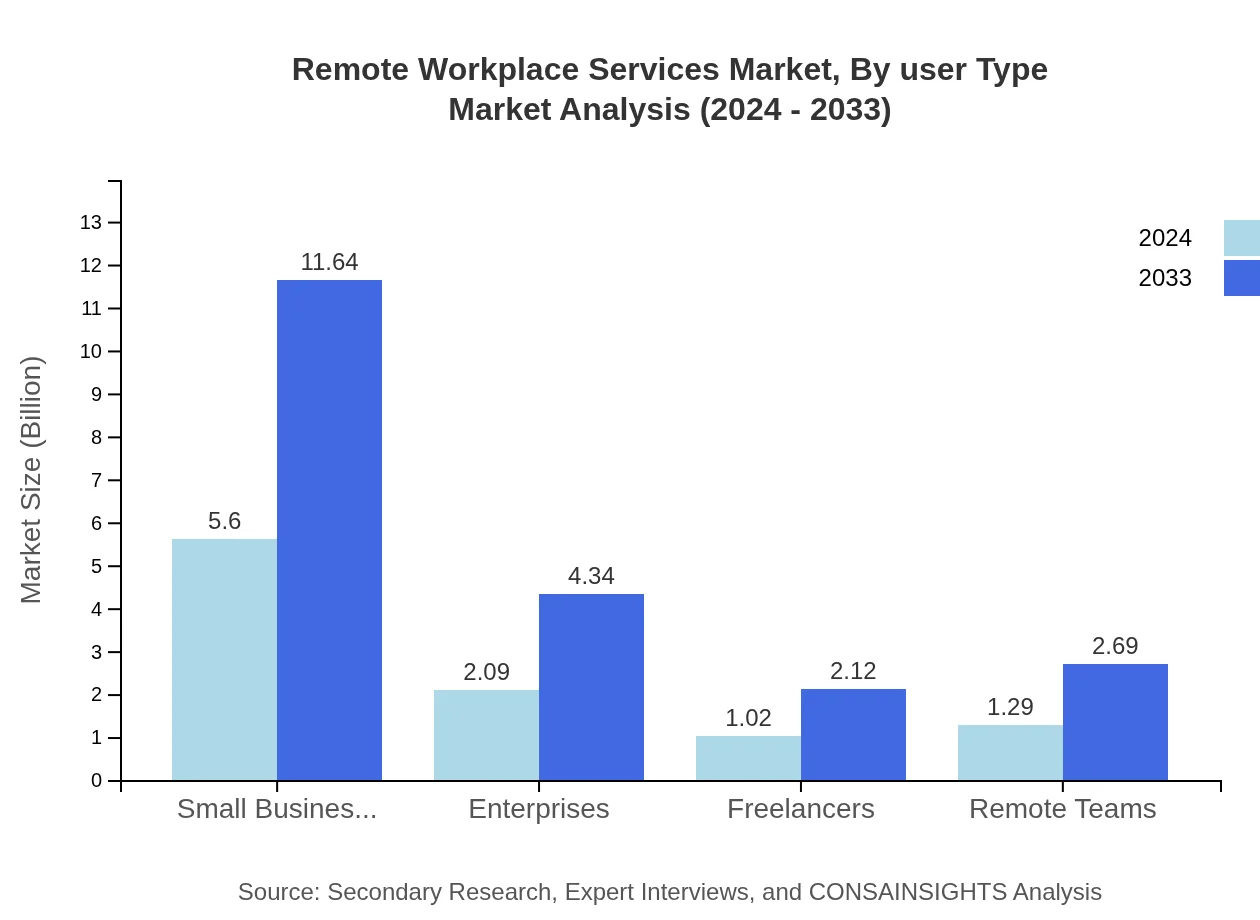
Examining user type segmentation reveals distinct market dynamics for Small Businesses, Enterprises, Freelancers, and Remote Teams. Small Businesses lead this segment with extensive adoption rates, as evidenced by a market size growth from 5.60 units to 11.64 units and a dominant share of 56%. Enterprises show steady progression with figures moving from 2.09 units to 4.34 units and a corresponding share of 20.87%. Freelancers and Remote Teams, though smaller in quantitative contribution, exhibit robust growth – from 1.02 to 2.12 units and from 1.29 to 2.69 units respectively, with shares of 10.18% and 12.95%. This segmentation underscores the tailored needs of each user group, driving service customization and innovation to accommodate varying operational scales and work styles.
Remote Workplace Services Market Trends and Future Forecast
Tell us your focus area and get a customized research report.
Global Market Leaders and Top Companies in Remote Workplace Services Industry
RemoteConnect Inc.:
RemoteConnect Inc. is a pioneering organization offering end-to-end remote work solutions, including advanced cloud platforms, secure collaboration tools, and comprehensive IT support. The company is known for its innovative approach and robust service portfolio, which has set industry benchmarks and driven significant digital transformation for enterprises globally.VirtualWorks Solutions:
VirtualWorks Solutions specializes in delivering integrated remote workplace services tailored to diverse industries. With a focus on combining cutting-edge technology with user-friendly platforms, the firm has garnered a strong reputation for enhancing productivity and communication across distributed workforces.We're grateful to work with incredible clients.









FAQs
How can the Remote Workplace Services Report help align our marketing strategy with customer adoption trends?
The Remote Workplace Services report, valued at $10 billion with an 8.2% CAGR, provides insights into customer needs and preferences, allowing companies to tailor marketing strategies that resonate with evolving customer expectations and improve adoption rates.
What product features are in highest demand according to the Remote Workplace Services trends?
Key product features in demand include robust virtual collaboration tools and cloud services, which together account for 67.57% and 23.84% market share, respectively. These tools are crucial for facilitating effective remote work environments.
Which regions offer the best market entry and expansion opportunities in the Remote Workplace Services industry?
North America and Europe present the best opportunities, with market sizes growing from $3.78 billion to $7.86 billion and $2.65 billion to $5.52 billion respectively by 2033, highlighting significant growth potential and demand.
What emerging technologies and innovations are shaping the Remote Workplace Services market?
Emerging technologies such as AI-powered collaboration tools and advanced security solutions are shaping the market, emphasizing the importance of security in remote workspaces, alongside the rise of subscription-based service models to enhance flexibility.
Does the Remote Workplace Services Report include competitive landscape and market share analysis?
Yes, the report includes an in-depth competitive landscape analysis, showcasing market shares across different segments. This information aids in understanding competitors' positioning and identifying potential strategic partnerships.
How can executives use the Remote Workplace Services Report to evaluate investment risks and ROI?
Executives can leverage insights from the report's market size and growth projections, particularly its 8.2% CAGR, to assess potential ROI and analyze investment risks in various regions and segments of the remote workplace services market.
What is the market size of remote Workplace Services?
The remote workplace services market is currently valued at $10 billion, with projections indicating growth driven by an 8.2% CAGR, suggesting robust demand for flexible work solutions over the coming years.
What segments are driving growth in the remote Workplace Services market?
Segments such as healthcare, small businesses, and virtual collaboration tools are key growth drivers, with healthcare projected to grow from $4.45 billion to $9.25 billion by 2033, showcasing significant demand.