
Reports >
Life Sciences
>
Resuscitation Devices Market Report

Resuscitation Devices Market Report
First published: 12 October 2024 | Last updated: 25 May 2026 | Report Code: resuscitation-devices
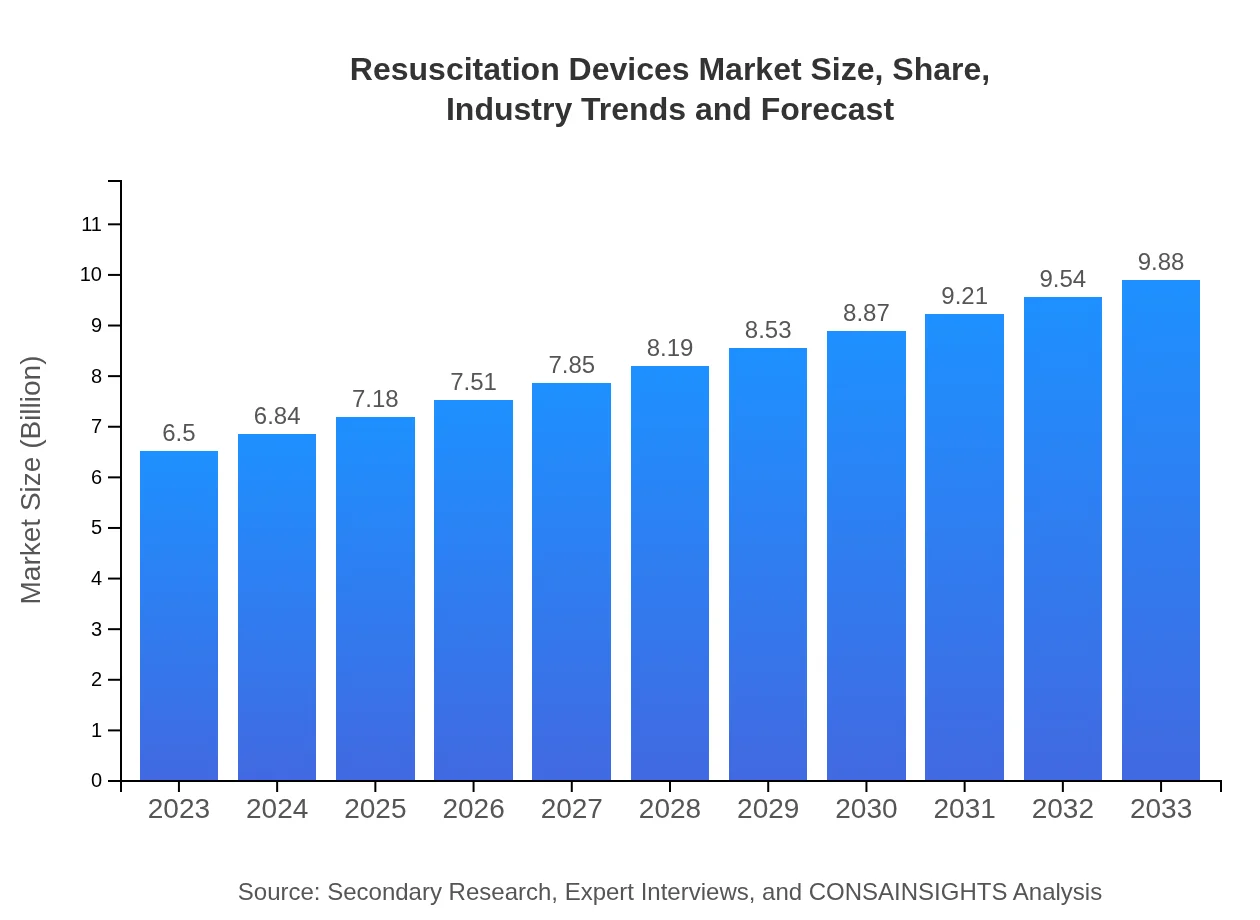
Resuscitation Devices Market — USD 6.5 billion in 2023, Growing to USD 9.88B by 2033 at 4.2% CAGR
This report provides an in-depth analysis of the Resuscitation Devices market, covering key insights on market size, trends, segmentation, regional analysis, and forecasts from 2023 to 2033.
Key Takeaways
- Global market worth $6.50 Billion in 2023, expected to reach $9.88 Billion by 2033 at a 4.2% CAGR.
- North America is largest regional market, while no single fastest-growing region is stated because regional CAGR differences remain within 0.15 percentage points.
- Market growth supported by rising emergency care needs, technological advances in automated devices, and broader adoption across hospitals and ambulance services.
- Primary industry players include Medtronic, Philips Healthcare, ZOLL Medical Corporation, and Stryker Corporation.
- Segment diversity spans manual, electrical, and mechanical technologies and multiple end-users such as hospitals, ambulance services, and home care.
Resuscitation Devices Market Report — Executive Summary
North America remains largest market by forecast-period value, while no single fastest-growing region is stated because top regional growth rates are separated by less than 0.15 percentage points. The resuscitation devices market is projected to grow from $6.50 Billion in 2023 to $9.88 Billion by 2033, reflecting a 4.2% CAGR over the forecast period. Growth is driven by increasing incidence of cardiac and respiratory emergencies, expansion of emergency medical services, and innovation in automated and electrical resuscitation solutions. Hospitals, ambulance services, and home care settings form the primary end-user base. Product segmentation includes manual, automated, and advanced airway devices, while regional demand varies across North America, Europe, Asia Pacific, Latin America, and the Middle East and Africa. Prominent manufacturers such as Medtronic, Philips Healthcare, ZOLL Medical Corporation, and Stryker Corporation are investing in product development and strategic collaborations to meet evolving clinical and regulatory requirements.
Key Growth Drivers
- Rising frequency of cardiac arrest and respiratory failure incidents increasing demand for resuscitation equipment.
- Technological progress in automated and electrical devices improving clinical effectiveness and adoption rates.
- Expansion of emergency medical infrastructure and ambulance services in multiple regions bolstering procurement.
- Growing awareness of home-based emergency readiness driving uptake of portable and user-friendly devices.
- Regulatory approvals and strategic partnerships enabling faster market entry and broader distribution networks.
| Metric | Value |
|---|---|
| Study Period | 2023 - 2033 |
| 2023 Market Size | $6.50 Billion |
| CAGR (2023-2033) | 4.2% |
| 2033 Market Size | $9.88 Billion |
| Top Companies | Medtronic , Philips Healthcare, ZOLL Medical Corporation, Stryker Corporation |
| Published Date | 12 October 2024 |
| Last Modified Date | 25 May 2026 |
Resuscitation Devices Market Overview
Customize Resuscitation Devices Market Report market research report
- ✔ Get in-depth analysis of Resuscitation Devices market size, growth, and forecasts.
- ✔ Understand Resuscitation Devices's regional dynamics and industry-specific trends.
- ✔ Identify potential applications, end-user demand, and growth segments in Resuscitation Devices
What is the Market Size & CAGR of Resuscitation Devices Market Report market in 2023?
Resuscitation Devices Industry Analysis
Resuscitation Devices Market Segmentation and Scope
Tell us your focus area and get a customized research report.
Resuscitation Devices Market Report Market Analysis Report by Region
Europe Resuscitation Devices Market Report:
Europe grows from $1.99 Billion in 2023 to $3.02 Billion in 2033. Demand is driven by expanded emergency care access, investments in prehospital services, and modernization of resuscitation equipment in clinical settings.Asia Pacific Resuscitation Devices Market Report:
Asia Pacific grows from $1.11 Billion in 2023 to $1.69 Billion in 2033. Market momentum stems from healthcare infrastructure development, broader ambulance coverage, and increasing awareness of cardiac and respiratory emergency management.North America Resuscitation Devices Market Report:
North America is largest regional market, rising from $2.43 Billion in 2023 to $3.7 Billion in 2033. The region's sizable hospital networks, advanced emergency services, and early adoption of automated devices support continuing demand.South America Resuscitation Devices Market Report:
Latin America grows from $0.64 Billion in 2023 to $0.97 Billion in 2033. Growth is supported by evolving emergency medical services, procurement by hospitals and ambulance providers, and gradual introduction of advanced device technologies.Middle East & Africa Resuscitation Devices Market Report:
Middle East and Africa grows from $0.33 Billion in 2023 to $0.5 Billion in 2033. Expansion reflects improving emergency care capabilities, targeted investments in critical-care equipment, and rising adoption in hospital and prehospital settings.Tell us your focus area and get a customized research report.
Research Methodology
Resuscitation Devices Market Analysis By Device Type
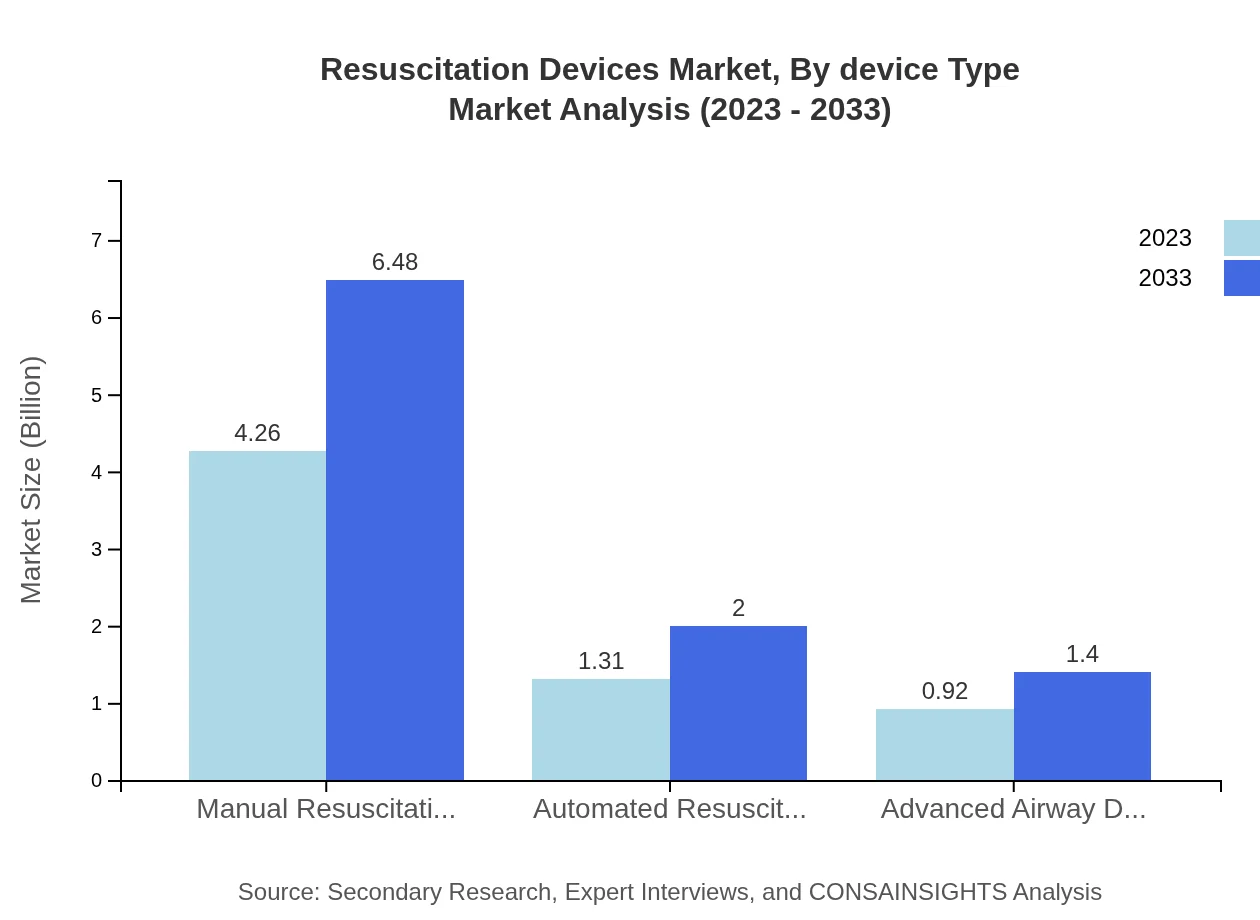
The device type segment of the Resuscitation Devices market includes Manual Resuscitation Devices, Automated Resuscitation Devices, and Advanced Airway Devices. As of 2023, manual resuscitation devices hold a significant market share of 65.61%, projected to reach a valuation of $6.48 billion by 2033. Automated devices, representing 20.19% share, are gaining traction due to their ease of use and efficiency, with expected growth to $2.00 billion. Advanced airway devices, comprising 14.2%, are also expected to witness sustained growth, reaching $1.40 billion.
Resuscitation Devices Market Analysis By Application
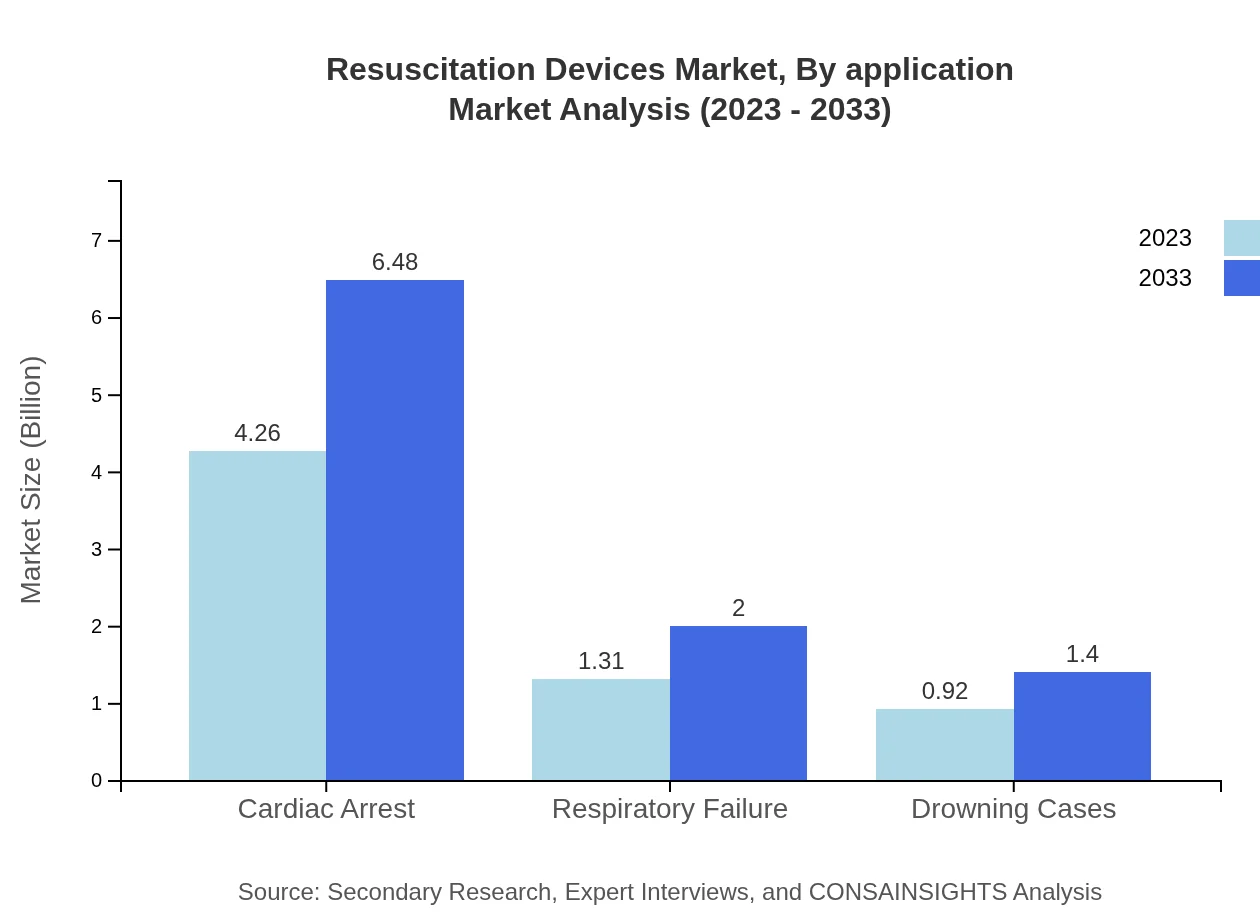
The application segment includes Cardiac Arrest, Respiratory Failure, and Drowning Cases. Cardiac arrest applications dominate the market, expected to maintain a share of 65.61%, growing to $6.48 billion by 2033. Respiratory failure applications account for 20.19% of the market, projected to reach $2.00 billion. Drowning cases represent a smaller share of 14.2%, with growth to $1.40 billion as awareness and treatment options improve.
Resuscitation Devices Market Analysis By End User
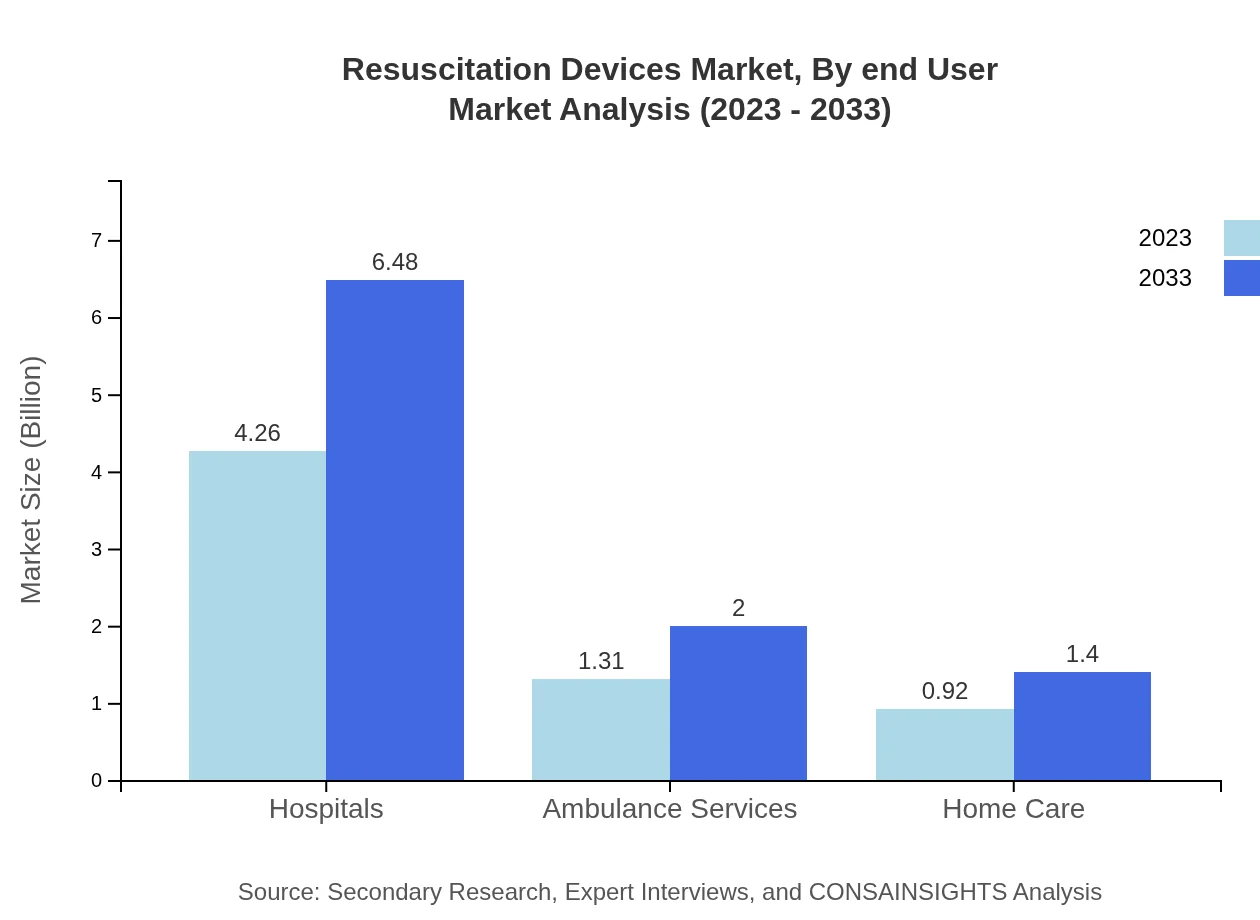
In terms of end-users, Hospitals dominate, with a significant share of 65.61% in 2023, translating to $6.48 billion by 2033. Ambulance services hold a share of 20.19%, expected to grow to $2.00 billion. Home care accounts for 14.2% of the market, projected to reach $1.40 billion, emphasizing the shift toward patient management at home.
Resuscitation Devices Market Analysis By Technology
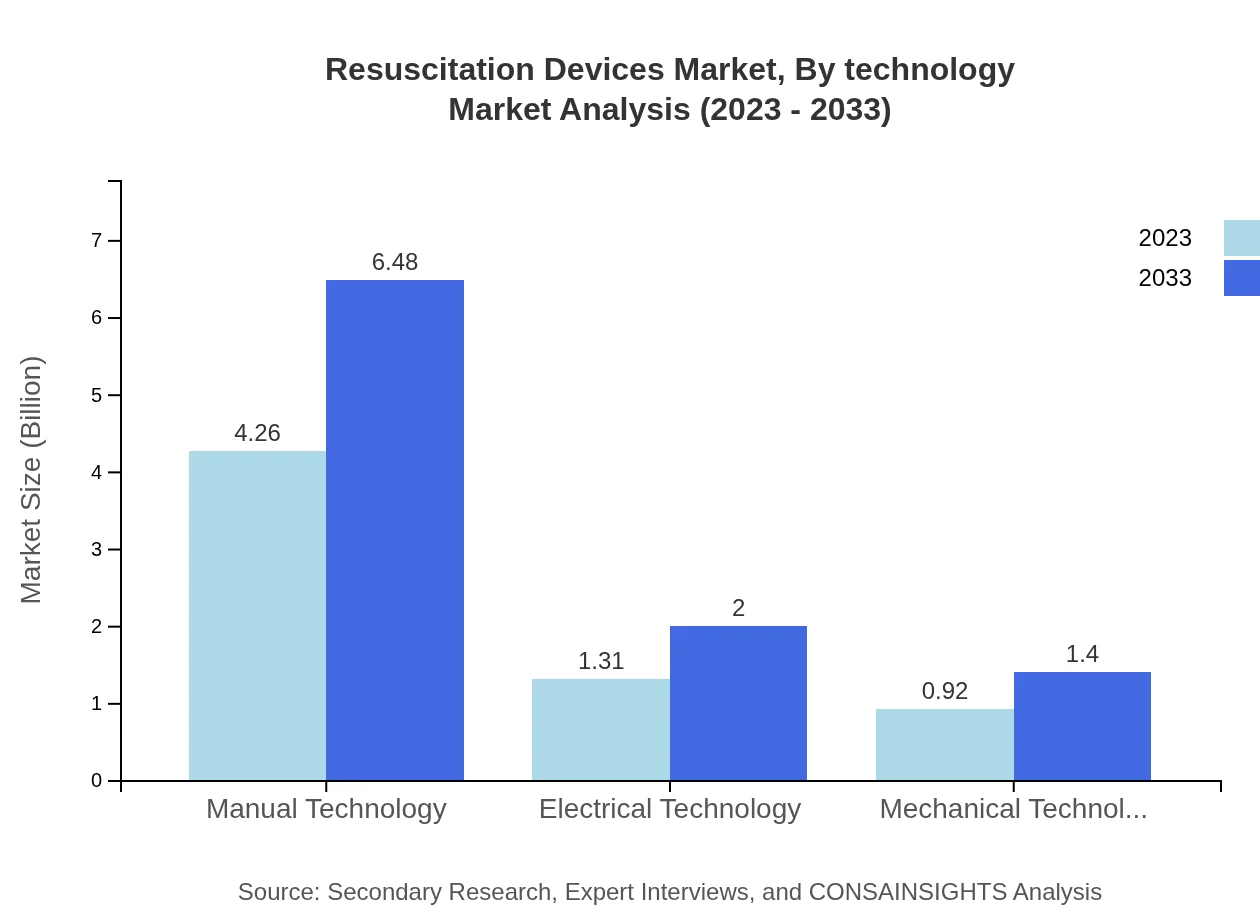
The technology segment is classified into Manual Technology, Electrical Technology, and Mechanical Technology. Manual technology holds the largest market share of 65.61%, with a growth trajectory towards $6.48 billion. Electrical technology stands at 20.19%, with a forecast to reach $2.00 billion, while mechanical technology accounts for 14.2%, expected to reach $1.40 billion as innovations enhance device functionality.
Resuscitation Devices Market Analysis By Region
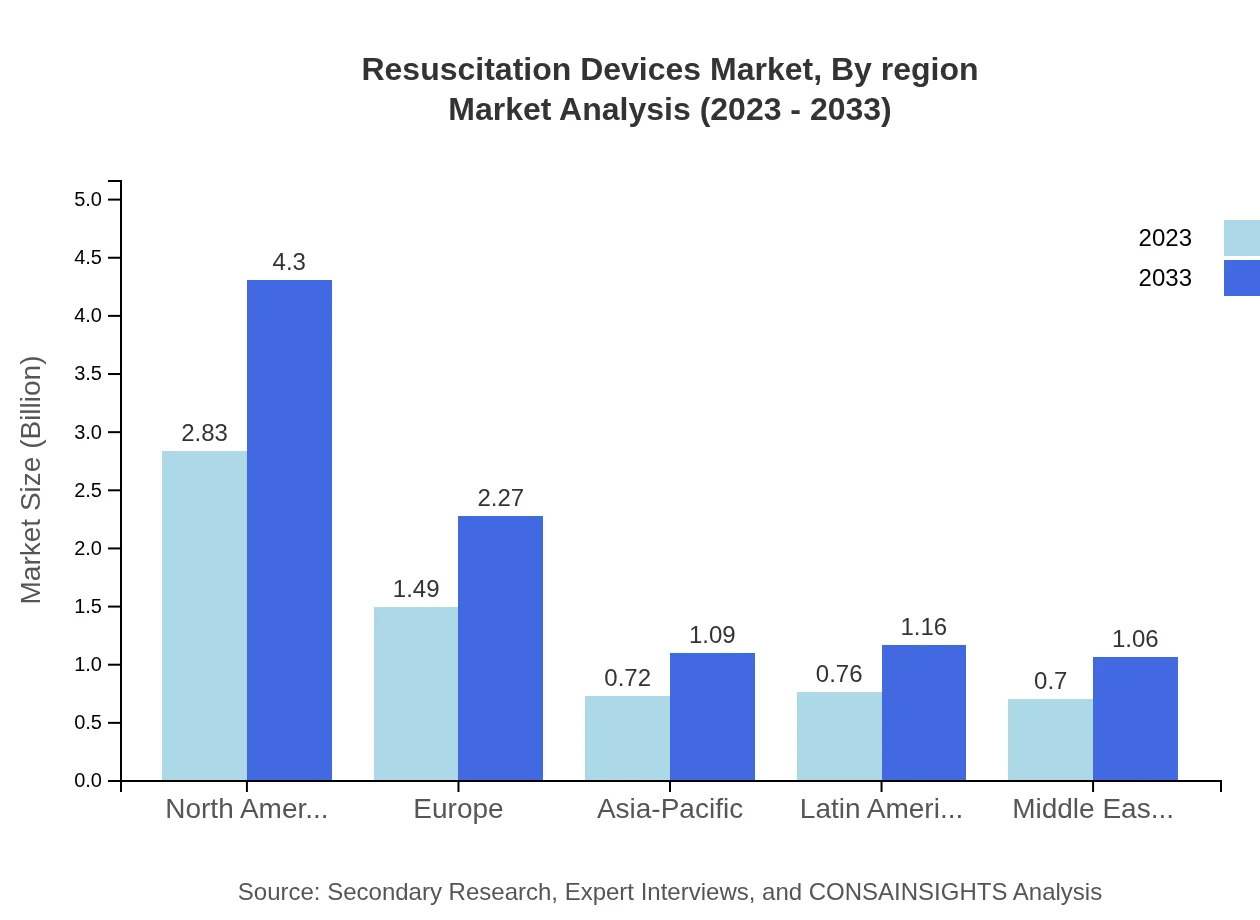
A regional analysis highlights the discrepancies in market growth and acceptance trends. North America leads significantly, followed by Europe and Asia-Pacific. The shared growth potential in emerging regions such as the Middle East and Africa, alongside the robust healthcare frameworks in developed regions, indicate a balanced outlook for market expansion.
Resuscitation Devices Market Trends and Future Forecast
Tell us your focus area and get a customized research report.
Global Market Leaders and Top Companies in Resuscitation Devices Industry
Medtronic :
A key player in developing advanced resuscitation devices, Medtronic specializes in innovative cardiovascular and monitoring services, significantly impacting emergency care.Philips Healthcare:
Philips is known for its advanced cardiopulmonary resuscitation solutions, offering a range of automated devices that are widely used in hospitals and emergency services.ZOLL Medical Corporation:
ZOLL produces life-saving devices and software solutions in emergency medicine, contributing to advancements in defibrillation and post-resuscitation care.Stryker Corporation:
Stryker's medical technologies include specialized resuscitation devices, such as automatic defibrillators, that are integral to modern emergency response efforts.We're grateful to work with incredible clients.








FAQs
What is the market size of the resuscitation devices market in 2023?
The market size in 2023 is $6.50 Billion. This figure reflects current demand across hospitals, ambulance services, and home care and serves as the baseline for forecast analysis.
How big will the market be by 2033?
By 2033 the market is projected to reach $9.88 Billion, based on the provided forecast that incorporates technological adoption and expanding emergency medical services.
What is CAGR for the forecast period?
The reported compound annual growth rate for 2023 to 2033 is 4.2%, representing the average annual expansion used in the market projection model.
Is there a single fastest Growing region in the Resuscitation Devices Market Report market?
No single fastest-growing region is stated for the Resuscitation Devices Market Report market because the top regional implied CAGR values are within 0.15 percentage points of each other, making the ranking too close to call reliably.
Which companies lead the resuscitation devices market?
Top companies listed include Medtronic, Philips Healthcare, ZOLL Medical Corporation, and Stryker Corporation, noted for product development and market presence.
What are the primary end Users for these devices?
Primary end-users are hospitals, ambulance services, and home care providers, which together account for the main demand channels for resuscitation equipment.
What technologies are covered in the segmentation?
Segment coverage includes manual, electrical, and mechanical technologies as well as automated device categories and advanced airway solutions.
How does regional variation affect market planning?
Regional differences in infrastructure, regulatory environments, and healthcare spending shape procurement strategies and prioritization of device types.