
Reports >
Life Sciences
>
Revenue Cycle Management Market Report

Revenue Cycle Management Market Report
First published: 21 October 2024 | Last updated: 25 May 2026 | Report Code: revenue-cycle-management
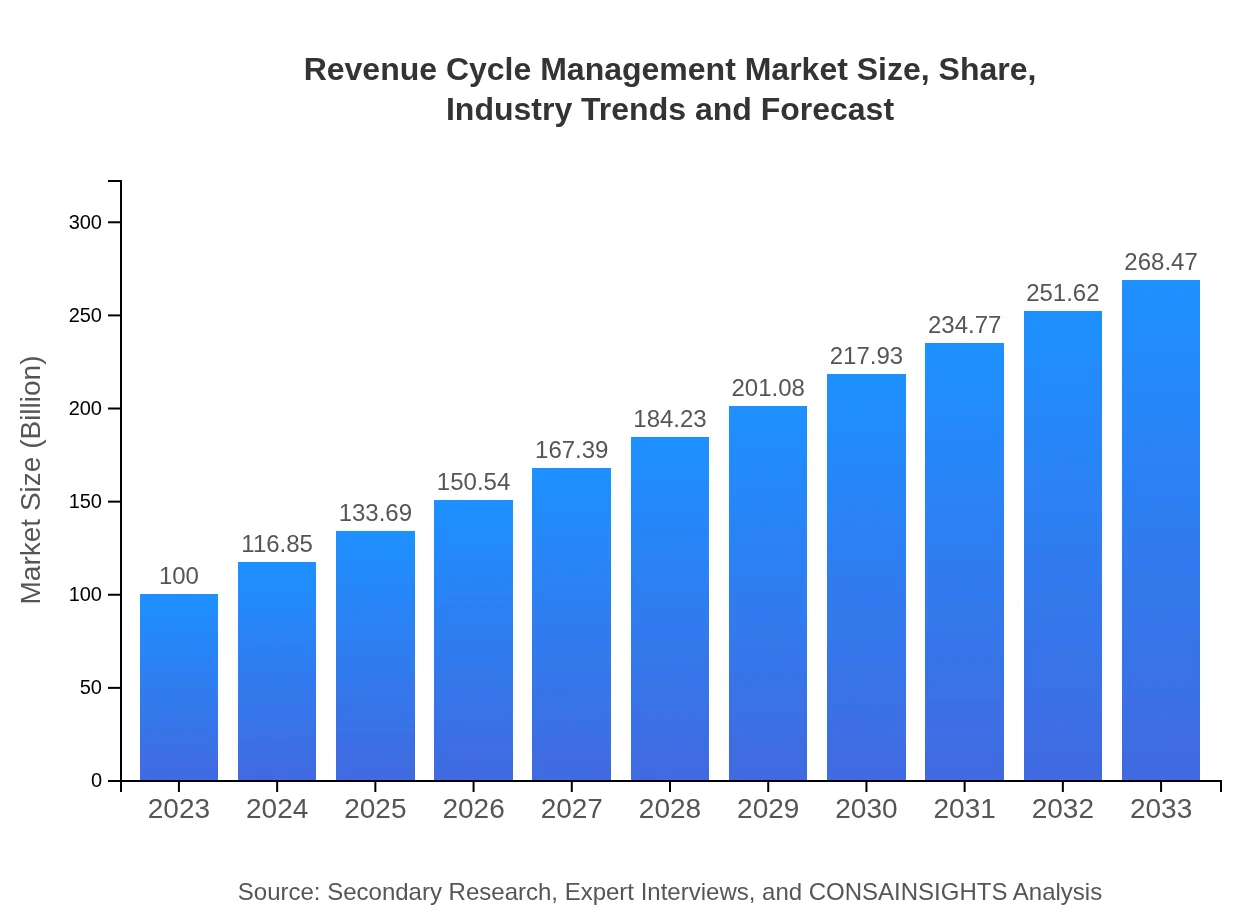
Revenue Cycle Management Market — USD 100 billion in 2023, Growing to USD 268.47B by 2033 at 10% CAGR
This report provides an extensive analysis of the Revenue Cycle Management (RCM) market, spanning the years 2023 to 2033. It covers market size, growth trends, technology innovations, segmentation, and regional insights, delivering a comprehensive overview to stakeholders in the RCM sector.
Key Takeaways
- Global market expands from $100.00 Billion in 2023 to $268.47 Billion by 2033 at a 10% CAGR.
- North America is largest regional market, while no single fastest-growing region is stated because regional CAGR differences remain within 0.15 percentage points.
- Europe moves from $27.55 Billion to $73.96 Billion between 2023 and 2033, underlining steady demand.
- Asia Pacific rises from $18.73 Billion to $50.28 Billion from 2023 to 2033, reflecting digital adoption in healthcare.
- Top vendors include Cerner Corporation, McKesson Corporation, Optum360, and Allscripts Healthcare Solutions.
Revenue Cycle Management Market Report — Executive Summary
North America remains largest market by forecast-period value, while no single fastest-growing region is stated because top regional growth rates are separated by less than 0.15 percentage points. The Revenue Cycle Management market is forecast to grow from $100.00 Billion in 2023 to $268.47 Billion in 2033 at a 10% CAGR. Growth is driven by digitization of healthcare revenue processes, integration of electronic health records, and the need to optimize billing and collections. Providers are adopting RCM software and services to improve claims processing, denials management, and accounts receivable workflows. Market structure spans solution types, deployment options, and a range of end users including hospitals and physician practices. Regional patterns show North America as the largest market. Key participants such as Cerner Corporation, McKesson Corporation, Optum360, and Allscripts Healthcare Solutions are prominent. Research combines primary expert interviews and secondary company documentation to support observations.
Key Growth Drivers
- Wider adoption of electronic health records increases demand for integrated revenue cycle tools.
- Need for improved claims processing and denials management to reduce revenue leakage.
- Shift toward value-based care incentivizes accurate revenue tracking and enhanced patient billing workflows.
- Cloud-based deployments facilitate scalability and remote management of RCM functions.
- Rising volume of healthcare data drives investment in analytics-enabled revenue cycle solutions.
| Metric | Value |
|---|---|
| Study Period | 2023 - 2033 |
| 2023 Market Size | $100.00 Billion |
| CAGR (2023-2033) | 10% |
| 2033 Market Size | $268.47 Billion |
| Top Companies | Cerner Corporation, McKesson Corporation, Optum360, Allscripts Healthcare Solutions |
| Published Date | 21 October 2024 |
| Last Modified Date | 25 May 2026 |
Revenue Cycle Management Market Overview
Customize Revenue Cycle Management Market Report market research report
- ✔ Get in-depth analysis of Revenue Cycle Management market size, growth, and forecasts.
- ✔ Understand Revenue Cycle Management's regional dynamics and industry-specific trends.
- ✔ Identify potential applications, end-user demand, and growth segments in Revenue Cycle Management
What is the Market Size & CAGR of Revenue Cycle Management Market Report market in 2023?
Revenue Cycle Management Industry Analysis
Revenue Cycle Management Market Segmentation and Scope
Tell us your focus area and get a customized research report.
Revenue Cycle Management Market Report Market Analysis Report by Region
Europe Revenue Cycle Management Market Report:
Europe grows from $27.55 Billion in 2023 to $73.96 Billion in 2033. Growth reflects digitization of healthcare revenue processes, regulatory emphasis on accurate reimbursement, and uptake of cloud-based RCM deployments.Asia Pacific Revenue Cycle Management Market Report:
Asia Pacific grows from $18.73 Billion in 2023 to $50.28 Billion in 2033. Regional momentum is linked to increased healthcare digital transformation, rising adoption of software-driven claims processing, and growing need for efficient revenue collection.North America Revenue Cycle Management Market Report:
North America is largest regional market, rising from $38.76 Billion in 2023 to $104.06 Billion in 2033. Regional adoption is driven by extensive EHR integration, investment in automated billing and strong demand for enterprise RCM solutions.South America Revenue Cycle Management Market Report:
Latin America grows from $6.75 Billion in 2023 to $18.12 Billion in 2033. Expansion is supported by modernization of hospital billing systems, increased adoption of RCM services, and efforts to streamline accounts receivable management.Middle East & Africa Revenue Cycle Management Market Report:
Middle East and Africa grows from $8.21 Billion in 2023 to $22.04 Billion in 2033. Growth stems from investments in healthcare IT, the shift toward centralized billing, and uptake of solutions to manage denials and claims processing.Tell us your focus area and get a customized research report.
Research Methodology
Revenue Cycle Management Market Analysis By Solution Type
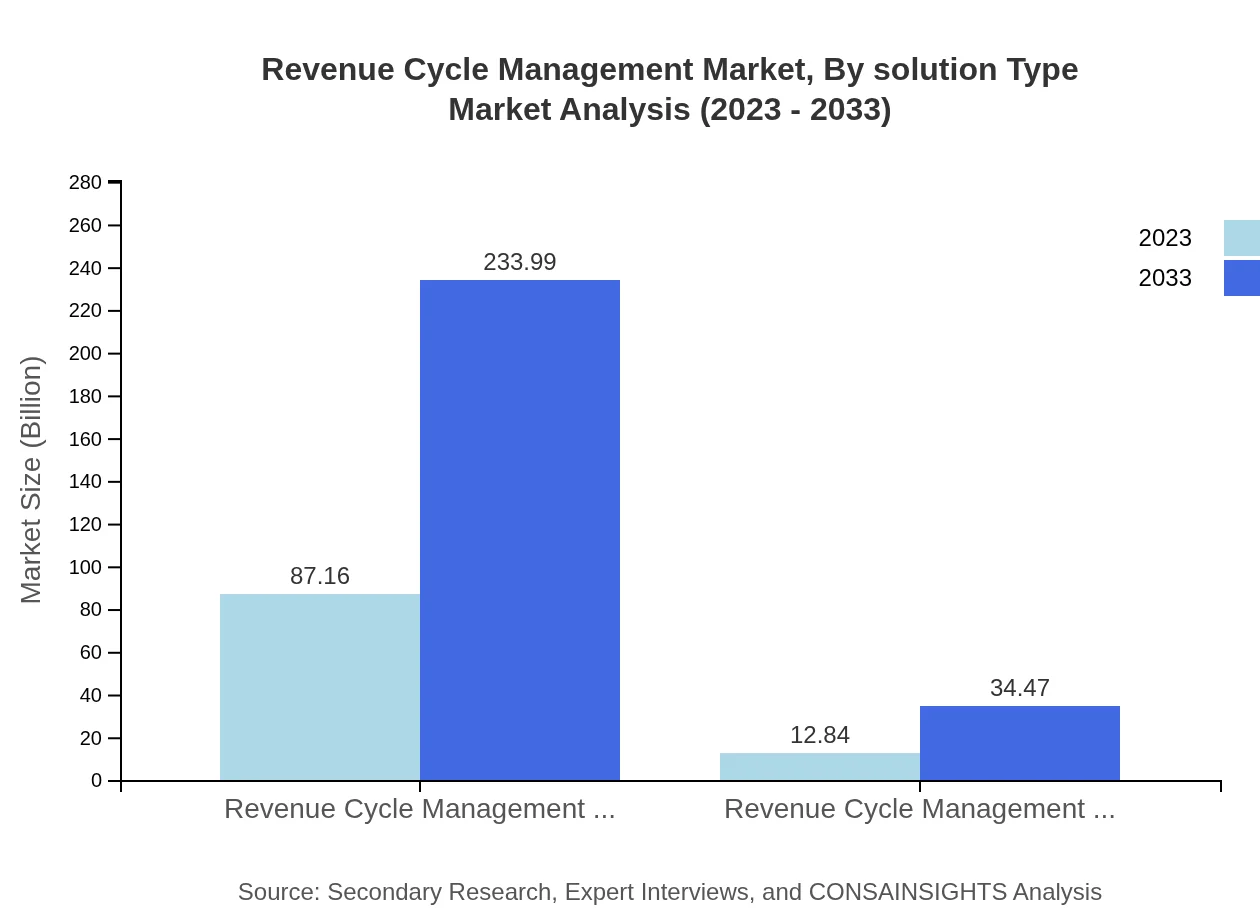
The Revenue Cycle Management market by solution type segments into software and services. As of 2023, software dominates with a market size of $87.16 billion, predicted to reach $233.99 billion by 2033, highlighting the growing reliance on integrated RCM systems. Services contribute $12.84 billion in 2023 and are expected to rise to $34.47 billion by 2033, due to the increasing complexity of healthcare billing and the necessity for specialized management solutions.
Revenue Cycle Management Market Analysis By Deployment Type
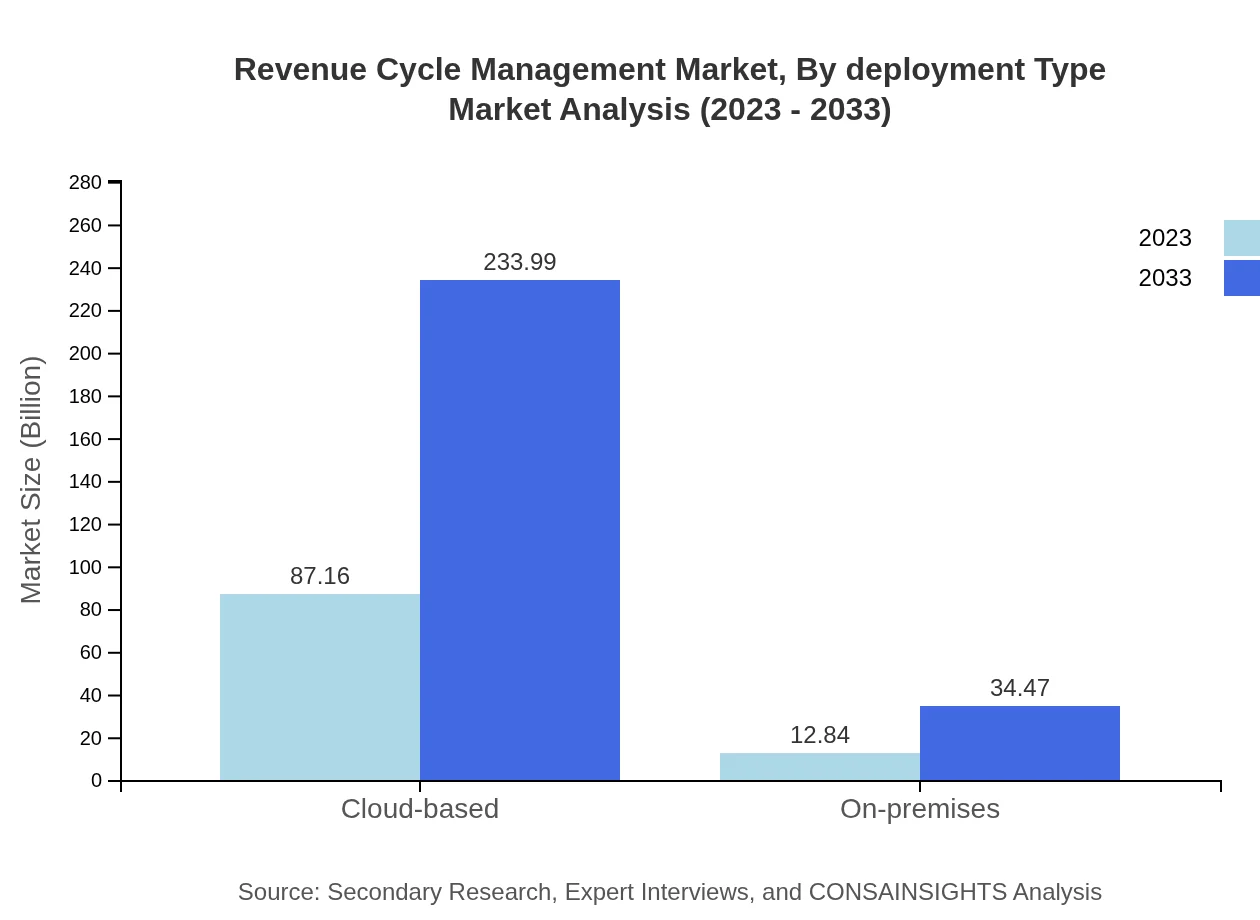
The deployment type segment of the Revenue Cycle Management market consists of cloud-based and on-premises solutions. In 2023, cloud-based solutions dominate the market at $87.16 billion, anticipated to grow to $233.99 billion by 2033, attributable to their scalability and reduced operational costs. Conversely, on-premises solutions, valued at $12.84 billion in 2023, are projected to rise to $34.47 billion by 2033, although their growth rate is slower compared to cloud offerings.
Revenue Cycle Management Market Analysis By End User
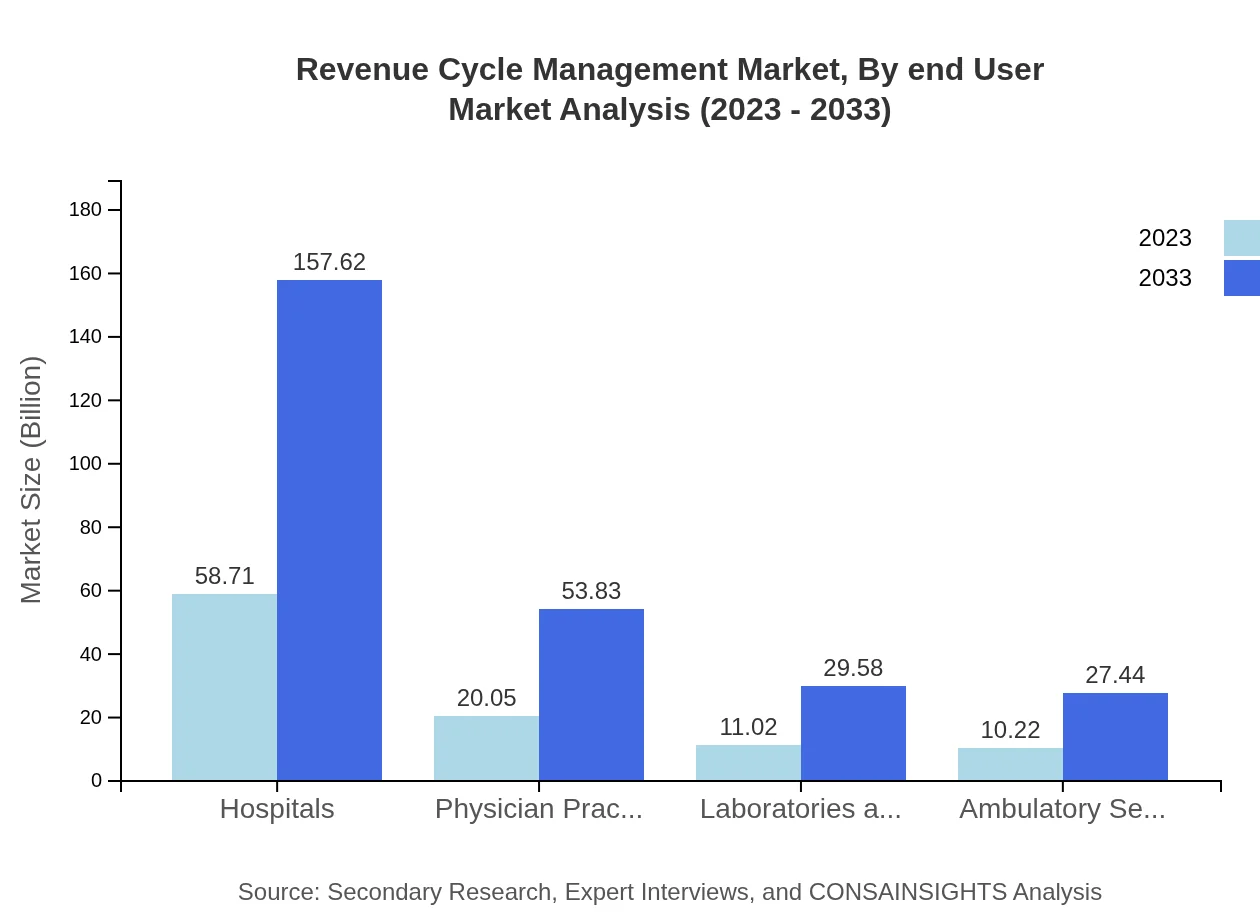
End-users of the Revenue Cycle Management market include hospitals, physician practices, laboratories, and ambulatory service centers. Hospitals hold the largest market share, valued at $58.71 billion in 2023 and projected to reach $157.62 billion by 2033. Physician practices follow, with a size of $20.05 billion in 2023, expected to grow to $53.83 billion by 2033. Laboratories and diagnostics represent a segment worth $11.02 billion in 2023, forecasted to reach $29.58 billion by 2033. Ambulatory service centers hold a share of $10.22 billion in 2023, projected to increase to $27.44 billion by the end of the decade.
Revenue Cycle Management Market Analysis By Application
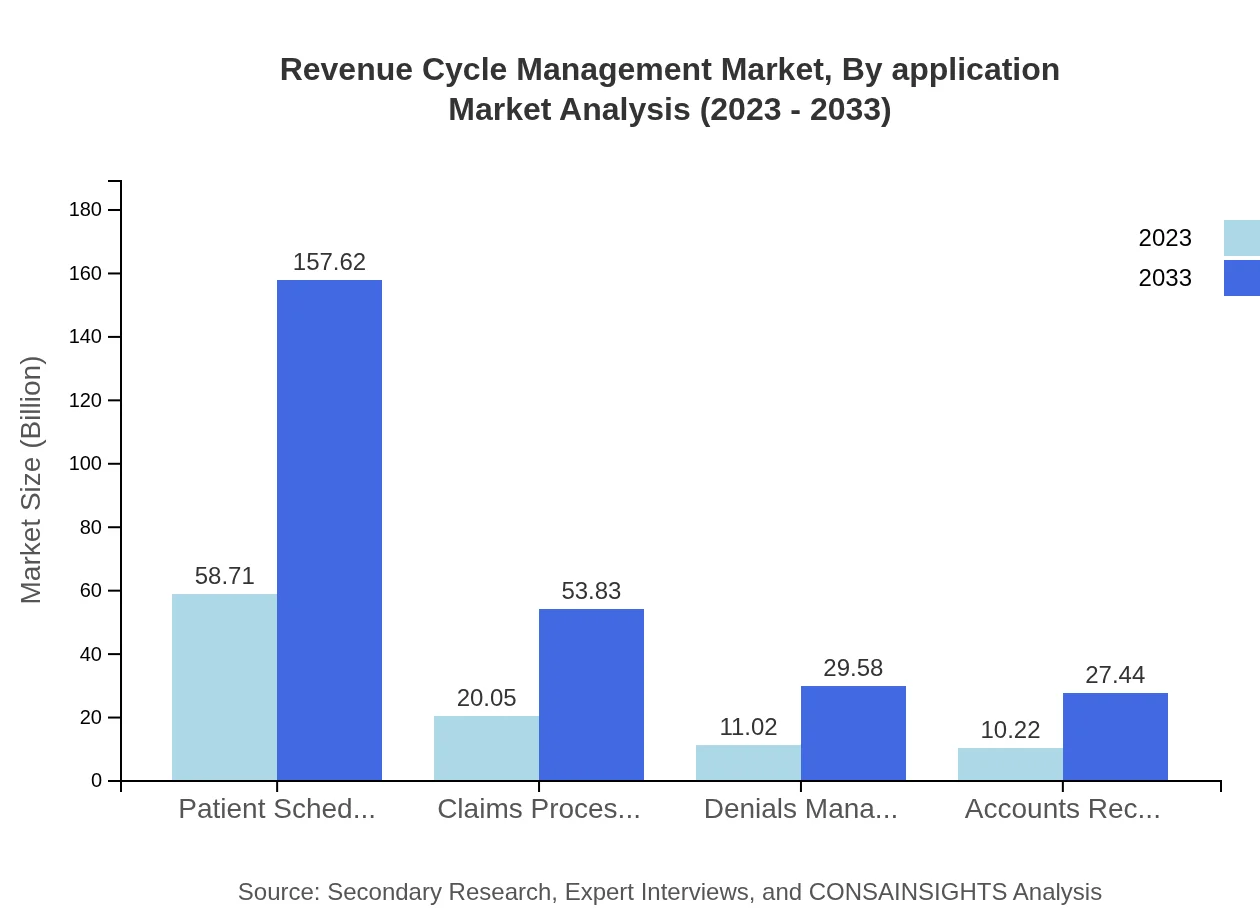
Applications within the Revenue Cycle Management market include patient scheduling, claims processing, denials management, and accounts receivable management. Patient scheduling leads this segment with a market value of $58.71 billion in 2023, forecasted to reach $157.62 billion by 2033. Claims processing is valued at $20.05 billion in 2023, anticipated to grow to $53.83 billion by 2033, while denials management and accounts receivable management contribute $11.02 billion and $10.22 billion, respectively.
Revenue Cycle Management Market Trends and Future Forecast
Tell us your focus area and get a customized research report.
Global Market Leaders and Top Companies in Revenue Cycle Management Industry
Cerner Corporation:
Cerner Corporation offers comprehensive health information technology solutions, focusing on streamlining revenue cycle processes for healthcare providers and enhancing operational efficiencies.McKesson Corporation:
McKesson is a leading healthcare services and information technology company, specializing in pharmacy solutions and revenue cycle management services.Optum360:
A subsidiary of UnitedHealth Group, Optum360 provides innovative solutions in revenue cycle management, focusing on healthcare analytics, claims processing, and billing solutions.Allscripts Healthcare Solutions:
Allscripts offers a comprehensive portfolio of EHR and RCM solutions, facilitating improved financial performance and patient care for healthcare providers.We're grateful to work with incredible clients.









FAQs
What is the market size of the Revenue Cycle Management market in 2023?
The Revenue Cycle Management market size in 2023 is $100.00 Billion, as stated in the report's baseline market valuation for the start of the forecast period.
How big will the market be in 2033?
By 2033 the market is projected to reach $268.47 Billion according to the provided forecast figures covering the 2023 to 2033 period.
What is CAGR for the forecast period?
The compound annual growth rate for the market during 2023 to 2033 is 10%, reflecting the report's specified trajectory for market expansion.
Is there a single fastest Growing region in the Revenue Cycle Management Market Report market?
No single fastest-growing region is stated for the Revenue Cycle Management Market Report market because the top regional implied CAGR values are within 0.15 percentage points of each other, making the ranking too close to call reliably.
Which companies are listed as top participants?
Top companies named in the report include Cerner Corporation, McKesson Corporation, Optum360, and Allscripts Healthcare Solutions as notable market participants.
What end users are covered in segmentation?
Segmentation lists end users such as Hospitals, Physician Practices, Laboratories and Diagnostics, and Ambulatory Service Centers across the by-end-user category.
What solution types are included in the report?
The report includes Revenue Cycle Management Software and Revenue Cycle Management Services under the by-solution-type segmentation categories.
How was the research conducted?
Research combined primary interviews with industry experts, secondary company reports and publications, and data triangulation with internal validation to ensure accuracy.