

Preimplantation Genetics Diagnosis Pgd Market Report
First published: 21 October 2024 | Last updated: 25 May 2026 | Report Code: preimplantation-genetics-diagnosis-pgd
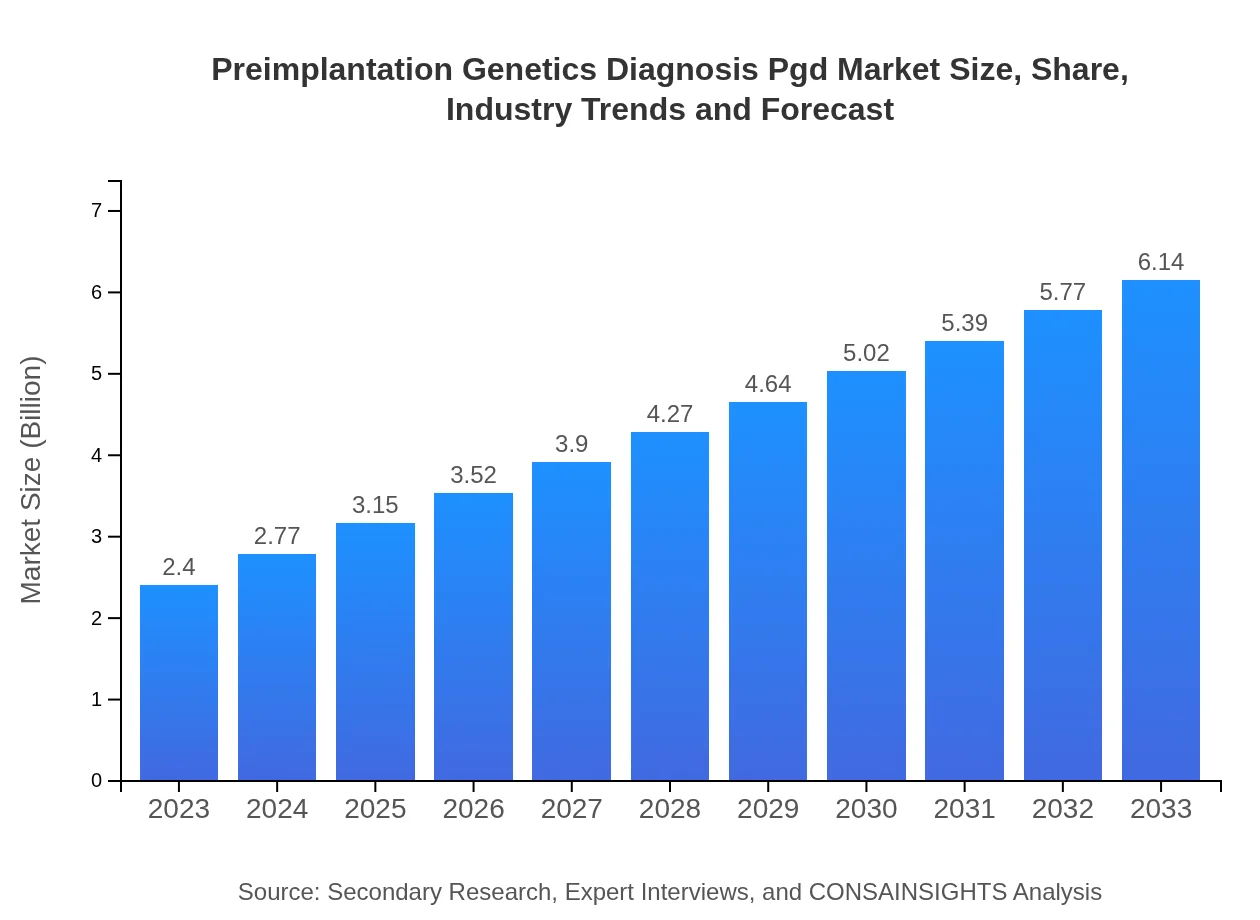
Preimplantation Genetics Diagnosis Pgd Market — USD 2.4 billion in 2023, Growing to USD 6.14B by 2033 at 9.5% CAGR
This report provides a comprehensive analysis of the Preimplantation Genetic Diagnosis (PGD) market, covering key insights, projections, and trends from 2023 to 2033. It explores the market dynamics, segmentation, regional performance, and the influence of technology in shaping the future of PGD.
Key Takeaways
- Global market value rises from $2.40 Billion in 2023 to $6.14 Billion in 2033 at a 9.5% CAGR.
- North America is largest regional market, while no single fastest-growing region is stated because regional CAGR differences remain within 0.15 percentage points.
- Europe expands from $0.62 Billion in 2023 to $1.59 Billion in 2033 while Asia Pacific grows from $0.47 Billion to $1.21 Billion.
- Leading participants include Illumina, Thermo Fisher Scientific, Natera, and Gene by Gene, reflecting strong industry consolidation and technology focus.
- Segment breadth spans test kits and services, multiple techniques (PCR, NGS, microarray) and end users such as hospitals and fertility clinics.
Preimplantation Genetics Diagnosis Pgd Market Report — Executive Summary
North America remains largest market by forecast-period value, while no single fastest-growing region is stated because top regional growth rates are separated by less than 0.15 percentage points. This report evaluates the market for preimplantation genetic diagnosis, noting a rise from $2.40 Billion in 2023 to $6.14 Billion in 2033 at a 9.5% CAGR. Growth is driven by wider adoption of sequencing and PCR-based workflows, increased fertility services, and greater awareness of genetic disease screening. The landscape is shaped by technology integration, partnerships, and investments from established firms including Illumina, Thermo Fisher Scientific, Natera, and Gene by Gene. Coverage includes product types (test kits, services), techniques (PCR, NGS, microarray), applications such as inherited disorder screening and cancer prediction, and end users like hospitals, fertility clinics, and research institutes. Regional breakdown highlights North America as the largest market and provides country-level trends where relevant. Regulatory evolution and diagnostic accuracy improvements are presented as ongoing influences on clinical adoption and market expansion.
Key Growth Drivers
- Wider clinical adoption of sequencing and PCR techniques improving diagnostic accuracy and throughput.
- Rising demand for fertility services and embryo screening to reduce inherited disease incidence.
- Ongoing investments and collaborations among established life‑sciences companies to expand test portfolios.
- Enhanced public awareness and acceptance of genetic diagnostics, supporting greater utilization of PGD services.
- Advances in bioinformatics and laboratory workflows that lower per-test time and increase scalability.
| Metric | Value |
|---|---|
| Study Period | 2023 - 2033 |
| 2023 Market Size | $2.40 Billion |
| CAGR (2023-2033) | 9.5% |
| 2033 Market Size | $6.14 Billion |
| Top Companies | Illumina, Thermo Fisher Scientific, Natera, Gene by Gene |
| Published Date | 21 October 2024 |
| Last Modified Date | 25 May 2026 |
Preimplantation Genetics Diagnosis Pgd Market Overview
Customize Preimplantation Genetics Diagnosis Pgd Market Report market research report
- ✔ Get in-depth analysis of Preimplantation Genetics Diagnosis Pgd market size, growth, and forecasts.
- ✔ Understand Preimplantation Genetics Diagnosis Pgd's regional dynamics and industry-specific trends.
- ✔ Identify potential applications, end-user demand, and growth segments in Preimplantation Genetics Diagnosis Pgd
What is the Market Size & CAGR of Preimplantation Genetics Diagnosis Pgd Market Report market in 2023?
Preimplantation Genetics Diagnosis Pgd Industry Analysis
Preimplantation Genetics Diagnosis Pgd Market Segmentation and Scope
Tell us your focus area and get a customized research report.
Preimplantation Genetics Diagnosis Pgd Market Report Market Analysis Report by Region
Europe Preimplantation Genetics Diagnosis Pgd Market Report:
Europe grows from $0.62 Billion in 2023 to $1.59 Billion in 2033. Growth is driven by rising awareness of genetic screening, regulatory advancements, and integration of sequencing and PCR-based diagnostics across clinical centers.Asia Pacific Preimplantation Genetics Diagnosis Pgd Market Report:
Asia Pacific grows from $0.47 Billion in 2023 to $1.21 Billion in 2033. Market development is underpinned by expanding fertility services, increased access to diagnostic technologies, and growing investment in life‑sciences capabilities.North America Preimplantation Genetics Diagnosis Pgd Market Report:
North America is largest regional market, rising from $0.85 Billion in 2023 to $2.18 Billion in 2033. Regional growth reflects high clinical adoption, established laboratory infrastructure, and investments by diagnostic firms and service providers.South America Preimplantation Genetics Diagnosis Pgd Market Report:
Latin America grows from $0.23 Billion in 2023 to $0.59 Billion in 2033. Demand is supported by broader availability of reproductive health services and gradual adoption of standardized genetic testing methodologies.Middle East & Africa Preimplantation Genetics Diagnosis Pgd Market Report:
Middle East and Africa grows from $0.22 Billion in 2023 to $0.57 Billion in 2033. Market momentum is linked to investments in healthcare infrastructure and gradual incorporation of advanced diagnostic techniques in specialized centers.Tell us your focus area and get a customized research report.
Research Methodology
Preimplantation Genetics Diagnosis Pgd Market Analysis By Technique
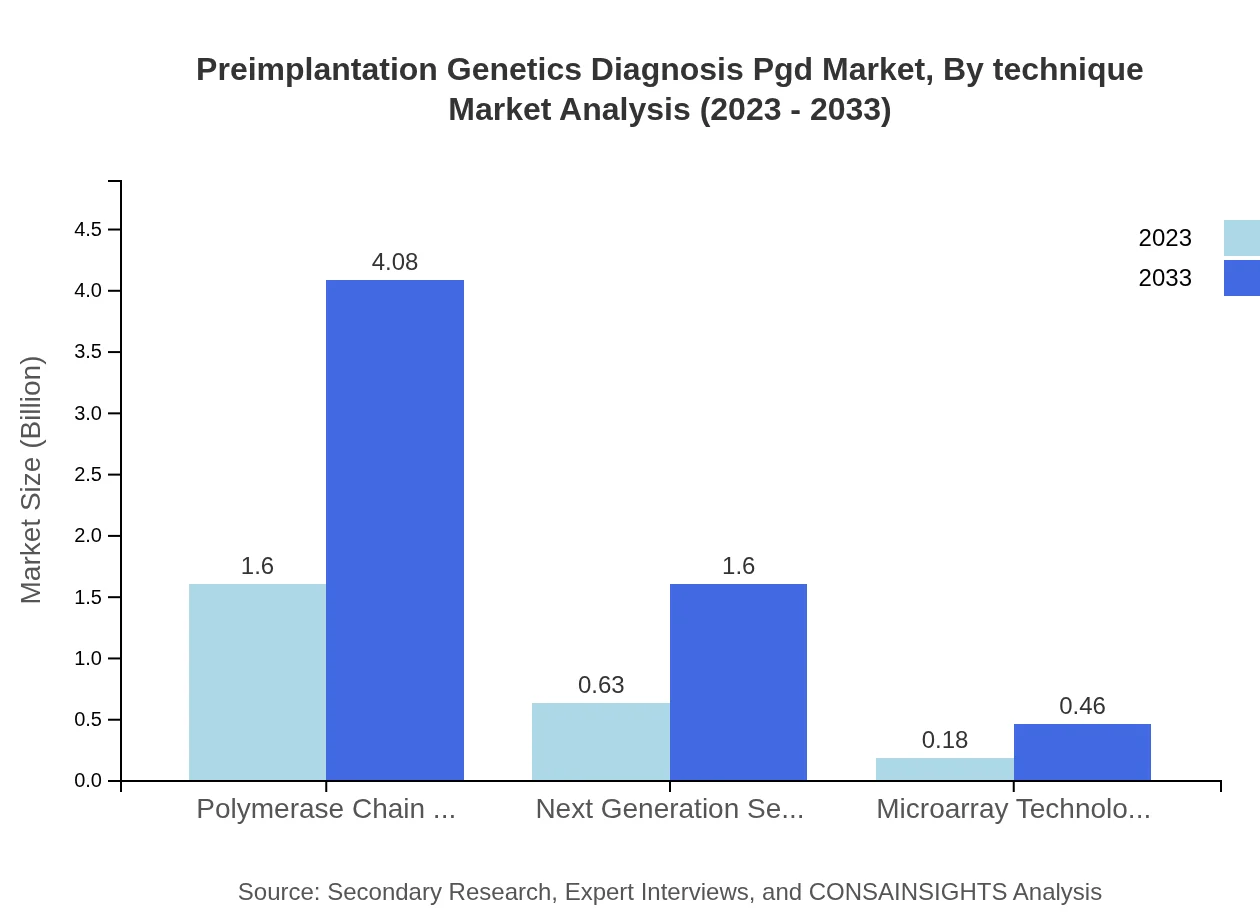
In 2023, the market share of the Polymerase Chain Reaction (PCR) method is estimated at $1.60 billion and is anticipated to grow to $4.08 billion by 2033, holding a consistent market share of approximately 66.47%. Next Generation Sequencing (NGS) generates $0.63 billion in 2023, expected to expand to $1.60 billion by 2033, maintaining a 26.09% share. Microarray Technology represents a smaller segment, valued at $0.18 billion in 2023 and projected to reach $0.46 billion by 2033 with a 7.44% share.
Preimplantation Genetics Diagnosis Pgd Market Analysis By Application
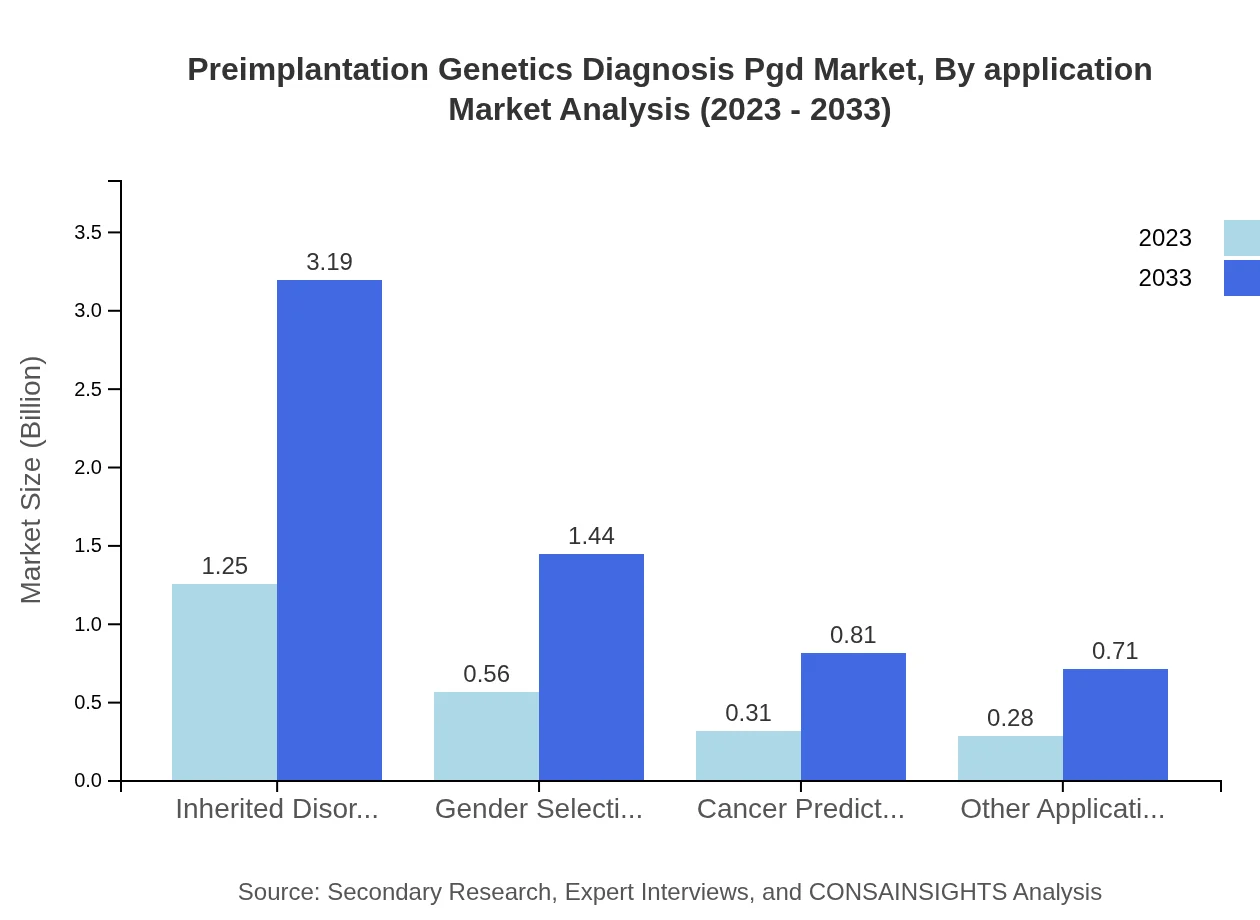
The applications of PGD are diversifying with Inherited Disorders projected to dominate at $1.25 billion (51.91% share) in 2023 and rise to $3.19 billion by 2033. Other segments include Gender Selection at $0.56 billion (23.4% share) in 2023, rising to $1.44 billion by 2033, followed by Cancer Prediction at $0.31 billion, expected to increase to $0.81 billion, holding a 13.12% share.
Preimplantation Genetics Diagnosis Pgd Market Analysis By Product Type
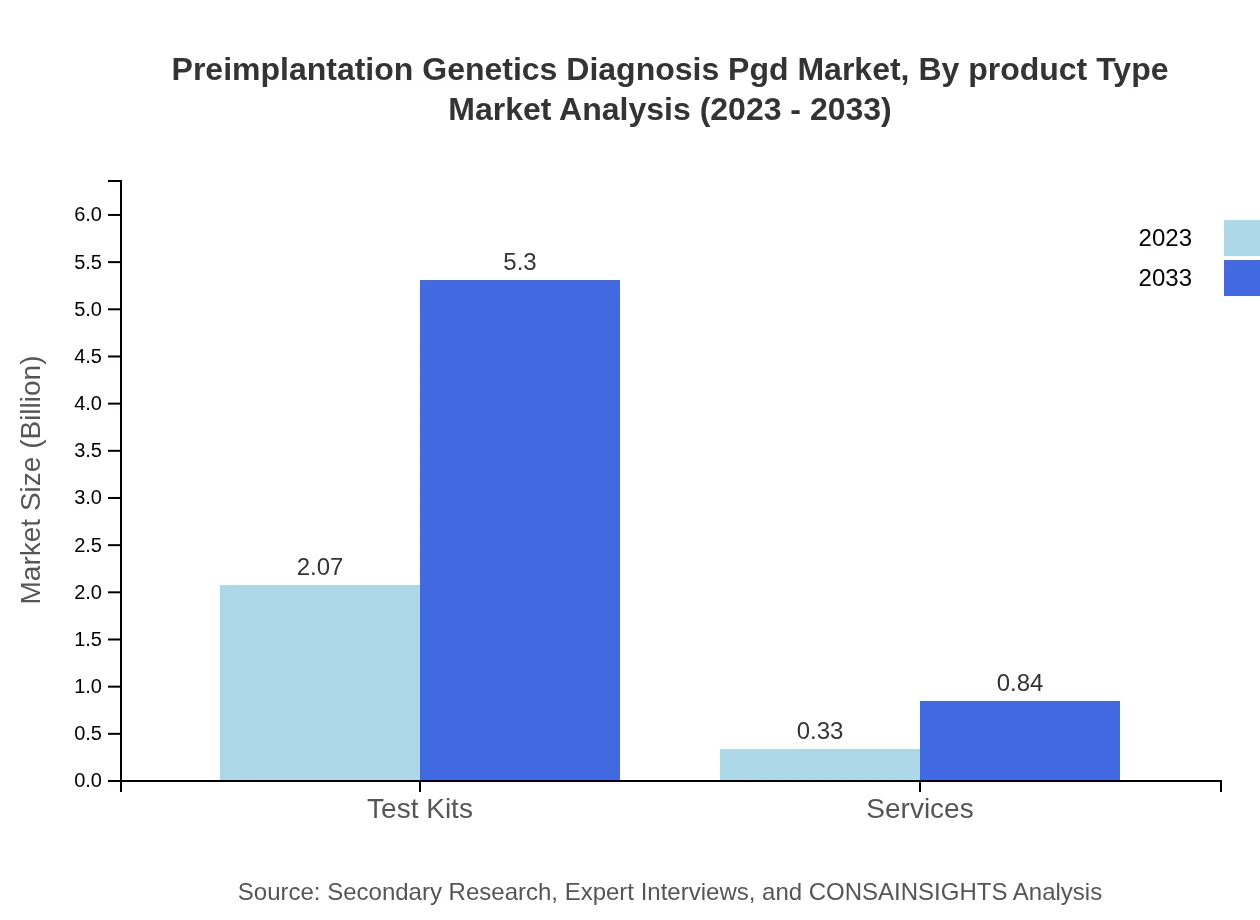
Test Kits dominate the market, expected to grow from $2.07 billion (86.28% share) in 2023 to $5.30 billion by 2033. Services, while smaller, are also growing from $0.33 billion (13.72% share) in 2023 to $0.84 billion by 2033, reflecting an expanding service-based industry in PGD.
Preimplantation Genetics Diagnosis Pgd Market Analysis By End User
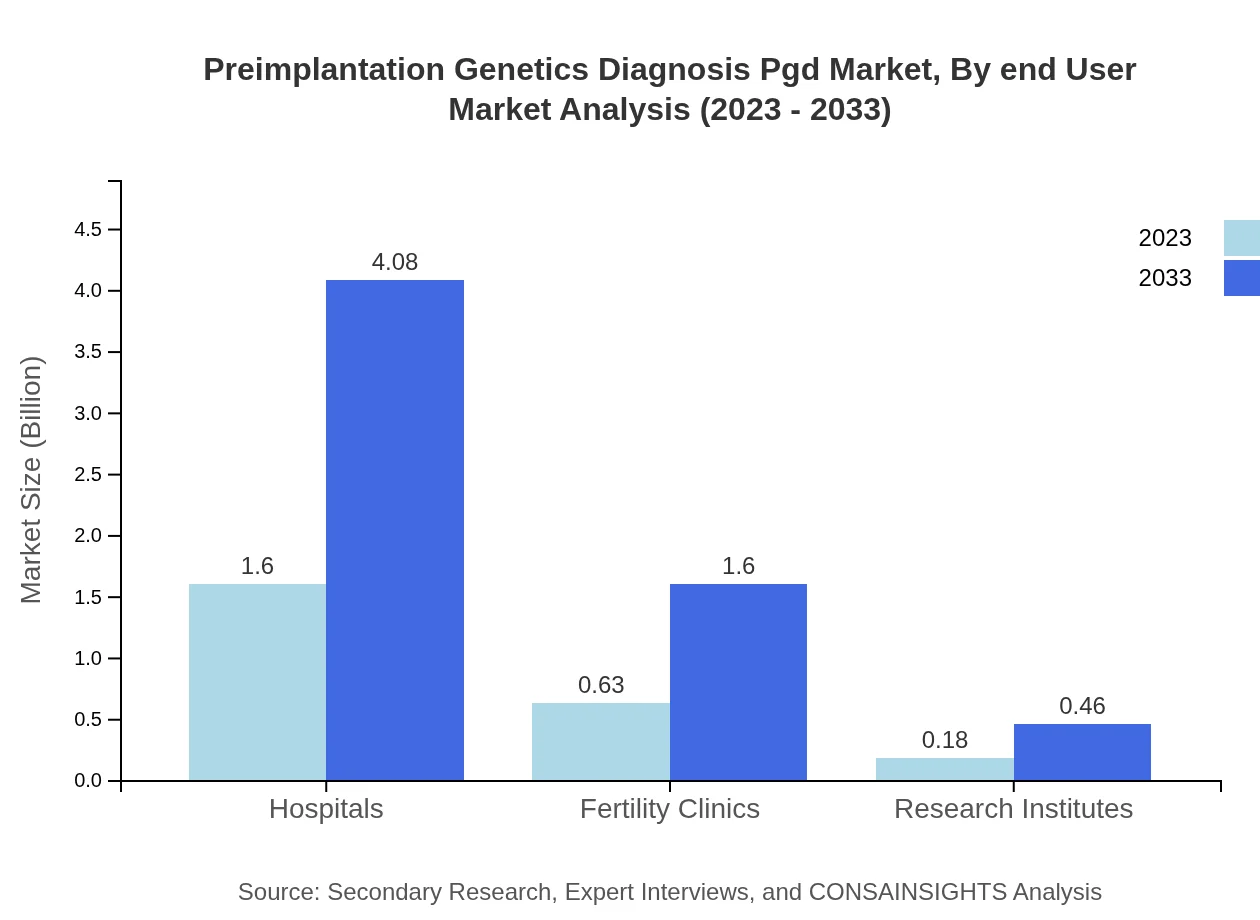
Hospitals lead the market with a significant share, projected to expand from $1.60 billion in 2023 to $4.08 billion by 2033, capturing a 66.47% market share. Fertility Clinics will grow from $0.63 billion (26.09% share) to $1.60 billion, signifying their increasing role in PGD. Research Institutes represent a smaller segment, moving from $0.18 billion to $0.46 billion, indicating a steady contribution to the industry from academic perspectives.
Preimplantation Genetics Diagnosis Pgd Market Trends and Future Forecast
Tell us your focus area and get a customized research report.
Global Market Leaders and Top Companies in Preimplantation Genetics Diagnosis Pgd Industry
Illumina:
Illumina is a leading developer of life science tools and integrated solutions for the analysis of genetic variation and function, advancing PGD methodologies through innovative sequencing platforms.Thermo Fisher Scientific:
Thermo Fisher Scientific provides a diverse range of PGD solutions, leveraging advanced PCR and NGS technologies to cater to hospitals and fertility clinics.Natera:
Natera specializes in genetic testing and reproductive health solutions, particularly recognized for its non-invasive genetic testing approaches that enhance PGD capabilities.Gene by Gene:
Gene by Gene is renowned for its comprehensive genetic testing services and laboratory expertise, contributing significantly to the PGD market.We're grateful to work with incredible clients.









FAQs
What is the market size in 2023?
The market size in 2023 is $2.40 Billion, based on the report’s base-year valuation and reported industry aggregation for that year.
How big will the market be in 2033?
The market is projected to reach $6.14 Billion by 2033 according to the forecast figures provided in the report.
What is CAGR for the forecast period?
The reported compound annual growth rate (CAGR) for the 2023 to 2033 forecast period is 9.5% as stated in the market data.
Is there a single fastest Growing region in the Preimplantation Genetics Diagnosis Pgd Market Report market?
No single fastest-growing region is stated for the Preimplantation Genetics Diagnosis Pgd Market Report market because the top regional implied CAGR values are within 0.15 percentage points of each other, making the ranking too close to call reliably.
Which companies lead the market?
Top companies noted in the report include Illumina, Thermo Fisher Scientific, Natera, and Gene by Gene as primary industry participants.
What are primary applications covered?
Key applications detailed are inherited disorder screening, gender selection, cancer prediction, and other clinical and research uses for embryo assessment.
Who are the main end users?
End users specified include hospitals, fertility clinics, and research institutes, reflecting clinical and research demand across settings.
How is the market segmented by technique?
Techniques reported include Polymerase Chain Reaction (PCR), Next Generation Sequencing (NGS), and microarray technology as the primary methodological segments.