
Reports >
Life Sciences
>
Vital Sign Monitoring Market Report

Vital Sign Monitoring Market Report
First published: 10 October 2024 | Last updated: 28 May 2026 | Report Code: vital-sign-monitoring
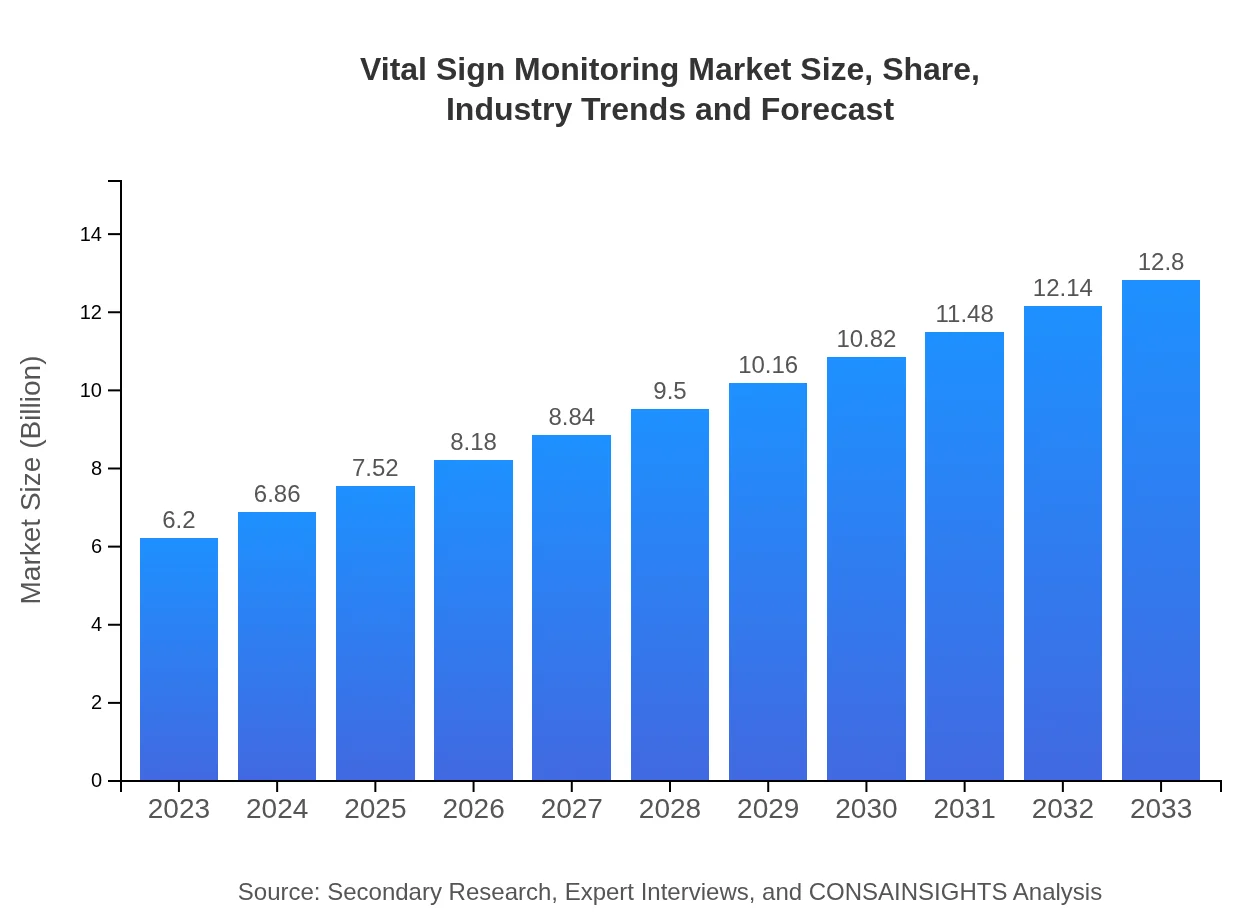
Vital Sign Monitoring Market — USD 6.2 billion in 2023, Growing to USD 12.80B by 2033 at 7.3% CAGR
This report explores the Vital Sign Monitoring market, evaluating size, growth rates, segmentation, regional insights, and trends from 2023 to 2033. It provides crucial data for stakeholders on market dynamics, technology trends, and leading companies.
Key Takeaways
- Global market projected to grow from $6.20 Billion in 2023 to $12.80 Billion in 2033 at a 7.3% CAGR.
- North America is largest regional market, while no single fastest-growing region is stated because regional CAGR differences remain within 0.15 percentage points.
- Europe and Asia Pacific show substantial absolute growth: Europe from $1.86 Billion to $3.85 Billion; Asia Pacific from $1.18 Billion to $2.43 Billion.
- Hospitals, homecare, and rehabilitation settings are highlighted end-user segments; monitoring and diagnostic devices are primary device categories.
- Key vendors include Philips Healthcare, Medtronic, Nihon Kohden and GE Healthcare, focusing on digital integration and product innovation.
Vital Sign Monitoring Market Report — Executive Summary
North America remains largest market by forecast-period value, while no single fastest-growing region is stated because top regional growth rates are separated by less than 0.15 percentage points. The report outlines market expansion driven by rising chronic disease prevalence, an ageing population, and wider adoption of remote monitoring and wearables. The global market value increases from $6.20 Billion in 2023 to $12.80 Billion in 2033 at a 7.3% CAGR for 2023 to 2033. Regional dynamics vary: North America remains the largest market. Product segmentation captures monitoring and diagnostic device types, multiple applications such as cardiac and respiratory monitoring, and technologies that include electronic and non-invasive solutions. Leading firms—Philips Healthcare, Medtronic, Nihon Kohden and GE Healthcare—are advancing connected platforms and interoperability. Ongoing trends include telehealth integration, EHR connectivity, and enhanced data analytics. The report synthesizes primary interviews, company publications and triangulated data to map market structure, adoption pathways, and near-term innovation priorities for stakeholders.
Key Growth Drivers
- Growing chronic disease burden and ageing demographics increasing demand for continuous vital sign observation.
- Expansion of telehealth and remote care models boosting adoption of home-based monitoring solutions.
- Proliferation of wearable and non-invasive technologies enabling continuous, patient-friendly data collection.
- Healthcare providers’ focus on preventive care and real-time clinical decision support driving procurement of integrated monitoring systems.
| Metric | Value |
|---|---|
| Study Period | 2023 - 2033 |
| 2023 Market Size | $6.20 Billion |
| CAGR (2023-2033) | 7.3% |
| 2033 Market Size | $12.80 Billion |
| Top Companies | Philips Healthcare, Medtronic , Nihon Kohden, GE Healthcare |
| Published Date | 10 October 2024 |
| Last Modified Date | 28 May 2026 |
Vital Sign Monitoring Market Overview
Customize Vital Sign Monitoring Market Report market research report
- ✔ Get in-depth analysis of Vital Sign Monitoring market size, growth, and forecasts.
- ✔ Understand Vital Sign Monitoring's regional dynamics and industry-specific trends.
- ✔ Identify potential applications, end-user demand, and growth segments in Vital Sign Monitoring
What is the Market Size & CAGR of Vital Sign Monitoring Market Report market in 2023?
Vital Sign Monitoring Industry Analysis
Vital Sign Monitoring Market Segmentation and Scope
Tell us your focus area and get a customized research report.
Vital Sign Monitoring Market Report Market Analysis Report by Region
Europe Vital Sign Monitoring Market Report:
Europe grows from $1.86 Billion in 2023 to $3.85 Billion in 2033. Expansion is driven by rising chronic illness burdens, integration of monitoring into care pathways, and increasing interest in remote patient management across public and private providers.Asia Pacific Vital Sign Monitoring Market Report:
Asia Pacific grows from $1.18 Billion in 2023 to $2.43 Billion in 2033. Market momentum reflects growing healthcare spending, rising demand for affordable monitoring devices, and expanding telehealth services in urban and peri-urban centers.North America Vital Sign Monitoring Market Report:
North America is largest regional market, rising from $2.23 Billion in 2023 to $4.59 Billion in 2033. Regional uptake is influenced by established healthcare infrastructure, strong investment in digital health, and provider adoption of connected monitoring solutions.South America Vital Sign Monitoring Market Report:
Latin America grows from $0.2 Billion in 2023 to $0.41 Billion in 2033. Growth factors include broader access to basic monitoring technologies, gradual enhancement of healthcare infrastructure, and increasing awareness of remote care options.Middle East & Africa Vital Sign Monitoring Market Report:
Middle East and Africa grows from $0.73 Billion in 2023 to $1.51 Billion in 2033. Regional progress is supported by targeted investments in healthcare systems, adoption of telemedicine platforms, and increased procurement of monitoring equipment.Tell us your focus area and get a customized research report.
Research Methodology
Vital Sign Monitoring Market Analysis By End User
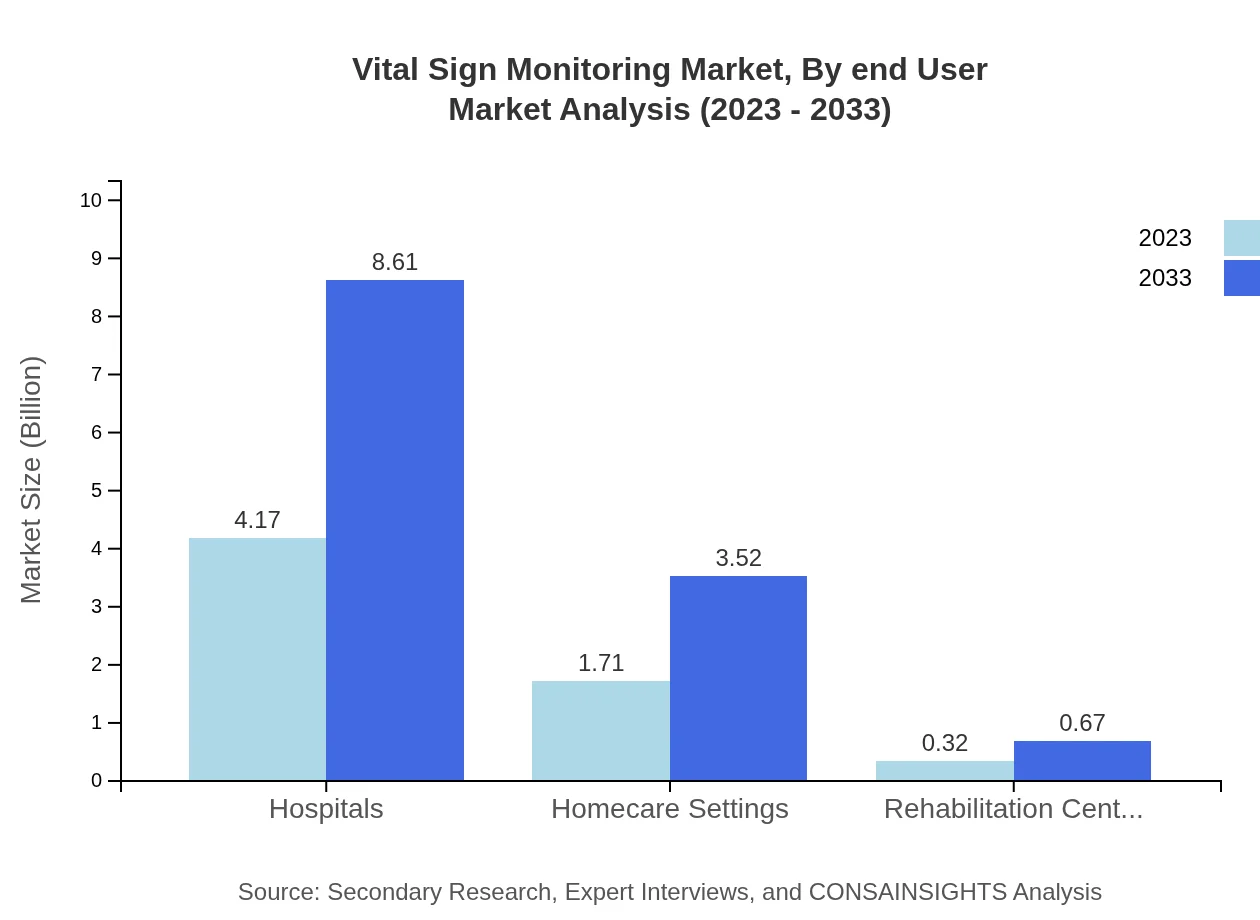
The segmentation reveals hospitals as the primary end-user, with a market size increasing from $4.17 billion in 2023 to $8.61 billion in 2033, maintaining a share of 67.25%. Homecare settings are also significant, showcasing a rise from $1.71 billion to $3.52 billion, representing a share of 27.52%. Rehabilitation centers hold a smaller share, growing from $0.32 billion to $0.67 billion, illustrating the diverse applications of vital sign monitoring devices.
Vital Sign Monitoring Market Analysis By Device Type
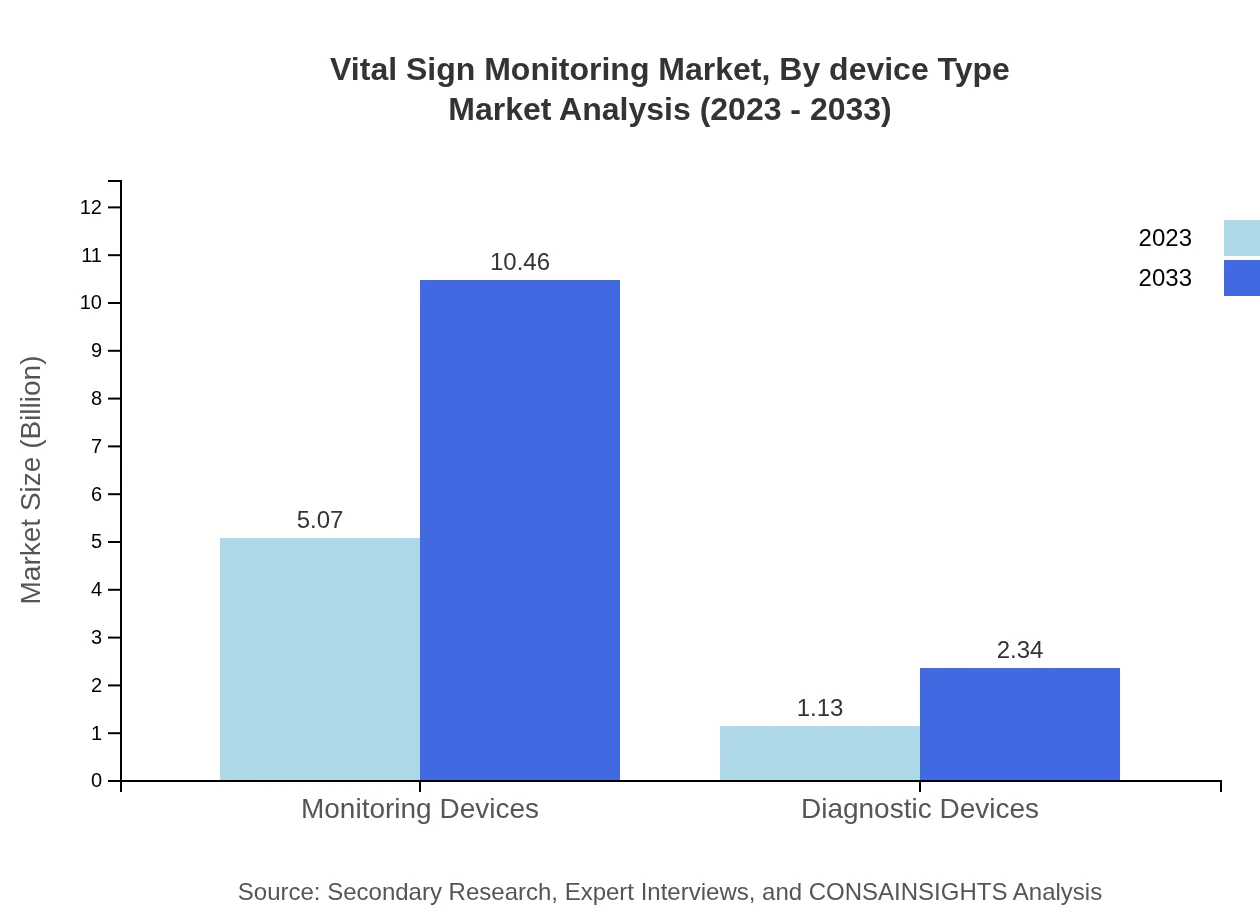
Monitoring Devices dominate the segment, expected to expand from $5.07 billion in 2023 to $10.46 billion by 2033, constituting approximately 81.71% of the overall market. Diagnostic Devices, while smaller, foresee growth from $1.13 billion to $2.34 billion, capturing 18.29% share, indicating a steady demand for both primary and advanced diagnostic capabilities.
Vital Sign Monitoring Market Analysis By Technology
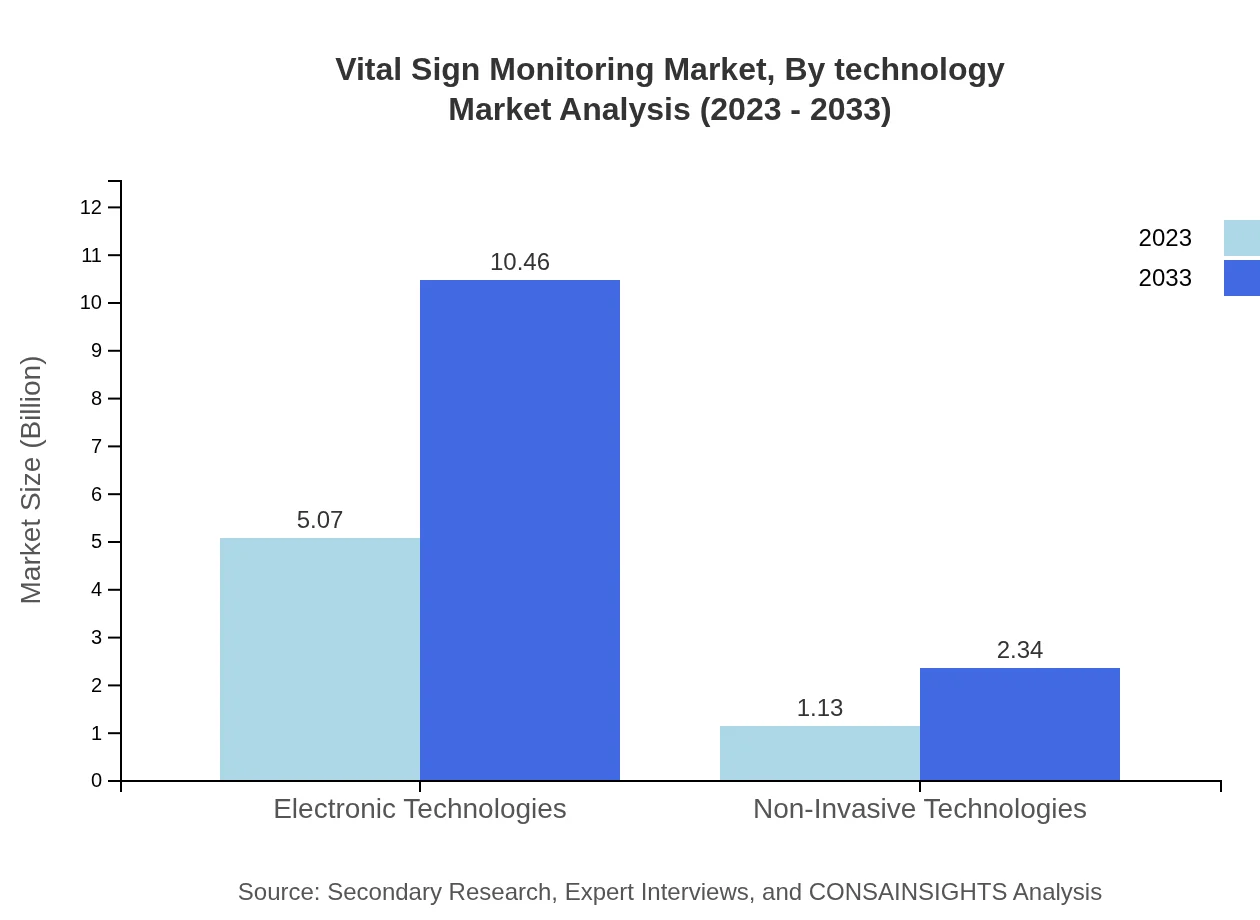
Electronic Technologies lead the technology segment, escalating from $5.07 billion to $10.46 billion, maintaining an 81.71% market share. Non-Invasive Technologies show a growing inclination, expected to expand from $1.13 billion to $2.34 billion, illustrating evolving consumer preferences for less intrusive health monitoring options.
Vital Sign Monitoring Market Analysis By Application
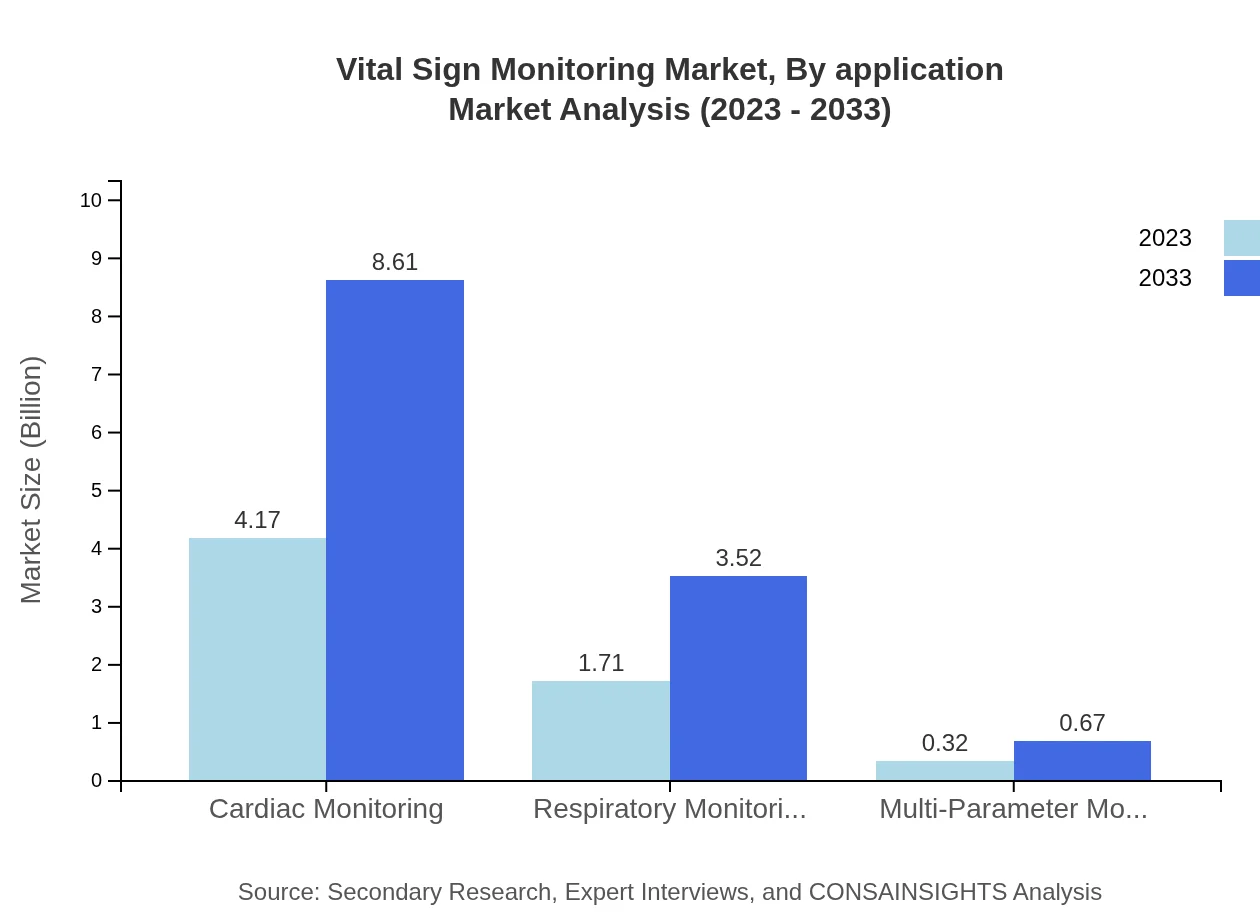
The application segment is largely driven by cardiac monitoring, projected to grow significantly from $4.17 billion in 2023 to $8.61 billion by 2033, thereby holding a steady 67.25% market share. Respiratory monitoring follows, rising from $1.71 billion to $3.52 billion, indicating strong growth in applications related to chronic respiratory diseases.
Vital Sign Monitoring Market Trends and Future Forecast
Tell us your focus area and get a customized research report.
Global Market Leaders and Top Companies in Vital Sign Monitoring Industry
Philips Healthcare:
Philips Healthcare offers a comprehensive portfolio in vital sign monitoring with a focus on advanced digital technology for health improvement and management.Medtronic :
Medtronic provides a broad range of monitoring devices, emphasizing on cardiac care and diabetes management, enhancing patient outcomes through robust monitoring systems.Nihon Kohden:
Nihon Kohden leads in the development of medical devices including advanced multi-parameter monitoring systems, catering to diverse healthcare needs globally.GE Healthcare:
GE Healthcare delivers innovative monitoring systems that enhance patient safety and facilitate real-time health data management in clinical environments.We're grateful to work with incredible clients.









FAQs
What is the market size of the Vital Sign Monitoring Market Report?
The market size is $6.20 Billion in 2023 and is projected to reach $12.80 Billion by 2033, based on the provided forecast period of 2023 to 2033.
How big is the market expected to grow by 2033?
The market is expected to grow to $12.80 Billion by 2033 from $6.20 Billion in 2023, reflecting the specified expansion over the 2023 to 2033 forecast period.
What is CAGR of the market for 2023 to 2033?
The compounded annual growth rate provided for the forecast period 2023 to 2033 is 7.3%, as stated in the input dataset.
Is there a single fastest Growing region in the Vital Sign Monitoring Market Report market?
No single fastest-growing region is stated for the Vital Sign Monitoring Market Report market because the top regional implied CAGR values are within 0.15 percentage points of each other, making the ranking too close to call reliably.
Which companies lead the market?
Top companies listed are Philips Healthcare, Medtronic, Nihon Kohden and GE Healthcare, noted for product innovation and platform integration in vital sign monitoring.
What are the main application segments?
Primary application segments include cardiac monitoring, respiratory monitoring and multi-parameter monitoring, as specified among the provided sub-segment entries.
Who are the key end Users for these solutions?
End-user sub-segments include hospitals, homecare settings and rehabilitation centers, reflecting typical deployment environments for monitoring solutions.
How is technology categorized in the report?
Technology segmentation in the input lists electronic technologies and non-invasive technologies as primary categories for device platforms and solutions.
What device types are covered?
Device-type segmentation includes monitoring devices and diagnostic devices, as specified in the provided sub-segment information.
Why is telehealth mentioned as a driver?
Telehealth expansion is cited as a market catalyst in the contextual input, supporting remote monitoring uptake and integration with clinical workflows.