
Reports >
Life Sciences
>
Walking Assist Devices Market Report

Walking Assist Devices Market Report
First published: 11 October 2024 | Last updated: 28 May 2026 | Report Code: walking-assist-devices
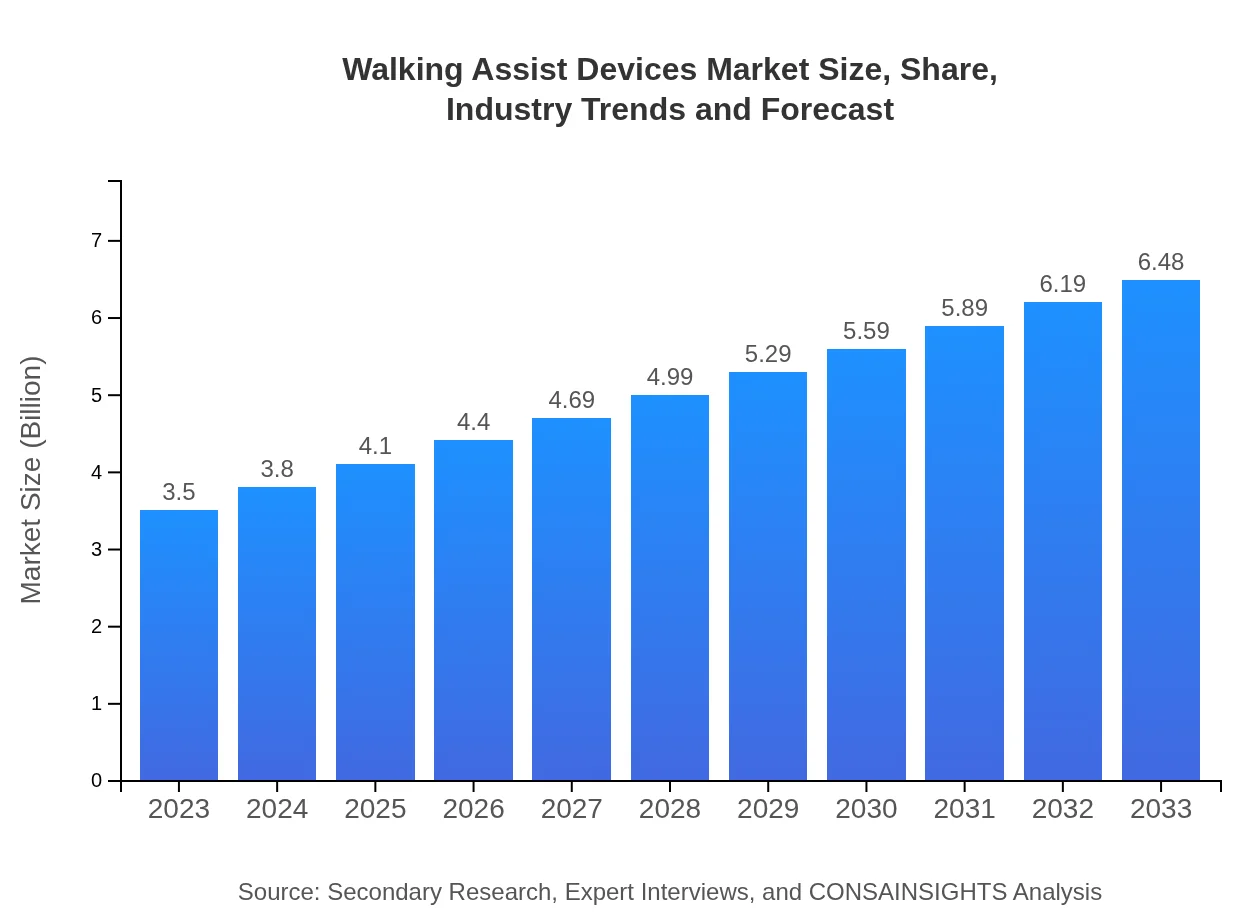
Walking Assist Devices Market — USD $3.5 Billion in 2023, Growing to USD 6.48null by 2033 at 6.2% CAGR
This report presents an in-depth analysis of the Walking Assist Devices market, highlighting current trends, growth factors, and forecasts from 2023 to 2033. It provides detailed insights into market size, segmentation, regional analysis, and key players, offering a comprehensive overview for stakeholders and investors.
Key Takeaways
- Global market value is $3.50 Billion in 2023, projected to reach $6.48 Billion by 2033.
- North America is largest regional market, while no single fastest-growing region is stated because regional CAGR differences remain within 0.15 percentage points.
- The market expands at a 6.2% CAGR during the 2023 to 2033 forecast period.
- North America registers the highest regional value, rising from $1.18 Billion in 2023 to $2.2 Billion in 2033.
- Europe grows from $1.16 Billion to $2.15 Billion between 2023 and 2033, reflecting sustained demand.
- Top manufacturers include Invacare Corporation, Drive DeVilbiss Healthcare, Medline Industries, Inc., and Graham-Field Health Products, Inc.
Walking Assist Devices Market Report — Executive Summary
North America remains largest market by forecast-period value, while no single fastest-growing region is stated because top regional growth rates are separated by less than 0.15 percentage points. The Walking Assist Devices market is on a steady expansion path, driven by demographic shifts, increasing mobility impairment prevalence, and greater adoption of assistive solutions. Valued at $3.50 Billion in 2023, the sector is forecast to reach $6.48 Billion by 2033 at a 6.2% CAGR. Product breadth spans canes, walkers and wheelchairs, with material choices such as aluminum, plastic and steel influencing design and cost. Distribution mixes include online and offline channels, and end users comprise healthcare providers, institutions and individuals. Regional performance highlights North America leading in absolute value, with significant contributions from Europe and Asia Pacific. Competitive activity centers on portfolio enhancements and channels expansion, with notable players such as Invacare Corporation, Drive DeVilbiss Healthcare, Medline Industries, Inc. and Graham-Field Health Products, Inc. Research and development aimed at comfort, customization and connectivity are shaping product evolution, while regulatory and affordability considerations remain relevant constraints.
Key Growth Drivers
- Aging populations increasing demand for mobility assistance and long-term care solutions.
- Rising prevalence of mobility-impairing conditions and disabilities that prompt device adoption.
- Product innovation focusing on ergonomic design and material improvements such as aluminum and plastic frames.
- Expanded availability via online and offline distribution channels improving market accessibility.
- Institutional procurement by healthcare providers and rehabilitation centers supporting steady volume growth.
| Metric | Value |
|---|---|
| Study Period | 2023 - 2033 |
| 2023 Market Size | $3.50 Billion |
| CAGR (2023-2033) | 6.2% |
| 2033 Market Size | $6.48 Billion |
| Top Companies | Invacare Corporation, Drive DeVilbiss Healthcare, Medline Industries, Inc., Graham-Field Health Products, Inc. |
| Published Date | 11 October 2024 |
| Last Modified Date | 28 May 2026 |
Walking Assist Devices Market Overview
Customize Walking Assist Devices Market Report market research report
- ✔ Get in-depth analysis of Walking Assist Devices market size, growth, and forecasts.
- ✔ Understand Walking Assist Devices's regional dynamics and industry-specific trends.
- ✔ Identify potential applications, end-user demand, and growth segments in Walking Assist Devices
What is the Market Size & CAGR of Walking Assist Devices Market Report market in 2023?
Walking Assist Devices Industry Analysis
Walking Assist Devices Market Segmentation and Scope
Tell us your focus area and get a customized research report.
Walking Assist Devices Market Report Market Analysis Report by Region
Europe Walking Assist Devices Market Report:
Europe grows from $1.16 Billion in 2023 to $2.15 Billion in 2033. Growth in the region is supported by aging demographics, healthcare provider adoption and an emphasis on products that enhance independence and rehabilitation outcomes.Asia Pacific Walking Assist Devices Market Report:
Asia Pacific grows from $0.65 Billion in 2023 to $1.2 Billion in 2033. Market expansion is driven by increasing awareness of mobility solutions, larger patient populations needing assistive devices, and broader distribution reach.North America Walking Assist Devices Market Report:
North America is largest regional market, rising from $1.18 Billion in 2023 to $2.2 Billion in 2033. Regional demand reflects established healthcare infrastructure, institutional procurement by providers, and sustained consumer uptake of mobility aids.South America Walking Assist Devices Market Report:
Latin America grows from $0.18 Billion in 2023 to $0.33 Billion in 2033. Regional growth reflects gradual increases in accessibility to assistive products, institutional purchases, and rising recognition of mobility-related healthcare needs.Middle East & Africa Walking Assist Devices Market Report:
Middle East and Africa grows from $0.33 Billion in 2023 to $0.61 Billion in 2033. Demand in this region is influenced by growing healthcare services, improved availability of assistive devices and initiatives to address mobility impairments.Tell us your focus area and get a customized research report.
Research Methodology
Walking Assist Devices Market Analysis By Device Type
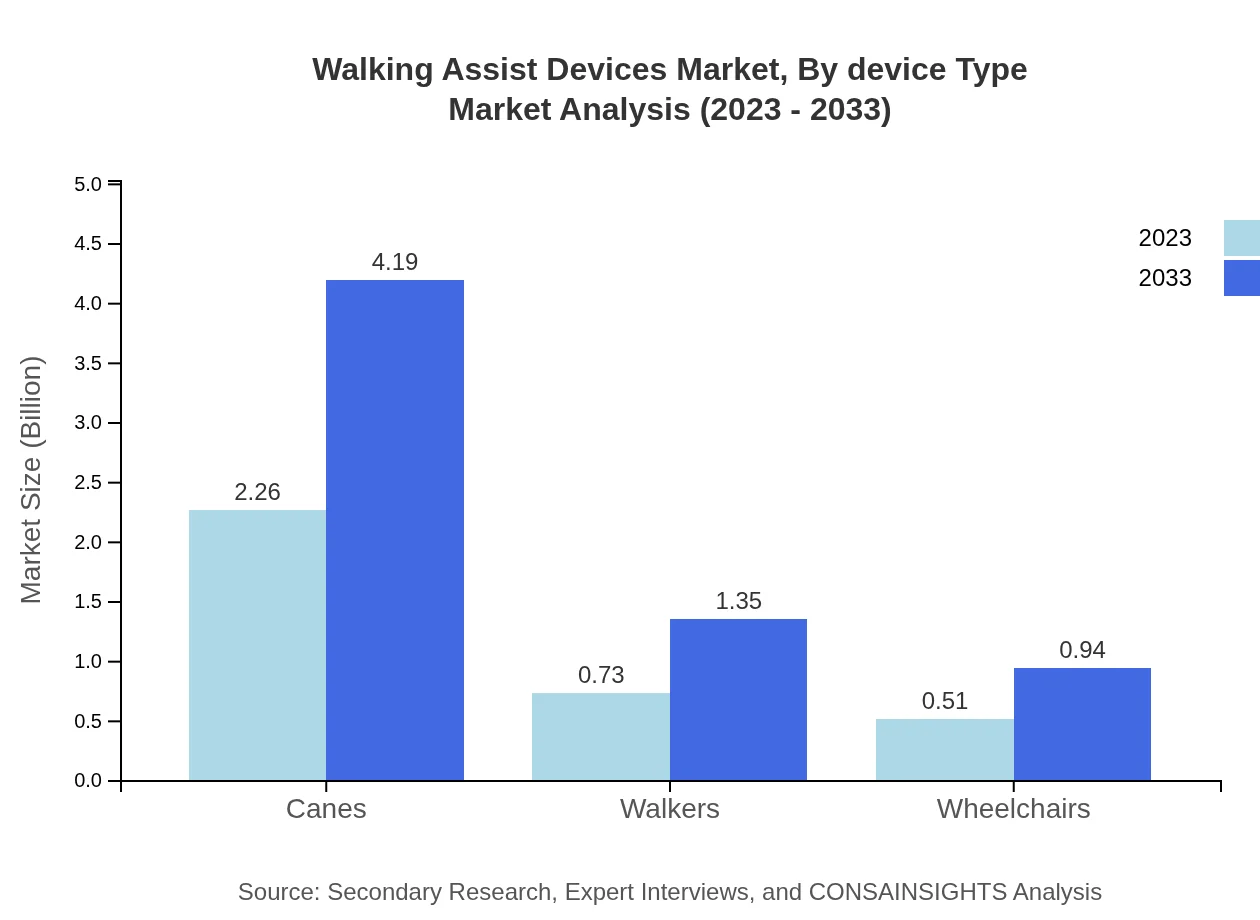
The Walking Assist Devices market is segmented by device type, which includes canes, walkers, and wheelchairs. Canes dominate the market, estimated at $2.26 billion in 2023, expected to double to $4.19 billion by 2033. Walkers and wheelchairs follow, with values of $0.73 billion and $0.51 billion in 2023, projected to reach $1.35 billion and $0.94 billion respectively by 2033.
Walking Assist Devices Market Analysis By User Type
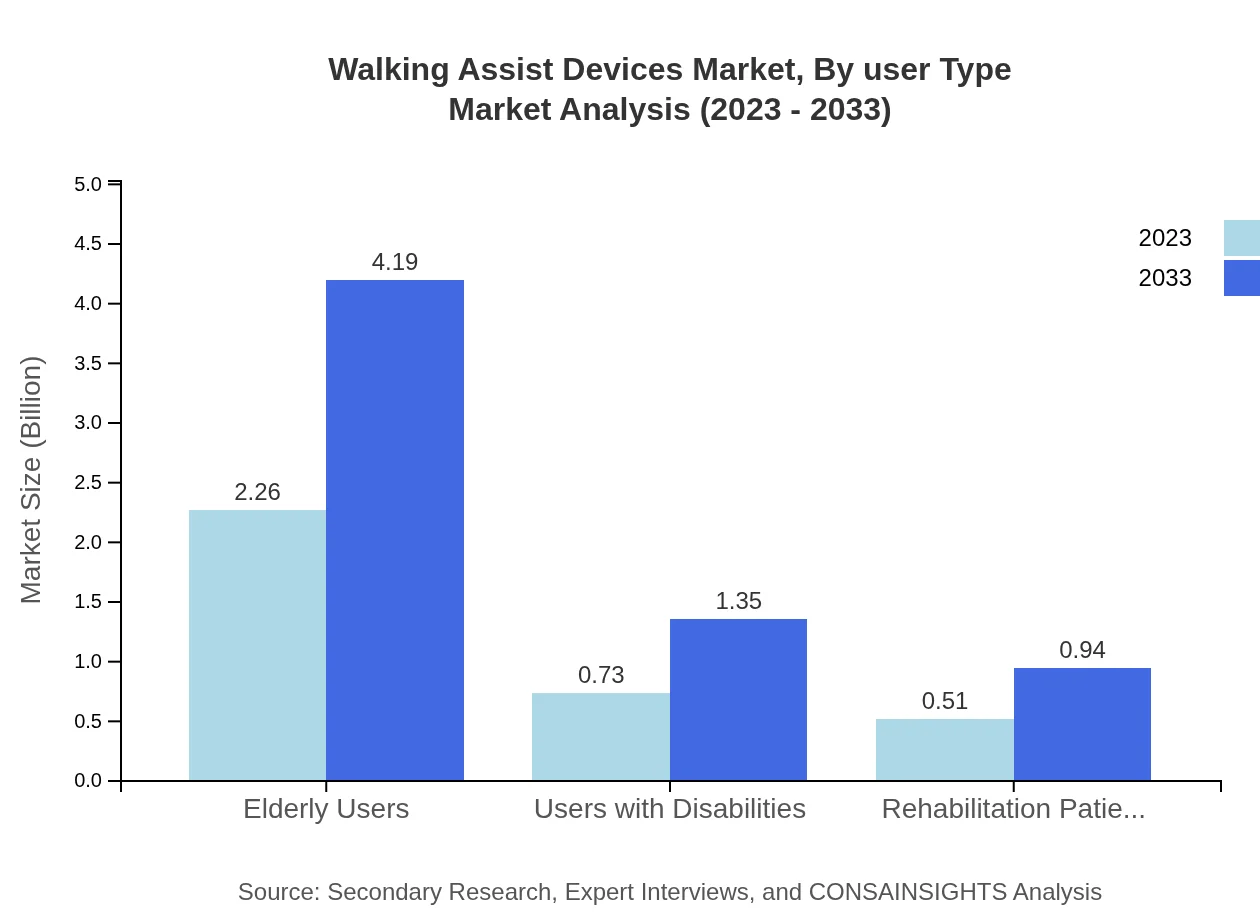
This segment highlights different user types: elderly users, users with disabilities, and rehabilitation patients. Elderly users represent the largest market share with a size of $2.26 billion in 2023, expected to grow to $4.19 billion by 2033. Users with disabilities and rehabilitation patients also show promising growth, rising from $0.73 billion to $1.35 billion and from $0.51 billion to $0.94 billion respectively during the same period.
Walking Assist Devices Market Analysis By Raw Material
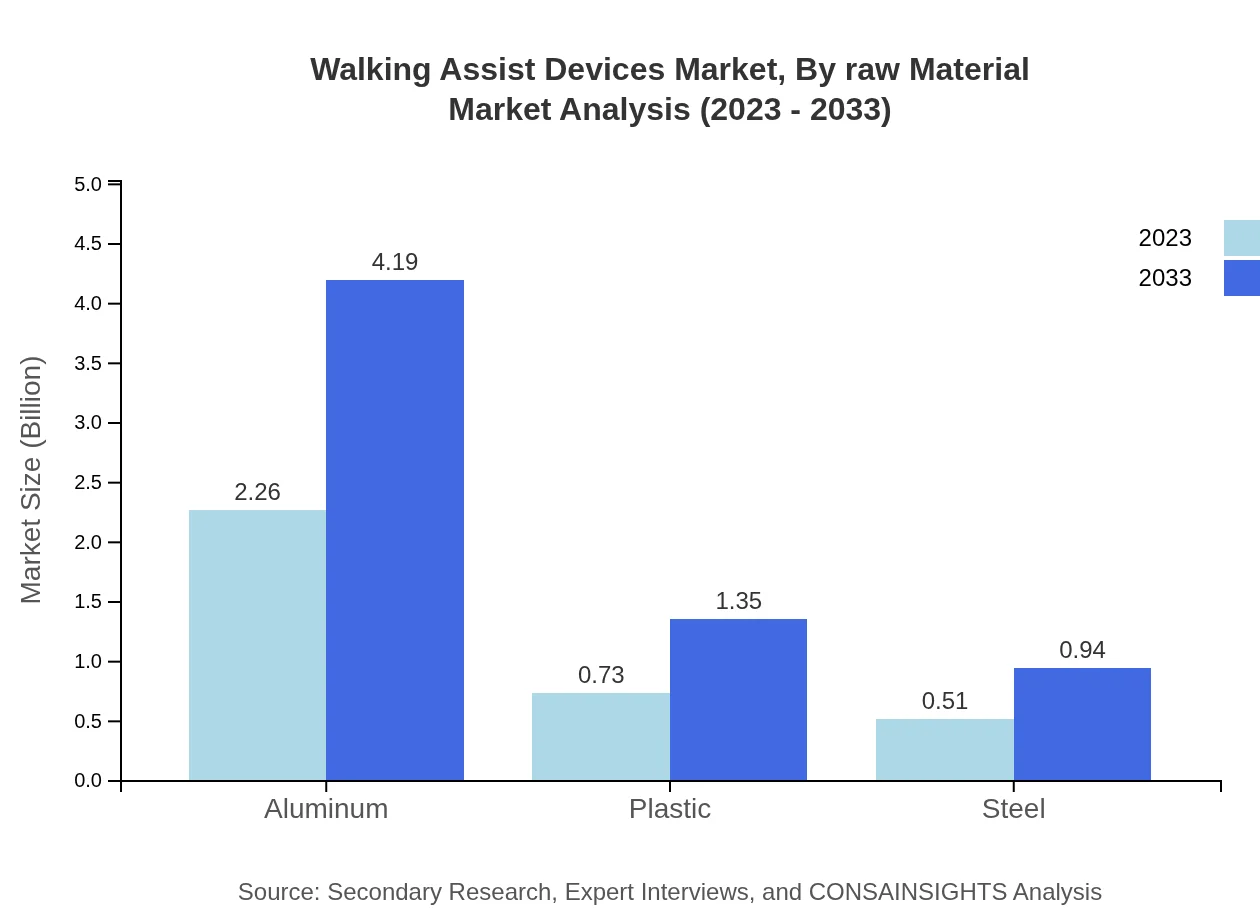
In terms of raw materials, the market includes aluminum, plastic, and steel. Aluminum-based devices lead the market with $2.26 billion in 2023, projected to reach $4.19 billion by 2033. Plastic and steel devices are also significant, with current sizes of $0.73 billion and $0.51 billion, expected to grow to $1.35 billion and $0.94 billion respectively over the forecast period.
Walking Assist Devices Market Analysis By Distribution Channel
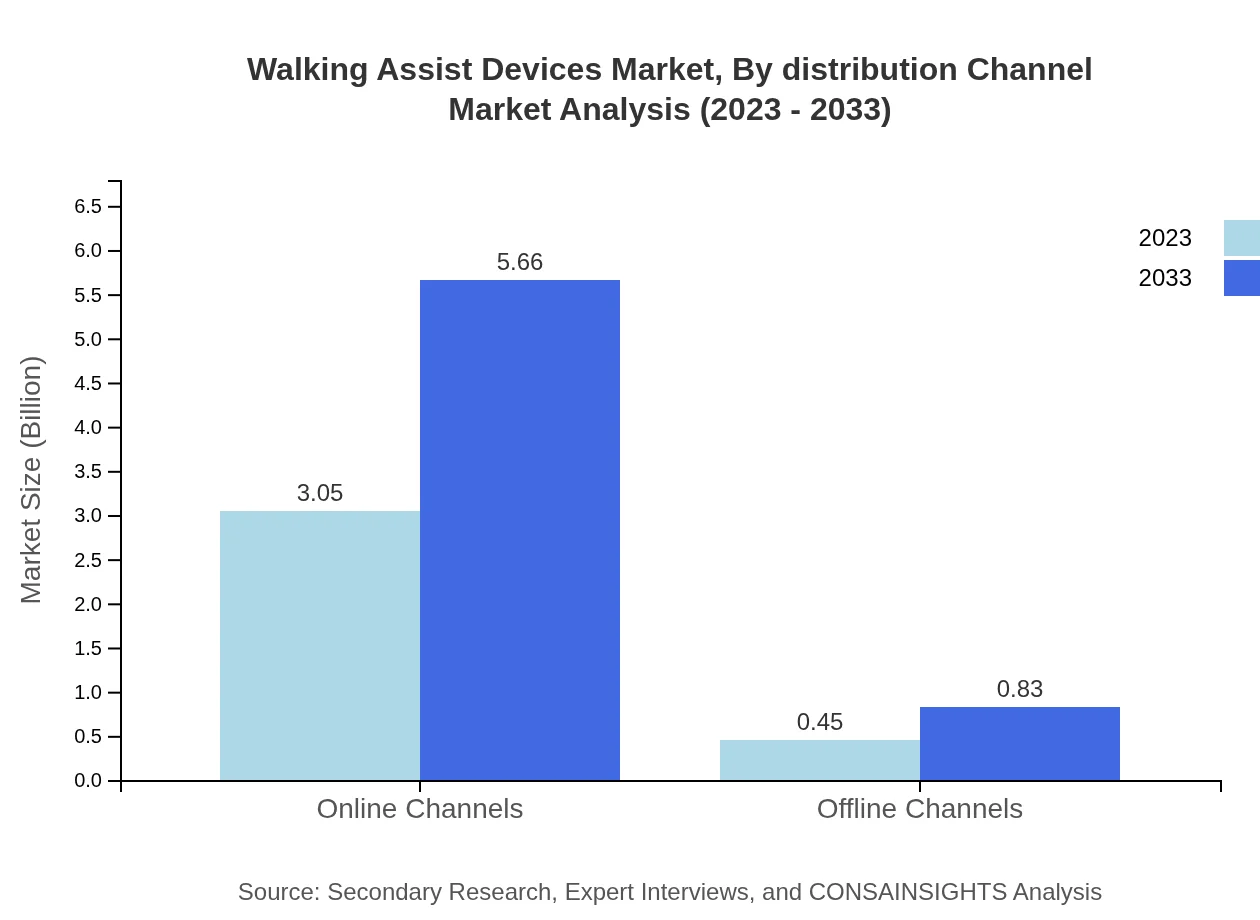
The distribution channels encompass online and offline sales. Online channels dominate with a market value of $3.05 billion in 2023, likely increasing to $5.66 billion by 2033 due to the growing trend of digital commerce. Offline channels show slower growth, from $0.45 billion to $0.83 billion, highlighting the shift towards e-commerce.
Walking Assist Devices Market Analysis By End User
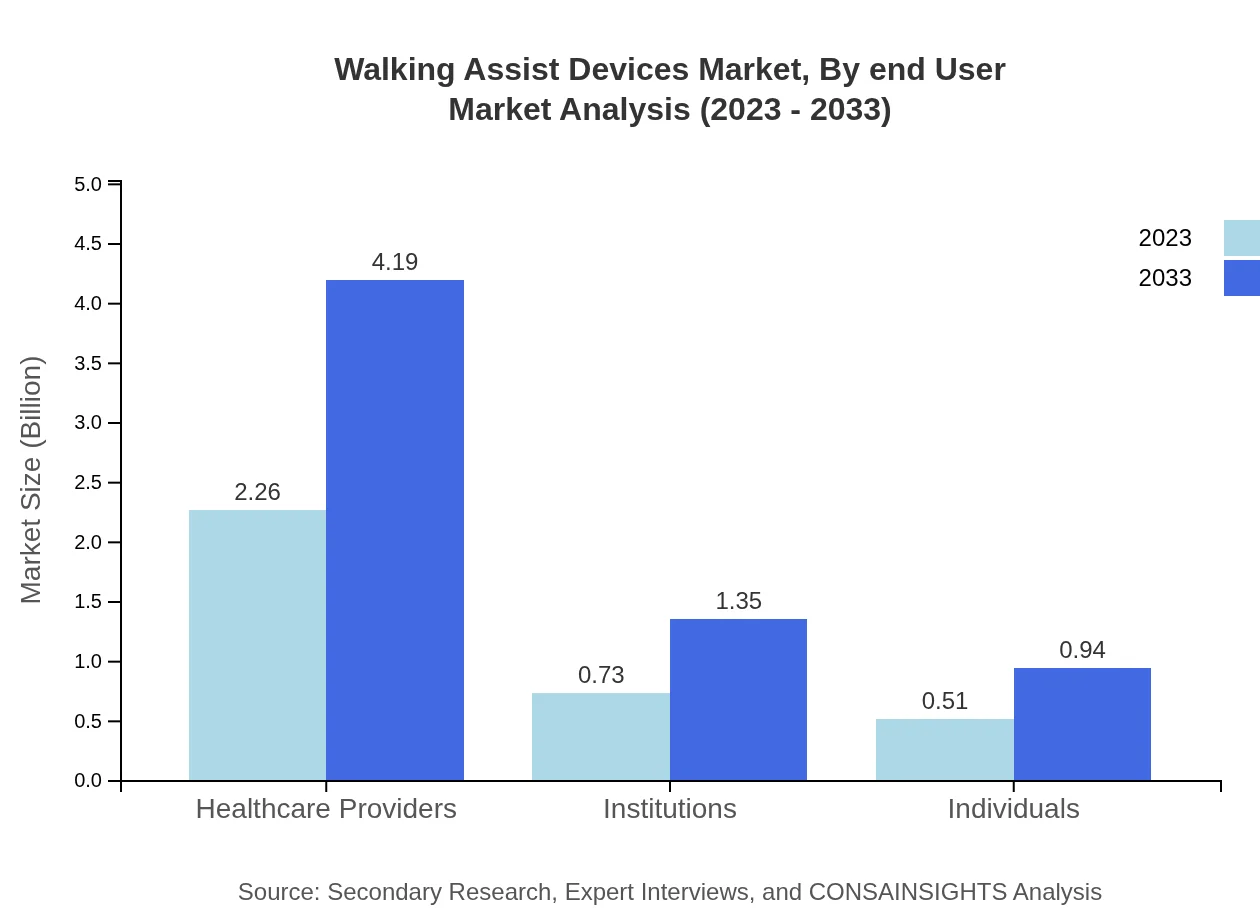
End-user segments include healthcare providers, institutions, and individuals. Healthcare providers hold the largest share, valued at $2.26 billion in 2023, expected to rise to $4.19 billion by 2033. Institutions and individuals follow with significant shares of $0.73 billion and $0.51 billion respectively, reflecting the diverse applications of walking assist devices in healthcare settings.
Walking Assist Devices Market Trends and Future Forecast
Tell us your focus area and get a customized research report.
Global Market Leaders and Top Companies in Walking Assist Devices Industry
Invacare Corporation:
A prominent manufacturer of durable medical equipment, Invacare specializes in mobility solutions including wheelchairs and walkers, addressing the needs of the elderly and disabled.Drive DeVilbiss Healthcare:
Drive DeVilbiss Healthcare offers a wide array of mobility aids, including walking frames and canes, recognized for their innovation and quality.Medline Industries, Inc.:
Medline designs and supplies an extensive range of healthcare products including walking assist devices, ensuring high standards and regulatory compliance.Graham-Field Health Products, Inc.:
Known for its diverse product portfolio, Graham-Field produces mobility aids that enhance the quality of life for patients with mobility impairments.We're grateful to work with incredible clients.









FAQs
What is the market size of the Walking Assist Devices Market Report in 2023?
The market size in 2023 is $3.50 Billion according to the report's baseline valuation for the forecast period 2023 to 2033.
How big will the market be in 2033?
By 2033 the market is projected to reach $6.48 Billion as specified for the 2023 to 2033 forecast horizon.
What is CAGR of the market for 2023 to 2033?
The report states a compound annual growth rate (CAGR) of 6.2% for the forecast period 2023 to 2033.
Is there a single fastest Growing region in the Walking Assist Devices Market Report market?
No single fastest-growing region is stated for the Walking Assist Devices Market Report market because the top regional implied CAGR values are within 0.15 percentage points of each other, making the ranking too close to call reliably.
Which companies are named as top participants?
Top companies listed include Invacare Corporation, Drive DeVilbiss Healthcare, Medline Industries, Inc., and Graham-Field Health Products, Inc.
What are common device types included in the market?
Device categories specified are canes, walkers and wheelchairs, each reflected in the market segmentation data.
Who are the primary end users of walking assist devices?
End-user segments include healthcare providers, institutions and individuals, as set out in the report's segmentation details.
How are products distributed in this market?
Distribution channels identified comprise online channels and offline channels, indicating a mixed retail and institutional approach.
What raw materials are cited for device construction?
Raw materials listed in the segmentation include aluminum, plastic and steel for device manufacturing.
What drives innovation in walking assist devices?
Innovation is propelled by ergonomic design needs, material selection, and demand for user-friendly features tailored to mobility challenges.