
Reports >
Life Sciences
>
Wound Care Management Market Report

Wound Care Management Market Report
First published: 07 October 2024 | Last updated: 28 May 2026 | Report Code: wound-care-management
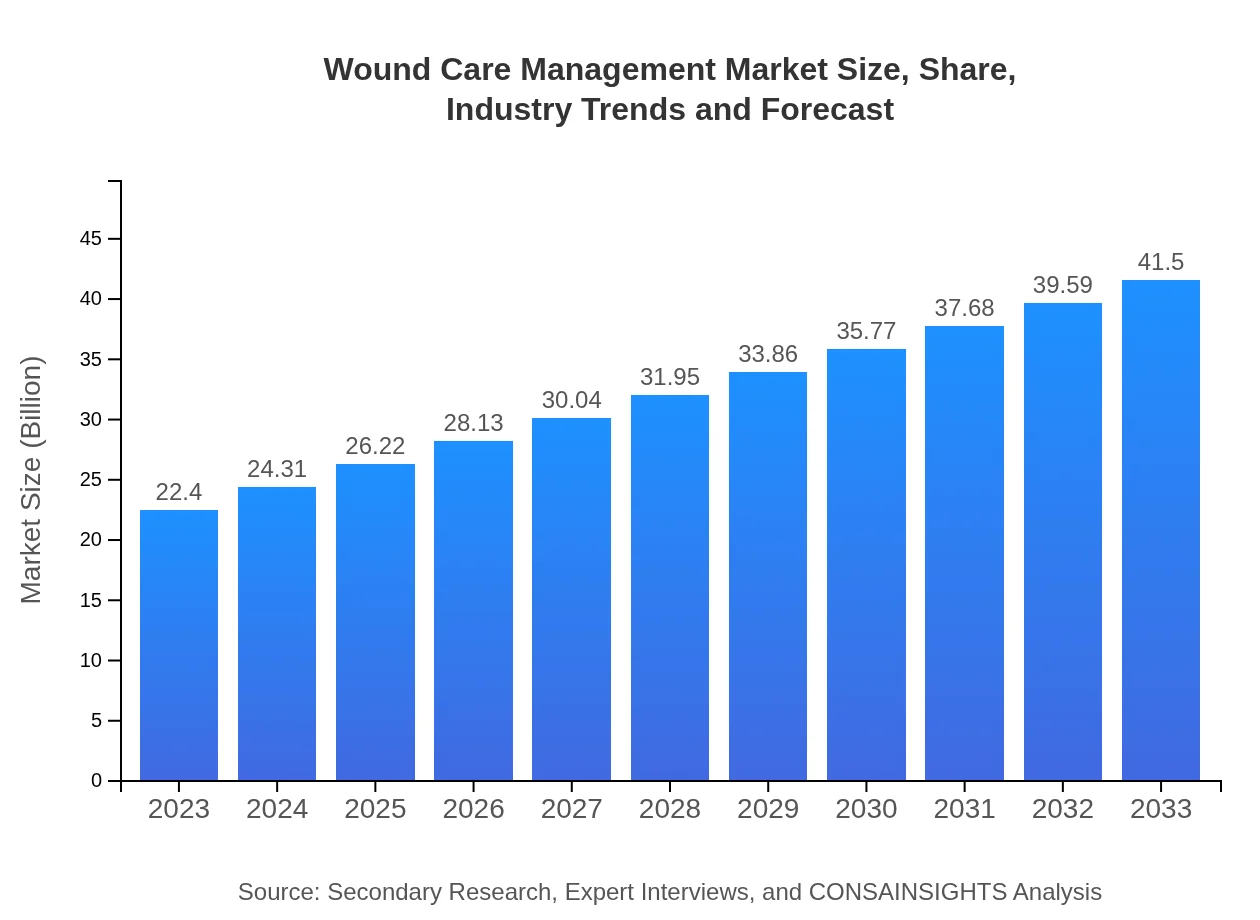
Wound Care Management Market — USD 22.4 billion in 2023, Growing to USD 41.50B by 2033 at 6.2% CAGR
This report provides an extensive analysis of the wound care management market, covering key insights, market size, and forecasts for the period from 2023 to 2033, including discussions on trends, regional breakdowns, and competitive landscape.
Key Takeaways
- Global market expands from $22.40 Billion in 2023 to $41.50 Billion in 2033 at a 6.2% CAGR.
- North America is largest regional market, while no single fastest-growing region is stated because regional CAGR differences remain within 0.15 percentage points.
- Europe grows from $5.38 Billion to $9.96 Billion over the forecast period, reflecting investment in advanced therapies.
- Asia Pacific increases from $4.59 Billion to $8.5 Billion as demand for outpatient and home care rises.
Wound Care Management Market Report — Executive Summary
North America remains largest market by forecast-period value, while no single fastest-growing region is stated because top regional growth rates are separated by less than 0.15 percentage points. The wound care management market is forecast to grow from $22.40 Billion in 2023 to $41.50 Billion by 2033, at a 6.2% CAGR. Expansion is supported by rising incidence of chronic wounds, an aging population, and continued product innovation in dressings, devices and topical solutions. Shifts toward outpatient care and home-based treatment are reshaping distribution and end-user channels, while digital tools and telehealth enable remote monitoring and patient engagement. The market features established players such as Medtronic, Smith & Nephew, Bristol-Myers Squibb and KCI Medical, with competition driven by product differentiation and strategic partnerships. Coverage includes segmentation by product, application, end-user and distribution, and regional breakdowns to inform market entry and investment decisions.
Key Growth Drivers
- Increasing prevalence of chronic wounds and comorbidities that require ongoing wound management.
- Demographic shifts toward an older population raising long-term care and treatment demand.
- Technological innovation in advanced dressings, biosynthetic materials and wound care devices.
- Movement toward outpatient and home healthcare settings that favor portable and user-friendly solutions.
| Metric | Value |
|---|---|
| Study Period | 2023 - 2033 |
| 2023 Market Size | $22.40 Billion |
| CAGR (2023-2033) | 6.2% |
| 2033 Market Size | $41.50 Billion |
| Top Companies | Medtronic , Smith & Nephew, Bristol-Myers Squibb, KCI Medical |
| Published Date | 07 October 2024 |
| Last Modified Date | 28 May 2026 |
Wound Care Management Market Overview
Customize Wound Care Management Market Report market research report
- ✔ Get in-depth analysis of Wound Care Management market size, growth, and forecasts.
- ✔ Understand Wound Care Management's regional dynamics and industry-specific trends.
- ✔ Identify potential applications, end-user demand, and growth segments in Wound Care Management
What is the Market Size & CAGR of Wound Care Management Market Report market in 2023?
Wound Care Management Industry Analysis
Wound Care Management Market Segmentation and Scope
Tell us your focus area and get a customized research report.
Wound Care Management Market Report Market Analysis Report by Region
Europe Wound Care Management Market Report:
Europe grows from $5.38 Billion in 2023 to $9.96 Billion in 2033. Market advancement reflects reimbursement frameworks, clinical adoption of advanced dressings and devices, and focus on outpatient care pathways.Asia Pacific Wound Care Management Market Report:
Asia Pacific grows from $4.59 Billion in 2023 to $8.5 Billion in 2033. Growth is influenced by increasing healthcare expenditure, expanding home healthcare services, and rising awareness of chronic wound management.North America Wound Care Management Market Report:
North America is largest regional market, rising from $7.66 Billion in 2023 to $14.2 Billion in 2033. Regional expansion is supported by high healthcare investment, adoption of advanced wound therapies, and strong presence of major manufacturers.South America Wound Care Management Market Report:
Latin America grows from $1.89 Billion in 2023 to $3.5 Billion in 2033. Demand is propelled by improving access to wound care products, growing healthcare infrastructure, and adoption of cost-effective treatment options.Middle East & Africa Wound Care Management Market Report:
Middle East and Africa grows from $2.88 Billion in 2023 to $5.34 Billion in 2033. Regional drivers include expanding healthcare services, investment in clinical care, and broader availability of wound care technologies.Tell us your focus area and get a customized research report.
Research Methodology
Wound Care Management Market Analysis By Product
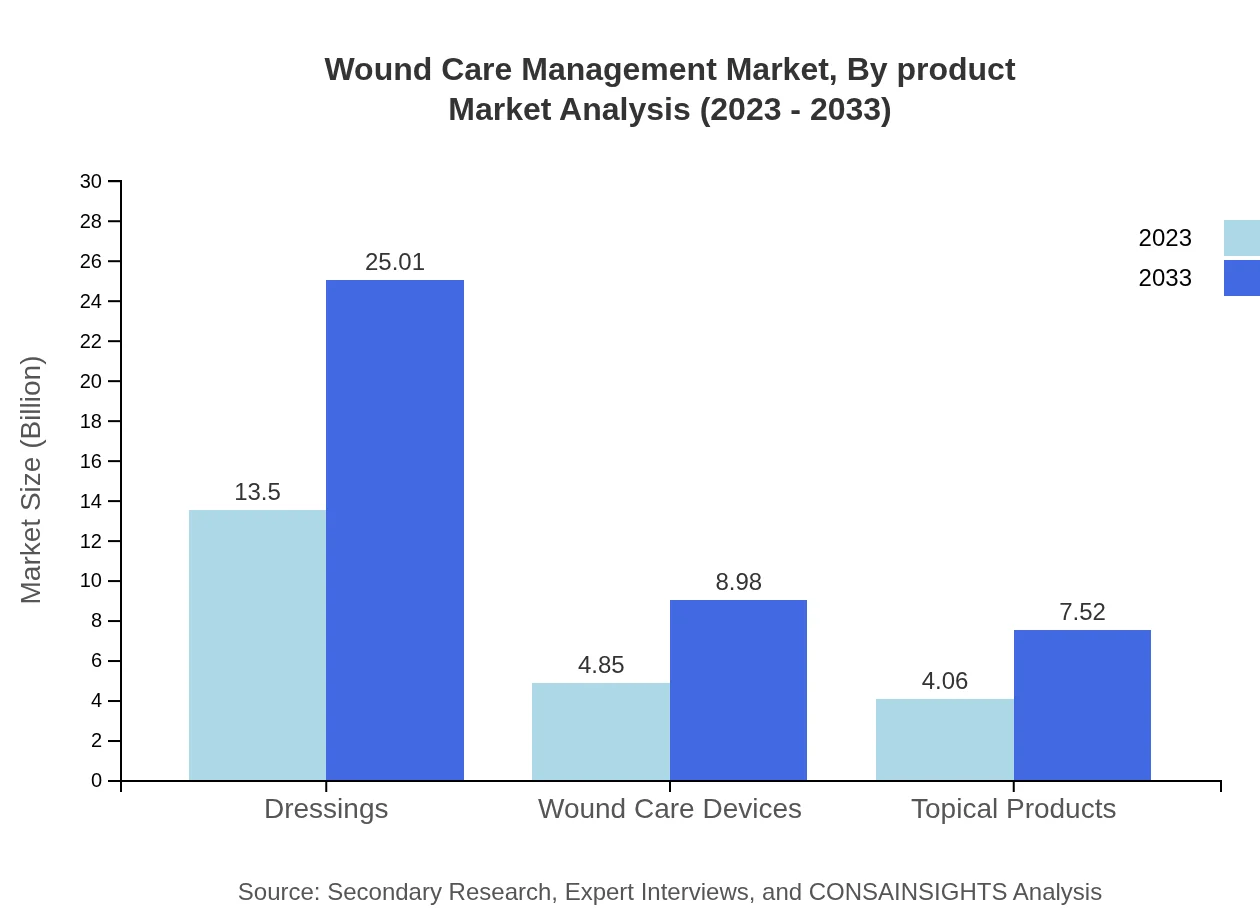
In the wound care management market, dressings dominate, with a market size of $13.50 billion in 2023, anticipated to reach $25.01 billion in 2033. In terms of market share, dressings also hold a significant portion at 60.26%. Wound care devices are projected to grow from $4.85 billion in 2023 to $8.98 billion by 2033, while topical products are expected to increase from $4.06 billion to $7.52 billion. This indicates a well-structured product segmentation where advanced dressings continue to lead.
Wound Care Management Market Analysis By Application
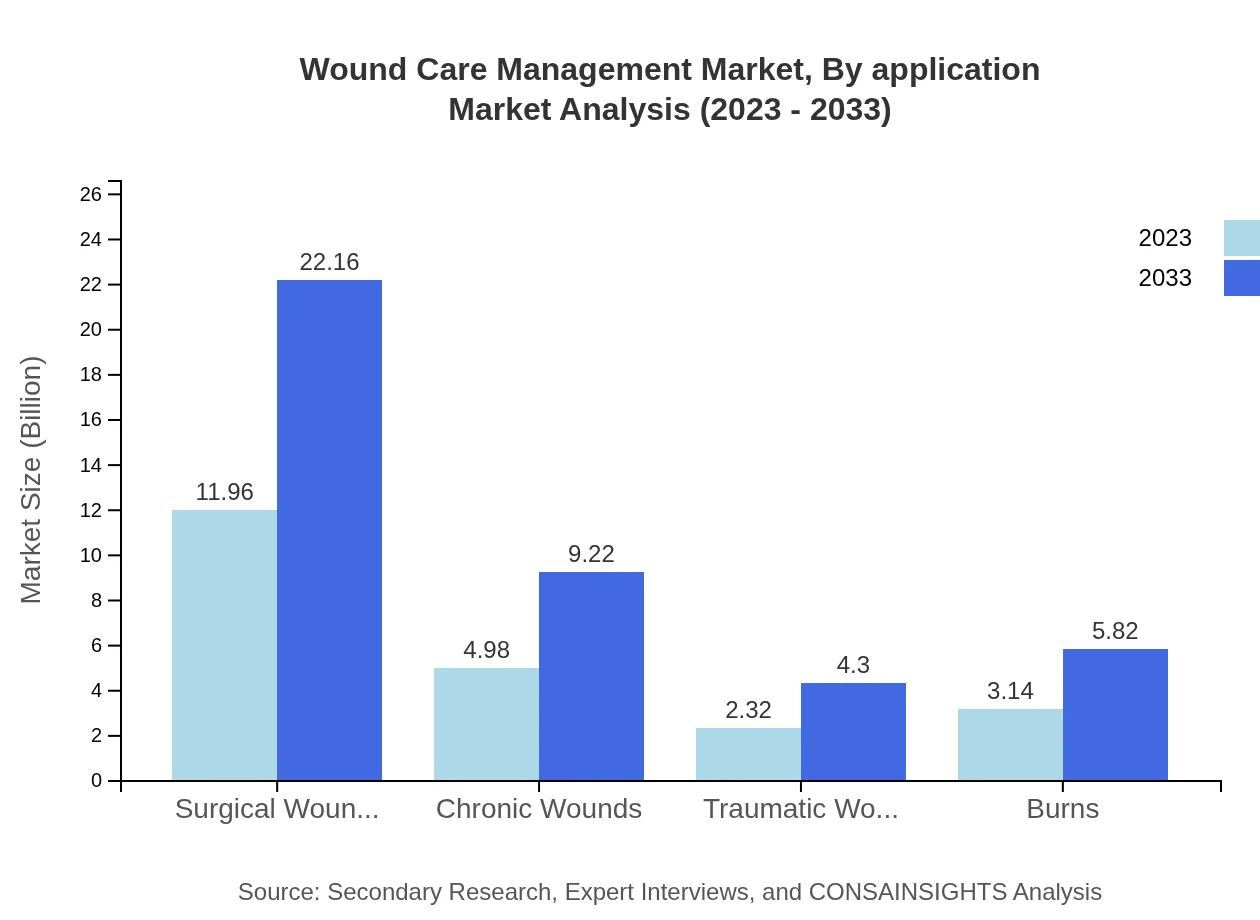
The market is heavily influenced by application types. Surgical wounds account for $11.96 billion in 2023, with expectations of growth to $22.16 billion by 2033, marking a substantial market share of 53.4%. Chronic wounds, valued at $4.98 billion in 2023, are projected to reach $9.22 billion, while traumatic wounds and burns show steady growth patterns as well.
Wound Care Management Market Analysis By End User
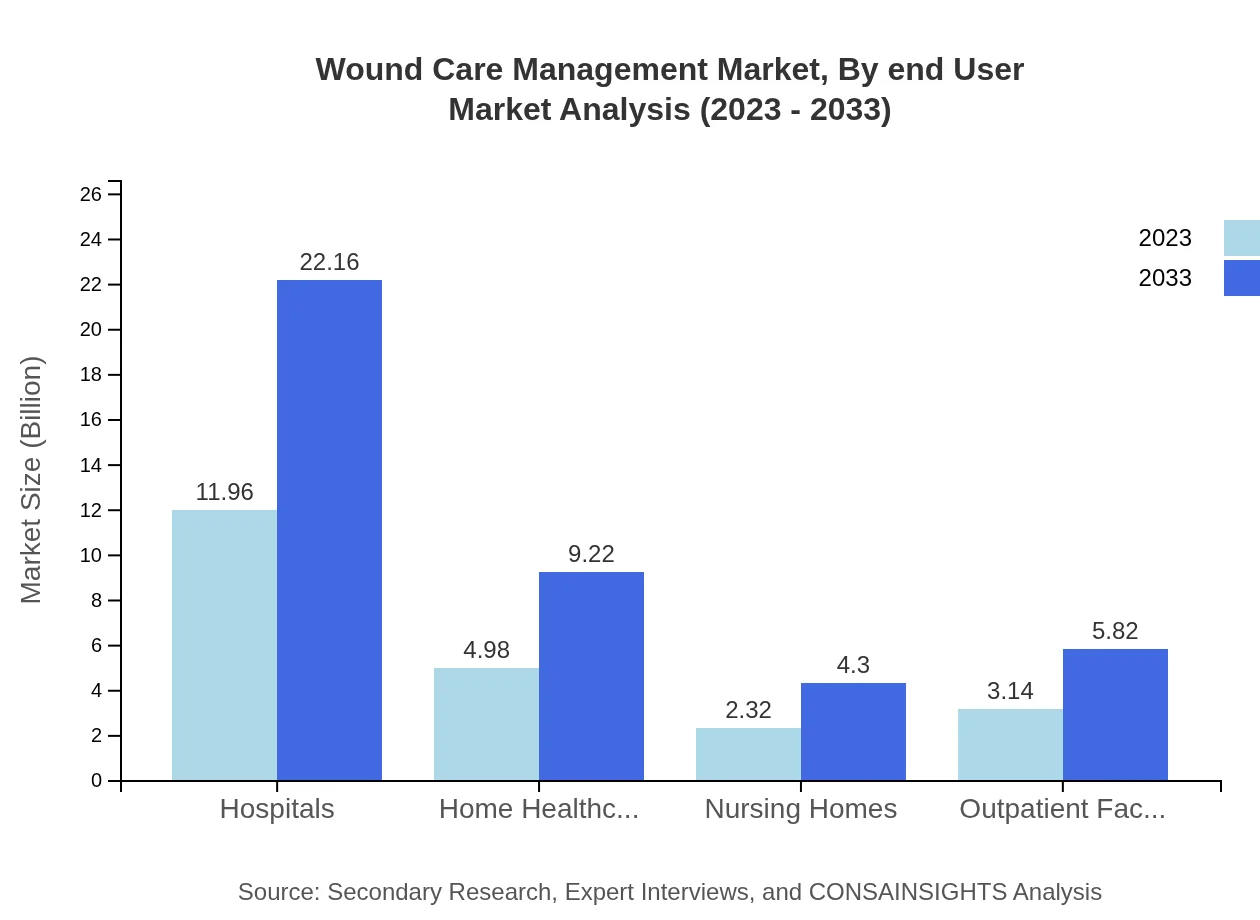
Hospitals represent the bulk of the wound care management market, with a size of $11.96 billion in 2023 expected to rise to $22.16 billion by 2033. Home healthcare and nursing homes also contribute significantly, with respective market values projected to increase from $4.98 billion and $2.32 billion in 2023 to $9.22 billion and $4.30 billion by 2033.
Wound Care Management Market Analysis By Distribution Channel
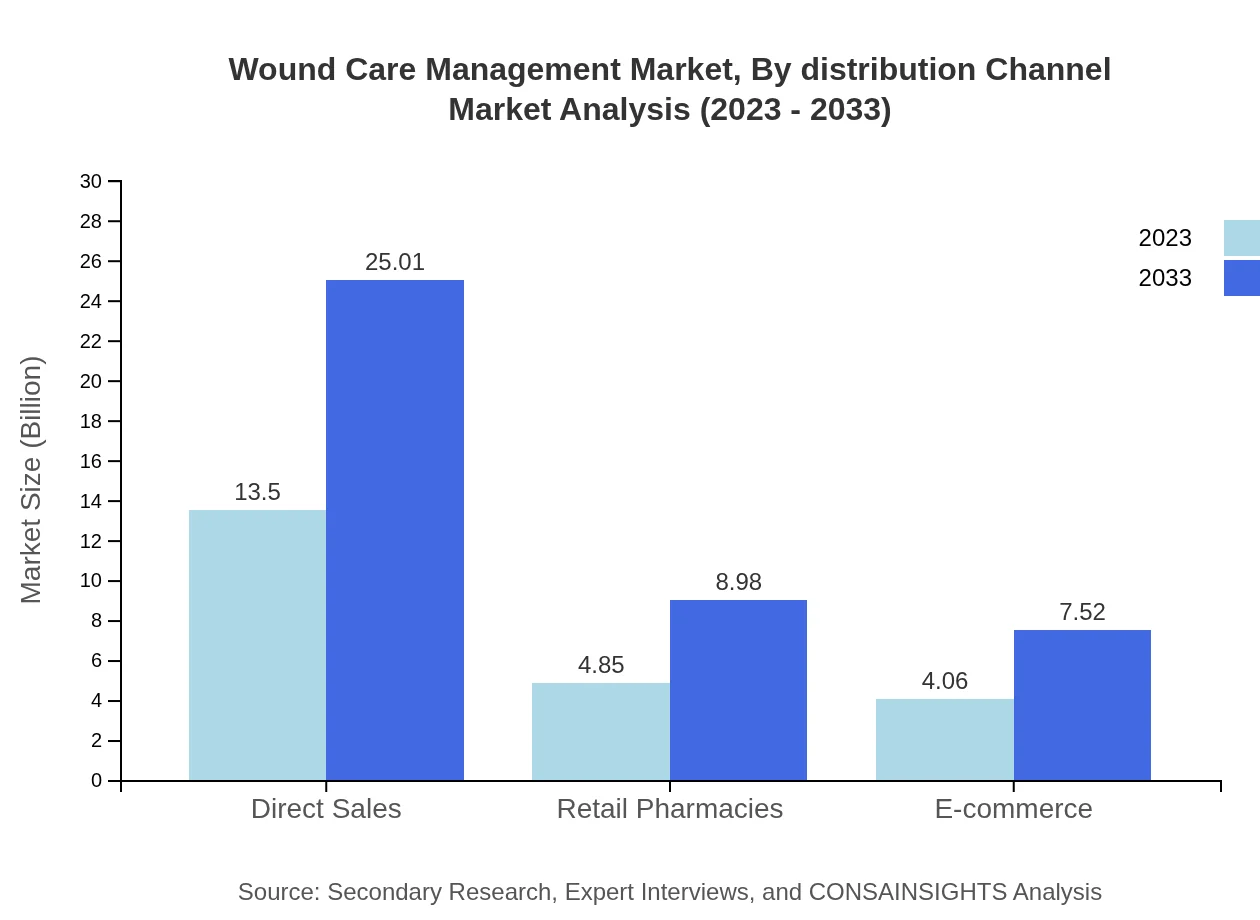
The market exhibits diverse distribution strategies. Direct sales hold a prominent position with a market size of $13.50 billion in 2023, forecasted to expand to $25.01 billion. E-commerce is playing a growing role, with significant sales expected from online platforms.
Wound Care Management Market Analysis By Region Strategy
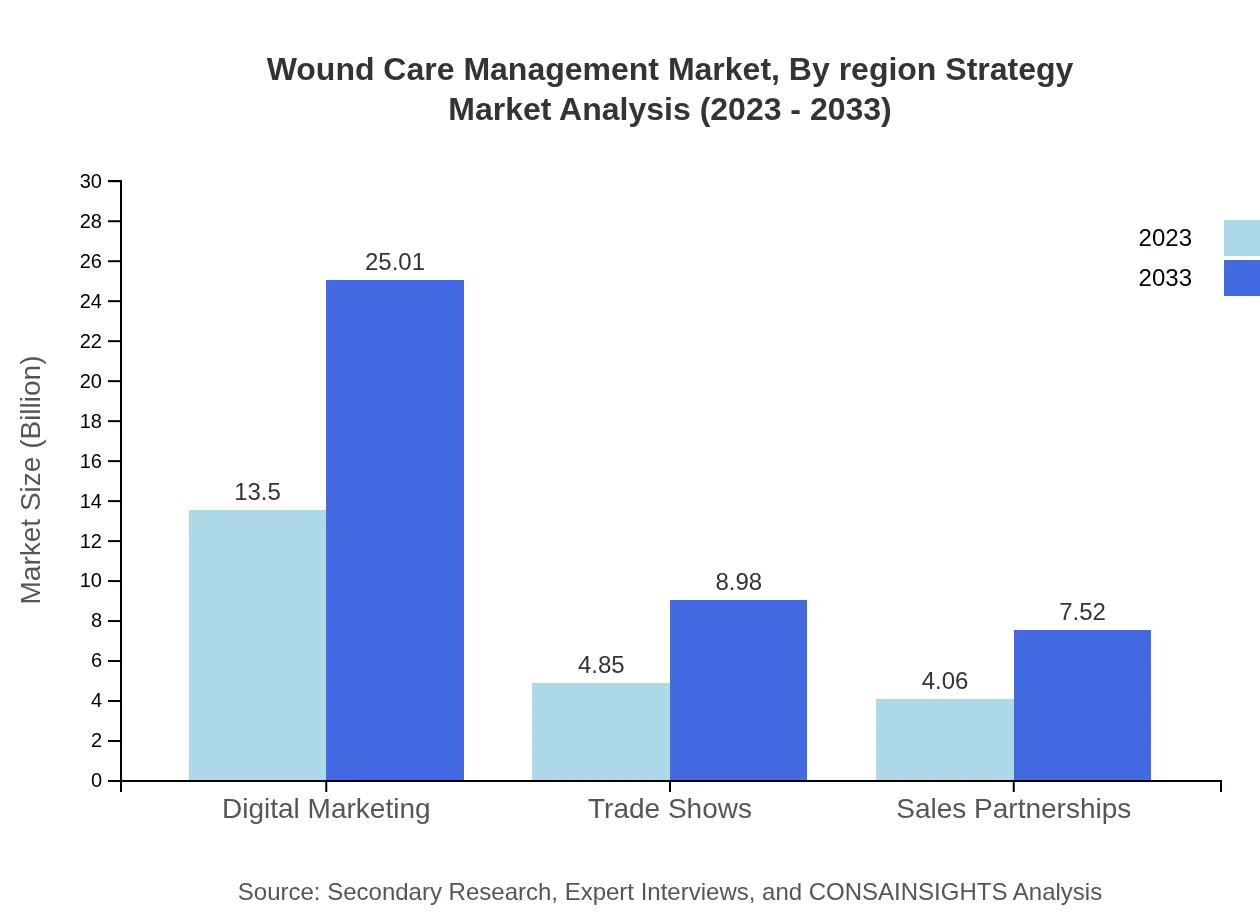
Innovative marketing strategies are essential in enhancing product visibility in the wound care management market. Companies are leveraging digital marketing, trade shows, and sales partnerships to bolster their presence, with digital marketing projected to grow from $13.50 billion to $25.01 billion by 2033.
Wound Care Management Market Trends and Future Forecast
Tell us your focus area and get a customized research report.
Global Market Leaders and Top Companies in Wound Care Management Industry
Medtronic :
A leading player in advanced wound care, Medtronic focuses on innovative therapies and devices encompassing a wide range of treatments for chronic and acute wounds.Smith & Nephew:
Known for its extensive portfolio in wound treatment, Smith & Nephew combines advanced technology with traditional products to enhance healing processes.Bristol-Myers Squibb:
An important contributor to wound care management, especially in topical ointments and solutions that aid in healing various types of wounds.KCI Medical:
A pioneer in negative pressure wound therapy, KCI's innovative approaches to wound management have transformed patient care standardsWe're grateful to work with incredible clients.








FAQs
What is the market size of the wound care management market in 2023?
The market size for 2023 is $22.40 Billion according to the report data provided for the forecast analysis.
How big will the market be in 2033?
The projected market value for 2033 is $41.50 Billion based on the stated forecast period and growth assumptions in the dataset.
What is CAGR for the forecast period?
The compound annual growth rate (CAGR) for 2023 to 2033 is 6.2% as specified in the report inputs.
Is there a single fastest Growing region in the Wound Care Management Market Report market?
No single fastest-growing region is stated for the Wound Care Management Market Report market because the top regional implied CAGR values are within 0.15 percentage points of each other, making the ranking too close to call reliably.
Which companies are leading in wound care management?
Top companies listed include Medtronic, Smith & Nephew, Bristol-Myers Squibb and KCI Medical as key market participants.
How are distribution channels evolving?
Distribution is shifting toward retail pharmacies, direct sales and e-commerce to support outpatient and home healthcare delivery models.
What are common product segments in the market?
Product categories include dressings, wound care devices and topical products, covering a range of clinical and home-use solutions.
Why are outpatient settings important for growth?
Outpatient and home care settings promote convenient treatment access and reduce hospital stays, aligning with trends toward decentralized wound management.