

Antifreeze Proteins Market Report
First published: 11 October 2024 | Last updated: 25 May 2026 | Report Code: antifreeze-proteins
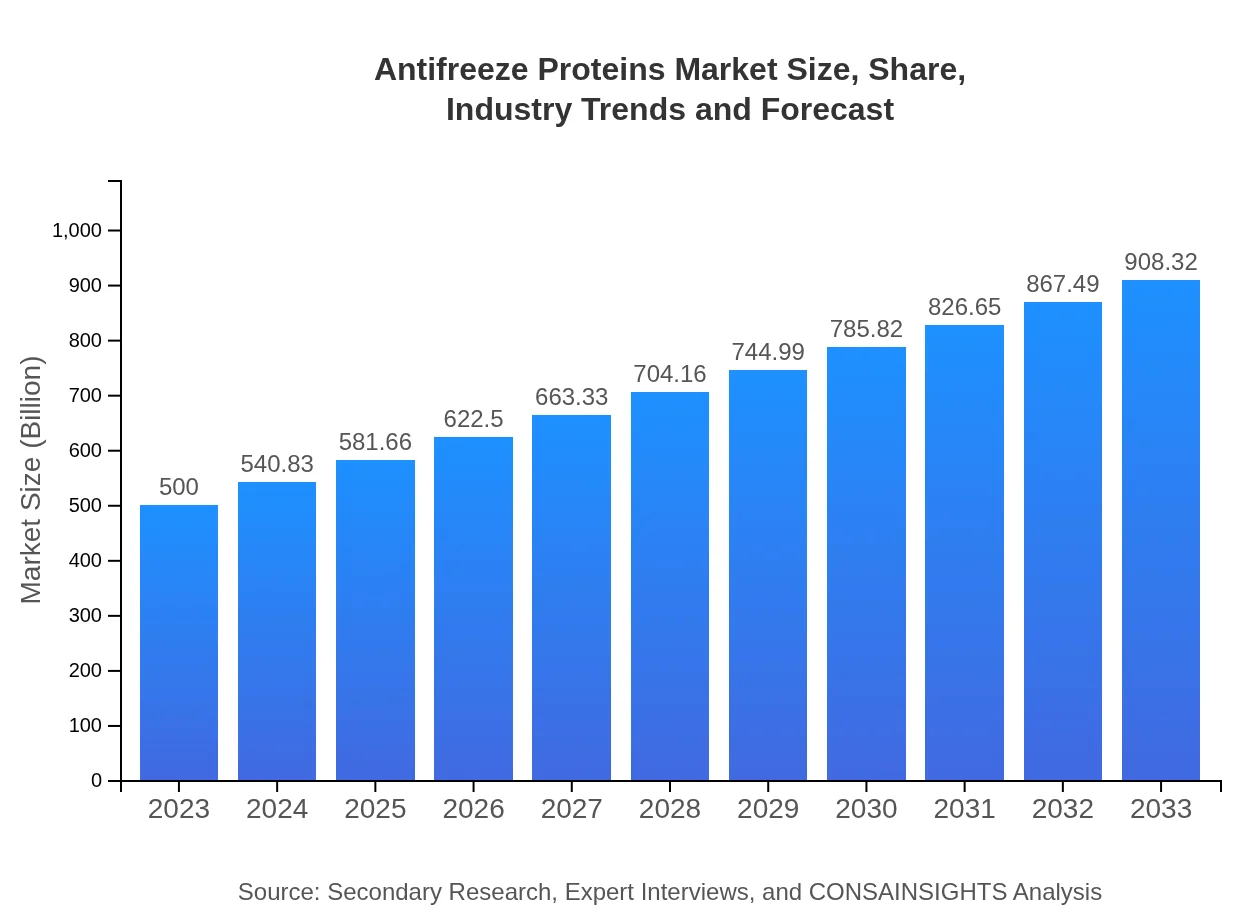
Antifreeze Proteins Market — USD 500 million in 2023, Growing to USD 908.32M by 2033 at 6% CAGR
This report provides a comprehensive analysis of the antifreeze proteins market, highlighting current trends, market sizes, and forecasts for growth from 2023 to 2033 across various segments and regions.
Key Takeaways
- Global market value increases from $500.00 Billion in 2023 to $908.32 Billion in 2033 at a 6% CAGR.
- North America is largest regional market, while no single fastest-growing region is stated because regional CAGR differences remain within 0.15 percentage points.
- North America is the largest region, rising from $180.15 Billion in 2023 to $327.27 Billion in 2033.
- Regional expansion across Europe, Asia Pacific, Latin America and Middle East and Africa supports diverse end-user applications.
- Top corporate participants include Cargill, Incorporated, Unilever, BASF SE and Novozymes.
- Primary demand centers on food processing, pharmaceuticals and biotechnology applications that benefit from cryopreservation and product stability.
Antifreeze Proteins Market Report — Executive Summary
North America remains largest market by forecast-period value, while no single fastest-growing region is stated because top regional growth rates are separated by less than 0.15 percentage points. The Antifreeze Proteins Market Report details a steadily expanding sector driven by needs for temperature-controlled preservation across food processing, pharmaceuticals and biotechnology. Market value is recorded at $500.00 Billion in 2023 and is forecast to reach $908.32 Billion by 2033, with a compound annual growth rate of 6% from 2023 to 2033. Growth is supported by rising interest in sustainable preservation solutions, improved extraction and stabilization techniques, and rising R&D investments that expand application scope. Segmentation covers source types (natural and synthetic), formulation forms (liquid, powder, emulsions), distribution channels (direct sales, online retail, distributors) and end-users including food processing, cosmetics, agriculture and pharmaceuticals. Regional profiles highlight North America as the largest market, with recorded growth across Europe, Asia Pacific, Latin America and Middle East and Africa. Key players listed include Cargill, Incorporated, Unilever, BASF SE and Novozymes. The report synthesizes primary expert interviews, company reports and secondary literature, with triangulation and expert-led validation to map market dynamics and emerging opportunities while noting cost and supply-chain constraints.
Key Growth Drivers
- Increasing adoption in food processing for improved shelf-life and freeze-thaw stability
- Rising pharmaceutical and biotechnology use for cryopreservation and biologic stabilization
- Technological improvements in protein extraction and stabilization methods enhancing scalability
- Greater R&D investment supporting novel applications and plant-based protein development
- Demand for sustainable preservation approaches across multiple end-user industries
| Metric | Value |
|---|---|
| Study Period | 2023 - 2033 |
| 2023 Market Size | $500.00 Million |
| CAGR (2023-2033) | 6% |
| 2033 Market Size | $908.32 Million |
| Top Companies | Cargill, Incorporated, Unilever, BASF SE, Novozymes |
| Published Date | 11 October 2024 |
| Last Modified Date | 25 May 2026 |
Antifreeze Proteins Market Overview
Customize Antifreeze Proteins Market Report market research report
- ✔ Get in-depth analysis of Antifreeze Proteins market size, growth, and forecasts.
- ✔ Understand Antifreeze Proteins's regional dynamics and industry-specific trends.
- ✔ Identify potential applications, end-user demand, and growth segments in Antifreeze Proteins
What is the Market Size & CAGR of Antifreeze Proteins Market Report market in 2023?
Antifreeze Proteins Industry Analysis
Antifreeze Proteins Market Segmentation and Scope
Tell us your focus area and get a customized research report.
Antifreeze Proteins Market Report Market Analysis Report by Region
Europe Antifreeze Proteins Market Report:
Europe grows from $127.8 Billion in 2023 to $232.17 Billion in 2033. Expansion is supported by food industry applications, regulatory focus on product preservation, and active biotechnology research that drives uptake of antifreeze proteins.Asia Pacific Antifreeze Proteins Market Report:
Asia Pacific grows from $107.55 Billion in 2023 to $195.38 Billion in 2033. Regional growth is underpinned by rising food processing activity, expanding pharmaceutical manufacturing, and greater investment in protein-based preservation solutions.North America Antifreeze Proteins Market Report:
North America is largest regional market, rising from $180.15 Billion in 2023 to $327.27 Billion in 2033. Regional demand is shaped by strong adoption in food processing and biopharma sectors, investment in stabilization technologies, and established distribution networks.South America Antifreeze Proteins Market Report:
Latin America grows from $28.75 Billion in 2023 to $52.23 Billion in 2033. Local drivers include increasing food-processing needs, agricultural applications, and gradual adoption of biotechnology and preservation technologies.Middle East & Africa Antifreeze Proteins Market Report:
Middle East and Africa grows from $55.75 Billion in 2023 to $101.28 Billion in 2033. Growth is supported by expanding pharmaceutical and food-processing sectors and growing interest in preservation methods suited to regional supply chains.Tell us your focus area and get a customized research report.
Research Methodology
Antifreeze Proteins Market Analysis By Source
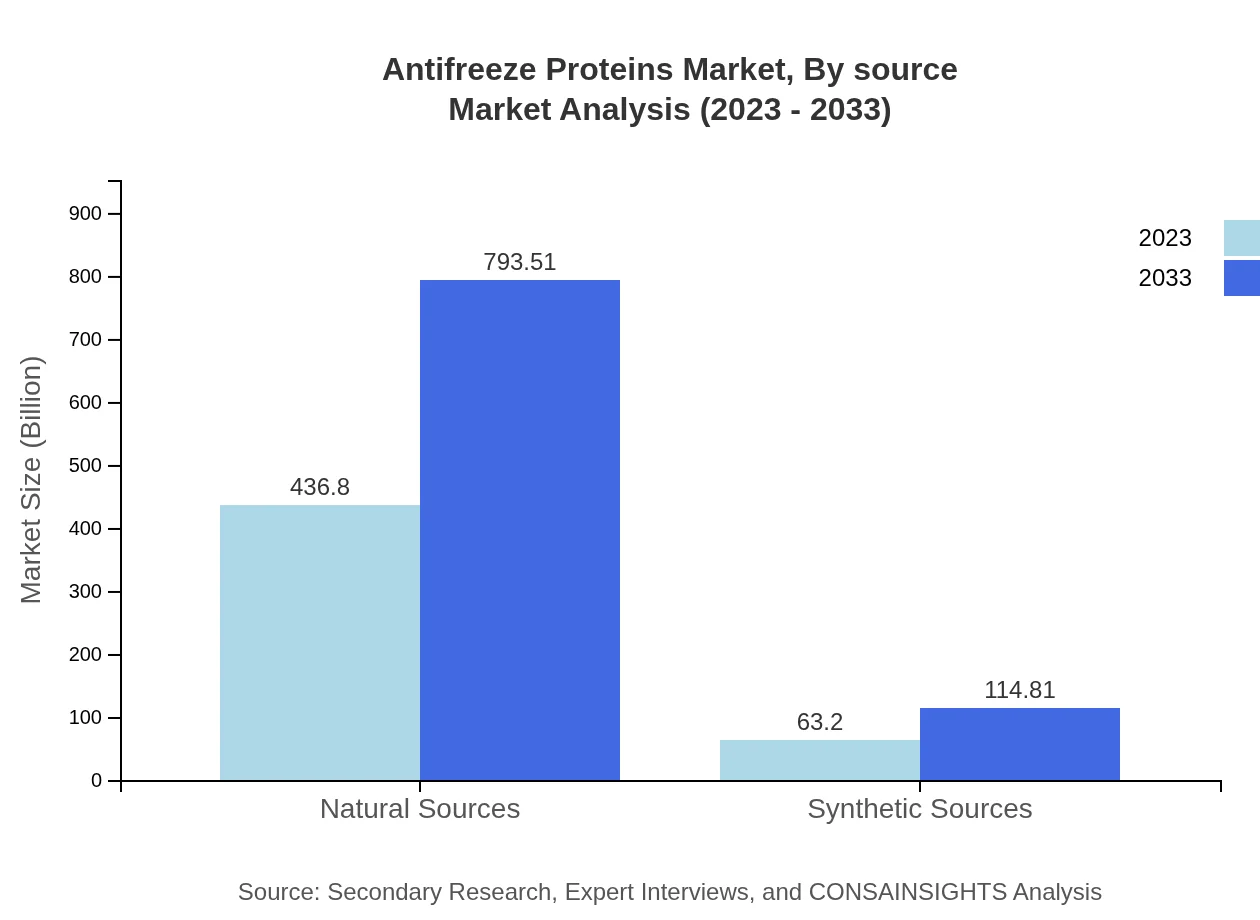
The antifreeze proteins market by source consists of natural and synthetic proteins. In 2023, natural sources dominate the market at $436.80 million, holding an 87.36% share. By 2033, this segment is projected to reach $793.51 million. Synthetic sources, while smaller at $63.20 million in 2023 (12.64% share), show potential growth to $114.81 million by 2033 as technology improves production methods.
Antifreeze Proteins Market Analysis By Application
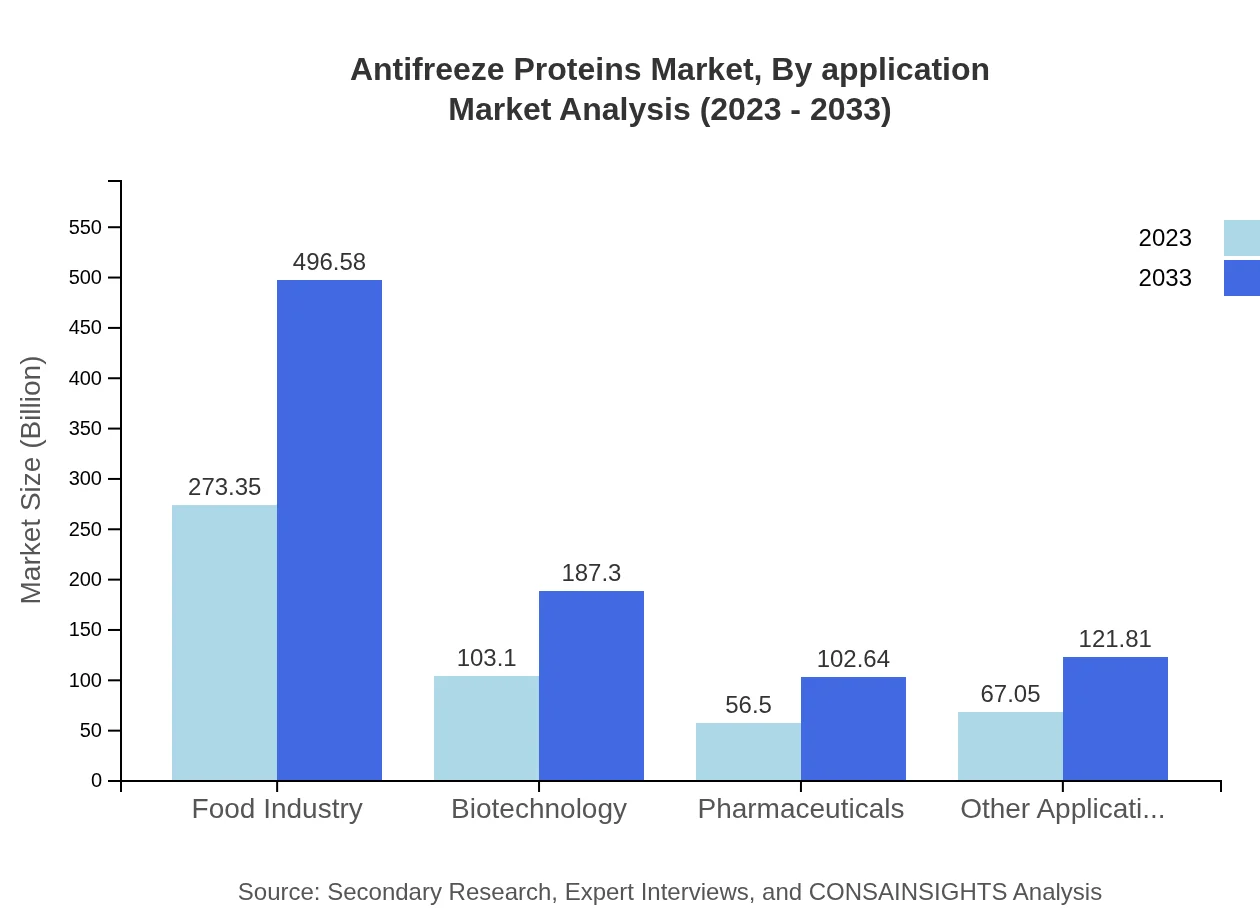
Applications of antifreeze proteins vary widely, with food processing leading the segment. Estimated at $327.05 million in 2023 and expected to reach $594.13 million by 2033, food processing encapsulates the highest share at 65.41%. Other growing applications include cosmetics ($105.15 million in 2023) and pharmaceuticals ($56.50 million), showcasing the versatility of antifreeze proteins.
Antifreeze Proteins Market Analysis By End User
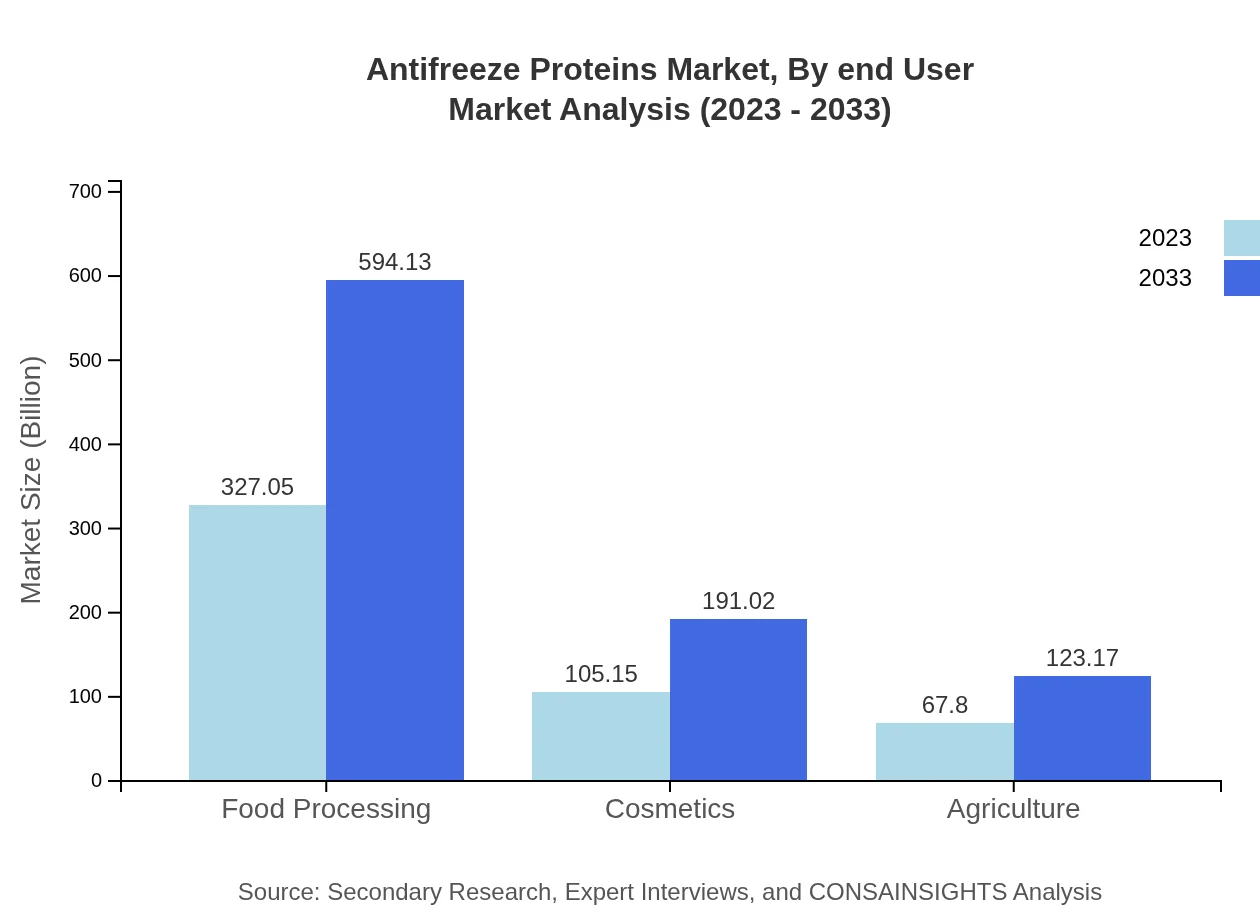
The end-user segmentation includes food industry, biotechnology, agriculture, and pharmaceuticals. The food industry leads with a significant market of $273.35 million in 2023. Stakeholders in biotechnology are predicted to experience growth from $103.10 million to $187.30 million by 2033, indicating the rising integration of antifreeze proteins in research and application.
Antifreeze Proteins Market Analysis By Formulation
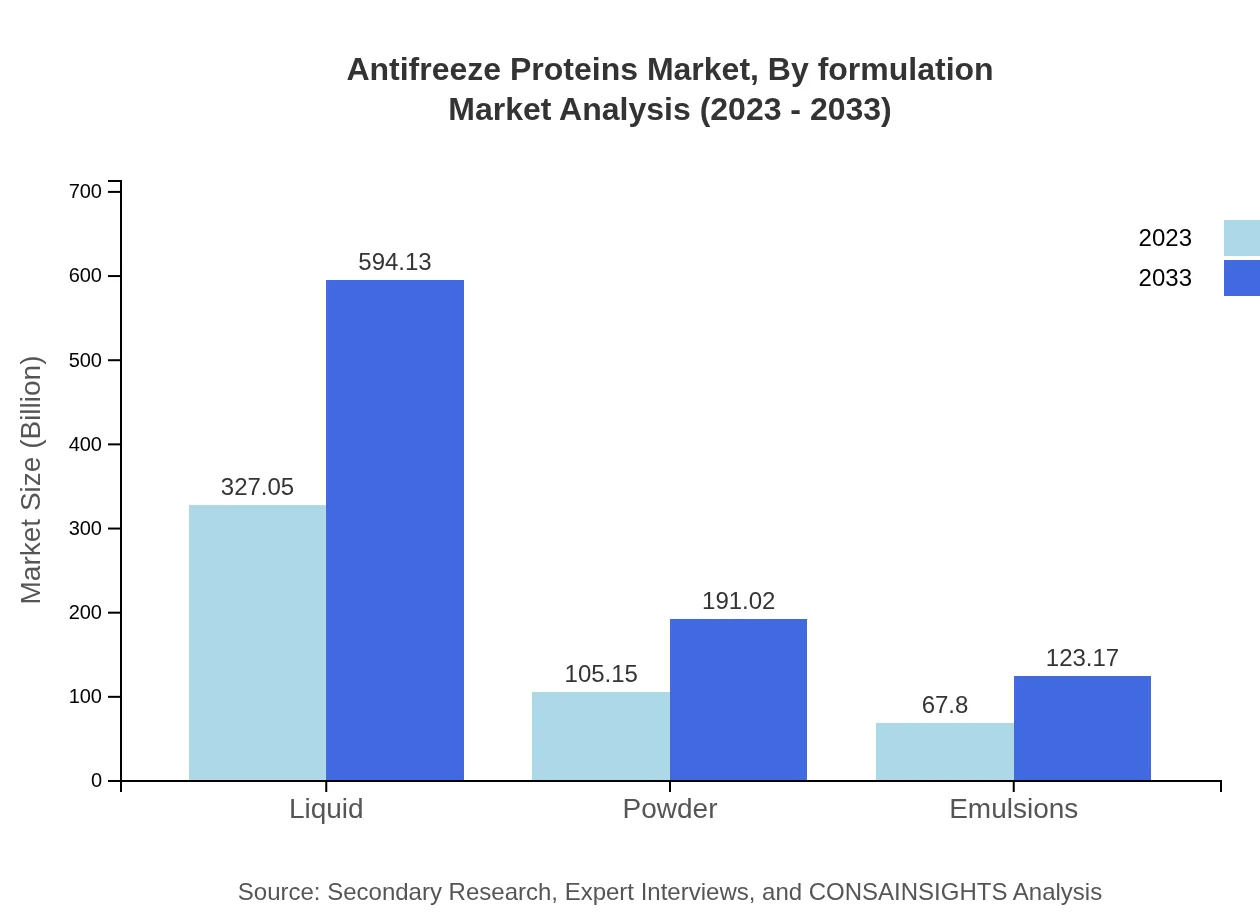
The market is further divided into liquid, powder, and emulsions. Liquid formulations are prominent, valued at $327.05 million in 2023, with a strong growth trajectory to $594.13 million. Powdered formulations, while smaller ($105.15 million), provide concentrated solutions for specific applications, while emulsions play an essential role at $67.80 million, both growing steadily.
Antifreeze Proteins Market Analysis By Distribution Channel
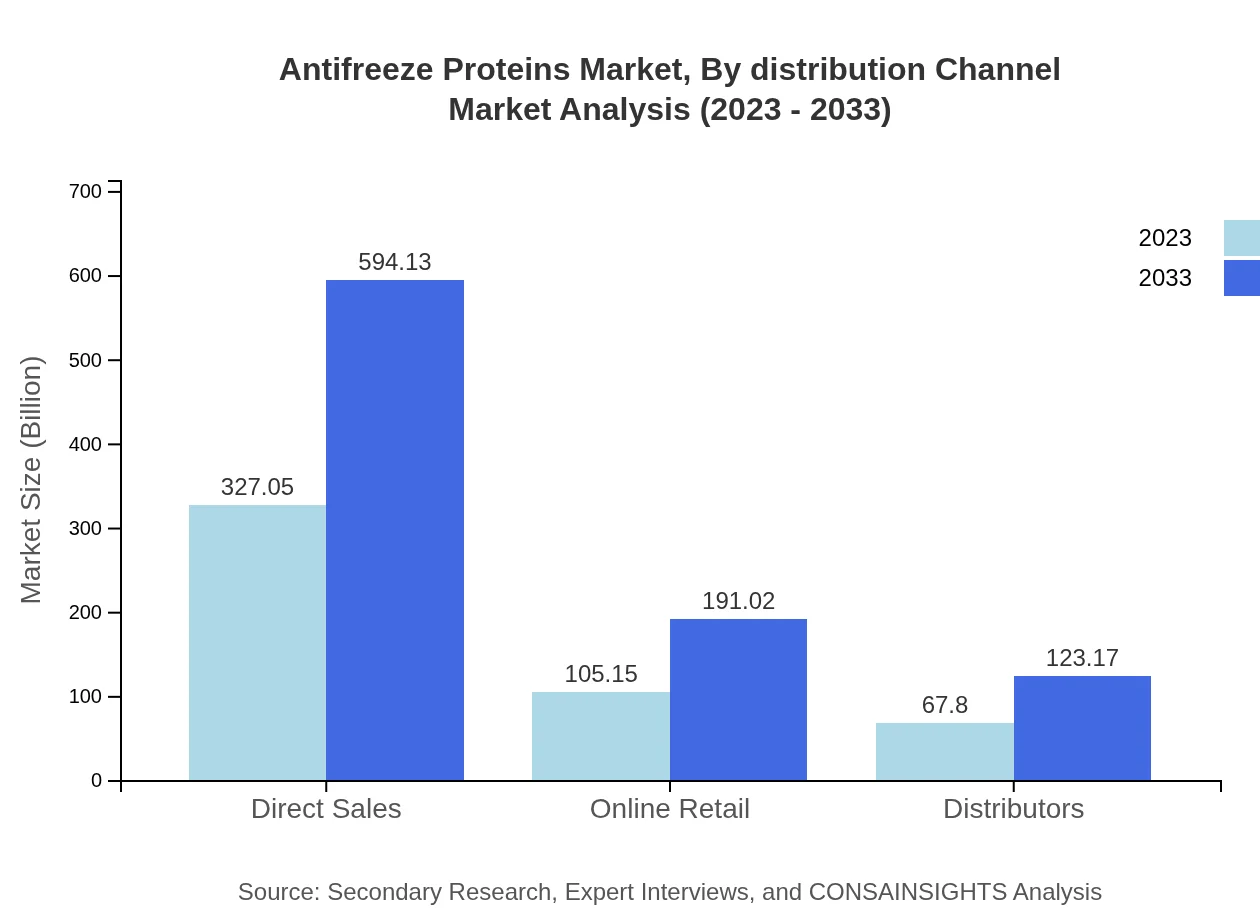
Distribution channels include direct sales, online retail, and distributors. Direct sales, at $327.05 million in 2023, dominate the market due to established relationships with major industries. Online retail is showing increasing relevance, growing from $105.15 million, as digital sales channels expand their reach and efficiency.
Antifreeze Proteins Market Trends and Future Forecast
Tell us your focus area and get a customized research report.
Global Market Leaders and Top Companies in Antifreeze Proteins Industry
Cargill, Incorporated:
A major player in the agri-food sector, Cargill is investing in antifreeze proteins for food preservation and processing, providing innovative solutions with minimal environmental impact.Unilever:
Well-recognized for its sustainability initiatives, Unilever incorporates antifreeze proteins in various cosmetic products, enhancing their formulation against temperature fluctuations.BASF SE:
BASF is heavily invested in biopolymers, including antifreeze proteins, focusing on applications in pharmaceuticals and food industries for preservation and stability.Novozymes:
A leader in biotechnology, Novozymes focuses on innovative production processes for antifreeze proteins, particularly for food and agricultural applications.We're grateful to work with incredible clients.








FAQs
What is the market size of the Antifreeze Proteins Market Report in 2023?
The market size in 2023 is $500.00 Billion, as stated in the report's base-year valuation and used as the starting point for the 2023 to 2033 forecast.
How big will the market be in 2033?
The projected market value for 2033 is $908.32 Billion according to the provided forecast data covering 2023 to 2033.
What is CAGR for the forecast period?
The compound annual growth rate for the 2023 to 2033 forecast period is 6%, as specified in the report data.
Is there a single fastest Growing region in the Antifreeze Proteins Market Report market?
No single fastest-growing region is stated for the Antifreeze Proteins Market Report market because the top regional implied CAGR values are within 0.15 percentage points of each other, making the ranking too close to call reliably.
Which companies are listed as key participants?
Top companies named in the report include Cargill, Incorporated, Unilever, BASF SE and Novozymes based on market presence and activity.
How are market segments defined by source?
By-source segmentation includes Natural Sources and Synthetic Sources, as provided in the report's breakdown.
What are the main applications included?
Primary application segments listed are the Food Industry, Biotechnology, Pharmaceuticals and Other Applications, reflecting cross-sector usage.
Who contributed to the research methodology?
Research combined primary interviews with industry experts and secondary sources such as company reports and publications, with data triangulation and validation.
How big is the European market in 2023 and 2033?
Europe is reported at $127.8 Billion in 2023 and grows to $232.17 Billion by 2033 according to the regional data.
Why are formulation types important?
Formulation categories—Liquid, Powder and Emulsions—affect handling, shelf-life and application suitability across different end users.