
Reports >
Life Sciences
>
Aortic Repair Devices Market Report

Aortic Repair Devices Market Report
First published: 21 October 2024 | Last updated: 28 May 2026 | Report Code: aortic-repair-devices
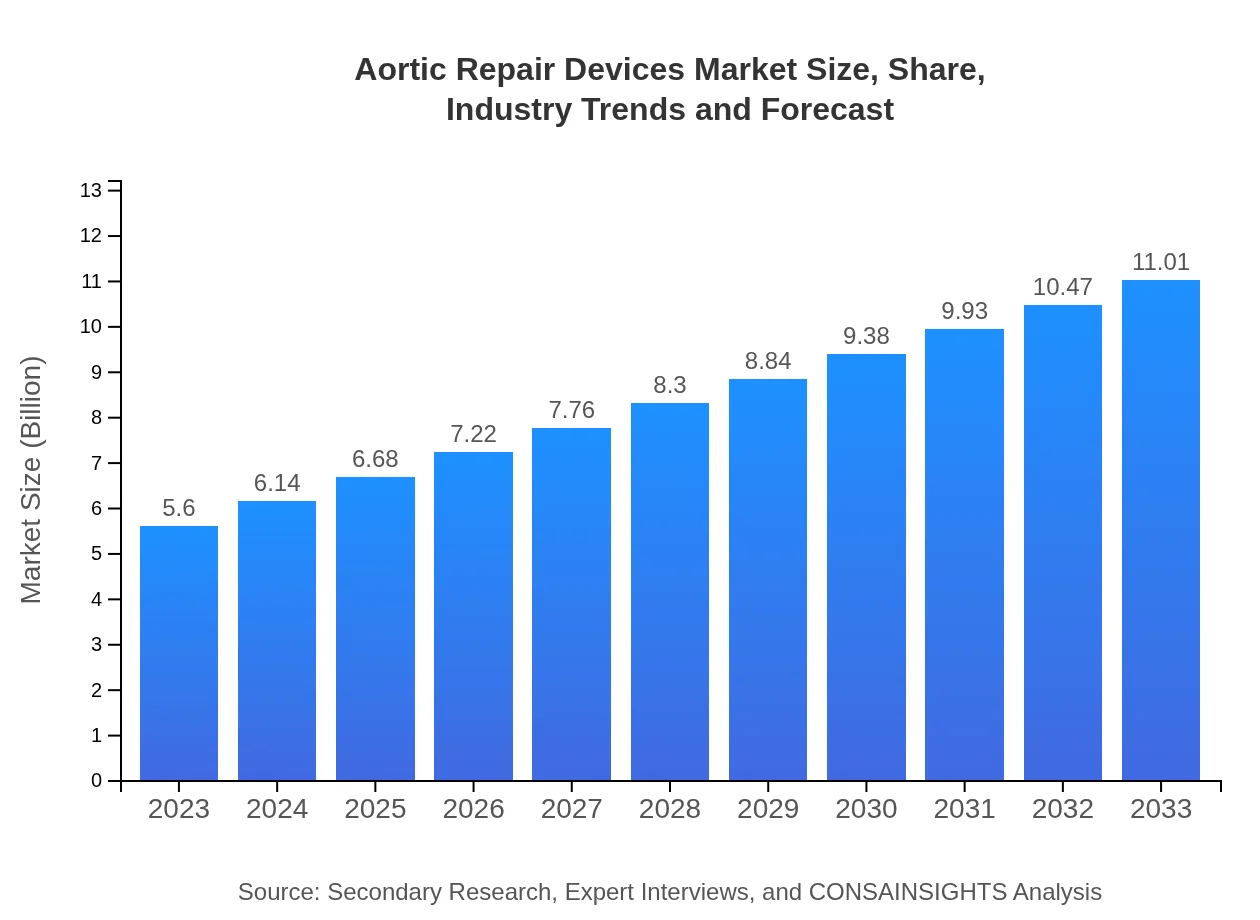
Aortic Repair Devices Market — USD 5.6 billion in 2023, Growing to USD 11.01B by 2033 at 6.8% CAGR
This report provides an in-depth analysis of the Aortic Repair Devices market, highlighting trends, size, growth forecasts, and regional dynamics from 2023 to 2033. It offers valuable insights for stakeholders, investors, and industry participants to navigate the evolving landscape.
Key Takeaways
- Global market expands from $5.60 Billion in 2023 to $11.01 Billion by 2033 at a 6.8% CAGR.
- North America is largest regional market; Latin America is regional market region based on implied CAGR across 2023 to 2033.
- Latin America is the regional market region, rising from $0.28 Billion to $0.56 Billion at an implied 7.18% CAGR.
- Europe and Asia Pacific show significant increases: Europe from $1.41 Billion to $2.77 Billion, Asia Pacific from $1.15 Billion to $2.26 Billion.
- Key manufacturers include Medtronic, Abbott Laboratories, Boston Scientific, Cook Medical, and Terumo Corporation.
Aortic Repair Devices Market Report — Executive Summary
Regional analysis shows North America as largest market and Latin America as fastest-growing region by implied CAGR. The market for aortic repair devices is projected to more than double between 2023 and 2033, supported by broader adoption of minimally invasive procedures, improvements in device materials, and increasing prevalence of aortic conditions. Patient preference for less invasive treatments and technological advancements in stent grafts and polymer-based devices serve as primary growth drivers. Regional dynamics vary: North America leads in market size, while Latin America exhibits the highest implied growth rate. Competitive activity centers on established medical-device firms including Medtronic, Abbott Laboratories, Boston Scientific, Cook Medical, and Terumo Corporation. The report segments the market by device type, material, application, and end user to clarify demand patterns and identify opportunities amid regulatory and reimbursement considerations.
Key Growth Drivers
- Rising incidence of aortic aneurysms and dissections increases clinical demand for repair devices.
- Shift toward minimally invasive procedures boosts adoption of stent grafts and balloon-expandable technologies.
- Material innovations, including polymer-based solutions, improve device compatibility and performance.
- Greater healthcare investment and improved reimbursement frameworks support wider deployment of advanced devices.
- Established device manufacturers expanding portfolios and clinical support accelerate market penetration.
| Metric | Value |
|---|---|
| Study Period | 2023 - 2033 |
| 2023 Market Size | $5.60 Billion |
| CAGR (2023-2033) | 6.8% |
| 2033 Market Size | $11.01 Billion |
| Top Companies | Medtronic , Abbott Laboratories, Boston Scientific, Cook Medical, Terumo Corporation |
| Published Date | 21 October 2024 |
| Last Modified Date | 28 May 2026 |
Aortic Repair Devices Market Overview
Customize Aortic Repair Devices Market Report market research report
- ✔ Get in-depth analysis of Aortic Repair Devices market size, growth, and forecasts.
- ✔ Understand Aortic Repair Devices's regional dynamics and industry-specific trends.
- ✔ Identify potential applications, end-user demand, and growth segments in Aortic Repair Devices
What is the Market Size & CAGR of Aortic Repair Devices Market Report market in 2023?
Aortic Repair Devices Industry Analysis
Aortic Repair Devices Market Segmentation and Scope
Tell us your focus area and get a customized research report.
Aortic Repair Devices Market Report Market Analysis Report by Region
Europe Aortic Repair Devices Market Report:
Europe grows from $1.41 Billion in 2023 to $2.77 Billion in 2033. Adoption is driven by aging populations, growing awareness of aortic disease treatments, and ongoing technology updates in stent graft and balloon-expandable device offerings.Asia Pacific Aortic Repair Devices Market Report:
Asia Pacific grows from $1.15 Billion in 2023 to $2.26 Billion in 2033. Market advancement is supported by rising healthcare expenditures, increasing access to advanced cardiovascular care, and wider availability of innovative device solutions.North America Aortic Repair Devices Market Report:
North America is largest regional market, rising from $1.97 Billion in 2023 to $3.88 Billion in 2033. Growth in the region reflects strong clinical adoption of minimally invasive techniques, established reimbursement pathways, and active deployment by major device manufacturers.South America Aortic Repair Devices Market Report:
Latin America is fastest-growing region by implied CAGR, increasing from $0.28 Billion in 2023 to $0.56 Billion in 2033. 28 Billion in 2023 to $0.56 Billion in 2033 and is noted as the regional growth market with an implied 7.18% CAGR. Expansion reflects improving healthcare infrastructure and greater uptake of minimally invasive cardiovascular procedures.Middle East & Africa Aortic Repair Devices Market Report:
Middle East and Africa grows from $0.78 Billion in 2023 to $1.53 Billion in 2033. Growth drivers include expanding healthcare facilities, strengthened clinical capabilities, and adoption of modern device technologies.Tell us your focus area and get a customized research report.
Research Methodology
Aortic Repair Devices Market Analysis By Device Type
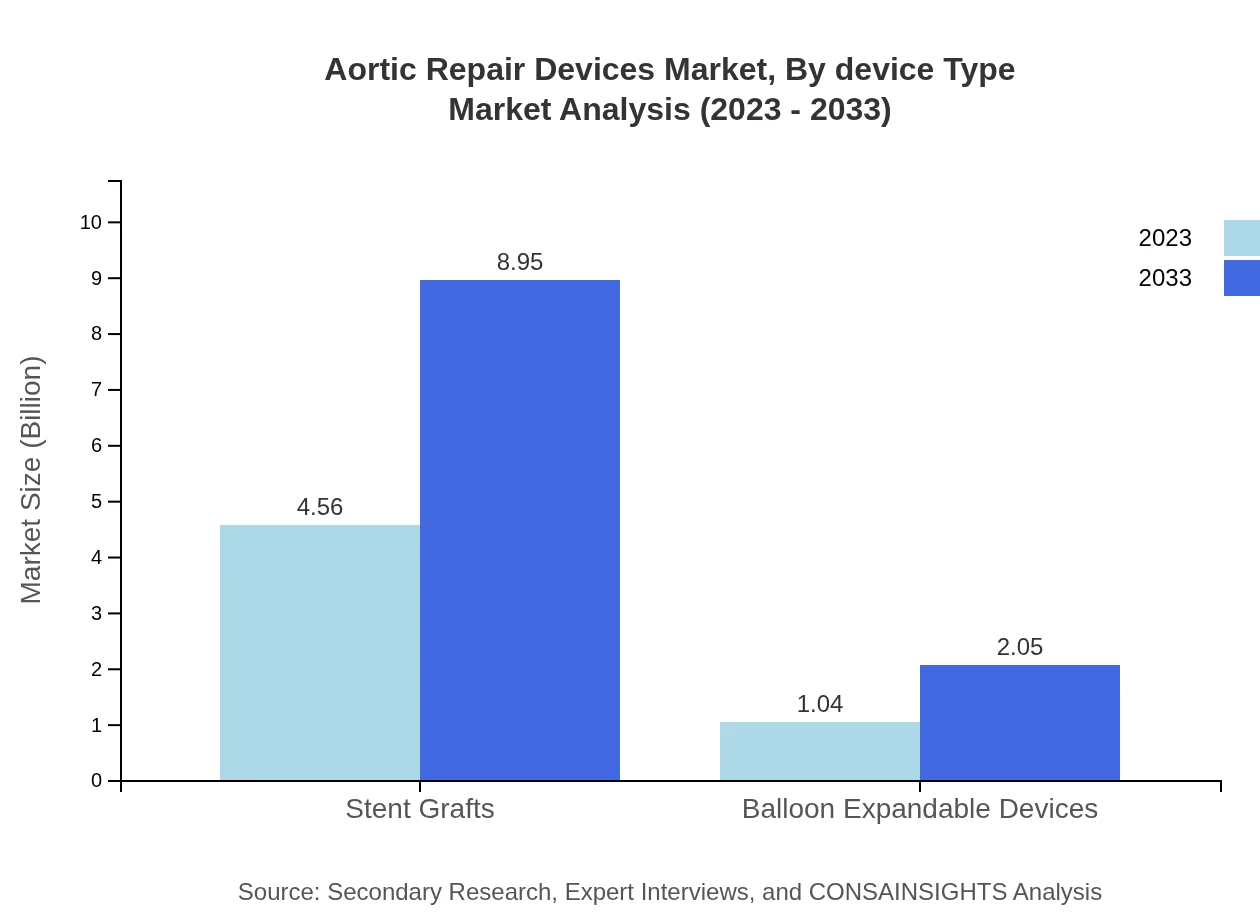
The Aortic Repair Devices market is significantly influenced by the device type, mainly comprising polymer-based devices and metal-based devices. By 2033, polymer-based devices show a notable market growth, expanding from $4.56 billion in 2023 to $8.95 billion, holding a market share of 81.35%. Meanwhile, metal-based devices are projected to grow from $1.04 billion to $2.05 billion, maintaining an 18.65% share.
Aortic Repair Devices Market Analysis By Application
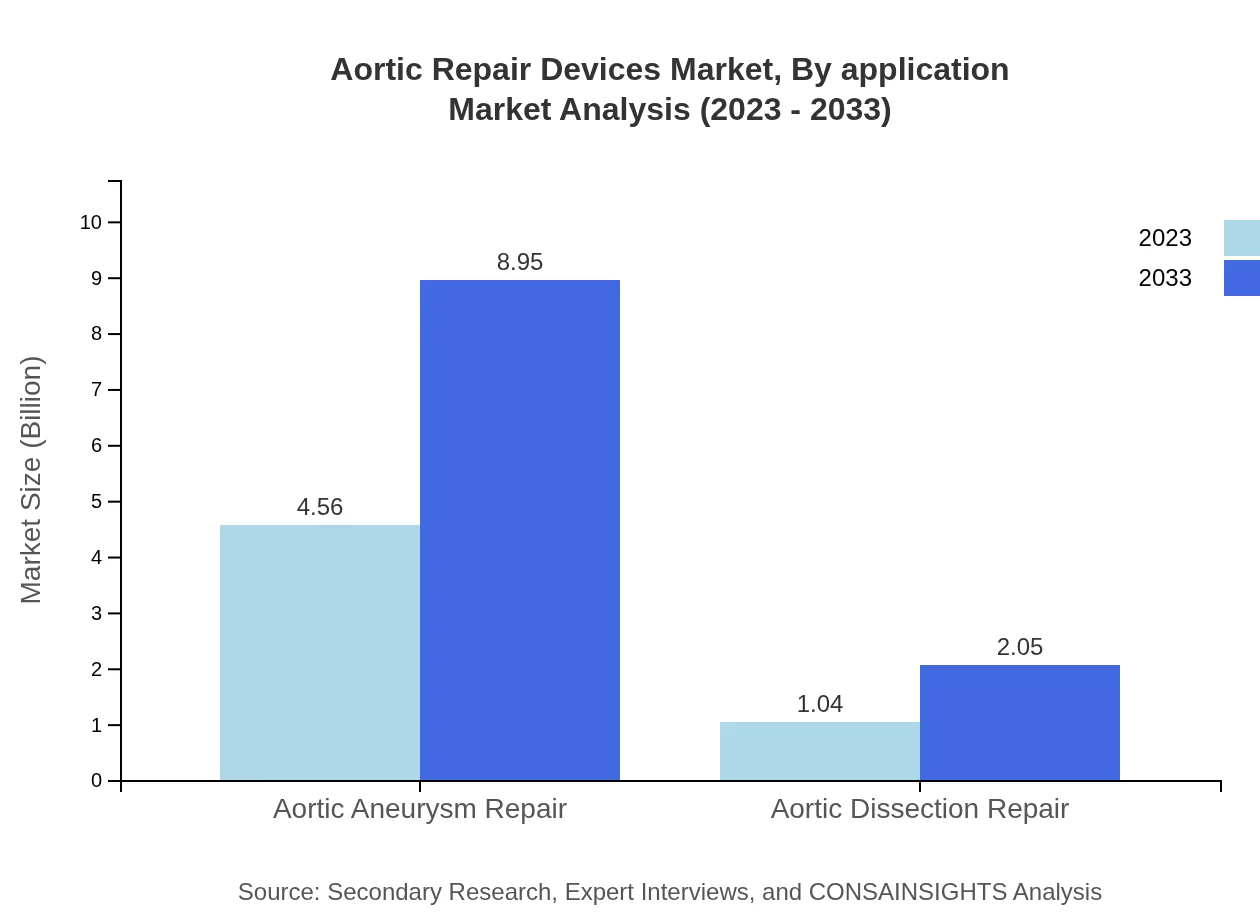
The major applications within the Aortic Repair Devices market are aortic aneurysm repair and aortic dissection repair. The aortic aneurysm repair segment dominates the market, with sizes anticipated to improve from $4.56 billion in 2023 to $8.95 billion in 2033, representing an 81.35% market share. The aortic dissection repair segment will see growth from $1.04 billion to $2.05 billion, holding a significant portion of 18.65% of the overall market.
Aortic Repair Devices Market Analysis By Material
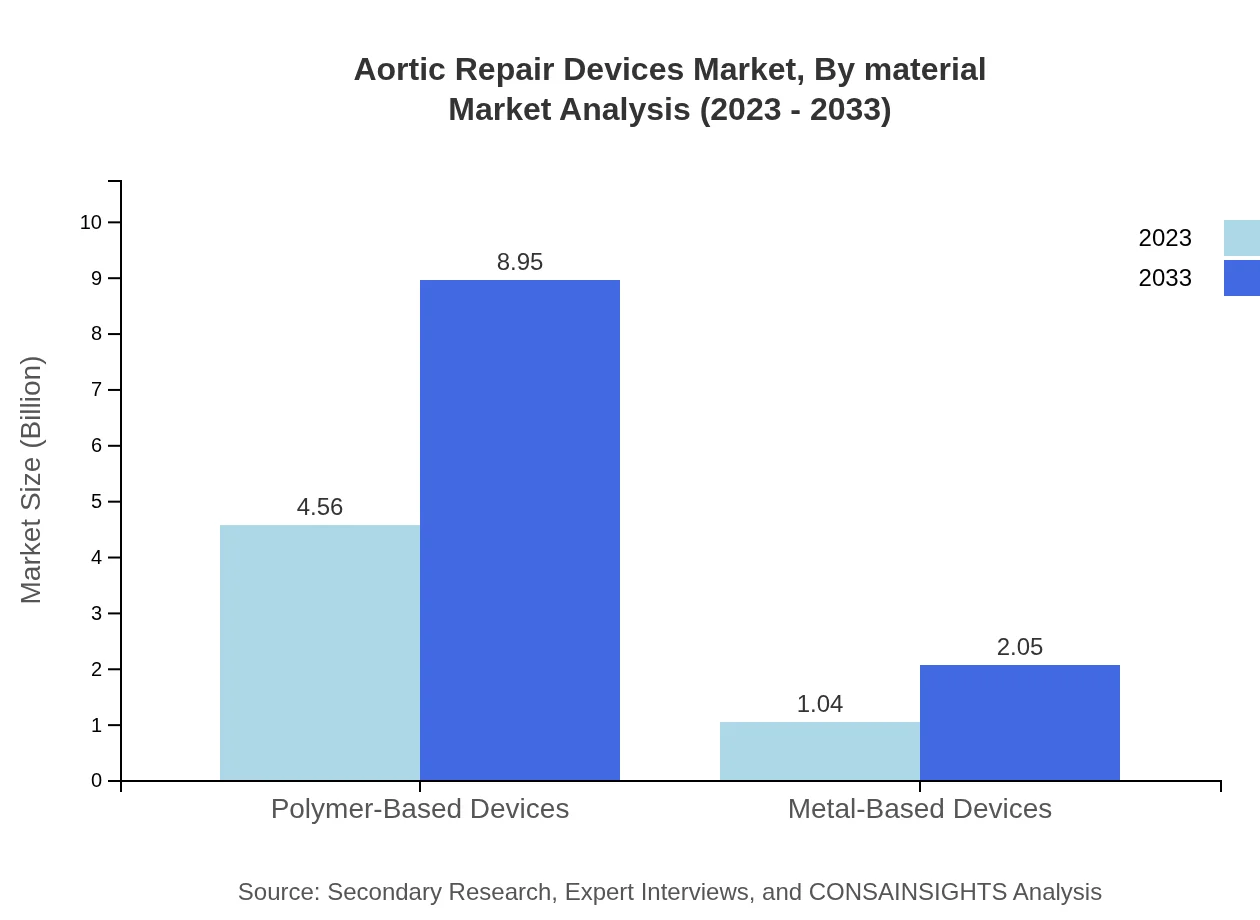
Market segmentation by material emphasizes the dominance of polymer-based devices, projected to grow from $4.56 billion in 2023 to $8.95 billion by 2033, reflecting an 81.35% market share. Conversely, metal-based devices, while critical, are expected to have lesser growth from $1.04 billion to $2.05 billion, capturing 18.65% of the market share.
Aortic Repair Devices Market Analysis By End User
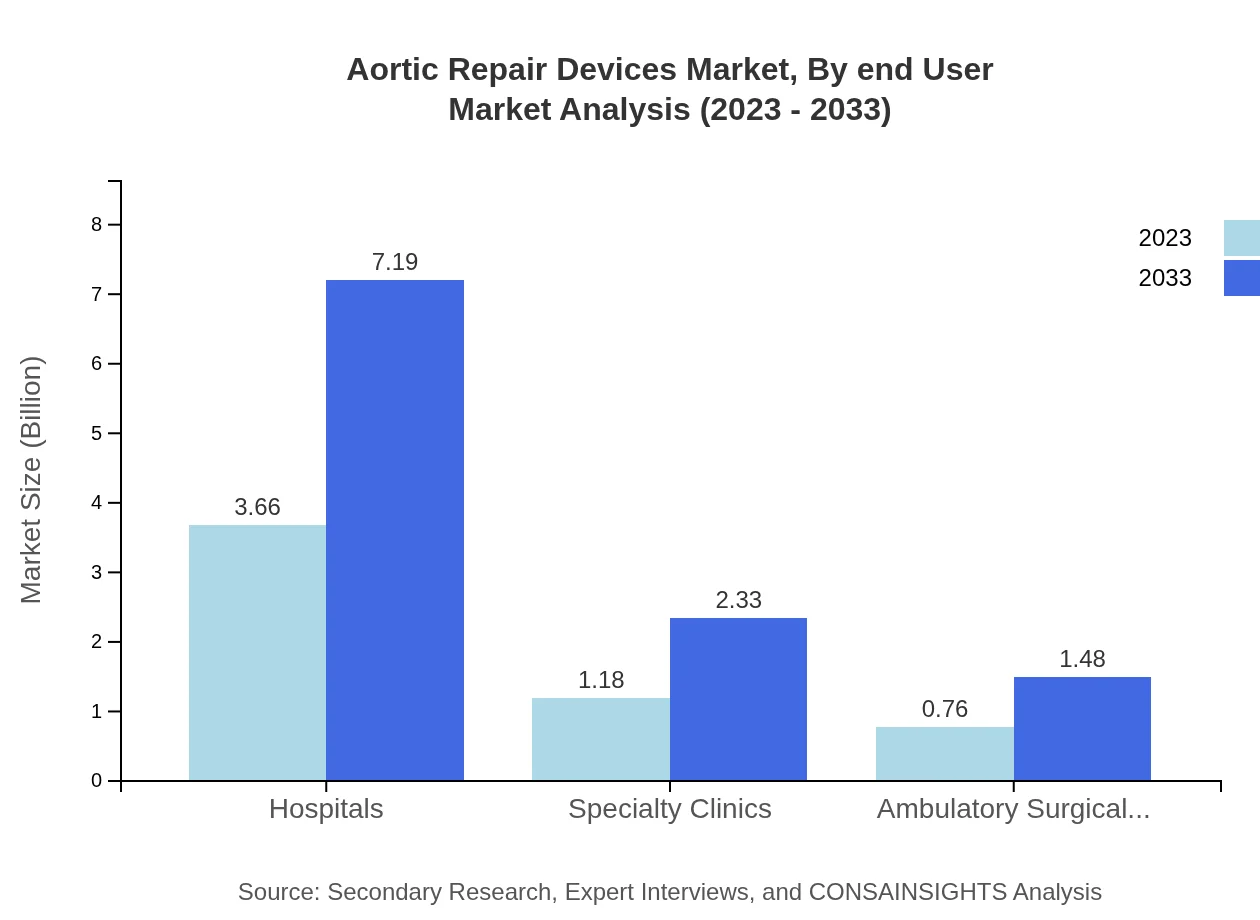
Hospitals, specialty clinics, and ambulatory surgical centers are the key end-users of Aortic Repair Devices. The hospital segment is the largest, expected to grow significantly from $3.66 billion in 2023 to $7.19 billion by 2033, holding a market share of 65.37%. Specialty clinics and ambulatory surgical centers contribute shares of 21.14% and 13.49%, respectively, with market sizes reaching $1.18 billion to $2.33 billion and $0.76 billion to $1.48 billion by 2033.
Aortic Repair Devices Market Trends and Future Forecast
Tell us your focus area and get a customized research report.
Global Market Leaders and Top Companies in Aortic Repair Devices Industry
Medtronic :
Medtronic is a global leader in medical technology, providing advanced Aortic Repair Devices and innovations that improve treatment outcomes.Abbott Laboratories:
Abbott is renowned for its high-quality cardiovascular devices, including stent grafts and related technologies in aortic repair.Boston Scientific:
Boston Scientific specializes in a wide array of medical devices, including cutting-edge solutions for aortic diseases.Cook Medical:
Cook Medical is known for its comprehensive range of devices for vascular therapies, with a strong focus on aortic repair.Terumo Corporation:
Terumo is a global healthcare company significantly involved in innovative device manufacturing for cardiovascular treatments.We're grateful to work with incredible clients.








FAQs
What is the market size of aortic repair devices in 2023?
The market size for aortic repair devices in 2023 is $5.60 Billion, as reported in the provided dataset.
How big will the market be in 2033?
By 2033 the market is projected to reach $11.01 Billion according to the supplied figures.
What is CAGR for the forecast period?
The compound annual growth rate for the 2023 to 2033 forecast period is 6.8%, based on the input data.
Which region is the fastest Growing in the Aortic Repair Devices Market Report market?
Latin America is the fastest-growing region, projected to expand from $0.28 Billion in 2023 to $0.56 Billion in 2033, reflecting an implied 7.18% CAGR over the forecast period.
Which region is the fastest Growing?
Latin America is the regional market region, with an implied 7.18% CAGR, increasing from $0.28 Billion in 2023 to $0.56 Billion in 2033.
Who are the top companies in this market?
Top companies listed in the input include Medtronic, Abbott Laboratories, Boston Scientific, Cook Medical, and Terumo Corporation.
What are common device types in this market?
Device types specified in the data include stent grafts and balloon-expandable devices.
Why are minimally invasive procedures important for growth?
Minimally invasive procedures support growth by increasing procedure adoption, reducing hospital stays, and improving patient outcomes, which drives demand for compatible devices.
What end users are covered in the segmentation?
End-user subsegments provided include hospitals, specialty clinics, and ambulatory surgical centers as listed in the input.
Which materials are highlighted for devices?
The dataset specifies polymer-based and metal-based devices as primary material categories.