

Artificial Blood Vessels Market Report
First published: 20 October 2024 | Last updated: 25 May 2026 | Report Code: artificial-blood-vessels
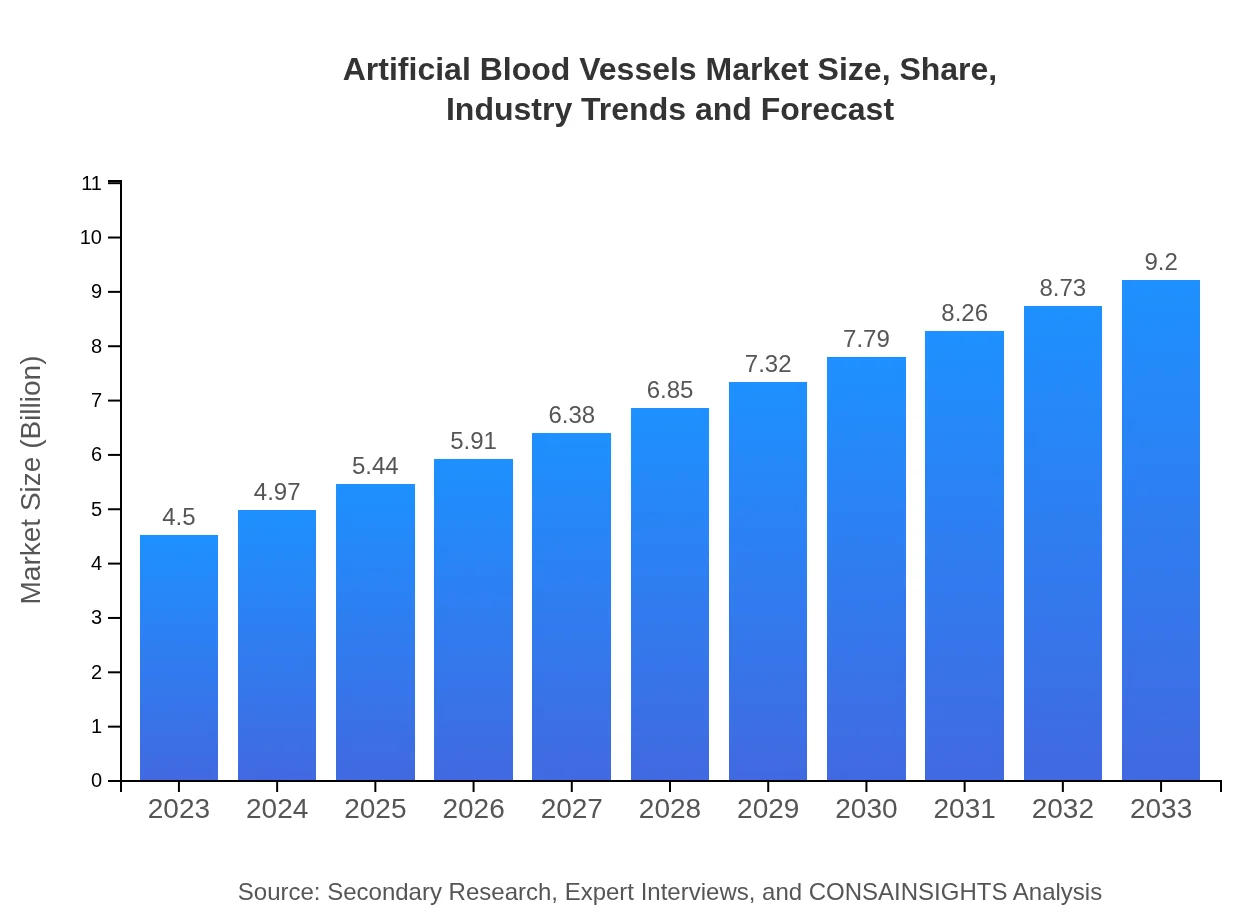
Artificial Blood Vessels Market — USD $4.5 Billion in 2023, Growing to USD 9.20null by 2033 at 7.2% CAGR
This report provides a comprehensive analysis of the Artificial Blood Vessels market, including growth trends, segmentation, and regional dynamics from 2023 to 2033. It offers insights into market size, key players, and future forecasts to guide stakeholders in decision-making.
Key Takeaways
- Global market size increases from $4.50 Billion in 2023 to $9.20 Billion in 2033 at a 7.2% CAGR.
- North America is largest regional market, while no single fastest-growing region is stated because regional CAGR differences remain within 0.15 percentage points.
- Europe expands from $1.42 Billion in 2023 to $2.90 Billion in 2033, reflecting steady demand for vascular solutions.
- Asia Pacific grows from $0.80 Billion in 2023 to $1.63 Billion in 2033, driven by rising healthcare investment and clinical adoption.
- Market innovation led by Medtronic, Boston Scientific, Terumo Corporation, and CryoLife, Inc. supports product development and commercialization.
Artificial Blood Vessels Market Report — Executive Summary
North America remains largest market by forecast-period value, while no single fastest-growing region is stated because top regional growth rates are separated by less than 0.15 percentage points. The Artificial Blood Vessels Market Report provides a focused assessment of a market increasing from $4.50 Billion in 2023 to $9.20 Billion in 2033, with a 7.2% CAGR over 2023 to 2033. Growth is supported by technological advancements in graft materials, expanding clinical applications in vascular and cardiac surgery, and rising prevalence of vascular disorders. Regional performance is tracked across North America, Europe, Asia Pacific, Latin America, and Middle East and Africa, with North America holding the largest market value by 2033. Product innovation, collaborations between manufacturers and research institutions, and growing healthcare expenditures are identifiable trends. The report also examines segmentation by material, application, end-user, and distribution channels, and profiles major players such as Medtronic, Boston Scientific, Terumo Corporation, and CryoLife, Inc.
Key Growth Drivers
- Advances in material science improving biocompatibility and graft durability support wider clinical adoption.
- Increasing incidence of vascular diseases and surgical demand expands need for synthetic and engineered vessels.
- Greater healthcare spending and expanded access to surgical care in multiple regions boost market uptake.
- Research collaborations and clinical trials accelerate development and regulatory approvals for novel graft technologies.
- Rising interest in personalized medical devices and methods such as patient-specific grafts fosters product differentiation.
| Metric | Value |
|---|---|
| Study Period | 2023 - 2033 |
| 2023 Market Size | $4.50 Billion |
| CAGR (2023-2033) | 7.2% |
| 2033 Market Size | $9.20 Billion |
| Top Companies | Medtronic , Boston Scientific, Terumo Corporation, CryoLife, Inc. |
| Published Date | 20 October 2024 |
| Last Modified Date | 25 May 2026 |
Artificial Blood Vessels Market Overview
Customize Artificial Blood Vessels Market Report market research report
- ✔ Get in-depth analysis of Artificial Blood Vessels market size, growth, and forecasts.
- ✔ Understand Artificial Blood Vessels's regional dynamics and industry-specific trends.
- ✔ Identify potential applications, end-user demand, and growth segments in Artificial Blood Vessels
What is the Market Size & CAGR of Artificial Blood Vessels Market Report market in 2023?
Artificial Blood Vessels Industry Analysis
Artificial Blood Vessels Market Segmentation and Scope
Tell us your focus area and get a customized research report.
Artificial Blood Vessels Market Report Market Analysis Report by Region
Europe Artificial Blood Vessels Market Report:
Europe grows from $1.42 Billion in 2023 to $2.9 Billion in 2033. Demand is supported by an aging population, ongoing clinical research, and increasing use of engineered grafts in vascular and cardiac surgical procedures across key healthcare systems.Asia Pacific Artificial Blood Vessels Market Report:
Asia Pacific grows from $0.8 Billion in 2023 to $1.63 Billion in 2033. Expansion is underpinned by rising healthcare expenditures, broader access to surgical care, and growing clinical adoption of synthetic vessels and new biomaterials in emerging markets.North America Artificial Blood Vessels Market Report:
North America is largest regional market, rising from $1.71 Billion in 2023 to $3.49 Billion in 2033. Regional strength is driven by advanced clinical infrastructure, high procedural volumes, investment in medical device innovation, and established reimbursement frameworks that support adoption.South America Artificial Blood Vessels Market Report:
Latin America grows from $0.15 Billion in 2023 to $0.31 Billion in 2033. Growth reflects expanding healthcare services, increased procedural capacity, and gradual adoption of advanced vascular repair products in regional medical centers.Middle East & Africa Artificial Blood Vessels Market Report:
Middle East and Africa grows from $0.42 Billion in 2023 to $0.87 Billion in 2033. Market progress is influenced by investments in healthcare infrastructure, improving access to surgical interventions, and increased interest in new graft technologies.Tell us your focus area and get a customized research report.
Research Methodology
Artificial Blood Vessels Market Analysis By Material
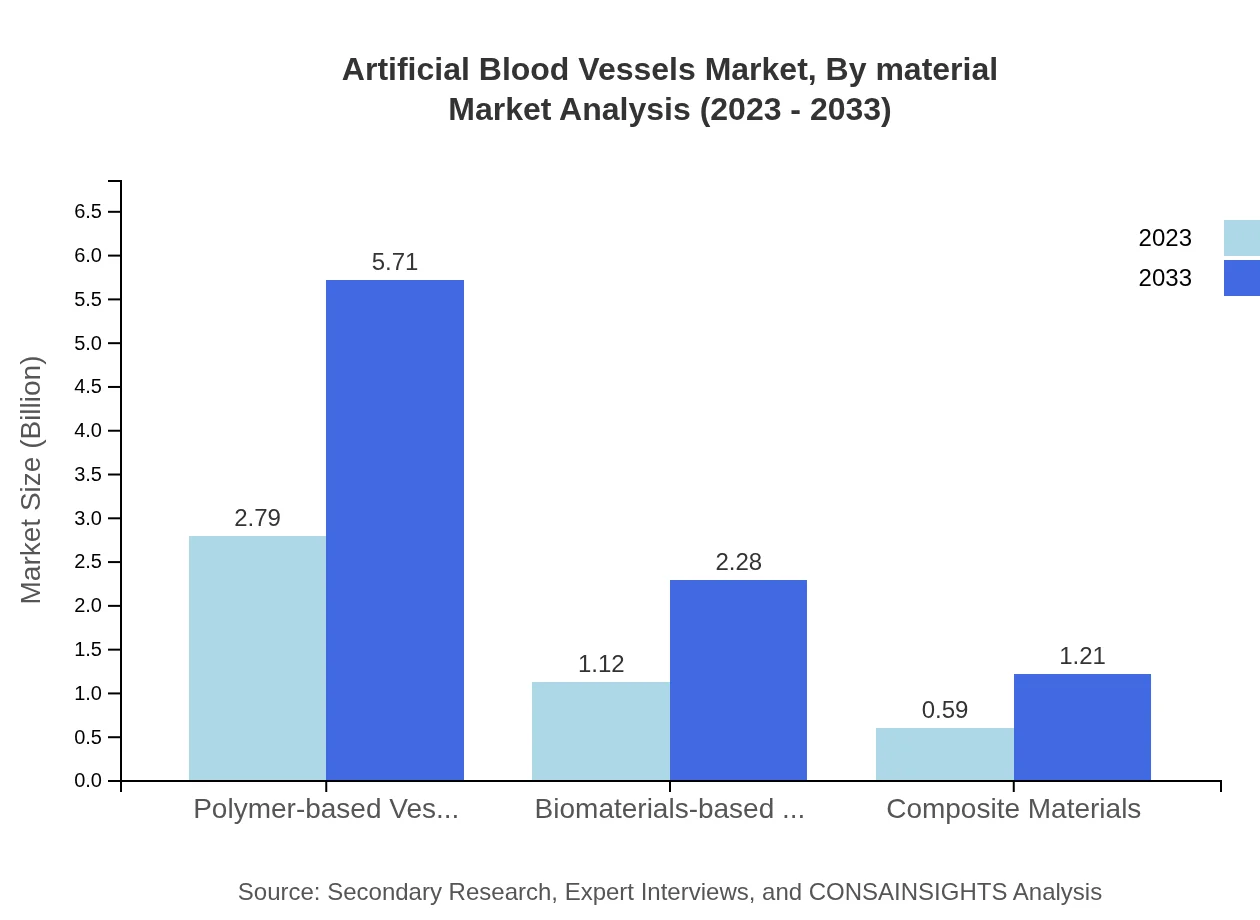
The market, segmented by material, features polymer-based vessels holding the largest share. In 2023, polymer-based vessels command a market size of USD 2.79 billion, projected to reach USD 5.71 billion by 2033, maintaining a steady market share of 62.09%. Biomaterials-based vessels and composite materials follow, with market sizes of USD 1.12 billion and USD 0.59 billion respectively, indicating their significance and potential for growth.
Artificial Blood Vessels Market Analysis By Application
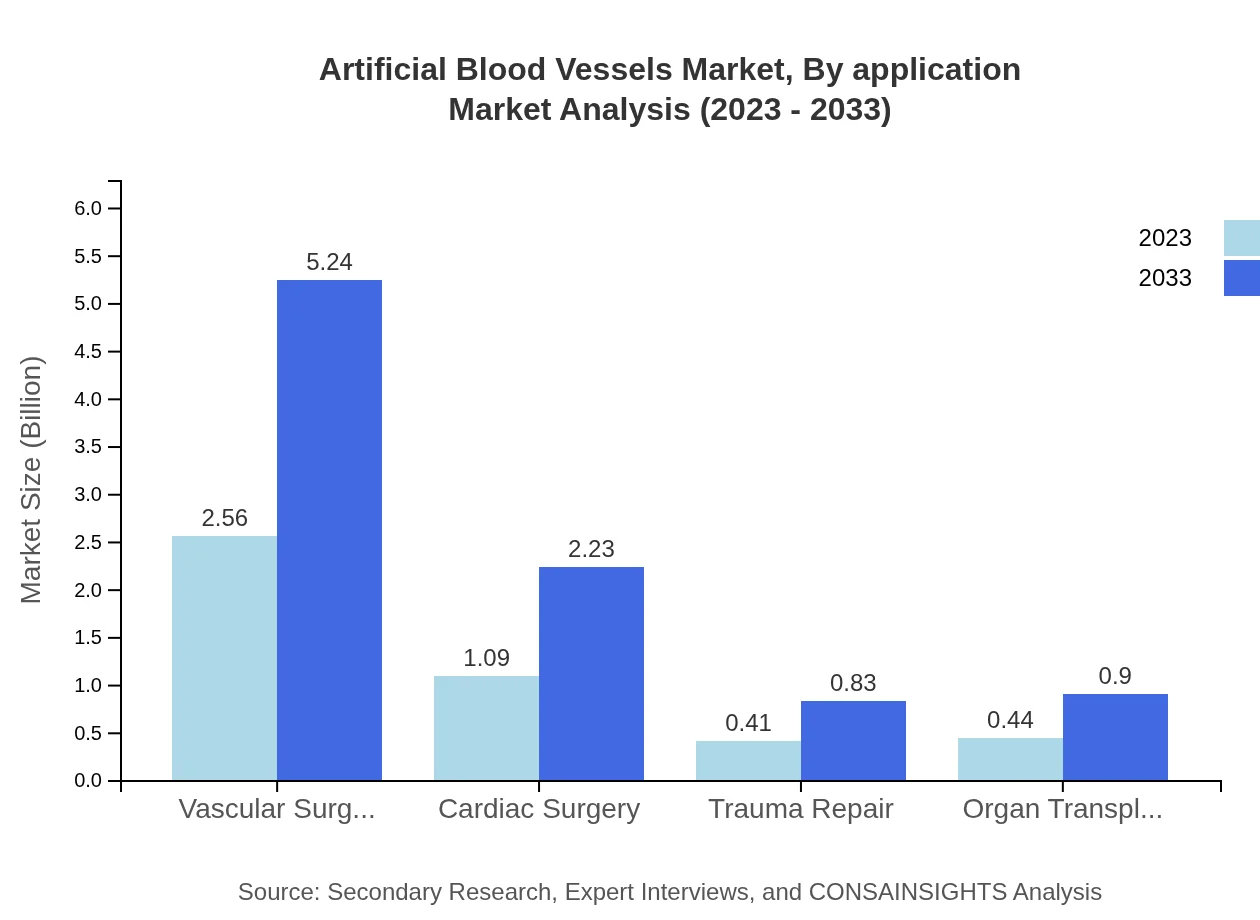
Applications for artificial blood vessels span vascular surgeries, cardiac surgeries, trauma repair, and organ transplantation. Vascular surgeries are expected to dominate with a market size of USD 2.56 billion in 2023 and projected to be USD 5.24 billion by 2033. Cardiac surgeries will also show substantial growth from USD 1.09 billion to USD 2.23 billion during the same period, reflecting increased surgical procedures.
Artificial Blood Vessels Market Analysis By End User
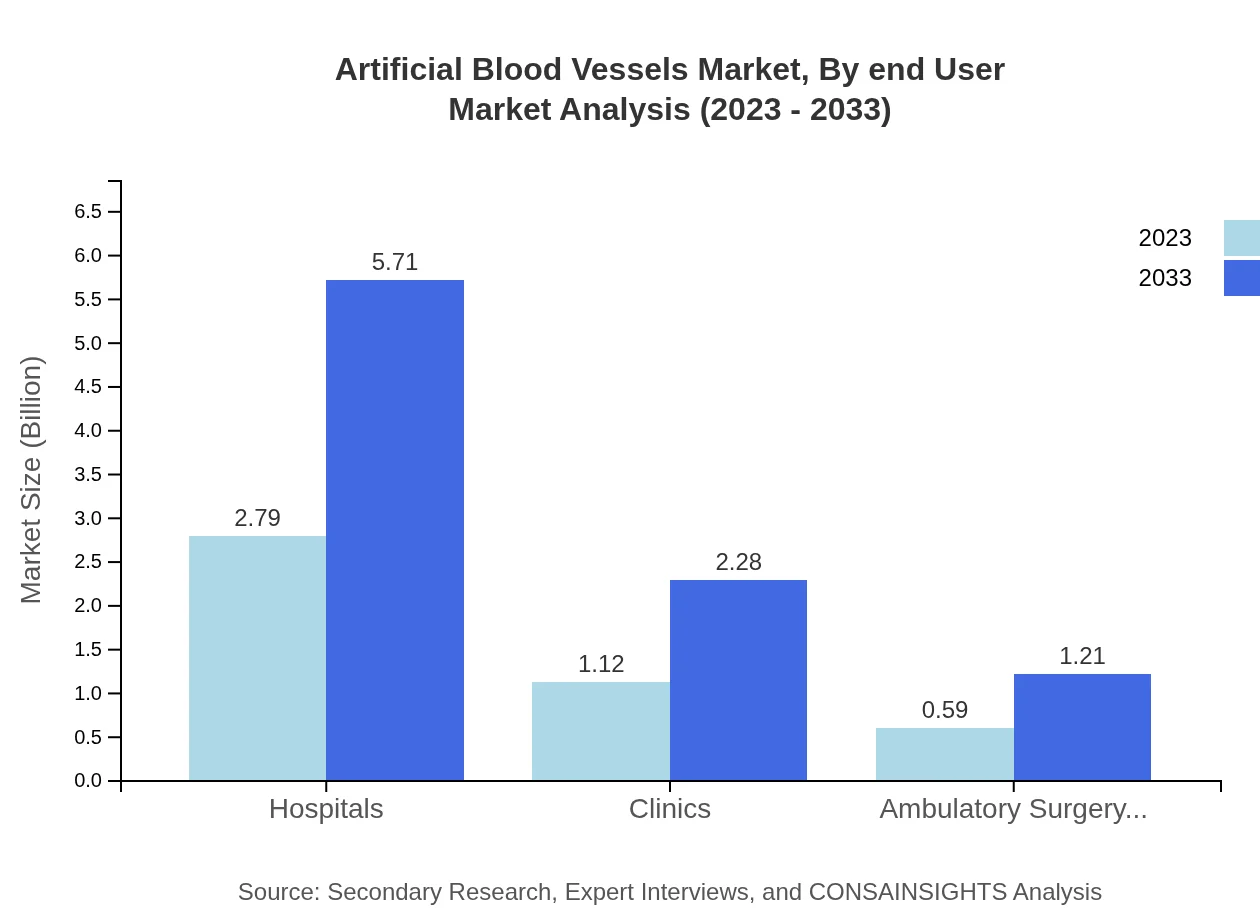
In terms of end-users, hospitals remain the primary consumers of artificial blood vessels with a market size of USD 2.79 billion in 2023. This segment is anticipated to reach USD 5.71 billion by 2033. Clinics and ambulatory surgery centers also play crucial roles, accounting for USD 1.12 billion and USD 0.59 billion respectively in 2023.
Artificial Blood Vessels Market Analysis By Region
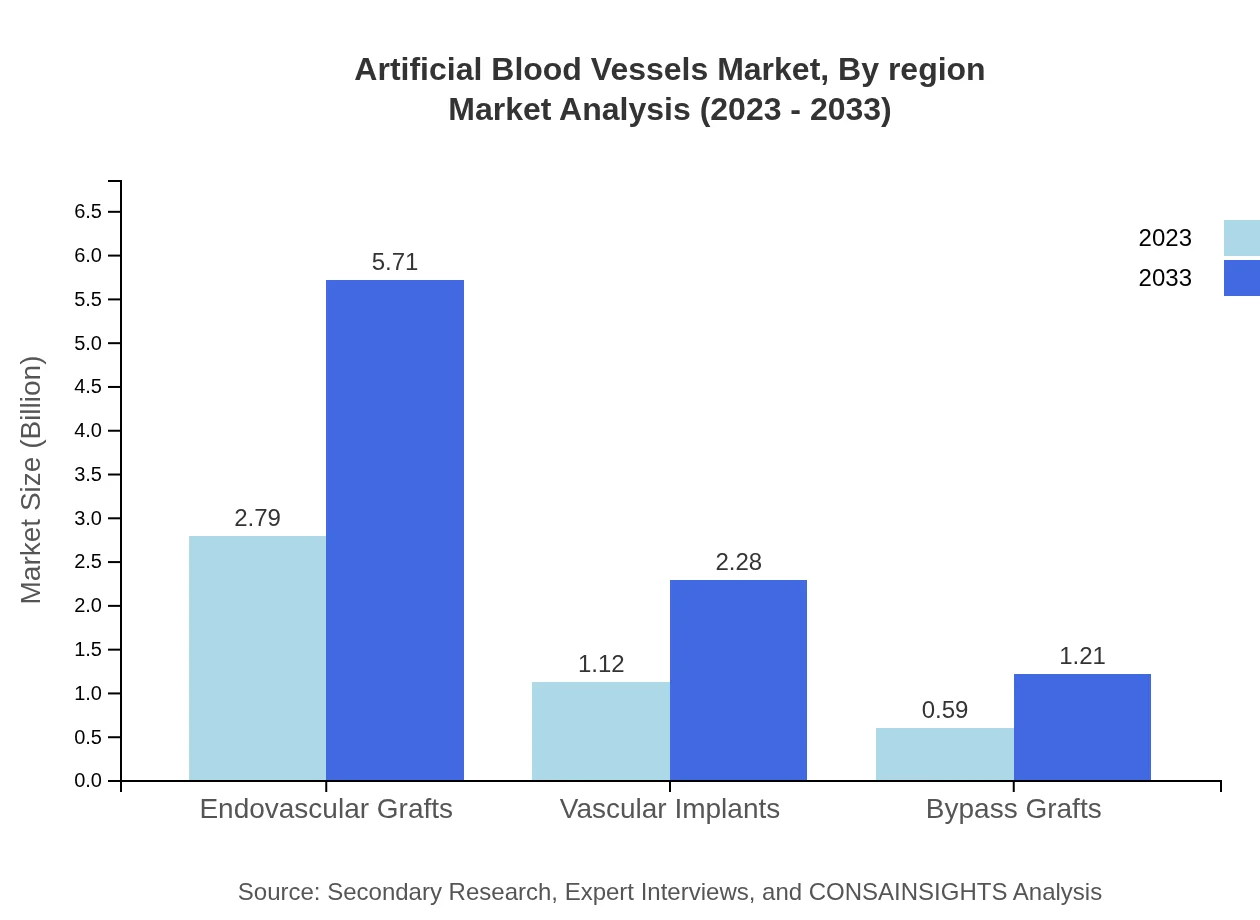
The product type analysis includes endovascular grafts, vascular implants, and bypass grafts. Endovascular grafts dominate the market with a size of USD 2.79 billion in 2023, expected to grow to USD 5.71 billion by 2033, capturing a 62.09% market share. Conversely, bypass grafts showcase a modest growth trajectory, starting from USD 0.59 billion and enhancing to USD 1.21 billion.
Artificial Blood Vessels Market Analysis By Distribution Channel
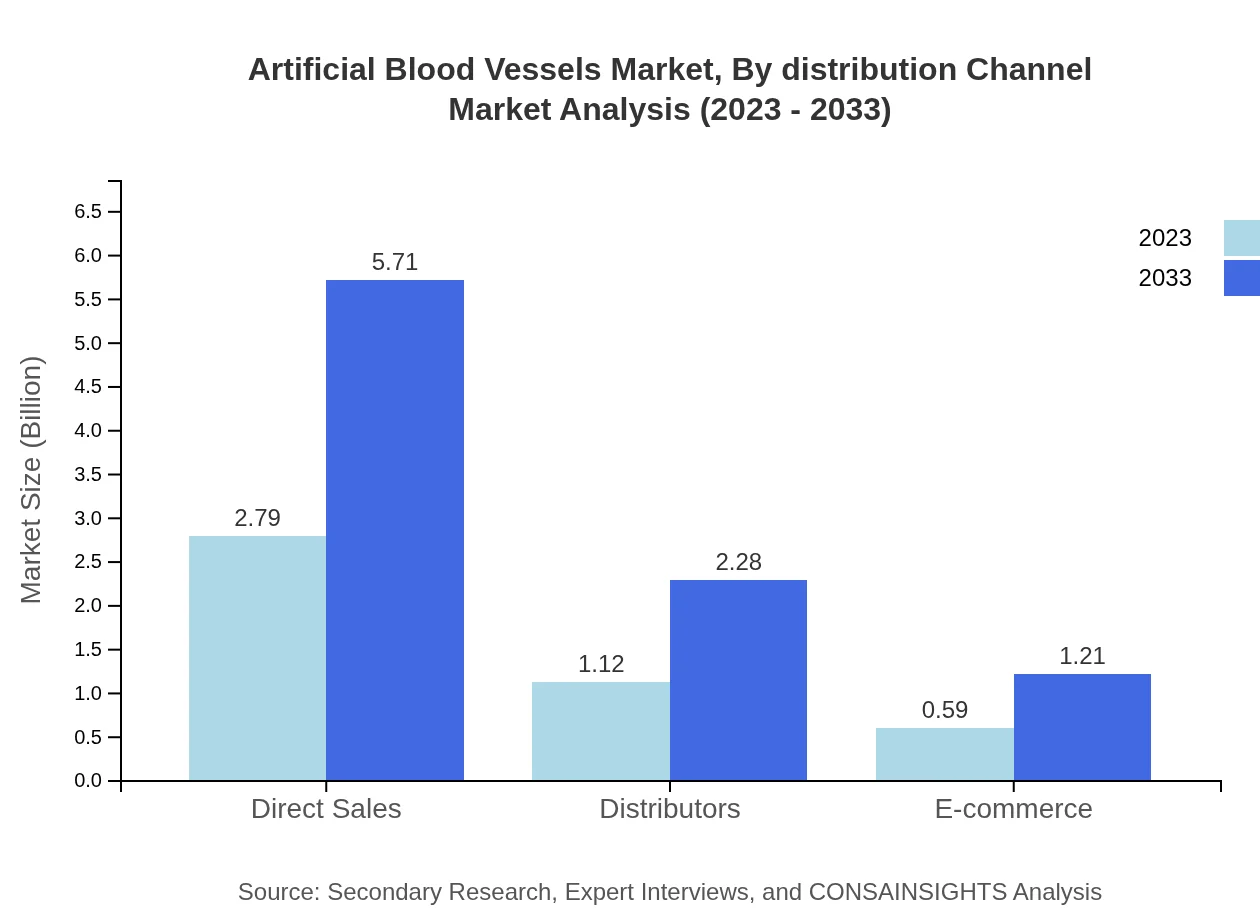
Distribution channels for artificial blood vessels include direct sales, distributors, and e-commerce. Direct sales are leading with a market size of USD 2.79 billion in 2023, projected to reach USD 5.71 billion by 2033. Distributors will also showcase significant growth, increasing from USD 1.12 billion to USD 2.28 billion.
Artificial Blood Vessels Market Trends and Future Forecast
Tell us your focus area and get a customized research report.
Global Market Leaders and Top Companies in Artificial Blood Vessels Industry
Medtronic :
Medtronic is a leading player in the global medical technology arena, particularly known for its artificial blood vessels and vascular grafts that are widely used in various surgical procedures.Boston Scientific:
Boston Scientific develops innovative medical solutions, including state-of-the-art vascular grafts that support patient recovery and outcomes, enhancing their position in the artificial blood vessels market.Terumo Corporation:
Terumo focuses on the high-quality production of medical devices, including artificial blood vessels, emphasizing research and development to ensure cutting-edge solutions.CryoLife, Inc.:
CryoLife is recognized for its advanced preservation technologies for tissues and vascular grafts, leading innovative approaches in the artificial blood vessels segment.We're grateful to work with incredible clients.








FAQs
What is the current market size of the artificial blood vessels market?
The global market was $4.50 Billion in 2023, reflecting the baseline for the forecast period and serving as the reference point for projected expansion to 2033.
How big will the market be in 2033?
The market is projected to reach $9.20 Billion by 2033, representing the end value for the 2023 to 2033 forecast horizon as stated in the report data.
What is CAGR of this market?
The market is forecast to grow at a compound annual growth rate of 7.2% during the 2023 to 2033 period, as provided in the report figures.
Is there a single fastest Growing region in the Artificial Blood Vessels Market Report market?
No single fastest-growing region is stated for the Artificial Blood Vessels Market Report market because the top regional implied CAGR values are within 0.15 percentage points of each other, making the ranking too close to call reliably.
Which companies are leading the artificial blood vessels sector?
Top firms identified include Medtronic, Boston Scientific, Terumo Corporation, and CryoLife, Inc., which are prominent in product development and commercialization efforts.
How are materials influencing market development?
Innovations in polymers, biomaterials and composite structures enhance graft performance and biocompatibility, supporting broader clinical use across surgical specialties.
What role do hospitals play as end users?
Hospitals are key end users, providing the majority of complex vascular and cardiac procedures where artificial vessels are selected for grafting and repair interventions.
What is driving adoption in Asia Pacific?
Asia Pacific growth is supported by increased healthcare investments and procedure volumes, reflected in a rise from $0.80 Billion in 2023 to $1.63 Billion in 2033.
What factors affect market commercialization?
Regulatory pathways, reimbursement policies, and clinical evidence from trials and studies influence time-to-market and adoption rates for new artificial vessel products.
Who contributes primary insights for this research?
Primary insights are derived from interviews with industry experts, complemented by secondary sources and validation processes described in the methodology.