

Aseptic Processing Market Report
First published: 22 October 2024 | Last updated: 25 May 2026 | Report Code: aseptic-processing
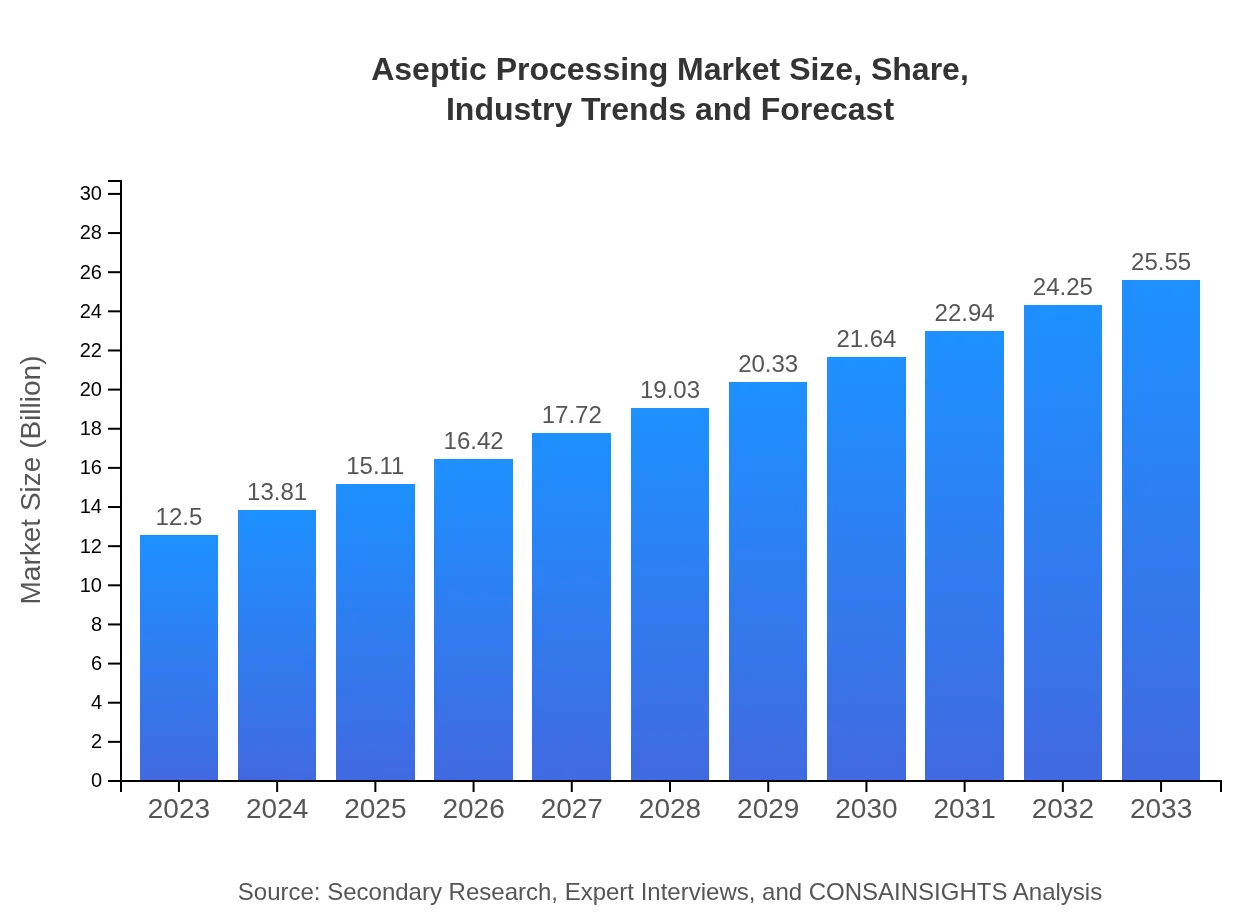
Aseptic Processing Market — USD 12.5 billion in 2023, Growing to USD 25.55B by 2033 at 7.2% CAGR
This report offers a comprehensive analysis of the Aseptic Processing market, covering essential insights such as market size, growth projections, segmentation, and regional dynamics for the forecast period from 2023 to 2033.
Key Takeaways
- Global market increases from $12.50 Billion in 2023 to $25.55 Billion in 2033 at a 7.2% CAGR.
- North America is largest regional market, while no single fastest-growing region is stated because regional CAGR differences remain within 0.15 percentage points.
- Europe grows from $3.92 Billion to $8.02 Billion, while Asia Pacific expands from $2.25 Billion to $4.59 Billion.
- Market development is supported by advances in sterilization methods, automation, and demand for shelf-stable and safe products.
- Leading companies include Tetra Pak, Becton Dickinson and Company, GEA Group, and Stevanato Group.
Aseptic Processing Market Report — Executive Summary
North America remains largest market by forecast-period value, while no single fastest-growing region is stated because top regional growth rates are separated by less than 0.15 percentage points. This report outlines the Aseptic Processing market’s trajectory from 2023 to 2033, with the total market rising from $12.50 Billion to $25.55 Billion at a 7.2% CAGR. Growth is driven by demand for extended shelf life, enhanced product safety, and increasing adoption of automated systems and advanced sterilization techniques. North America holds the largest regional share, supported by established manufacturing capacity and investment in technology. The market is segmented by product, industry, technology, application, and sterilization method, revealing diverse opportunities across pharmaceuticals, biotechnology, food and beverage, and cosmetics. Firms such as Tetra Pak, Becton Dickinson and Company, GEA Group, and Stevanato Group are active participants. Ongoing innovation, regulatory requirements for contamination control, and a push for sustainability are expected to direct capital allocation and R&D priorities. The report synthesizes primary interviews, secondary sources, and internal validation to present a structured view of trends, obstacles, and actionable insights for stakeholders planning market entry, partnerships, or expansion.
Key Growth Drivers
- Rising consumer demand for safer, longer-lasting food and beverage products increases uptake of aseptic methods.
- Pharmaceutical and biotechnology firms require contamination control, driving investment in aseptic equipment and consumables.
- Automation adoption reduces contamination risk and labor costs, encouraging conversion from manual to automated processing.
- Advances in sterilization technologies broaden application scope and improve process reliability across industries.
- Sustainability initiatives promote energy-efficient processing and reduced waste, influencing supplier and buyer strategies.
| Metric | Value |
|---|---|
| Study Period | 2023 - 2033 |
| 2023 Market Size | $12.50 Billion |
| CAGR (2023-2033) | 7.2% |
| 2033 Market Size | $25.55 Billion |
| Top Companies | Tetra Pak, Becton Dickinson and Company, GEA Group, Stevanato Group |
| Published Date | 22 October 2024 |
| Last Modified Date | 25 May 2026 |
Aseptic Processing Market Overview
Customize Aseptic Processing Market Report market research report
- ✔ Get in-depth analysis of Aseptic Processing market size, growth, and forecasts.
- ✔ Understand Aseptic Processing's regional dynamics and industry-specific trends.
- ✔ Identify potential applications, end-user demand, and growth segments in Aseptic Processing
What is the Market Size & CAGR of Aseptic Processing Market Report market in 2023?
Aseptic Processing Industry Analysis
Aseptic Processing Market Segmentation and Scope
Tell us your focus area and get a customized research report.
Aseptic Processing Market Report Market Analysis Report by Region
Europe Aseptic Processing Market Report:
Europe grows from $3.92 Billion in 2023 to $8.02 Billion in 2033. This progression reflects regulatory focus on product safety, investments in sterilization and automation, and demand for extended shelf life in food and pharmaceutical applications.Asia Pacific Aseptic Processing Market Report:
Asia Pacific grows from $2.25 Billion in 2023 to $4.59 Billion in 2033. Growth drivers include rising consumption of packaged goods, expanding pharmaceutical and biotech manufacturing, and increasing adoption of automated aseptic systems.North America Aseptic Processing Market Report:
North America is largest regional market, rising from $4.75 Billion in 2023 to $9.7 Billion in 2033. Regional expansion is supported by established manufacturing infrastructure, technology adoption, and demand from pharmaceutical and food and beverage sectors.South America Aseptic Processing Market Report:
Latin America grows from $0.58 Billion in 2023 to $1.18 Billion in 2033. Market advances are linked to growing packaged food demand, improving manufacturing capabilities, and gradual investment in aseptic technologies.Middle East & Africa Aseptic Processing Market Report:
Middle East and Africa grows from $1.01 Billion in 2023 to $2.06 Billion in 2033. Expansion is supported by investment in food safety infrastructure, pharmaceutical production growth, and adoption of modern sterilization techniques.Tell us your focus area and get a customized research report.
Research Methodology
Aseptic Processing Market Analysis By Product
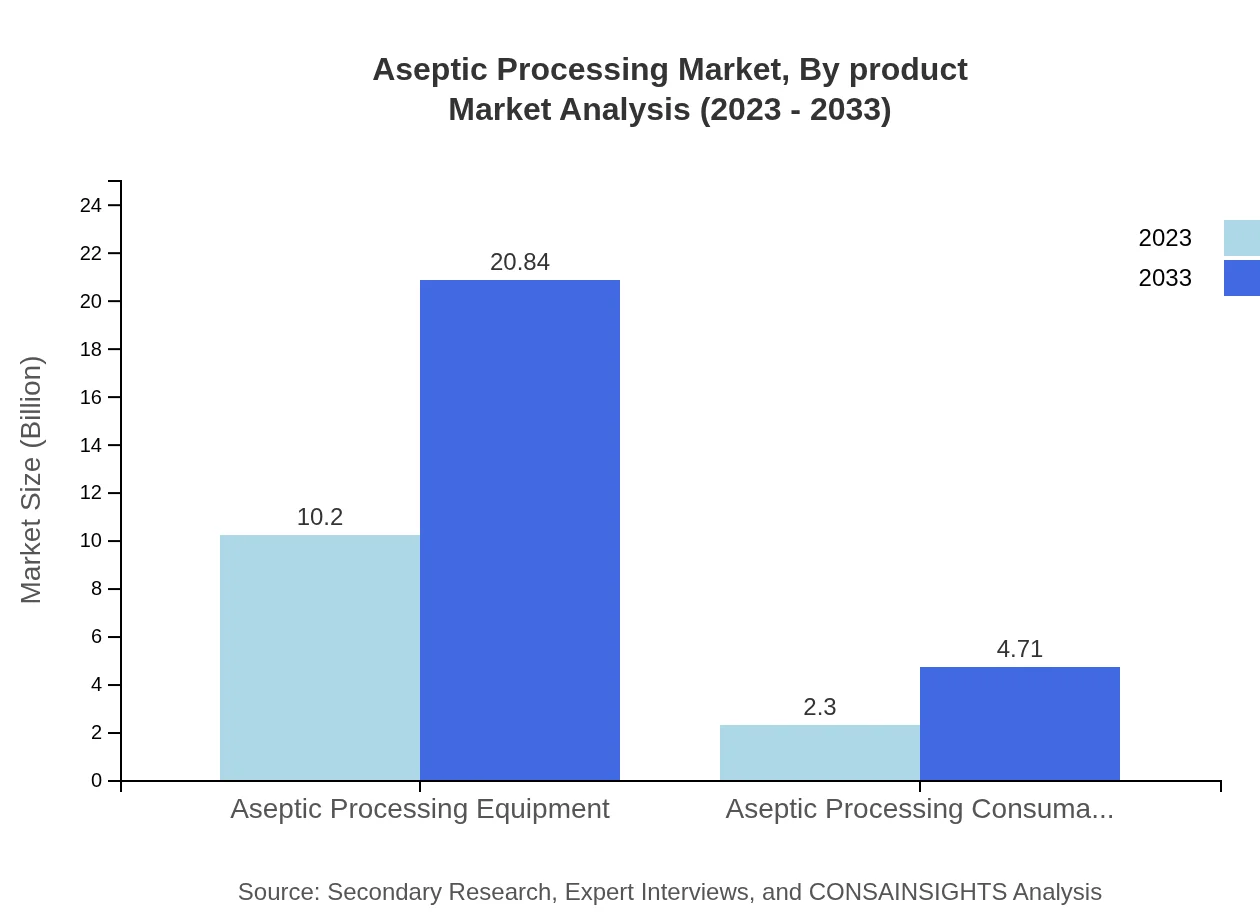
The Aseptic Processing market is segmented by product into Aseptic Processing Equipment and Aseptic Processing Consumables. In 2023, the equipment segment, valued at $10.20 billion, is expected to grow to $20.84 billion by 2033, while consumables will increase from $2.30 billion to $4.71 billion. This increasing demand for equipment underscores the industry's shift towards automated processing.
Aseptic Processing Market Analysis By Industry
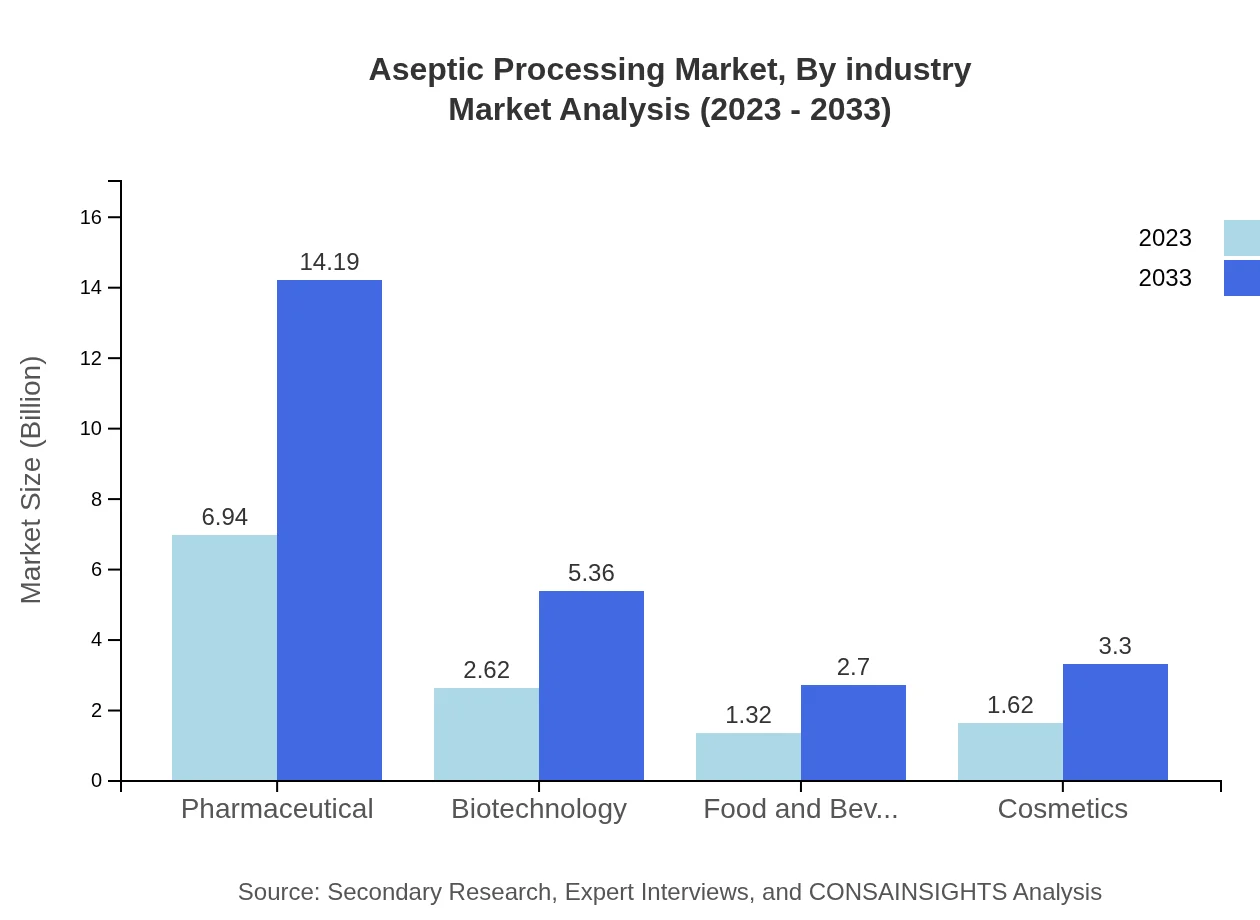
The primary sectors utilizing Aseptic Processing include Pharmaceuticals, Biotechnology, Food and Beverage, and Cosmetics. The Pharmaceutical sector is projected to grow from $6.94 billion in 2023 to $14.19 billion by 2033, while the Biotechnology sector increases from $2.62 billion to $5.36 billion in the same period. The Food and Beverage market shows significant growth due to increasing consumer demand for longer-shelf-life products, anticipated to rise from $1.32 billion to $2.70 billion.
Aseptic Processing Market Analysis By Sterilization Technique
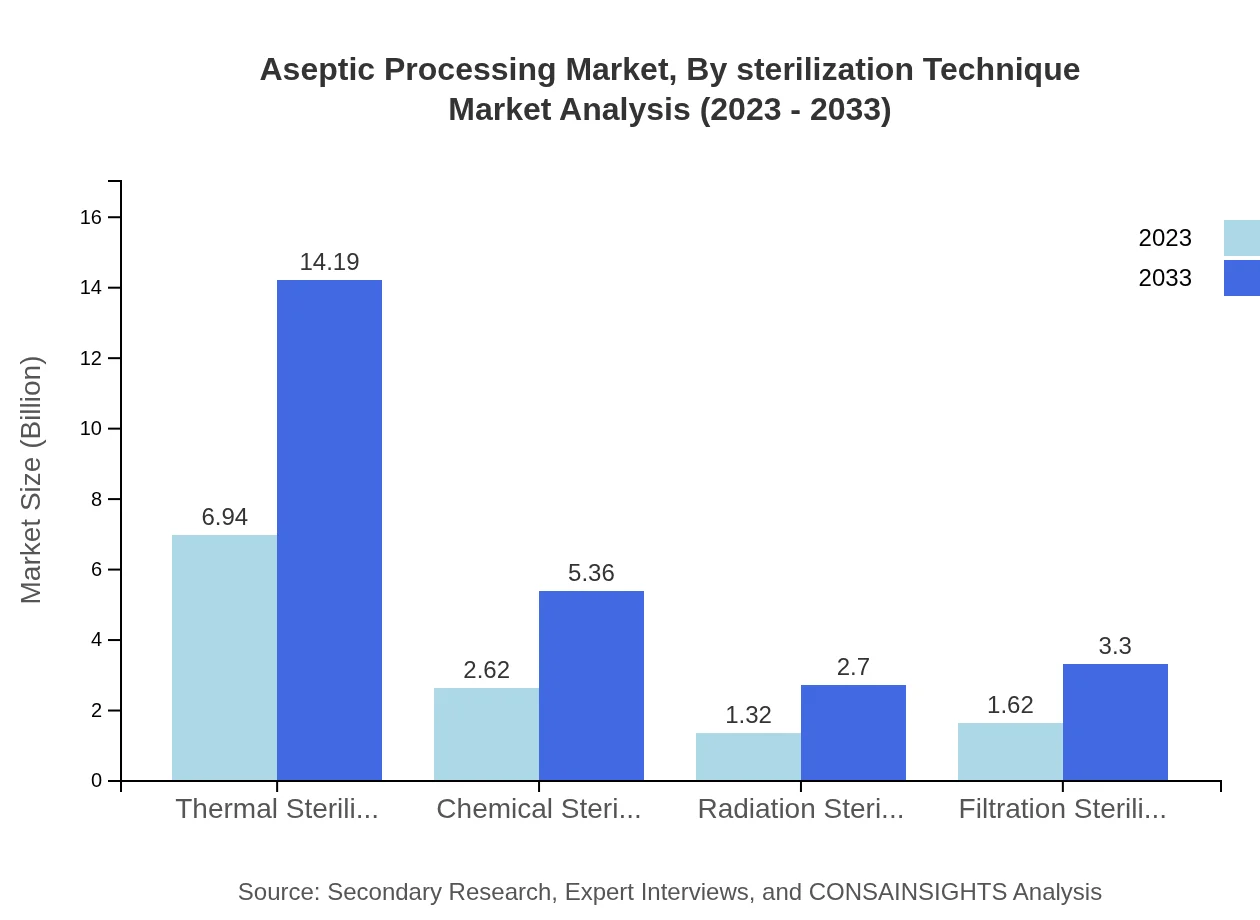
Key sterilization techniques in Aseptic Processing include Thermal Sterilization, Chemical Sterilization, Radiation Sterilization, and Filtration Sterilization. Thermal Sterilization dominates with a market size of $6.94 billion in 2023, growing to $14.19 billion by 2033. In contrast, Chemical Sterilization will rise from $2.62 billion to $5.36 billion, driven by diverse applications across industries.
Aseptic Processing Market Analysis By Application
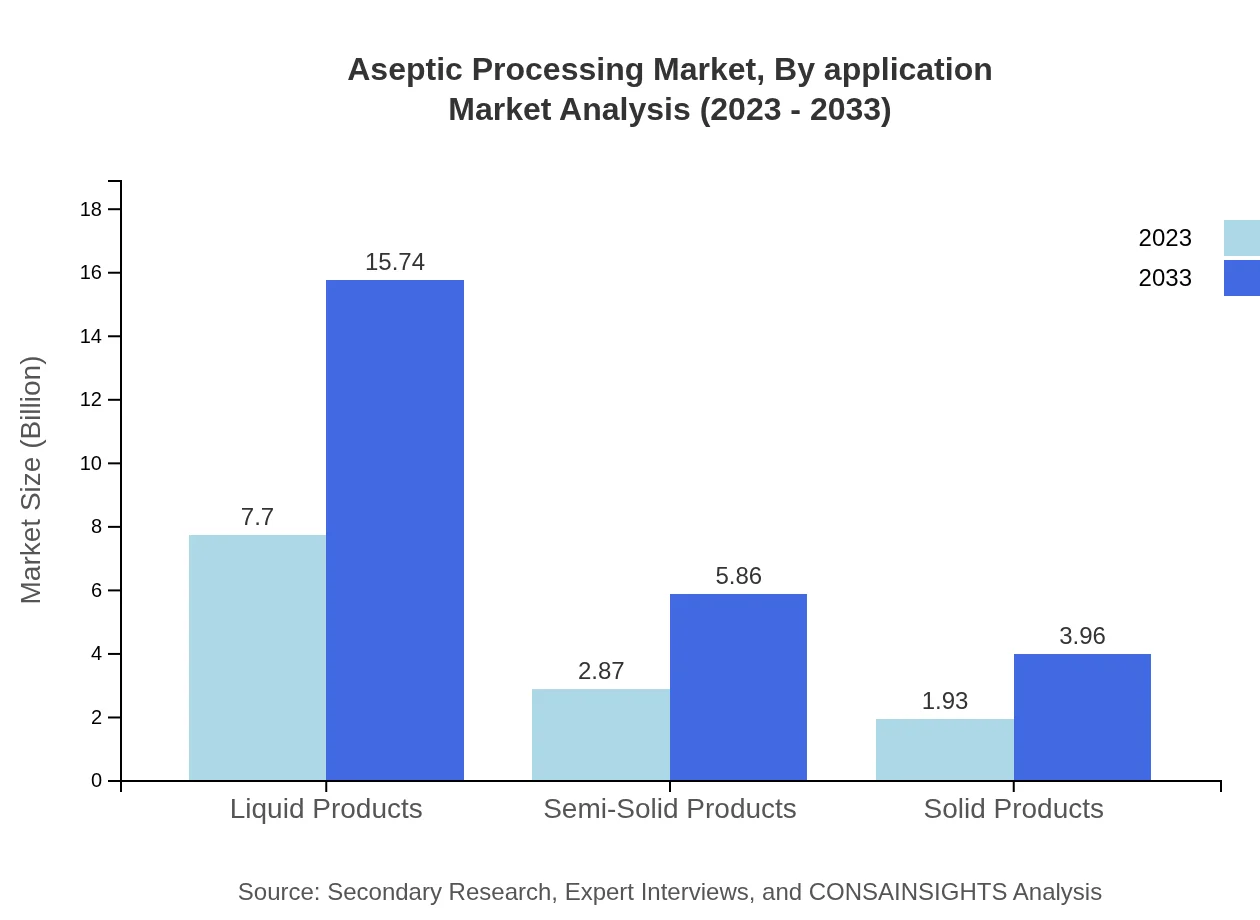
The applications of Aseptic Processing encompass Liquid Products, Semi-Solid Products, and Solid Products. Liquid Products lead with a projected growth from $7.70 billion in 2023 to $15.74 billion by 2033. Semi-Solid Products will follow with an anticipated rise from $2.87 billion to $5.86 billion, while Solid Products are also expected to grow significantly in response to evolving consumer preferences.
Aseptic Processing Market Analysis By Technology
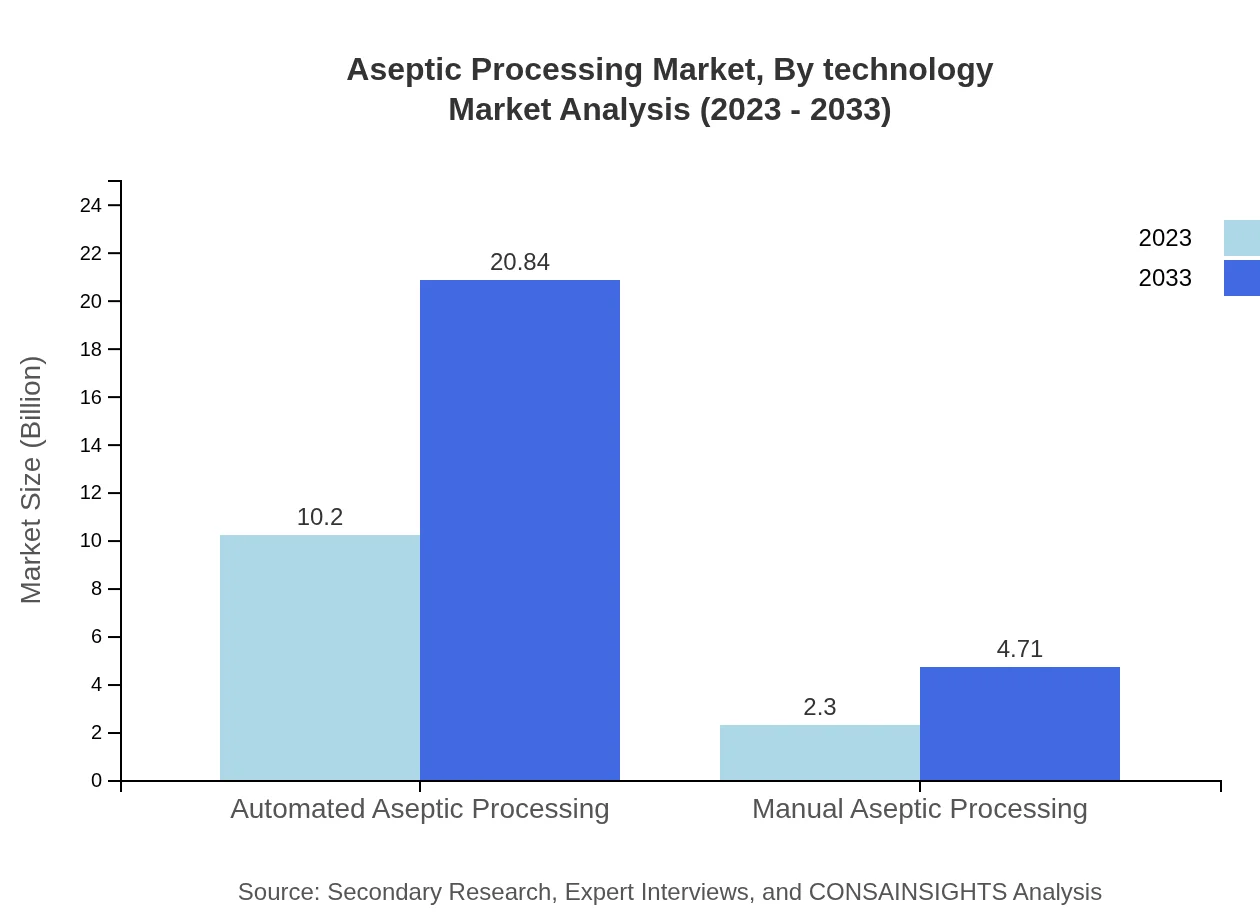
The technological landscape within Aseptic Processing is dominated by automated systems, which account for 81.57% market share in 2023, totaling $10.20 billion, increasing to a projected $20.84 billion by 2033. This emphasizes a trend towards efficiency and scalability in aseptic production, as automation minimizes human error and improves productivity.
Aseptic Processing Market Trends and Future Forecast
Tell us your focus area and get a customized research report.
Global Market Leaders and Top Companies in Aseptic Processing Industry
Tetra Pak:
Tetra Pak is renowned for its innovative aseptic processing and packaging solutions, especially in dairy and beverage sectors, emphasizing sustainability and efficiency in food processing.Becton Dickinson and Company:
Becton Dickinson is a leader in medical technology, providing sophisticated aseptic processing solutions for pharmaceuticals, ensuring safety and compliance in drug manufacturing.GEA Group:
GEA Group specializes in food processing technologies and equipment, enhancing the preservation and safety of various food products through advanced aseptic solutions.Stevanato Group:
Stevanato Group focuses on pharmaceutical packaging and solutions, developing innovative systems that uphold stringent aseptic processing standards for health products.We're grateful to work with incredible clients.








FAQs
What is the market size of the Aseptic Processing Market Report in 2023?
The market size in 2023 is $12.50 Billion as reported for the Aseptic Processing Market Report.
How big will the market be in 2033?
The forecasted market value for 2033 is $25.55 Billion according to the provided data for the Aseptic Processing Market Report.
What is CAGR for the forecast period?
The compound annual growth rate for the 2023 to 2033 forecast period is 7.2%.
Is there a single fastest Growing region in the Aseptic Processing Market Report market?
No single fastest-growing region is stated for the Aseptic Processing Market Report market because the top regional implied CAGR values are within 0.15 percentage points of each other, making the ranking too close to call reliably.
Which companies are leading the market?
Top companies cited include Tetra Pak, Becton Dickinson and Company, GEA Group, and Stevanato Group.
What are common applications driving aseptic processing?
Applications include liquid, semi-solid, and solid products across food and beverage, pharmaceutical, biotechnology, and cosmetics sectors.
How are sterilization techniques influencing the market?
Multiple sterilization approaches—thermal, chemical, radiation, and filtration—support broader implementation and process flexibility.
What research methods supported this report?
The study used primary interviews with industry experts and secondary research from company reports and publications, plus data triangulation and internal validation.