
Reports >
Life Sciences
>
Enteral Feeding Devices Market Report

Enteral Feeding Devices Market Report
First published: 22 October 2024 | Last updated: 25 May 2026 | Report Code: enteral-feeding-devices
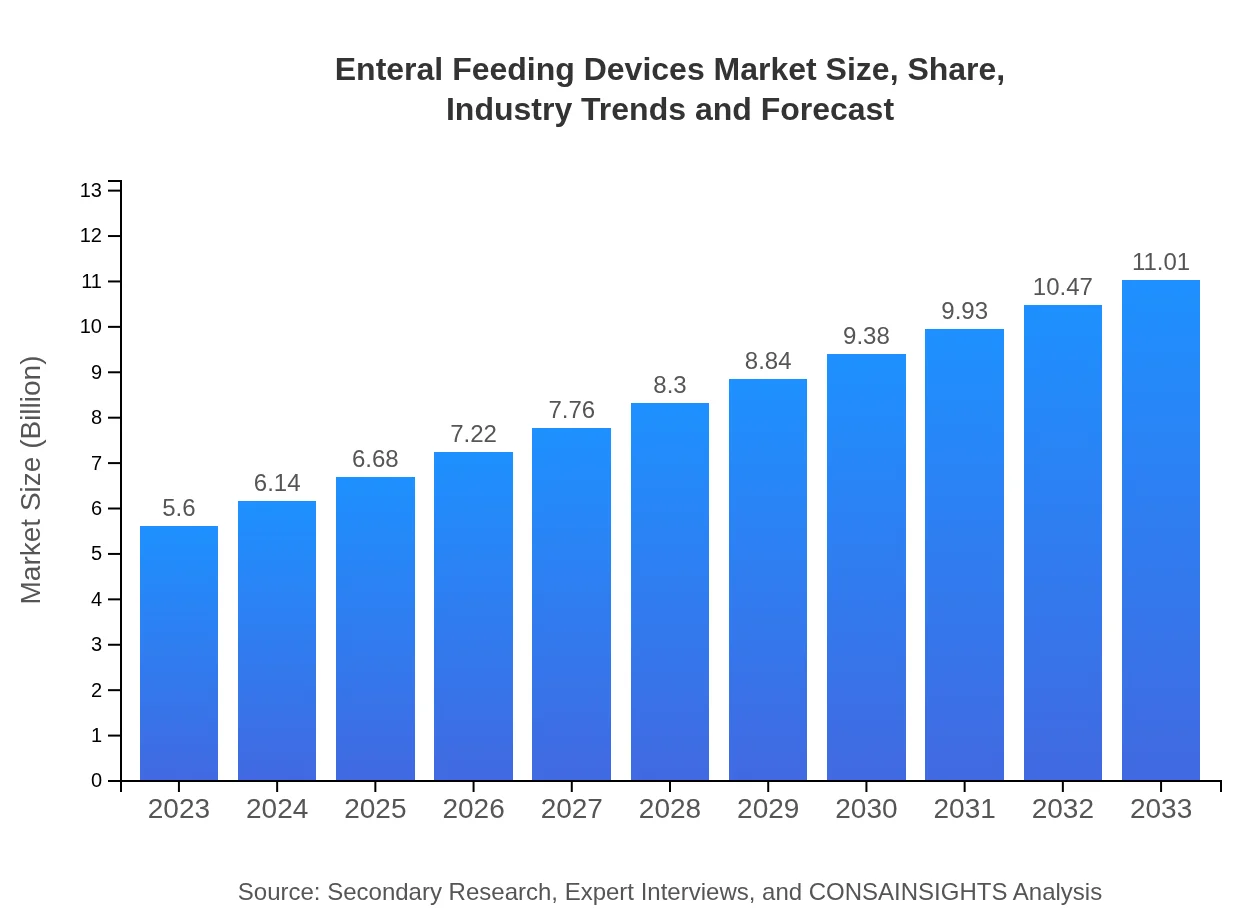
Enteral Feeding Devices Market — USD 5.6 billion in 2023, Growing to USD 11.01B by 2033 at 6.8% CAGR
This report provides a comprehensive analysis of the Enteral Feeding Devices market, highlighting key trends, forecasts, and insights from 2023 to 2033, including market sizes, segmentation, and regional analysis.
Key Takeaways
- Global market grows from $5.60 Billion in 2023 to $11.01 Billion in 2033 at a 6.8% CAGR.
- Europe is largest regional market, while no single fastest-growing region is stated because regional CAGR differences remain within 0.15 percentage points.
- North America rises from $1.88 Billion to $3.69 Billion between 2023 and 2033, reflecting sustained demand.
- Asia Pacific increases from $1.00 Billion in 2023 to $1.97 Billion in 2033, driven by expanding care settings.
- Market structure includes feeding pumps, feeding tubes, accessories, and end-users such as hospitals and home care.
Enteral Feeding Devices Market Report — Executive Summary
Europe remains largest market by forecast-period value, while no single fastest-growing region is stated because top regional growth rates are separated by less than 0.15 percentage points. The Enteral Feeding Devices Market Report outlines sustained expansion driven by rising needs for nutritional support in clinical and home settings. The market size increases from $5.60 Billion in 2023 to $11.01 Billion in 2033, reflecting a 6.8% CAGR for the forecast period 2023 to 2033. Demand stems from higher prevalence of chronic conditions requiring enteral nutrition, growing use of enteral methods over parenteral feeding, and technological improvements in pumps and consumables. The market is structured by product categories—feeding pumps, feeding tubes, and accessories—and by end-users including hospitals, long-term care facilities, home care, and rehabilitation centers. Europe is identified as the largest regional market, while the regional market region is not specified due to close regional growth rates. Regulatory compliance such as FDA and CE marking shapes product introductions and market access. Prominent players noted include Abbott Laboratories, Fresenius Kabi, Baxter International, and Nestlé Health Science, whose activities influence competitive dynamics through product launches and partnerships.
Key Growth Drivers
- Increasing clinical demand for enteral nutrition due to chronic disease prevalence and aging populations.
- Preference for enteral feeding over parenteral approaches in many care settings, supporting device uptake.
- Technological advancements in feeding pumps and monitoring that improve usability and patient comfort.
- Expansion of care delivery outside hospitals, including home care and long-term care facilities.
- Regulatory emphasis on safety and efficacy, prompting product updates and market entry strategies.
| Metric | Value |
|---|---|
| Study Period | 2023 - 2033 |
| 2023 Market Size | $5.60 Billion |
| CAGR (2023-2033) | 6.8% |
| 2033 Market Size | $11.01 Billion |
| Top Companies | Abbott Laboratories, Fresenius Kabi, Baxter International, Nestlé Health Science |
| Published Date | 22 October 2024 |
| Last Modified Date | 25 May 2026 |
Enteral Feeding Devices Market Overview
Customize Enteral Feeding Devices Market Report market research report
- ✔ Get in-depth analysis of Enteral Feeding Devices market size, growth, and forecasts.
- ✔ Understand Enteral Feeding Devices's regional dynamics and industry-specific trends.
- ✔ Identify potential applications, end-user demand, and growth segments in Enteral Feeding Devices
What is the Market Size & CAGR of Enteral Feeding Devices Market Report market in 2023?
Enteral Feeding Devices Industry Analysis
Enteral Feeding Devices Market Segmentation and Scope
Tell us your focus area and get a customized research report.
Enteral Feeding Devices Market Report Market Analysis Report by Region
Europe Enteral Feeding Devices Market Report:
Europe is largest regional market, rising from $1.94 Billion in 2023 to $3.82 Billion in 2033. 94 Billion in 2023 to $3.82 Billion in 2033 and is identified as the largest regional market. Drivers include established healthcare infrastructure, aging populations requiring long-term nutritional support, and regulatory focus on device safety and performance.Asia Pacific Enteral Feeding Devices Market Report:
Asia Pacific grows from $1 Billion in 2023 to $1.97 Billion in 2033. Expansion is linked to rising healthcare access, broader use of enteral feeding beyond hospitals, and incremental technology adoption in rehabilitation and home care contexts.North America Enteral Feeding Devices Market Report:
North America grows from $1.88 Billion in 2023 to $3.69 Billion in 2033. Growth reflects strong use in hospital systems, home care adoption, technological adoption, and regulatory frameworks that facilitate device deployment across clinical and non-clinical settings.South America Enteral Feeding Devices Market Report:
Latin America grows from $0.08 Billion in 2023 to $0.16 Billion in 2033. Market progress is supported by improving healthcare delivery, increased awareness of enteral nutrition, and gradual penetration of advanced feeding technologies.Middle East & Africa Enteral Feeding Devices Market Report:
Middle East and Africa grows from $0.69 Billion in 2023 to $1.37 Billion in 2033. Growth is driven by enhancements in healthcare infrastructure, greater availability of long-term care, and adoption of standardized regulatory practices.Tell us your focus area and get a customized research report.
Research Methodology
Enteral Feeding Devices Market Analysis By Product
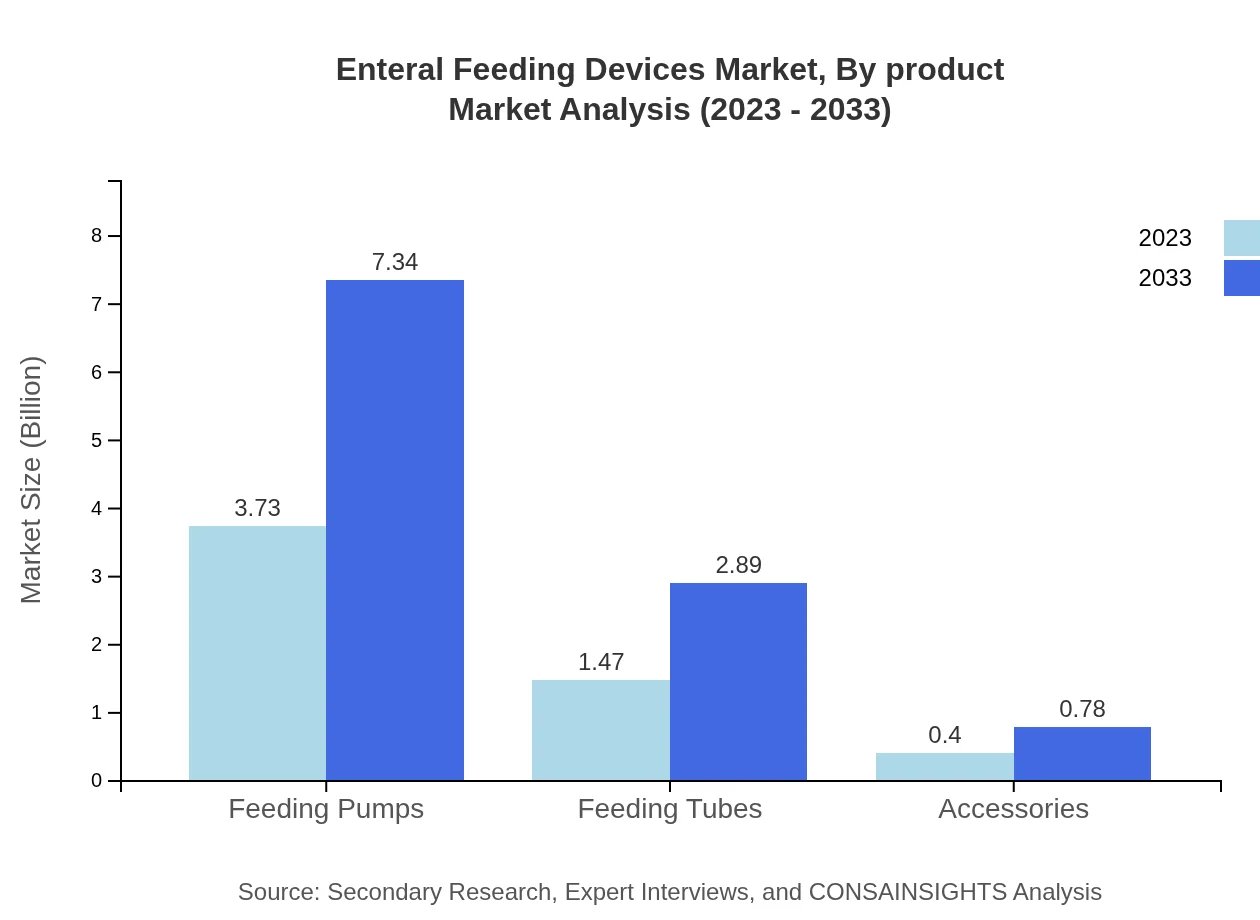
The Enteral Feeding Devices market by product type includes Feeding Pumps, Feeding Tubes, and Accessories. Feeding Pumps dominate this segment, expected to grow from $3.73 billion in 2023 to $7.34 billion by 2033. Feeding Tubes account for a significant share as well, rising from $1.47 billion to $2.89 billion during the same period. Accessories play a crucial supporting role, with market values projected to increase from $0.40 billion to $0.78 billion.
Enteral Feeding Devices Market Analysis By Application
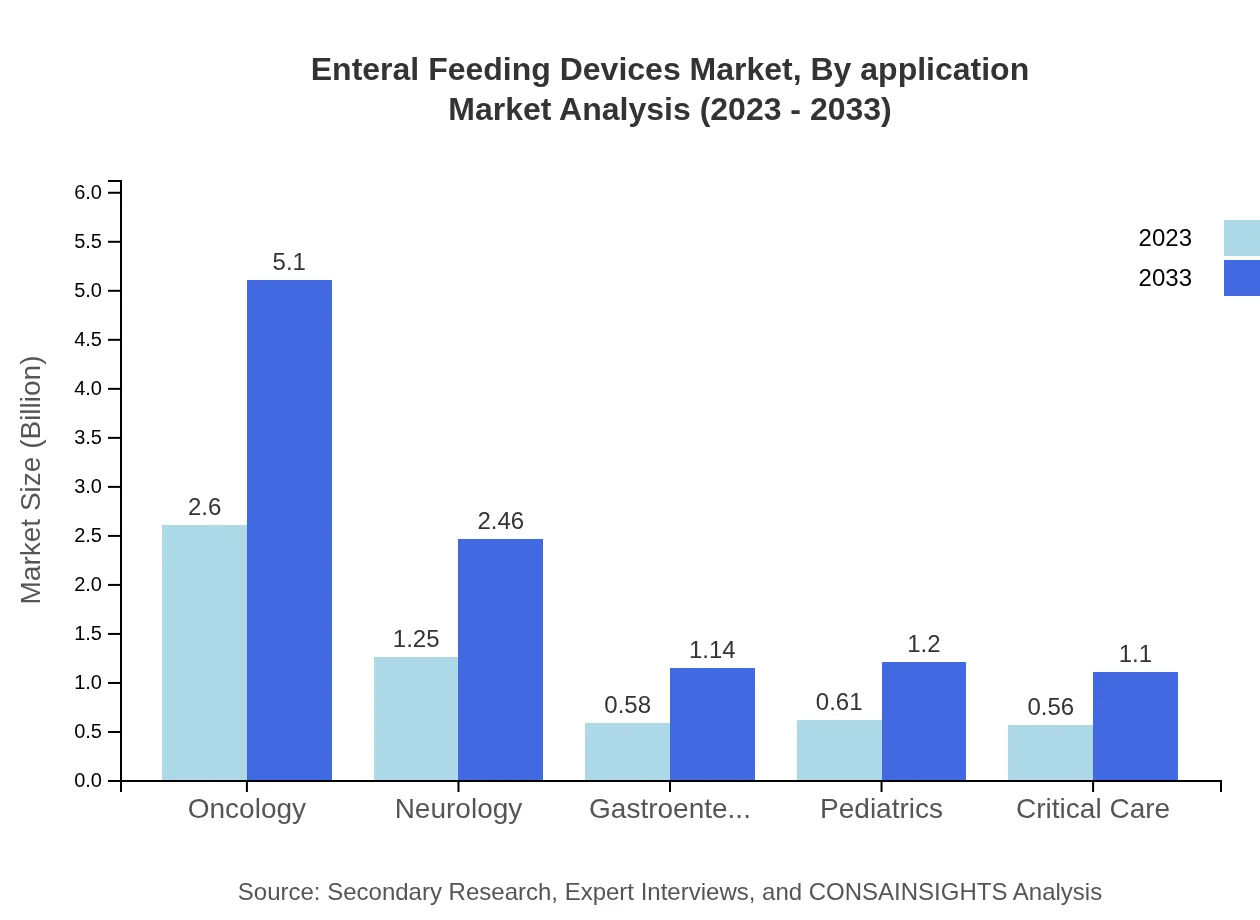
Application segments for Enteral Feeding Devices include Oncology, Neurology, Gastroenterology, Pediatrics, and Critical Care. Oncology leads the market with a value of $2.60 billion in 2023, expected to rise to $5.10 billion by 2033. Neurology and Gastroenterology applications also show significant potential, with market values projected to grow markedly from $1.25 to $2.46 billion and $0.58 to $1.14 billion respectively.
Enteral Feeding Devices Market Analysis By End User
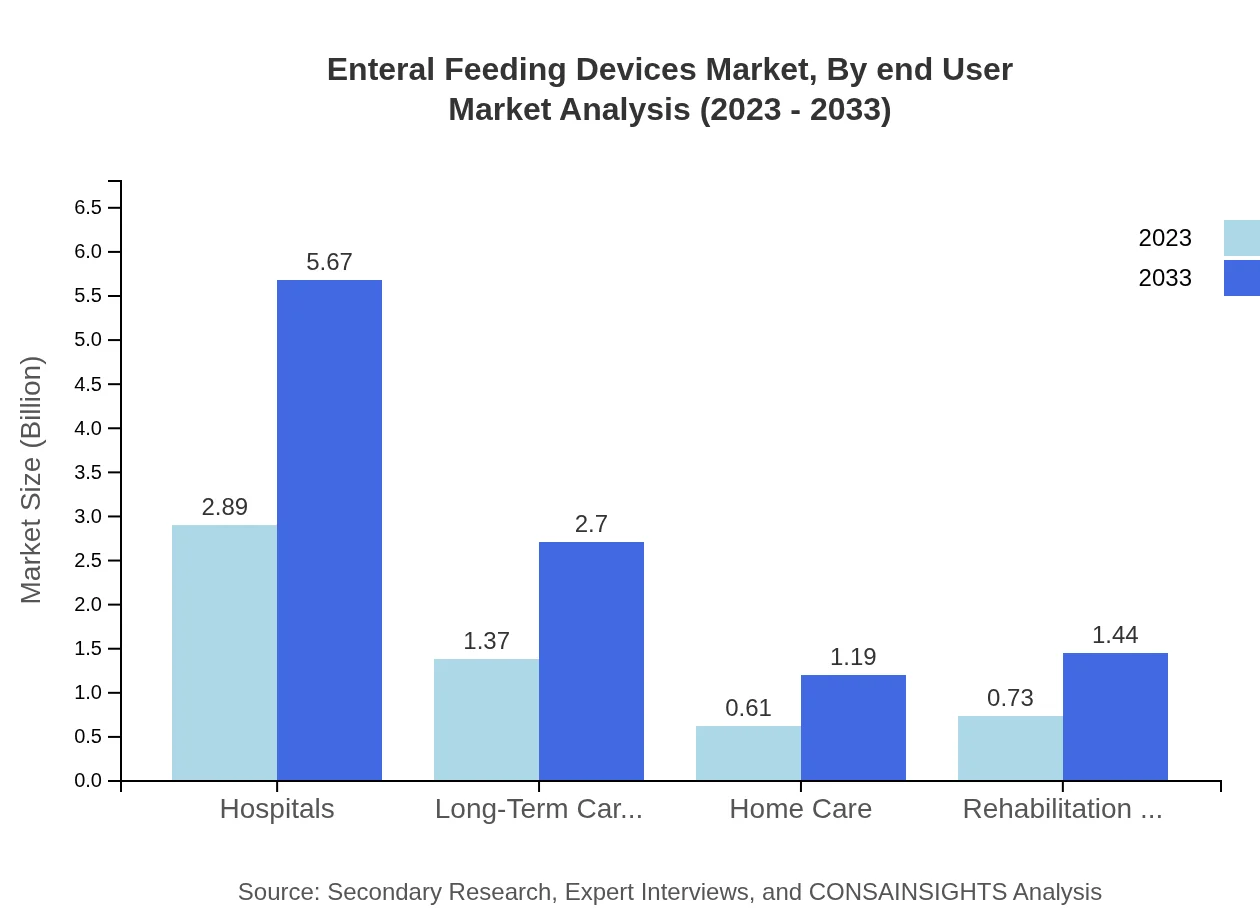
End-user segments include Hospitals, Long-Term Care Facilities, Home Care, and Rehabilitation Centers. Hospitals currently dominate the sector, anticipated to grow from $2.89 billion to $5.67 billion. Long-Term Care Facilities will also see growth, from $1.37 billion to $2.70 billion by 2033 due to an aging population and increasing healthcare needs.
Enteral Feeding Devices Market Analysis By Region Compliance
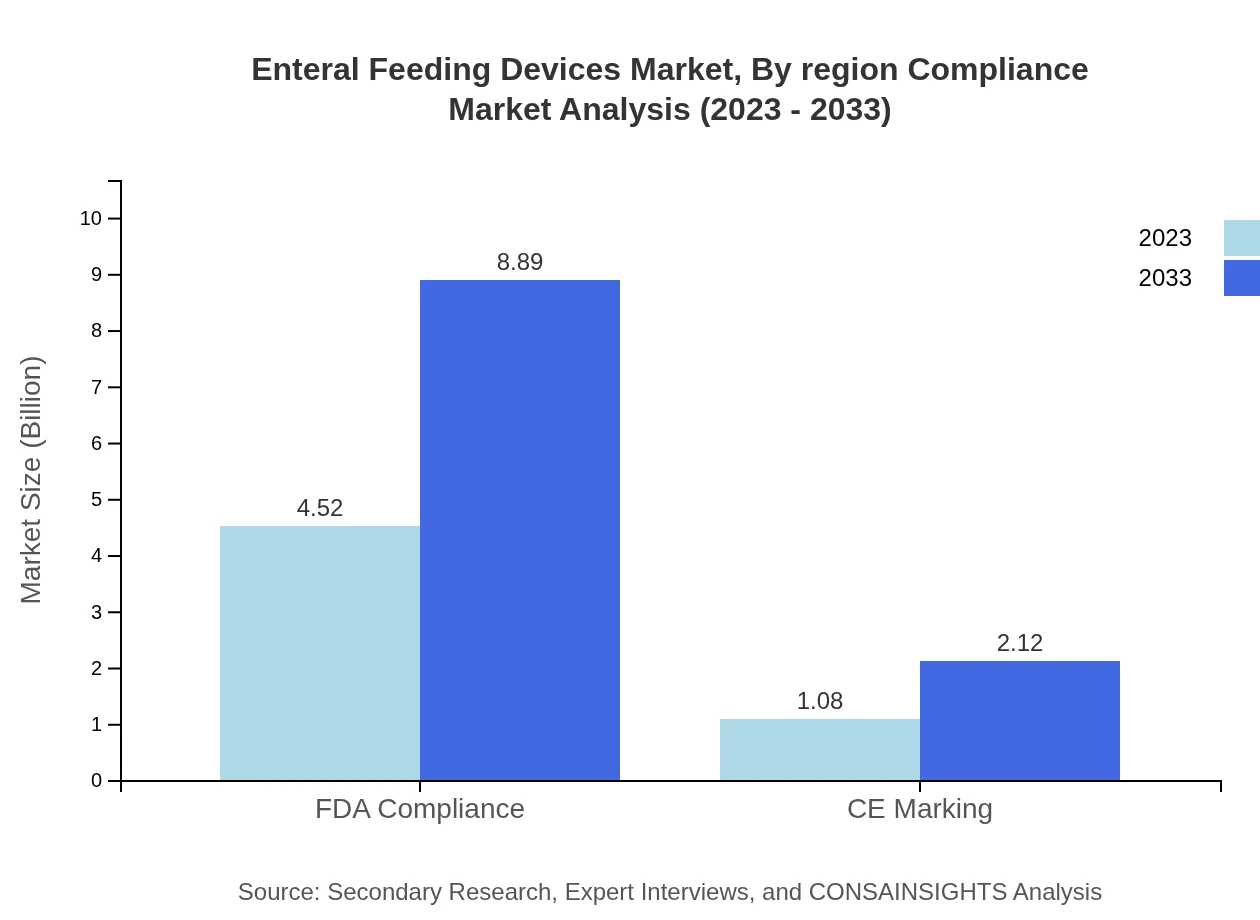
Regulatory compliance plays a critical role in the Enteral Feeding Devices market. FDA compliance, accounting for a market size of $4.52 billion in 2023, is projected to reach $8.89 billion by 2033. CE marking also possesses considerable market potential, increasing from $1.08 billion to $2.12 billion, reflecting growing regulatory scrutiny and safety standards.
Enteral Feeding Devices Market Trends and Future Forecast
Tell us your focus area and get a customized research report.
Global Market Leaders and Top Companies in Enteral Feeding Devices Industry
Abbott Laboratories:
Abbott is a global healthcare company known for its innovative medical devices, including enteral feeding solutions. Their products focus on patient nutrition and improving healthcare outcomes.Fresenius Kabi:
Fresenius Kabi specializes in infusion and enteral nutrition, manufacturing high-quality products that meet diverse patient needs across hospitals and home care.Baxter International:
Baxter is a leader in the healthcare market, known for its advanced enteral feeding devices that support patients in critical care and home health settings.Nestlé Health Science:
Nestlé Health Science is dedicated to pioneering nutritional products, including a range of enteral feeding formulations, enhancing patient health and wellbeing.We're grateful to work with incredible clients.








FAQs
What is the market size of the Enteral Feeding Devices Market Report in 2023?
The market size for 2023 is $5.60 Billion, as stated for the base year in the report data provided.
How big will the market be in 2033?
The market is projected to reach $11.01 Billion by 2033 according to the report figures for the forecast end year.
What is CAGR for the forecast period?
The report specifies a Compound Annual Growth Rate (CAGR) of 6.8% for the period 2023 to 2033.
Is there a single fastest Growing region in the Enteral Feeding Devices Market Report market?
No single fastest-growing region is stated for the Enteral Feeding Devices Market Report market because the top regional implied CAGR values are within 0.15 percentage points of each other, making the ranking too close to call reliably.
Who are the top companies in this market?
Top companies listed include Abbott Laboratories, Fresenius Kabi, Baxter International, and Nestlé Health Science.
Why is enteral feeding adoption increasing?
Adoption rises due to higher needs for nutritional support among chronic and elderly populations and a shift toward enteral methods over parenteral feeding.
What end Users are covered in the market segmentation?
The segmentation includes hospitals, long-term care facilities, home care, and rehabilitation centers as principal end-user categories.
Which product categories are included in the market?
Product categories specified are feeding pumps, feeding tubes, and accessories as the primary by-product segments.
How is regulatory compliance represented in the report?
Regulatory compliance segments include FDA Compliance and CE Marking as the specified by-region-compliance categories.
What research methods were used for the report?
Research combined primary interviews with industry experts, secondary company materials, data triangulation, and expert-led trend analysis.