

Fetal And Neonatal Care Equipment Market Report
First published: 22 October 2024 | Last updated: 25 May 2026 | Report Code: fetal-and-neonatal-care-equipment
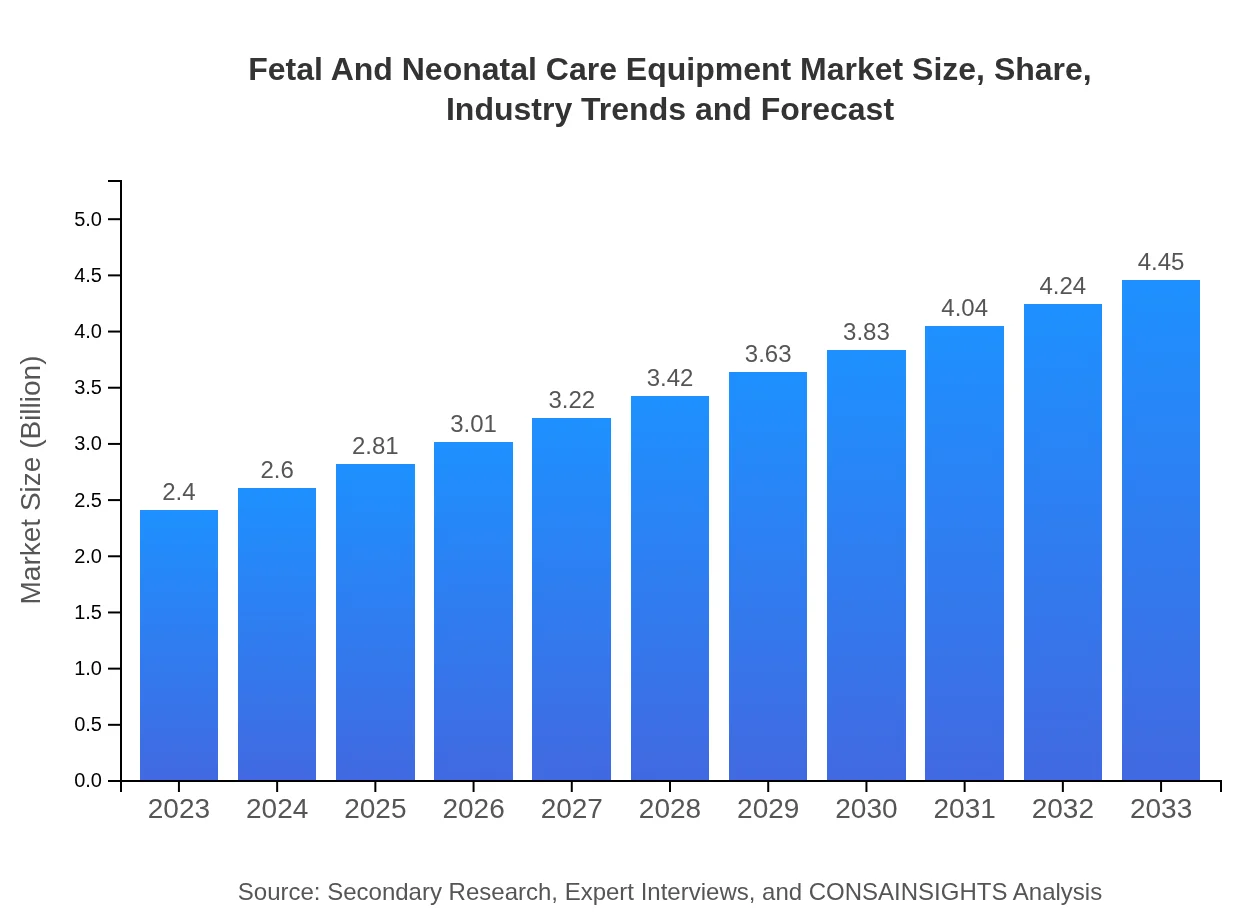
Fetal And Neonatal Care Equipment Market — USD $2.4 Billion in 2023, Growing to USD 4.45null by 2033 at 6.2% CAGR
This report delves into the Fetal and Neonatal Care Equipment market, providing insights on current trends, market size, and growth forecasts from 2023 to 2033. It aims to assist stakeholders in understanding the dynamics of this niche market.
Key Takeaways
- Global market grows from $2.40 Billion in 2023 to $4.45 Billion by 2033 with a 6.2% CAGR over the forecast period.
- North America is largest regional market, while no single fastest-growing region is stated because regional CAGR differences remain within 0.15 percentage points.
- North America is the largest region, expanding from $0.9 Billion in 2023 to $1.68 Billion in 2033.
- Europe increases from $0.77 Billion to $1.44 Billion between 2023 and 2033, reflecting steady demand for neonatal technologies.
- Asia Pacific rises from $0.39 Billion to $0.72 Billion, supported by expanding healthcare access and technology adoption.
- Top manufacturers include GE Healthcare, Philips Healthcare, Medtronic, Siemens Healthineers, and Natus Medical Incorporated.
Fetal And Neonatal Care Equipment Market Report — Executive Summary
North America remains largest market by forecast-period value, while no single fastest-growing region is stated because top regional growth rates are separated by less than 0.15 percentage points. The fetal and neonatal care equipment market is driven by higher awareness of maternal and infant health, technological improvements in monitoring and therapy devices, and rising investments in neonatal care. The market value moves from $2.40 Billion in 2023 to $4.45 Billion in 2033 at a 6.2% CAGR for 2023 to 2033. Demand is supported by adoption of digital monitoring, growth in neonatal intensive care services, and increasing availability of specialized devices across hospitals, clinics, and home care settings. Regional shifts show North America as the largest market growing to $1.68 Billion by 2033, while Europe and Asia Pacific also register notable increases. Key companies such as GE Healthcare, Philips Healthcare, Medtronic, Siemens Healthineers, and Natus Medical Incorporated are active in product innovation and partnerships. Market segmentation spans monitoring, therapy, and diagnostic devices, and end users include hospitals, clinics, and home care. Regulatory focus and integration of remote monitoring shape competitive dynamics and investment priorities throughout the forecast period.
Key Growth Drivers
- Rising focus on maternal and neonatal outcomes increases demand for specialized equipment in hospitals and care centers.
- Advances in digital monitoring and diagnostic technology enable earlier detection and intervention for at-risk infants.
- Expansion of neonatal intensive care capacity and specialized units supports higher consumption of therapy and monitoring devices.
- Greater availability of home care solutions extends monitoring and treatment options beyond traditional clinical settings.
- Continued product development and collaborations among manufacturers strengthen the innovation pipeline and device offerings.
| Metric | Value |
|---|---|
| Study Period | 2023 - 2033 |
| 2023 Market Size | $2.40 Billion |
| CAGR (2023-2033) | 6.2% |
| 2033 Market Size | $4.45 Billion |
| Top Companies | GE Healthcare, Philips Healthcare, Medtronic , Siemens Healthineers, Natus Medical Incorporated |
| Published Date | 22 October 2024 |
| Last Modified Date | 25 May 2026 |
Fetal And Neonatal Care Equipment Market Overview
Customize Fetal And Neonatal Care Equipment Market Report market research report
- ✔ Get in-depth analysis of Fetal And Neonatal Care Equipment market size, growth, and forecasts.
- ✔ Understand Fetal And Neonatal Care Equipment's regional dynamics and industry-specific trends.
- ✔ Identify potential applications, end-user demand, and growth segments in Fetal And Neonatal Care Equipment
What is the Market Size & CAGR of Fetal And Neonatal Care Equipment Market Report market in 2023?
Fetal And Neonatal Care Equipment Industry Analysis
Fetal And Neonatal Care Equipment Market Segmentation and Scope
Tell us your focus area and get a customized research report.
Fetal And Neonatal Care Equipment Market Report Market Analysis Report by Region
Europe Fetal And Neonatal Care Equipment Market Report:
Europe grows from $0.77 Billion in 2023 to $1.44 Billion in 2033. The region's expansion is driven by investment in neonatal units, regulatory emphasis on quality and safety, and uptake of advanced monitoring and diagnostic devices.Asia Pacific Fetal And Neonatal Care Equipment Market Report:
Asia Pacific grows from $0.39 Billion in 2023 to $0.72 Billion in 2033. Growth reflects improving healthcare access, increasing neonatal care capacity, and rising adoption of digital monitoring and therapy technologies in clinical and home care environments.North America Fetal And Neonatal Care Equipment Market Report:
North America is largest regional market, rising from $0.9 Billion in 2023 to $1.68 Billion in 2033. Regional demand is supported by established healthcare infrastructure, higher adoption of neonatal technologies, and continued investment in intensive care and monitoring solutions.South America Fetal And Neonatal Care Equipment Market Report:
Latin America grows from $0.24 Billion in 2023 to $0.44 Billion in 2033. Local growth is influenced by expanding healthcare services, gradual adoption of neonatal equipment, and efforts to strengthen maternal and infant health programs.Middle East & Africa Fetal And Neonatal Care Equipment Market Report:
Middle East and Africa grows from $0.09 Billion in 2023 to $0.17 Billion in 2033. Drivers include investments in healthcare infrastructure, targeted neonatal care initiatives, and growing access to essential monitoring and therapeutic devices.Tell us your focus area and get a customized research report.
Research Methodology
Fetal And Neonatal Care Equipment Market Analysis By Product
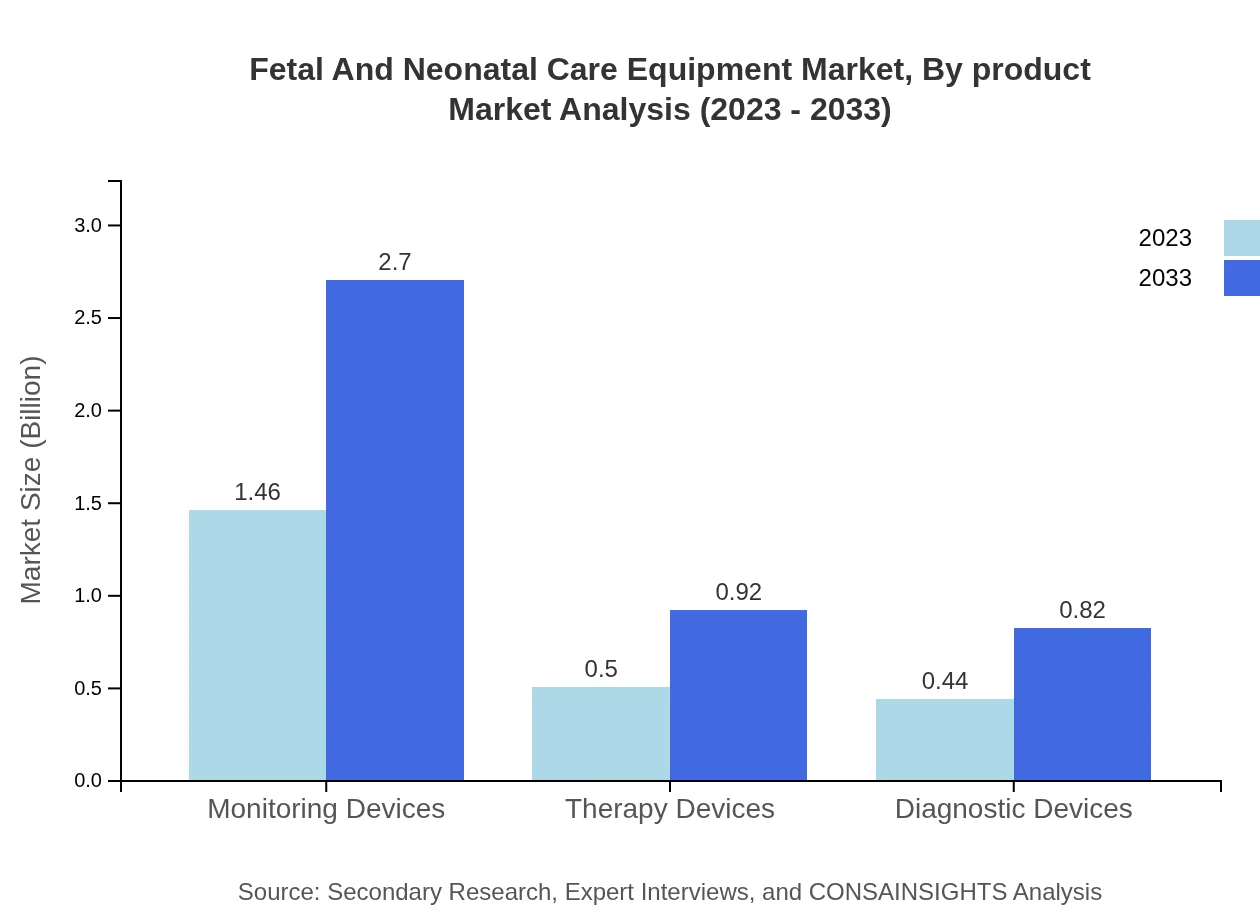
Monitoring devices dominate the market, constituting over 60% market share in 2023, projected to grow to 70% by 2033. Therapy and diagnostic devices follow, contributing 20% and 18% respectively. Digital technologies are increasingly adopted, projecting strong growth as healthcare providers leverage data-driven decisions.
Fetal And Neonatal Care Equipment Market Analysis By Application
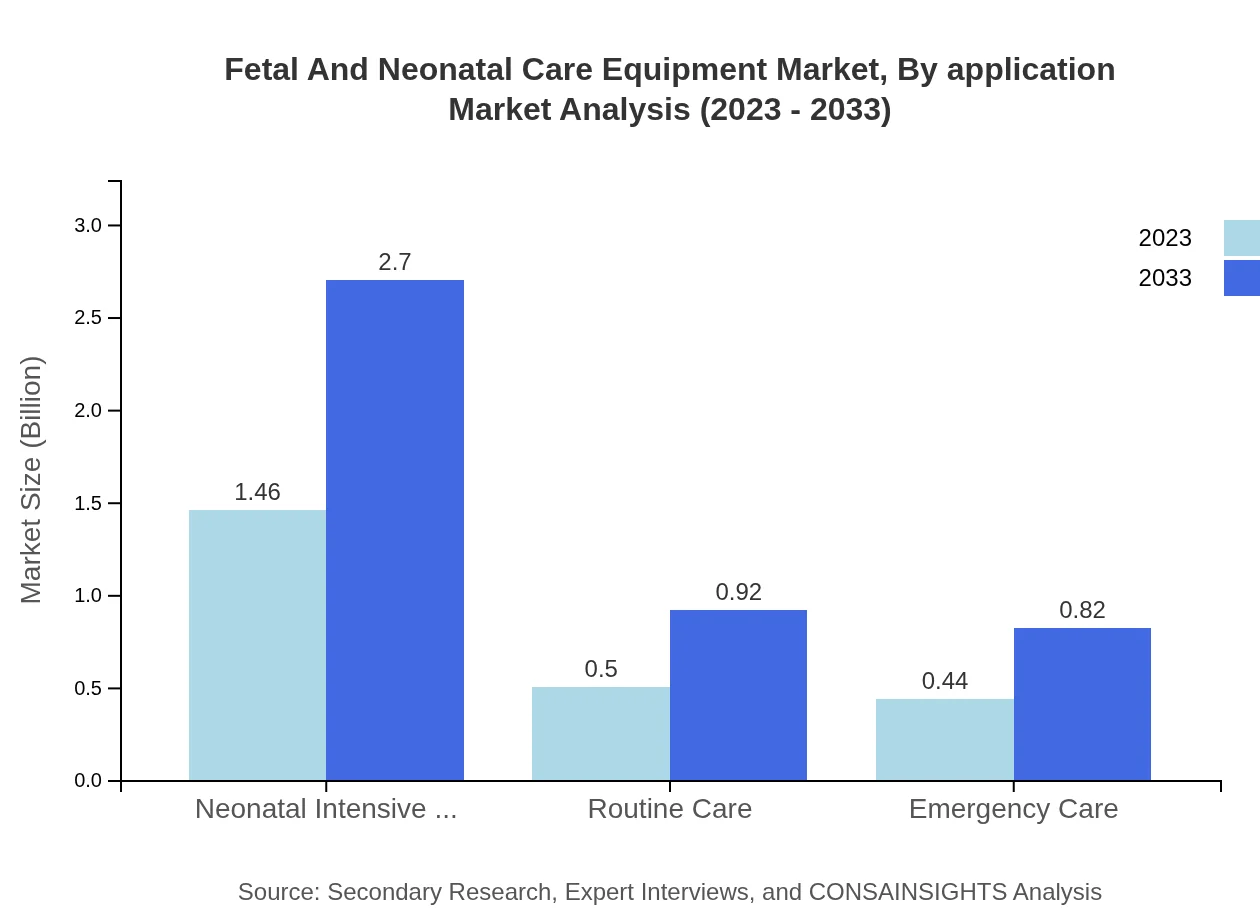
The neonatal intensive care segment commands the majority share, driven by high demands for advanced monitoring systems. Routine care and emergency care categories are also significant, showcasing gradual market expansion fueled by public healthcare initiatives.
Fetal And Neonatal Care Equipment Market Analysis By End User
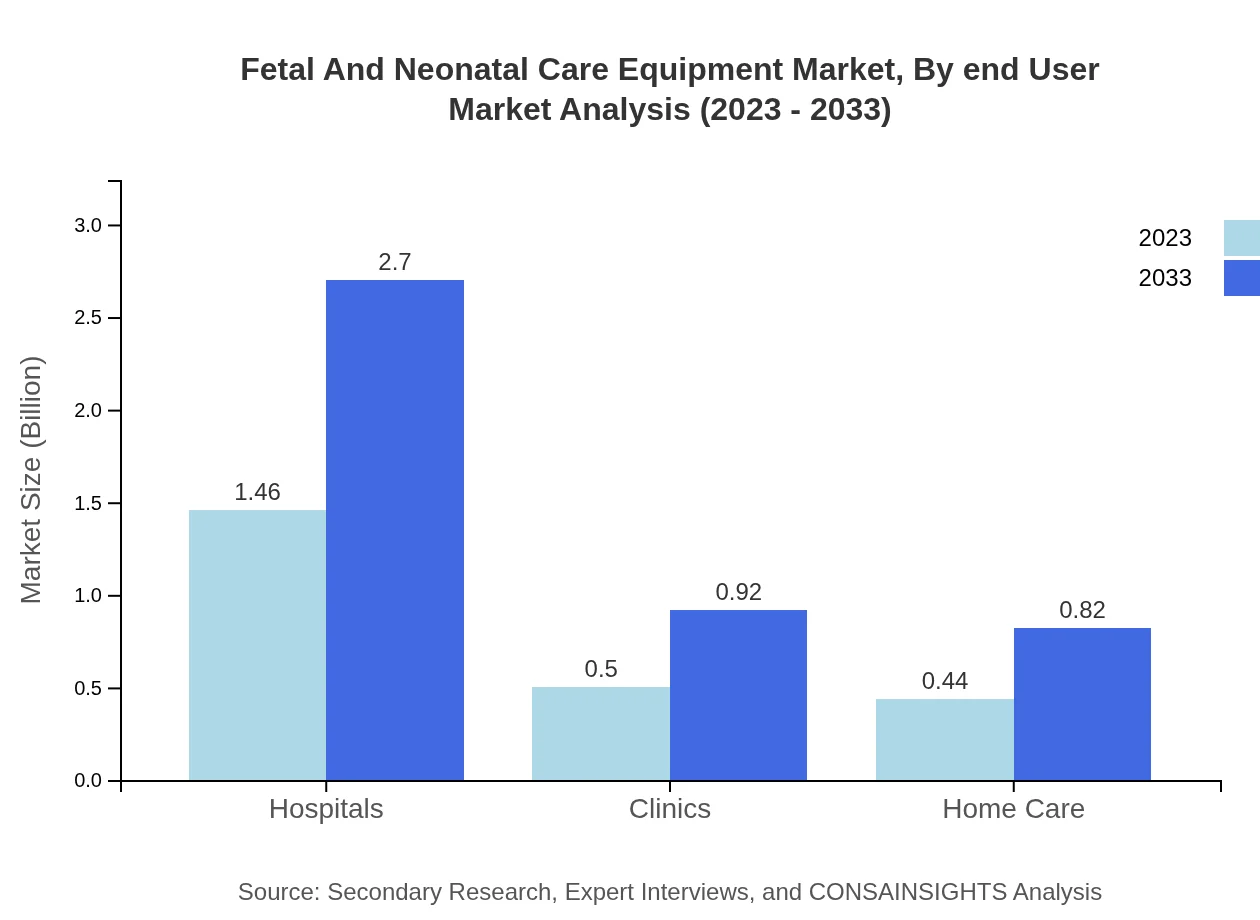
Hospitals are the primary users of fetal and neonatal care equipment, occupying over 60% of the market share, while clinics and home care settings account for an increasing portion as care strategies shift towards more equitable healthcare access and patient empowerment.
Fetal And Neonatal Care Equipment Market Analysis By Region
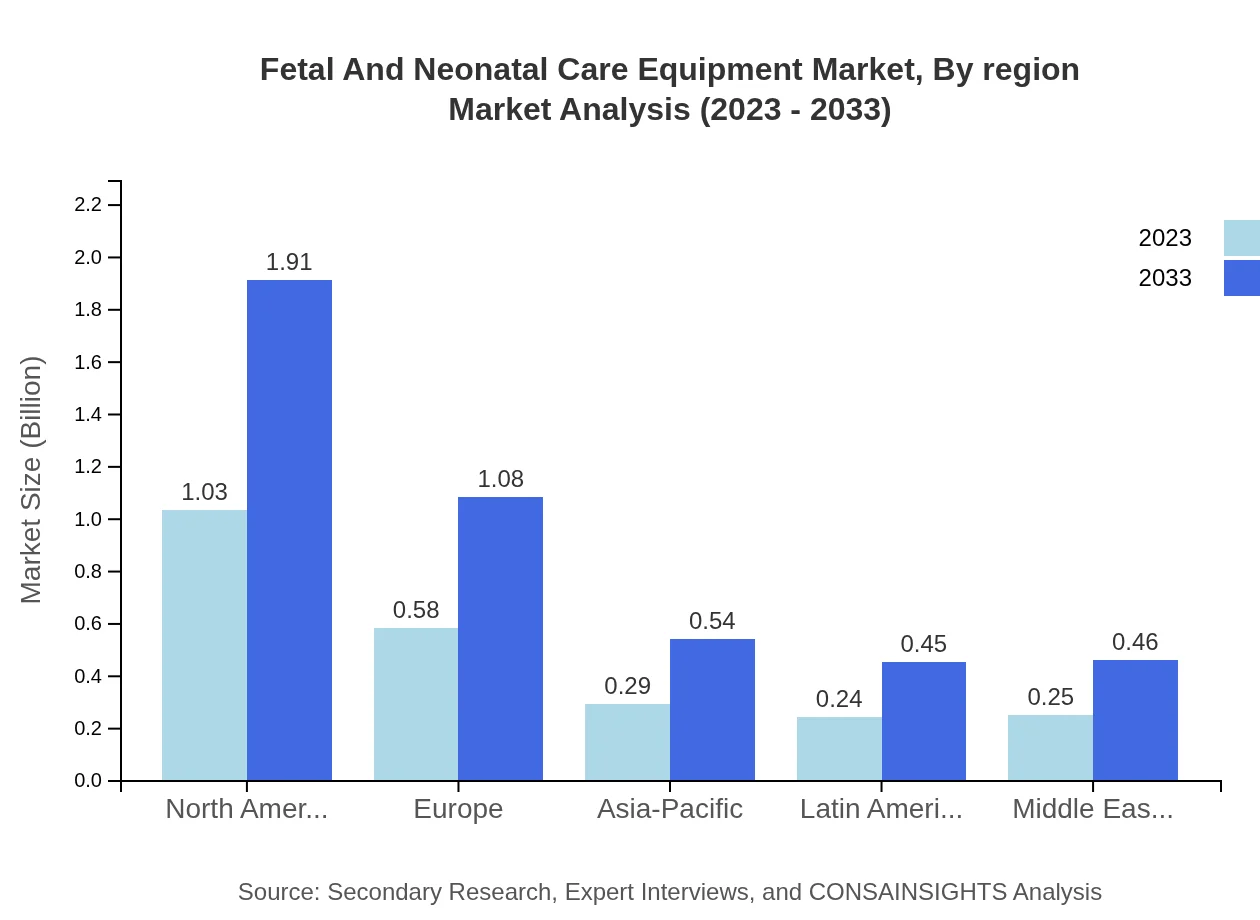
Regional dynamics heavily influence the market structure, with North America leading in terms of size and innovation, followed closely by Europe. Asia Pacific is rapidly growing due to significant investments in health infrastructure, while Latin America and Middle East & Africa show potential for expansion due to healthcare reforms.
Fetal And Neonatal Care Equipment Market Analysis By Technology
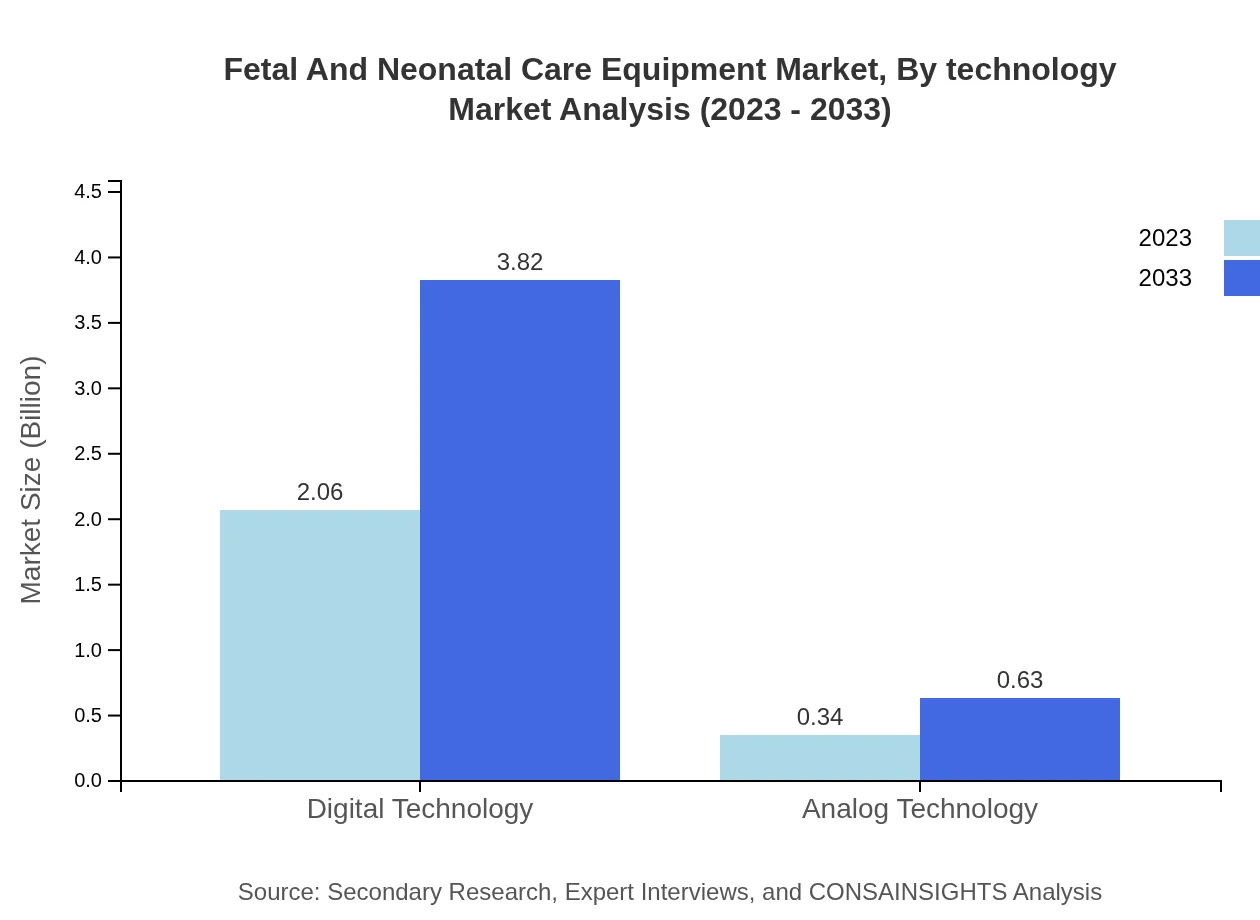
The market is increasingly leaning towards digital technology, capturing a dominant share of around 85% in 2023. Innovations in telemedicine and remote monitoring solutions are reshaping traditional care models, enhancing the overall patient experience.
Fetal And Neonatal Care Equipment Market Trends and Future Forecast
Tell us your focus area and get a customized research report.
Global Market Leaders and Top Companies in Fetal And Neonatal Care Equipment Industry
GE Healthcare:
GE Healthcare specializes in advanced medical imaging, monitoring, and diagnostic technologies that cater specifically to the needs of neonatal and fetal care.Philips Healthcare:
Philips Healthcare provides a range of innovative neonatal care solutions designed to improve the quality of care and improve the management of at-risk infants.Medtronic :
Medtronic is a leader in developing and providing advanced medical device technology used in fetal monitoring and neonatal intensive care.Siemens Healthineers:
Siemens Healthineers offers comprehensive solutions, enabling healthcare providers to enhance operating efficiency and improve fetal and neonatal patient outcomes.Natus Medical Incorporated:
Natus Medical focuses on innovative medical devices and software solutions specifically aimed at improving the quality of care for newborns and infants.We're grateful to work with incredible clients.









FAQs
What is the market size of the fetal and neonatal care equipment market in 2023?
The market size in 2023 is $2.40 Billion, as reported in the input data for the forecast analysis covering 2023 to 2033.
How big will the market be in 2033?
The reported market value for 2033 is $4.45 Billion, reflecting growth over the 2023 to 2033 forecast period under the stated assumptions.
What is CAGR of the market from 2023 to 2033?
The compound annual growth rate for the period 2023 to 2033 is 6.2%, based on the provided market projections.
Who are the leading companies operating in this market?
Top companies listed in the input are GE Healthcare, Philips Healthcare, Medtronic, Siemens Healthineers, and Natus Medical Incorporated.
Is there a single fastest Growing region in the Fetal And Neonatal Care Equipment Market Report market?
No single fastest-growing region is stated for the Fetal And Neonatal Care Equipment Market Report market because the top regional implied CAGR values are within 0.15 percentage points of each other, making the ranking too close to call reliably.
Which regions show notable growth in absolute terms?
Europe and Asia Pacific demonstrate substantial increases: Europe from $0.77 Billion to $1.44 Billion, and Asia Pacific from $0.39 Billion to $0.72 Billion between 2023 and 2033.
What are the main product segments in the market?
Product segmentation includes monitoring devices, therapy devices, and diagnostic devices, as specified among the sub-segment categories.
How do end User categories shape demand?
End users such as hospitals, clinics, and home care drive demand patterns, with hospitals being central for intensive neonatal care and home care expanding remote monitoring usage.
What research methods supported the market assessment?
The study uses primary interviews with industry experts, secondary company reports and publications, data triangulation, and expert-led trend analysis.
Why is the fastest Growing region not named?
A regional growth market is not specified because the top regional growth rates are within 0.15 percentage points, and no single region is designated as fastest-growing.