

Blood Flow Measurement Devices Market Report
First published: 20 October 2024 | Last updated: 25 May 2026 | Report Code: blood-flow-measurement-devices
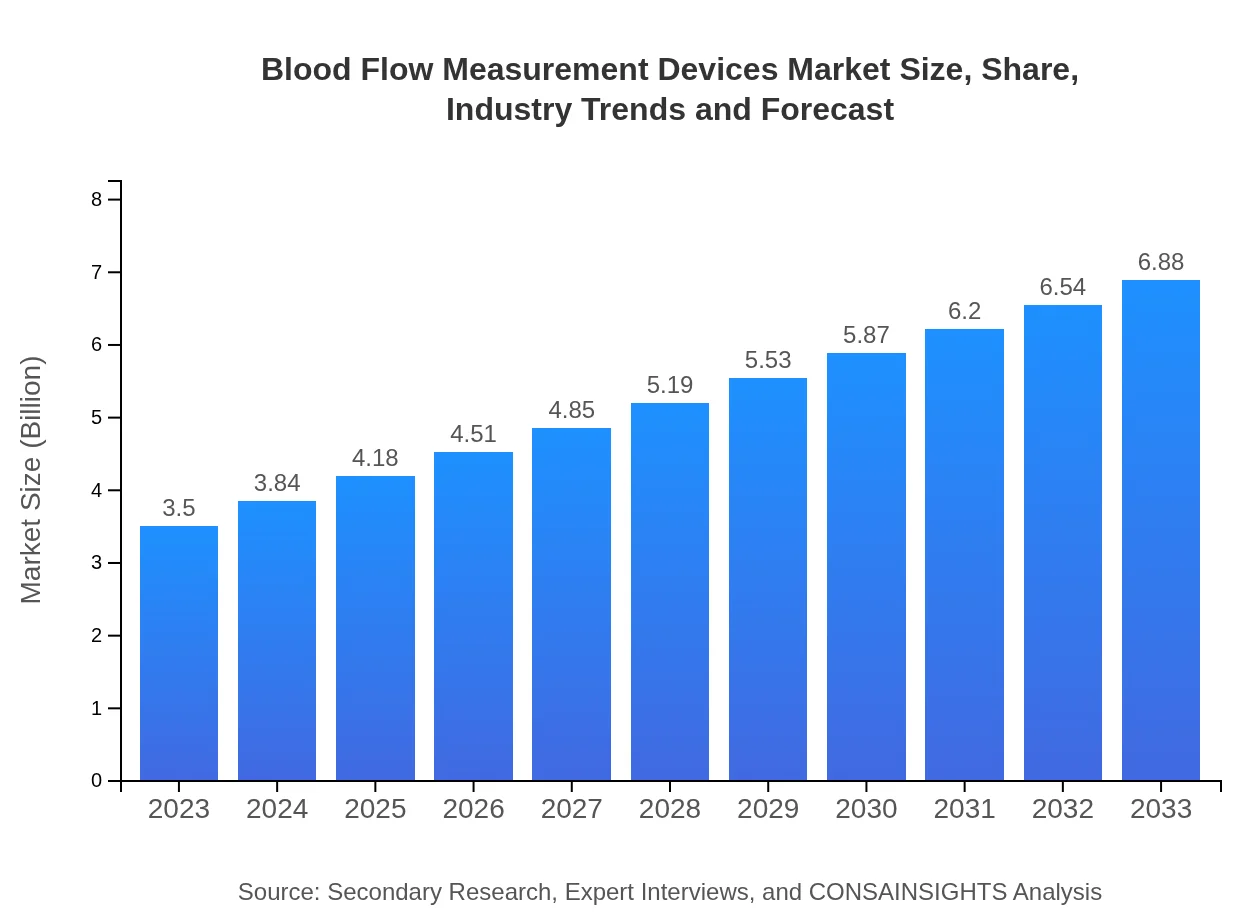
Blood Flow Measurement Devices Market — USD $3.5 Billion in 2023, Growing to USD 6.88B by 2033 at 6.8% CAGR
This report provides a comprehensive analysis of the Blood Flow Measurement Devices market from 2023 to 2033, focusing on market size, trends, segmentation, and regional insights. It aims to deliver valuable data and forecasts essential for stakeholders in the healthcare sector.
Key Takeaways
- Global market expands from $3.50 Billion in 2023 to $6.88 Billion by 2033 at a 6.8% CAGR.
- North America is largest regional market, while no single fastest-growing region is stated because regional CAGR differences remain within 0.15 percentage points.
- North America leads regionally, rising from $1.18 Billion in 2023 to $2.31 Billion in 2033.
- Europe grows from $1.02 Billion in 2023 to $2.00 Billion in 2033, reflecting clinical demand and infrastructure.
- Asia Pacific advances from $0.73 Billion in 2023 to $1.44 Billion in 2033, driven by increasing healthcare investment.
- Market includes non-invasive and invasive device types, with hospitals and research centers as primary end users.
Blood Flow Measurement Devices Market Report — Executive Summary
North America remains largest market by forecast-period value, while no single fastest-growing region is stated because top regional growth rates are separated by less than 0.15 percentage points. This report outlines the Blood Flow Measurement Devices market, which recorded $3.50 Billion in 2023 and is forecast to reach $6.88 Billion by 2033 at a 6.8% CAGR. Growth is supported by clinical demand for precise diagnostics, wider adoption in hospitals and research institutions, and ongoing technological innovation across optical, ultrasound, and electromagnetic platforms. Geographic analysis highlights North America as the largest region, with notable increases across Europe, Asia Pacific, Latin America, and Middle East and Africa. Key vendors such as Medtronic, Abbott Laboratories, GE Healthcare, Siemens Healthineers, and Philips Healthcare are profiled relative to market trends. The study covers segmentation by region, technology, application, device type, and end user, and discusses primary drivers, implementation challenges, and adoption scenarios to inform strategic planning and investment decisions.
Key Growth Drivers
- Rising clinical demand for precise hemodynamic assessment in hospitals and research centers boosts device adoption.
- Technological progress in optical, ultrasound, and electromagnetic measurement improves diagnostic accuracy and procedural utility.
- Increased healthcare infrastructure investment in Asia Pacific and Europe expands access to advanced monitoring systems.
- Aging populations and higher cardiovascular disease prevalence sustain long-term need for blood flow evaluation tools.
| Metric | Value |
|---|---|
| Study Period | 2023 - 2033 |
| 2023 Market Size | $3.50 Billion |
| CAGR (2023-2033) | 6.8% |
| 2033 Market Size | $6.88 Billion |
| Top Companies | Medtronic , Abbott Laboratories, GE Healthcare, Siemens Healthineers, Philips Healthcare |
| Published Date | 20 October 2024 |
| Last Modified Date | 25 May 2026 |
Blood Flow Measurement Devices Market Overview
Customize Blood Flow Measurement Devices Market Report market research report
- ✔ Get in-depth analysis of Blood Flow Measurement Devices market size, growth, and forecasts.
- ✔ Understand Blood Flow Measurement Devices's regional dynamics and industry-specific trends.
- ✔ Identify potential applications, end-user demand, and growth segments in Blood Flow Measurement Devices
What is the Market Size & CAGR of Blood Flow Measurement Devices Market Report market in 2023?
Blood Flow Measurement Devices Industry Analysis
Blood Flow Measurement Devices Market Segmentation and Scope
Tell us your focus area and get a customized research report.
Blood Flow Measurement Devices Market Report Market Analysis Report by Region
Europe Blood Flow Measurement Devices Market Report:
Europe grows from $1.02 Billion in 2023 to $2 Billion in 2033. 02 Billion in 2023 to $2.00 Billion by 2033. This advancement is supported by strong clinical demand, health system upgrades, and adoption of newer measurement technologies in hospital and research settings.Asia Pacific Blood Flow Measurement Devices Market Report:
Asia Pacific grows from $0.73 Billion in 2023 to $1.44 Billion in 2033. The region's increase is associated with rising healthcare spending, expanding access to diagnostic services, and growing interest in non-invasive monitoring solutions.North America Blood Flow Measurement Devices Market Report:
North America is largest regional market, rising from $1.18 Billion in 2023 to $2.31 Billion in 2033. Regional growth is linked to established healthcare infrastructure, widespread clinical adoption, and investments by leading vendors that support advanced diagnostic tool deployment.South America Blood Flow Measurement Devices Market Report:
Latin America grows from $0.15 Billion in 2023 to $0.29 Billion in 2033. Market development in this region is influenced by gradual enhancements in healthcare capacity and selective adoption of specialized diagnostic equipment.Middle East & Africa Blood Flow Measurement Devices Market Report:
Middle East and Africa grows from $0.43 Billion in 2023 to $0.84 Billion in 2033. Growth drivers include targeted healthcare investments and increasing utilization of blood flow measurement devices across clinical facilities.Tell us your focus area and get a customized research report.
Research Methodology
Blood Flow Measurement Devices Market Analysis By Device Type
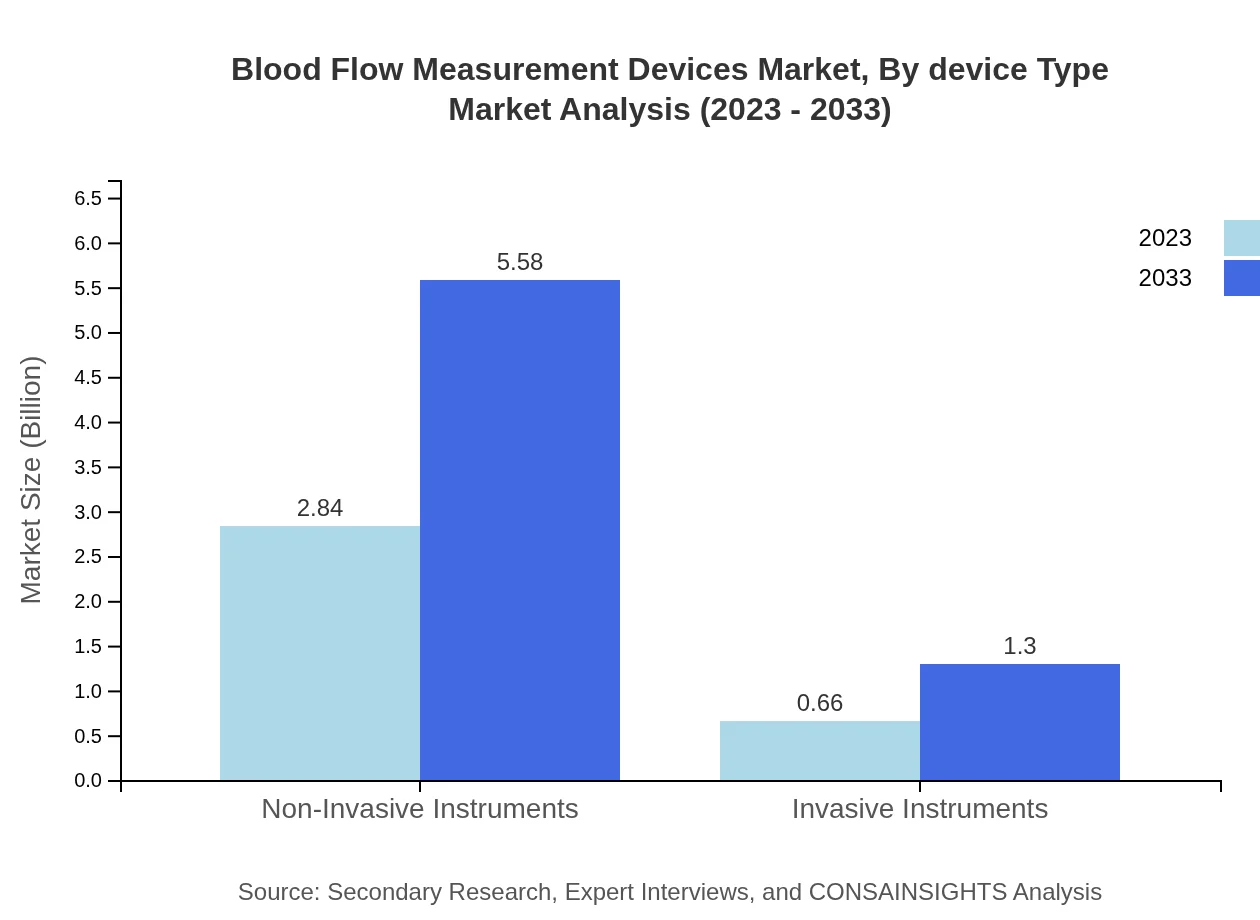
The Blood Flow Measurement Devices market comprises non-invasive and invasive instruments, with non-invasive instruments accounting for a significant market share due to their comfort and ease of use. In 2023, the non-invasive segment is valued at $2.84 billion, projected to rise to $5.58 billion by 2033, reflecting a substantial market share of 81.08%. Invasive instruments, while more accurate, represent 18.92% of the market, growing from $0.66 billion to $1.30 billion over the same period.
Blood Flow Measurement Devices Market Analysis By Application
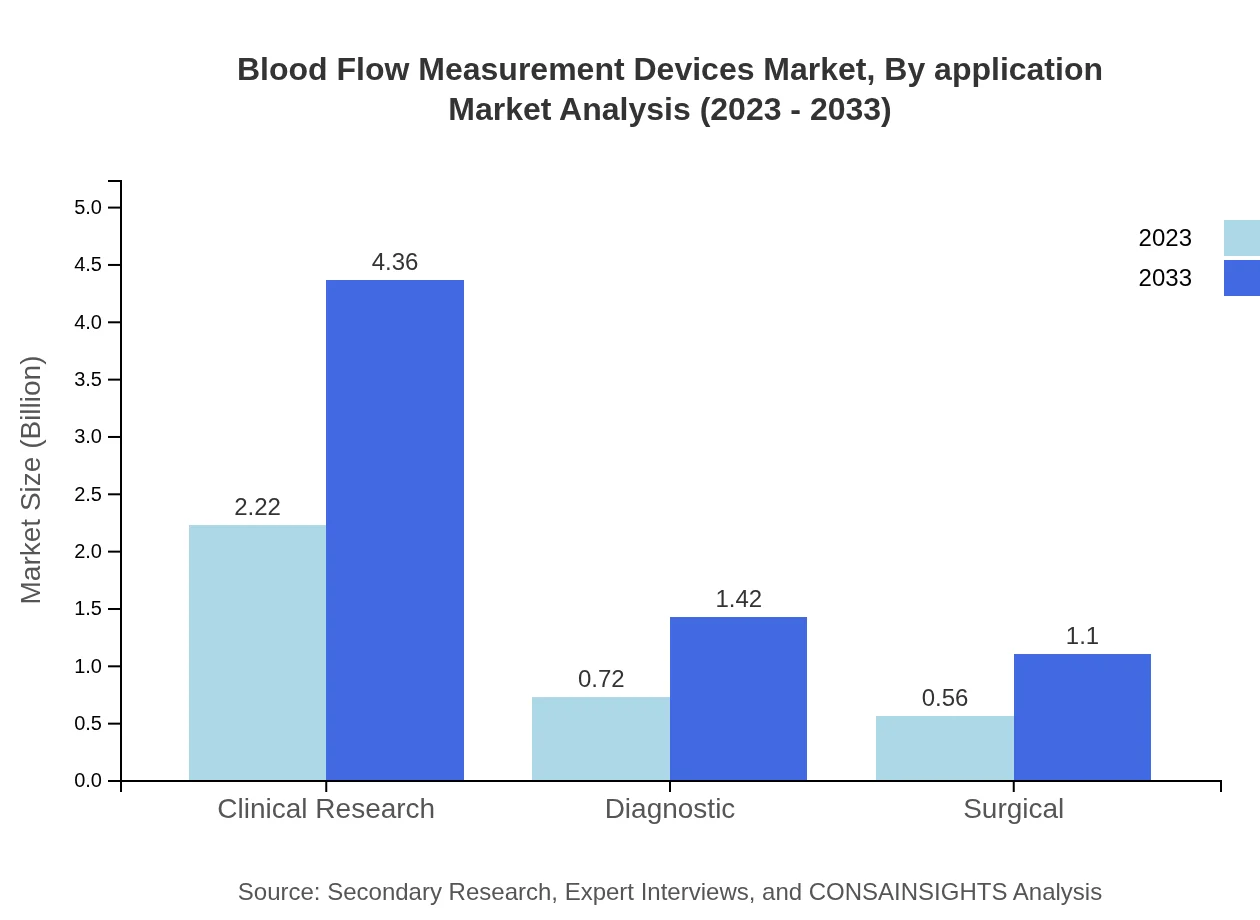
The application segment highlights key areas like clinical research, diagnostics, and surgical procedures. Clinical research commands a dominant market position with a 63.34% share, seeing growth from $2.22 billion in 2023 to $4.36 billion by 2033. The diagnostics and surgical segments, while smaller at 20.6% and 16.06% market shares respectively, are also experiencing growth owing to increasing need for accurate assessments in medical procedures.
Blood Flow Measurement Devices Market Analysis By End User
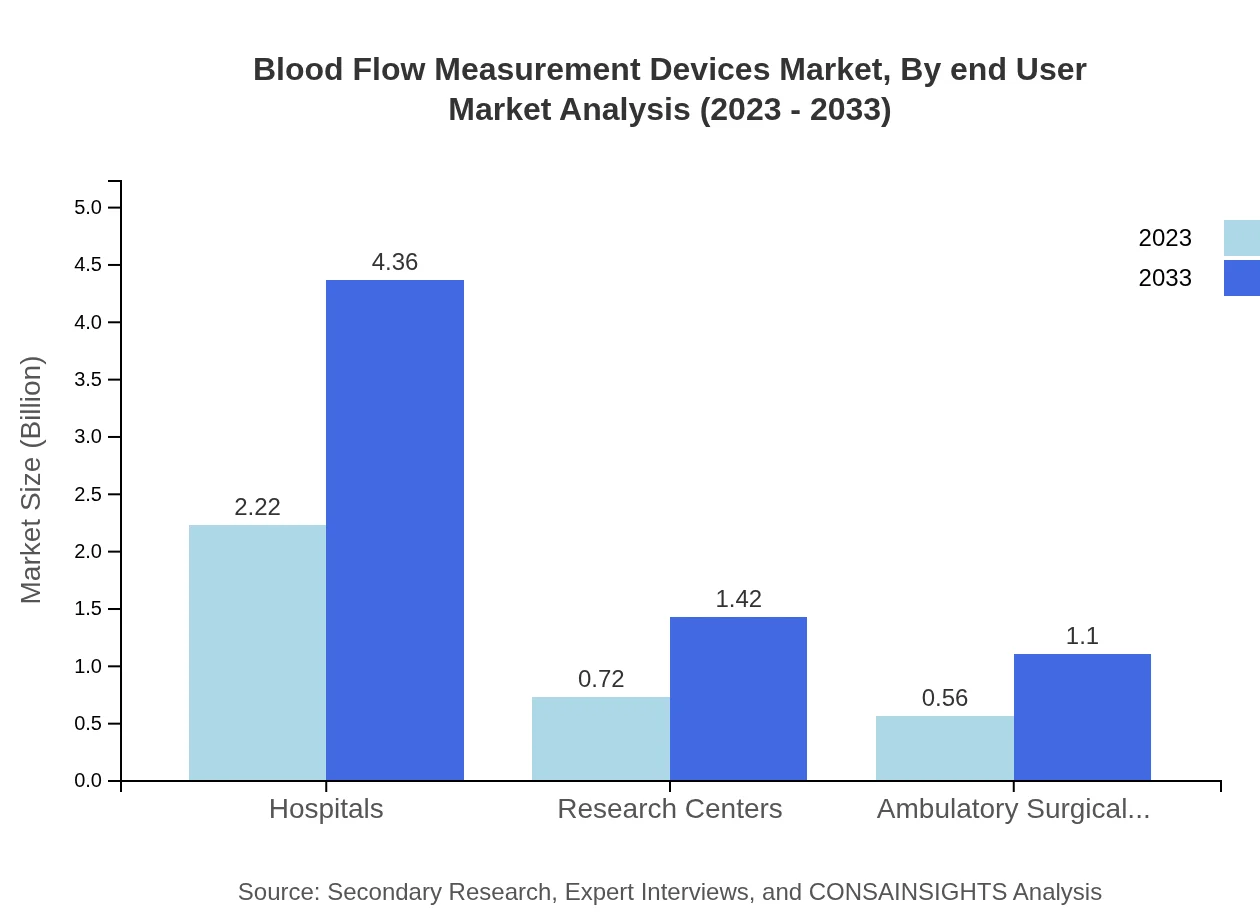
Hospitals, research centers, and ambulatory surgical centers represent the primary end-users of blood flow measurement devices. Hospitals lead with a substantial 63.34% share, with the market size expanding from $2.22 billion in 2023 to $4.36 billion by 2033. Research centers follow at 20.6%, expecting growth from $0.72 billion to $1.42 billion in the same period, supported by the use of these devices in studies and research trials.
Blood Flow Measurement Devices Market Analysis By Technology
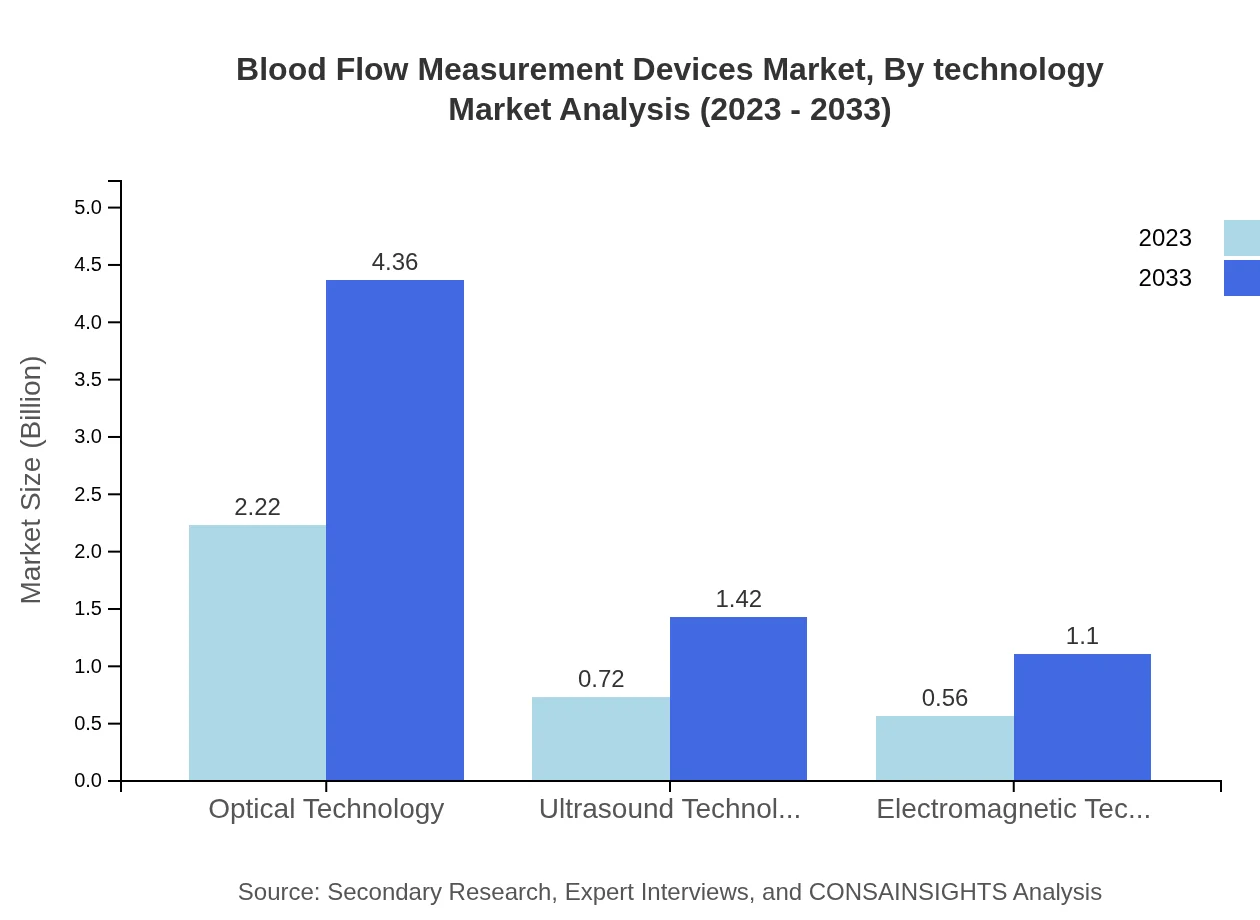
Technological advancements play a vital role in the Blood Flow Measurement Devices market, with optical technology leading the sector with a 63.34% share. This segment is expected to grow from $2.22 billion to $4.36 billion between 2023 and 2033. Other technologies, including ultrasound and electromagnetic, contribute to the overall market growth, with increasing innovations enhancing device accuracy and functionality.
Blood Flow Measurement Devices Market Analysis By Region
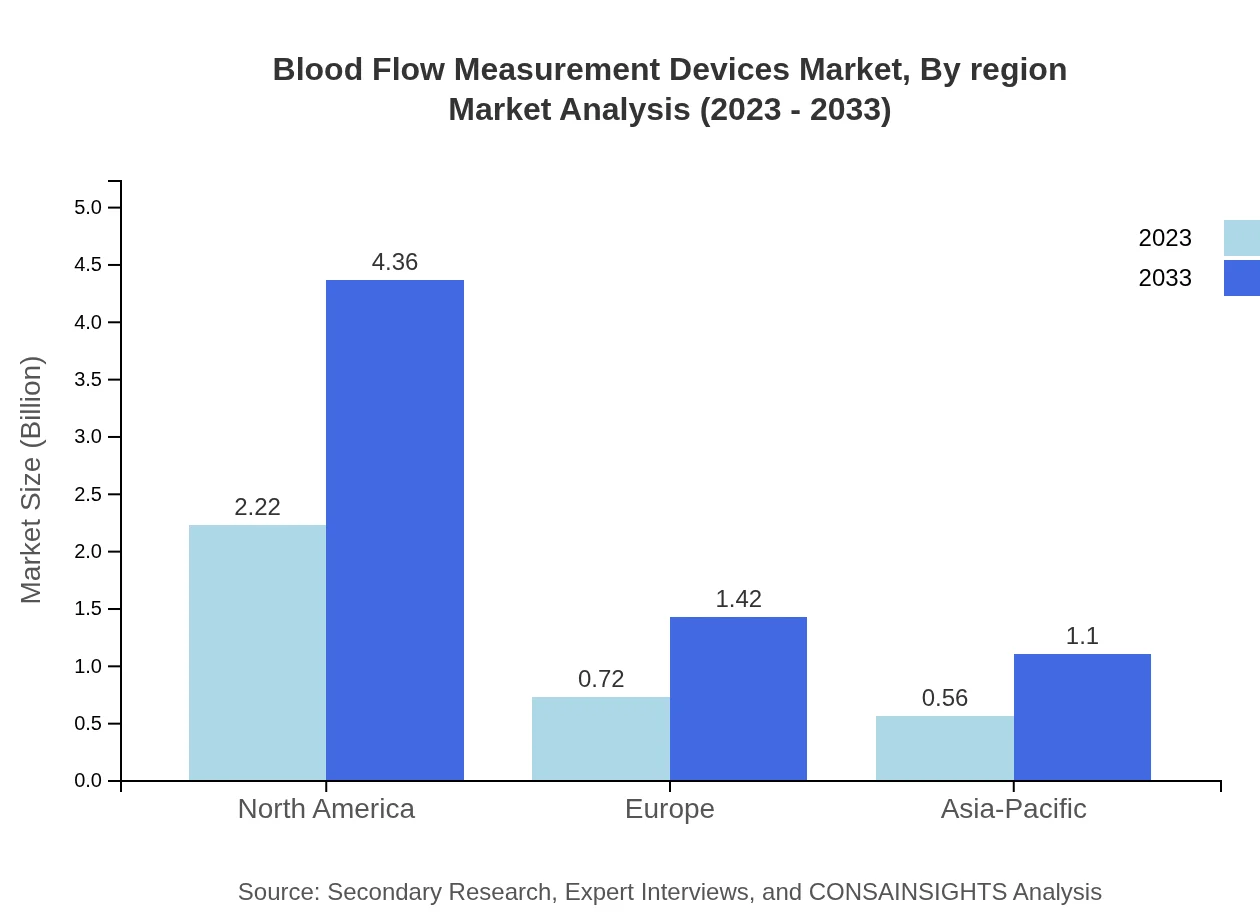
The regional segmentation reveals distinct growth patterns and potential. North America dominates with the largest share, while Asia Pacific shows the fastest growth rate due to improved healthcare access. Europe remains a strong market due to technological advancements. South America and the Middle East and Africa, though smaller, exhibit steady growth driven by healthcare improvements and increased awareness of circulatory health.
Blood Flow Measurement Devices Market Trends and Future Forecast
Tell us your focus area and get a customized research report.
Global Market Leaders and Top Companies in Blood Flow Measurement Devices Industry
Medtronic :
A global leader in medical technology, Medtronic specializes in innovative solutions for cardiac care including advanced blood flow measurement devices.Abbott Laboratories:
Abbott is a pioneering biotechnology company that provides medical devices and diagnostic solutions, known for its contributions to blood monitoring technologies.GE Healthcare:
GE Healthcare offers a range of advanced imaging and monitoring technologies, focusing on enhancing diagnostic precision in cardiovascular care.Siemens Healthineers:
Siemens Healthineers is committed to transforming healthcare delivery with innovative blood flow measurement and diagnostic tools.Philips Healthcare:
Philips focuses on health technology, providing various blood flow measurement devices that aim to improve patient outcomes.We're grateful to work with incredible clients.









FAQs
What is the market size of the Blood Flow Measurement Devices Market Report in 2023?
The market size for 2023 is $3.50 Billion, as reported in the dataset provided, representing the baseline measurement for the 2023 to 2033 forecast period.
How big will the market be in 2033?
Projected market value for 2033 is $6.88 Billion according to the supplied figures, reflecting expected expansion across device types and regions through the forecast horizon.
What is CAGR for the forecast period?
The compound annual growth rate for the 2023 to 2033 forecast period is 6.8%, based on the input data describing market progression between 2023 and 2033.
Is there a single fastest Growing region in the Blood Flow Measurement Devices Market Report market?
No single fastest-growing region is stated for the Blood Flow Measurement Devices Market Report market because the top regional implied CAGR values are within 0.15 percentage points of each other, making the ranking too close to call reliably.
Which companies are noted as top participants?
Top companies listed in the input include Medtronic, Abbott Laboratories, GE Healthcare, Siemens Healthineers, and Philips Healthcare as key industry participants.
What device types are covered in the market segmentation?
Device-type segmentation includes Non-Invasive Instruments and Invasive Instruments, covering a broad range of clinical modalities and procedural contexts.
How are end users categorized in the report?
End-user segmentation specifies Hospitals, Research Centers, and Ambulatory Surgical Centers as primary adopters of blood flow measurement devices.
What technologies drive market development?
Technologies identified include Optical Technology, Ultrasound Technology, and Electromagnetic Technology, each contributing to improved measurement capabilities and clinical uptake.
What regional trends are noted for Europe?
Europe grows from $1.02 Billion in 2023 to $2.00 Billion in 2033, with expansion influenced by clinical demand and healthcare system investments reported in the input.
Who conducted the research methodology for this report?
The research methodology included primary interviews with industry experts and secondary research through company reports and publications, per the provided methodology facts.