
Reports >
Life Sciences
>
Cell Fractionation Market Report

Cell Fractionation Market Report
First published: 12 October 2024 | Last updated: 25 May 2026 | Report Code: cell-fractionation
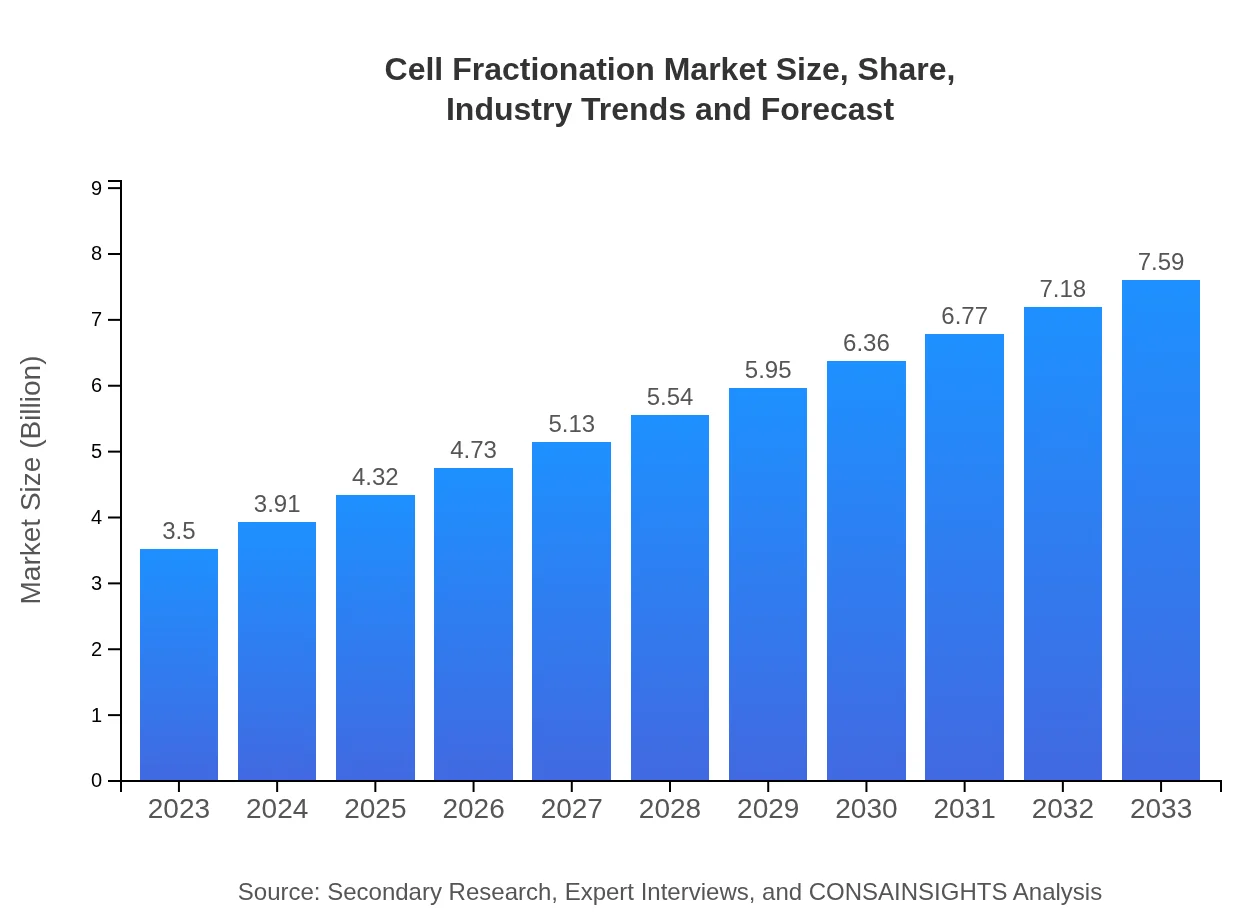
Cell Fractionation Market — USD 3.5 billion in 2023, Growing to USD 7.59B by 2033 at 7.8% CAGR
This report provides a comprehensive analysis of the Cell Fractionation market, covering market size, growth rates, regional insights, and technological advancements from 2023 to 2033. It aims to equip stakeholders with key insights and data for informed decision-making.
Key Takeaways
- Global market value increases from $3.50 Billion in 2023 to $7.59 Billion in 2033 at a 7.8% CAGR.
- North America is largest regional market, while no single fastest-growing region is stated because regional CAGR differences remain within 0.15 percentage points.
- Europe grows from $1.05 Billion to $2.27 Billion over the forecast period, reflecting sustained research investment.
- Technologies such as centrifugation, membrane filtration, and magnetic bead separation underpin product segmentation.
- Major participants named include Thermo Fisher Scientific, Merck Group, Beckman Coulter, and GE Healthcare.
Cell Fractionation Market Report — Executive Summary
North America remains largest market by forecast-period value, while no single fastest-growing region is stated because top regional growth rates are separated by less than 0.15 percentage points. The Cell Fractionation market is positioned for notable expansion, increasing from $3.50 Billion in 2023 to $7.59 Billion in 2033 at a 7.8% CAGR. Growth is supported by rising activity in life-sciences research, demand for precise separation techniques, and ongoing innovation in laboratory automation and miniaturization. Key product groupings encompass centrifuges, membrane filters, and kits and reagents, while primary techniques include density gradient centrifugation, ultrafiltration, and magnetic bead separation. End users span research institutes, hospitals and clinics, and pharmaceutical companies. Regional dynamics show North America as the largest market, with Europe and Asia Pacific also demonstrating meaningful increases. Leading firms such as Thermo Fisher Scientific, Merck Group, Beckman Coulter, and GE Healthcare drive technology development and commercial availability. The industry faces challenges related to equipment costs and workforce skills, but strategic partnerships, R&D investment, and regulatory compliance efforts continue to shape market direction through the forecast period.
Key Growth Drivers
- Expanding biotechnology and pharmaceutical research budgets fueling demand for separation technologies.
- Advances in automation and miniaturization improving throughput and reproducibility of fractionation workflows.
- Wider adoption of cell-based therapies and personalized approaches raising need for precise component isolation.
- Ongoing product innovation from established laboratory equipment and reagent suppliers enhancing capability.
- Increased clinical and translational research activity in hospitals and research institutes supporting market uptake.
| Metric | Value |
|---|---|
| Study Period | 2023 - 2033 |
| 2023 Market Size | $3.50 Billion |
| CAGR (2023-2033) | 7.8% |
| 2033 Market Size | $7.59 Billion |
| Top Companies | Thermo Fisher Scientific, Merck Group, Beckman Coulter, GE Healthcare |
| Published Date | 12 October 2024 |
| Last Modified Date | 25 May 2026 |
Cell Fractionation Market Overview
Customize Cell Fractionation Market Report market research report
- ✔ Get in-depth analysis of Cell Fractionation market size, growth, and forecasts.
- ✔ Understand Cell Fractionation's regional dynamics and industry-specific trends.
- ✔ Identify potential applications, end-user demand, and growth segments in Cell Fractionation
What is the Market Size & CAGR of Cell Fractionation Market Report market in 2023?
Cell Fractionation Industry Analysis
Cell Fractionation Market Segmentation and Scope
Tell us your focus area and get a customized research report.
Cell Fractionation Market Report Market Analysis Report by Region
Europe Cell Fractionation Market Report:
Europe grows from $1.05 Billion in 2023 to $2.27 Billion in 2033. Growth in the region is supported by strong academic and clinical research programs, regulatory-driven quality standards, and investment in laboratory automation and separation platforms.Asia Pacific Cell Fractionation Market Report:
Asia Pacific grows from $0.7 Billion in 2023 to $1.52 Billion in 2033. Expansion reflects growing research capacity, increased pharmaceutical manufacturing activity, and greater uptake of modern fractionation technologies in academic and industrial laboratories.North America Cell Fractionation Market Report:
North America is largest regional market, rising from $1.22 Billion in 2023 to $2.64 Billion in 2033. Regional demand is sustained by concentrated biotechnology and pharmaceutical R&D, significant research infrastructure, and active adoption of advanced separation equipment and reagents.South America Cell Fractionation Market Report:
Latin America grows from $0.17 Billion in 2023 to $0.36 Billion in 2033. Regional drivers include expanding clinical research initiatives, rising biotechnology activities, and gradual modernization of laboratory infrastructure supporting adoption of fractionation methods.Middle East & Africa Cell Fractionation Market Report:
Middle East and Africa grows from $0.37 Billion in 2023 to $0.8 Billion in 2033. Market progression is influenced by incremental investments in healthcare research, development of regional research centers, and expanding access to laboratory technologies.Tell us your focus area and get a customized research report.
Research Methodology
Cell Fractionation Market Analysis By Product
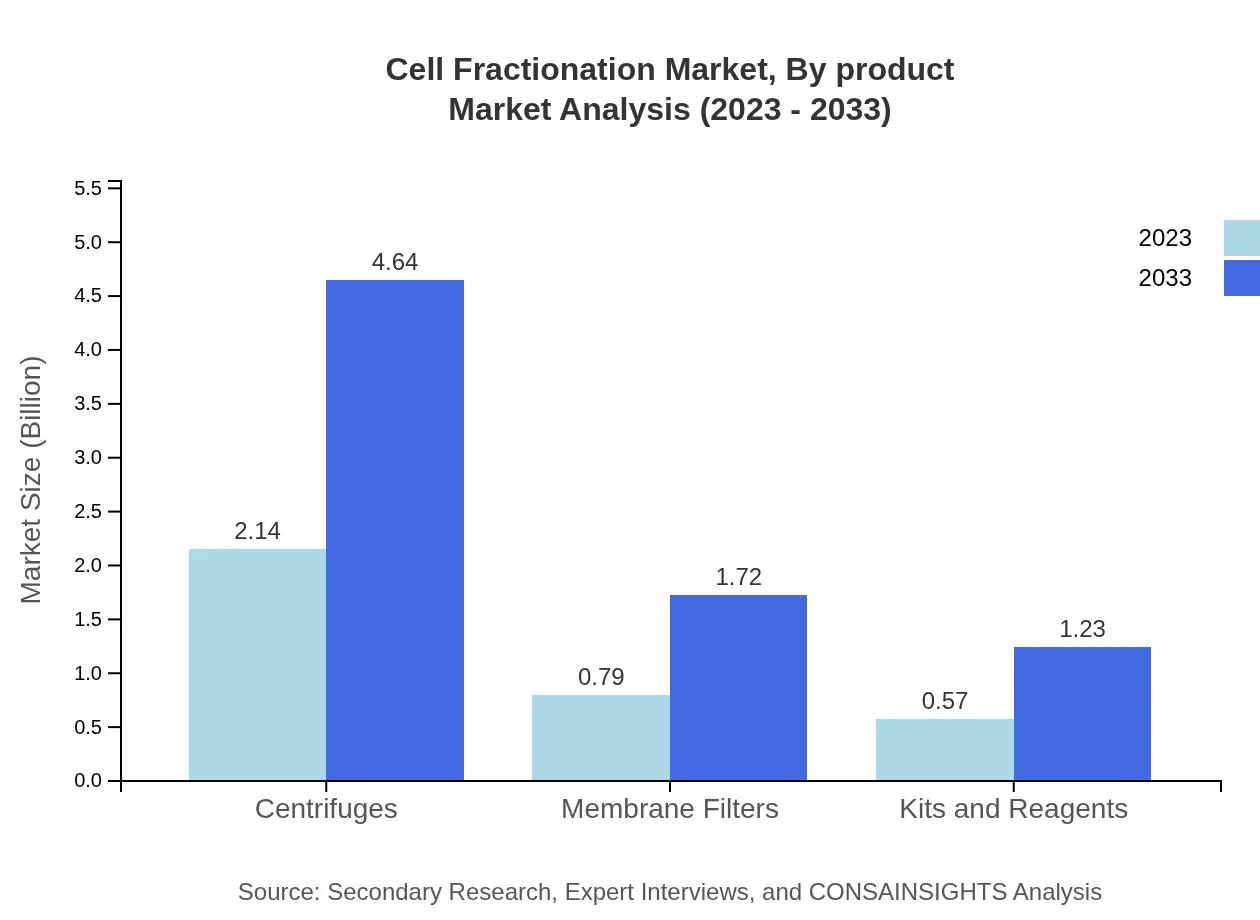
The market for centrifuges is projected to grow from 2.14 billion USD in 2023 to 4.64 billion USD by 2033, maintaining a market share of 61.11%. Membrane filters, another essential product, will grow from 0.79 billion USD to 1.72 billion USD with a share of 22.68%. Kits and reagents are expanding from 0.57 billion USD to 1.23 billion USD, capturing approximately 16.21% of the market. These products are critical for enabling efficient cell fractionation processes.
Cell Fractionation Market Analysis By Technique
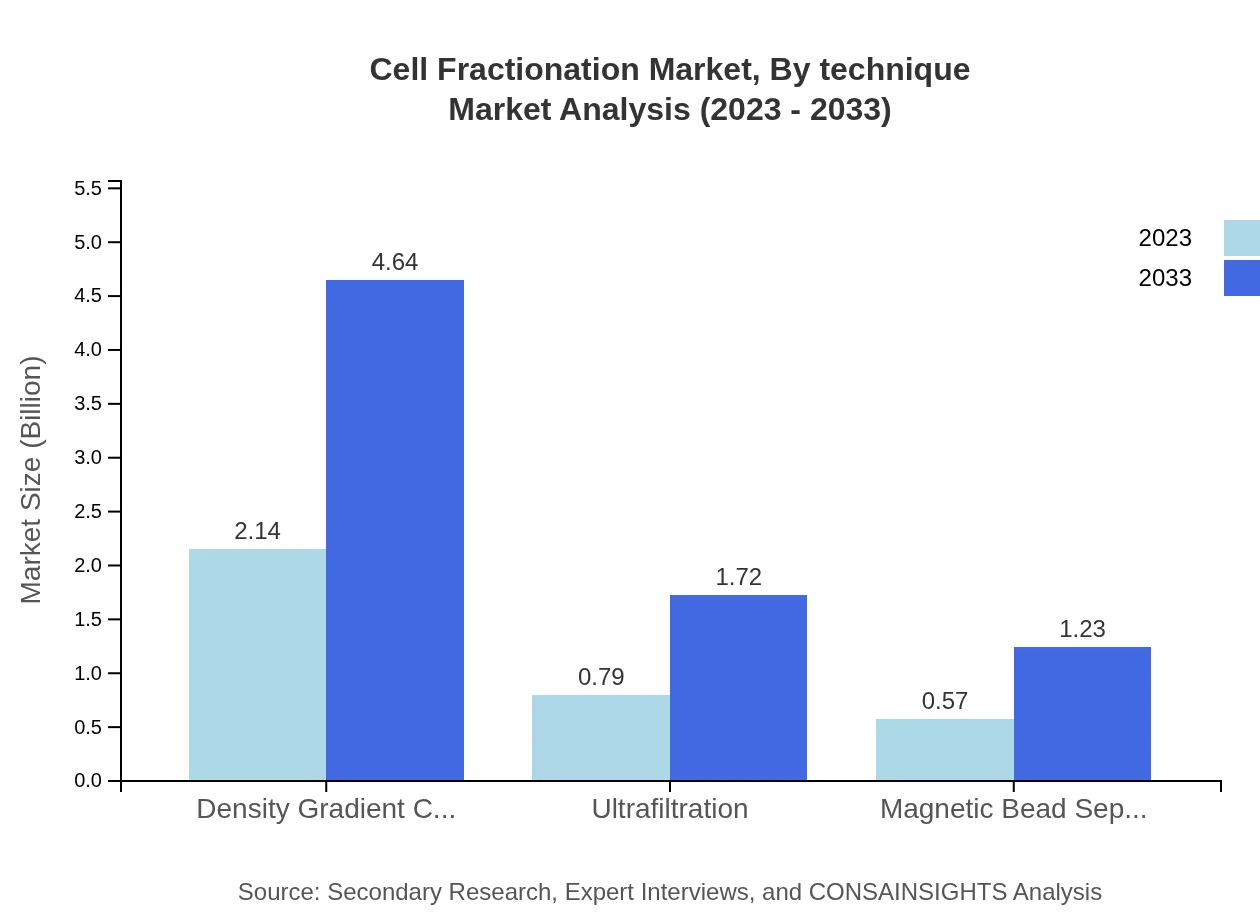
Density gradient centrifugation leads the technique segment with a size of 2.14 billion USD in 2023, growing to 4.64 billion USD by 2033. It holds a consistent share of 61.11%. Ultrafiltration and magnetic bead separation follow, with ultrafiltration growing from 0.79 billion USD to 1.72 billion USD (22.68% share) and magnetic bead separation starting at 0.57 billion USD, reaching 1.23 billion USD by 2033, representing a 16.21% share. These techniques are vital for isolating specific cell types in various applications.
Cell Fractionation Market Analysis By Application
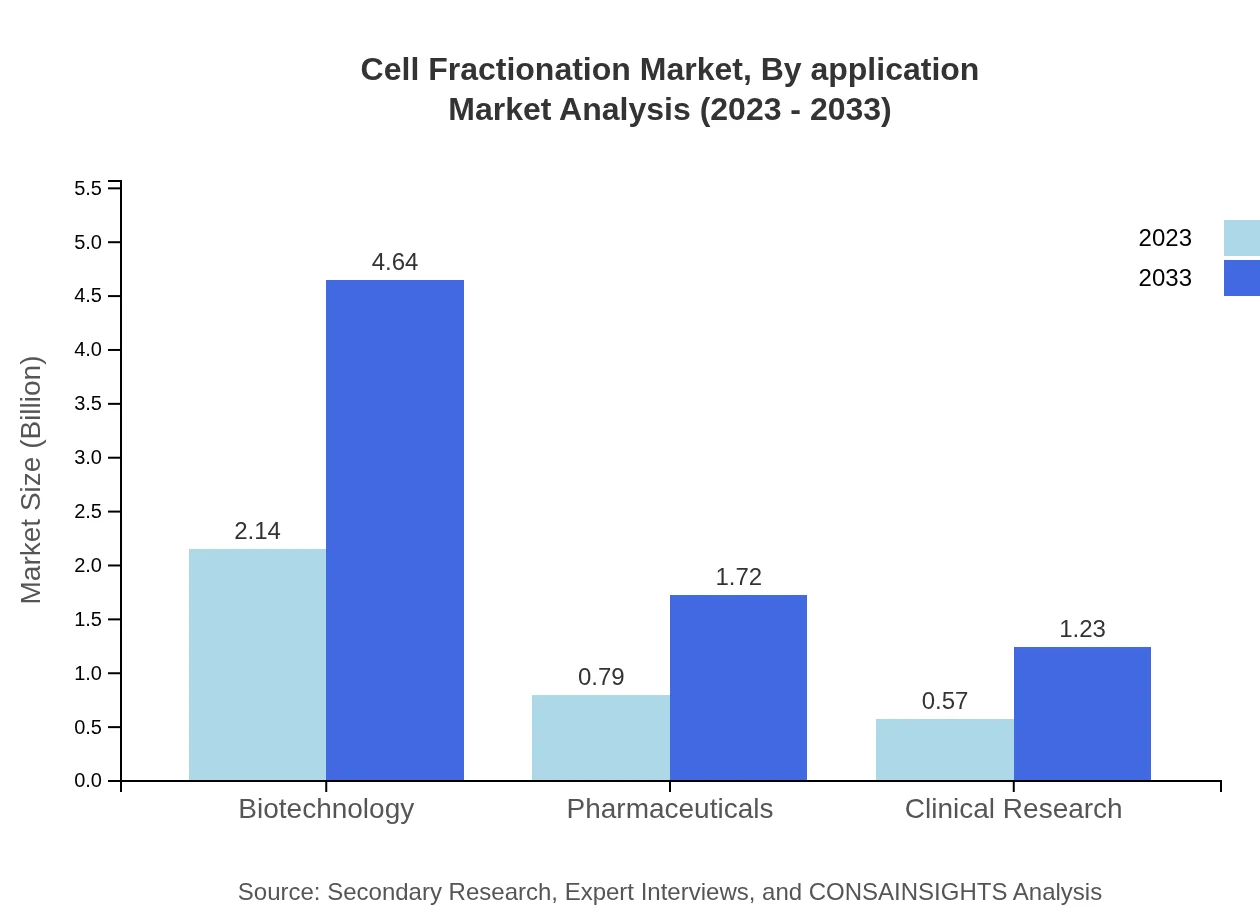
The prominent applications include biotechnology, pharmaceuticals, and clinical research. The biotechnology application segment is expected to reach a market size of 2.14 billion USD by 2033 from 1.05 billion USD in 2023, maintaining a significant share of 61.11%. Pharmaceutical applications will grow from 0.79 billion USD to 1.72 billion USD, capturing 22.68% of the market, while clinical research, starting at 0.57 billion USD, progresses to 1.23 billion USD by 2033, holding a 16.21% market share.
Cell Fractionation Market Analysis By End User
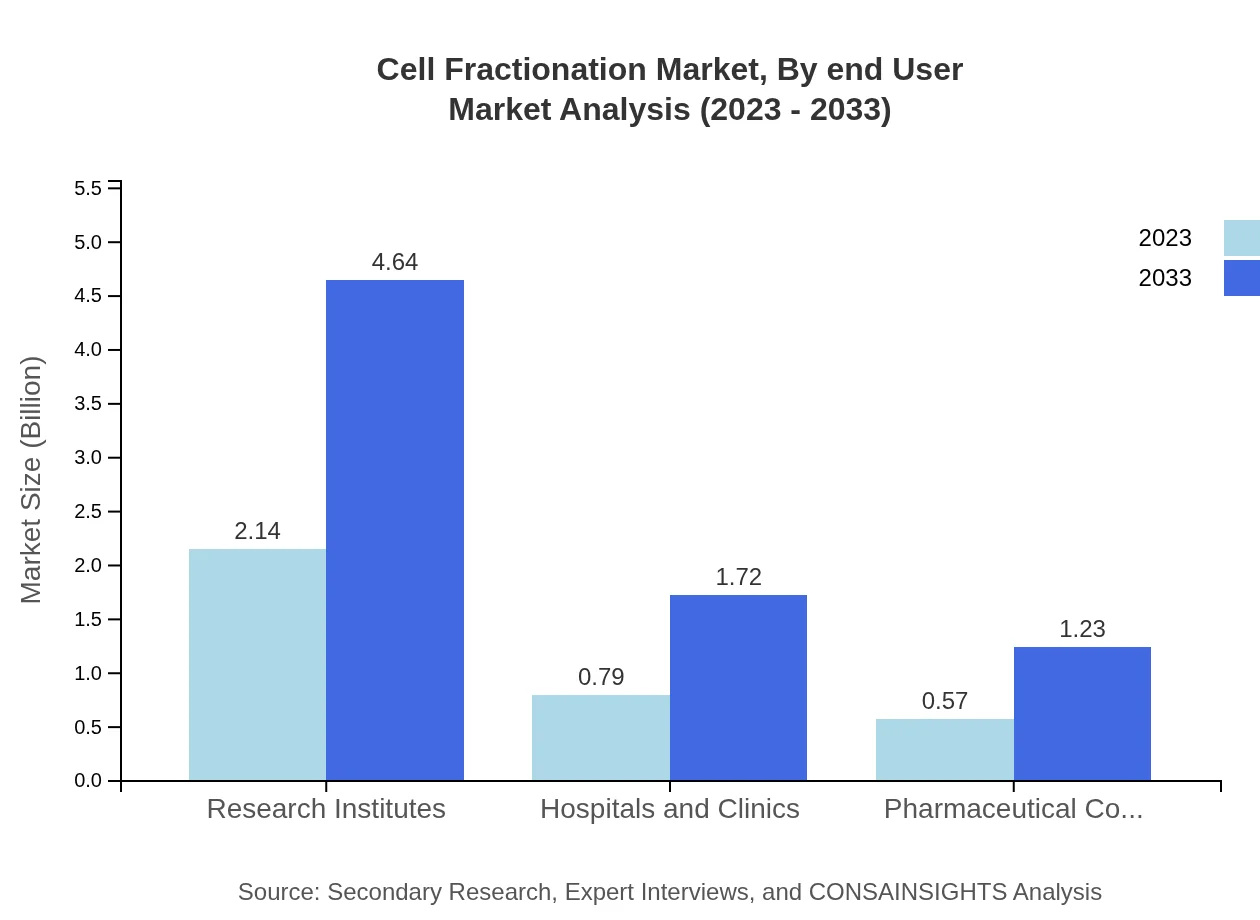
Key end-users include research institutes, hospitals and clinics, and pharmaceutical companies. Research institutes will see growth from 2.14 billion USD to 4.64 billion USD (61.11% share). Hospitals and clinics grow from 0.79 billion USD to 1.72 billion USD (22.68% share), and pharmaceutical companies will advance from 0.57 billion USD to 1.23 billion USD (16.21% share). The demand from these end-users drives innovation in cell fractionation technologies.
Cell Fractionation Market Trends and Future Forecast
Tell us your focus area and get a customized research report.
Global Market Leaders and Top Companies in Cell Fractionation Industry
Thermo Fisher Scientific:
Thermo Fisher Scientific is a leader in serving science, offering cutting-edge cell fractionation solutions across various industries, focusing on enhancing laboratory productivity and efficiency.Merck Group:
Merck Group is renowned for its innovative bioprocessing solutions, contributing significantly to the field of cell separation and fractionation technologies.Beckman Coulter:
Beckman Coulter specializes in laboratory instruments and reagents, providing advanced separation and sorting solutions crucial for cell fractionation.GE Healthcare:
GE Healthcare leads in medical technology and pharmaceutical innovations, offering essential tools that enhance cell fractionation processes in research and clinical settings.We're grateful to work with incredible clients.








FAQs
What is the market size of the cell fractionation market in 2023?
The market size was $3.50 Billion in 2023 as reported for the forecast starting year.
How big will the market be in 2033?
The projected market value for 2033 is $7.59 Billion according to the provided forecast data.
What is CAGR of the market for 2023 to 2033?
The compound annual growth rate for the period 2023 to 2033 is 7.8% as stated in the report data.
Is there a single fastest Growing region in the Cell Fractionation Market Report market?
No single fastest-growing region is stated for the Cell Fractionation Market Report market because the top regional implied CAGR values are within 0.15 percentage points of each other, making the ranking too close to call reliably.
Which companies are listed as key players?
Top companies named include Thermo Fisher Scientific, Merck Group, Beckman Coulter, and GE Healthcare.
What are primary techniques cited for cell fractionation?
Primary techniques include density gradient centrifugation, ultrafiltration, and magnetic bead separation as listed in the segmentation.
Who are the main end users of cell fractionation products?
End users comprise research institutes, hospitals and clinics, and pharmaceutical companies as specified in the report.
What is driving market growth according to the report?
Reported drivers include expanding research activity in biotechnology and pharmaceuticals, technology advances, and increased adoption in clinical research.