

Cell Free Protein Expression Market Report
First published: 14 October 2024 | Last updated: 25 May 2026 | Report Code: cell-free-protein-expression
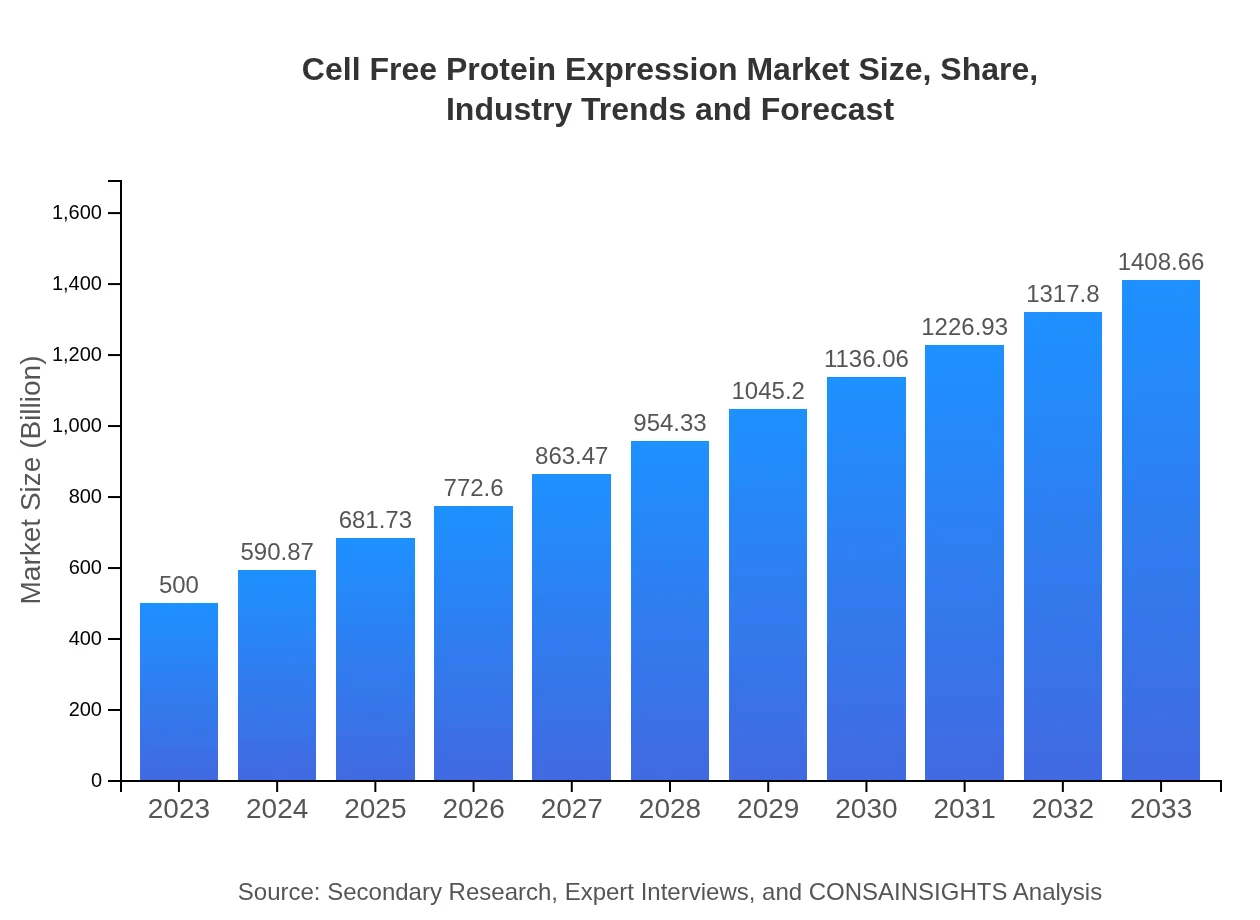
Cell Free Protein Expression Market — USD 500 million in 2023, Growing to USD 1408.66M by 2033 at 10.5% CAGR
This report provides a comprehensive analysis of the Cell Free Protein Expression market, focusing on insights and data from 2023 to 2033. It covers market size, industry trends, segmentation, regional analysis, and leading companies in the field.
Key Takeaways
- Global market size grows from $500.00 Billion in 2023 to $1408.66 Billion by 2033 at a 10.5% CAGR.
- North America is largest regional market, while no single fastest-growing region is stated because regional CAGR differences remain within 0.15 percentage points.
- Europe advances from $127.7 Billion to $359.77 Billion between 2023 and 2033, reflecting strong demand in life-sciences.
- Asia Pacific expands from $107.95 Billion to $304.13 Billion by 2033, driven by research and biopharma investment.
- Key vendors include Promega Corporation, New England Biolabs, Thermo Fisher Scientific, and Qiagen offering enabling platforms.
Cell Free Protein Expression Market Report — Executive Summary
North America remains largest market by forecast-period value, while no single fastest-growing region is stated because top regional growth rates are separated by less than 0.15 percentage points. The Cell Free Protein Expression market is positioned for substantial expansion during the 2023 to 2033 forecast period, rising from $500.00 Billion to $1408.66 Billion at a 10.5% CAGR. Growth is propelled by increasing requirements for rapid protein production in research, biologics development, and diagnostic applications. Technological progress—such as automation and high-throughput platforms—supports higher throughput and scalability. Regulatory emphasis on quality and increased R&D spending by academic and commercial organizations further stimulate adoption. The market structure includes multiple method and end-user segments, with prominent suppliers like Promega Corporation, New England Biolabs, Thermo Fisher Scientific, and Qiagen providing instruments, reagents, and integrated workflows. Regional performance varies, with North America holding the largest share. The report synthesizes primary interviews and secondary sources to present validated insights for stakeholders evaluating product strategies, investment priorities, or partnership opportunities.
Key Growth Drivers
- Rising demand for recombinant proteins in research and therapeutic development increases adoption of rapid expression systems.
- Advances in automation and high-throughput workflows improve productivity and encourage scaling of cell-free platforms.
- Greater investment by academic and commercial research organizations fuels procurement of reagents and instrumentation.
- Regulatory focus on manufacturing quality and process control drives interest in controllable cell-free production methods.
- Expansion of diagnostic and biopharmaceutical applications widens use cases for cell-free protein expression technologies.
| Metric | Value |
|---|---|
| Study Period | 2023 - 2033 |
| 2023 Market Size | $500.00 Million |
| CAGR (2023-2033) | 10.5% |
| 2033 Market Size | $1408.66 Million |
| Top Companies | Promega Corporation, New England Biolabs, Thermo Fisher Scientific, Qiagen |
| Published Date | 14 October 2024 |
| Last Modified Date | 25 May 2026 |
Cell Free Protein Expression Market Overview
Customize Cell Free Protein Expression Market Report market research report
- ✔ Get in-depth analysis of Cell Free Protein Expression market size, growth, and forecasts.
- ✔ Understand Cell Free Protein Expression's regional dynamics and industry-specific trends.
- ✔ Identify potential applications, end-user demand, and growth segments in Cell Free Protein Expression
What is the Market Size & CAGR of Cell Free Protein Expression Market Report market in 2023?
Cell Free Protein Expression Industry Analysis
Cell Free Protein Expression Market Segmentation and Scope
Tell us your focus area and get a customized research report.
Cell Free Protein Expression Market Report Market Analysis Report by Region
Europe Cell Free Protein Expression Market Report:
Europe grows from $127.7 Billion in 2023 to $359.77 Billion in 2033. The region benefits from strong biopharma activity, increasing diagnostic development, and demand for scalable protein production tied to research and therapeutic programs.Asia Pacific Cell Free Protein Expression Market Report:
Asia Pacific grows from $107.95 Billion in 2023 to $304.13 Billion in 2033. Growth is supported by rising research expenditure, expansion of biotechnology firms, and increased adoption of advanced protein expression platforms in both industry and academia.North America Cell Free Protein Expression Market Report:
North America is largest regional market, rising from $188.15 Billion in 2023 to $530.08 Billion in 2033. Regional strength is underpinned by substantial R&D investment, widespread adoption in academic and commercial laboratories, and vendor presence from leading suppliers.South America Cell Free Protein Expression Market Report:
Latin America grows from $26.65 Billion in 2023 to $75.08 Billion in 2033. Local drivers include growing research capacity, expanding biotech initiatives, and heightened interest in diagnostic and therapeutic research applications.Middle East & Africa Cell Free Protein Expression Market Report:
Middle East and Africa grows from $49.55 Billion in 2023 to $139.6 Billion in 2033. Growth is influenced by emerging research programs, investments in life-sciences infrastructure, and growing demand for diagnostic and biopharmaceutical capabilities.Tell us your focus area and get a customized research report.
Research Methodology
Cell Free Protein Expression Market Analysis By Method
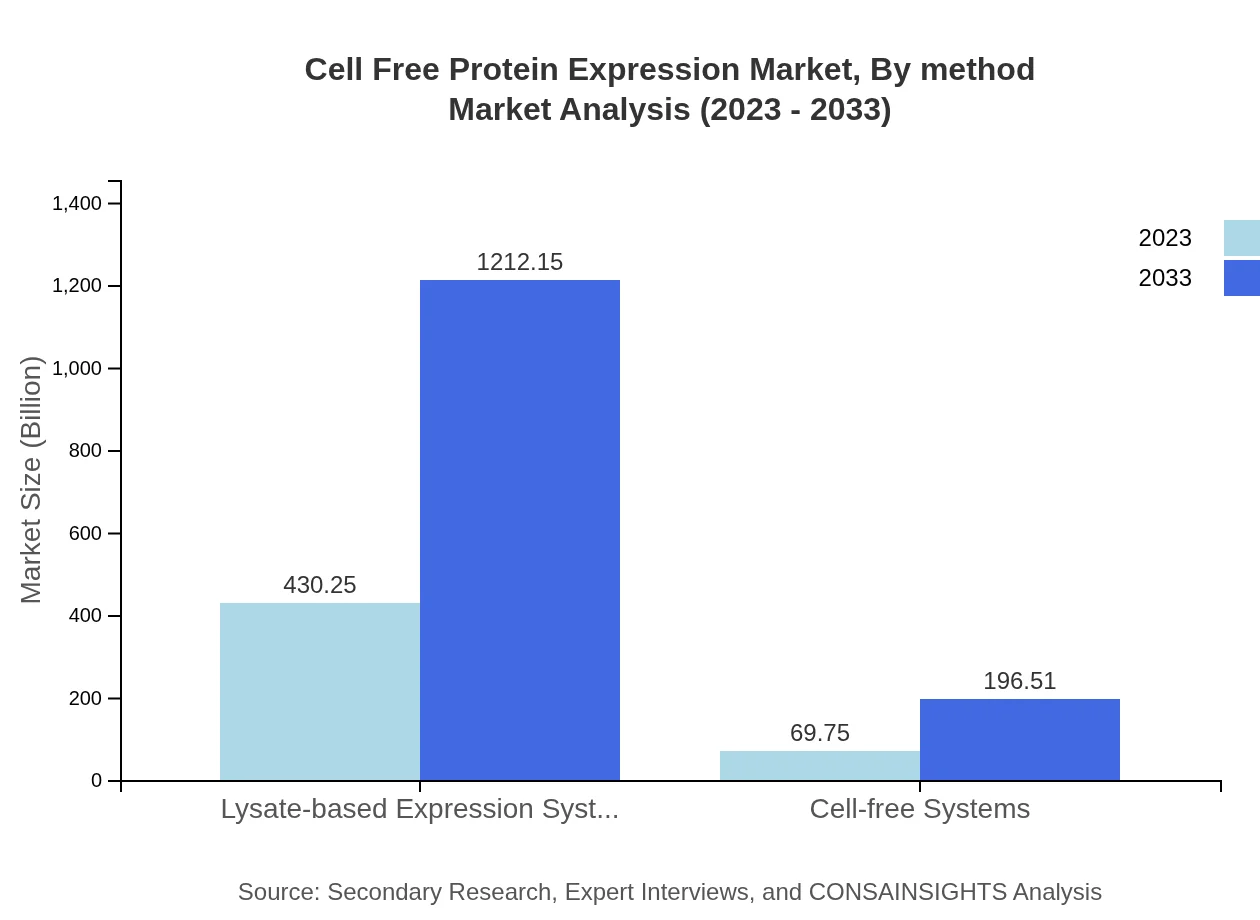
The Cell-Free Protein Expression market, by method, shows a dominant performance by lysate-based expression systems, which is expected to grow from $430.25 million in 2023 to $1,212.15 million by 2033. Cell-free systems, while currently smaller, are expected to see growth from $69.75 million to $196.51 million during the same period, reflecting a gradual shift towards newer technologies as validation for their applications increases.
Cell Free Protein Expression Market Analysis By Application
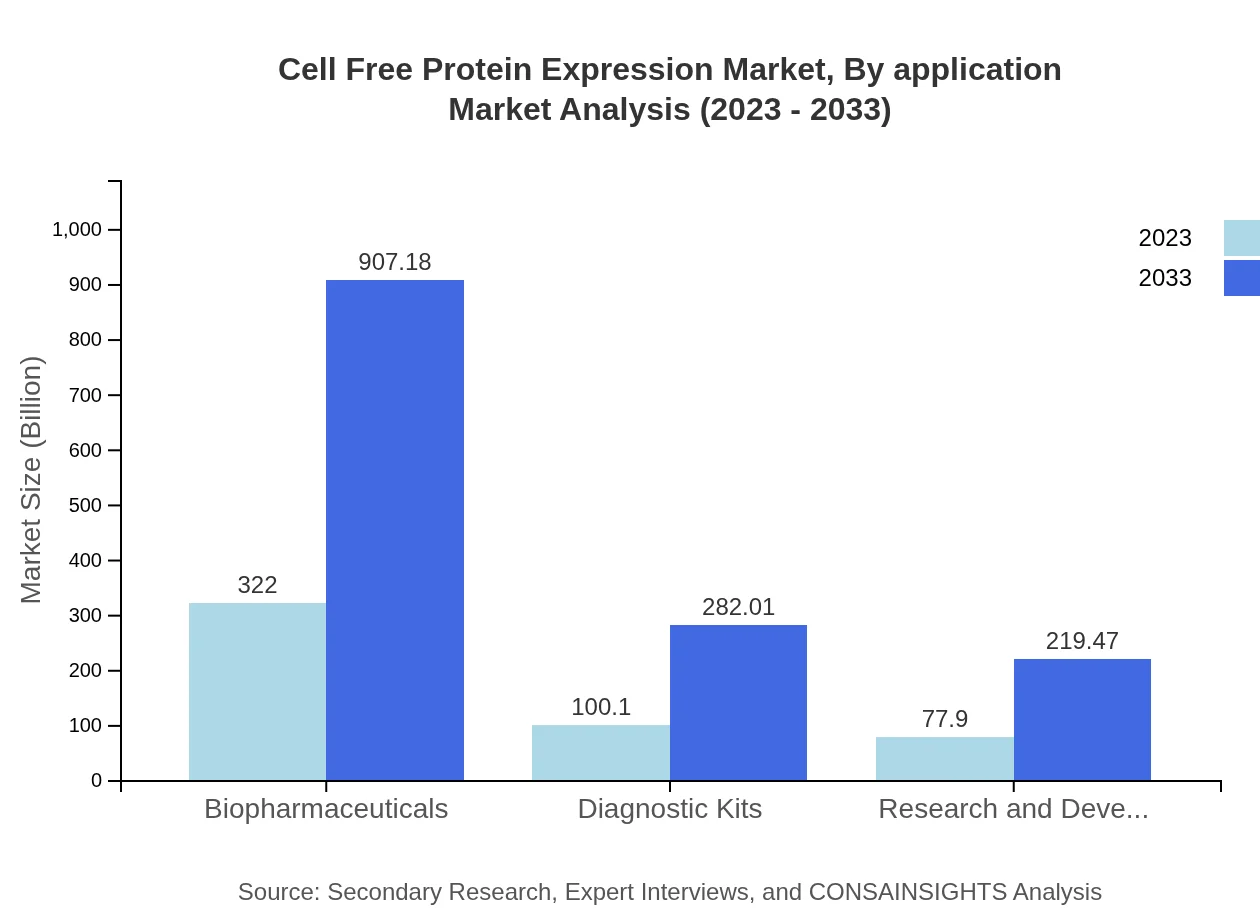
The market analysis by application shows that biopharmaceuticals remain the largest segment, projected to grow from $322 million in 2023 to $907.18 million by 2033. Academic research institutes also play a significant role, expanding from $278.05 million to $783.36 million, indicating the core academic interest in protein expression for various research applications.
Cell Free Protein Expression Market Analysis By End User
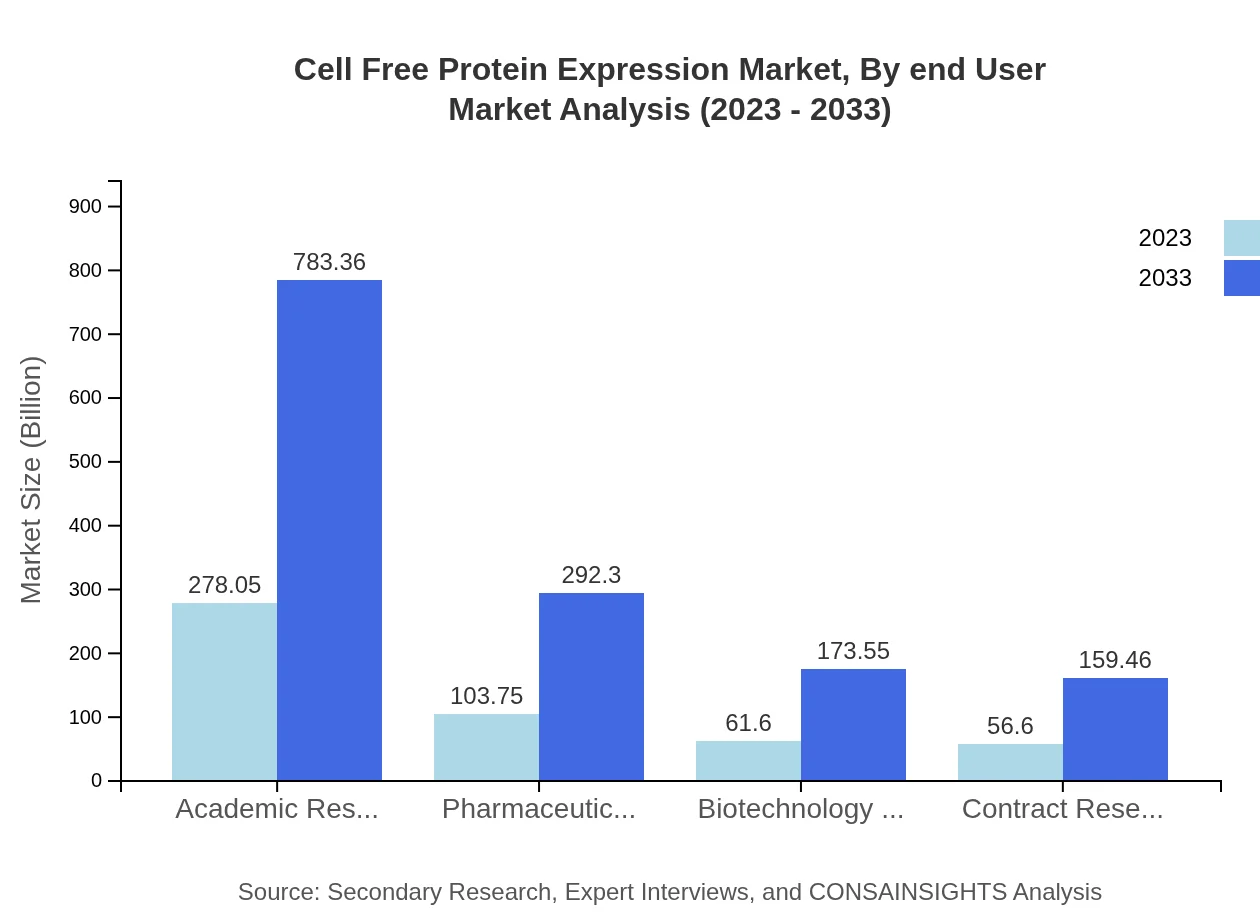
In terms of end-users, pharmaceutical companies are dominant with a market size growth from $103.75 million in 2023 to $292.30 million by 2033, illustrating their reliance on innovative expression methods. Other contributors include biotechnology firms, CROs, and research and development sectors, each exhibiting significant growth prospects due to their integrative role in biotechnological advancements.
Cell Free Protein Expression Market Analysis By Region
Global Cell-Free Protein Expression Market, By Region (Not Applicable) Market Analysis (2023 - 2033)
Although direct regional categorization is not applicable, the growth rates in each geographic segment reflect distinct market dynamics and opportunities across different regions, highlighting the global interest and investment in Cell Free Protein Expression technologies.
Cell Free Protein Expression Market Trends and Future Forecast
Tell us your focus area and get a customized research report.
Global Market Leaders and Top Companies in Cell Free Protein Expression Industry
Promega Corporation:
A leading company in the field, Promega specializes in providing innovative biotechnology products and services, including cell-free protein expression systems that cater to researchers' needs.New England Biolabs:
Known for its pioneering work in molecular biology, New England Biolabs offers advanced cell-free protein expression solutions, enhancing efficient and versatile protein production.Thermo Fisher Scientific:
Thermo Fisher is a global leader in serving science, providing cell-free expression systems as part of its extensive portfolio aimed at enabling discovery and development in the life sciences.Qiagen :
Qiagen focuses on providing sample and assay technologies for molecular diagnostics and research, including cell-free protein expression systems, catering to diverse research applications.We're grateful to work with incredible clients.









FAQs
What is the market size of the Cell Free Protein Expression Market Report in 2023?
The market size in 2023 is $500.00 Billion, based on the input data for the forecast analysis covering the 2023 to 2033 period.
How big will the market be in 2033?
The market is projected to reach $1408.66 Billion by 2033, as specified for the 2023 to 2033 forecast period in the provided dataset.
What is CAGR for the forecast period?
The compounded annual growth rate for 2023 to 2033 is 10.5%, as stated in the input information for the market projection.
Is there a single fastest Growing region in the Cell Free Protein Expression Market Report market?
No single fastest-growing region is stated for the Cell Free Protein Expression Market Report market because the top regional implied CAGR values are within 0.15 percentage points of each other, making the ranking too close to call reliably.
Who are the top companies operating in this market?
Top companies listed include Promega Corporation, New England Biolabs, Thermo Fisher Scientific, and Qiagen, per the supplied company list.
Why is investment rising in cell Free protein platforms?
Investment increases due to needs for faster protein production, applications in biopharma and diagnostics, and improvements in automation and scalability.
What are common end users of cell Free protein expression systems?
End users include Academic Research Institutes, Pharmaceutical Companies, Biotechnology Firms, and Contract Research Organizations (CROs) as specified in the input.
What research methods supported the market findings?
The study used primary interviews with industry experts, secondary company reports and publications, data triangulation, internal validation, and expert-led trend analysis.