
Reports >
Life Sciences
>
Cell Viability Assays Market Report

Cell Viability Assays Market Report
First published: 08 October 2024 | Last updated: 25 May 2026 | Report Code: cell-viability-assays
Cell Viability Assays Market — USD 2.5 billion in 2023, Growing to USD 4.91B by 2033 at 6.8% CAGR
This report provides an in-depth analysis of the global Cell Viability Assays market, covering current trends, market size, competitive landscape, and future projections from 2023 to 2033. It aims to equip stakeholders with valuable insights for informed decision-making.
Key Takeaways
- Global market increases from $2.50 Billion in 2023 to $4.91 Billion in 2033 at a 6.8% CAGR.
- North America is largest regional market, while no single fastest-growing region is stated because regional CAGR differences remain within 0.15 percentage points.
- Europe expands from $0.83 Billion in 2023 to $1.63 Billion in 2033, reflecting sustained research activity.
- Asia Pacific rises from $0.45 Billion in 2023 to $0.89 Billion in 2033 amid growing lab infrastructure.
- Top companies include Thermo Fisher Scientific Inc., Sigma-Aldrich (Millipore Sigma), Promega Corporation, Bio-Rad Laboratories, Inc., and Abcam plc.
Cell Viability Assays Market Report — Executive Summary
North America remains largest market by forecast-period value, while no single fastest-growing region is stated because top regional growth rates are separated by less than 0.15 percentage points. This report assesses the global cell viability assays market from 2023 to 2033, documenting expansion from $2.50 Billion to $4.91 Billion at a 6.8% CAGR. Growth is supported by increased investment in drug discovery, cancer research, toxicology testing and the adoption of high-throughput and automated laboratory platforms. The analysis covers product and assay-type segmentation, end-user demand across pharmaceutical companies, biotechnology firms, academic institutions and CROs, and regional performance. North America is identified as the largest regional market based on end-period value. Leading suppliers such as Thermo Fisher Scientific Inc., Sigma-Aldrich (Millipore Sigma), Promega Corporation, Bio-Rad Laboratories, Inc., and Abcam plc are profiled for market positioning and strategic initiatives. The study highlights innovation trends, regulatory considerations, and collaboration between industry and academia as ongoing influences on market dynamics.
Key Growth Drivers
- Rising investment in drug discovery programs increases demand for robust cell viability testing.
- Expansion of cancer research and toxicology assessment drives uptake of diverse assay formats.
- Adoption of automated and high-throughput screening systems accelerates assay deployment in labs.
- Collaboration between biotech firms and academic institutions fuels development and validation of new assays.
- Emphasis on personalized medicine prompts demand for precise cell health measurement tools.
| Metric | Value |
|---|---|
| Study Period | 2023 - 2033 |
| 2023 Market Size | $2.50 Billion |
| CAGR (2023-2033) | 6.8% |
| 2033 Market Size | $4.91 Billion |
| Top Companies | Thermo Fisher Scientific Inc., Sigma-Aldrich (Millipore Sigma), Promega Corporation, Bio-Rad Laboratories, Inc., Abcam plc |
| Published Date | 08 October 2024 |
| Last Modified Date | 25 May 2026 |
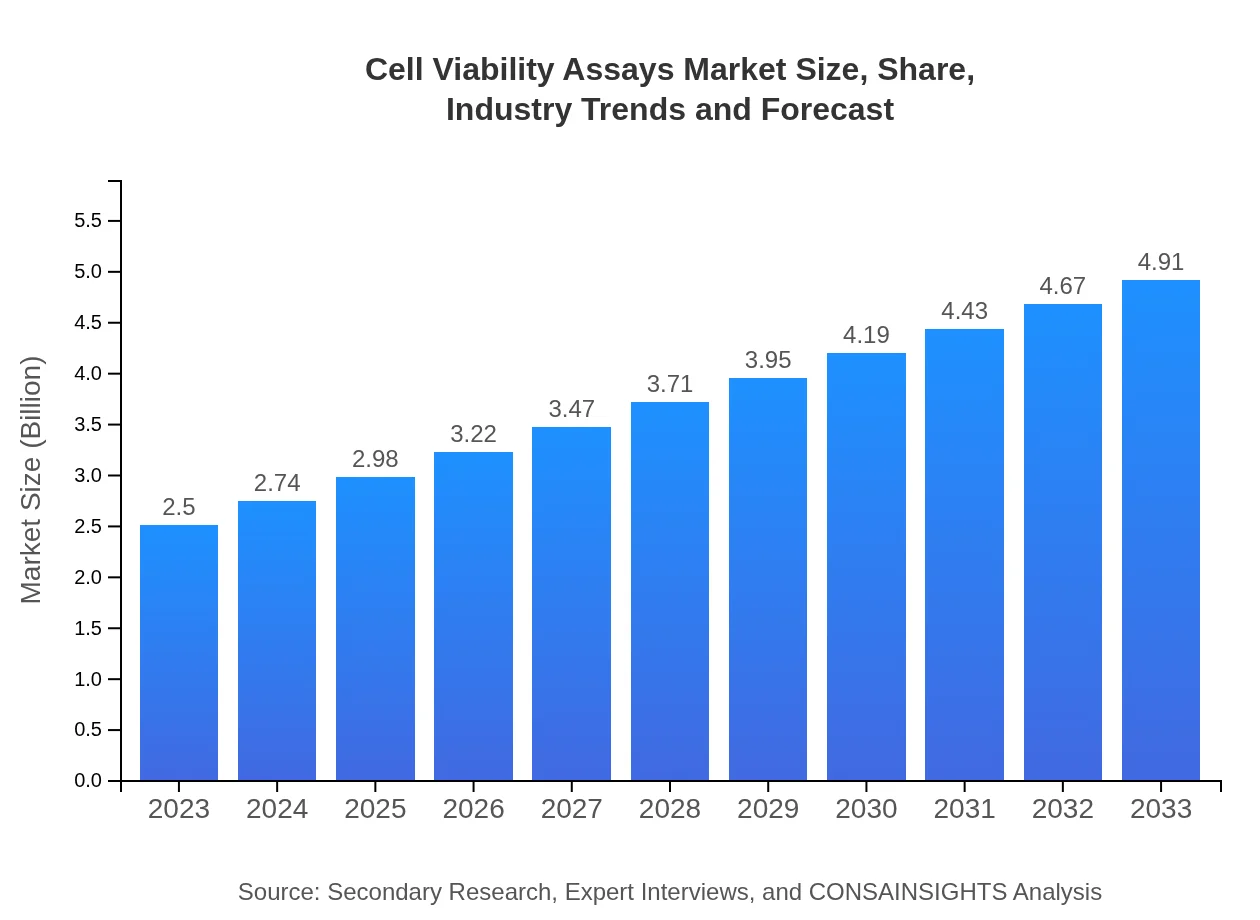
Cell Viability Assays Market Overview
Customize Cell Viability Assays Market Report market research report
- ✔ Get in-depth analysis of Cell Viability Assays market size, growth, and forecasts.
- ✔ Understand Cell Viability Assays's regional dynamics and industry-specific trends.
- ✔ Identify potential applications, end-user demand, and growth segments in Cell Viability Assays
What is the Market Size & CAGR of Cell Viability Assays Market Report market in 2023?
Cell Viability Assays Industry Analysis
Cell Viability Assays Market Segmentation and Scope
Tell us your focus area and get a customized research report.
Cell Viability Assays Market Report Market Analysis Report by Region
Europe Cell Viability Assays Market Report:
Europe grows from $0.83 Billion in 2023 to $1.63 Billion in 2033. The region's trajectory is supported by active cancer research programs, a strong presence of academic institutions, and collaborations between industry and universities that accelerate assay adoption and validation.Asia Pacific Cell Viability Assays Market Report:
Asia Pacific grows from $0.45 Billion in 2023 to $0.89 Billion in 2033. Expansion is driven by investment in laboratory infrastructure, rising biotech research activity, and growing participation in drug discovery and toxicology testing across emerging markets.North America Cell Viability Assays Market Report:
North America is largest regional market, rising from $0.85 Billion in 2023 to $1.67 Billion in 2033. Regional strength is tied to concentrated pharmaceutical and biotech R&D, advanced laboratory infrastructure, and substantial adoption of automated screening platforms that drive demand for diverse assay formats.South America Cell Viability Assays Market Report:
Latin America grows from $0.11 Billion in 2023 to $0.21 Billion in 2033. Market growth reflects developing research capabilities, increasing academic and CRO activities, and gradual uptake of assay technologies in pharmaceutical and biotech applications.Middle East & Africa Cell Viability Assays Market Report:
Middle East and Africa grows from $0.26 Billion in 2023 to $0.5 Billion in 2033. Growth is influenced by expanding research initiatives, partnerships with international firms, and incremental investment in laboratory capabilities for healthcare and pharmaceutical research.Tell us your focus area and get a customized research report.
Research Methodology
Cell Viability Assays Market Analysis By Assay Type
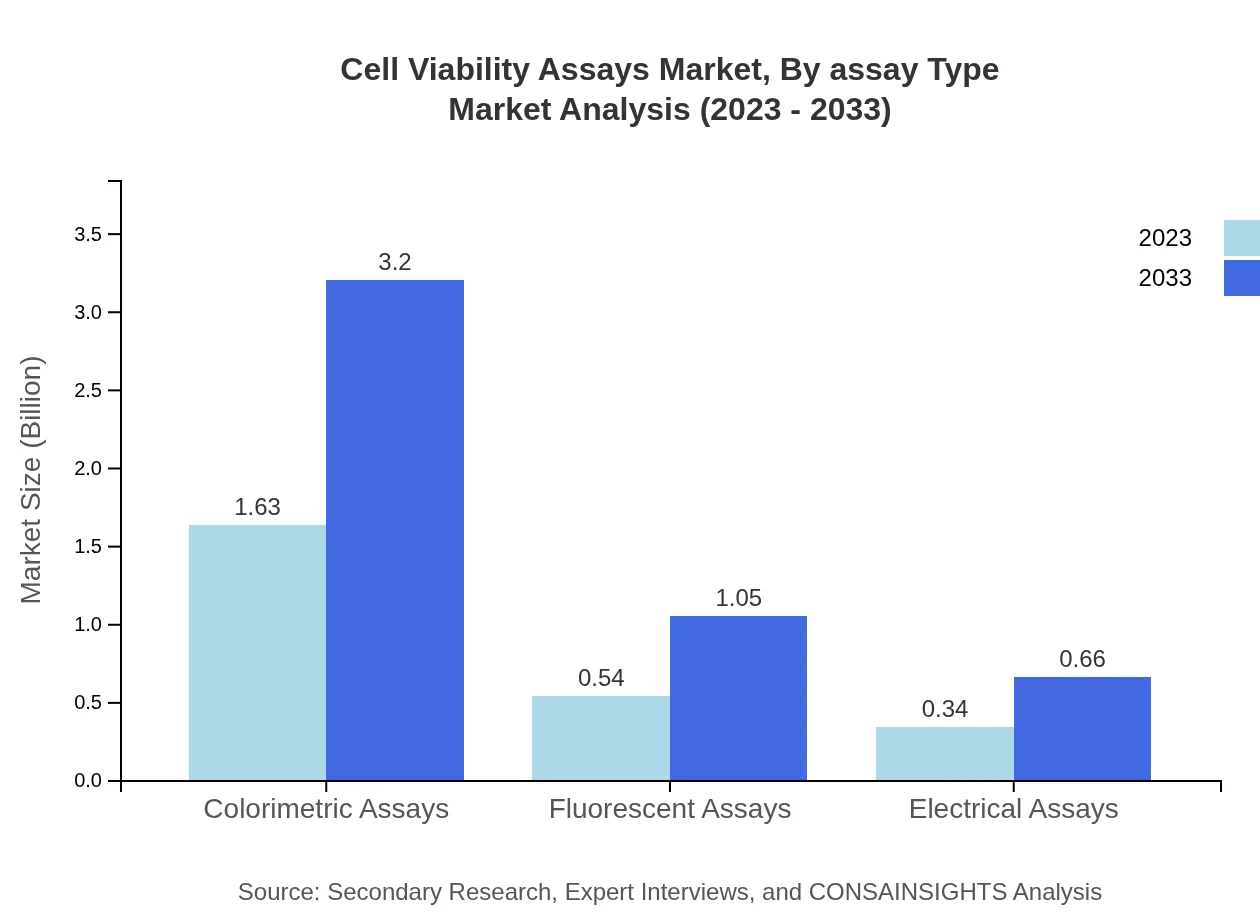
Colorimetric assays lead the market with significant revenue generation, accounting for approximately 65.13% of the share in 2023. Fluorescent assays follow, holding a market share of 21.47%, recognized for their sensitivity and specificity, particularly in complex biological samples. Electrical assays, while smaller, are gaining traction due to their unique capabilities in real-time assessments.
Cell Viability Assays Market Analysis By Application
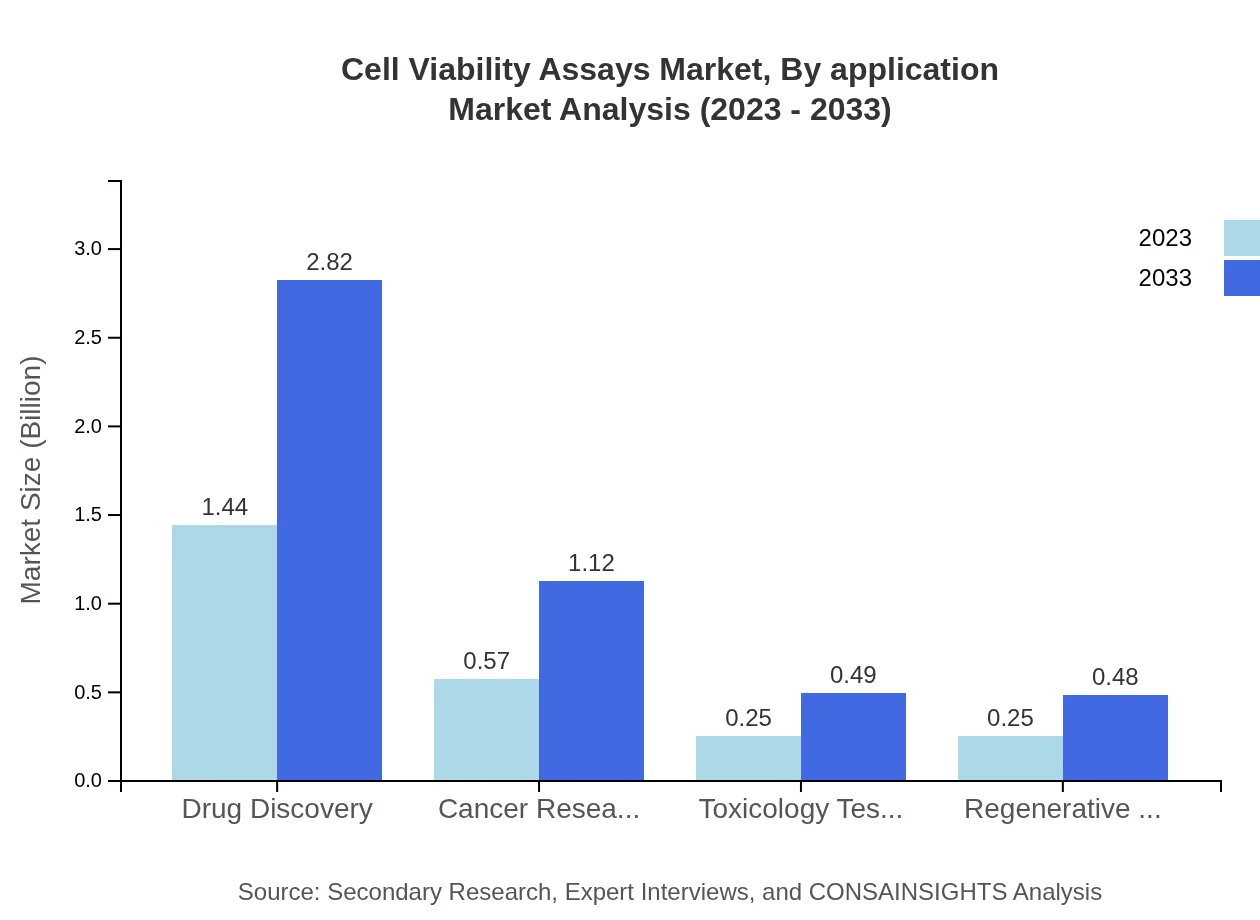
The drug discovery segment dominates the market, reflecting a 57.45% share in 2023, driven by the continuous quest for novel therapeutic agents. The cancer research segment accounts for 22.83% of the market, highlighting the critical need for reliable viability assessments in oncology research. Other noteworthy applications include toxicology testing and regenerative medicine, which are steadily gaining importance as healthcare focuses on innovative treatments.
Cell Viability Assays Market Analysis By End User
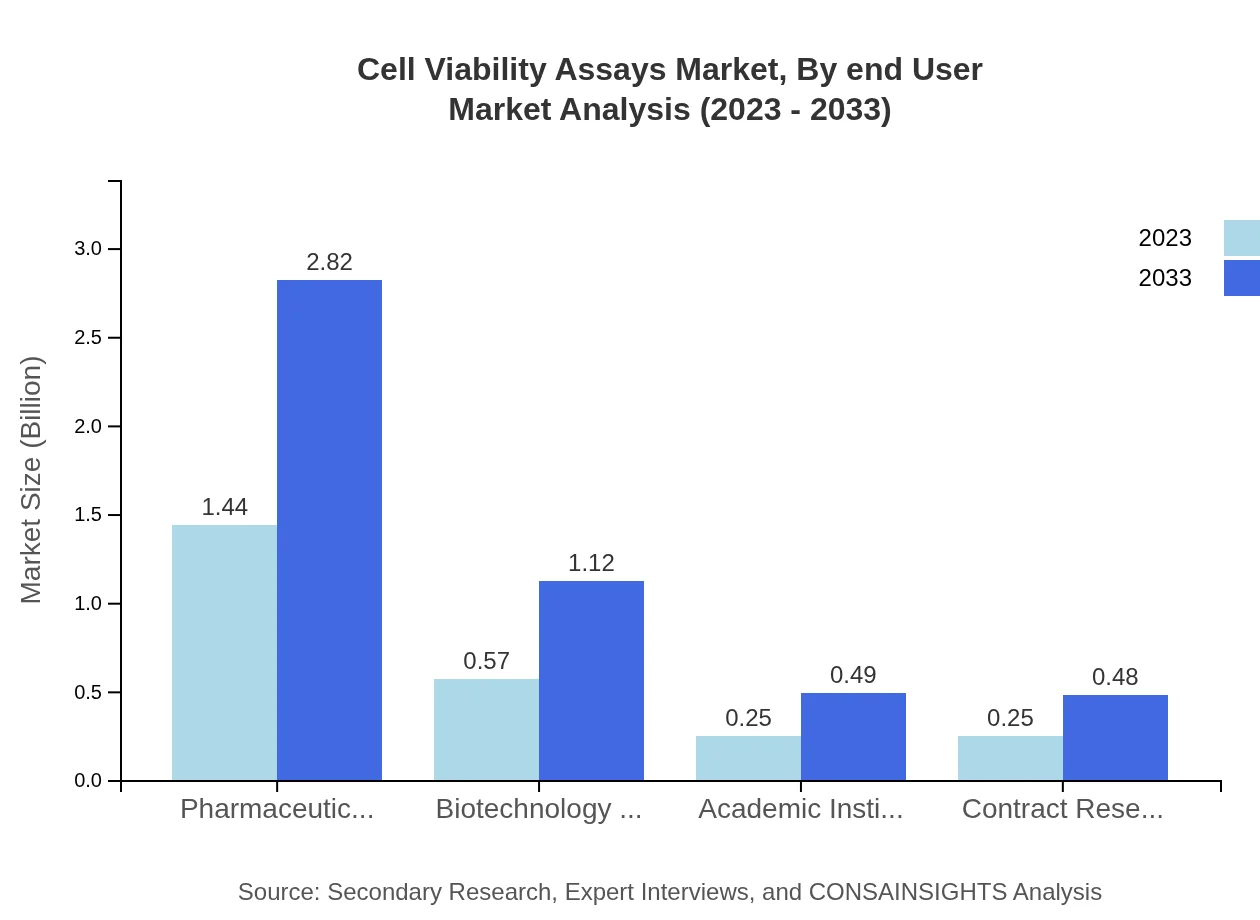
Pharmaceutical companies lead the market share, estimated at 57.45% in 2023, as they utilize these assays throughout the drug development process. Biotechnology firms represent 22.83% of the market, reflecting their reliance on these assays for innovative research. Academic institutions, along with contract research organizations, also play a notable role, highlighting the competitive environment in advancing cell viability research.
Cell Viability Assays Market Analysis By Region Geography
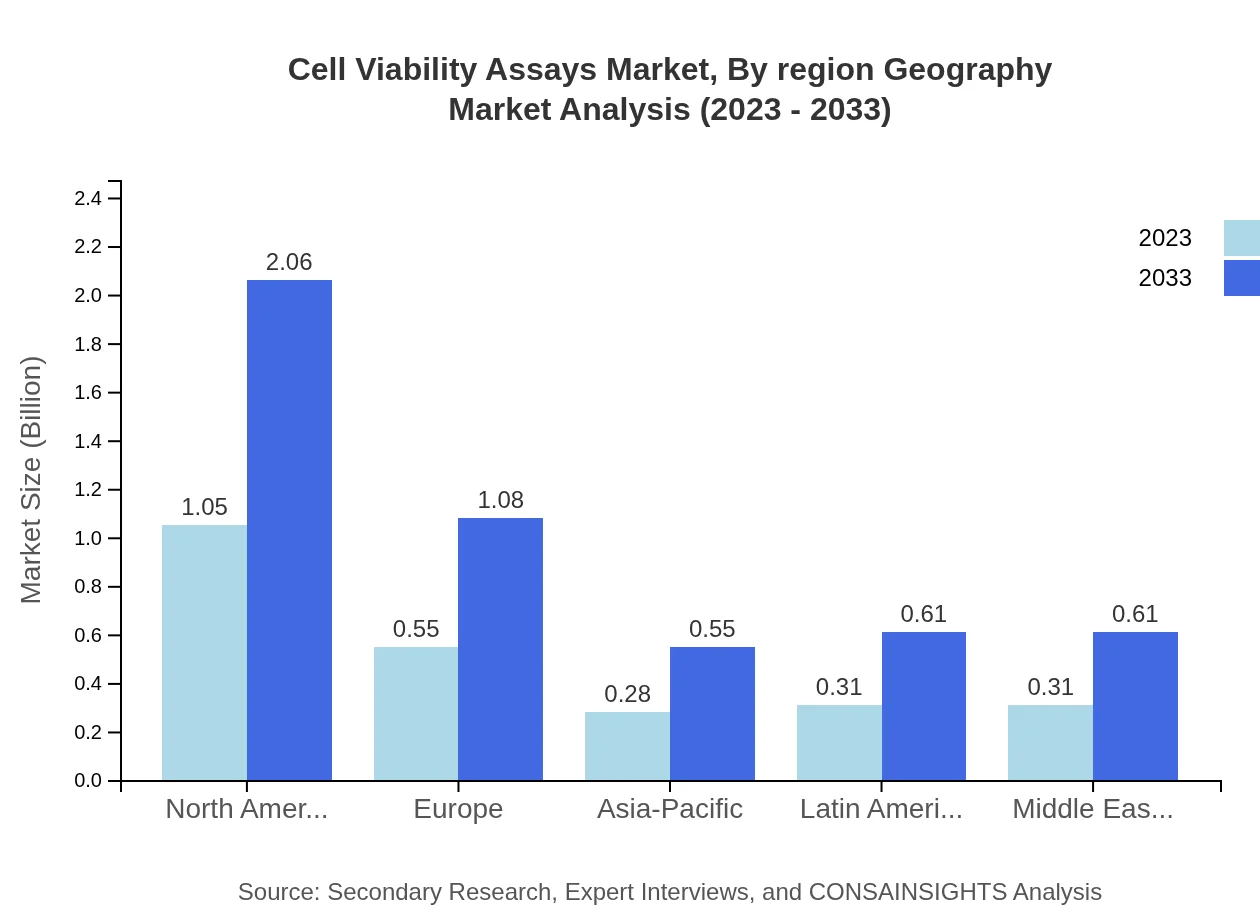
The competitive landscape across regions shows significant variation. North America retains a dominant position due to its established lifesciences market, while Europe is rapidly expanding due to supportive regulations. The Asia-Pacific region is emerging as a critical market, underpinned by growing investment in biotechnology and research sectors, with additional growth expected in Latin America and the Middle East & Africa as regulatory environments improve.
Cell Viability Assays Market Trends and Future Forecast
Tell us your focus area and get a customized research report.
Global Market Leaders and Top Companies in Cell Viability Assays Industry
Thermo Fisher Scientific Inc.:
Thermo Fisher is a leading provider of laboratory equipment and reagents, including a wide range of cell viability assays, enhancing research and development across diverse applications.Sigma-Aldrich (Millipore Sigma):
A key player in chemicals and reagents, Sigma-Aldrich offers various cell viability products that cater to the needs of researchers in pharmaceutical and academic sectors.Promega Corporation:
Promega specializes in providing innovative assays and reagents, particularly in the realms of cell health, apoptosis, and drug efficacy testing, contributing significantly to the assay market.Bio-Rad Laboratories, Inc.:
Bio-Rad provides a comprehensive line of cell viability assays, serving the needs of researchers in gene expression analysis and protein studies.Abcam plc:
Abcam is known for its extensive collection of high-quality antibodies and assays, including cell viability assays, which support drug discovery and therapeutic development.We're grateful to work with incredible clients.









FAQs
What is the market size of the Cell Viability Assays Market Report in 2023?
The market size is $2.50 Billion in 2023, as stated in the report's baseline year figure used for the 2023 to 2033 forecast.
What is CAGR for the forecast period?
The compound annual growth rate (CAGR) for the 2023 to 2033 forecast period is 6.8%, as specified in the report metrics.
How big is the market expected to be in 2033?
The market is projected to reach $4.91 Billion by 2033, reflecting growth over the 2023 base at the reported CAGR.
Is there a single fastest Growing region in the Cell Viability Assays Market Report market?
No single fastest-growing region is stated for the Cell Viability Assays Market Report market because the top regional implied CAGR values are within 0.15 percentage points of each other, making the ranking too close to call reliably.
Which companies lead the industry?
Top named companies include Thermo Fisher Scientific Inc., Sigma-Aldrich (Millipore Sigma), Promega Corporation, Bio-Rad Laboratories, Inc., and Abcam plc.
What applications support market expansion?
Key applications boosting demand are drug discovery, cancer research, toxicology testing and regenerative medicine, which require validated cell viability measurements.
Who are the primary end users?
Primary end users listed are pharmaceutical companies, biotechnology firms, academic institutions and contract research organizations (CROs).
How big is the Europe market in the forecast?
Europe increases from $0.83 Billion in 2023 to $1.63 Billion in 2033, reflecting research activity and regional demand for assay solutions.
What drives adoption in Asia Pacific?
Asia Pacific grows from $0.45 Billion in 2023 to $0.89 Billion in 2033, supported by expanding laboratory infrastructure and growing biotech research.
Why is no fastest Growing region named?
The report does not designate a regional growth market; top regional growth rates fall within 0.15 percentage points and are therefore not singled out.