
Reports >
Technology And Media
>
China Smart Cities

China Smart Cities
First published: 08 January 2026 | Last updated: 31 January 2026 | Report Code: china-smart-cities
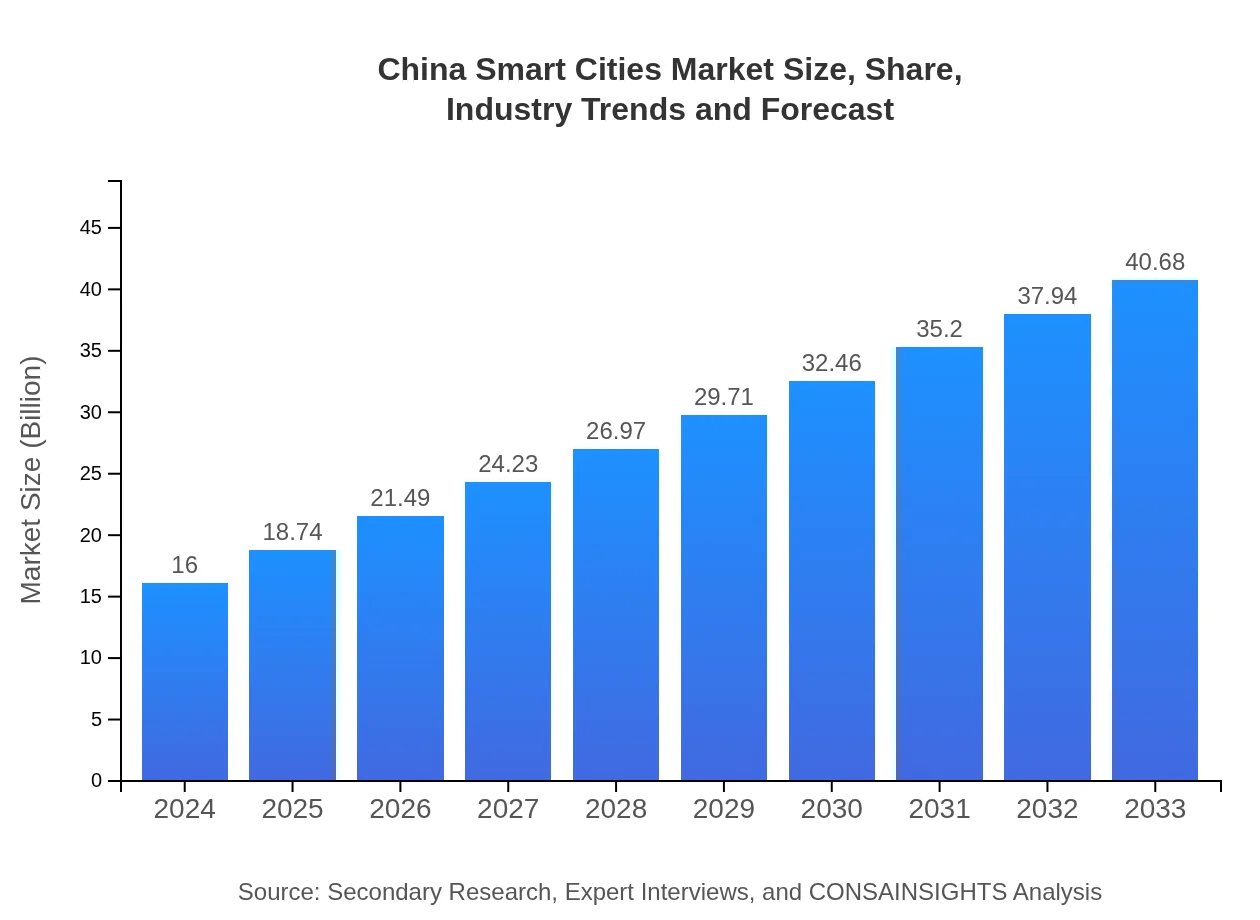
China Smart Cities Market — USD $16 Billion in 2024, Growing to USD 40.68 by 2033 at 10.5% CAGR
This report offers a comprehensive analysis of the China Smart Cities market, providing detailed insights, data trends, and technological breakthroughs. Covering aspects from market size and growth projections to regional performance and segmentation nuances, it outlines key industry drivers and challenges. The forecast period spans from 2024 to 2033, offering valuable strategic perspectives.
| Metric | Value |
|---|---|
| Study Period | 2024 - 2033 |
| 2024 Market Size | $16.00 Billion |
| CAGR (2024-2033) | 10.5% |
| 2033 Market Size | $40.68 Billion |
| Top Companies | Huawei Technologies, Alibaba Cloud |
| Published Date | 08 January 2026 |
| Last Modified Date | 31 January 2026 |
China Smart Cities Market Overview
Customize China Smart Cities market research report
- ✔ Get in-depth analysis of China Smart Cities market size, growth, and forecasts.
- ✔ Understand China Smart Cities's regional dynamics and industry-specific trends.
- ✔ Identify potential applications, end-user demand, and growth segments in China Smart Cities
What is the Market Size & CAGR of China Smart Cities market in 2024?
China Smart Cities Industry Analysis
China Smart Cities Market Segmentation and Scope
Tell us your focus area and get a customized research report.
China Smart Cities Market Analysis Report by Region
Europe China Smart Cities:
Europe is contributing robustly to the smart cities revolution with initiatives aimed at reducing carbon footprints and enhancing connectivity. The market size is expected to grow from 4.55 in 2024 to 11.57 in 2033, driven by stringent environmental regulations and substantial investment in renewable energy and digital infrastructure projects. The region’s focus on sustainability and high quality of urban living encourages further integration of smart technologies across various metropolitan areas.Asia Pacific China Smart Cities:
In the Asia Pacific region, the market is witnessing a transition driven by rapid urbanization and technological leaps. Investments in smart infrastructure and digital connectivity are on the rise as cities strive to implement sustainable initiatives. The projections indicate that the market will grow from a 2024 size of 2.96 to 7.52 by 2033, fueled by robust public policy and private initiatives. The region’s diverse economic landscape is driving tailored solutions that cater to local needs while aligning with global standards.North America China Smart Cities:
North America remains a significant market with its high initial investment in smart technology. The region’s market is projected to expand from a 2024 size of 6.18 to 15.70 by 2033. Key urban centers are investing in digital transformation projects that focus on improving energy management, public safety, and efficient traffic controls. Innovation hubs and high technology adoption rates further stimulate market growth, making North America a critical player in the global smart city landscape.South America China Smart Cities:
South America presents opportunities for smart urban innovation despite its varied economic challenges. With a starting market size of 1.10 in 2024 and expected growth to 2.79 by 2033, the region is adopting smart technologies to tackle urban congestion and infrastructural deficits. Although slower in pace when compared to Asia Pacific, targeted investments and government incentives are paving the way for more integrated urban solutions, leading to improved public services and sustainable development.Middle East & Africa China Smart Cities:
In the Middle East and Africa region, smart city initiatives are emerging slowly but steadily. With a market size of 1.22 in 2024 and predictions reaching 3.10 by 2033, growth is driven by government-led modernization and strategic economic diversification plans. Despite infrastructural challenges, the region is leveraging innovative technologies in sectors such as transportation and energy. Increasing foreign investments and regional partnerships are expected to further accelerate the adoption of smart urban solutions.Tell us your focus area and get a customized research report.
China Smart Cities Market Analysis By Technology
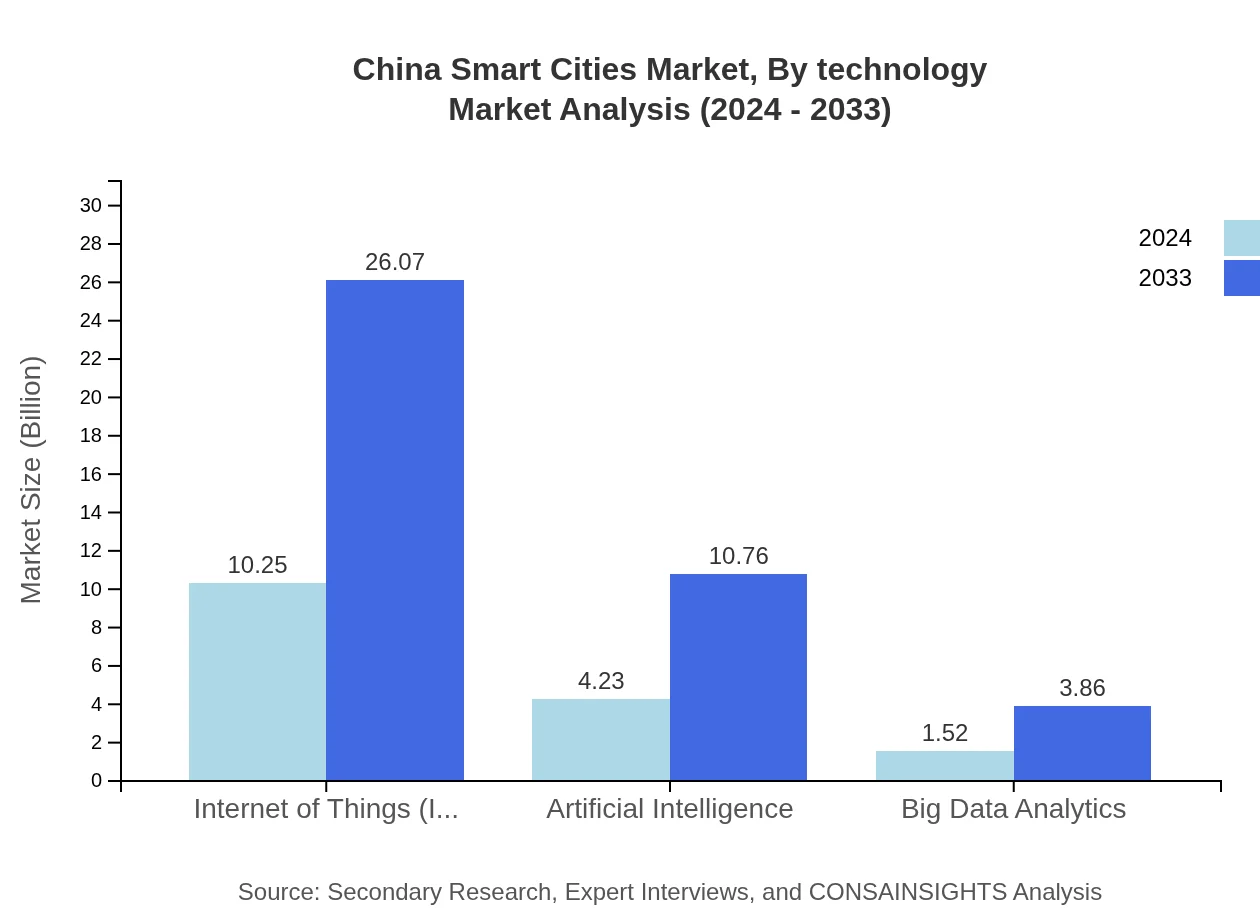
The technology segment in China Smart Cities is predominantly driven by IoT, artificial intelligence, and big data analytics. IoT adoption, with a size projection growing from 10.25 in 2024 to 26.07 by 2033, underscores the need for interconnected sensor networks and real-time city management. Parallelly, artificial intelligence and big data contribute to predictive analytics and operational efficiency in various urban applications. These technologies enable the integration of renewable energy solutions, intelligent traffic systems, and robust public safety measures. The convergence of these innovative technologies is revolutionizing how cities manage resources, address urban challenges, and enhance service delivery.
China Smart Cities Market Analysis By Application
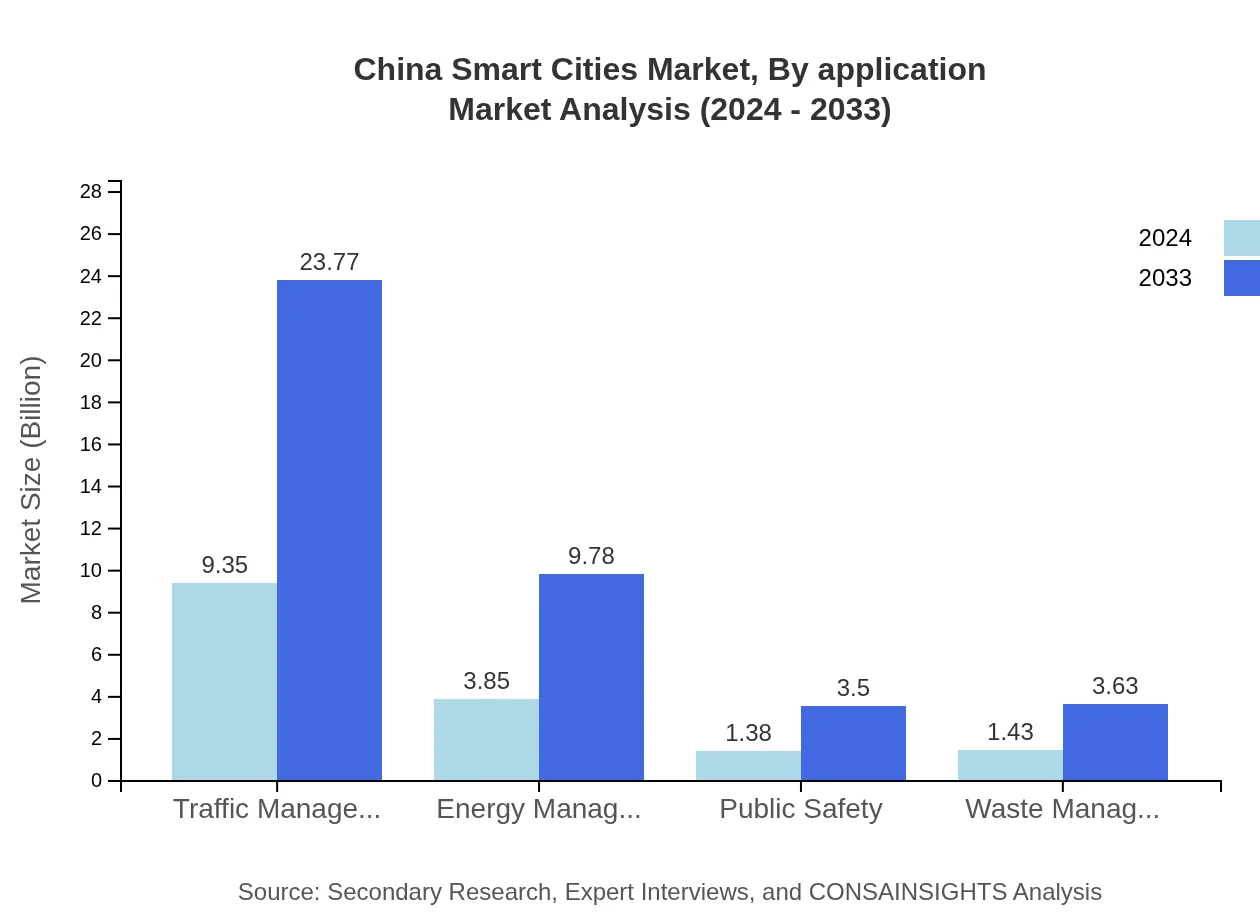
Applications in smart cities range widely from traffic management to waste management and public safety. Traffic management, growing significantly from a size of 9.35 in 2024 to 23.77 by 2033, represents a critical area where technology minimizes congestion and improves commuter experiences. Public safety and waste management solutions leverage sensor data and intelligent analytics to optimize urban operations. Additionally, energy management applications are witnessing robust adoption, as smart grids and metering systems enhance efficiency. These application segments are vital as they directly influence the quality of public services, enabling more secure, efficient, and responsive urban environments.
China Smart Cities Market Analysis By Infrastructure
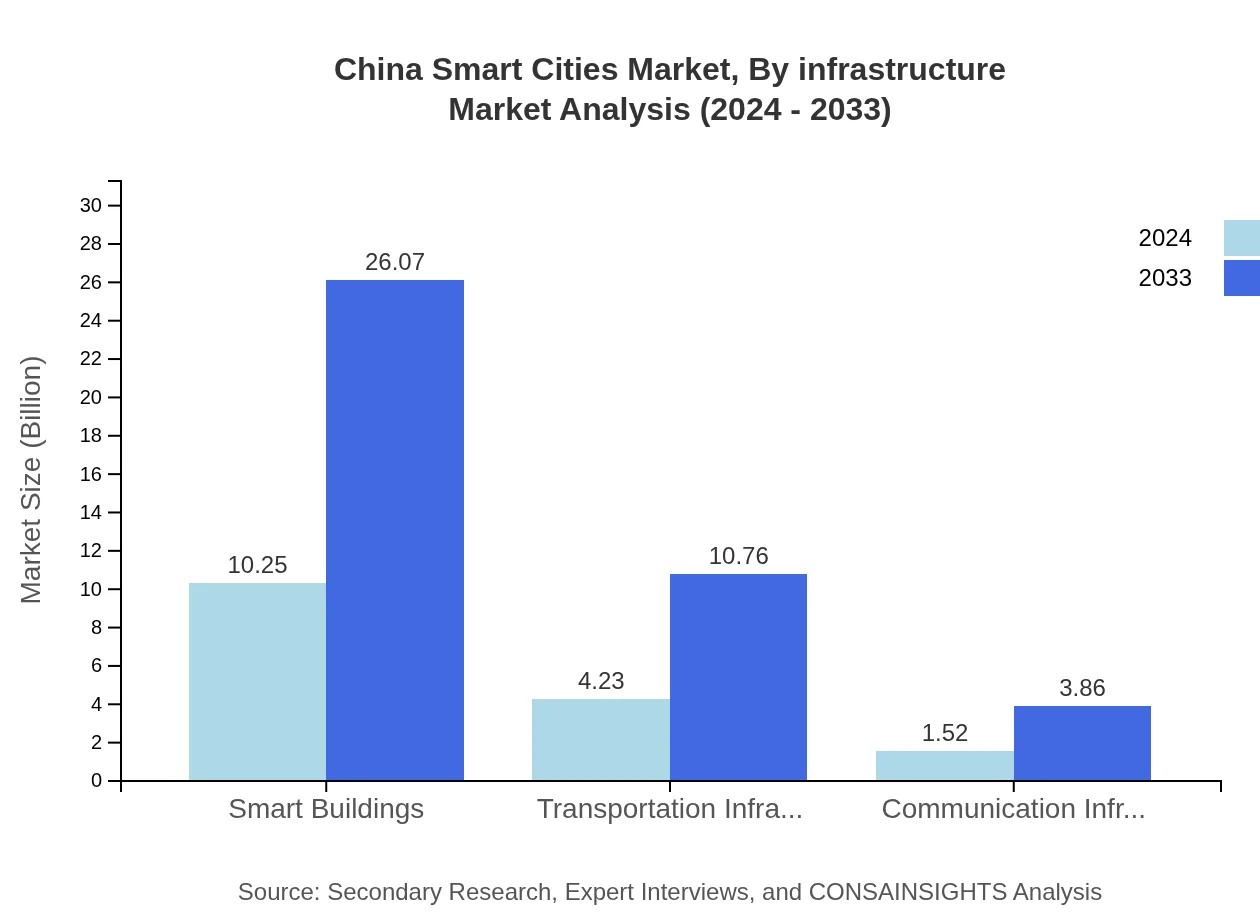
Infrastructure is a major pillar supporting smart city initiatives in China. This segment comprises investments in smart buildings, transportation, and communication infrastructures. Projections indicate that smart buildings are set to expand from a market size of 10.25 in 2024 to 26.07 by 2033, highlighting the importance of energy-efficient and digitally-enabled structures. Transportation infrastructure, including advanced road systems and digital traffic signals, is similarly vital, with corresponding increases in investment. Communication networks form the backbone of these developments, ensuring seamless data transfer and connectivity. The infrastructure market is critical for enabling the integration of diverse smart solutions across urban centers, driving both economic and social benefits.
China Smart Cities Market Analysis By Policy
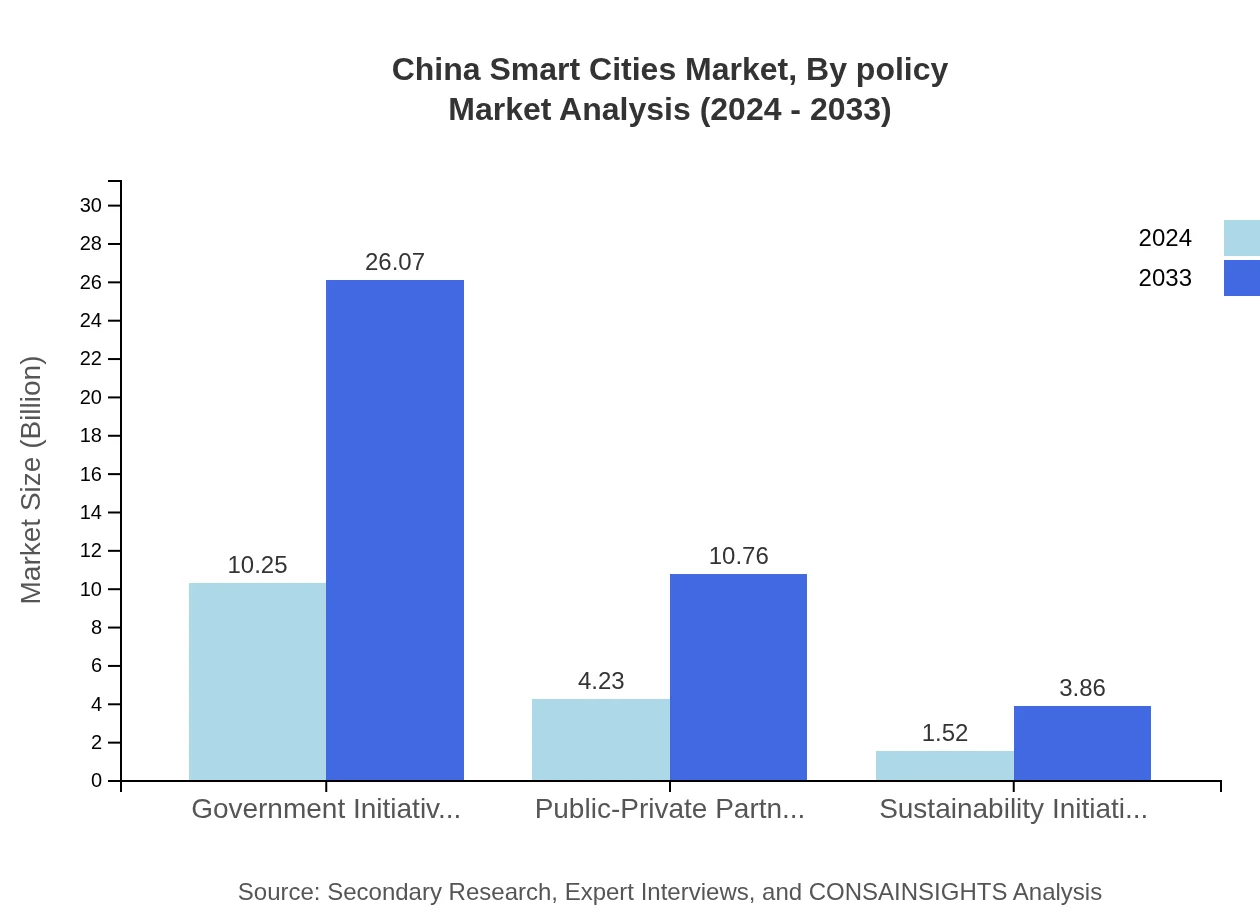
Government initiatives and policy frameworks are fundamental drivers in the evolution of smart cities. The policy segment is marked by robust public-private partnerships, strategic governmental investments, and sustainability initiatives. Data indicates that government-led projects are expected to increase from a market size of 10.25 in 2024 to 26.07 by 2033 while maintaining a steady market share. Public-private partnerships also illustrate significant contributions, with metrics showing growth from 4.23 to 10.76 over the same period. These policies create an enabling environment that reduces market uncertainties, fosters technological innovation, and galvanizes community support for integrating smart solutions on a wide scale.
China Smart Cities Market Analysis By End User
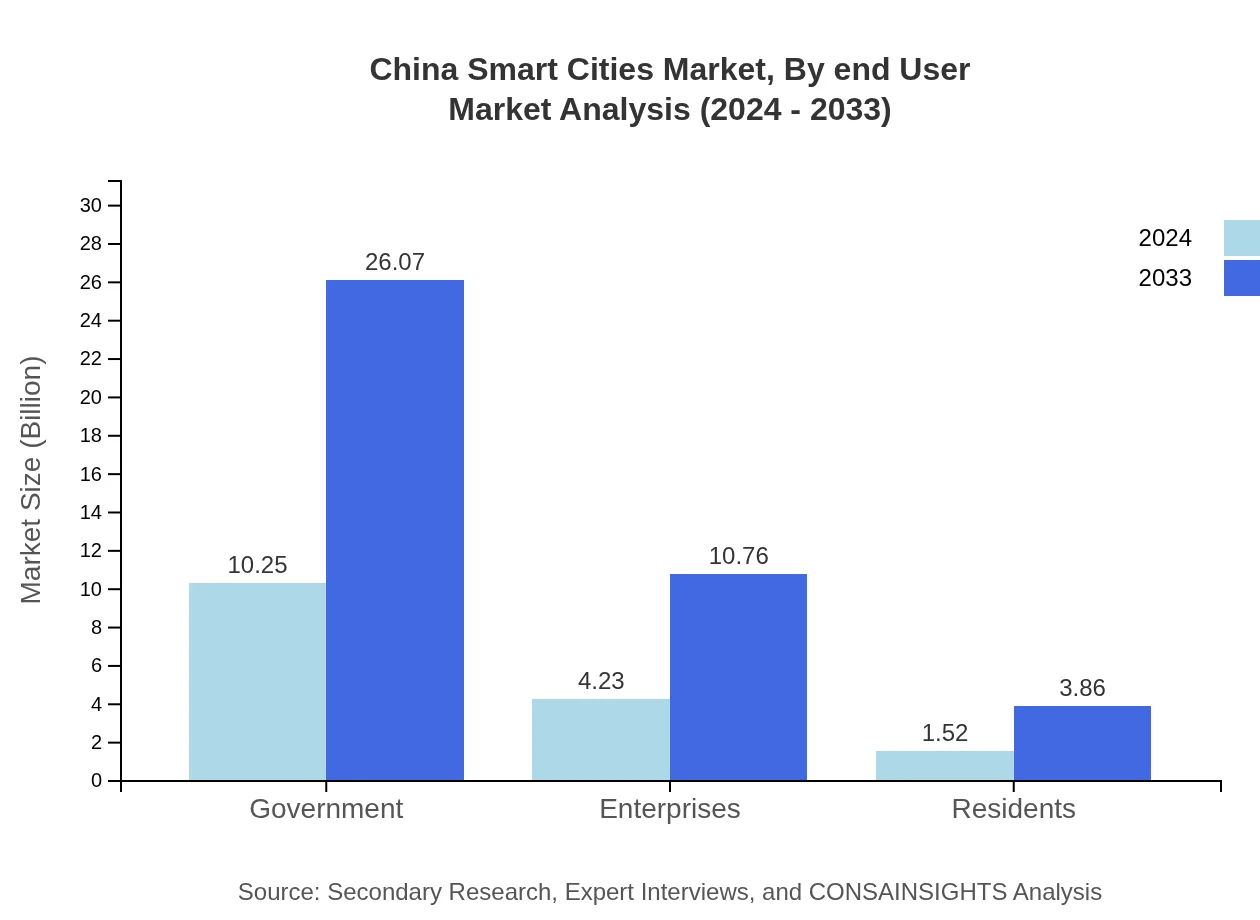
The end-user segment in the China Smart Cities market focuses on the beneficiaries of smart city solutions, including enterprises and residents. End-user engagement is critical as it determines the overall success and adoption of technology-driven urban solutions. Enterprises benefit from streamlined operations and improved data accessibility, while residents experience enhanced quality of life through better service delivery. Market data shows that both groups maintain steady market shares, emphasizing the relevance of digital inclusion. As the market matures, customized solutions are being deployed to meet unique end-user requirements, thereby ensuring that technological implementations are both effective and user-centric. This approach fosters a collaborative urban ecosystem that is responsive to the needs of all stakeholders.
China Smart Cities Market Trends and Future Forecast
Tell us your focus area and get a customized research report.
Global Market Leaders and Top Companies in China Smart Cities Industry
Huawei Technologies:
Huawei Technologies stands at the forefront of China Smart Cities innovation. The company’s pioneering work in advancing IoT, AI, and 5G connectivity has been instrumental in developing robust urban digital infrastructures, enabling cities to efficiently manage resources and enhance public services.Alibaba Cloud:
Alibaba Cloud leverages its cutting-edge cloud computing and data analytics capabilities to transform urban management. Its comprehensive suite of smart city solutions helps integrate multiple data streams, ensuring reliable and scalable deployments across critical urban sectors.We're grateful to work with incredible clients.








FAQs
How can the China Smart Cities Report help align our marketing strategy with customer adoption trends?
The China Smart Cities market is projected to reach $16 billion with a CAGR of 10.5%. Utilizing this report aligns marketing strategies by identifying current customer adoption trends in key urban areas, allowing targeted campaigns that resonate with specific demographic and technological preferences.
What product features are in highest demand according to the China Smart Cities trends?
Top demand is for smart buildings and traffic management systems, anticipated to grow with a combined market size of $19.58 billion by 2033. Features such as energy management, IoT integration, and public safety solutions dominate buyer interest, guiding product development routes.
Which regions offer the best market entry and expansion opportunities in the China Smart Cities industry?
Regions to watch include North America ($15.7 billion by 2033) and Europe ($11.57 billion by 2033), due to supportive government initiatives. Asia Pacific, while smaller ($7.52 billion), offers rapid growth potential, particularly for IoT and AI implementations in smart cities.
What emerging technologies and innovations are shaping the China Smart Cities market?
Key technologies include IoT for infrastructure connectivity, AI for data analytics and traffic management, and sustainability innovations. These drive efficiency, reduce costs and enhance public safety, promoting transformative urban developments, thus creating investment opportunities for tech firms.
Does the China Smart Cities Report include competitive landscape and market share analysis?
Yes, the report provides a thorough analysis of the competitive landscape including market share breakdowns by segments such as Government Initiatives (64.08%) and Public-Private Partnerships (26.44%), essential for understanding competitive dynamics and positioning in this growing market.
How can executives use the China Smart Cities Report to evaluate investment risks and ROI?
Executives can leverage the report's market projections and segment analyses to assess risks tied to emerging technologies and regional markets. The $16 billion market size and expected 10.5% CAGR provide robust ROI insights, helping streamline investment strategies.
What is the market size of China Smart Cities?
The China Smart Cities market is valued at $16 billion, with an impressive CAGR of 10.5% anticipated through 2033. These insights inform strategic planning and growth trajectories within the urban smart technology sector.