
Reports >
Life Sciences
>
Diabetes Care Drugs Market Report

Diabetes Care Drugs Market Report
First published: 21 October 2024 | Last updated: 25 May 2026 | Report Code: diabetes-care-drugs
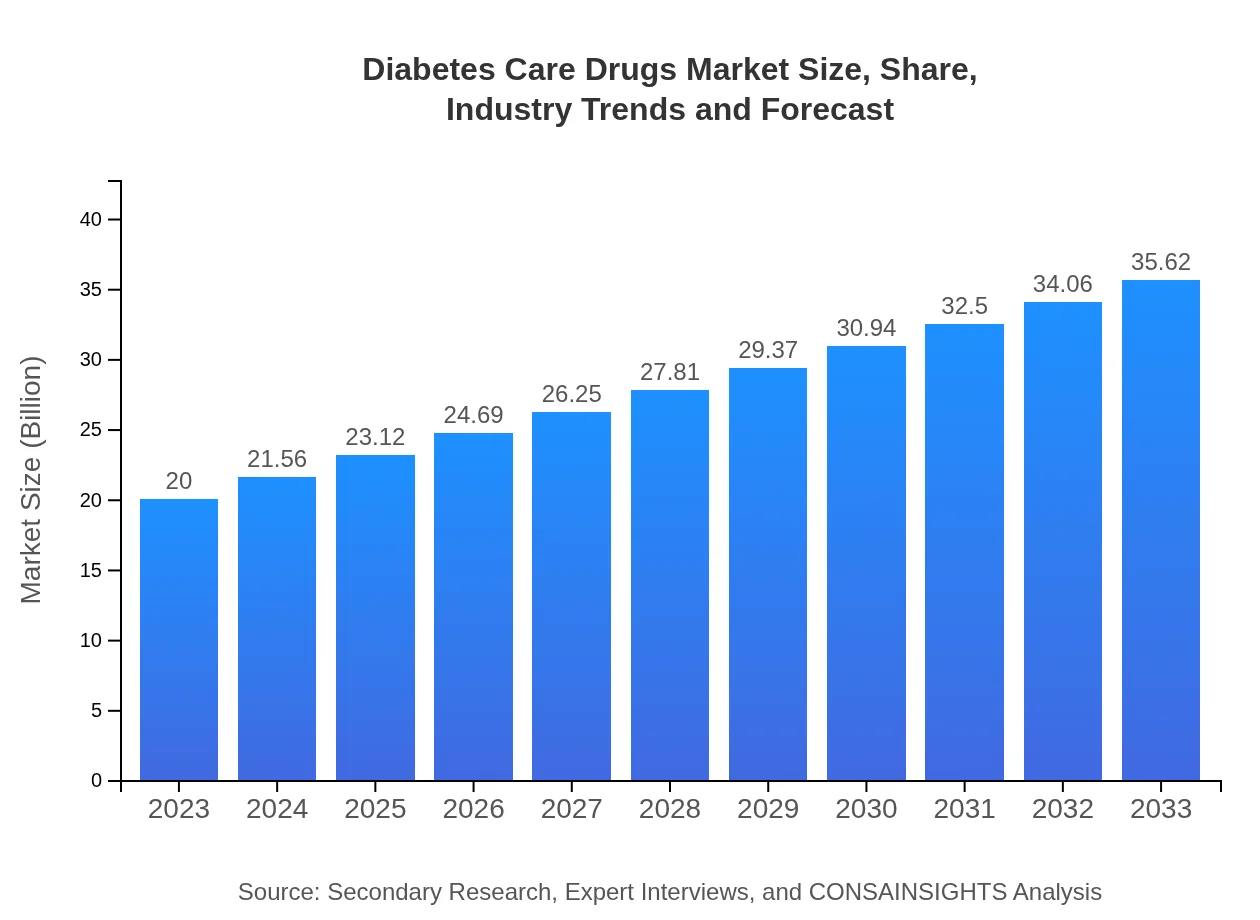
Diabetes Care Drugs Market — USD 20 billion in 2023, Growing to USD 35.62B by 2033 at 5.8% CAGR
This report provides an in-depth analysis of the Diabetes Care Drugs market, covering insights on market size, growth trends, regional dynamics, and competitive landscape from 2023 to 2033.
Key Takeaways
- Global market expands from $20.00 Billion in 2023 to $35.62 Billion in 2033, reflecting a 5.8% CAGR over the forecast period.
- North America is largest regional market, while no single fastest-growing region is stated because regional CAGR differences remain within 0.15 percentage points.
- Europe grows from $6.95 Billion in 2023 to $12.38 Billion in 2033, representing a substantial regional advancement.
- Asia Pacific increases from $3.56 Billion in 2023 to $6.34 Billion in 2033; Middle East and Africa and Latin America also show notable expansion.
- Leading players driving the landscape include Novo Nordisk, Sanofi, Boehringer Ingelheim, and Bristol-Myers Squibb.
Diabetes Care Drugs Market Report — Executive Summary
North America remains largest market by forecast-period value, while no single fastest-growing region is stated because top regional growth rates are separated by less than 0.15 percentage points. The Diabetes Care Drugs Market Report outlines a decade of steady expansion driven by rising diabetes prevalence, technological and formulation advances, and growing healthcare investment. The market is valued at $20.00 Billion in 2023 and is forecast to reach $35.62 Billion by 2033 at a 5.8% CAGR between 2023 and 2033. Treatment categories covered include insulin, oral hypoglycemics, and non-insulin injectables across tablets and injections, with patient segments for Type 1 and Type 2 diabetes. Distribution channels span hospital and retail pharmacies as well as online platforms. Regional performance highlights North America as the largest market, with significant contributions also from Europe and Asia Pacific. Innovation in drug development, increased awareness, and expanded access to care are central trends shaping competitive strategies among companies such as Novo Nordisk, Sanofi, Boehringer Ingelheim, and Bristol-Myers Squibb. The report combines primary interviews and secondary sources to present actionable insights for stakeholders planning investment, product development, or market entry.
Key Growth Drivers
- Increasing global diabetes prevalence driven by population aging, obesity trends, and sedentary lifestyles increases long-term demand for glucose-lowering therapies.
- Ongoing advances in drug formulations and therapeutic classes expand treatment options, supporting higher adoption and improved clinical outcomes.
- Rising healthcare expenditure and improved access to medical services enable broader availability of diabetes medications across channels.
- Greater patient awareness and emphasis on chronic disease management encourage sustained medication adherence and uptake of novel therapies.
- Digital health adoption and integration with diabetes care facilitate monitoring and treatment optimization, reinforcing pharmaceutical demand.
| Metric | Value |
|---|---|
| Study Period | 2023 - 2033 |
| 2023 Market Size | $20.00 Billion |
| CAGR (2023-2033) | 5.8% |
| 2033 Market Size | $35.62 Billion |
| Top Companies | Novo Nordisk, Sanofi, Boehringer Ingelheim, Bristol-Myers Squibb |
| Published Date | 21 October 2024 |
| Last Modified Date | 25 May 2026 |
Diabetes Care Drugs Market Overview
Customize Diabetes Care Drugs Market Report market research report
- ✔ Get in-depth analysis of Diabetes Care Drugs market size, growth, and forecasts.
- ✔ Understand Diabetes Care Drugs's regional dynamics and industry-specific trends.
- ✔ Identify potential applications, end-user demand, and growth segments in Diabetes Care Drugs
What is the Market Size & CAGR of Diabetes Care Drugs Market Report market in 2023?
Diabetes Care Drugs Industry Analysis
Diabetes Care Drugs Market Segmentation and Scope
Tell us your focus area and get a customized research report.
Diabetes Care Drugs Market Report Market Analysis Report by Region
Europe Diabetes Care Drugs Market Report:
Europe grows from $6.95 Billion in 2023 to $12.38 Billion in 2033. Growth is supported by strong clinical adoption, rising public health initiatives, and investment in diabetes care that drive demand for oral and injectable therapies.Asia Pacific Diabetes Care Drugs Market Report:
Asia Pacific grows from $3.56 Billion in 2023 to $6.34 Billion in 2033. Expansion is underpinned by a rising diabetes burden, expanding healthcare access, and growing awareness that fuel uptake of both traditional and novel diabetes medications.North America Diabetes Care Drugs Market Report:
North America is largest regional market, rising from $6.99 Billion in 2023 to $12.44 Billion in 2033. The region’s scale reflects mature healthcare infrastructure, significant medical expenditure, and rapid adoption of advanced therapies, positioning it as the largest regional market in the dataset.South America Diabetes Care Drugs Market Report:
Latin America grows from $0.65 Billion in 2023 to $1.15 Billion in 2033. Market expansion is influenced by improving access to healthcare, increasing diagnosis rates, and gradual adoption of a wider range of diabetes treatments.Middle East & Africa Diabetes Care Drugs Market Report:
Middle East and Africa grows from $1.86 Billion in 2023 to $3.31 Billion in 2033. Regional growth is supported by enhanced healthcare investment, expanding treatment availability, and efforts to address rising chronic disease prevalence.Tell us your focus area and get a customized research report.
Research Methodology
Diabetes Care Drugs Market Analysis By Drug Type
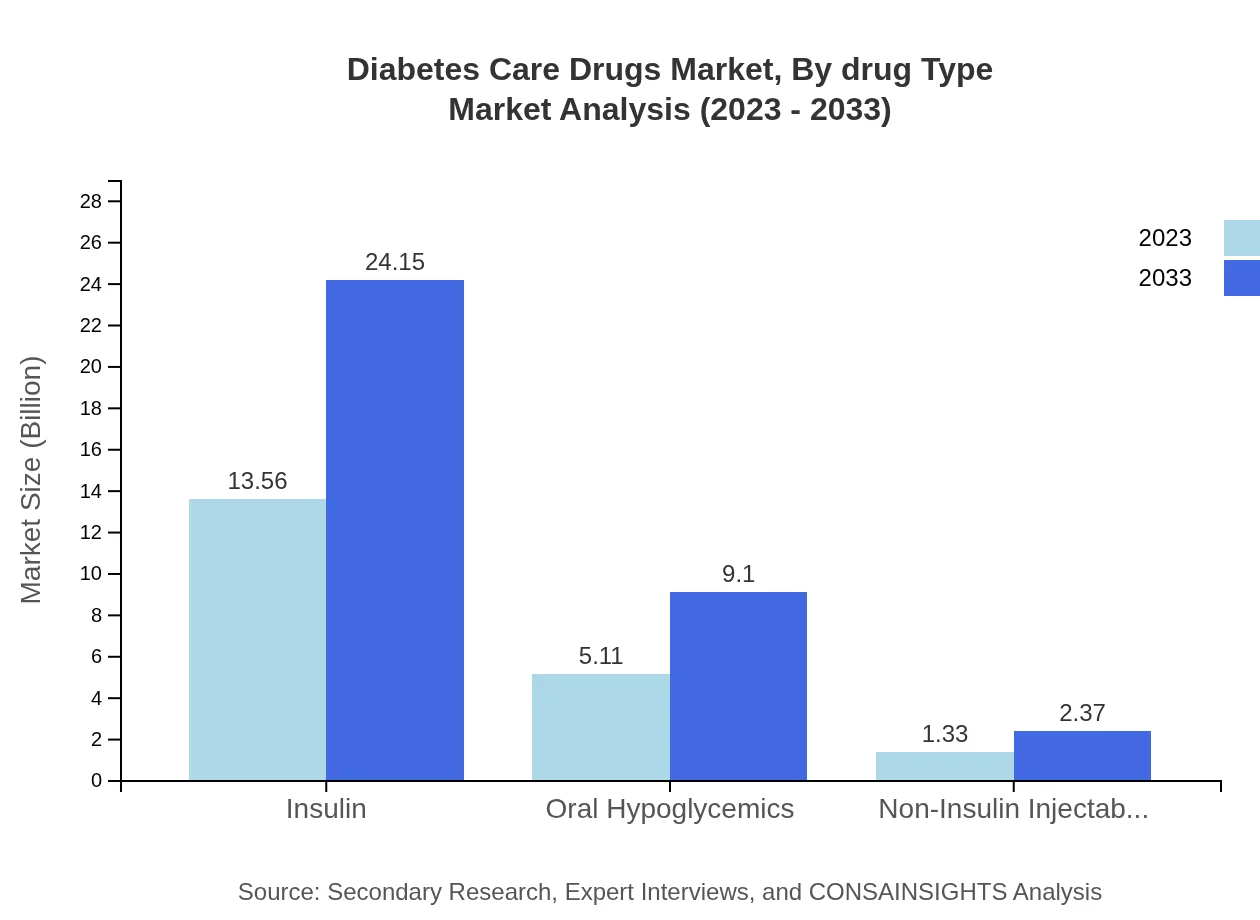
The diabetes care drugs market can be classified into several therapeutic classes. Insulin remains the dominant segment, recording a market value of $13.56 billion in 2023, projected to increase to $24.15 billion by 2033, holding a share of 67.8%. Oral hypoglycemics follow with a 25.54% share, valued at $5.11 billion in 2023 and estimated to reach $9.10 billion by 2033. Non-insulin injectables, although smaller at $1.33 billion in 2023, are anticipated to grow to $2.37 billion, capturing 6.66% of the market.
Diabetes Care Drugs Market Analysis By Formulation
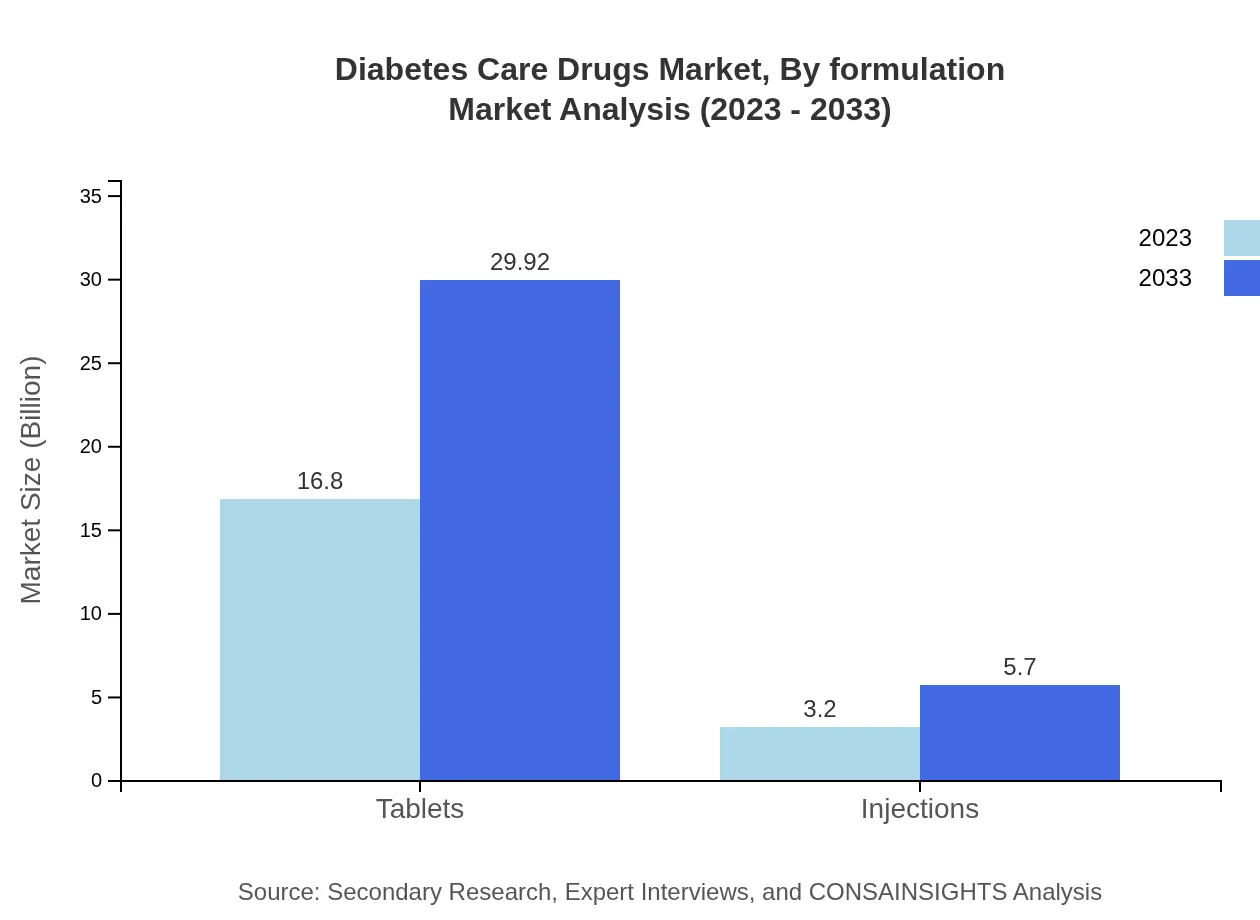
Among the various formulations, tablets stand out with a market size of $16.80 billion in 2023, growing to $29.92 billion by 2033, dominating with 83.99% of the market. Injections, while comprising a smaller segment at $3.20 billion in 2023, are projected to expand to $5.70 billion by 2033, representing a 16.01% share. The trend towards patient-centered care and preferences for certain delivery methods significantly influence these numbers.
Diabetes Care Drugs Market Analysis By Distribution Channel
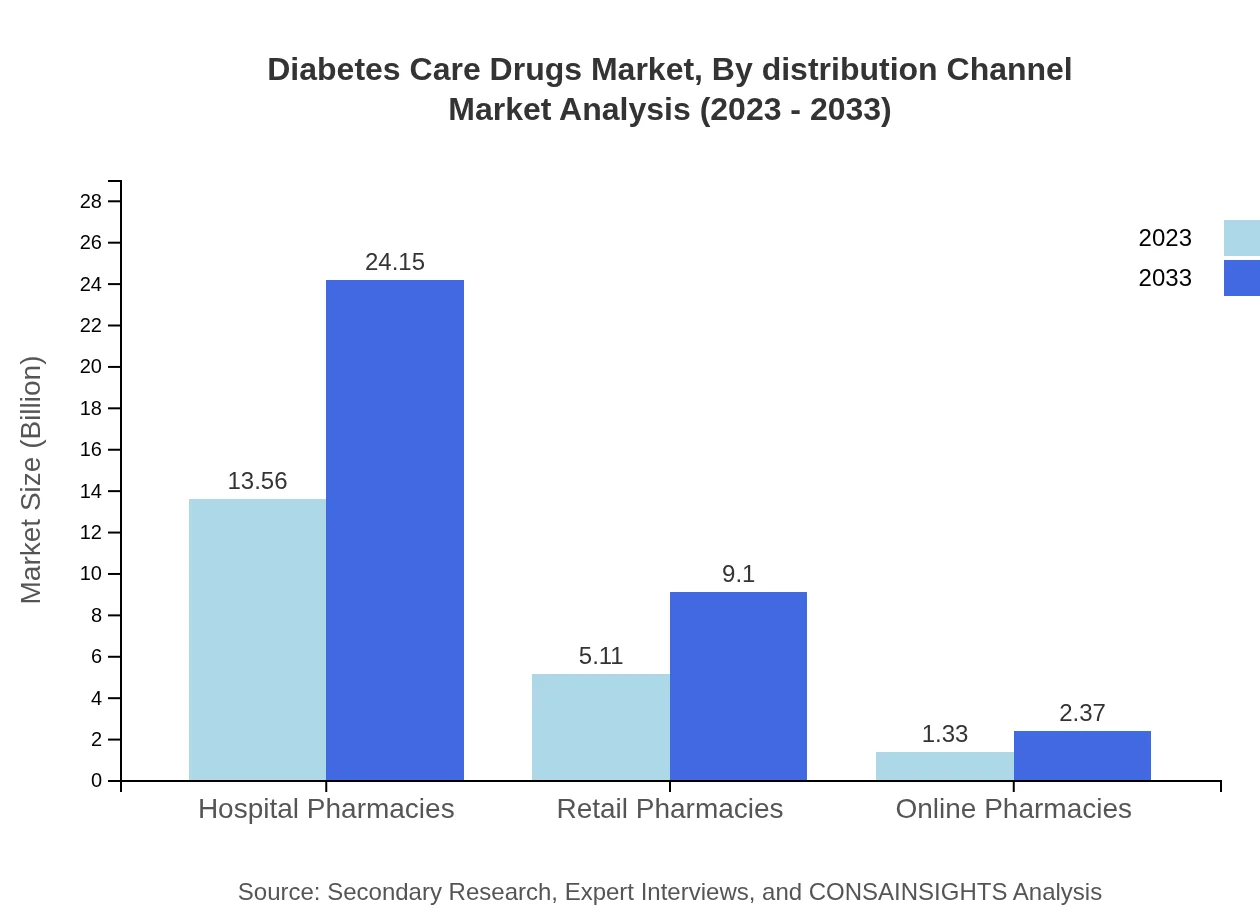
The distribution channels for diabetes care drugs include hospital pharmacies, retail pharmacies, and online pharmacies. Hospital pharmacies dominate with a significant market size of $13.56 billion in 2023, expected to reach $24.15 billion by 2033, maintaining a 67.8% market share. Retail pharmacies and online pharmacies also contribute considerably, with respective market values of $5.11 billion and $1.33 billion in 2023, expected to grow to $9.10 billion and $2.37 billion respectively.
Diabetes Care Drugs Market Analysis By Patient Type
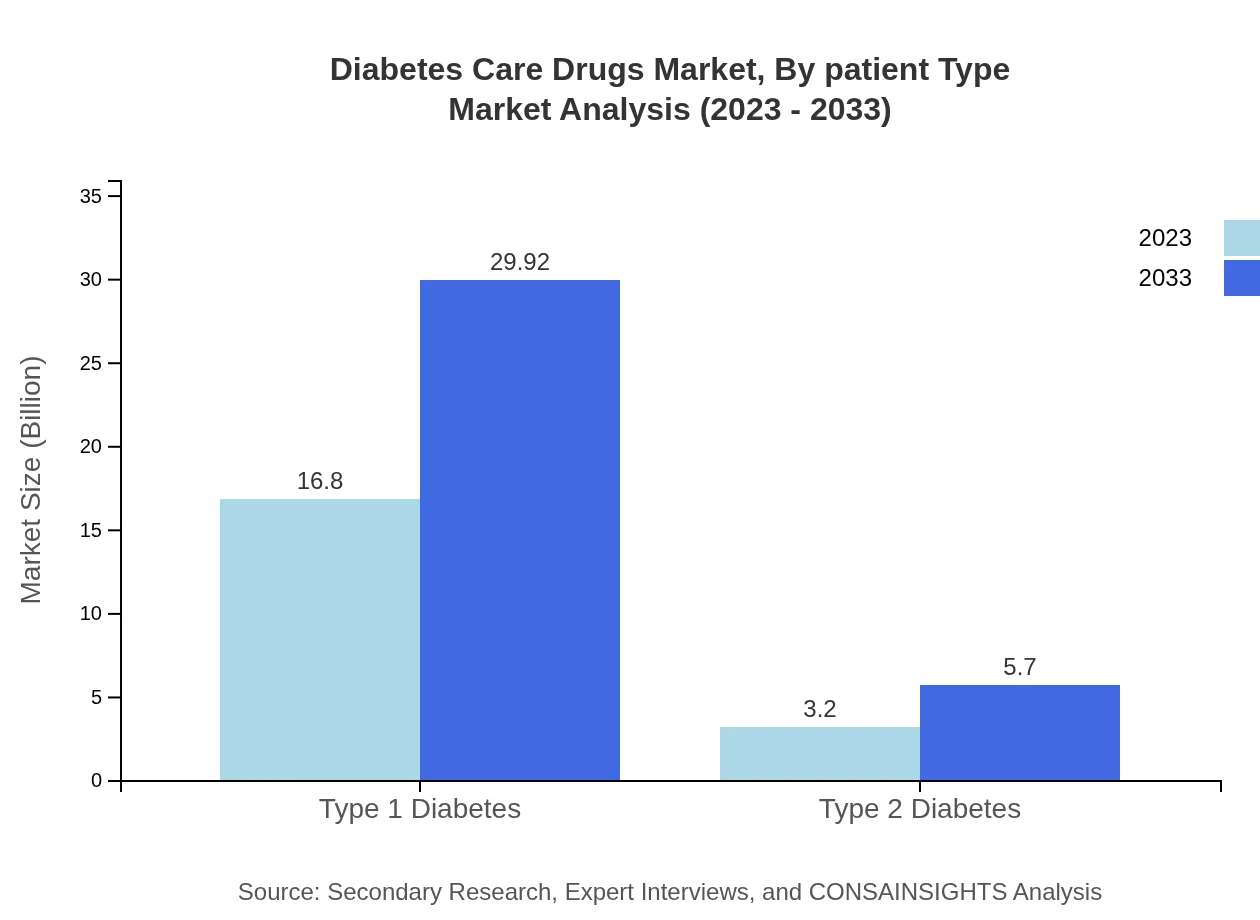
The patient type segmentation shows that Type 1 diabetes medications dominate with a market size of $16.80 billion in 2023, projected to grow to $29.92 billion by 2033, holding an 83.99% share. Conversely, Type 2 diabetes has a smaller market size of $3.20 billion in 2023, predicted to expand to $5.70 billion by 2033, representing 16.01% of the market. This reflects the ongoing trend toward more effective and tailored treatments in practice.
Diabetes Care Drugs Market Trends and Future Forecast
Tell us your focus area and get a customized research report.
Global Market Leaders and Top Companies in Diabetes Care Drugs Industry
Novo Nordisk:
A leader in diabetes care, Novo Nordisk has a strong portfolio of insulin and GLP-1 receptor agonists, playing a key role in treatment paradigms globally.Sanofi:
Sanofi is a major player in the diabetes market, providing a range of insulin products and innovative therapies addressing diabetes management needs.Boehringer Ingelheim:
Known for its contributions to diabetes care, Boehringer Ingelheim focuses on innovation in diabetes treatments and brings a comprehensive approach to managing the disease.Bristol-Myers Squibb:
With a strong presence in the diabetes segment, Bristol-Myers Squibb has a wide variety of diabetes drugs that cater to diverse patient needs.We're grateful to work with incredible clients.






FAQs
What is the market size of the Diabetes Care Drugs Market Report in 2023?
The market size for 2023 is $20.00 Billion as reported. This figure serves as the baseline for forecasting growth across therapeutic classes and regions during the forecast period.
How big will the Diabetes Care Drugs Market Report be in 2033?
The market is projected to be $35.62 Billion in 2033, reflecting expansion across insulin, oral hypoglycemics, and non-insulin injectables driven by demographic and clinical demand.
What is CAGR of the Diabetes Care Drugs Market Report for the forecast period?
The compound annual growth rate for the forecast period 2023 to 2033 is 5.8%, representing the expected annualized growth trajectory over that decade.
Is there a single fastest Growing region in the Diabetes Care Drugs Market Report market?
No single fastest-growing region is stated for the Diabetes Care Drugs Market Report market because the top regional implied CAGR values are within 0.15 percentage points of each other, making the ranking too close to call reliably.
Which major companies shape the competitive landscape?
Key participants cited include Novo Nordisk, Sanofi, Boehringer Ingelheim, and Bristol-Myers Squibb, who influence product development, market access, and therapeutic innovation.
What are primary drivers of market growth?
Primary drivers include rising diabetes prevalence, improved formulations, increased healthcare expenditure, and greater patient awareness, all supporting higher drug demand and treatment adoption.
How are therapy segments organized in the report?
Therapy segmentation covers insulin, oral hypoglycemics, and non-insulin injectables, with formulation categories including tablets and injections, and patient segments by Type 1 and Type 2 diabetes.
Who provided input for the market research methodology?
The research drew on primary interviews with industry experts and secondary sources such as company reports and publications, followed by data triangulation and expert validation.