
Reports >
Technology And Media
>
Exposure Management

Exposure Management
First published: 15 January 2026 | Last updated: 31 January 2026 | Report Code: exposure-management
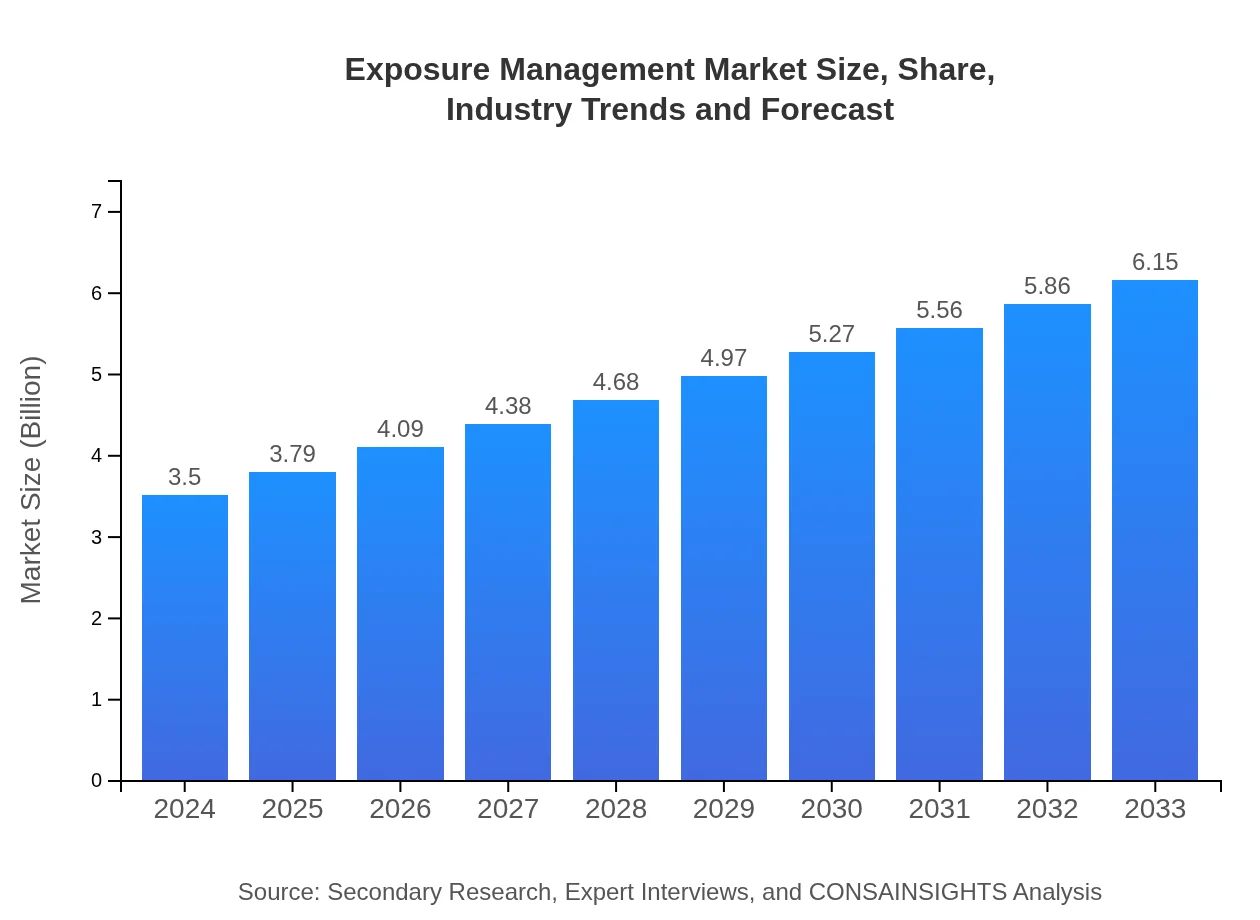
Exposure Management Market — USD $3.5 Billion in 2024, Growing to USD 6.15 by 2033 at 6.3% CAGR
This comprehensive report on Exposure Management delivers an insightful analysis of the market from 2024 through 2033. It provides detailed forecasts, market sizing, growth trends, technological breakthroughs, and a regional breakdown. Readers will gain a clear understanding of industry challenges, opportunities, and evolving competitive dynamics in this rapidly transforming sector.
| Metric | Value |
|---|---|
| Study Period | 2024 - 2033 |
| 2024 Market Size | $3.50 Billion |
| CAGR (2024-2033) | 6.3% |
| 2033 Market Size | $6.15 Billion |
| Top Companies | RiskTech Solutions, Exposureright Inc., SecureRisk Global |
| Published Date | 15 January 2026 |
| Last Modified Date | 31 January 2026 |
Exposure Management Market Overview
Customize Exposure Management market research report
- ✔ Get in-depth analysis of Exposure Management market size, growth, and forecasts.
- ✔ Understand Exposure Management's regional dynamics and industry-specific trends.
- ✔ Identify potential applications, end-user demand, and growth segments in Exposure Management
What is the Market Size & CAGR of Exposure Management market in 2024?
Exposure Management Industry Analysis
Exposure Management Market Segmentation and Scope
Tell us your focus area and get a customized research report.
Exposure Management Market Analysis Report by Region
Europe Exposure Management:
Europe sees a consistent growth pattern, with market values rising from $1.26 Billion in 2024 to $2.21 Billion by 2033. Legislative reforms and the prioritization of data security have contributed significantly to this positive trend. European organizations are investing heavily in exposure management to comply with stringent risk regulations and enhance their crisis response capabilities.Asia Pacific Exposure Management:
In Asia Pacific, the market is witnessing significant momentum with projected growth from approximately $0.60 Billion in 2024 to $1.05 Billion by 2033. Drivers include rapid industrialization, technology adoption, and proactive government initiatives which enhance resilience across industries. Local enterprises are increasingly adopting integrated exposure solutions, supported by expanding digital infrastructures and evolving risk management practices.North America Exposure Management:
In North America, the market is robust, growing from approximately $1.18 Billion in 2024 to $2.07 Billion by 2033. Mature regulatory frameworks and high technology penetration are key factors driving adoption. Companies in this region are leveraging advanced analytics and automation to refine their exposure risk mitigation owing to intense competition and the need for operational resilience.South America Exposure Management:
South America, though representing a smaller share with figures escalating from $0.02 Billion in 2024 to $0.04 Billion by 2033, is gradually focusing on modernizing its exposure strategies. Increased awareness and emerging economies are encouraging investments in risk management technologies, thereby setting the stage for incremental growth.Middle East & Africa Exposure Management:
In the Middle East and Africa, the market is expanding from $0.44 Billion in 2024 to $0.78 Billion by 2033. Political stability and diversifying economies are leading to increased investments in disaster recovery and risk mitigation solutions. The adoption of advanced risk management platforms is gradually becoming a strategic priority to secure investments in these emerging regions.Tell us your focus area and get a customized research report.
Exposure Management Market Analysis By Product
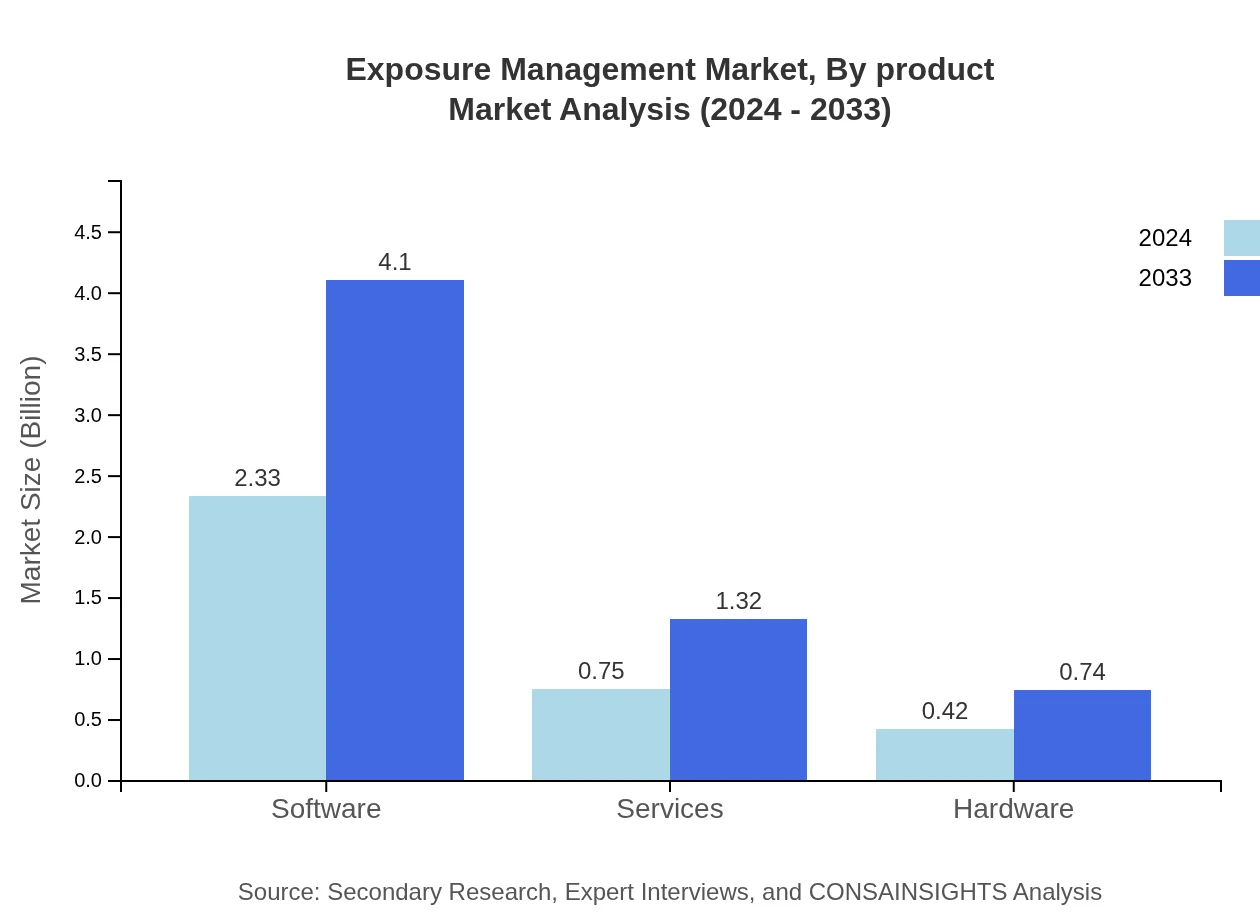
The by-product segment analyzes software, services, and hardware components essential for effective exposure management. Software, commanding a substantial portion with figures reaching a market size of $2.33 Billion by 2024 and a projection of $4.10 Billion by 2033, forms the backbone of digital risk analytics platforms. Services, though smaller in scale, are critical in providing consultancy and implementation support, with a market size of $0.75 Billion rising to $1.32 Billion. Hardware, albeit the smallest, plays a crucial role in ensuring secure data processing, with market valuations growing from $0.42 Billion to $0.74 Billion. These elements work synergistically to provide comprehensive solutions that meet diverse organizational requirements.
Exposure Management Market Analysis By Application
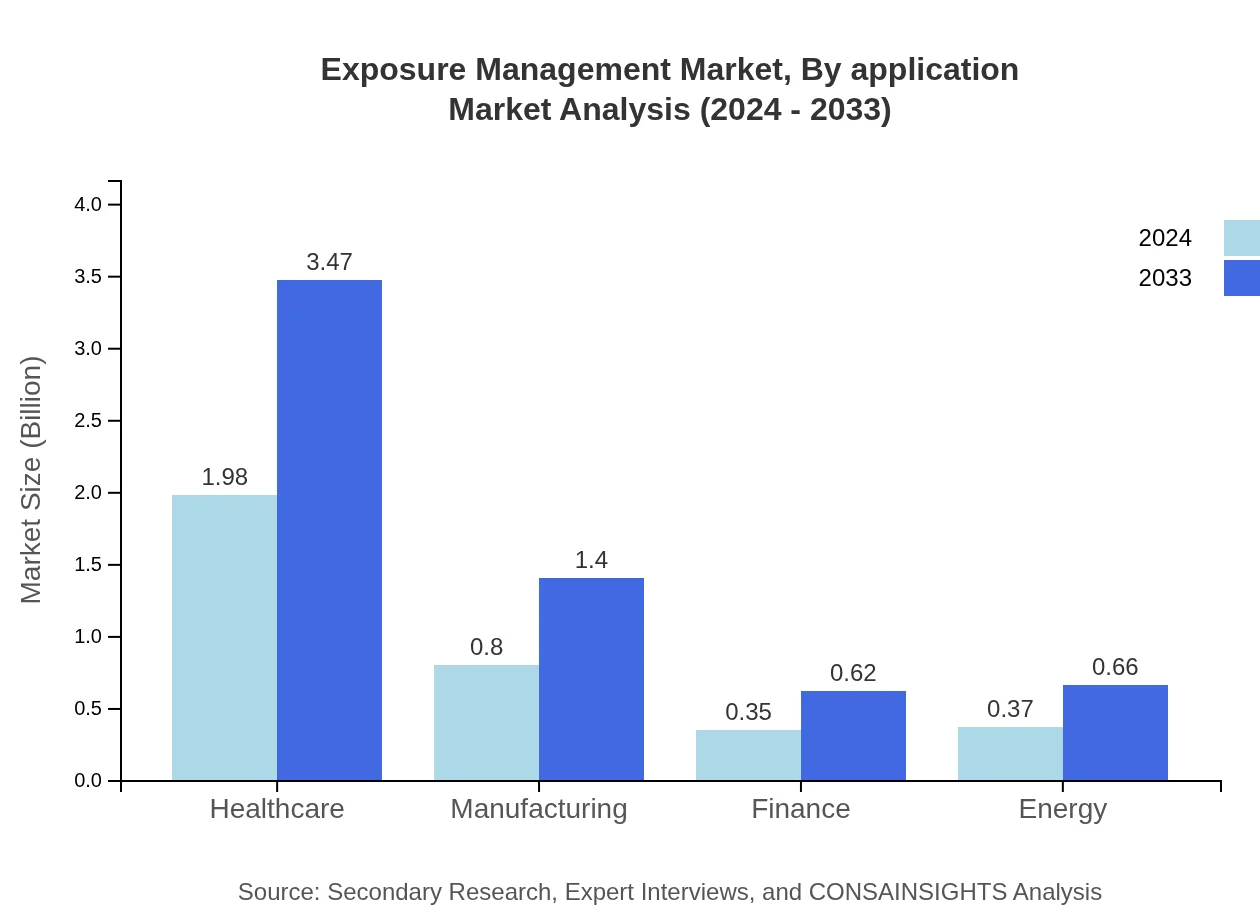
In the application segment, the focus shifts to serving industries such as corporate, government, non-profit organizations, healthcare, manufacturing, finance, and energy. Corporate users lead with exposures addressed through innovative software platforms, as evidenced by a market size of $2.33 Billion in 2024 and forecasts of $4.10 Billion by 2033. Government and non-profit agencies show consistent demand for risk mitigation services, while healthcare remains a significant beneficiary, growing from $1.98 Billion to $3.47 Billion. Manufacturing, finance, and energy sectors, each playing distinct roles in the global economy, continue to invest in technology solutions that bolster their operational risk management frameworks, ensuring compliance and resilience.
Exposure Management Market Analysis By Deployment Model
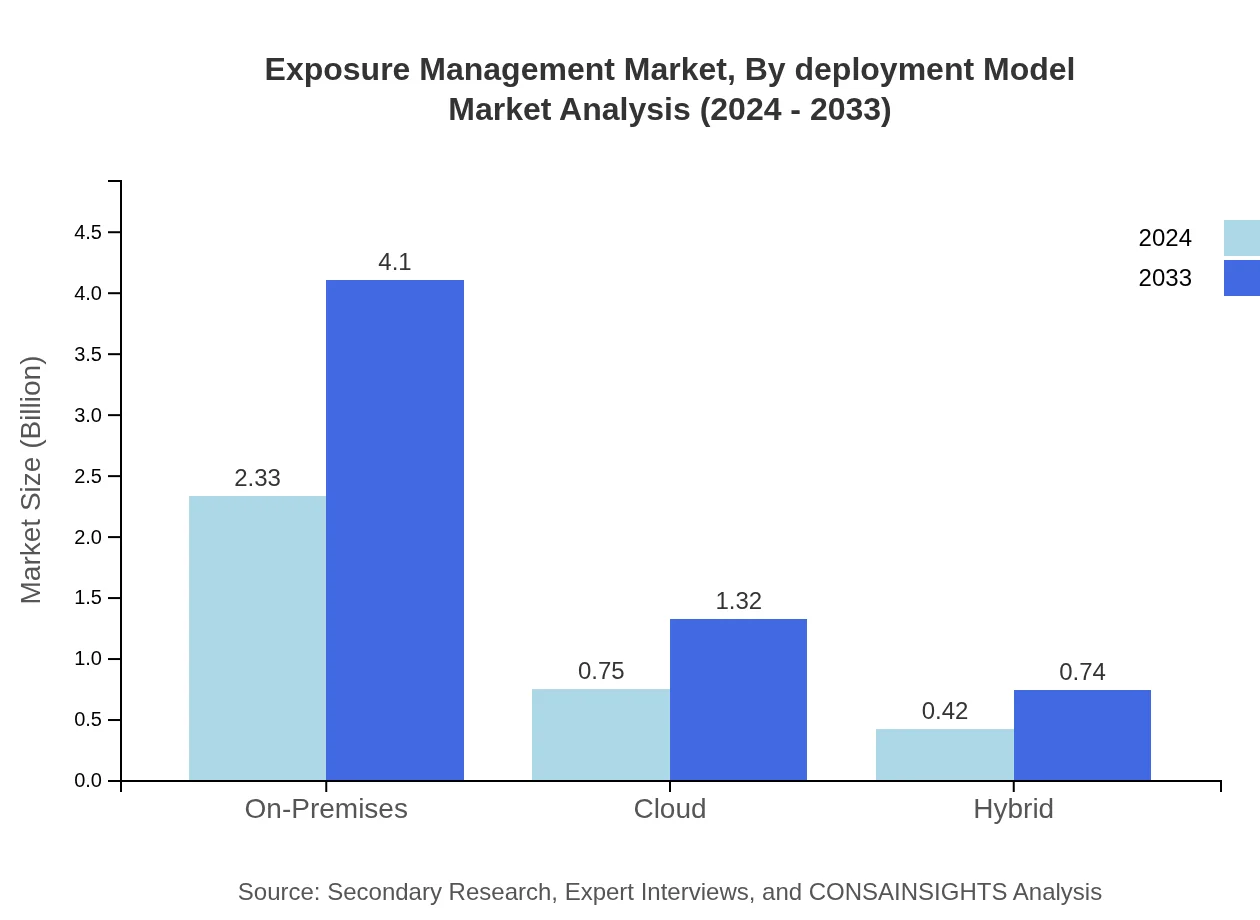
The deployment model segment captures the strategic preferences for on-premises, cloud, and hybrid deployments. On-premises solutions continue to dominate, offering robust control and high security, with market sizes growing from $2.33 Billion to $4.10 Billion. Cloud solutions are gaining traction due to their scalability and cost efficiency, evidenced by growth from $0.75 Billion to $1.32 Billion. Hybrid deployments are emerging as a favored model, allowing organizations to integrate the benefits of both on-premises and cloud, with valuations increasing from $0.42 Billion to $0.74 Billion. This diversity in deployment options reflects the evolving needs of businesses aiming to balance performance, flexibility, and security in risk management.
Exposure Management Market Analysis By End User
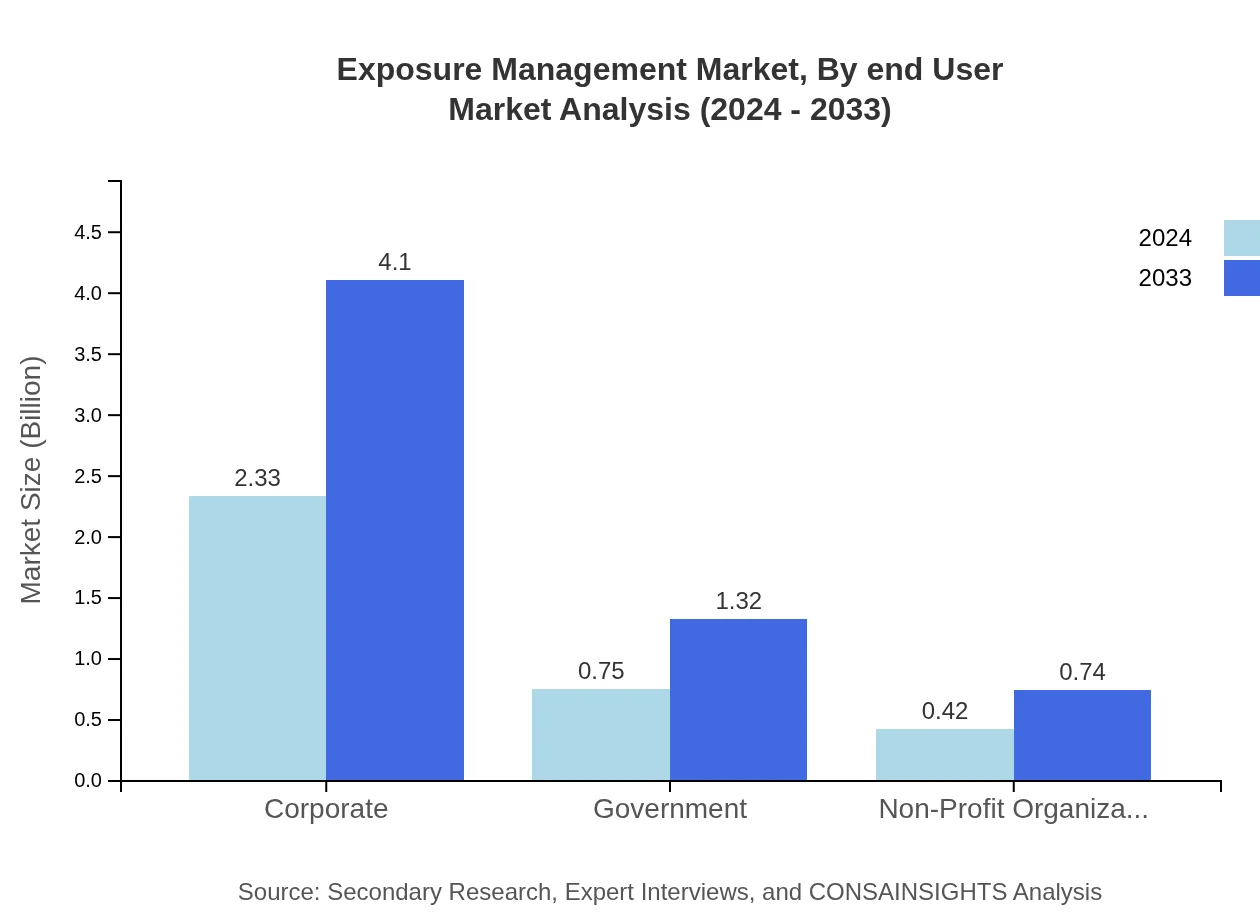
End-users of exposure management solutions are broadly categorized into various sectors with distinct risk dynamics. Corporations and financial institutions drive innovation, utilizing sophisticated software to track and mitigate exposures, while government bodies and non-profit organizations require reliable risk solutions to ensure public accountability and operational continuity. Industries such as healthcare and manufacturing benefit from specialized modules designed for sector-specific challenges. This segmentation underscores the market’s adaptability, as tailored solutions are developed to meet diverse regulatory, operational, and security demands across multiple industries, ensuring that each end-user receives support aligned to their specific risk landscape.
Exposure Management Market Analysis By Region Collision
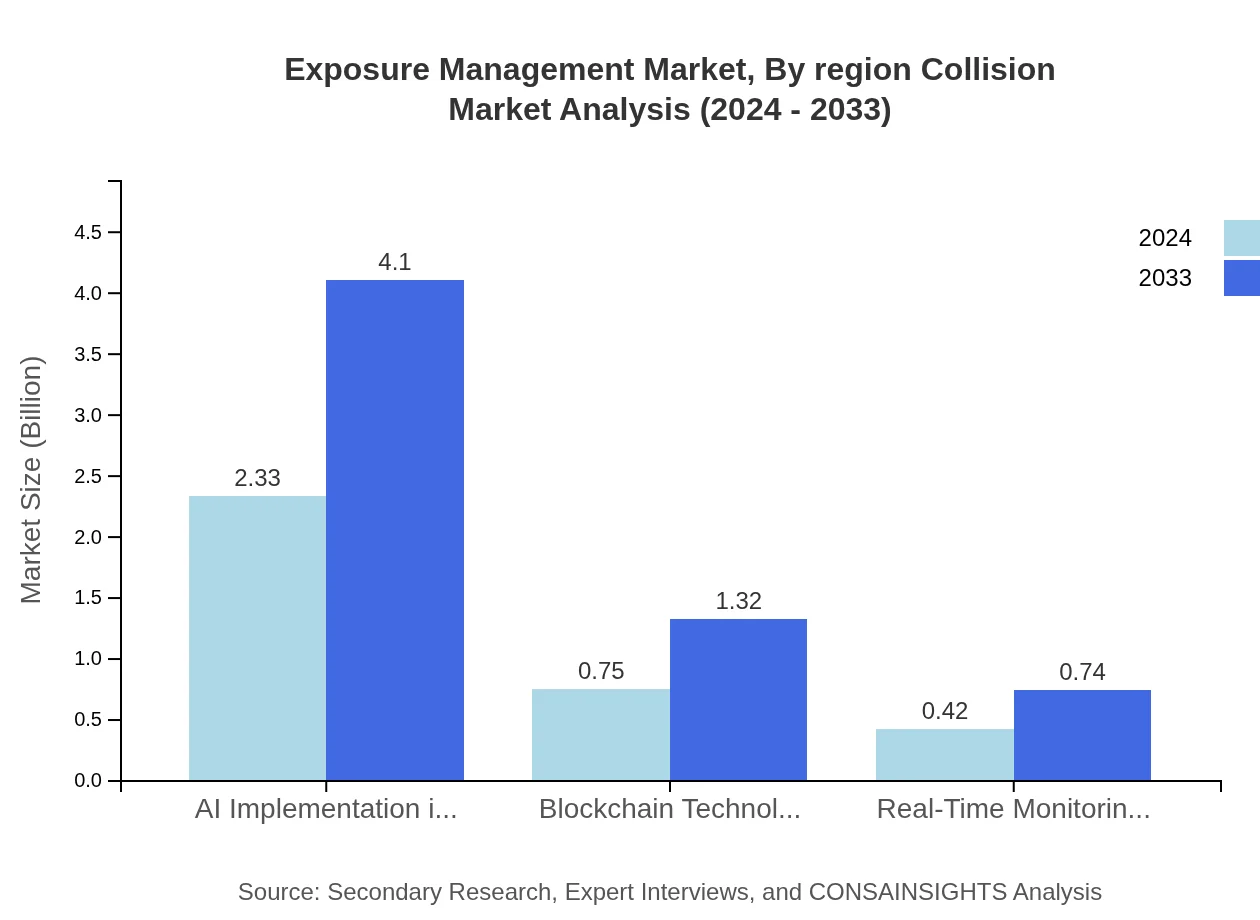
Emerging trends in Exposure Management are shaped by the integration of advanced technologies like AI, blockchain, and real-time monitoring systems. These innovations are not only enhancing data accuracy but also transforming how risks are identified, quantified, and mitigated. For example, AI Implementation in Exposure Management is set to double market valuations from $2.33 Billion to $4.10 Billion, while blockchain technology integration and real-time monitoring are expected to see proportional growth. As these technologies mature, they are redefining competitive dynamics by enabling predictive analytics, automation, and secure data sharing, thereby creating substantial opportunities for early adopters and driving overall market evolution.
Exposure Management Market Trends and Future Forecast
Tell us your focus area and get a customized research report.
Global Market Leaders and Top Companies in Exposure Management Industry
RiskTech Solutions:
RiskTech Solutions is a pioneer in developing advanced exposure management platforms that combine real-time analytics with innovative risk mitigation strategies. Their cutting-edge offerings have set industry benchmarks and empowered numerous enterprises to navigate complex regulatory landscapes.Exposureright Inc.:
Exposureright Inc. specializes in integrating cloud-based and on-premises solutions, ensuring robust risk management for a diverse range of clients. Their commitment to continuous innovation has enabled them to remain at the forefront of technology-driven risk analysis.SecureRisk Global:
SecureRisk Global is renowned for its comprehensive exposure management systems, which blend artificial intelligence with data analytics. The company’s solutions are highly valued across the corporate and government sectors, reflecting their deep expertise in risk management.We're grateful to work with incredible clients.








FAQs
How can the exposure Management report help align our marketing strategy with customer adoption trends?
The exposure-management market is currently valued at $3.5 billion, growing at a CAGR of 6.3%. Understanding this growth helps companies tailor their marketing strategies to align with increasing customer adoption, ensuring relevant messaging and targeting to key demographics, thus maximizing engagement.
What product features are in highest demand according to the exposure Management trends?
Key features in high demand include software for real-time monitoring, AI implementations, and strong security frameworks. The software segment alone is projected to grow to $4.10 billion by 2033, capturing 66.65% market share, reflecting user preference for advanced technological solutions.
Which regions offer the best market entry and expansion opportunities in the exposure Management industry?
North America leads with a projected market of $2.07 billion by 2033, while Europe follows at $2.21 billion. Together, these regions represent optimal opportunities for market entry, driven by robust technological infrastructure and regulatory support for exposure management solutions.
What emerging technologies and innovations are shaping the exposure Management market?
Emerging technologies such as AI and blockchain are reshaping exposure management. With AI projected to capture $2.33 billion by 2033 and blockchain showing promising growth, these innovations drive efficiency, security, and enhanced capabilities within the market, attracting customer interest.
Does the exposure Management report include competitive landscape and market share analysis?
Yes, the report offers comprehensive insights into the competitive landscape, detailing market share distribution among segments. For instance, software holds a commanding 66.65% market share in 2024, providing a clear overview for stakeholders about key players and market dynamics.
How can executives use the exposure Management report to evaluate investment risks and ROI?
Executives can utilize the report's detailed market data, including a CAGR of 6.3%, to assess potential ROI from investments. By analyzing regional growth projections and sector-specific demands, they can make informed decisions to mitigate risks and capitalize on lucrative opportunities.
What is the market size of exposure Management?
The exposure-management market is valued at $3.5 billion, with a projected CAGR of 6.3%. This growth indicates robust demand across market segments, making it a critical area for investment and innovation over the coming years.