
Reports >
Life Sciences
>
Feed Prebiotics Market Report

Feed Prebiotics Market Report
First published: 21 October 2024 | Last updated: 25 May 2026 | Report Code: feed-prebiotics
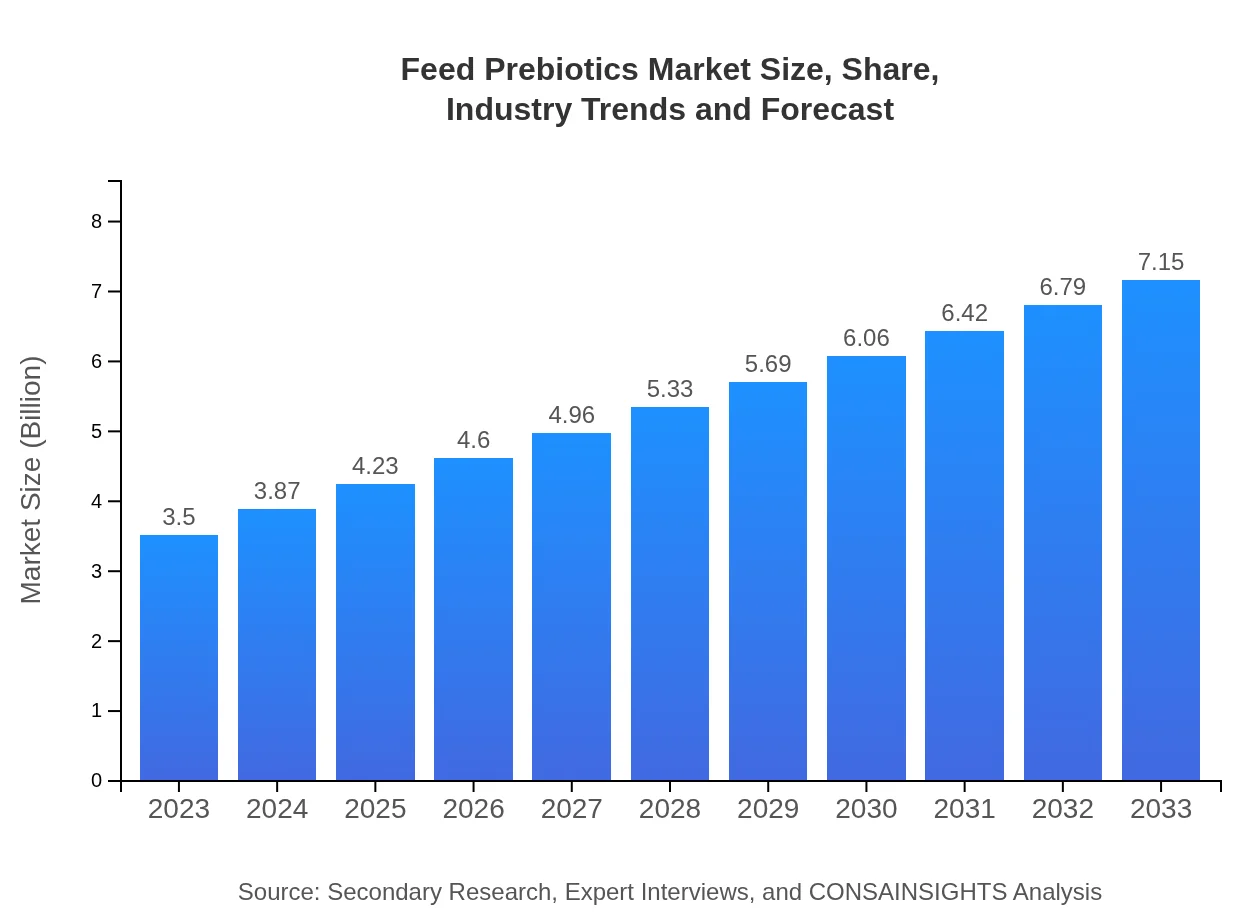
Feed Prebiotics Market — USD 3.5 billion in 2023, Growing to USD 7.15B by 2033 at 7.2% CAGR
This report provides a comprehensive analysis of the Feed Prebiotics market, including current trends, future forecasts, regional insights, and market dynamics, covering the forecast period from 2023 to 2033.
Key Takeaways
- Global feed prebiotics market grows from $3.50 Billion in 2023 to $7.15 Billion in 2033 at a 7.2% CAGR.
- North America is largest regional market, while no single fastest-growing region is stated because regional CAGR differences remain within 0.15 percentage points.
- Europe and Asia Pacific show notable expansion: Europe from $0.9 Billion to $1.83 Billion; Asia Pacific from $0.74 Billion to $1.51 Billion.
- Key product subsegments include plant-based and synthetic sources, with functionality focused on gut health, immune support, and growth performance.
- Leading firms profiled include DuPont, Beneo, Tate & Lyle, and Kemin Industries.
Feed Prebiotics Market Report — Executive Summary
North America remains largest market by forecast-period value, while no single fastest-growing region is stated because top regional growth rates are separated by less than 0.15 percentage points. This report provides a focused evaluation of the feed prebiotics sector, tracing expansion from $3.50 Billion in 2023 to $7.15 Billion by 2033 at a 7.2% CAGR over 2023 to 2033. Growth is driven by rising demand for improved animal nutrition, emphasis on gut health and immune support, and broader adoption of functional feeds across livestock and companion animals. The analysis covers source and application breakdowns, highlighting plant-based and synthetic inputs and use cases across poultry, swine, cattle, aquaculture, and pet food. Regional coverage identifies North America as the largest market and examines drivers in Europe, Asia Pacific, Latin America, and Middle East & Africa. Competitive profiling includes DuPont, Beneo, Tate & Lyle, and Kemin Industries. Methodology combines expert interviews, company disclosures, triangulated secondary research, and internal validation to ensure a robust market outlook.
Key Growth Drivers
- Increasing industry focus on animal gut health and immune function boosts feed prebiotics adoption.
- Expansion of commercial meat, dairy, and aquaculture sectors raises demand for functional feed ingredients.
- Shift toward plant-based and natural feed inputs encourages development of new prebiotic formulations.
- Manufacturers’ R&D and formulation advances enable species-specific and performance-oriented prebiotic solutions.
- Regulatory emphasis on feed safety and efficacy supports validated prebiotic inclusion in commercial feeds.
| Metric | Value |
|---|---|
| Study Period | 2023 - 2033 |
| 2023 Market Size | $3.50 Billion |
| CAGR (2023-2033) | 7.2% |
| 2033 Market Size | $7.15 Billion |
| Top Companies | DuPont, Beneo, Tate & Lyle, Kemin Industries |
| Published Date | 21 October 2024 |
| Last Modified Date | 25 May 2026 |
Feed Prebiotics Market Overview
Customize Feed Prebiotics Market Report market research report
- ✔ Get in-depth analysis of Feed Prebiotics market size, growth, and forecasts.
- ✔ Understand Feed Prebiotics's regional dynamics and industry-specific trends.
- ✔ Identify potential applications, end-user demand, and growth segments in Feed Prebiotics
What is the Market Size & CAGR of Feed Prebiotics Market Report market in 2023?
Feed Prebiotics Industry Analysis
Feed Prebiotics Market Segmentation and Scope
Tell us your focus area and get a customized research report.
Feed Prebiotics Market Report Market Analysis Report by Region
Europe Feed Prebiotics Market Report:
Europe grows from $0.9 Billion in 2023 to $1.83 Billion in 2033. Regional momentum reflects demand for natural and sustainable feed ingredients, regulatory emphasis on animal welfare, and manufacturers’ focus on clean-label prebiotic products.Asia Pacific Feed Prebiotics Market Report:
Asia Pacific grows from $0.74 Billion in 2023 to $1.51 Billion in 2033. Regional expansion is supported by rising livestock and aquaculture production, greater functional feed adoption, and growing awareness of growth-performance and gut-health benefits.North America Feed Prebiotics Market Report:
North America is largest regional market, rising from $1.23 Billion in 2023 to $2.51 Billion in 2033. Growth is driven by robust commercial feed industries, adoption of advanced formulations, and investment in R&D and animal health solutions.South America Feed Prebiotics Market Report:
Latin America grows from $0.16 Billion in 2023 to $0.33 Billion in 2033. Local drivers include expanding meat and dairy production, increasing interest in feed efficiency, and gradual uptake of specialized feed additives.Middle East & Africa Feed Prebiotics Market Report:
Middle East and Africa grows from $0.47 Billion in 2023 to $0.97 Billion in 2033. Growth factors include developing commercial livestock systems, interest in animal health improvements, and demand for performance-enhancing feed components.Tell us your focus area and get a customized research report.
Research Methodology
Feed Prebiotics Market Analysis By Product Type
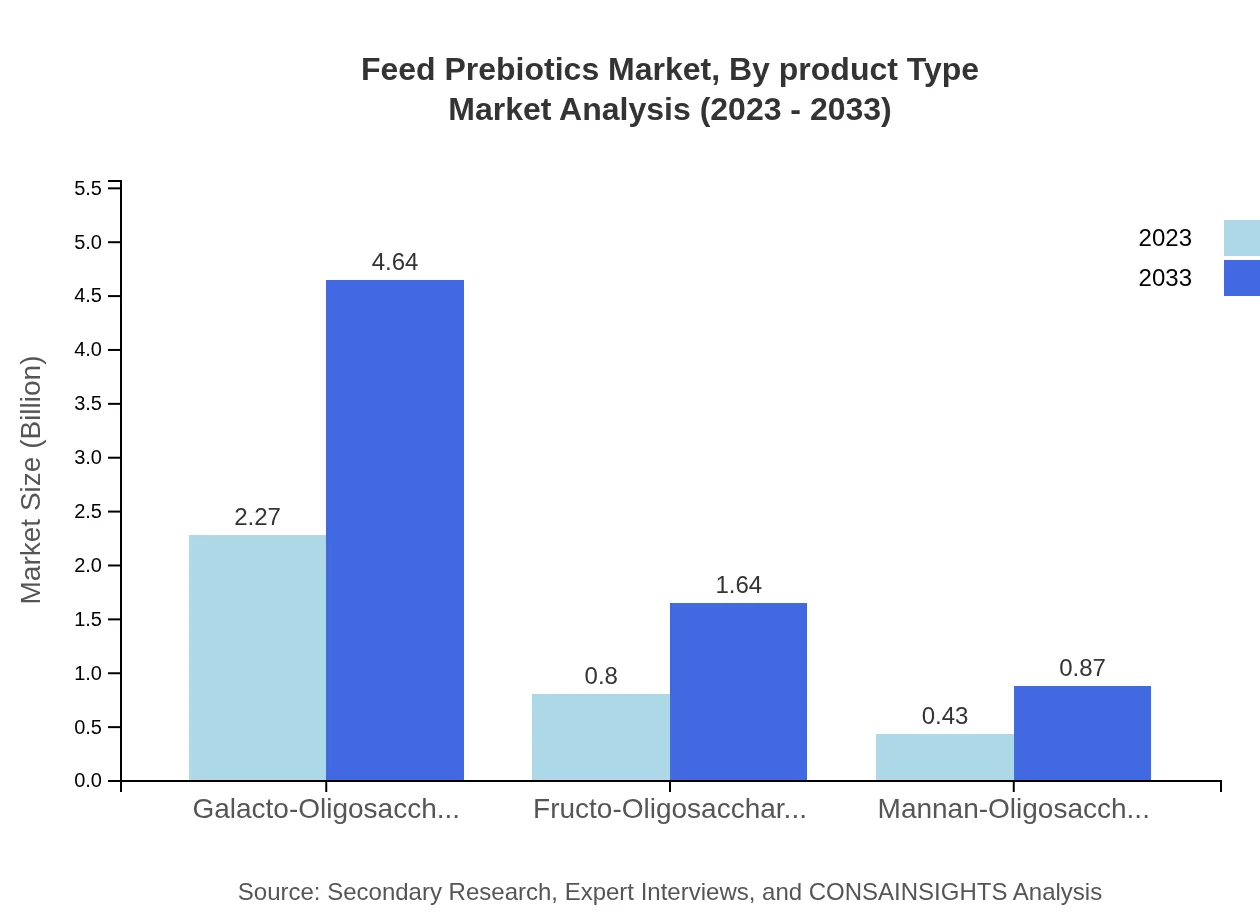
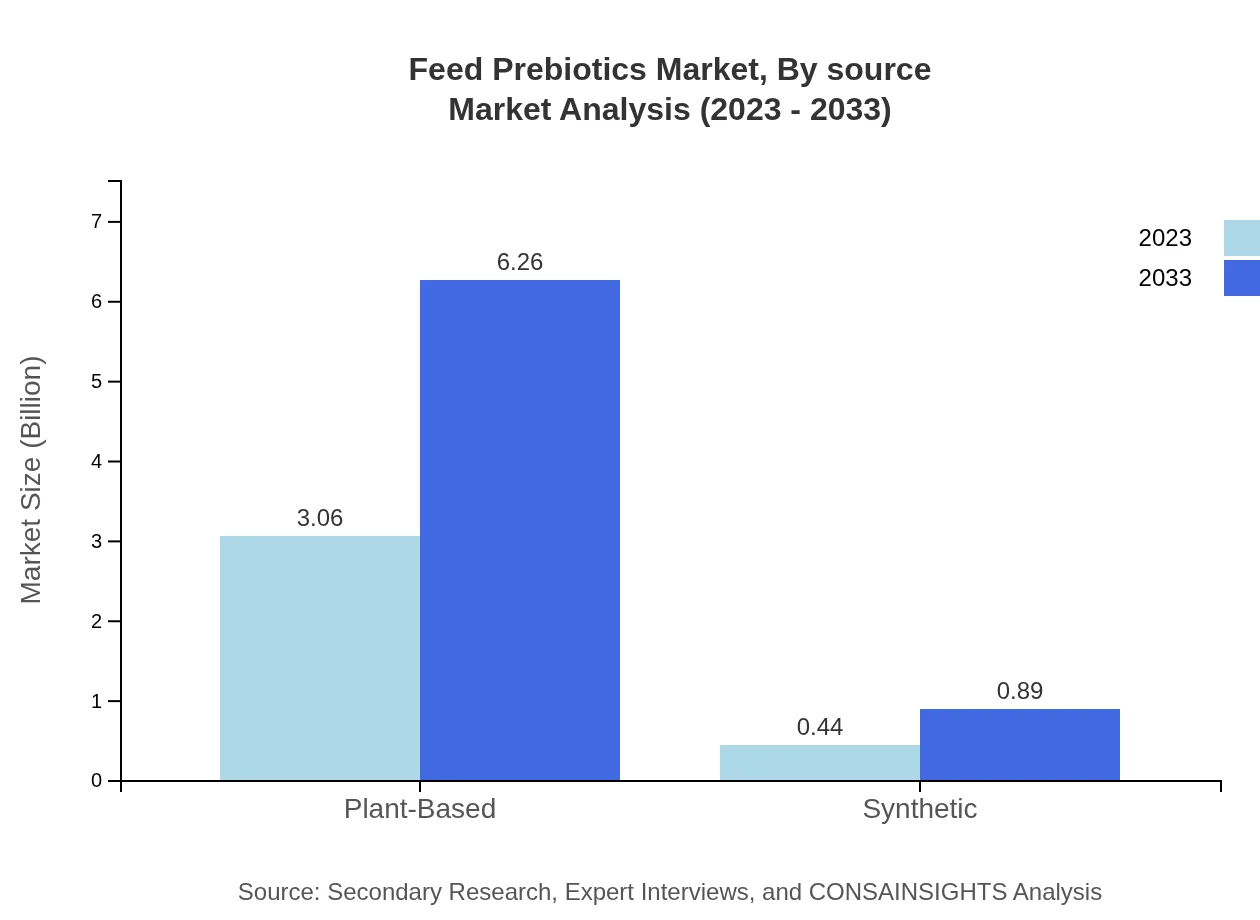
The Feed Prebiotics market, categorized by product type, reveals significant growth in plant-based prebiotics, reflecting a market size increase from $3.06 billion in 2023 to $6.26 billion in 2033, dominating the market share at 87.54%. In contrast, synthetic prebiotics demonstrate a smaller share, growing from $0.44 billion in 2023 to $0.89 billion by 2033, accounting for 12.46% of the overall market.
Feed Prebiotics Market Analysis By Application
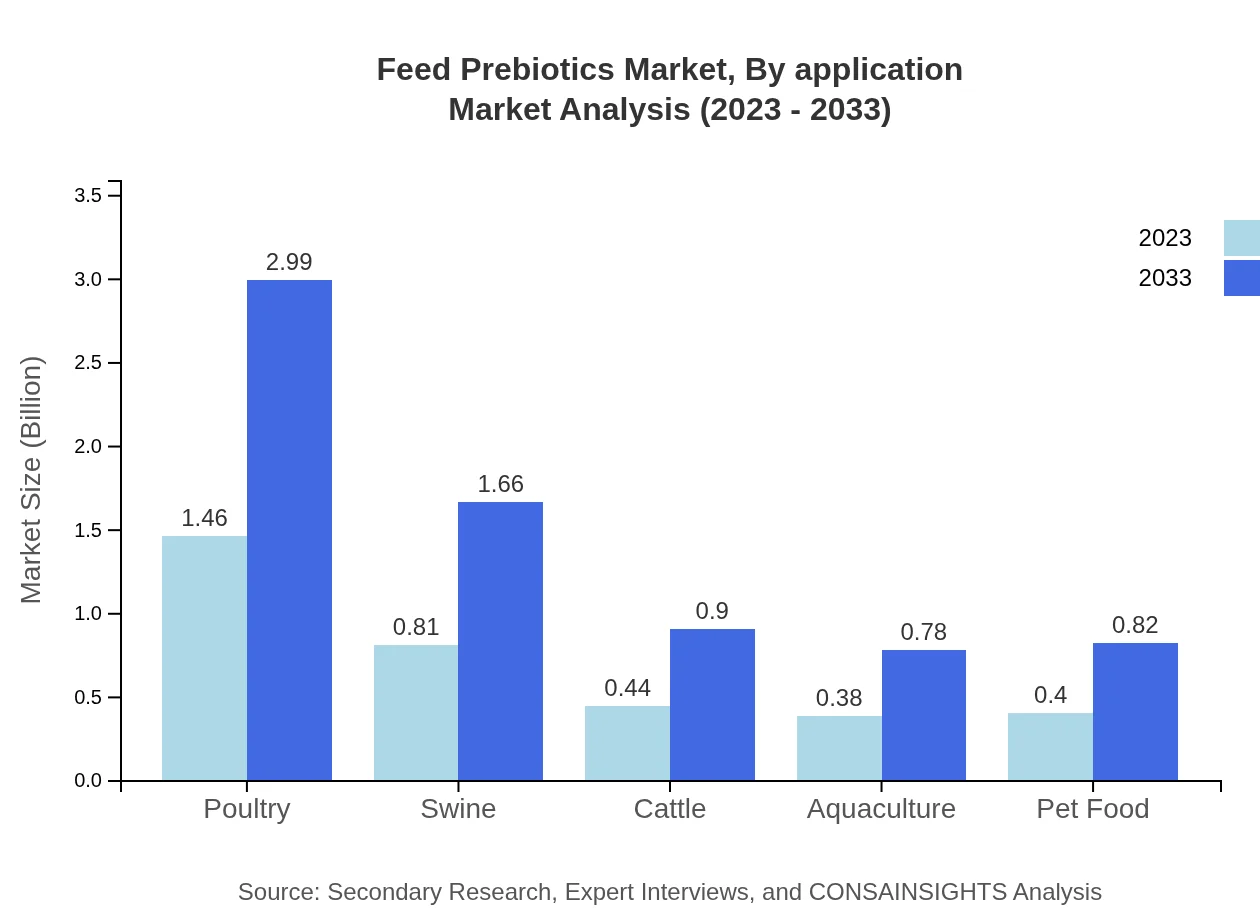
The application segment analysis indicates that poultry remains the largest area of growth, with the market size increasing from $1.46 billion to $2.99 billion between 2023 and 2033, signifying a dominant share at 41.79%. The swine and cattle segments also demonstrate growth, with sizes projected to ascend from $0.81 billion to $1.66 billion and from $0.44 billion to $0.90 billion respectively, while aquaculture is anticipated to grow from $0.38 billion to $0.78 billion. Pet food applications also exhibit promise, growing from $0.40 billion to $0.82 billion.
Feed Prebiotics Market Analysis By Functionality
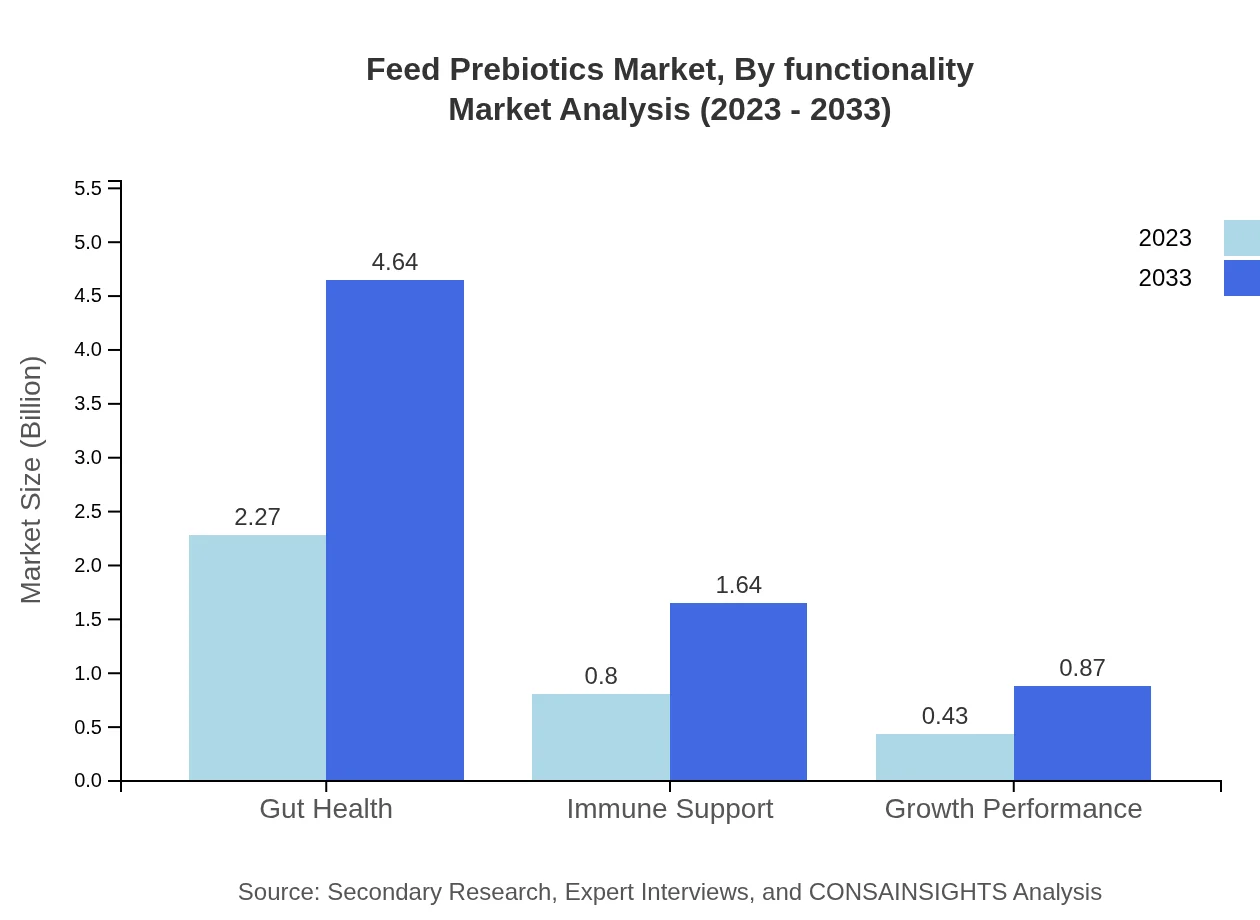
The functionality segment highlights gut health as the leading focus, with a market size forecasted to grow from $2.27 billion to $4.64 billion, holding a 64.83% share. Immune support and growth performance also contribute significantly, projected to rise from $0.80 billion to $1.64 billion and from $0.43 billion to $0.87 billion, each maintaining shares around 22.94% and 12.23% respectively.
Feed Prebiotics Market Trends and Future Forecast
Tell us your focus area and get a customized research report.
Global Market Leaders and Top Companies in Feed Prebiotics Industry
DuPont:
A leader in the development of probiotic and prebiotic formulations, DuPont provides innovative solutions for animal nutrition, enhancing gut health and improving livestock performance.Beneo:
Beneo specializes in functional food ingredients derived from chicory roots and other sources, offering high-quality prebiotic ingredients vital for animal feed applications.Tate & Lyle:
Tate & Lyle produces specialty food ingredients and provides a diverse range of functional prebiotic solutions aimed at enhancing animal well-being and performance.Kemin Industries:
Kemin Industries leverages science and technology to offer nutritional solutions in animal feed, focusing on improving health and performance through effective prebiotic products.We're grateful to work with incredible clients.








FAQs
What is the market size of the feed prebiotics market in 2023?
The market size in 2023 is $3.50 Billion, reflecting current demand for prebiotic additives in animal nutrition across multiple applications and species.
How big will the market be in 2033?
By 2033 the market is projected to reach $7.15 Billion, indicating continued expansion driven by functional feed adoption and improved animal health practices.
What is CAGR of the forecast period?
The compound annual growth rate for the forecast period 2023 to 2033 is 7.2%, based on the market trajectory from $3.50 Billion to $7.15 Billion.
Is there a single fastest Growing region in the Feed Prebiotics Market Report market?
No single fastest-growing region is stated for the Feed Prebiotics Market Report market because the top regional implied CAGR values are within 0.15 percentage points of each other, making the ranking too close to call reliably.
Which companies are leading in this market?
Top companies named in the report include DuPont, Beneo, Tate & Lyle, and Kemin Industries, noted for product development and market presence.
What applications drive demand for feed prebiotics?
Primary applications include poultry, swine, cattle, aquaculture, and pet food, each leveraging prebiotics to support growth performance, gut health, and disease resilience.
How is the report methodology constructed?
The study uses primary interviews with industry experts, secondary research from company reports and publications, data triangulation, and internal validation to ensure accuracy.
What regional trends are highlighted in Europe?
Europe grows from $0.9 Billion in 2023 to $1.83 Billion in 2033, driven by demand for natural ingredients, sustainable feed practices, and regulatory focus on animal health.
Why are plant Based prebiotics notable?
Plant-based sources are emphasized as part of a broader shift toward natural feed inputs, aligning with clean-label preferences and sustainable production trends.
What is the market outlook for Asia Pacific?
Asia Pacific expands from $0.74 Billion in 2023 to $1.51 Billion in 2033, supported by growing livestock production and increasing uptake of functional feed additives.