

Fermenters Market Report
First published: 21 October 2024 | Last updated: 25 May 2026 | Report Code: fermenters
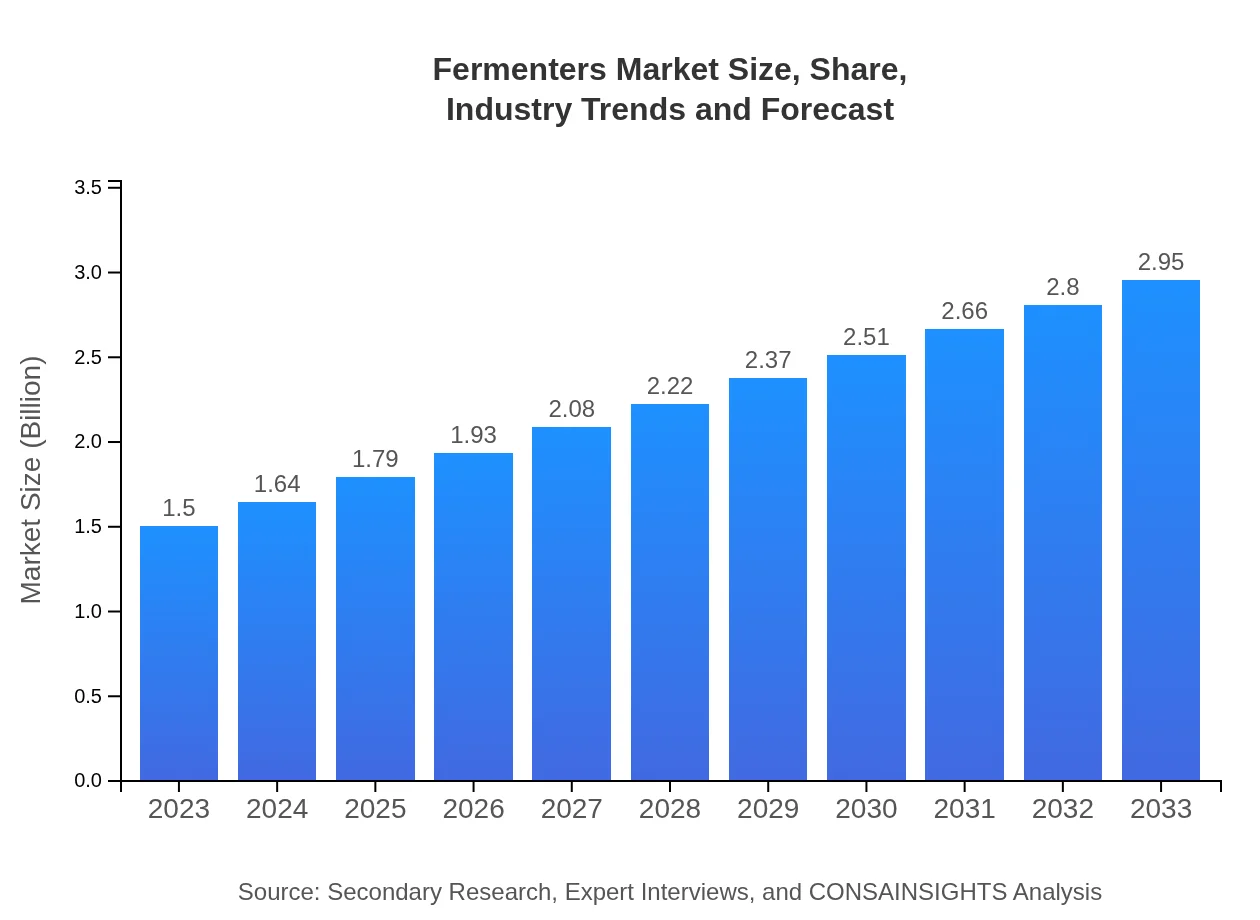
Fermenters Market — USD 1.5 billion in 2023, Growing to USD 2.95B by 2033 at 6.8% CAGR
This report provides an extensive analysis of the Fermenters market, including insights into market trends, size, and anticipated growth from 2023 to 2033. It aims to equip stakeholders with detailed information regarding the dynamics and segmentation within the industry.
Key Takeaways
- Global market value rises from $1.50 Billion in 2023 to $2.95 Billion in 2033 at a 6.8% CAGR over 2023 to 2033.
- North America is largest regional market, while no single fastest-growing region is stated because regional CAGR differences remain within 0.15 percentage points.
- Europe moves from $0.38 Billion to $0.75 Billion and Asia Pacific from $0.30 Billion to $0.58 Billion over the forecast.
- Market segmentation includes batch, continuous and fed-batch types; conventional, specialized and novel technologies; and applications such as pharmaceuticals and biofuels.
- Leading suppliers include GE Healthcare, Thermo Fisher Scientific, Sartorius AG, and Eppendorf AG, reflecting a competitive supplier landscape.
Fermenters Market Report — Executive Summary
North America remains largest market by forecast-period value, while no single fastest-growing region is stated because top regional growth rates are separated by less than 0.15 percentage points. The Fermenters Market Report presents a data-driven view of a market growing from $1.50 Billion in 2023 to $2.95 Billion by 2033, reflecting a 6.8% CAGR for 2023 to 2033. Growth is underpinned by expanding biopharmaceutical production, biofuels demand, and food and beverage fermentation needs. Technological advances in fermenter design, adoption of specialized and novel technologies, and investments in biomanufacturing capacity support market expansion. North America is identified as the largest regional market, rising from $0.49 Billion to $0.96 Billion across the forecast. The report examines segmentation by type, technology, application, and configuration, and profiles major suppliers including GE Healthcare, Thermo Fisher Scientific, Sartorius AG, and Eppendorf AG. Methodology combines primary expert interviews with extensive secondary research, data triangulation, and expert-led trend analysis to ensure robust findings for strategic decision-making.
Key Growth Drivers
- Rising demand for biopharmaceuticals and increased biologics production capacity requiring scalable fermenter solutions.
- Growing biofuels production that depends on efficient fermentation systems to improve yields and process economics.
- Advances in fermentation technologies and novel bioreactor designs improving process control and productivity.
- Expansion in food and beverage fermentation applications that drive adoption of specialized and configurable fermenters.
- Investment in biomanufacturing infrastructure and sustainability initiatives supporting deployment of modern fermenter platforms.
| Metric | Value |
|---|---|
| Study Period | 2023 - 2033 |
| 2023 Market Size | $1.50 Billion |
| CAGR (2023-2033) | 6.8% |
| 2033 Market Size | $2.95 Billion |
| Top Companies | GE Healthcare, Thermo Fisher Scientific, Sartorius AG, Eppendorf AG |
| Published Date | 21 October 2024 |
| Last Modified Date | 25 May 2026 |
Fermenters Market Overview
Customize Fermenters Market Report market research report
- ✔ Get in-depth analysis of Fermenters market size, growth, and forecasts.
- ✔ Understand Fermenters's regional dynamics and industry-specific trends.
- ✔ Identify potential applications, end-user demand, and growth segments in Fermenters
What is the Market Size & CAGR of Fermenters Market Report market in 2023?
Fermenters Industry Analysis
Fermenters Market Segmentation and Scope
Tell us your focus area and get a customized research report.
Fermenters Market Report Market Analysis Report by Region
Europe Fermenters Market Report:
Europe grows from $0.38 Billion in 2023 to $0.75 Billion in 2033. Demand in pharmaceuticals, food production, and growing interest in sustainable bio-processes support equipment adoption and technology upgrades across the region.Asia Pacific Fermenters Market Report:
Asia Pacific grows from $0.3 Billion in 2023 to $0.58 Billion in 2033. Increasing biofuel initiatives, expanding pharmaceutical manufacturing, and rising food fermentation activities are key regional pull factors for fermenter installations.North America Fermenters Market Report:
North America is largest regional market, rising from $0.49 Billion in 2023 to $0.96 Billion in 2033. Local drivers include strong biomanufacturing capacity, supplier presence, and investments that support fermenter deployment across pharmaceuticals and related industries.South America Fermenters Market Report:
Latin America grows from $0.13 Billion in 2023 to $0.26 Billion in 2033. Growth is influenced by emerging bio-based projects, food and beverage fermentation demand, and investments aimed at expanding local bioprocessing capabilities.Middle East & Africa Fermenters Market Report:
Middle East and Africa grows from $0.2 Billion in 2023 to $0.4 Billion in 2033. Drivers include nascent biomanufacturing efforts, sustainability projects, and expanding applications in food processing and environmental treatment.Tell us your focus area and get a customized research report.
Research Methodology
Fermenters Market Analysis By Type
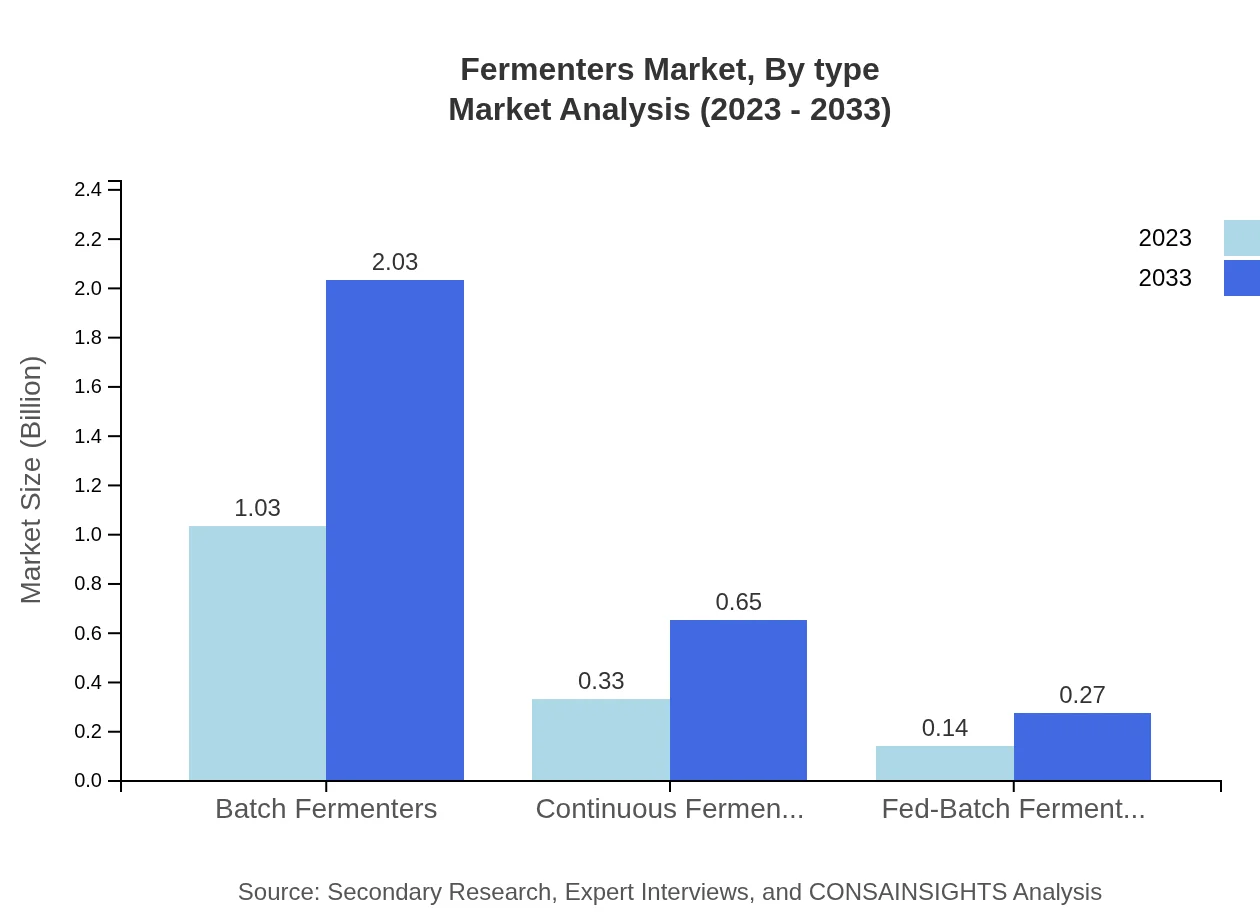
The Fermenters market is prominently dominated by batch fermenters, which accounted for 68.77% market share in 2023. Continuous fermenters and fed-batch fermenters also contribute, showing steady growth as well. Batch fermenters show a growth from 1.03 billion in 2023 to 2.03 billion in 2033. Continuous fermenters, while smaller in size, are expected to grow from 330 million to 650 million, reflecting their growing application in industries requiring constant operational processes.
Fermenters Market Analysis By Application
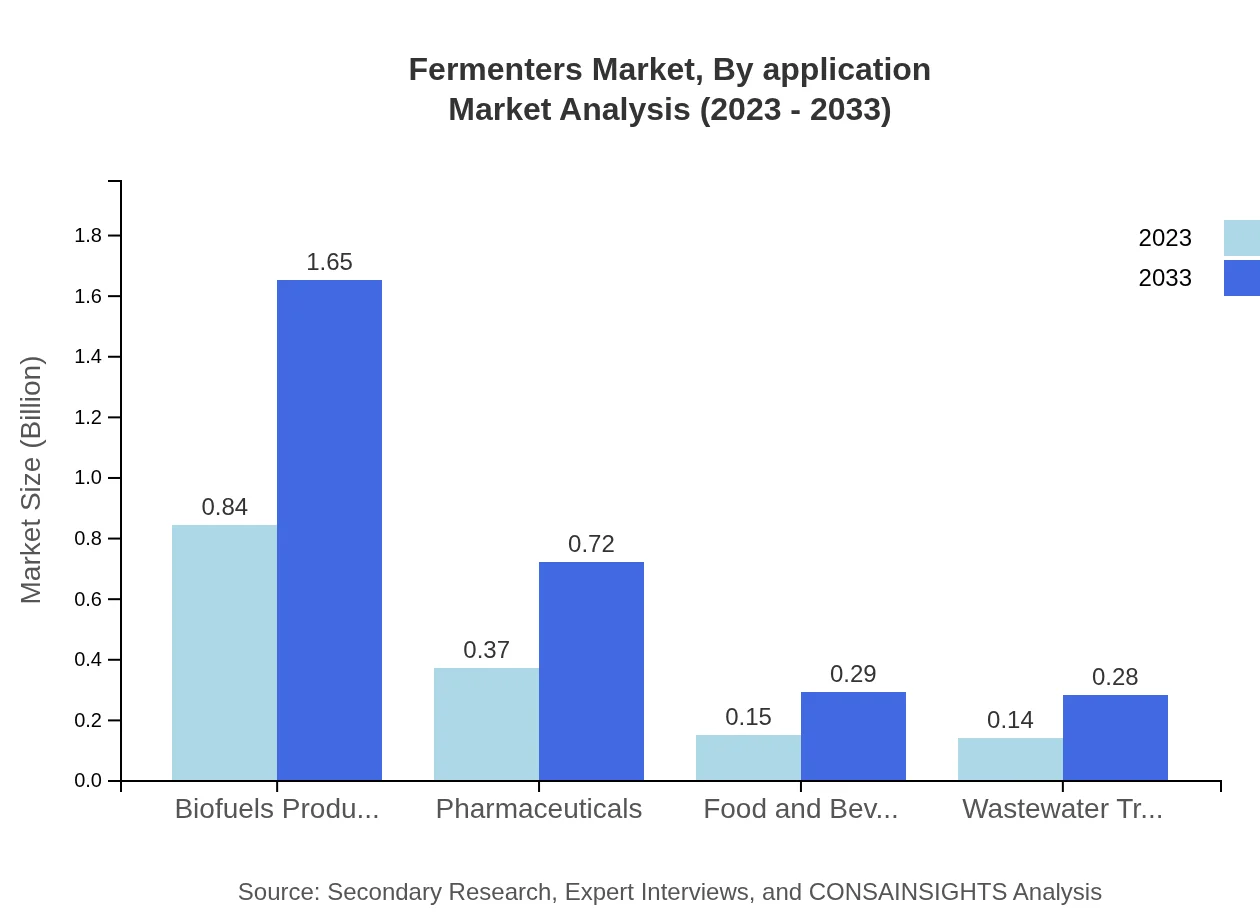
In the application segment, biofuels production leads with a market size of 0.84 billion in 2023, projected to grow to 1.65 billion by 2033, maintaining a share of 55.94%. Pharmaceuticals follow, accounting for 24.5% of the market. The food and beverage sector, while smaller, shows a steady growth, emphasizing the diversity in application for fermenters. Wastewater treatment is also gaining attention, with innovations leading to increased adoption in environmental sustainability.
Fermenters Market Analysis By Configuration
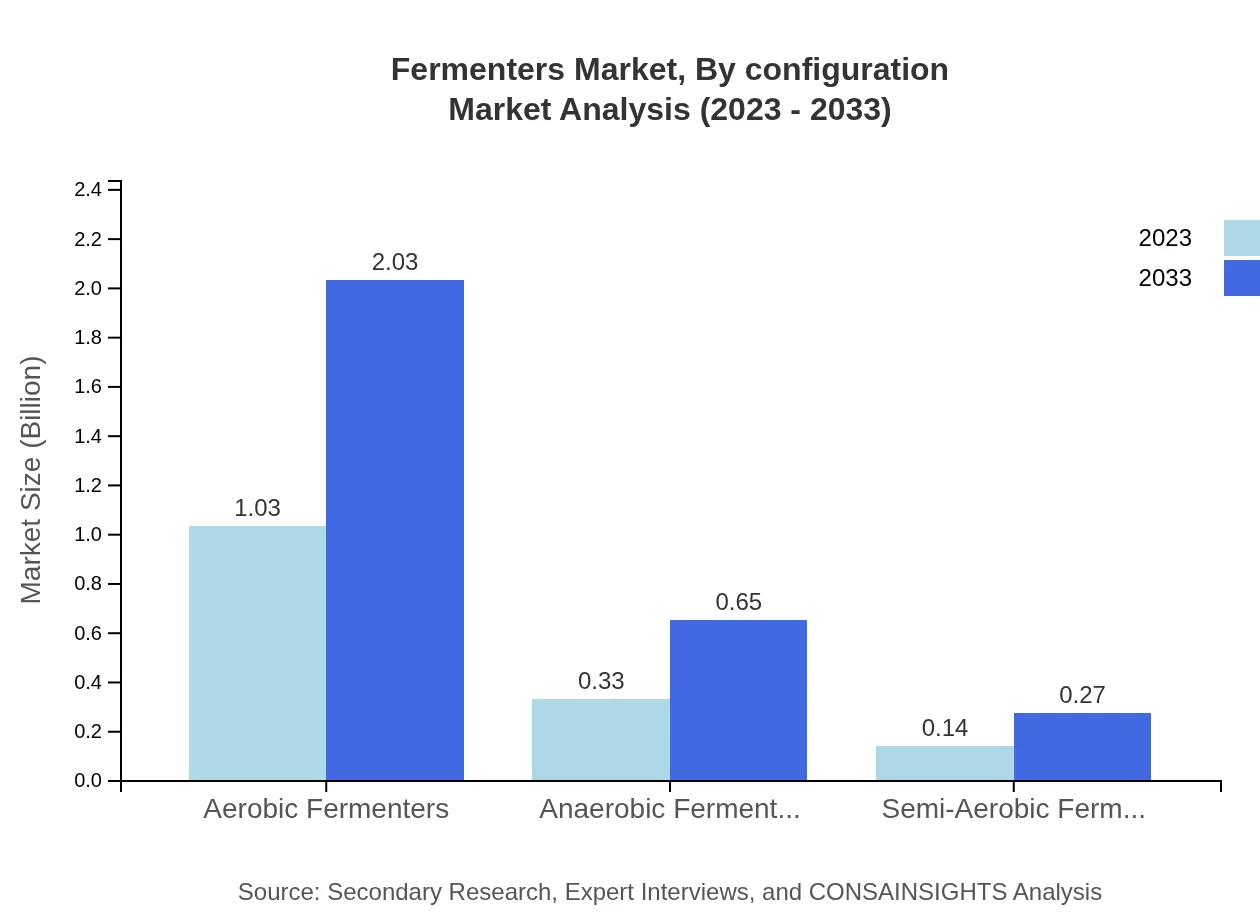
Aerobic fermenters dominate the configuration category, showing a strong presence due to their efficiency in various fermentation processes. Anaerobic fermenters are also notable players, particularly in energy production from waste, while semi-aerobic options are viable for specific applications. The trend continues towards integrating novel technologies into all configurations, optimizing the fermentation process.
Fermenters Market Analysis By Technology
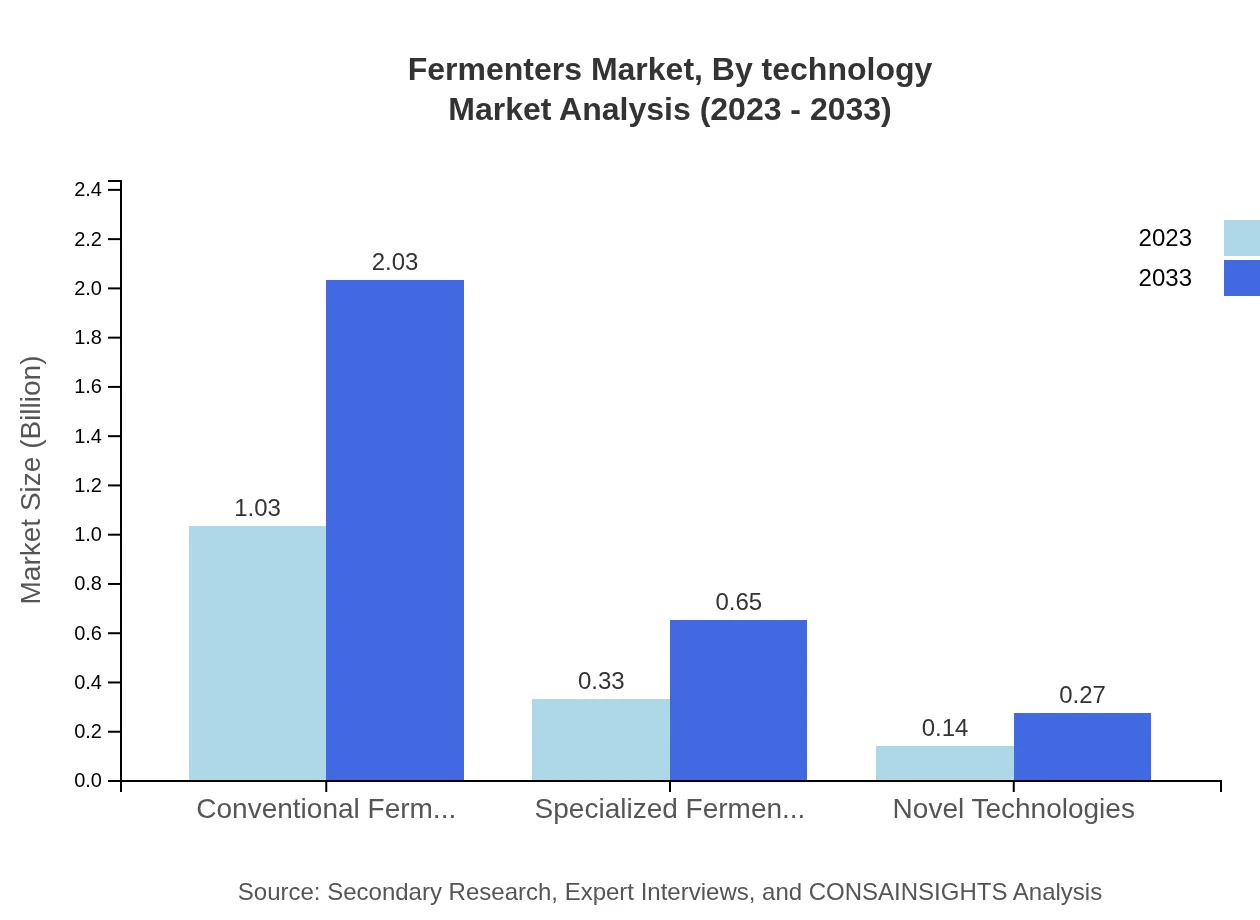
Technological advancements in fermentation processes, including automation and IoT integration, are pivotal trends shaping the market. Innovations aimed at enhancing yield efficiency, reducing operational costs, and ensuring real-time monitoring are fostering market growth. The adoption of novel technologies such as bioreactor design and improved culture mediums will significantly impact the Fermenters market dynamics, addressing current manufacturing challenges.
Fermenters Market Trends and Future Forecast
Tell us your focus area and get a customized research report.
Global Market Leaders and Top Companies in Fermenters Industry
GE Healthcare:
A leading provider of technology and service solutions for the biopharmaceutical industry, GE Healthcare focuses on optimizing fermentation processes through advanced bioreactor technologies.Thermo Fisher Scientific:
Specializing in laboratory and bioprocessing equipment, Thermo Fisher plays a crucial role in the Fermenters market with its innovative fermenter technologies, providing superior performance for biomanufacturing.Sartorius AG:
Sartorius specializes in biopharmaceuticals and has made significant advancements in fermentation technology, particularly in bioreactors and cell culture systems that enhance fermentation efficiency.Eppendorf AG:
Eppendorf offers a broad array of fermenters and bioreactors, focusing on enabling rapid development of biotherapeutics and other applications in academic and commercial settings.We're grateful to work with incredible clients.









FAQs
What is the market size of fermenters in 2023?
The market size for fermenters in 2023 is $1.50 Billion, reflecting baseline industry demand across pharmaceuticals, biofuels, and food applications.
How big will the fermenters market be by 2033?
By 2033, the fermenters market is projected to reach $2.95 Billion based on the stated forecast covering 2023 to 2033.
What is CAGR for the forecast period?
The compound annual growth rate (CAGR) for the 2023 to 2033 forecast period is 6.8% according to the report data.
Is there a single fastest Growing region in the Fermenters Market Report market?
No single fastest-growing region is stated for the Fermenters Market Report market because the top regional implied CAGR values are within 0.15 percentage points of each other, making the ranking too close to call reliably.
Which applications drive fermenter demand?
Key applications include pharmaceuticals, biofuels production, food and beverages, and wastewater treatment, each supporting equipment uptake across sectors.
Who are the leading companies in fermenters?
Top companies identified include GE Healthcare, Thermo Fisher Scientific, Sartorius AG, and Eppendorf AG as prominent equipment suppliers.
What types of fermenters are covered?
The market includes batch fermenters, continuous fermenters, and fed-batch fermenters as primary type categories examined in the report.
How is technology segmentation described?
Technology segmentation spans conventional fermentation, specialized fermentation, and novel technologies to capture a range of process capabilities.
Why are novel technologies important?
Novel technologies are important because they enable improved process efficiency, higher yields, and support evolving applications in biomanufacturing and sustainability.
What drives adoption in the food and beverage sector?
Adoption in food and beverage is propelled by demand for fermentation-based ingredients, process consistency, and scalable equipment configurations.