
Reports >
Life Sciences
>
Gluten Feed Market Report

Gluten Feed Market Report
First published: 12 October 2024 | Last updated: 25 May 2026 | Report Code: gluten-feed
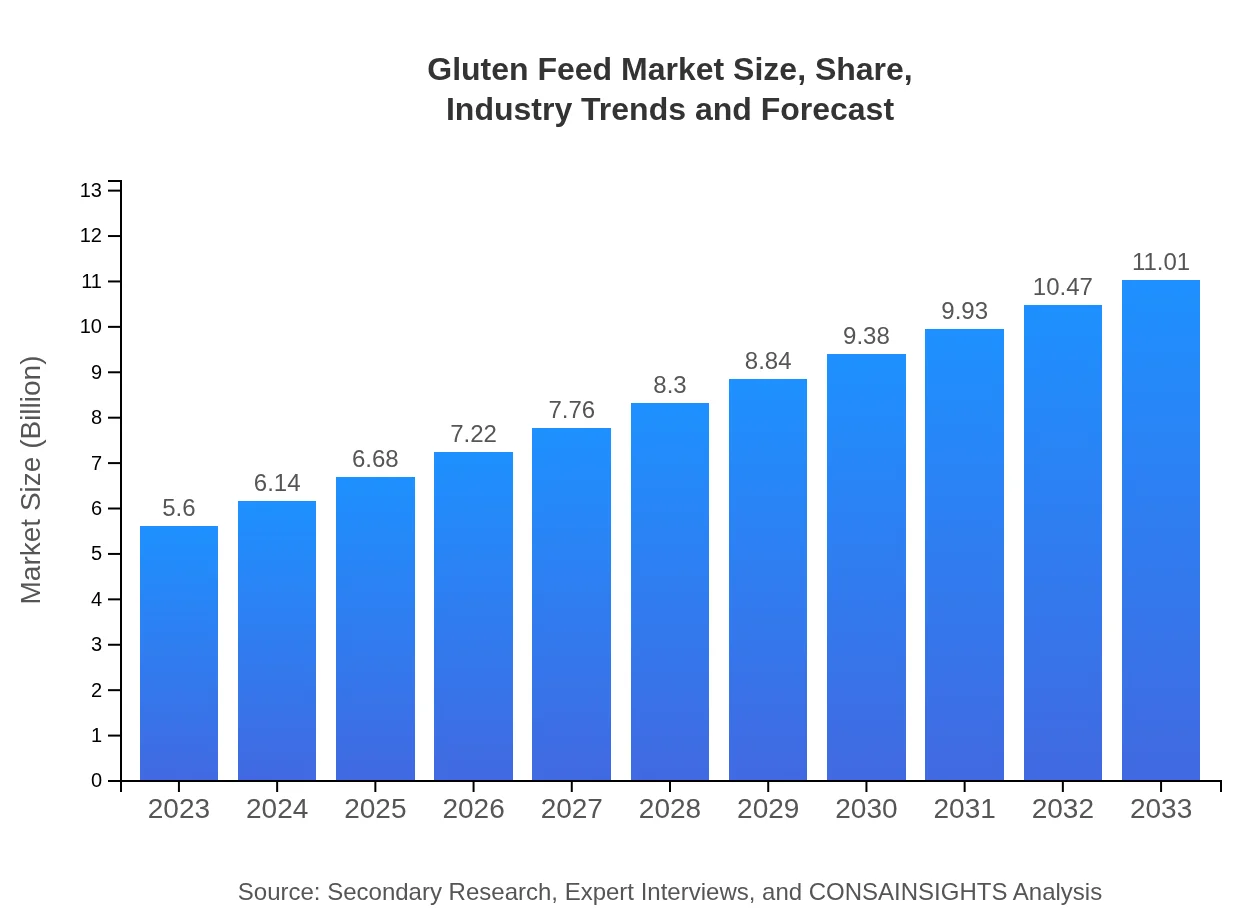
Gluten Feed Market — USD 5.6 billion in 2023, Growing to USD 11.01B by 2033 at 6.8% CAGR
This report provides an in-depth analysis of the Gluten Feed market, covering essential insights and forecasts from 2023 to 2033, including market size, segmentation, regional insights, and leading manufacturers.
Key Takeaways
- Global market expands from $5.60 Billion (2023) to $11.01 Billion (2033) at a 6.8% CAGR over 2023 to 2033.
- North America is largest regional market, while no single fastest-growing region is stated because regional CAGR differences remain within 0.15 percentage points.
- Europe and Asia Pacific also record notable growth: Europe from $1.51 Billion to $2.96 Billion, Asia Pacific from $1.16 Billion to $2.29 Billion.
- Market participants such as Cargill, Inc., Archer Daniels Midland Company (ADM), Tate & Lyle and Bunge Limited are prominent in supply and distribution.
- Demand is driven by livestock nutrition needs, processing innovations, and rising focus on sustainable feed solutions.
Gluten Feed Market Report — Executive Summary
North America remains largest market by forecast-period value, while no single fastest-growing region is stated because top regional growth rates are separated by less than 0.15 percentage points. The report outlines the Gluten Feed market trajectory from 2023 to 2033, with the global market climbing from $5.60 Billion to $11.01 Billion at a 6.8% CAGR. Growth is propelled by rising demand for high-protein feed in livestock, poultry and aquaculture, coupled with processing advancements and sustainability initiatives. Regional patterns show North America as the largest market, supported by established supply chains and strong animal-production activity. Europe and Asia Pacific contribute significant volumes as feed formulation and regulatory focus evolve. Industry structure is mixed, featuring multinational firms — including Cargill, Inc., Archer Daniels Midland Company (ADM), Tate & Lyle and Bunge Limited — alongside regional suppliers. Opportunities stem from formulation innovation, expanded distribution channels and increased adoption of efficient feed inputs. Challenges include raw material cost pressures and environmental regulation compliance. The report uses expert interviews and multi-source validation to present actionable insights for manufacturers, feed formulators, and supply-chain stakeholders planning through 2033.
Key Growth Drivers
- Rising demand for protein-rich animal feed from livestock and aquaculture sectors increases gluten feed consumption.
- Technological improvements in cereal processing enhance protein recovery and product consistency.
- Sustainability and efficient feed formulation priorities drive adoption of high-value by-products.
- Expanded distribution networks and presence of major agribusiness companies broaden market access.
- Increased regulatory emphasis on nutrition and animal health supports demand for standardized feed inputs.
| Metric | Value |
|---|---|
| Study Period | 2023 - 2033 |
| 2023 Market Size | $5.60 Billion |
| CAGR (2023-2033) | 6.8% |
| 2033 Market Size | $11.01 Billion |
| Top Companies | Cargill, Inc., Archer Daniels Midland Company (ADM), Tate & Lyle, Bunge Limited |
| Published Date | 12 October 2024 |
| Last Modified Date | 25 May 2026 |
Gluten Feed Market Overview
Customize Gluten Feed Market Report market research report
- ✔ Get in-depth analysis of Gluten Feed market size, growth, and forecasts.
- ✔ Understand Gluten Feed's regional dynamics and industry-specific trends.
- ✔ Identify potential applications, end-user demand, and growth segments in Gluten Feed
What is the Market Size & CAGR of Gluten Feed Market Report market in 2023?
Gluten Feed Industry Analysis
Gluten Feed Market Segmentation and Scope
Tell us your focus area and get a customized research report.
Gluten Feed Market Report Market Analysis Report by Region
Europe Gluten Feed Market Report:
Europe grows from $1.51 Billion in 2023 to $2.96 Billion in 2033. Regional advancement reflects regulatory attention to feed quality, increasing use of processed gluten in feed formulations, and investments in processing technology.Asia Pacific Gluten Feed Market Report:
Asia Pacific grows from $1.16 Billion in 2023 to $2.29 Billion in 2033. Demand in the region is driven by expanding livestock and aquaculture production, rising protein consumption trends and growing acceptance of efficient feed ingredients.North America Gluten Feed Market Report:
North America is largest regional market, rising from $2.01 Billion in 2023 to $3.96 Billion in 2033. Growth is supported by well-established feed supply chains, intensive livestock production systems and strong adoption of processed cereal by-products for animal nutrition.South America Gluten Feed Market Report:
Latin America grows from $0.39 Billion in 2023 to $0.77 Billion in 2033. Market expansion is associated with rising livestock output, improving processing capacity and greater integration of cereal by-products into feed blends.Middle East & Africa Gluten Feed Market Report:
Middle East and Africa grows from $0.52 Billion in 2023 to $1.03 Billion in 2033. Drivers include growing demand for quality animal feed, supply-chain improvements and adoption of protein-rich feed inputs to support regional livestock sectors.Tell us your focus area and get a customized research report.
Research Methodology
Gluten Feed Market Analysis By Type
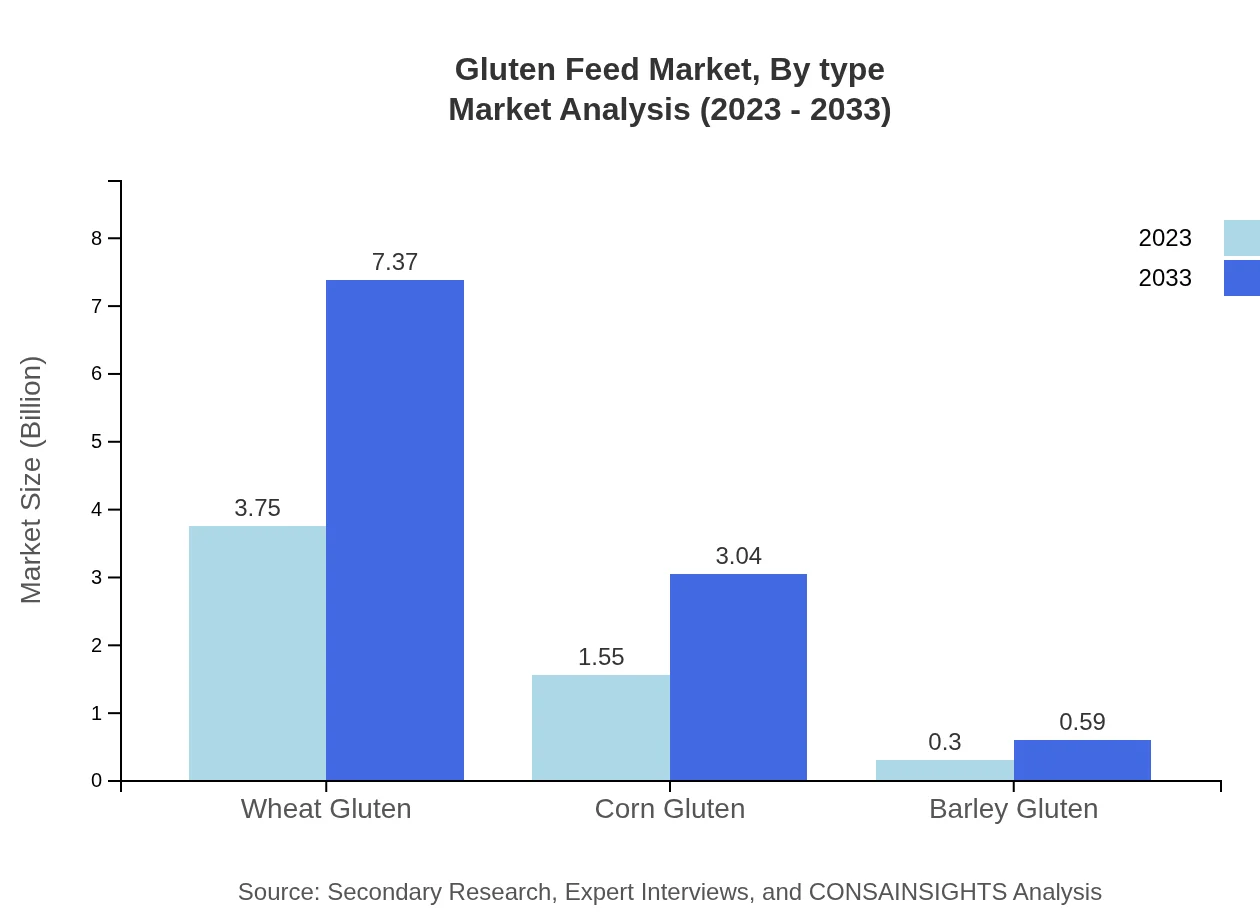
The Gluten Feed market is dominated by the Wheat Gluten segment, which contributes significantly to the overall market size. As of 2023, Wheat Gluten accounts for $3.75 billion, projected to reach $7.37 billion by 2033, holding a market share of 66.96%. Corn Gluten follows with a market value of $1.55 billion in 2023, likely to grow to $3.04 billion by 2033, securing a 27.66% share. Lastly, Barley Gluten holds a smaller share of 5.38%, with current values expected to rise from $0.30 billion in 2023 to $0.59 billion by 2033.
Gluten Feed Market Analysis By Application
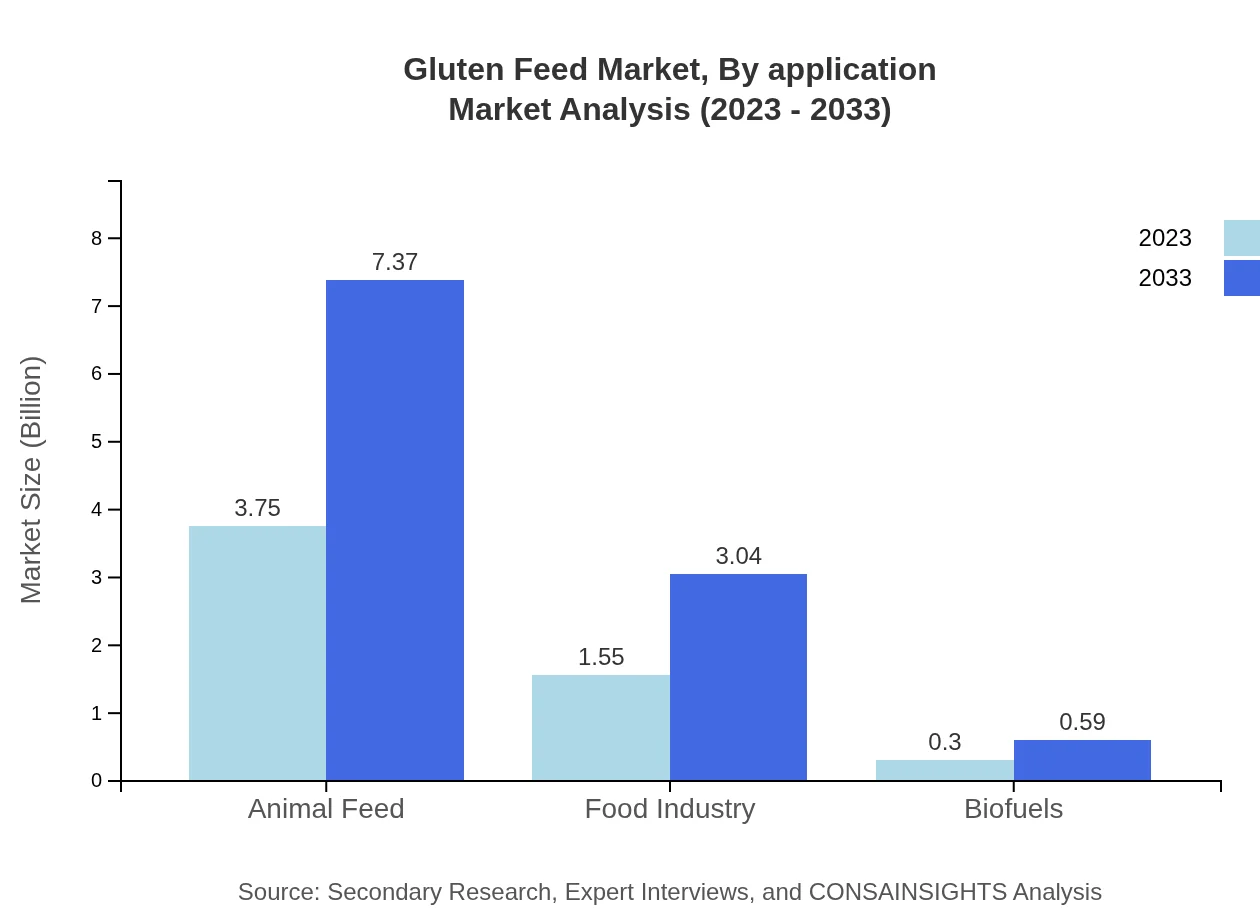
The application of gluten feed spans multiple sectors. The Animal Feed segment, valued at $3.75 billion in 2023, dominates the space with expectations of reaching $7.37 billion by 2033, reflecting a 66.96% share. The Food Industry, with a market share of 27.66%, sees growth from $1.55 billion to $3.04 billion during the same period. Biofuels exhibit a smaller but significant segment, with growth predicted from $0.30 billion to $0.59 billion.
Gluten Feed Market Analysis By Formulation
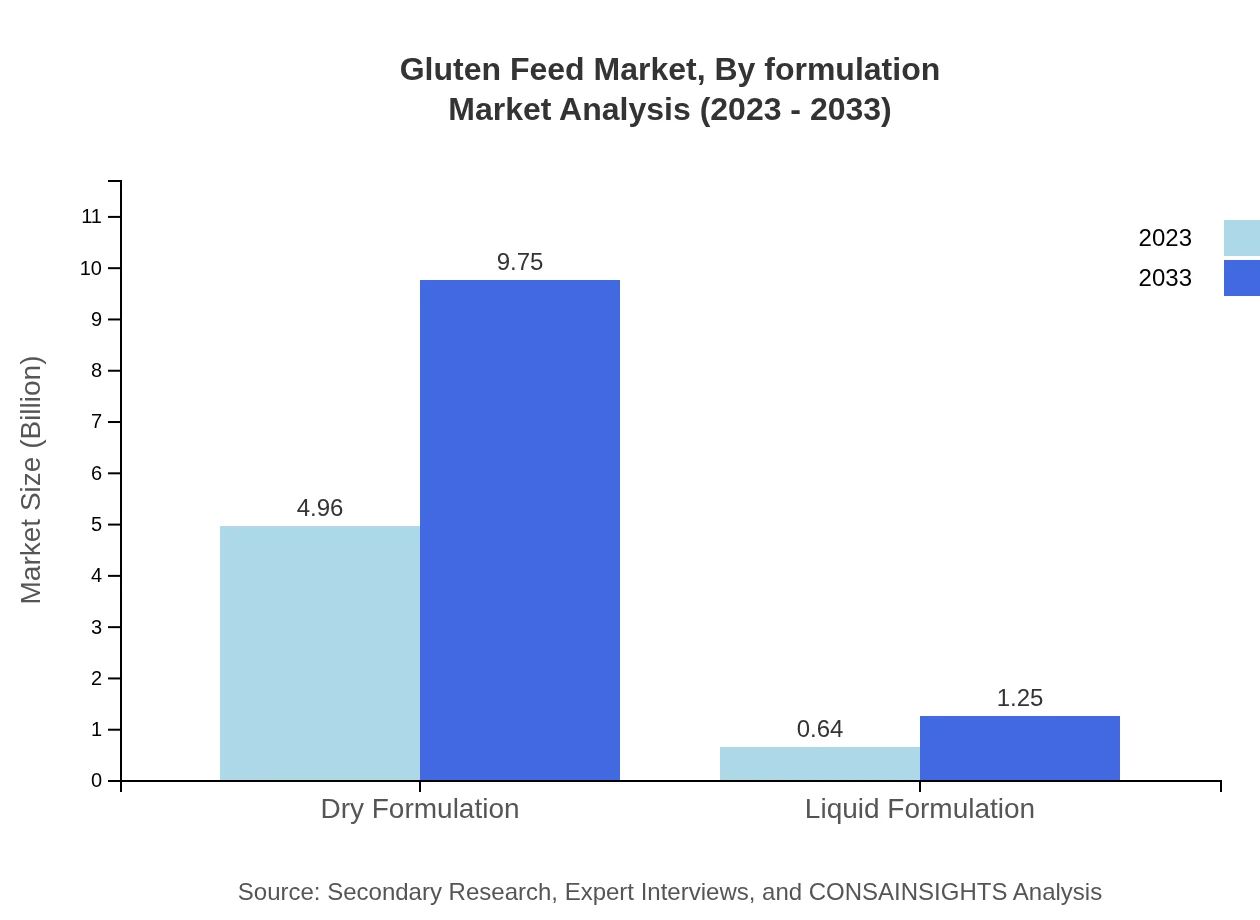
The market is primarily defined by Dry and Liquid formulations. Dry formulation leads with a substantial market size of $4.96 billion in 2023, projected to rise to $9.75 billion by 2033, holding an impressive 88.61% market share. Liquid formulation, although smaller, is anticipated to escalate from $0.64 billion to $1.25 billion, representing an 11.39% share.
Gluten Feed Market Analysis By Distribution Channel
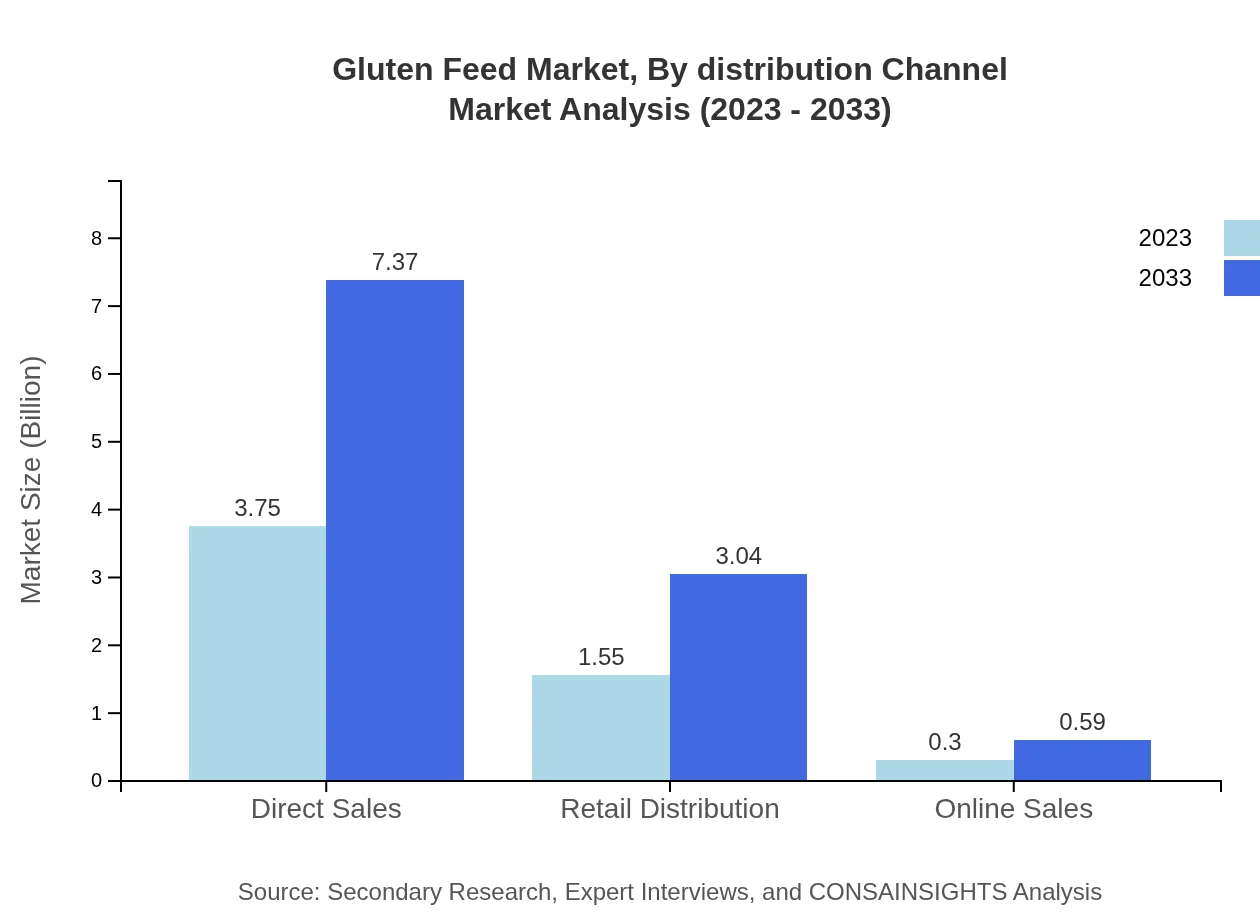
Direct sales dominate the distribution channel, accounting for $3.75 billion in 2023 with projections of $7.37 billion by 2033, sustaining a 66.96% market share. Retail distribution follows closely with $1.55 billion, expected to reach $3.04 billion, while online sales, though smaller at $0.30 billion, are anticipated to grow to $0.59 billion.
Gluten Feed Market Analysis By End User
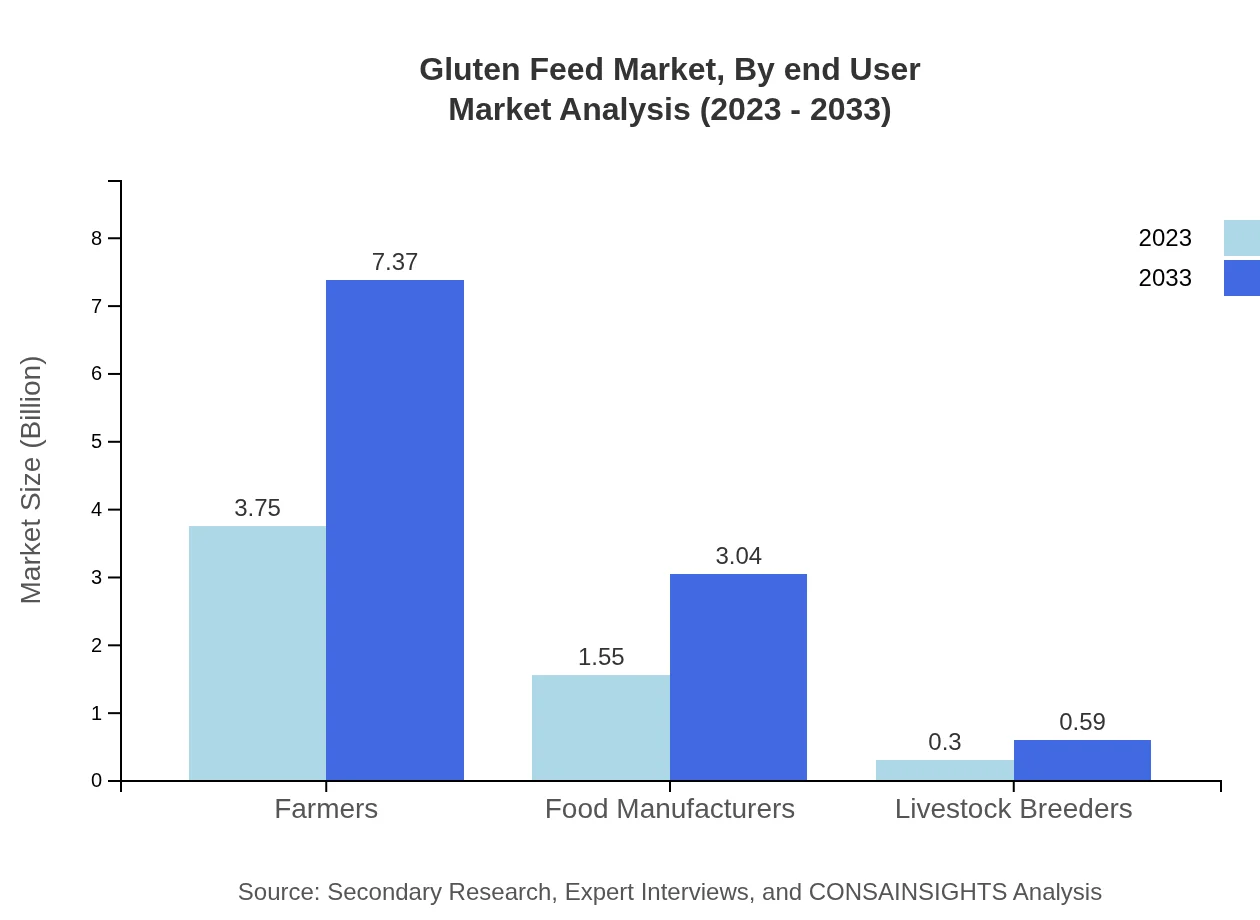
Farmers constitute the largest end-user segment with values reaching $3.75 billion in 2023 and projected to grow to $7.37 billion by 2033, maintaining a significant 66.96% market share. Food manufacturers exhibit a market value of $1.55 billion, expected to reach $3.04 billion, while Livestock breeders hold a smaller share, growing from $0.30 billion to $0.59 billion.
Gluten Feed Market Trends and Future Forecast
Tell us your focus area and get a customized research report.
Global Market Leaders and Top Companies in Gluten Feed Industry
Cargill, Inc.:
A leading global player in food production and agricultural services, Cargill is known for its high-quality gluten feed products that cater to both animal feed and food manufacturing sectors.Archer Daniels Midland Company (ADM):
ADM is a prominent multinational involved in food processing and commodities trading, providing a wide range of animal feed solutions, including significant gluten feed products.Tate & Lyle:
An international provider of food ingredients and solutions, Tate & Lyle offers innovative gluten-based products, emphasizing sustainability and nutrition.Bunge Limited:
Bunge is a global agribusiness company producing food and feed ingredients, diversifying into gluten feed segments to meet evolving market demands.We're grateful to work with incredible clients.









FAQs
What is the market size of the Gluten Feed market in 2023?
The market size for 2023 is $5.60 Billion, as reported. This baseline is used to measure projected expansion through the forecast period to 2033.
How big will the market be in 2033?
The market is projected to reach $11.01 Billion by 2033, reflecting expected growth in demand for protein-rich feed and expanded regional uptake.
What is CAGR of the market from 2023 to 2033?
The Compound Annual Growth Rate for the forecast period 2023 to 2033 is 6.8%, based on reported market size progression.
Is there a single fastest Growing region in the Gluten Feed Market Report market?
No single fastest-growing region is stated for the Gluten Feed Market Report market because the top regional implied CAGR values are within 0.15 percentage points of each other, making the ranking too close to call reliably.
Which companies are listed as top players in the market?
Top companies identified include Cargill, Inc., Archer Daniels Midland Company (ADM), Tate & Lyle and Bunge Limited, reflecting major agribusiness participants.
What are primary demand drivers for gluten feed?
Key drivers include increased livestock nutrition needs, processing advancements for protein recovery, and greater emphasis on sustainable feed formulations.
How is sustainability influencing the gluten feed market?
Sustainability priorities promote use of cereal-processing by-products and efficient formulations, encouraging wider adoption of gluten feed in animal nutrition strategies.
What research methods were used for this report?
The study used primary interviews with industry experts and secondary research from company reports and publications, combined with data triangulation and internal validation.