
Reports >
Life Sciences
>
Smart Implantable Pumps Market Report

Smart Implantable Pumps Market Report
First published: 12 October 2024 | Last updated: 28 May 2026 | Report Code: smart-implantable-pumps
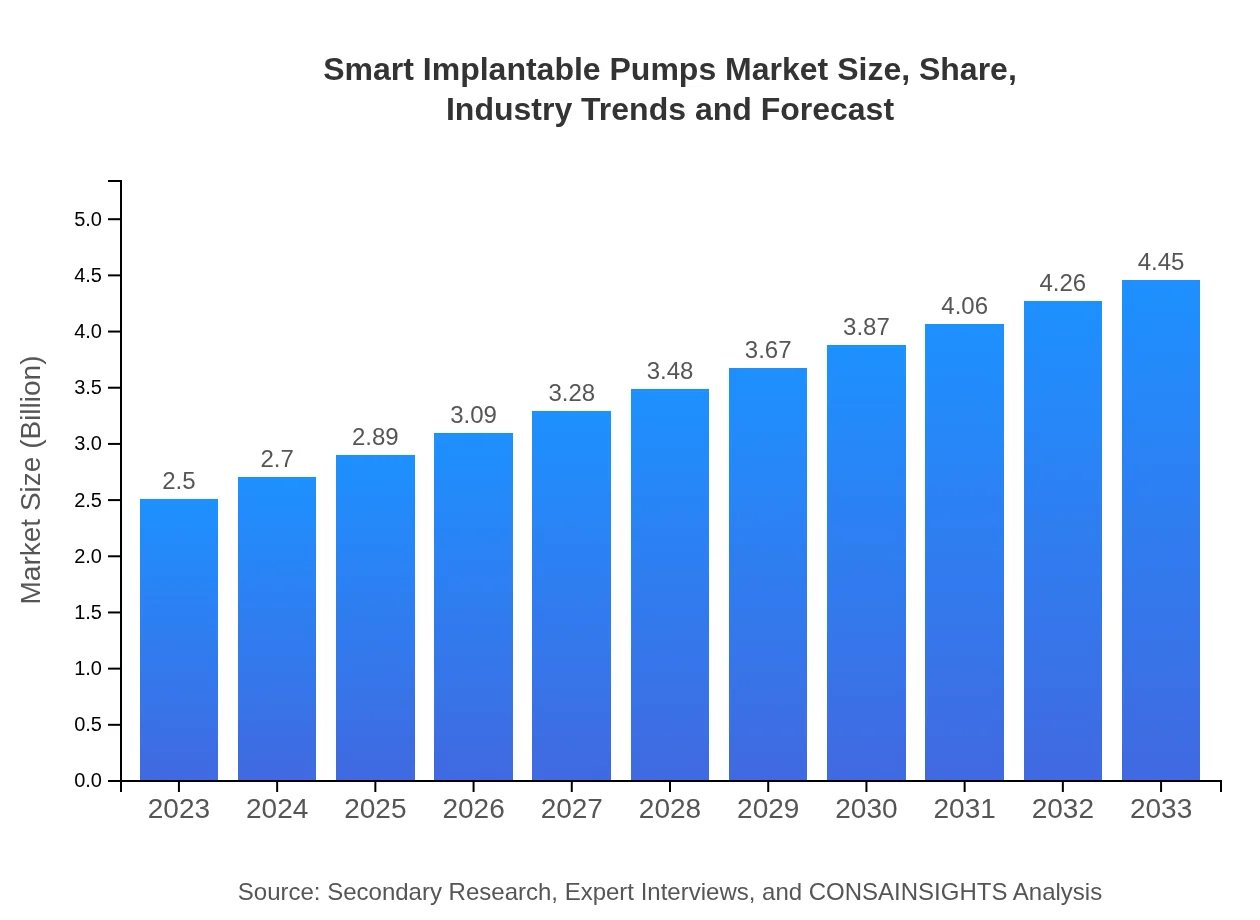
Smart Implantable Pumps Market — USD 2.5 billion in 2023, Growing to USD 4.45B by 2033 at 5.8% CAGR
This report provides comprehensive insights into the Smart Implantable Pumps market, analyzing current trends, growth prospects, and forecast data from 2023 to 2033. It covers market size, segmentation, regional analysis, and key players in the industry.
Key Takeaways
- Global market expands from $2.50 Billion in 2023 to $4.45 Billion in 2033 at a 5.8% CAGR.
- North America is the largest region, rising from $0.92 Billion in 2023 to $1.63 Billion in 2033.
- North America is largest regional market; Asia Pacific is regional market region based on implied CAGR across 2023 to 2033.
- Europe moves from $0.81 Billion in 2023 to $1.44 Billion in 2033, reflecting steady demand across clinical applications.
- Key vendors include Medtronic, Boston Scientific, Abbott Laboratories, and Bayer Healthcare, with ongoing R&D and partnerships.
Smart Implantable Pumps Market Report — Executive Summary
Regional analysis shows North America as largest market and Asia Pacific as fastest-growing region by implied CAGR. The Smart Implantable Pumps market is forecast to grow from $2.50 Billion in 2023 to $4.45 Billion by 2033, supported by a projected 5.8% CAGR. Growth is driven by rising chronic disease prevalence, advances in device miniaturization, and increased investment in smart medical technologies. Product segmentation covers insulin pumps, pain management pumps, and other implantable devices, while applications span diabetes management, chronic pain, cardiology, and chemotherapy. Device technologies such as electromechanical systems, microelectronics, and wireless capabilities are shaping product development. Regional dynamics show North America as the largest market and Asia Pacific registering the strongest implied growth. Leading companies—Medtronic, Boston Scientific, Abbott Laboratories, and Bayer Healthcare—are focusing on innovation and strategic collaborations. Regulatory frameworks including FDA regulations and global standards influence market entry and commercialization timelines. The report synthesizes primary interviews and secondary sources to present validated insights for stakeholders considering investment, product development, or market entry strategies.
Key Growth Drivers
- Increasing prevalence of chronic conditions boosting demand for long-term, controlled drug delivery systems.
- Advances in microelectronics and wireless technology enabling smaller, smarter implantable pump designs.
- Rising R&D investment and strategic collaborations among major medical device manufacturers.
- Regulatory frameworks such as FDA regulations and global standards shaping commercialization pathways.
- Greater adoption of personalized medicine practices that favor programmable implantable delivery solutions.
| Metric | Value |
|---|---|
| Study Period | 2023 - 2033 |
| 2023 Market Size | $2.50 Billion |
| CAGR (2023-2033) | 5.8% |
| 2033 Market Size | $4.45 Billion |
| Top Companies | Medtronic , Boston Scientific, Abbott Laboratories, Bayer Healthcare |
| Published Date | 12 October 2024 |
| Last Modified Date | 28 May 2026 |
Smart Implantable Pumps Market Overview
Customize Smart Implantable Pumps Market Report market research report
- ✔ Get in-depth analysis of Smart Implantable Pumps market size, growth, and forecasts.
- ✔ Understand Smart Implantable Pumps's regional dynamics and industry-specific trends.
- ✔ Identify potential applications, end-user demand, and growth segments in Smart Implantable Pumps
What is the Market Size & CAGR of Smart Implantable Pumps Market Report market in 2023?
Smart Implantable Pumps Industry Analysis
Smart Implantable Pumps Market Segmentation and Scope
Tell us your focus area and get a customized research report.
Smart Implantable Pumps Market Report Market Analysis Report by Region
Europe Smart Implantable Pumps Market Report:
Europe grows from $0.81 Billion in 2023 to $1.44 Billion in 2033. Continued uptake across clinical applications and regulatory alignment with global standards support steady market expansion.Asia Pacific Smart Implantable Pumps Market Report:
Asia Pacific is fastest-growing region by implied CAGR, increasing from $0.47 Billion in 2023 to $0.85 Billion in 2033. 47 Billion in 2023 to $0.85 Billion in 2033 at an implied 6.10% CAGR. Factors include increasing healthcare investment, growing chronic-disease burden, and expanding access to advanced medical devices.North America Smart Implantable Pumps Market Report:
North America is largest regional market, rising from $0.92 Billion in 2023 to $1.63 Billion in 2033. Local drivers include high clinical adoption, established healthcare infrastructure, and active R&D by major device manufacturers.South America Smart Implantable Pumps Market Report:
Latin America grows from $0.09 Billion in 2023 to $0.16 Billion in 2033. Market progress is linked to improving healthcare access and gradual adoption of implantable delivery technologies.Middle East & Africa Smart Implantable Pumps Market Report:
Middle East and Africa grows from $0.21 Billion in 2023 to $0.37 Billion in 2033. Growth drivers include expanding healthcare services, rising demand for long-term treatment solutions, and targeted investments in medical infrastructure.Tell us your focus area and get a customized research report.
Research Methodology
Smart Implantable Pumps Market Analysis By Product Type
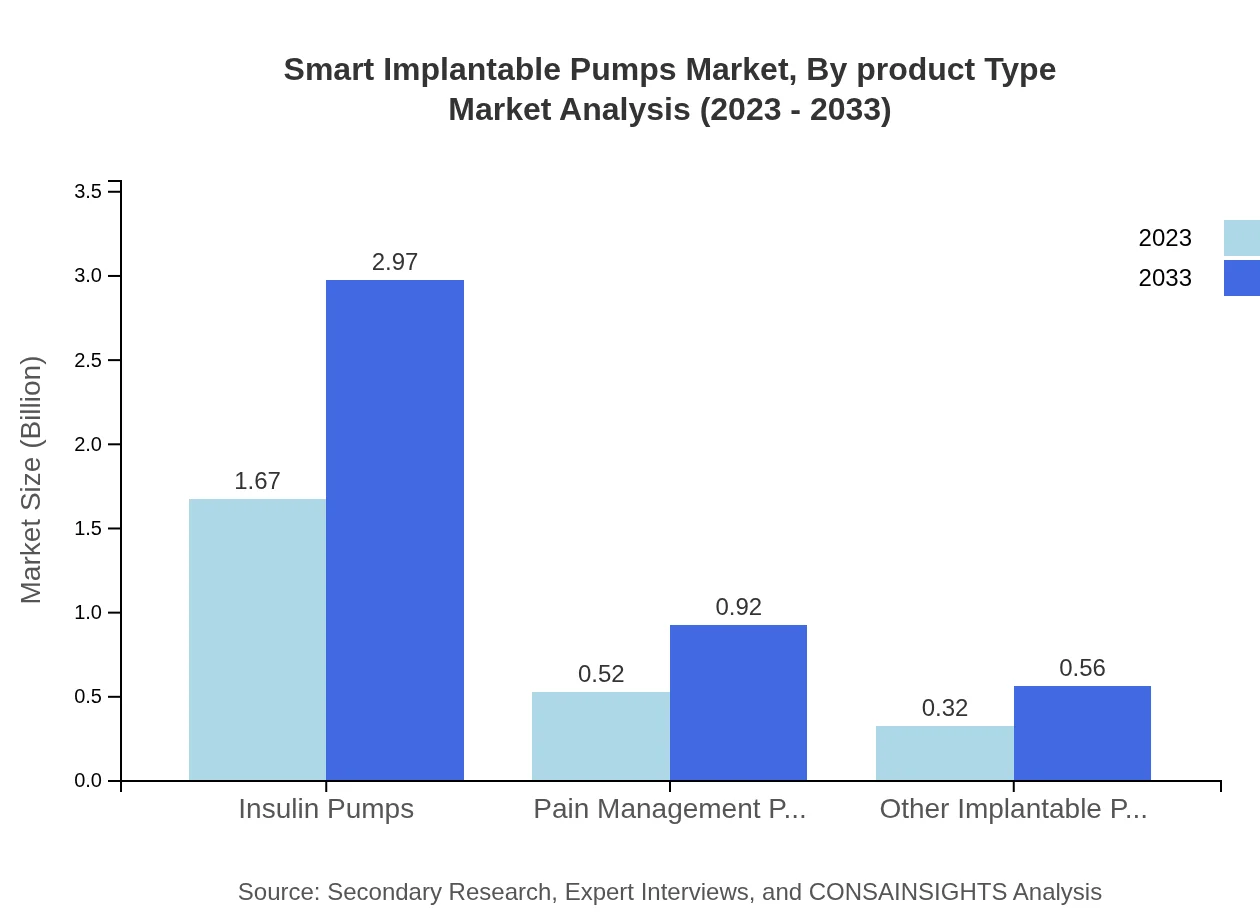
The analysis by product type reveals that insulin pumps are leading, with a market size of $1.67 billion in 2023, growing to $2.97 billion in 2033, maintaining a market share of 66.77%. Pain management pumps follow, showing promising growth from $0.52 billion to $0.92 billion, accounting for 20.63% of the market share. Other types, including microelectronics and wireless technology, are also diversifying the product offerings in the market.
Smart Implantable Pumps Market Analysis By Application Area
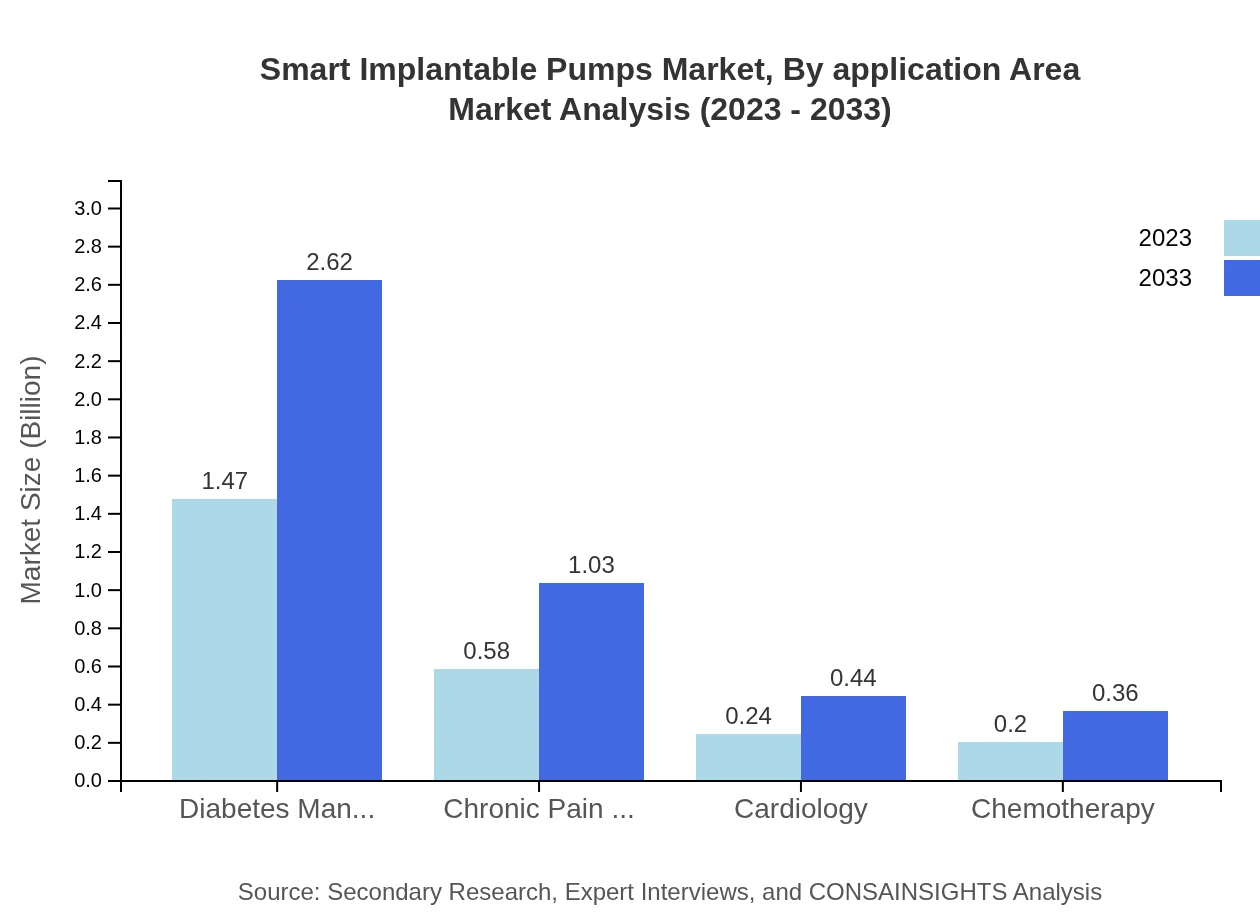
In terms of application, diabetes management remains at the forefront, with a size of $1.47 billion in 2023 and set to grow to $2.62 billion by 2033, capturing 58.84% of the market share. Chronic pain management is also a significant segment, growing from $0.58 billion to $1.03 billion, holding 23.23% of the market share. The cardiology and chemotherapy segments are smaller yet crucial, reflecting diverse medical approaches to treatment.
Smart Implantable Pumps Market Analysis By Device Technology
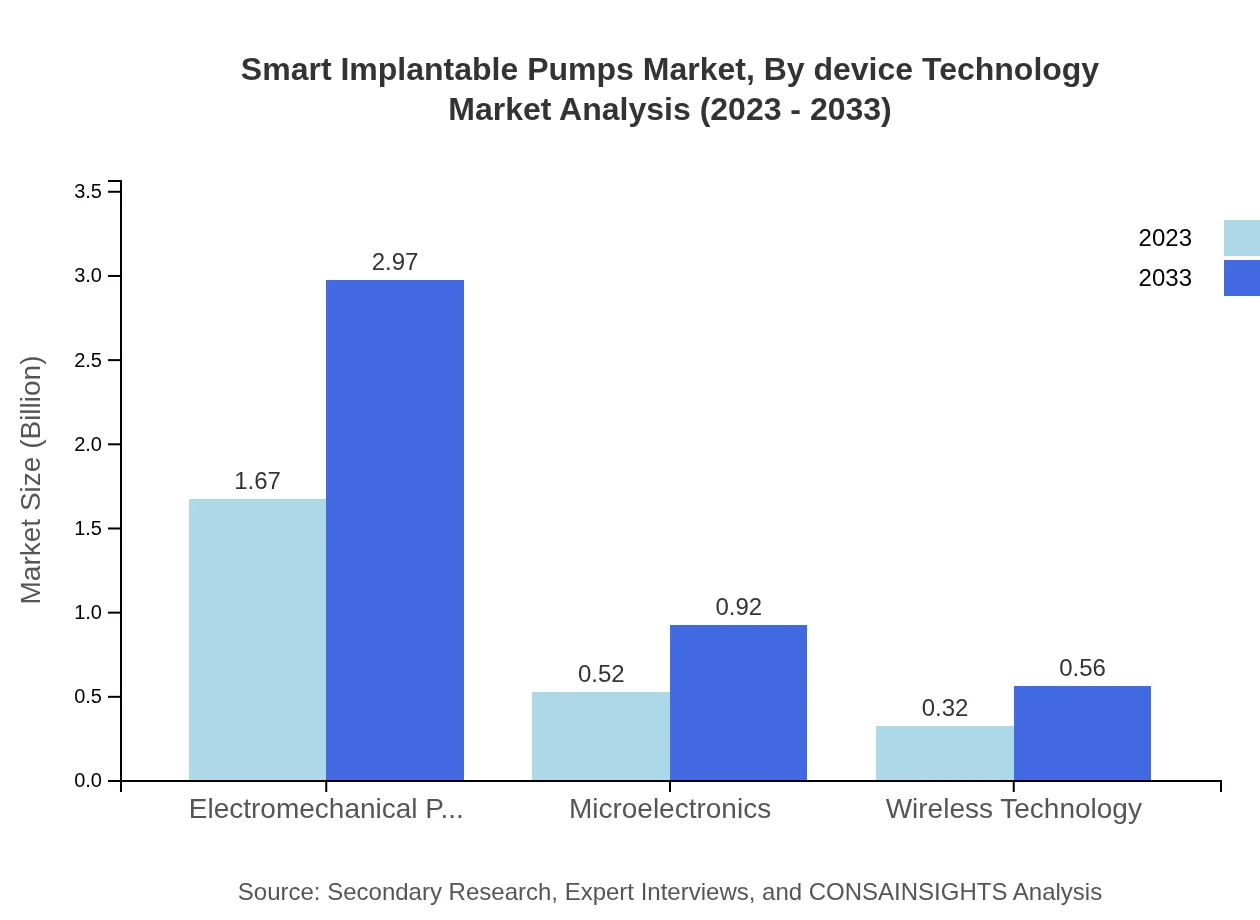
In the device technology segment, electromechanical pumps dominate with a size estimated at $1.67 billion in 2023, expected to reach $2.97 billion by 2033, maintaining a strong share of 66.77%. Microelectronics are growing in importance, moving from $0.52 billion to $0.92 billion, with a share of 20.63%, as manufacturers innovate towards more compact and efficient devices.
Smart Implantable Pumps Market Analysis By End User
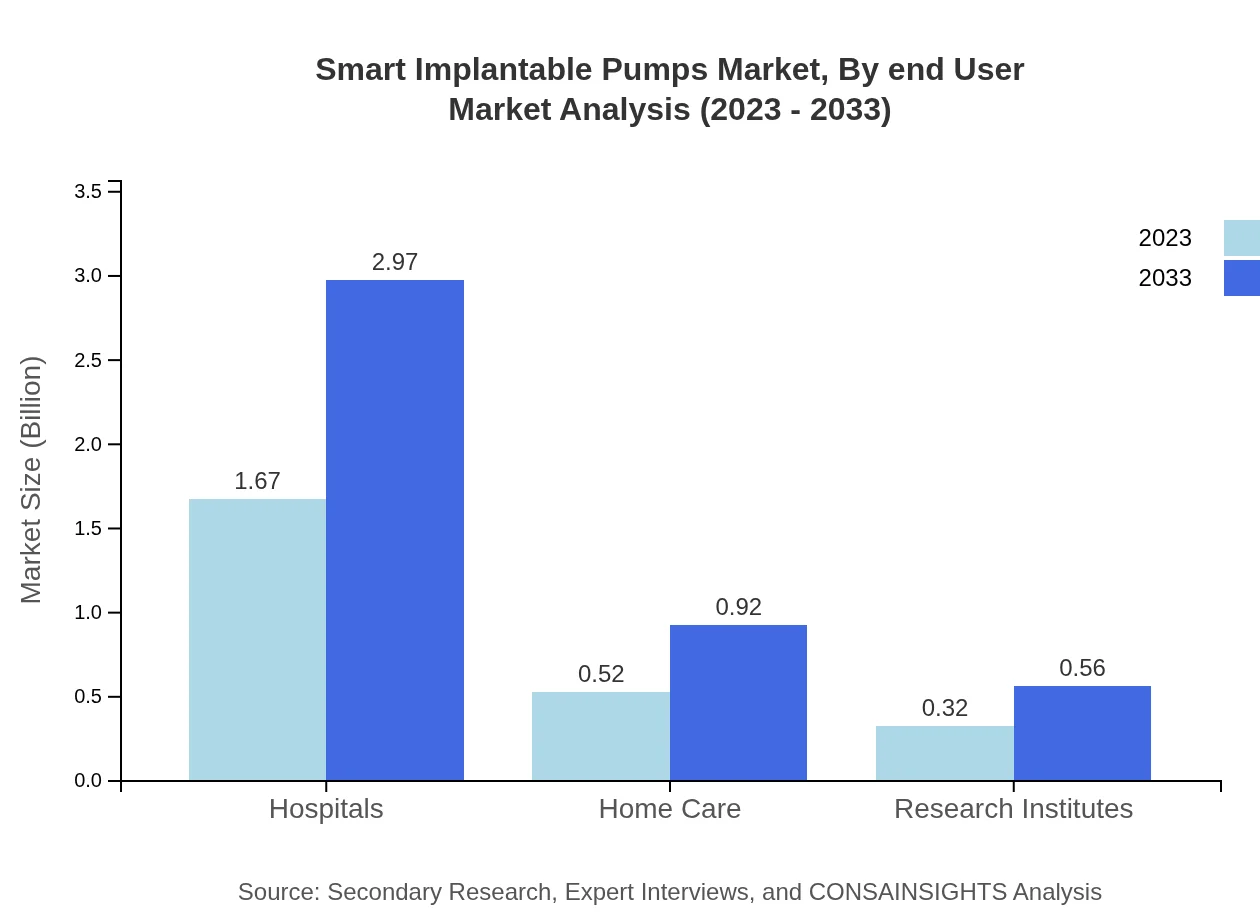
Hospitals are the largest end-users of Smart Implantable Pumps, reflecting a market size of $1.67 billion in 2023, increasing to $2.97 billion by 2033, with a stable share of 66.77%. Home care settings are also important, growing from $0.52 billion to $0.92 billion, indicating increased patient preference for home-based healthcare solutions.
Smart Implantable Pumps Market Analysis By Regulatory Framework
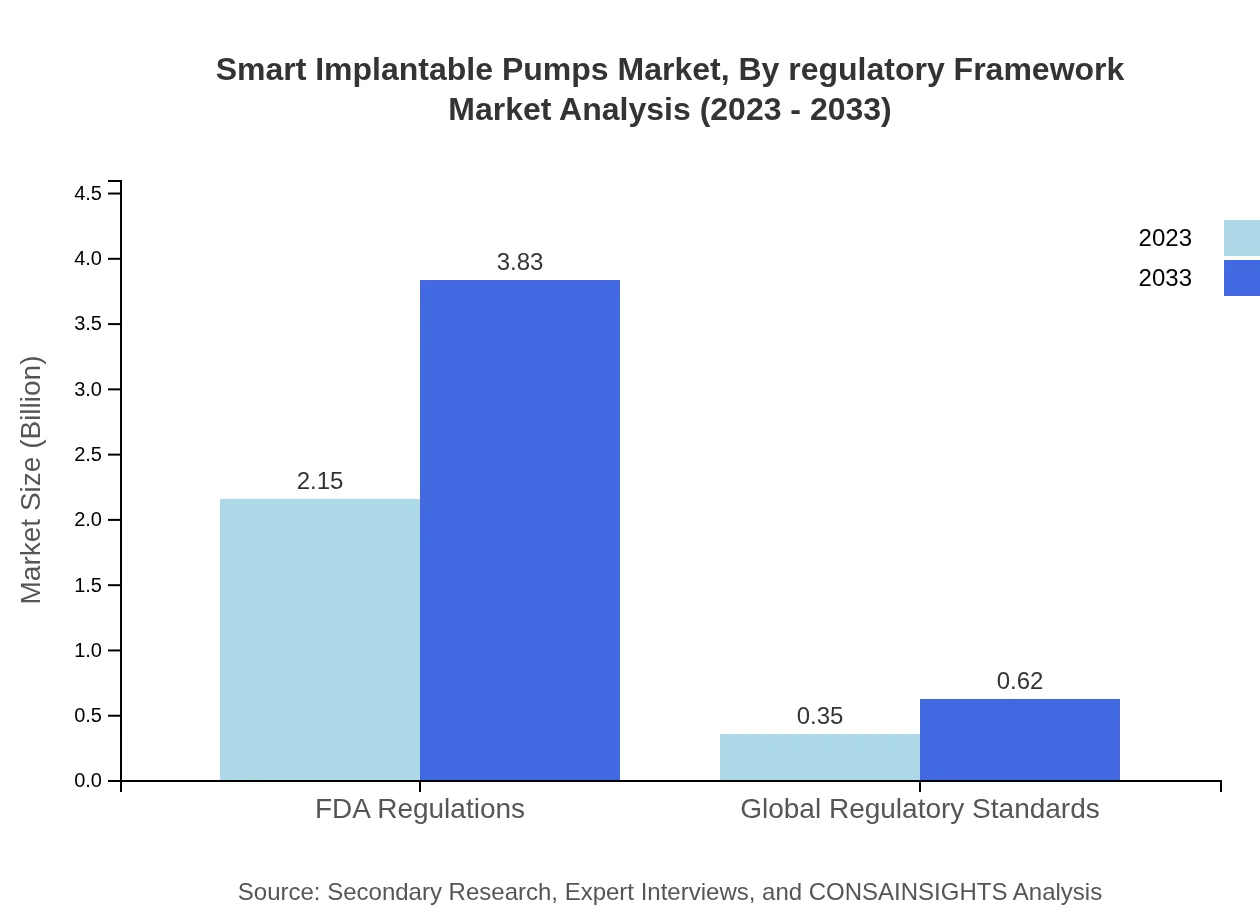
The market under regulatory frameworks indicates the influence of FDA regulations, projected to grow from $2.15 billion in 2023 to $3.83 billion in 2033, with an 86.02% market share. Global regulatory standards are also notable, growing from $0.35 billion to $0.62 billion, accounting for 13.98% of the market, emphasizing the importance of compliance in the industry.
Smart Implantable Pumps Market Trends and Future Forecast
Tell us your focus area and get a customized research report.
Global Market Leaders and Top Companies in Smart Implantable Pumps Industry
Medtronic :
Medtronic is a pioneering leader in medical technology, specializing in the development of advanced, reliable insulin pumps and implantable devices to improve patient outcomes.Boston Scientific:
Boston Scientific focuses on innovative implantable pumps for cardiology and pain management, emphasizing cutting-edge technology to enhance medical device efficacy.Abbott Laboratories:
Abbott provides a range of implantable pumps, particularly for diabetes care, harnessing technology to deliver integrated solutions for patient management.Bayer Healthcare:
Bayer is involved in developing advanced implantable drug delivery systems, focusing on innovations to aid chemotherapy and chronic disease management.We're grateful to work with incredible clients.









FAQs
What is the market size of the Smart Implantable Pumps Market Report in 2023?
The market size in 2023 is $2.50 Billion, as reported in the provided data for the Smart Implantable Pumps Market Report.
How big will the market be in 2033?
The market is projected to reach $4.45 Billion in 2033 according to the supplied forecast figures for the Smart Implantable Pumps Market Report.
What is CAGR of the market during the forecast period?
The reported compound annual growth rate for the forecast period 2023 to 2033 is 5.8% based on the provided dataset.
Which region is the fastest Growing in the Smart Implantable Pumps Market Report market?
Asia Pacific is the fastest-growing region, projected to expand from $0.47 Billion in 2023 to $0.85 Billion in 2033, reflecting an implied 6.10% CAGR over the forecast period.
Which region is the fastest Growing?
Asia Pacific is identified as the regional market region with an implied 6.10% CAGR, growing from $0.47 Billion in 2023 to $0.85 Billion in 2033.
Who are the top companies in this market?
Top companies listed in the input include Medtronic, Boston Scientific, Abbott Laboratories, and Bayer Healthcare as key industry participants.
What are the primary applications for implantable pumps?
Applications specified include diabetes management, chronic pain management, cardiology, and chemotherapy as primary clinical use areas.
How is the market segmented by device technology?
Device technology segmentation in the input comprises electromechanical pumps, microelectronics, and wireless technology as core technology categories.
What regulatory frameworks are referenced?
The provided data references FDA regulations and global regulatory standards as the primary regulatory frameworks affecting market activity.
What drives product innovation in this market?
Product innovation is driven by technological advancements, ongoing R&D investments, and the need for precision and personalized drug delivery solutions.