

In Vitro Toxicity Testing Market Report
First published: 08 October 2024 | Last updated: 25 May 2026 | Report Code: in-vitro-toxicity-testing
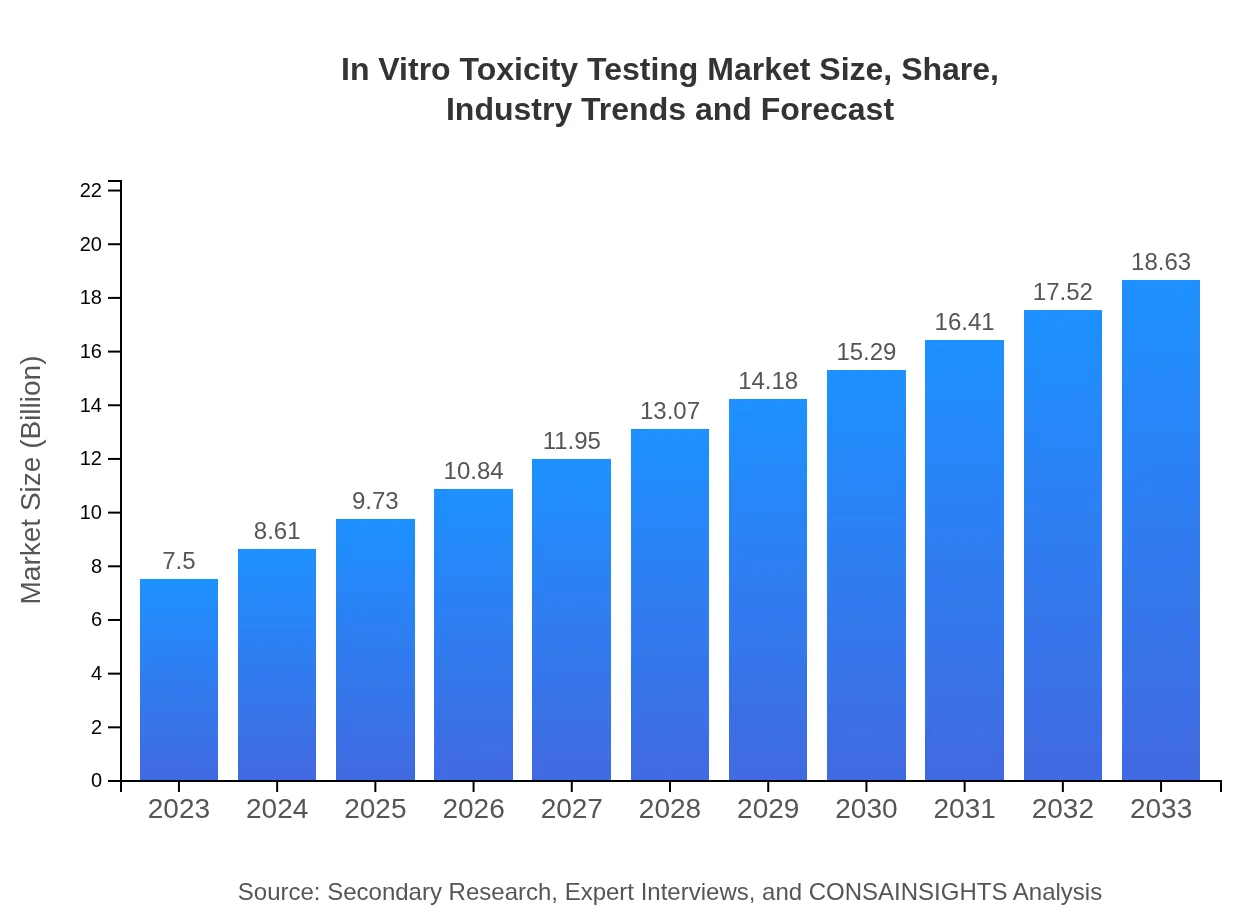
In Vitro Toxicity Testing Market — USD 7.5 billion in 2023, Growing to USD 18.63B by 2033 at 9.2% CAGR
This report provides a comprehensive analysis of the In Vitro Toxicity Testing market, offering insights into market trends, size, segmentation, and growth forecasts from 2023 to 2033.
Key Takeaways
- Global market expands from $7.50 Billion in 2023 to $18.63 Billion by 2033 at a 9.2% CAGR.
- North America is largest regional market, while no single fastest-growing region is stated because regional CAGR differences remain within 0.15 percentage points.
- Europe grows from $2.36 Billion to $5.86 Billion between 2023 and 2033, reflecting strong regulatory and pharmaceutical demand.
- Asia Pacific rises from $1.47 Billion in 2023 to $3.65 Billion in 2033, driven by expanding biotech and testing infrastructure.
- Top companies include Invitro Technologies, Cellestia Biotech, MilliporeSigma, Thermo Fisher Scientific, and Charles River Laboratories.
In Vitro Toxicity Testing Market Report — Executive Summary
North America remains largest market by forecast-period value, while no single fastest-growing region is stated because top regional growth rates are separated by less than 0.15 percentage points. This report analyzes the market for in vitro toxicity testing from 2023 to 2033, with the global market growing from $7.50 Billion to $18.63 Billion at a 9.2% CAGR. Growth is propelled by stricter safety regulations, demand for alternatives to animal testing, and advances in cell culture, bioassays, and omics methodologies. Major participants—Invitro Technologies, Cellestia Biotech, MilliporeSigma, Thermo Fisher Scientific, and Charles River Laboratories—are reinforcing positions via product innovation and expanded service offerings. Regional dynamics show North America as the largest market, and several regions exhibit competitive growth rates that are close enough that no single regional market region is named. The report covers market segmentation by method, product, end user, and application, and includes trend analysis, competitive profiling, and a synthesis of primary expert interviews and secondary sources to support findings.
Key Growth Drivers
- Regulatory pressure for safety evaluation pushing adoption of validated in vitro assays across industries.
- Increased research and development in pharmaceuticals and biotechnology creating demand for high-throughput and predictive toxicity tools.
- Technological progress in cell culture methods, bioassays, and omics platforms improving assay reliability and throughput.
- Rising interest in alternatives to animal testing encouraging broader implementation of in vitro approaches.
- Service expansion and collaboration among industry players enhancing access to specialized testing and interpretation.
| Metric | Value |
|---|---|
| Study Period | 2023 - 2033 |
| 2023 Market Size | $7.50 Billion |
| CAGR (2023-2033) | 9.2% |
| 2033 Market Size | $18.63 Billion |
| Top Companies | Invitro Technologies, Cellestia Biotech, MilliporeSigma, Thermo Fisher Scientific, Charles River Laboratories |
| Published Date | 08 October 2024 |
| Last Modified Date | 25 May 2026 |
In Vitro Toxicity Testing Market Overview
Customize In Vitro Toxicity Testing Market Report market research report
- ✔ Get in-depth analysis of In Vitro Toxicity Testing market size, growth, and forecasts.
- ✔ Understand In Vitro Toxicity Testing's regional dynamics and industry-specific trends.
- ✔ Identify potential applications, end-user demand, and growth segments in In Vitro Toxicity Testing
What is the Market Size & CAGR of In Vitro Toxicity Testing Market Report market in 2023?
In Vitro Toxicity Testing Industry Analysis
In Vitro Toxicity Testing Market Segmentation and Scope
Tell us your focus area and get a customized research report.
In Vitro Toxicity Testing Market Report Market Analysis Report by Region
Europe In Vitro Toxicity Testing Market Report:
Europe grows from $2.36 Billion in 2023 to $5.86 Billion in 2033. Regional drivers include stringent product safety regulations, a push toward alternatives to animal testing, and active pharmaceutical and cosmetic testing activity supporting in vitro adoption.Asia Pacific In Vitro Toxicity Testing Market Report:
Asia Pacific grows from $1.47 Billion in 2023 to $3.65 Billion in 2033. Expansion is driven by growing biotech sectors, rising R&D expenditure, and the development of laboratory capacity and testing services across emerging markets.North America In Vitro Toxicity Testing Market Report:
North America is largest regional market, rising from $2.51 Billion in 2023 to $6.24 Billion in 2033. This growth is linked to concentrated pharmaceutical R&D, established regulatory frameworks that favor validated in vitro methods, and strong investment in testing infrastructure.South America In Vitro Toxicity Testing Market Report:
Latin America grows from $0.3 Billion in 2023 to $0.75 Billion in 2033. Local growth reflects expanding pharmaceutical and chemical testing needs, evolving regulatory expectations, and growing access to in vitro platforms and services.Middle East & Africa In Vitro Toxicity Testing Market Report:
Middle East and Africa grows from $0.86 Billion in 2023 to $2.13 Billion in 2033. Market progress is supported by increasing healthcare investment, expanding research capabilities, and adoption of alternative testing approaches in regulatory and industrial settings.Tell us your focus area and get a customized research report.
Research Methodology
In Vitro Toxicity Testing Market Analysis By Method
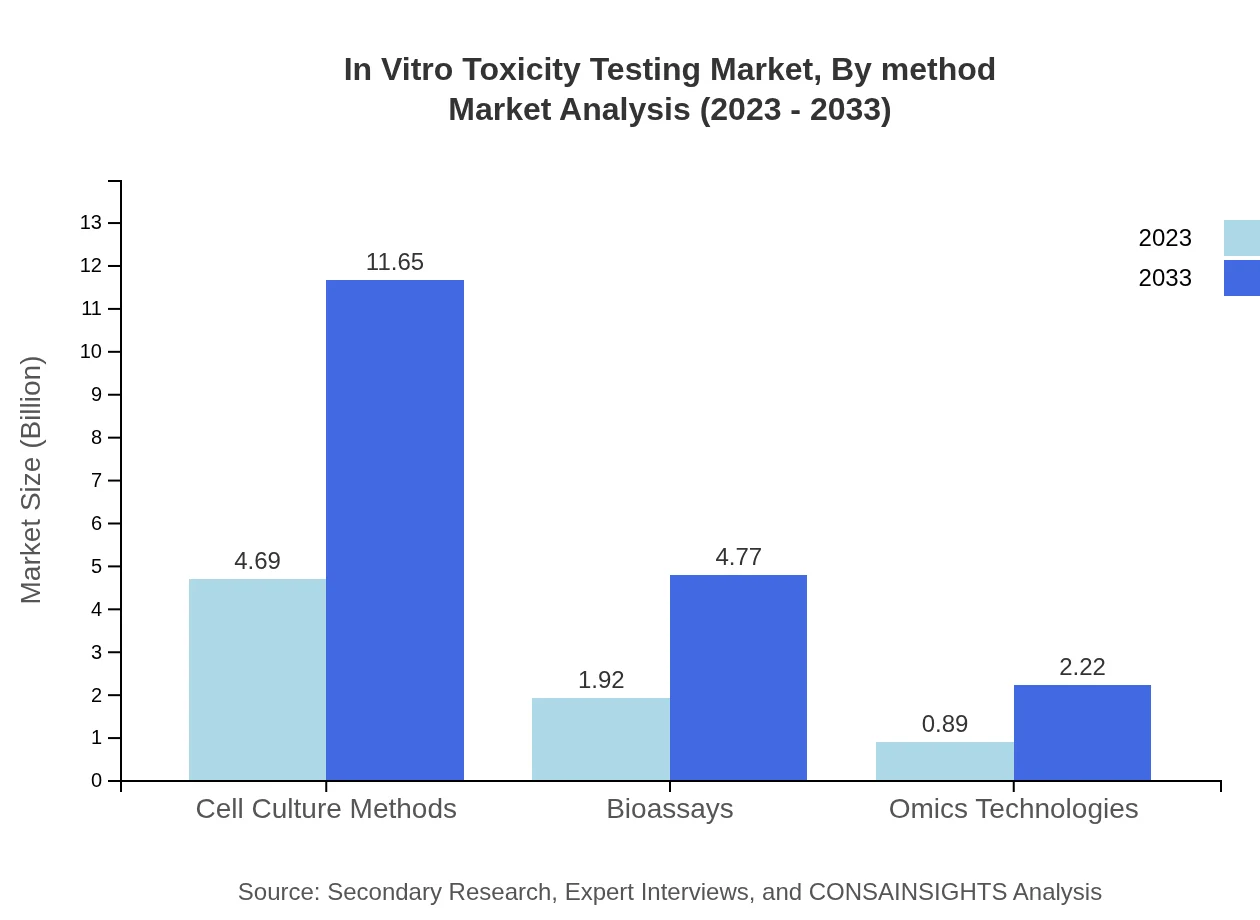
The In Vitro Toxicity Testing market by method features several critical approaches: Cell Culture Methods dominate with a market size of USD 4.69 billion in 2023, expected to rise to USD 11.65 billion by 2033, representing a share of 62.51%. Bioassays follow with a market size of USD 1.92 billion in 2023 and projected growth to USD 4.77 billion by 2033 (25.58% share). Omics Technologies represent a smaller segment with USD 0.89 billion, growing to USD 2.22 billion (11.91% share) over the forecast period.
In Vitro Toxicity Testing Market Analysis By Product
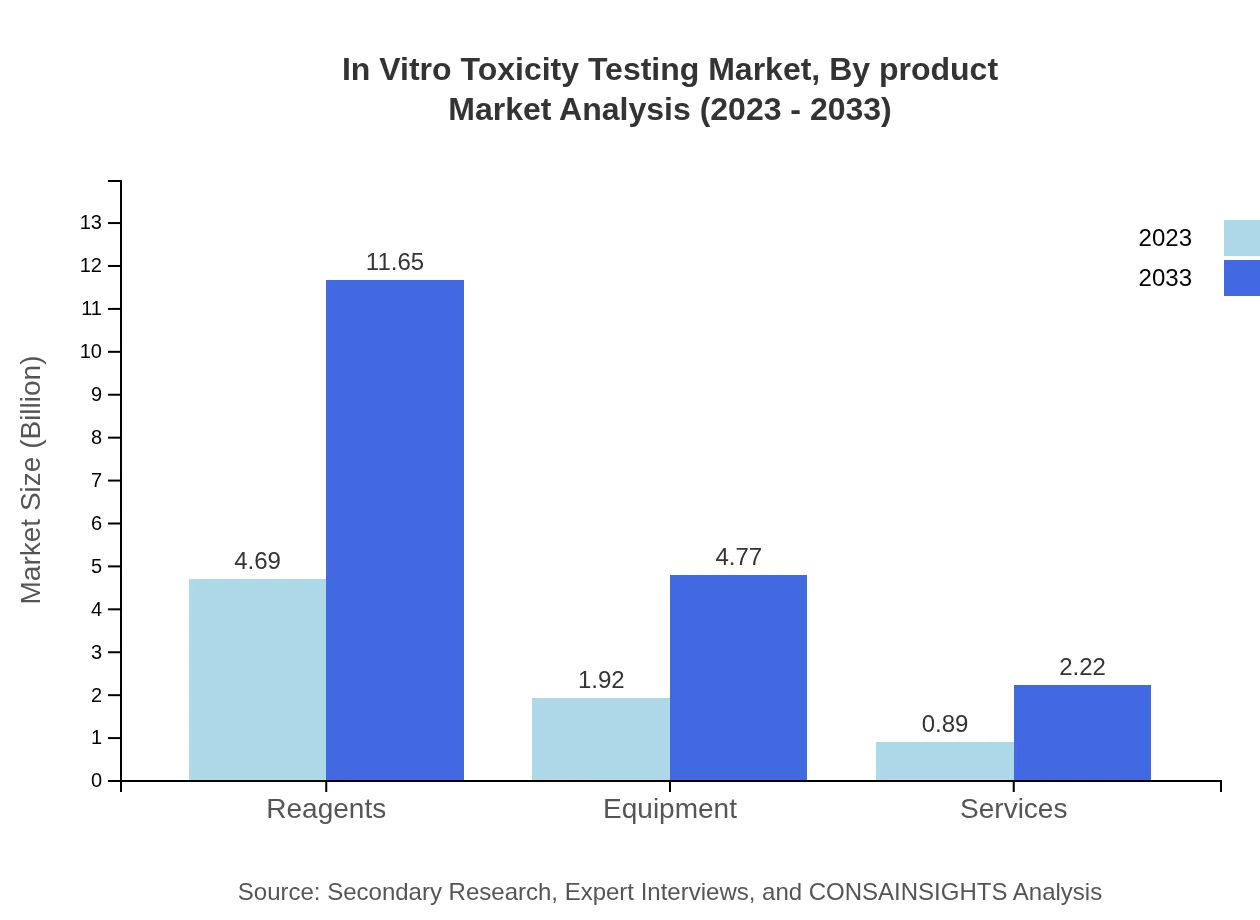
By product, the market is segmented into reagents, equipment, and services. Reagents hold the largest market share at USD 4.69 billion in 2023, anticipated to grow to USD 11.65 billion by 2033 (62.51% share). Equipment is positioned next, with an expected growth from USD 1.92 billion to USD 4.77 billion (25.58% share). Services, while smaller, are also essential, representing USD 0.89 billion in 2023 and projected growth to USD 2.22 billion (11.91% share).
In Vitro Toxicity Testing Market Analysis By Application
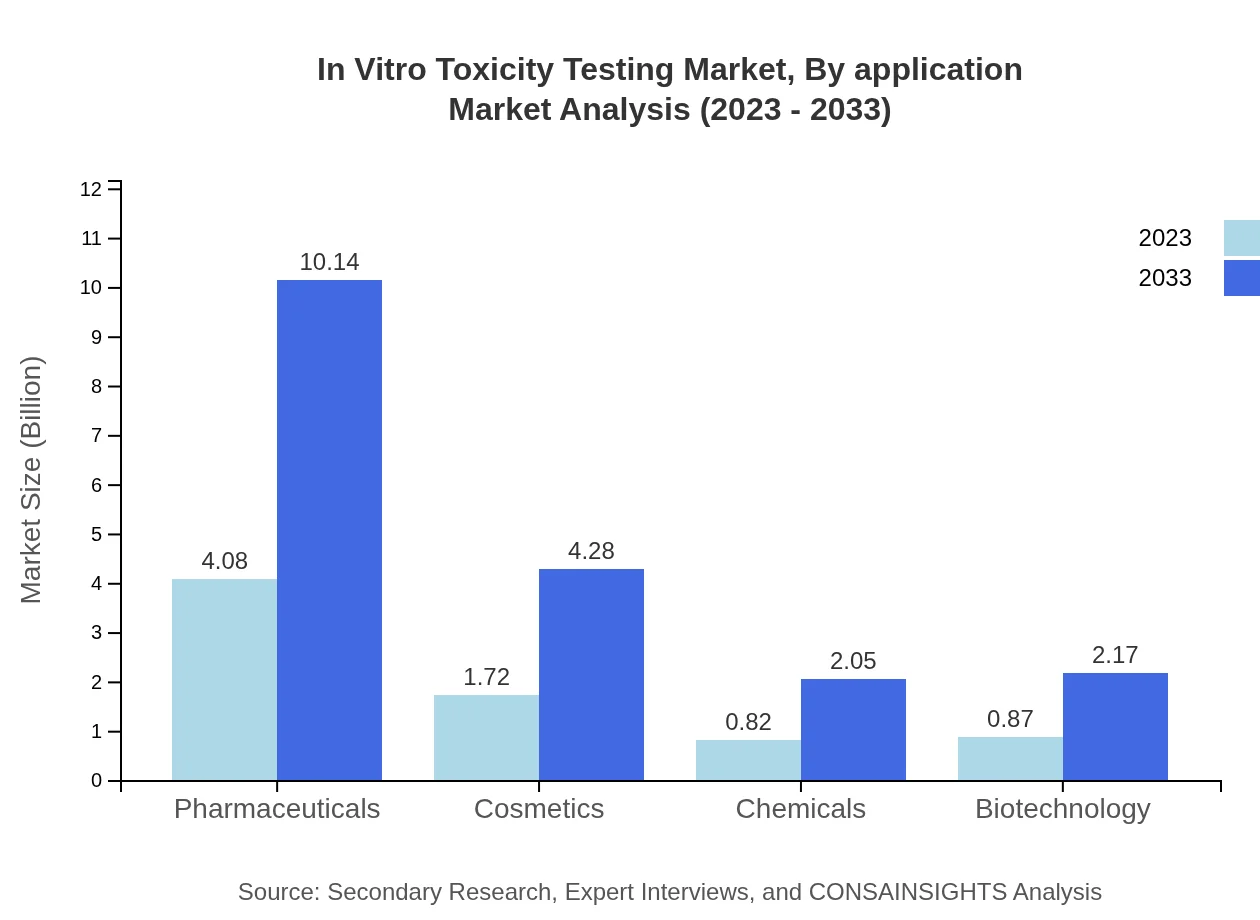
When analyzing by application, the Pharmaceuticals sector leads the market significantly, reflecting a size of USD 4.08 billion in 2023 and expected growth to USD 10.14 billion by 2033 (54.44% share), driven by rigorous drug safety evaluations. The Cosmetics sector holds USD 1.72 billion in 2023, projected to grow to USD 4.28 billion (22.95% share). The Chemicals and Biotechnology sectors with 10.99% and 11.62% shares, respectively, show growth potential as regulatory scrutiny increases on chemical safety.
In Vitro Toxicity Testing Market Analysis By End User
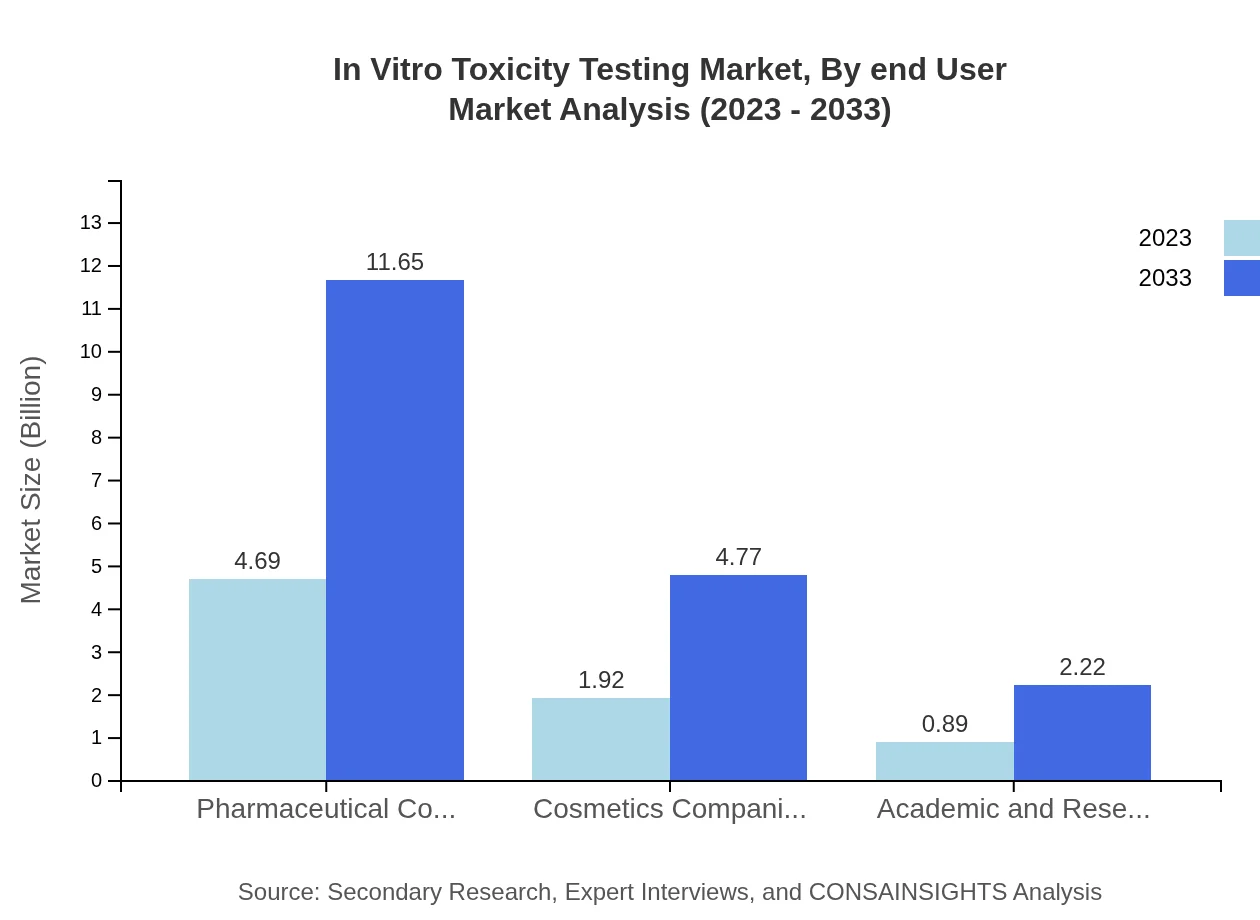
The major end-users in the In Vitro Toxicity Testing market include pharmaceutical companies, cosmetics companies, and academic institutions. Pharmaceutical companies dominate the market with a size of USD 4.69 billion in 2023, anticipated to increase to USD 11.65 billion by 2033 (62.51% share). Cosmetics companies, while smaller, show significant growth potential, projected to realize revenue growth from USD 1.92 billion to USD 4.77 billion (25.58% share). Academic and Research Institutions also contribute to the market, increasing their share from USD 0.89 billion to USD 2.22 billion (11.91% share).
In Vitro Toxicity Testing Market Trends and Future Forecast
Tell us your focus area and get a customized research report.
Global Market Leaders and Top Companies in In Vitro Toxicity Testing Industry
Invitro Technologies:
A leader in in vitro testing solutions, Invitro Technologies provides innovative approaches to assess toxicity through advanced cell culture techniques, significantly supporting drug development processes.Cellestia Biotech:
Cellestia Biotech specializes in the development of in vitro testing kits and services that accelerate the drug discovery process, focusing on safe chemical development and providing critical data for various stakeholders.MilliporeSigma:
MilliporeSigma offers a wide range of products and services for in vitro research, including reagents and assay solutions critical for toxicity testing across multiple industries.Thermo Fisher Scientific:
Known for their extensive product portfolio, Thermo Fisher Scientific provides essential tools and technologies for toxicity testing, facilitating high-quality research and compliance in product assessment.Charles River Laboratories:
Charles River Laboratories delivers comprehensive in vitro testing services, utilizing their expertise in drug development and regulatory compliance to enhance the safety of products across the healthcare spectrum.We're grateful to work with incredible clients.









FAQs
What is the market size of the In Vitro Toxicity Testing Market Report in 2023?
The market size in 2023 is $7.50 Billion, as stated in the report, reflecting the baseline value for the 2023 to 2033 forecast period.
How big will the market be in 2033?
The projected market value for 2033 is $18.63 Billion, based on the provided forecast spanning 2023 to 2033.
What is CAGR for the forecast period?
The Compound Annual Growth Rate for the 2023 to 2033 forecast period is 9.2% as indicated in the input data.
Is there a single fastest Growing region in the In Vitro Toxicity Testing Market Report market?
No single fastest-growing region is stated for the In Vitro Toxicity Testing Market Report market because the top regional implied CAGR values are within 0.15 percentage points of each other, making the ranking too close to call reliably.
Which companies lead the industry?
Top companies listed include Invitro Technologies, Cellestia Biotech, MilliporeSigma, Thermo Fisher Scientific, and Charles River Laboratories.
What are common methods included in segmentation?
Methods include cell culture methods, bioassays, and omics technologies, which form the key methodological categories reported.
How are end users categorized?
End users are categorized as pharmaceutical companies, cosmetics companies, and academic and research institutions within the segmentation.
What drives adoption of in vitro approaches?
Adoption is driven by regulatory requirements, ethical considerations regarding animal testing, and technological improvements in assay platforms.
Who provided input for the research?
Research incorporated primary interviews with industry experts alongside secondary data from company reports and publications.
What applications are covered in the report?
Applications covered include pharmaceuticals, cosmetics, chemicals, and biotechnology as key areas of in vitro toxicity testing use.