
Reports >
Life Sciences
>
Insect Feed Market Report

Insect Feed Market Report
First published: 20 October 2024 | Last updated: 28 May 2026 | Report Code: insect-feed
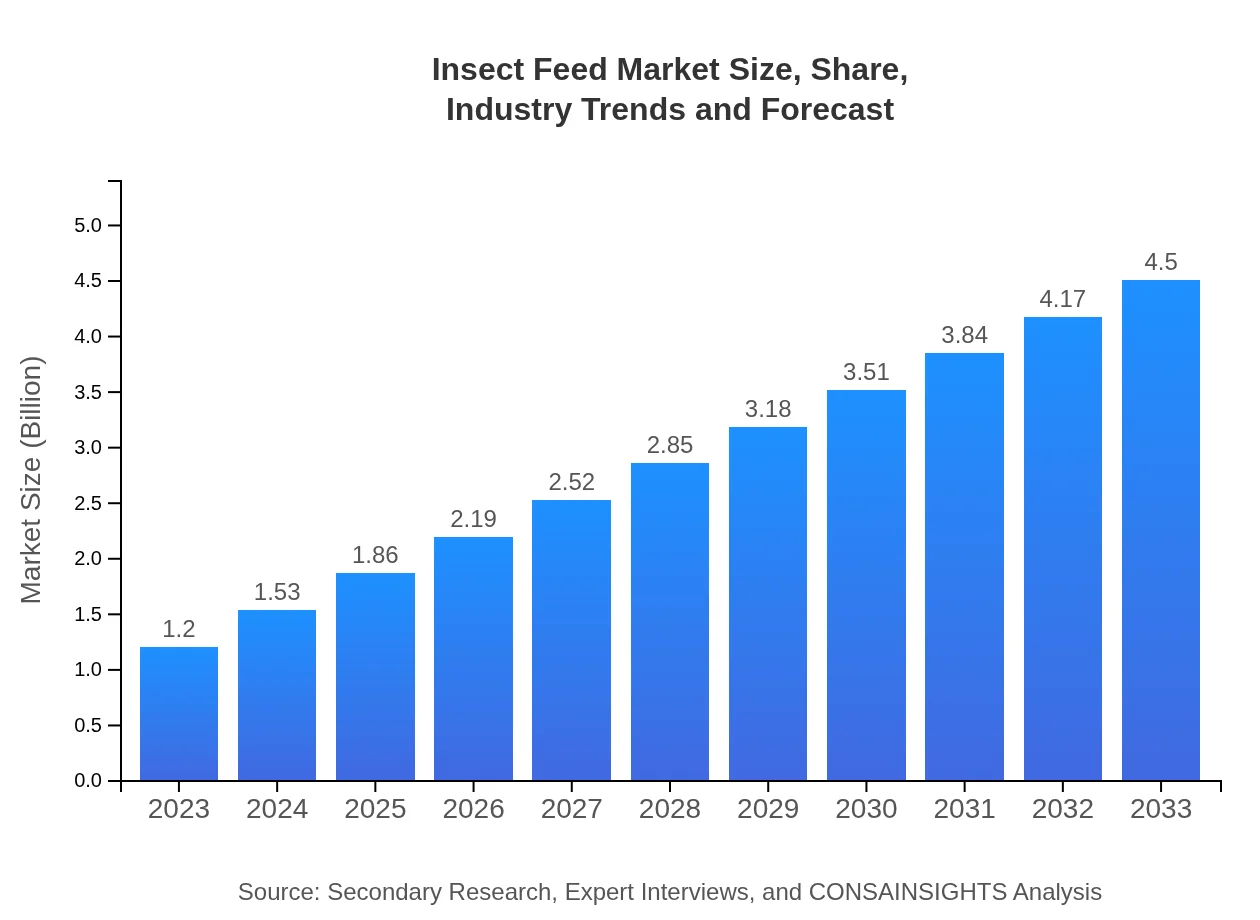
Insect Feed Market — USD 1.2 billion in 2023, Growing to USD 4.50B by 2033 at 13.5% CAGR
This report provides a comprehensive analysis of the Insect Feed market, including insights into market trends, size, segmentation, and forecasts for the years 2023 to 2033. It outlines key players, technological advancements, and regional dynamics shaping the industry.
Key Takeaways
- Global market expands from $1.20 Billion in 2023 to $4.50 Billion in 2033 at a 13.5% CAGR.
- North America is largest regional market; Latin America is regional market region based on implied CAGR across 2023 to 2033.
- Latin America is noted as the regional market region, moving from $0.02 Billion to $0.08 Billion.
- Europe grows from $0.32 Billion to $1.22 Billion, while Asia Pacific increases from $0.24 Billion to $0.91 Billion.
- Top companies profiled include AgriProtein, Enterra Feed Corporation, Ynsect, and Protix.
Insect Feed Market Report — Executive Summary
Regional analysis shows North America as largest market and Latin America as fastest-growing region by implied CAGR. The report presents an evidence-based view of the insect feed sector, driven by demand for sustainable protein alternatives and efficiency in agricultural inputs. Key forces include rising interest in insect-based animal feeds, regulatory developments across major jurisdictions, and technological advances in insect farming and processing. Market expansion is supported by growing adoption in livestock and aquaculture feed applications and increasing use in fertilizers and human consumption niches. Regional dynamics vary, with North America as the largest market by 2033 and Latin America exhibiting the highest implied growth rate. The analysis includes segmentation by application, insect type, processing method, distribution channel, and regulatory frameworks, and profiles leading companies such as AgriProtein, Enterra Feed Corporation, Ynsect, and Protix. Research relied on expert interviews, company documentation, and data validation to ensure robust findings and actionable insights for stakeholders.
Key Growth Drivers
- Rising demand for sustainable and high-quality protein sources in animal feed applications.
- Regulatory developments enabling alternative feed ingredients in key markets.
- Technological improvements in insect farming and processing that enhance scalability and cost-efficiency.
- Increased investment from specialized firms and partnerships across the value chain.
- Growing interest in insect-derived fertilizers and human consumption uses expanding addressable markets.
| Metric | Value |
|---|---|
| Study Period | 2023 - 2033 |
| 2023 Market Size | $1.20 Billion |
| CAGR (2023-2033) | 13.5% |
| 2033 Market Size | $4.50 Billion |
| Top Companies | AgriProtein, Enterra Feed Corporation, Ynsect, Protix |
| Published Date | 20 October 2024 |
| Last Modified Date | 28 May 2026 |
Insect Feed Market Overview
Customize Insect Feed Market Report market research report
- ✔ Get in-depth analysis of Insect Feed market size, growth, and forecasts.
- ✔ Understand Insect Feed's regional dynamics and industry-specific trends.
- ✔ Identify potential applications, end-user demand, and growth segments in Insect Feed
What is the Market Size & CAGR of Insect Feed Market Report market in 2023?
Insect Feed Industry Analysis
Insect Feed Market Segmentation and Scope
Tell us your focus area and get a customized research report.
Insect Feed Market Report Market Analysis Report by Region
Europe Insect Feed Market Report:
Europe grows from $0.32 Billion in 2023 to $1.22 Billion in 2033. Regulatory environments and research initiatives in Europe support alternative protein development, while established feed industries and sustainability agendas drive regional uptake.Asia Pacific Insect Feed Market Report:
Asia Pacific grows from $0.24 Billion in 2023 to $0.91 Billion in 2033. Demand stems from intensified livestock and aquaculture sectors seeking efficient protein inputs, along with growing interest in insect-derived products and processing innovation.North America Insect Feed Market Report:
North America is largest regional market, rising from $0.45 Billion in 2023 to $1.68 Billion in 2033. The region’s scale reflects commercial adoption, investment in processing technologies, and supportive market conditions that favor industrial insect production and application in animal feed.South America Insect Feed Market Report:
Latin America is fastest-growing region by implied CAGR, increasing from $0.02 Billion in 2023 to $0.08 Billion in 2033. The region is noted as the fastest-growing market with an implied 14.87% CAGR, supported by emerging commercial projects, favorable feed demand, and potential for scaling insect agriculture.Middle East & Africa Insect Feed Market Report:
Middle East and Africa grows from $0.16 Billion in 2023 to $0.61 Billion in 2033. Growth is influenced by interest in resource-efficient protein alternatives, nascent regulatory frameworks, and increasing attention to sustainable fertilizer and feed options.Tell us your focus area and get a customized research report.
Research Methodology
Insect Feed Market Analysis By Insect Type
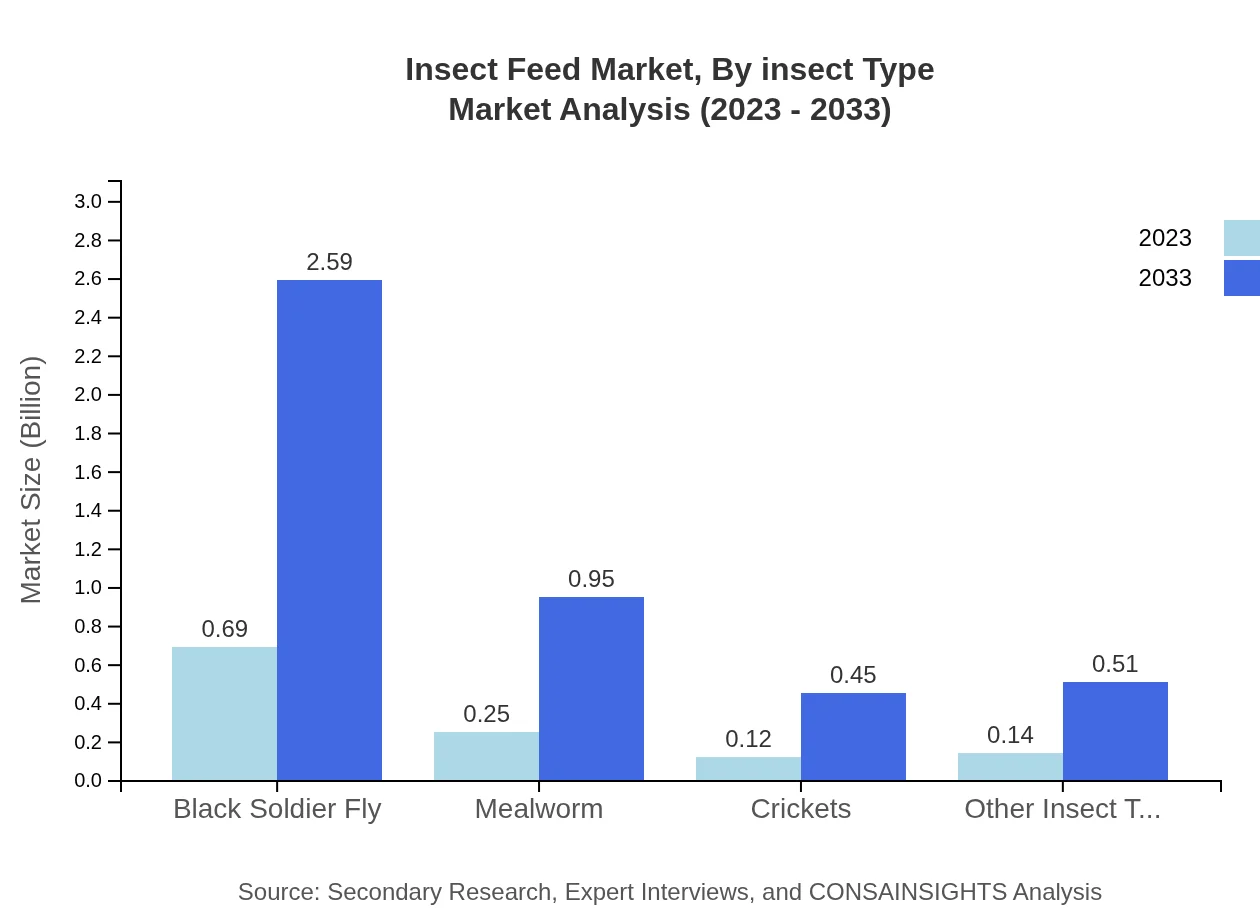
The segmenting by insect type shows significant performances, with the black soldier fly leading the market, expected to grow from $0.69 billion in 2023 to $2.59 billion by 2033, holding a share of 57.54%. Mealworms follow, expanding from $0.25 billion to $0.95 billion, while crickets remain a niche at $0.12 billion in 2023, rising to $0.45 billion. Other insect types also show growth potential, with the whole insects segment reflecting a significant share in the overall market.
Insect Feed Market Analysis By Application
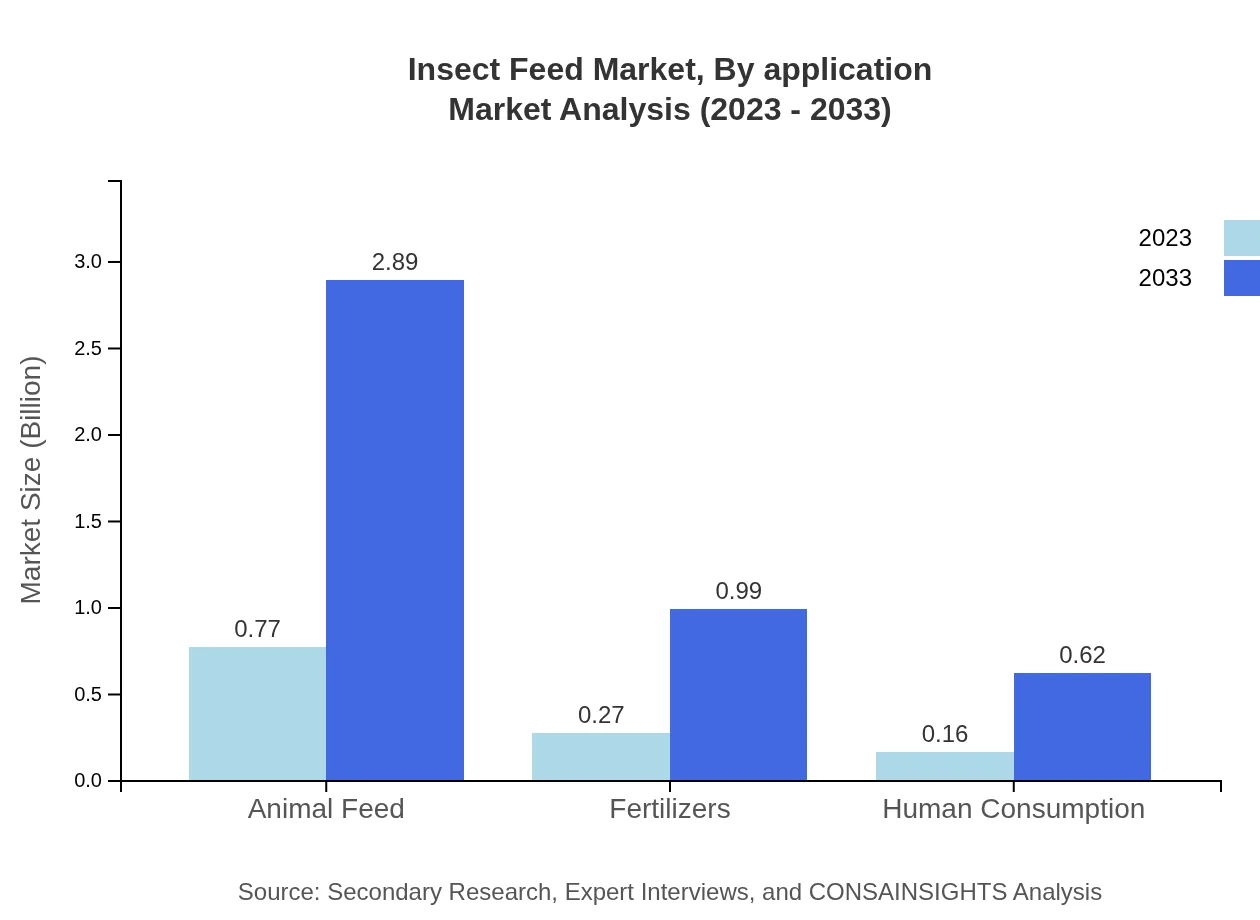
The application analysis reveals that animal feed dominates, significantly contributing to market size, moving from $0.77 billion in 2023 to $2.89 billion by 2033, resulting in a stable share of 64.18%. Fertilizers also show promise, increasing from $0.27 billion to $0.99 billion, while human consumption is projected to grow from $0.16 billion to $0.62 billion, capturing vital consumer interest.
Insect Feed Market Analysis By Processing Method
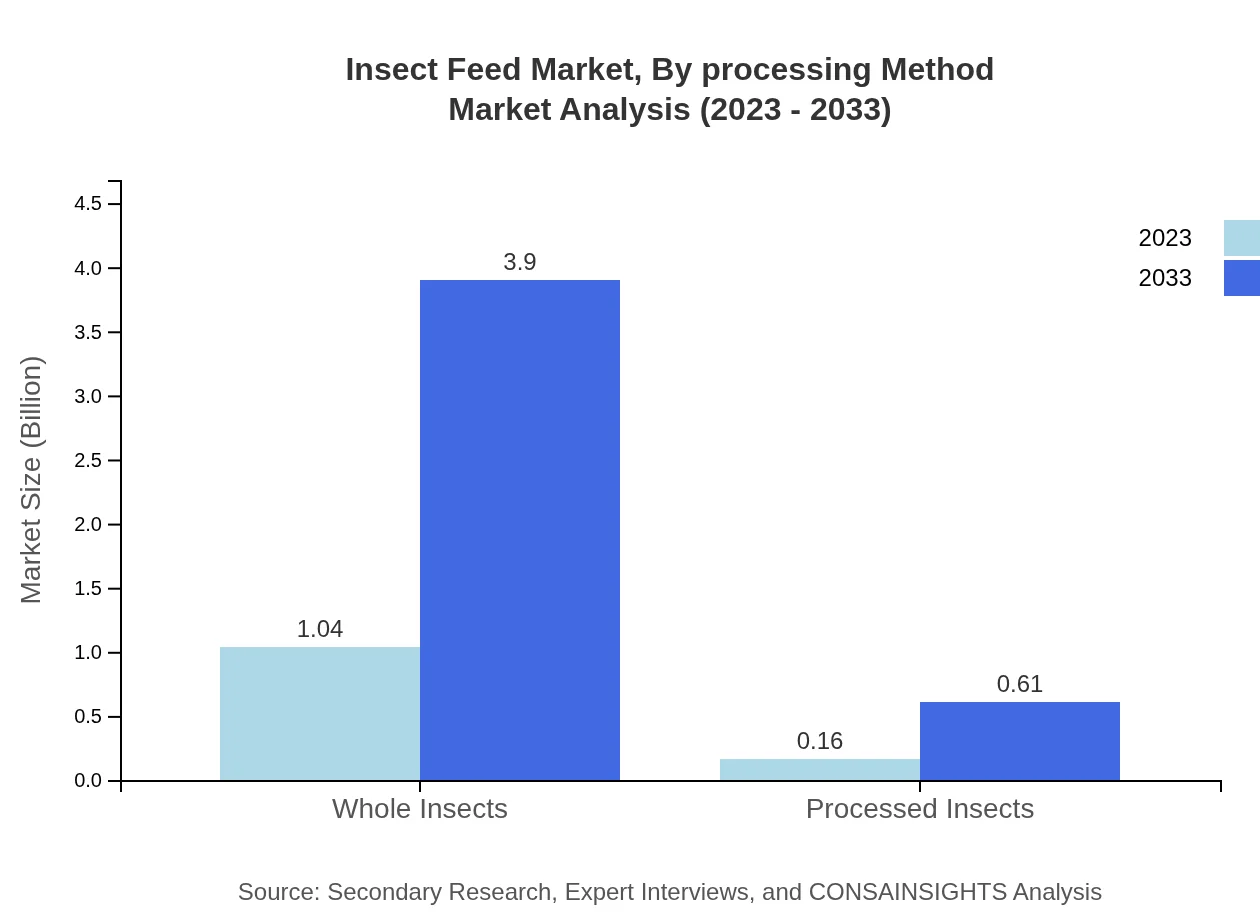
Processing methods in the insect feed industry are evolving, with shifts towards more efficient whole insect and processed insect options. The whole insects segment is immensely significant, currently at $1.04 billion and expected to reach $3.90 billion. Processed insects are presenting new opportunities as well, growing from $0.16 billion to $0.61 billion.
Insect Feed Market Analysis By Distribution Channel
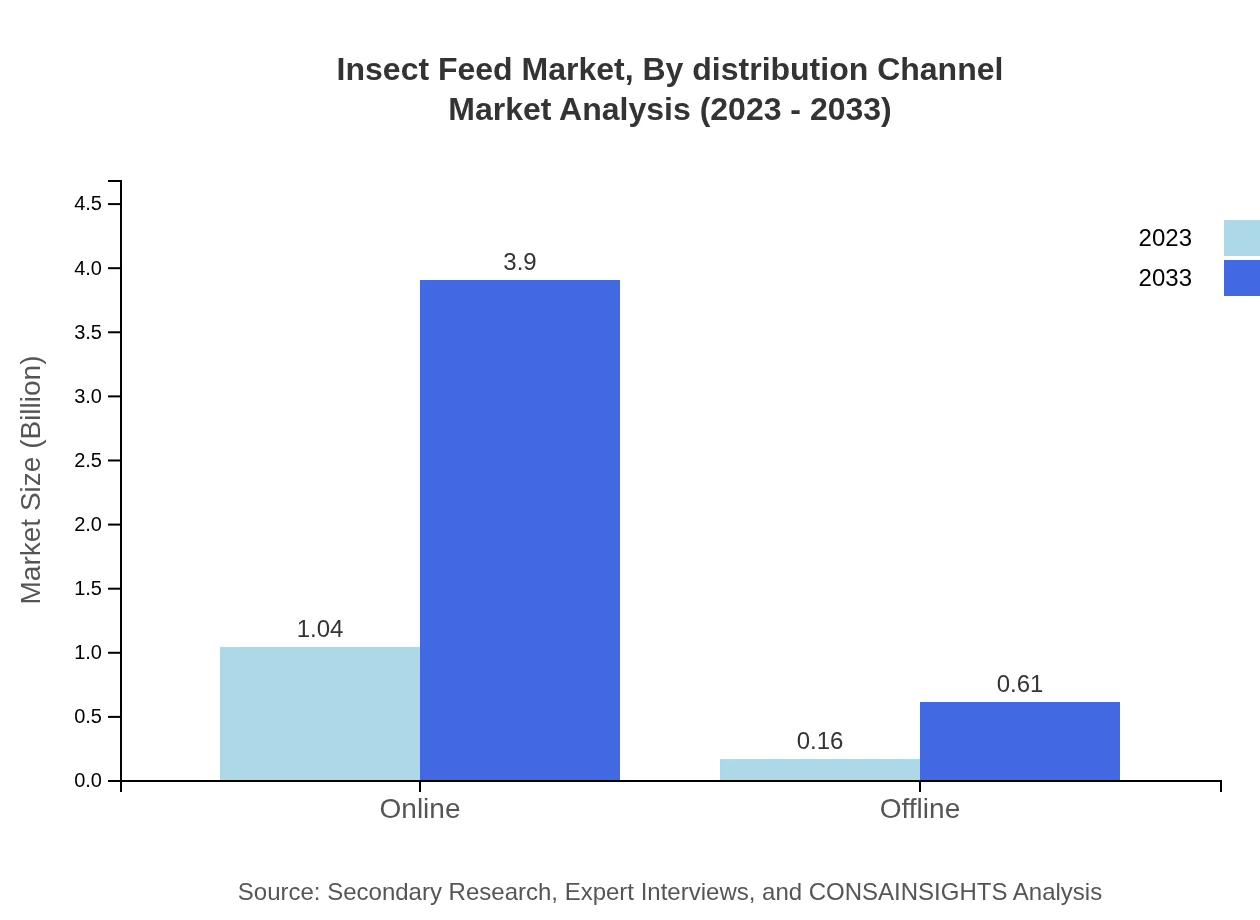
The online distribution channel leads the market significantly, making up 86.54% of the sales in 2023 and projected growth from $1.04 billion to $3.90 billion in 2033. The offline distribution markets, while smaller, are expected to grow steadily from $0.16 billion to $0.61 billion.
Insect Feed Market Analysis By Regulatory Framework
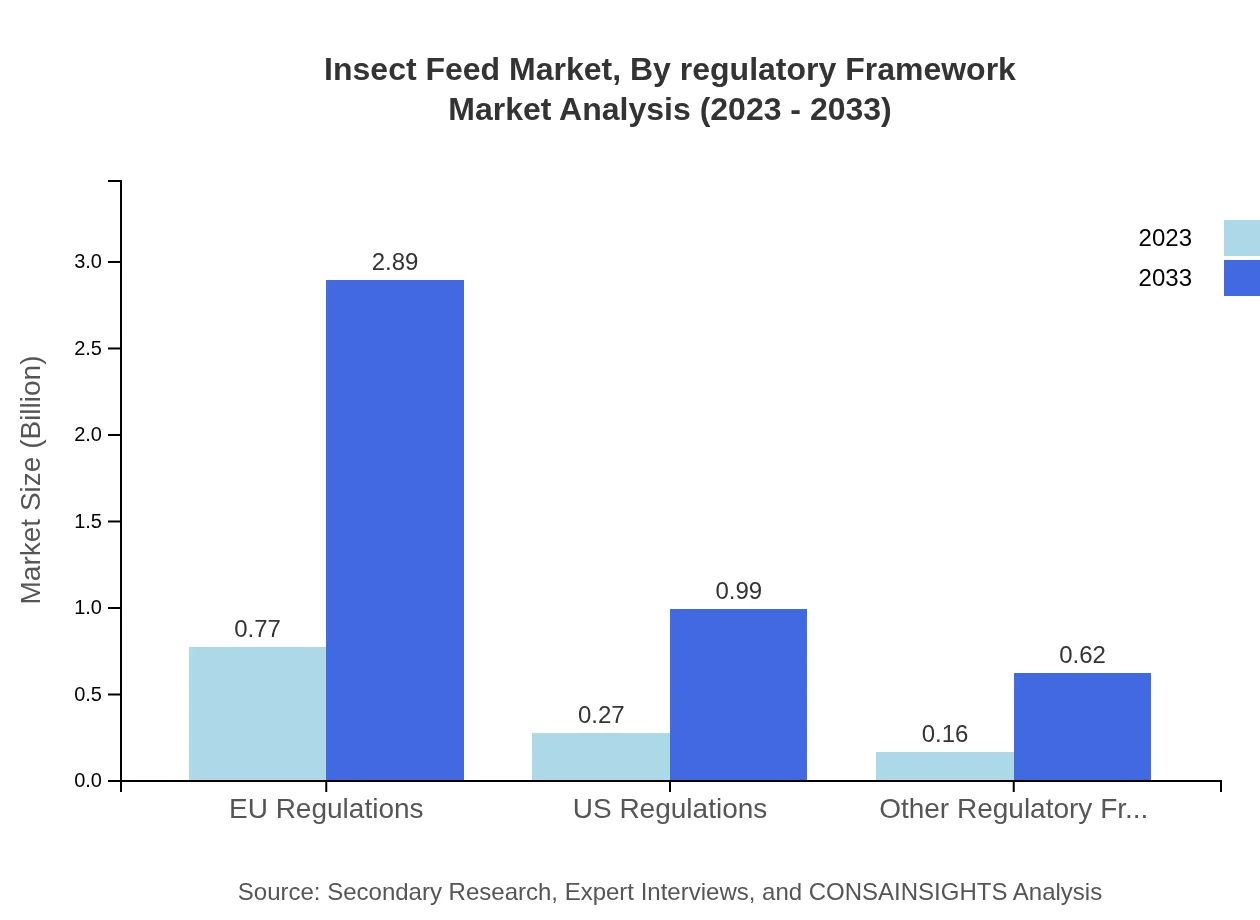
Regulatory frameworks impact the insect feed market heavily. The EU regulations are notably impacting market dynamics, with a projection from $0.77 billion to $2.89 billion. The US regulatory framework supports market entry, growing from $0.27 billion to $0.99 billion by 2033, demonstrating strong future prospects for compliance and organic growth.
Insect Feed Market Trends and Future Forecast
Tell us your focus area and get a customized research report.
Global Market Leaders and Top Companies in Insect Feed Industry
AgriProtein:
AgriProtein is a pioneer in the insect farming industry, focusing on sustainable protein sources for animal feed and enhancing waste recycling through its innovative practices.Enterra Feed Corporation:
Enterra Feed Corporation specializes in producing high-quality insect protein and fat primarily from black soldier fly larvae, catering directly to both animal feed and human consumption segments.Ynsect:
Ynsect is a leader in the cultivation of mealworms, providing sustainable feed solutions and contributing to the protein transition for agriculture across various regions.Protix:
Protix focuses on insect-based protein and fat production, emphasizing sustainability and technological development to meet the growing demand for healthy, sustainable protein.We're grateful to work with incredible clients.








FAQs
What is the market size of the insect feed market in 2023?
The market size in 2023 is $1.20 Billion as provided in the report data, representing the baseline for the forecast period of 2023 to 2033.
How big will the insect feed market be in 2033?
The market size in 2033 is $4.50 Billion according to the report, reflecting projected expansion over the 2023 to 2033 forecast horizon.
What is CAGR for the 2023 to 2033 forecast?
The compound annual growth rate (CAGR) for 2023 to 2033 is 13.5%, as stated in the input market projections.
Which region is the fastest Growing in the Insect Feed Market Report market?
Latin America is the fastest-growing region, projected to expand from $0.02 Billion in 2023 to $0.08 Billion in 2033, reflecting an implied 14.87% CAGR over the forecast period.
Which region is the fastest Growing?
Latin America is identified as the regional market region, rising from $0.02 Billion in 2023 to $0.08 Billion in 2033, with an implied 14.87% CAGR.
Who are the top companies in the insect feed market?
Top companies listed include AgriProtein, Enterra Feed Corporation, Ynsect, and Protix, which are highlighted as leading market participants.
What applications are covered in market segmentation?
Segment coverage includes Animal Feed, Fertilizers, and Human Consumption among the listed application subsegments for the market.
How does regulation influence market growth?
Regulatory frameworks such as EU Regulations and US Regulations affect adoption timelines, market access, and product approvals across regional markets.
What insect types are included in the analysis?
Insect types covered comprise Black Soldier Fly, Mealworm, Crickets, and Other Insect Types as specified in the segment facts.
Which distribution channels are analyzed?
Distribution channels in the report include Online and Offline channels, reflecting how products reach end users and commercial buyers.