

Intrapartum Monitoring Devices Market Report
First published: 10 October 2024 | Last updated: 25 May 2026 | Report Code: intrapartum-monitoring-devices
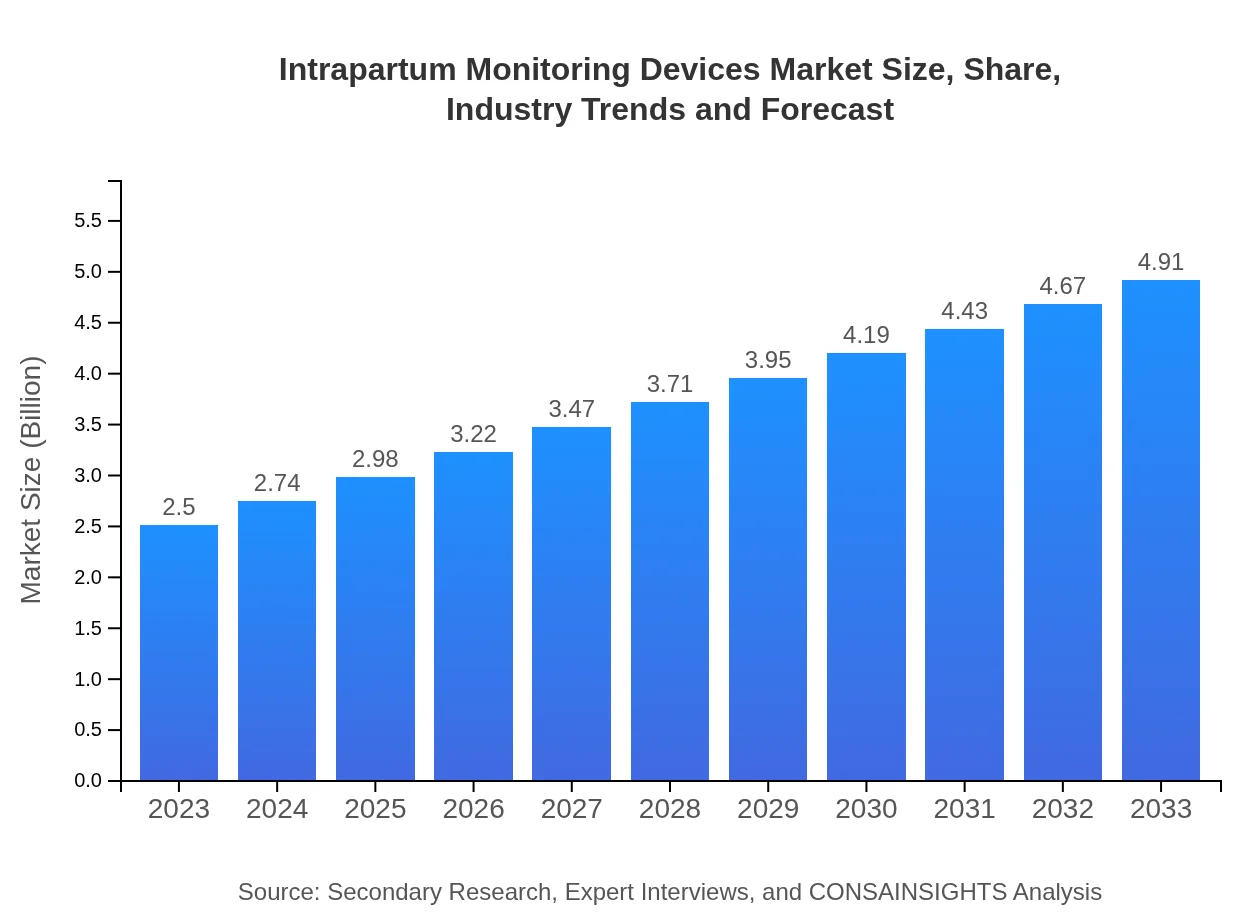
Intrapartum Monitoring Devices Market — USD 2.5 billion in 2023, Growing to USD 4.91B by 2033 at 6.8% CAGR
This report provides comprehensive insights into the Intrapartum Monitoring Devices market from 2023 to 2033. It includes market size forecasts, regional analysis, industry trends, and key players, offering valuable data for stakeholders looking to understand or invest in this sector.
Key Takeaways
- Global market expands from $2.50 Billion in 2023 to $4.91 Billion in 2033 at a 6.8% CAGR.
- North America is largest regional market, while no single fastest-growing region is stated because regional CAGR differences remain within 0.15 percentage points.
- Europe and Asia Pacific show significant gains: Europe $0.64B to $1.26B; Asia Pacific $0.52B to $1.02B.
- Major vendors include Philips Healthcare, GE Healthcare, Natus Medical Incorporated, Fujifilm Medical Systems and Medtronic.
- Market growth is supported by technological advances, rising institutional births, and uptake of wireless and connected monitoring solutions.
Intrapartum Monitoring Devices Market Report — Executive Summary
North America remains largest market by forecast-period value, while no single fastest-growing region is stated because top regional growth rates are separated by less than 0.15 percentage points. This report analyzes the intrapartum monitoring devices market from 2023 to 2033, where value rises from $2.50 Billion to $4.91 Billion at a 6.8% CAGR. Growth is driven by improved monitoring technologies, rising awareness of maternal-neonatal safety, and increased institutional deliveries. The landscape features strong vendor activity from Philips Healthcare, GE Healthcare, Natus Medical Incorporated, Fujifilm Medical Systems and Medtronic, with innovation focused on wireless connectivity, real-time data and integration with digital health platforms. Regional profiles highlight North America as the largest market, alongside notable expansion in Europe, Asia Pacific, Latin America and the Middle East and Africa. The study covers segmentation by device type, technology, application, end user and geographic usage, and employs expert interviews and data triangulation to validate findings. Regulatory, cost and infrastructure considerations are discussed to inform stakeholders evaluating product development, partnerships, and market entry strategies.
Key Growth Drivers
- Advances in monitoring technology enabling more accurate fetal and maternal assessments during labor.
- Rising institutional births and heightened focus on maternal and neonatal safety across healthcare systems.
- Adoption of wireless monitoring and connected solutions that allow real-time data transmission and remote oversight.
- Continuous vendor innovation and expanded product portfolios from established players supporting clinical adoption.
- Increased healthcare investment in emerging regions improving access to intrapartum monitoring devices.
| Metric | Value |
|---|---|
| Study Period | 2023 - 2033 |
| 2023 Market Size | $2.50 Billion |
| CAGR (2023-2033) | 6.8% |
| 2033 Market Size | $4.91 Billion |
| Top Companies | Philips Healthcare, GE Healthcare, Natus Medical Incorporated, Fujifilm Medical Systems, Medtronic |
| Published Date | 10 October 2024 |
| Last Modified Date | 25 May 2026 |
Intrapartum Monitoring Devices Market Overview
Customize Intrapartum Monitoring Devices Market Report market research report
- ✔ Get in-depth analysis of Intrapartum Monitoring Devices market size, growth, and forecasts.
- ✔ Understand Intrapartum Monitoring Devices's regional dynamics and industry-specific trends.
- ✔ Identify potential applications, end-user demand, and growth segments in Intrapartum Monitoring Devices
What is the Market Size & CAGR of Intrapartum Monitoring Devices Market Report market in 2023?
Intrapartum Monitoring Devices Industry Analysis
Intrapartum Monitoring Devices Market Segmentation and Scope
Tell us your focus area and get a customized research report.
Intrapartum Monitoring Devices Market Report Market Analysis Report by Region
Europe Intrapartum Monitoring Devices Market Report:
Europe grows from $0.64 Billion in 2023 to $1.26 Billion in 2033. Regional momentum is supported by investments in maternal health, regulatory frameworks for medical devices, and uptake of advanced monitoring systems in hospitals and birthing centers.Asia Pacific Intrapartum Monitoring Devices Market Report:
Asia Pacific grows from $0.52 Billion in 2023 to $1.02 Billion in 2033. Growth is driven by rising institutional deliveries, improving healthcare access, and increased deployment of wireless and digital monitoring solutions across varied clinical settings.North America Intrapartum Monitoring Devices Market Report:
North America is largest regional market, rising from $0.92 Billion in 2023 to $1.8 Billion in 2033. This growth reflects high clinical adoption, established healthcare infrastructure, vendor presence and investment in connected monitoring technologies that enhance intrapartum care.South America Intrapartum Monitoring Devices Market Report:
Latin America grows from $0.13 Billion in 2023 to $0.26 Billion in 2033. Market progression is linked to enhanced healthcare spending, expanding hospital capabilities and growing awareness of maternal and neonatal monitoring needs.Middle East & Africa Intrapartum Monitoring Devices Market Report:
Middle East and Africa grows from $0.29 Billion in 2023 to $0.58 Billion in 2033. Expansion reflects targeted healthcare investments, infrastructure development and gradual adoption of modern intrapartum monitoring equipment.Tell us your focus area and get a customized research report.
Research Methodology
Intrapartum Monitoring Devices Market Analysis By Device Type
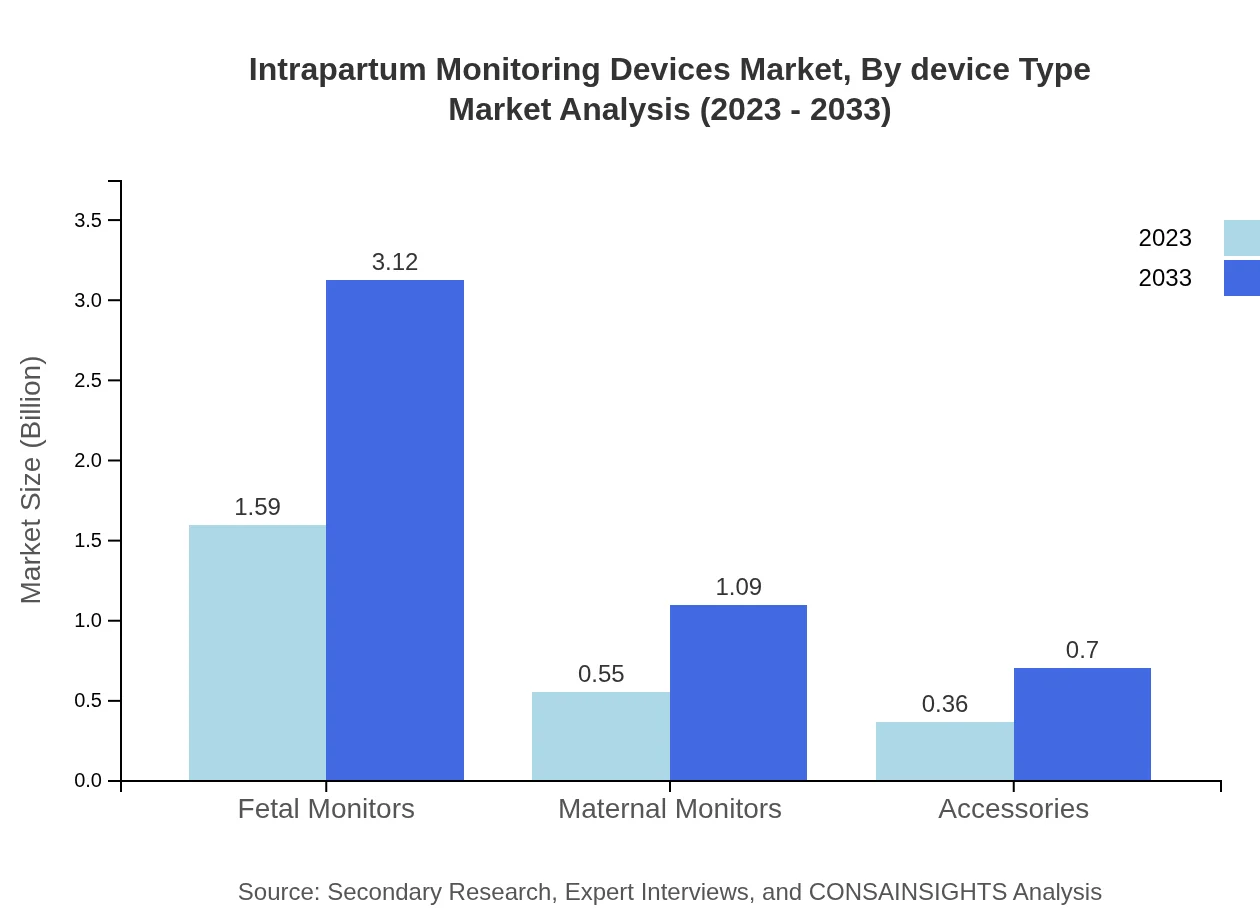
The segment focuses on various devices including fetal monitors, maternal monitors, and accessories. In 2023, fetal monitors dominate the market with a valuation of $1.59 billion, expected to grow to $3.12 billion by 2033. Maternal monitors and accessories follow, valued at $0.55 billion and $0.36 billion in 2023, forecasted to reach $1.09 billion and $0.70 billion, respectively.
Intrapartum Monitoring Devices Market Analysis By Technology
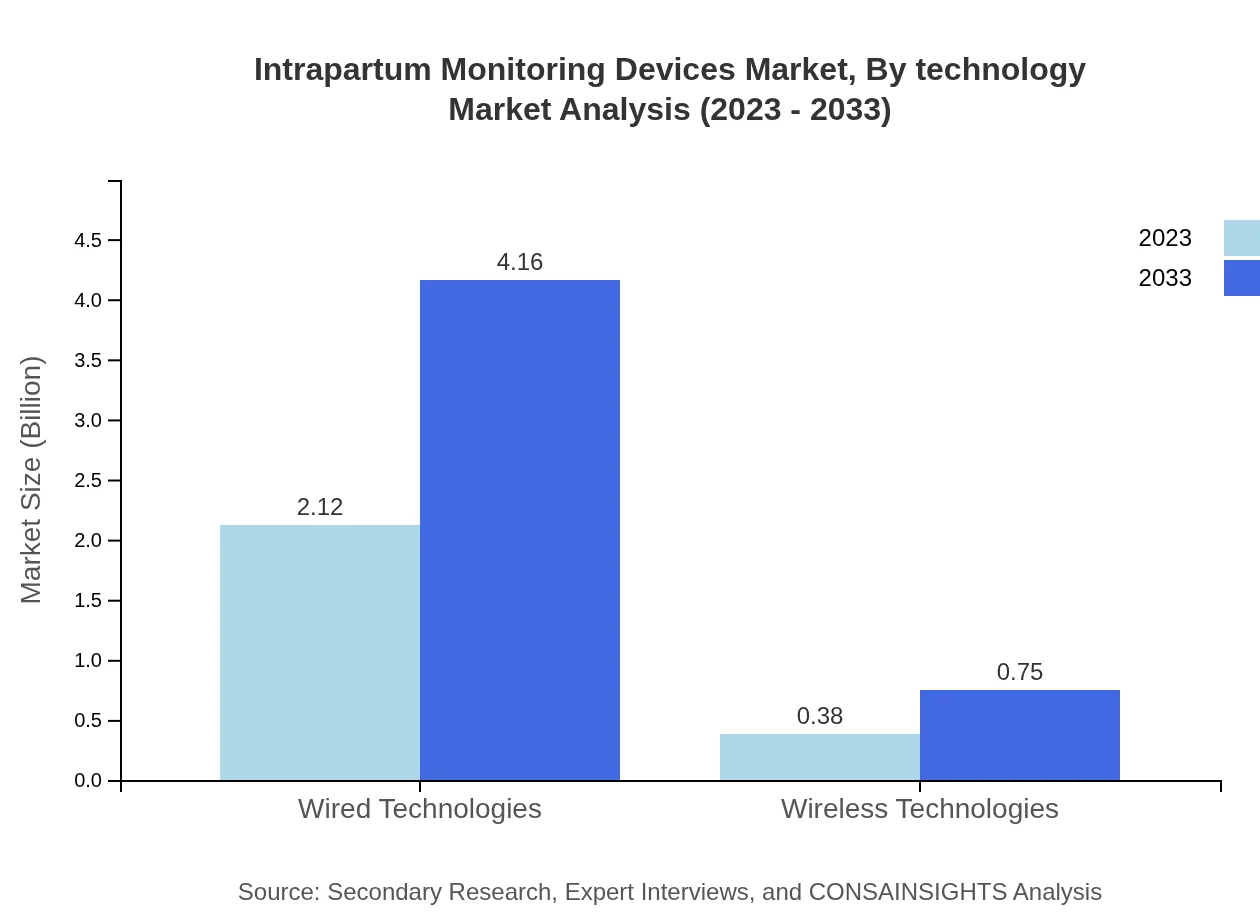
The market is segmented by technology into wired and wireless. Wired technologies lead, accounting for $2.12 billion in 2023, projected to ascend to $4.16 billion by 2033, while wireless technologies, valued at $0.38 billion, are expected to grow to $0.75 billion during the same period.
Intrapartum Monitoring Devices Market Analysis By Application
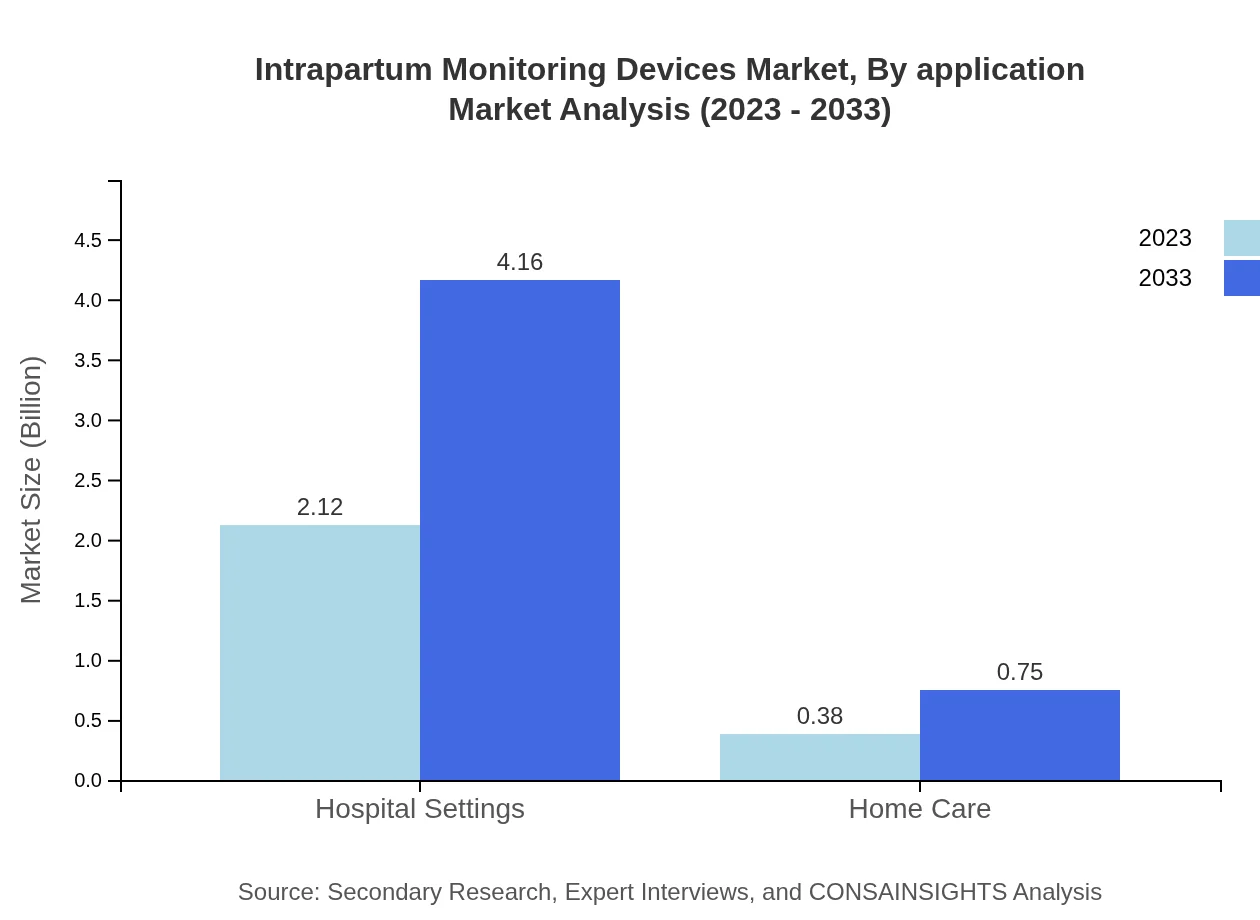
This segment includes hospital settings, birthing centers, and home care. Hospital settings dominate, with market size of $2.12 billion expected to rise to $4.16 billion by 2033. Birthing centers and home care markets are valued at $0.55 billion and $0.36 billion in 2023, expected to reach $1.09 billion and $0.70 billion, respectively.
Intrapartum Monitoring Devices Market Analysis By End User
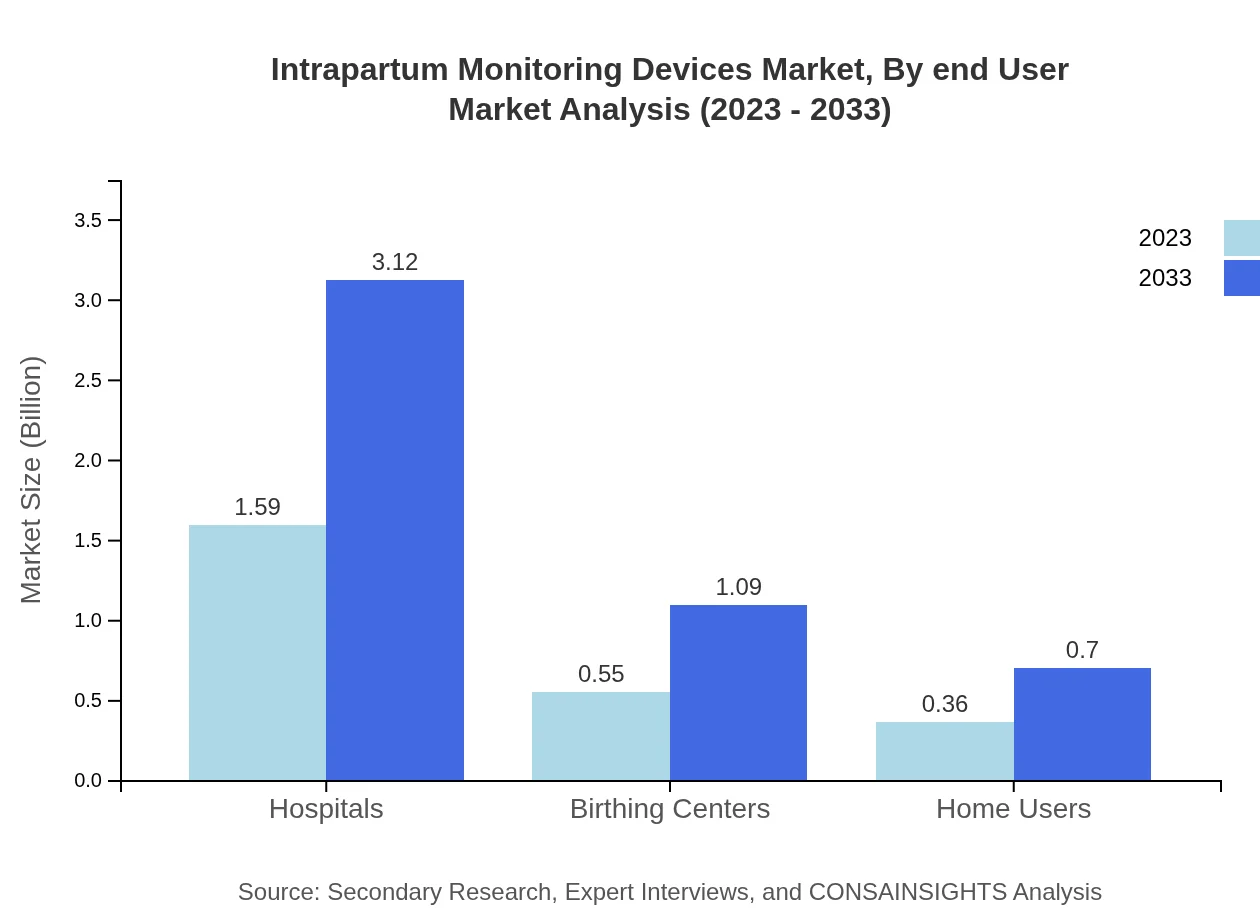
End-user segmentation indicates hospitals as the primary users with a market size of $1.59 billion in 2023, and anticipated growth to $3.12 billion by 2033. Birthing centers and home users are also significant end-users, with current market sizes of $0.55 billion and $0.36 billion, expected to grow accordingly.
Intrapartum Monitoring Devices Market Analysis By Region Usage
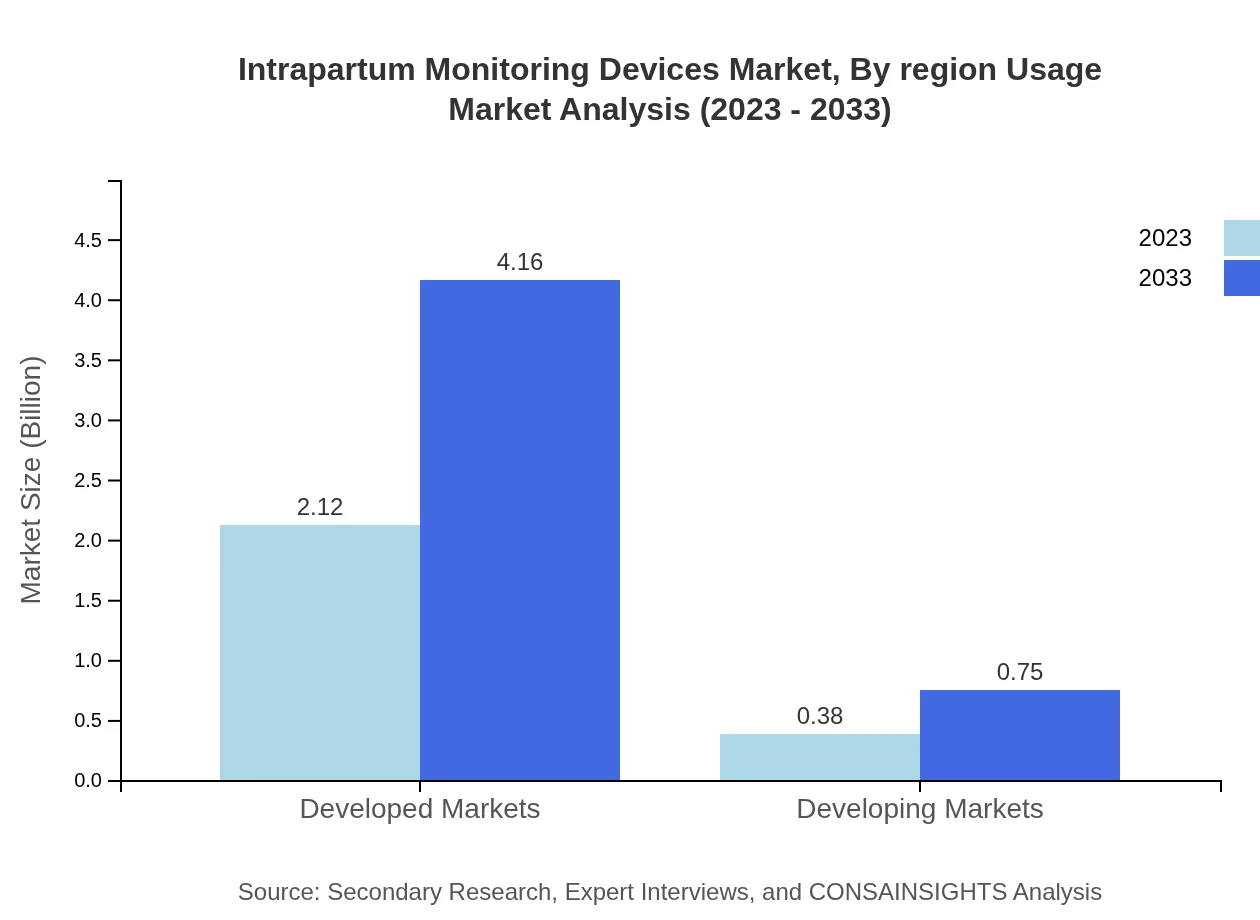
Regions are crucial in market segmentation, with developed markets, particularly North America and Europe, leading in both growth and market share due to advanced healthcare systems. Emerging markets in Asia and Latin America show rapid growth potential due to healthcare improvements and increased healthcare expenditures.
Intrapartum Monitoring Devices Market Trends and Future Forecast
Tell us your focus area and get a customized research report.
Global Market Leaders and Top Companies in Intrapartum Monitoring Devices Industry
Philips Healthcare:
Philips is a leader in health technology, focusing on innovative solutions for patient monitoring, including intrapartum monitoring devices.GE Healthcare:
GE Healthcare offers a comprehensive suite of monitoring solutions that enhance maternal and neonatal care, contributing significantly to market growth.Natus Medical Incorporated:
Natus specializes in newborn and maternal care medical devices, and is recognized for its innovative intrapartum and neonatal monitoring solutions.Fujifilm Medical Systems:
Fujifilm provides advanced healthcare solutions focused on improving diagnostic imaging and real-time monitoring technologies.Medtronic :
Medtronic's extensive range of medical devices includes solutions for intrapartum monitoring, contributing to healthcare safety and quality.We're grateful to work with incredible clients.









FAQs
What is the market size of the intrapartum monitoring devices market in 2023?
The market size in 2023 is $2.50 Billion, as reported for the global intrapartum monitoring devices sector for that year.
How big will the intrapartum monitoring devices market be in 2033?
By 2033 the market is projected to reach $4.91 Billion, reflecting the reported end‑period market value for the forecast horizon.
What is CAGR for the intrapartum monitoring devices market?
The reported compound annual growth rate (CAGR) for the market over 2023 to 2033 is 6.8%.
Is there a single fastest Growing region in the Intrapartum Monitoring Devices Market Report market?
No single fastest-growing region is stated for the Intrapartum Monitoring Devices Market Report market because the top regional implied CAGR values are within 0.15 percentage points of each other, making the ranking too close to call reliably.
Which companies lead the intrapartum monitoring devices market?
Top companies listed in the study include Philips Healthcare, GE Healthcare, Natus Medical Incorporated, Fujifilm Medical Systems and Medtronic.
What are key trends shaping the market?
Key trends include wireless monitoring, integration with digital health platforms, and product innovations that support real-time clinical decision making.
Who contributed to the research methodology?
The research incorporated primary interviews with industry experts and secondary research via company reports and publications.
How was data validated in the study?
Data were validated through triangulation and internal checks, supported by expert-led trend analysis to ensure robustness.
What applications are covered in the segmentation?
Segmentation covers applications such as hospital settings and home care, reflecting the primary usage contexts reported.
Which end users are profiled in the report?
End-user categories include hospitals, birthing centers and home users as specified among the study subsegments.