

Mucosal Atomization Devices Market Report
First published: 07 October 2024 | Last updated: 25 May 2026 | Report Code: mucosal-atomization-devices
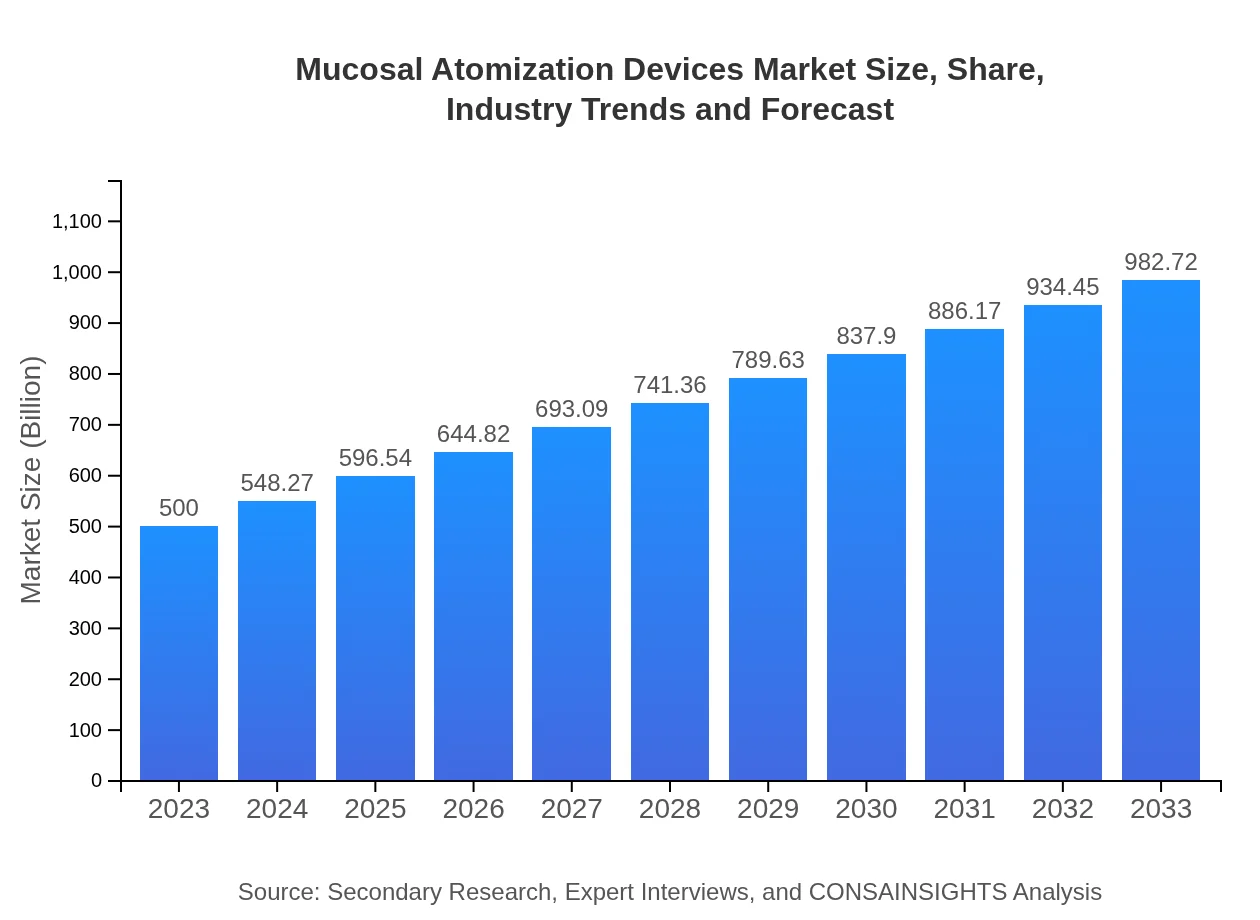
Mucosal Atomization Devices Market — USD 500 million in 2023, Growing to USD 982.72M by 2033 at 6.8% CAGR
This report provides an in-depth analysis of the Mucosal Atomization Devices market, covering essential insights, segmentation, and growth forecasts for the period 2023 to 2033.
Key Takeaways
- Global market expands from $500.00 Billion in 2023 to $982.72 Billion by 2033 at a 6.8% CAGR.
- North America is largest regional market, while no single fastest-growing region is stated because regional CAGR differences remain within 0.15 percentage points.
- North America is the largest region, increasing from $178.5 Billion in 2023 to $350.83 Billion in 2033.
- Europe grows from $146.3 Billion to $287.54 Billion between 2023 and 2033, reflecting heightened demand.
- Asia Pacific rises from $95.35 Billion in 2023 to $187.4 Billion in 2033, driven by broader device adoption.
- Top companies include Teleflex Inc., BD (Becton, Dickinson and Company), Medtronic plc, and Owen Mumford Ltd.
Mucosal Atomization Devices Market Report — Executive Summary
North America remains largest market by forecast-period value, while no single fastest-growing region is stated because top regional growth rates are separated by less than 0.15 percentage points. The mucosal atomization devices market demonstrates sustained expansion driven by rising preference for non-invasive drug delivery and technological improvements in device design. Market value is projected to grow from $500.00 Billion in 2023 to $982.72 Billion by 2033 at a 6.8% CAGR (2023 to 2033). Hospitals and home care settings are primary demand centers, while customization and ease of administration support adoption across clinical and outpatient environments. Regional performance varies: North America is the largest market with notable increases in both hospital procurement and outpatient use. Major companies such as Teleflex Inc., BD (Becton, Dickinson and Company), Medtronic plc, and Owen Mumford Ltd. focus on product development and partnerships. The industry faces regulatory and competitive pressures, but expanding healthcare investments and awareness of efficient delivery systems sustain the outlook through the forecast period.
Key Growth Drivers
- Rising adoption of non-invasive drug delivery methods in hospitals and home care settings
- Technological improvements in atomization devices enhancing patient comfort and dosing accuracy
- Increasing healthcare expenditure and outpatient care trends supporting device uptake
- Product development and strategic collaborations among leading companies expanding offerings
- Growing awareness of localized treatment benefits across clinical specialties
| Metric | Value |
|---|---|
| Study Period | 2023 - 2033 |
| 2023 Market Size | $500.00 Million |
| CAGR (2023-2033) | 6.8% |
| 2033 Market Size | $982.72 Million |
| Top Companies | Teleflex Inc., BD (Becton, Dickinson and Company), Medtronic plc, Owen Mumford Ltd. |
| Published Date | 07 October 2024 |
| Last Modified Date | 25 May 2026 |
Mucosal Atomization Devices Market Overview
Customize Mucosal Atomization Devices Market Report market research report
- ✔ Get in-depth analysis of Mucosal Atomization Devices market size, growth, and forecasts.
- ✔ Understand Mucosal Atomization Devices's regional dynamics and industry-specific trends.
- ✔ Identify potential applications, end-user demand, and growth segments in Mucosal Atomization Devices
What is the Market Size & CAGR of Mucosal Atomization Devices Market Report market in 2023?
Mucosal Atomization Devices Industry Analysis
Mucosal Atomization Devices Market Segmentation and Scope
Tell us your focus area and get a customized research report.
Mucosal Atomization Devices Market Report Market Analysis Report by Region
Europe Mucosal Atomization Devices Market Report:
Europe grows from $146.3 Billion in 2023 to $287.54 Billion in 2033. Demand is sustained by growing clinical adoption in hospitals, development of device capabilities, and rising awareness of non-invasive delivery methods across healthcare settings.Asia Pacific Mucosal Atomization Devices Market Report:
Asia Pacific grows from $95.35 Billion in 2023 to $187.4 Billion in 2033. Expansion is influenced by broader adoption of mucosal atomization devices in hospitals and home care, technological diffusion, and increasing healthcare expenditures in the region.North America Mucosal Atomization Devices Market Report:
North America is largest regional market, rising from $178.5 Billion in 2023 to $350.83 Billion in 2033. 5 Billion in 2023 and rises to $350.83 Billion in 2033. The region's scale reflects significant hospital procurement, outpatient adoption, and investments in device innovation, supporting continued expansion in clinical and home care applications.South America Mucosal Atomization Devices Market Report:
Latin America grows from $10.35 Billion in 2023 to $20.34 Billion in 2033. 35 Billion in 2023 and reaches $20.34 Billion in 2033. Growth is linked to rising awareness and gradual adoption of non-invasive delivery systems in clinical and outpatient environments across the region.Middle East & Africa Mucosal Atomization Devices Market Report:
Middle East and Africa grows from $69.5 Billion in 2023 to $136.6 Billion in 2033. Regional gains reflect growing healthcare investments, adoption in hospital settings, and increased focus on efficient localized treatment options.Tell us your focus area and get a customized research report.
Research Methodology
Mucosal Atomization Devices Market Analysis By Device Type
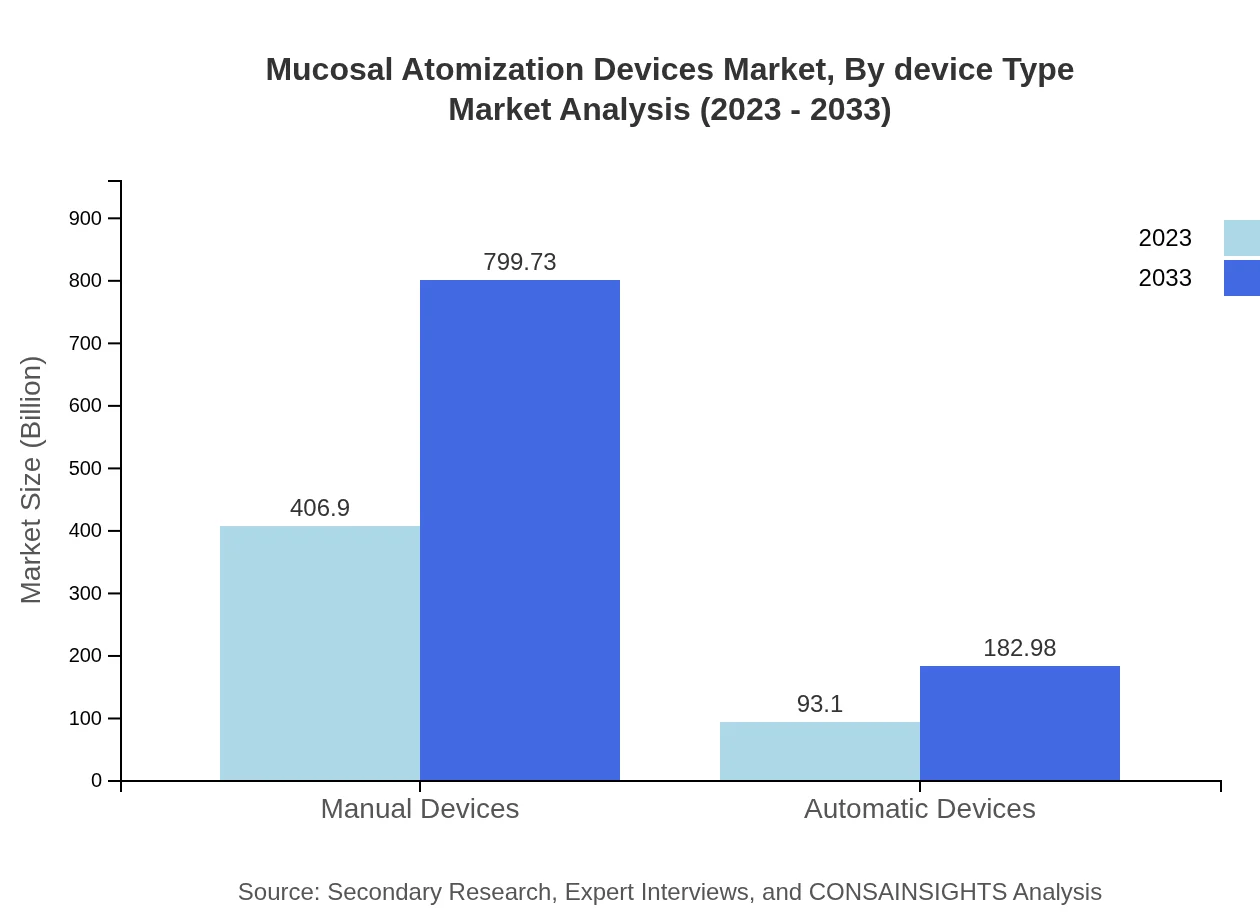
The market is significantly divided into manual and automatic devices. Manual devices are expected to dominate, with a market size of $406.90 million in 2023, anticipated to reach $799.73 million by 2033. Automatic devices, while lower in size at $93.10 million in 2023, are forecasted to grow to $182.98 million by 2033 as advancements in technology make these more accessible and desirable.
Mucosal Atomization Devices Market Analysis By Application
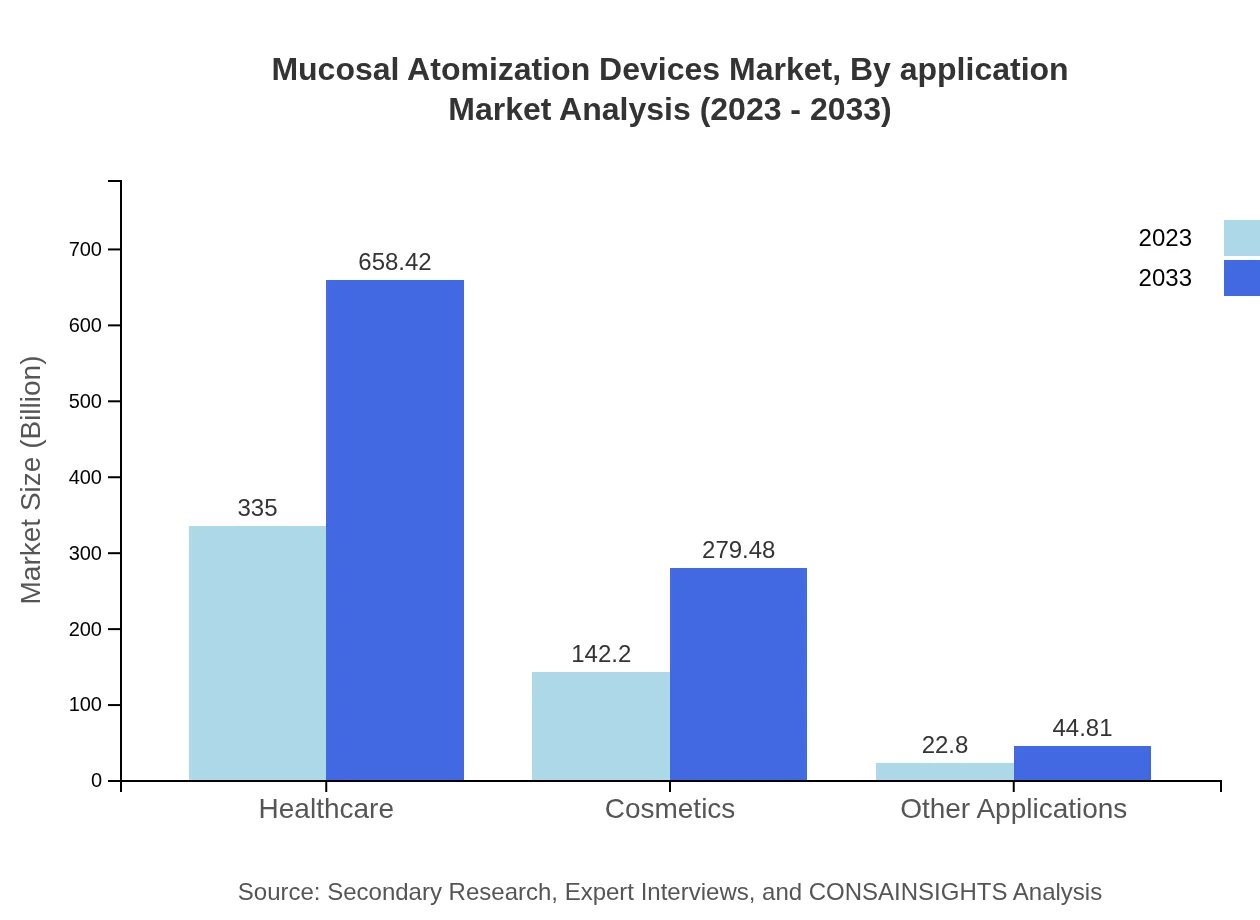
Applications are categorized into hospitals, home care, pharmaceuticals, cosmetics, and other applications. Hospitals lead with a size of $335 million in 2023, projected to grow to $658.42 million by 2033. Home care follows with a market size of $142.20 million in 2023, expected to reach $279.48 million by 2033, reflecting the increasing shift towards at-home healthcare solutions.
Mucosal Atomization Devices Market Analysis By End User
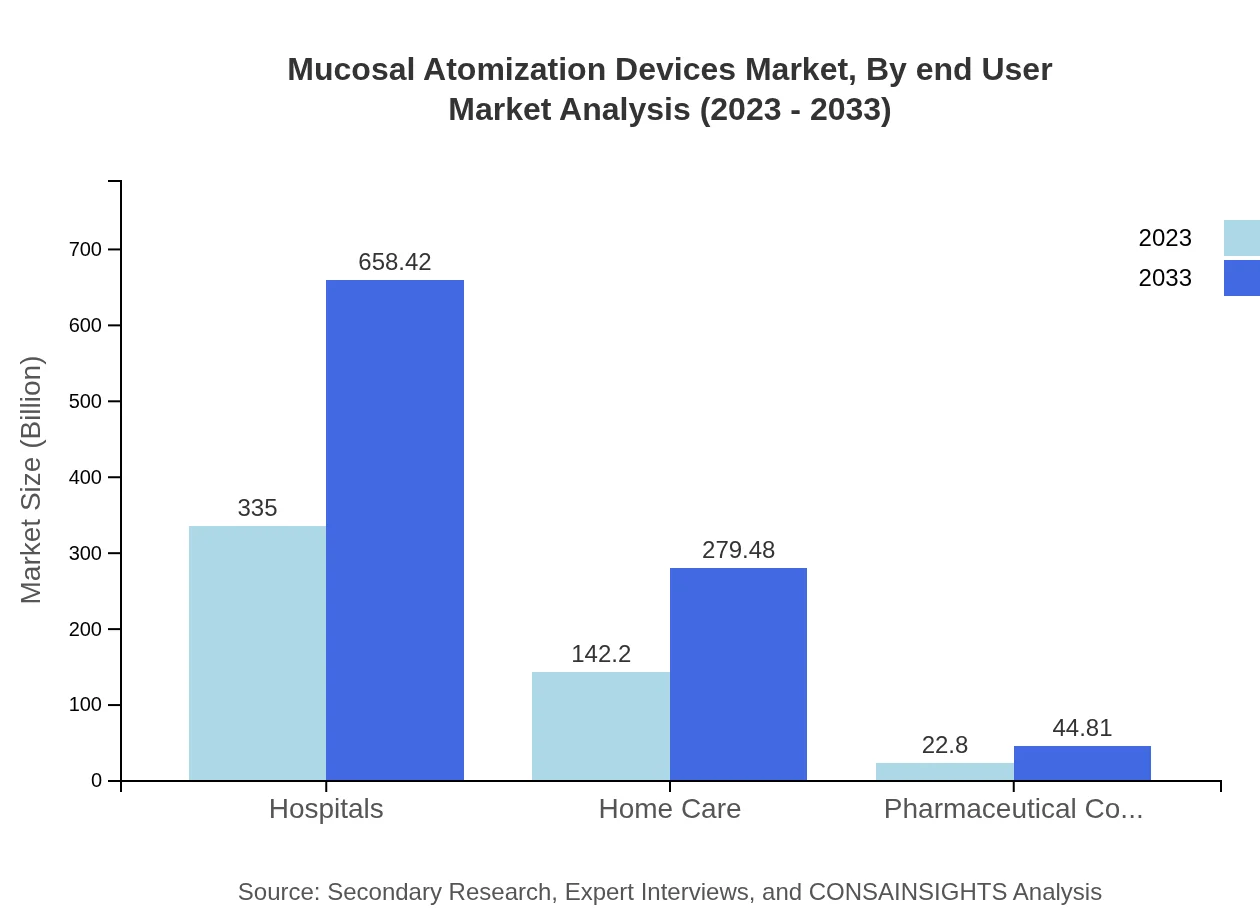
End-users prominently include healthcare providers, pharmaceutical companies, and consumer markets. Hospitals constitute 67% of the market share in 2023, remaining stable throughout the forecast period. The home care sector's growth reflects evolving patient care preferences and advancements in ease-of-use devices.
Mucosal Atomization Devices Market Analysis By Region Application
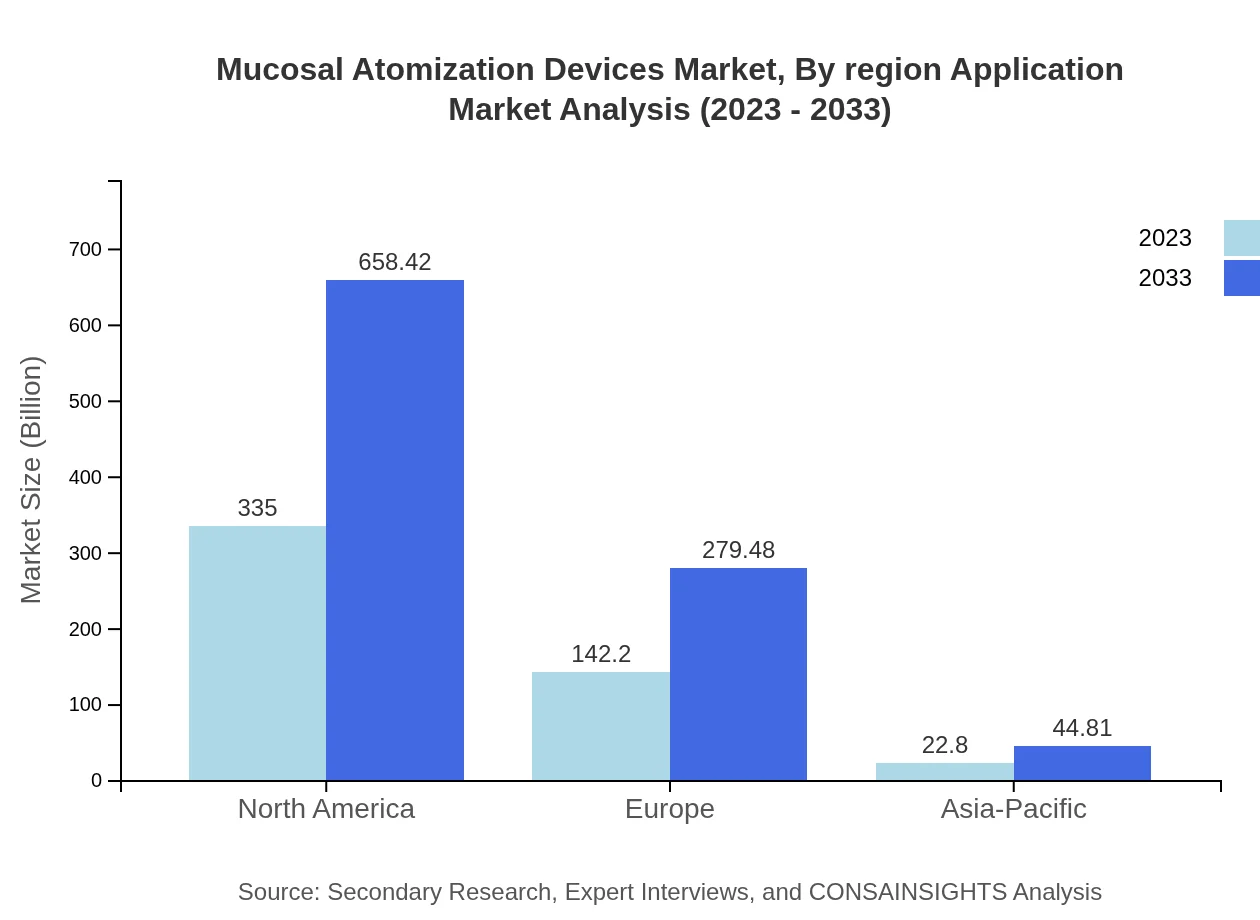
Regional dynamics highlight the different growth trajectories. North America holds a substantial market share, followed by Europe and Asia Pacific, leveraging innovations and larger healthcare budgets. Meanwhile, South America and the Middle East & Africa are emerging markets showing promising growth rates due to increased healthcare investments.
Mucosal Atomization Devices Market Trends and Future Forecast
Tell us your focus area and get a customized research report.
Global Market Leaders and Top Companies in Mucosal Atomization Devices Industry
Teleflex Inc.:
Teleflex is a leading provider of medical technologies, specializing in innovative and minimally invasive medical devices, including mucosal atomization solutions.BD (Becton, Dickinson and Company):
BD is a global medical technology company committed to improving safety and enhancing the quality of care. They offer a range of mucosal atomization devices for effective drug delivery.Medtronic plc:
Medtronic is a premier medical technology company known for its diverse range of advanced healthcare products including mucosal atomization devices tailored for unique patient needs.Owen Mumford Ltd.:
Owen Mumford specializes in the design and manufacturing of medical devices, with a focus on user-centered designs to enhance patient experience in drug delivery.We're grateful to work with incredible clients.








FAQs
What is the market size of mucosal atomization devices in 2023?
The market size in 2023 is $500.00 Billion according to the provided report data, reflecting the baseline for the forecast period from 2023 to 2033.
What is the expected market size in 2033?
By 2033 the market is projected to reach $982.72 Billion, as stated in the input data, representing growth measured across the 2023 to 2033 forecast period.
What is CAGR for the forecast period?
The reported compound annual growth rate for 2023 to 2033 is 6.8%, which underpins the increase from $500.00 Billion to $982.72 Billion over the decade.
Is there a single fastest Growing region in the Mucosal Atomization Devices Market Report market?
No single fastest-growing region is stated for the Mucosal Atomization Devices Market Report market because the top regional implied CAGR values are within 0.15 percentage points of each other, making the ranking too close to call reliably.
Why is the market growing globally?
Growth is attributed to demand for non-invasive delivery, technological advances in device design, greater outpatient and home care use, and increased awareness of efficient localized treatments.
Who are the top companies in this market?
The input lists Teleflex Inc., BD (Becton, Dickinson and Company), Medtronic plc, and Owen Mumford Ltd. as key participants in the market landscape.
How is the market segmented by device type?
Device-type segmentation includes Manual Devices and Automatic Devices, reflecting differing use cases and technology levels as provided in the segment facts.
How big is the Europe market in 2023 and 2033?
Europe is reported at $146.3 Billion in 2023 and is expected to reach $287.54 Billion by 2033, per the regional data supplied.
What role do hospitals play in the market?
Hospitals are a primary end-user segment driving demand for mucosal atomization devices, reflecting clinical adoption and procurement priorities noted in the segmentation facts.
Which region is the fastest Growing?
Not specified; the input indicates no single regional growth market is stated because top regional growth rates are within 0.15 percentage points.